Author Archives: City Gold Bullion

Another New 2018 Gold Price Low as Asian Buying Stays Weak

GOLD PRICES fell to new 2018 lows against a rising Dollar on Tuesday in London, hitting $1274 per ounce as President Trump threatened to hit back at China’s retaliation over last week’s new US trade tariffs with extra charges on another $200bn of Chinese imports.
 
Accused of “blackmail” by Beijing, Trump says these extra 10% tariffs will only come into force if China “refuses to change its practices.”
 
“The headlines gave gold a boost in Asia today,” says a trading note from Swiss refiners and finance group MKS Pamp, drawing “modest interest out of China.
 
“However the metal failed to extend further as offers [to sell around] $1283 restricted top-side gains.”
 
Global gold prices, typically quoted for London settlement, opened Tuesday morning some 1.3% below where Shanghai closed last Friday for the Dragon Boat holiday weekend.
 
Wholesale prices in the No.1 consumer nation fell by the same proportion today however, keeping a premium above London quotes of just $4.85 per ounce – barely changed from last week and still offering only half the usual incentive for new imports of gold bullion bars.
 
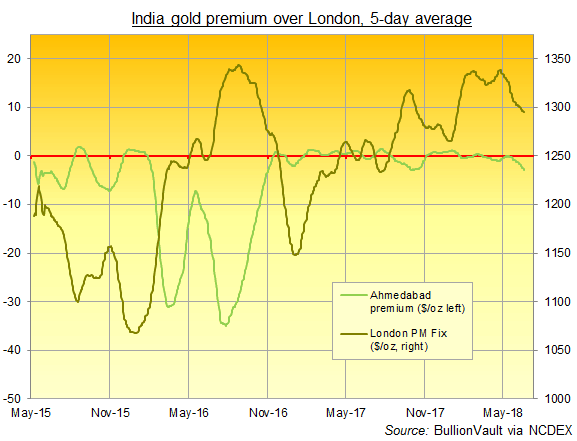
With few wedding dates now on Hindu calendars until the approach of November’s Diwali festival, India wholesale prices meantime held a $4 discount to London bullion on Tuesday, extending the weakest picture for demand versus supply since September last year in the No.2 consumer nation.
 
Wholesale gold prices in India have now traded at a discount for 5 weeks, despite global Dollar quotes retreating some $50 per ounce over that time.
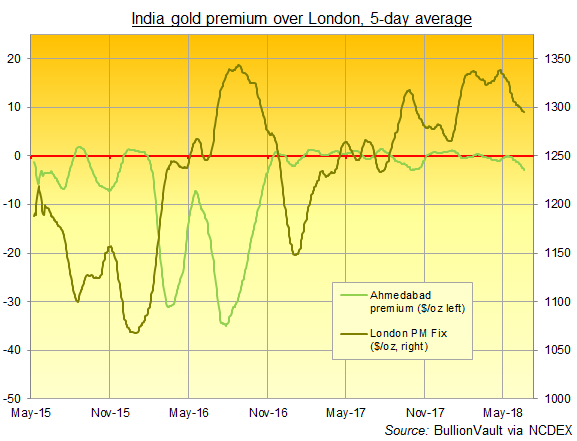
 
Chart of gold premium in Ahmedabad, rolling 5-day average. Source: BullionVault via NCDEX
 
Jewelers in neighboring Dubai – visited by 2 million Indian nationals last year – are currently offering heavy discounts as part of a month-long ‘My Jewellery Festival’, with free gifts for shoppers also including gold bullion coins.
 
No.5 consumer nation Turkey today saw its Lira fall to 3-week lows on the FX market, just 2% above late-May’s fresh all-time record as the Government of President Recep Tayyip Erdoğan – standing for re-election in what could prove a close poll this weekend – hit back at fellow Nato member the United States for blocking the delivery of F-35 warplanes over Ankara’s decision to buy air-defense missiles from Russia.
 
Silver meantime tracked gold prices lower again on Tuesday, falling to 5-week Dollar lows at $16.25 per ounce.
 
Weakness in the Euro currency however held the white metal above €14 per ounce, a four-month high when reached in late May.
 
Gold priced in the Euro meantime spiked and fell back to €1103, barely changed for the week after dipping below €1100 on Monday for the 5th time in 4 weeks.
 
On the geopolitical front Tuesday, the US Pentagon confirmed it is suspending plans for ‘wargames’ with ally South Korea following last week’s historic meeting in Singapore between President Trump and North Korea dictator Kim Jong un.
 
Kim today was reported to be visiting Beijing for meetings with ally China.
Gold Prices Hold 6-Month Low as China-US Trade War Deepens, Silver Betting Jumps

GOLD PRICES held at 6-month lows against the US Dollar on Monday morning in London as ‘trade war’ tensions worsened between the world’s two largest economies, writes Steffen Grosshauser at BullionVault.
 
Beijing at the weekend responded to US President Donald Trump’s new 25% import tariffs on $34 billion of Chinese goods by imposing a retaliatory levy on 659 high-value US goods, including cars, crude oil and agricultural products, choosing the same target value and dates as Washington.
 
Gold prices bounced to $1281 in wholesale bullion trade after hitting new 2018 lows at $1275 per ounce on Friday, breaking this year’s previously narrow $80 range for the first time.
 
Silver prices meantime stayed close to last week’s finish at $16.57 after falling by nearly 5% during Friday’s session.
 
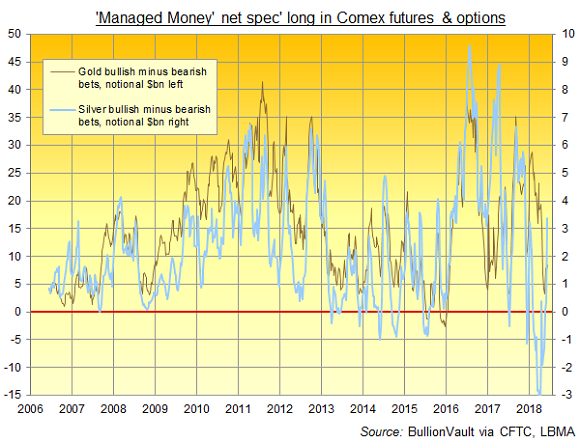
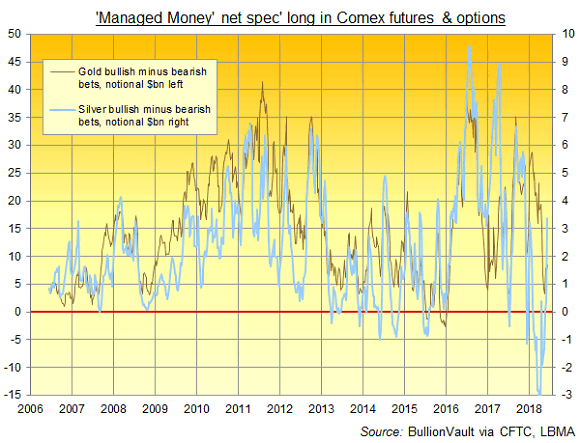
Latest data from the Commodity Futures Trading Commission (CFTC) show that speculative investors raised their net-long position on Comex silver futures and options by the greatest proportion since November 2014 in the week-ending last Tuesday.
 
Increasing the balance of bullish over bearish bets 8-fold, the Managed Money grew its net speculative long position for the sixth straight week after betting net bearish since the turn of the year.
 
Chart of Managed Money net betting on Comex gold and silver derivatives. Source: BullionVault via CFTC
 
The Managed Money category’s net betting on Comex gold futures and options, in contrast, rose just 11% for the week-ending immediate before the US Federal Reserve’s June interest-rate rise.
 
“We have been cautious about gold just because we still see a stronger dollar and the Fed raising rates as headwinds,” said Seattle asset group US Bank Wealth Management’s Rob Haworth.
 
“[Gold’s] support comes in at $1267 [while its] resistance comes in at $1301,” writes Scotiabank in a technical analysis.
 
Crude oil prices meantime recovered today as the Opec oil cartel prepared to meet this week to discuss raising output quotas.
 
Asian and European equities, in contrast, tumbled after the latest round of protectionist action in the US-China row, led by Germany’s Dax index which declined by 0.9%.
 
For world stock markets, “A further escalation of US-China trade tensions is of course a risk scenario,” said Yukio Ishizuki, senior currency strategist at Daiwa Securities in Tokyo.
 
“But the current tariffs, even if implemented, will hardly dent the global economy.”

Gold 'Doing Nothing' Amid Trump's 'Trade War' Tumult, Silver Cuts Weekly Jumpy to

GOLD and SILVER fell Friday lunchtime in London, dropping back to $1292 and $17.09 per ounce respectively as the White House confirmed new tariffs on an extra $50 billion of China’s annual exports to the United States.
 
US-China trade “has been very unfair, for a very long time,” said President Donald Trump, raising import tariffs to 25% on 1,100 different aerospace, robotics and auto-industry goods and spurring analyst and newspaper claims of a full-blown ‘trade war’.
 
Gold priced in Dollars headed for a weekly loss of $6 per ounce while silver trimmed its gain from last Friday’s finish to 1.8%.
 
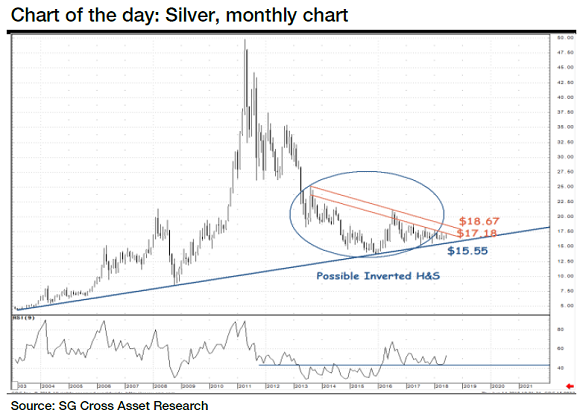
Having spiked sharply to a 2-month high above $17.30 yesterday, silver face “near term resistance at $17.18,” says technical analysis from French investment bank Societe Generale, pointing to “the descending trend line” running from early 2017.
 
Australian equities overnight added 1.3% for the day as Tokyo rose, but China led a drop in other major stock markets, with European-listed shares falling back to show a 1.6% gain for the week amid rumors of Trump’s new tariffs on Chinese imports.
 
The US president today also re-tweeted vindication of his decision to sack James Comey as head of the FBI following the Justice Department’s report on the mishandled investigation into Hillary Clinton’s emails prior to the 2016 presidential election.
 
“It’s been quite a tumultuous year for major geopolitical events, and yet gold has done nothing,” said Australian bank Macquarie’s precious metals analyst Matthew Turner, speaking to CNBC today.
 
With a trading range of just $80 per ounce so far in 2018, “in percentage terms that’s the lowest since 1970,” Turner added, “back when the gold price was fixed to the Dollar.”
 
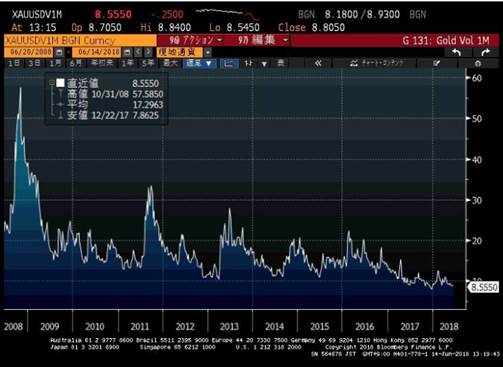
On a 1-month basis, volatility in the Dollar gold price last month fell to the record low seen at the end of last year says a note from Yuichi Ikemizu, Tokyo precious metals manager at global bullion bank ICBC Standard Bank.
 
“Because of this low volatility, fewer investors are in the market so the volatility gets even lower,” Ikemizu says, adding that Tokyo gold futures contracts on the Tocom Exchange now offer a huge 70-to-1 leverage for traders because margin payments are based on recent levels of price fluctuation.
 
“Low interest from private investors also means Japanese gold bullion dealers are suffering weak sales,” ICBC Standard’s Tokyo manager adds.
 
Chart of gold's 1-month volatility. Source: ICBC Standard Bank via Bloomberg
 
Asked what might break gold out of its doldrums, “Gold does well when central bankers are losing control, and right now central banks are tightening into a recovering economy,” Turner at Macquarie said today.
 
But 2019 is widely forecast to see global economic growth slow down, and “over the last 20 years it has been recession that’s been good for the gold price, not inflation,” he concludes.
 
Silver meantime “could be in the process of completing the second shoulder of a massive Inverted Head and Shoulder pattern undergoing since 2013,” says the technical note from bullion market-maker Societe Generale.
 
This follows silver marking “a lengthy base formation after testing the perennial trend line” joining its 2003, 2008 and 2015 lows, says SocGen’s technical analysis.
 
The inverted H&S – a potentially bullish pattern – would be confirmed  by a rise to $18.67 the SG Research team go on, pointing to a level “which also coincides with April 2017 highs and the 61.8% [Fibonacci] retracement of the 2016 to 2017 correction.”
 
Chart of silver price in Dollars. Source: Societe Generale
 
Before then, says a technical note from bullion bank Scotia Mocatta’s New York office, “New resistance comes in at [this April’s high of] $17.36.
 
“Momentum indicators are positive and [we] remain bullish on silver, targeting the $17.50 level.”

Gold Gains, Silver Leaps as Fed Hikes, ECB Moves to End New QE

GOLD BROKE back above $1300 per ounce and silver jumped to 2-month highs versus the Dollar on Thursday morning even though the Federal Reserve yesterday raised US interest rates and forecast further hikes ahead.
 
Priced in the Euro gold then leapt again, hitting new highs for June at €1113 per ounce as the single currency sank on the FX market despite the European Central Bank saying it plans to stop new QE money-creation and bond-buying scheme in December.
 
Against this tightening, “The Governing Council intends to maintain its policy of reinvesting the principal payments from maturing securities…for an extended period of time,” the ECB said.
 
Interest rates across the 19-nation Eurozone will also stay unchanged “at least through the summer of 2019,” holding deposit rates for commercial banks at minus 0.4% in the hope of “ensur[ing] that the evolution of inflation remains aligned with the current expectations of a sustained adjustment path.”
 
After Wall Street turned a small gain into a 0.4% loss following the Fed announcement Wednesday, Japan’s stock market today lost 0.9% and European equities slipped 0.3% before jumping on the ECB’s policy announcement.
 
Silver prices meantime broke to the top of their recent Dollar trading range, reaching the highest Dollar price since mid-April at $17.25 per ounce and touching 7-month highs for Euro and also British Pound investors.
 
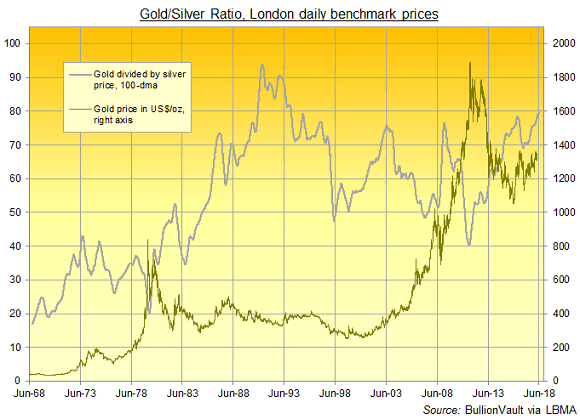
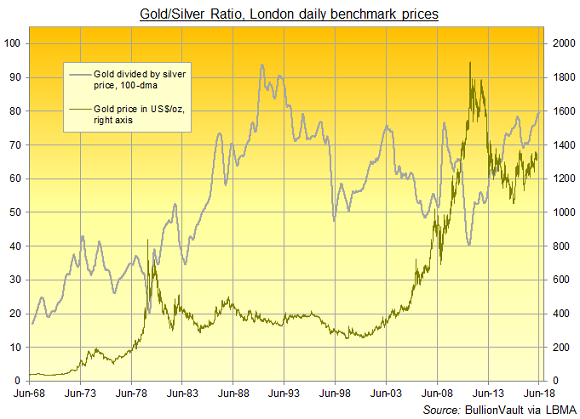
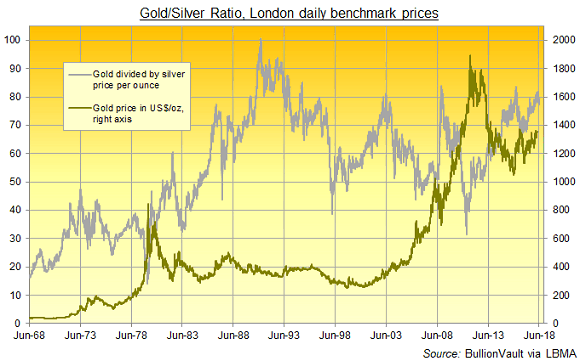
That pushed the price of gold, divided by silver, sharply lower to new 6-month lows just above 76.
 
April 2018 saw the Gold/Silver Ratio near the top of the last decade’s range, pricing one ounce of gold at nearly 82 ounces of silver.
 
On its 100-day moving average, the GSR last week set its highest level since the all-time peak marked during the early 1990s’ recession.
 
Gold/silver ratio, 100-day moving average since 1968. Source: BullionVault
 
While the price of silver has gained over 3.0% so far in June, the number of shares outstanding in the giant iShares Silver Trust (NYSEArca:SLV) has shrunk by 1.9% as investors sold out, cutting the quantity of silver bullion needed to back the ETF’s value by more than 190 tonnes to a 4-month low of 9,825 tonnes.
 
The largest gold-backed ETF – the SPDR Gold Trust (NYSEArca:GLD) – ended Wednesday unchanged in size for the 3rd session running.
 
Needing some 829 tonnes, the GLD also now stands at its smallest size since mid-February.
 
Wednesday’s policy decision from the US Fed came with new economic and interest-rate forecasts from FOMC members, showing the majority now expect to make two further hikes this year after yesterday’s move up to a ceiling of 2.0% on the Fed Funds rate.
 
Betting on interest-rate futures today moved to put a 51% probability on 2 more hikes by end-December, up from a 45% likelihood before Wednesday’s Fed announcement.
 
That would make a total of 4 in 2018, each spaced 3 months apart.
 
Giving his second quarterly press conference as Fed chair, Jerome Powell said he wants to speak with journalists after every meeting in future
 
“[This] does not signal anything about the timing or pace of future interest rate changes,” said Powell.
 
“This is only about improving communication.”

Gold Bullion 'Dull' Ahead of Fed But Unchanged YTD Despite Rising Interest Rates

GOLD BULLION rallied from a new 1-week low in US Dollar terms on Wednesday in London, trading unchanged for the year-to-date at $1294 per ounce ahead of today’s key Federal Reserve decision on US interest rates.
 
Asian stock markets slipped while European equities rose, reversing yesterday’s pattern as major government bond prices edged higher, nudging longer-term interest rates down.
 
“Markets failed to react in any meaningful way to the landmark meeting between US president Donald Trump and North Korean leader Kim Jong Un,” says a trading note from Swiss gold bullion refiners and finance group MKS Pamp, “instead shifting focus to 3 critical central bank meetings…kicking off today.”
 
The US Fed’s June decision will be followed by the European Central Bank tomorrow and then the Bank of Japan on Friday.
 
Silver prices outstripped gold bullion once again, rising back towards yesterday’s 7-week high of $16.95 per ounce, but platinum dropped to set new 3-week lows beneath $893.
 
Short-term US rates edged lower, and 5-year Treasury bonds offered a yield of 2.81% per annum – matching the latest reading of US consumer-price inflation, released Tuesday.
 
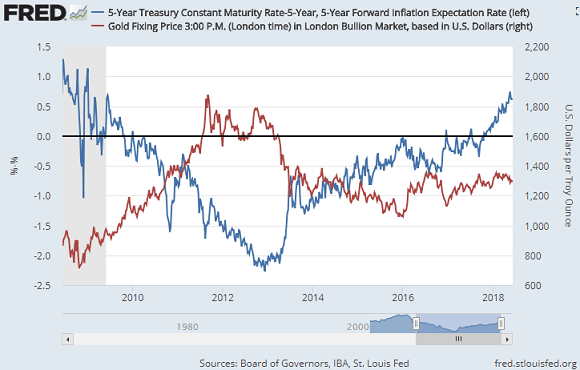
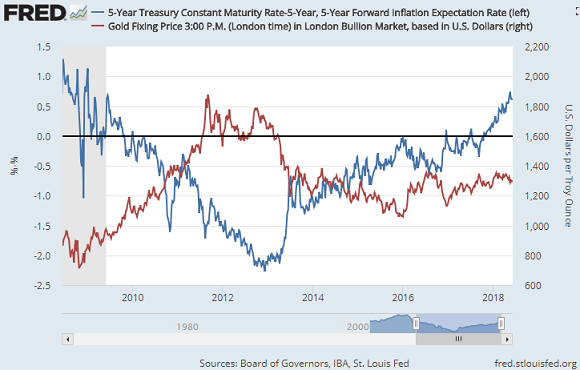
Compared to real US interest rates, adjusted for the pace of inflation, the Dollar price of gold bullion has flipped from showing a strongly negative relationship to showing a solidly positive connection in 2018 so far.
 
On a 12-month basis, the week-to-week correlation of gold and 5-year US Treasury bond yields – adjusted by market-based inflation expectations – has gone from a median reading of -0.61 between 2008 and end-2017 to +0.43 so far this year.
 
That figure would read +1.0 if they moved perfectly in lockstep together, or -1.0 if they moved exactly opposite, with gold falling as real rates rose.
 
Chart of inflation-adjusted 5-year US T-bond yields versus the gold price in Dollars. Source: St.Louis Fed
 
The rise in real 5-year yields so far in 2018 has totalled one-third of the rise over the same period five years ago, when gold prices fell at their fastest pace against the Dollar since the early 1980s.
 
Over the first 6 months of 2013 gold fell from $1657 to $1192.
 
To date in 2018 it shows no change at $1294 per ounce.
 
Betting on US interest-rate derivatives this morning put a 96% chance on the Fed raising its key interest rate to a ceiling of 2.0% at today’s meeting, as most analysts and economists predict.
 
Betting on the Fed then raising twice more before the end of this year has remained constant over the last month, putting the odds at 40% according to the CME’s FedWatch tool.
 
The Fed Funds futures market sees a slightly greater chance of 42.5% that the US central bank will raise only once more in 2018 after today.
 
Wednesday morning meantime saw “another dull and sluggish session for gold” in Asian hours says MKS, “remaining range-bound ahead of [these] important central bank meetings.”
 
Shanghai premiums slipped again this morning, drifting down to $5.50 per ounce above London quotes to offer just two-thirds of the typical incentive for new imports into China, gold’s No.1 consumer nation.
 
Gold bullion slipped Wednesday for Eurozone investors, edging back down to €1100 as the Euro rose on the FX market despite weaker-than-expected employment and industrial output data from the 19-nation single currency zone.
 
The UK gold price in Pounds per ounce in contrast rose back above £970 as pundits, politicians and traders weighed conflicting versions of yesterday’s “assurances” from Prime Minister Theresa May over giving Parliament a “meaningful vote” on the final Brexit deal now being negotiated ahead of the United Kingdom’s March 2019 exit from the European Union. 

'Darkening Clouds' See Gold Prices Dip as US Inflation Hits 6-Year High, Real Yield Correlation Snapped Since Trump

GOLD PRICES fell to 1-week lows beneath $1295 per ounce lunchtime Tuesday in London as new inflation data said the US cost of living rose 2.8% per year in May, the fastest pace since early 2012.
 
Ahead of tomorrow’s Federal Reserve decision on interest rates, short-dated US debt prices fell hard, driving 2-year yields back up towards last month’s decade highs of 2.58%.
 
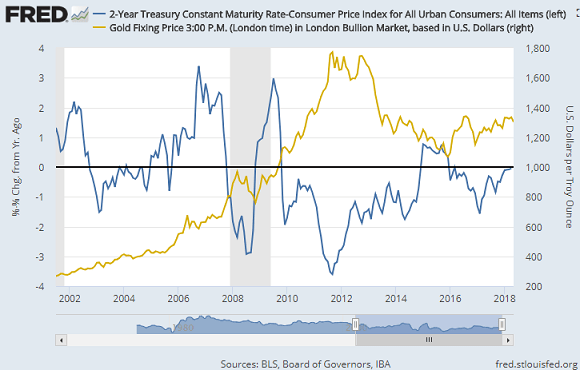
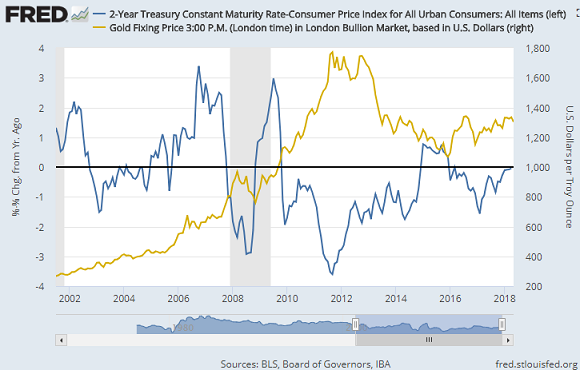
Previously showing a consistently negative relationship with real bond yields, the price of gold in Dollars has become positively correlated with 2-year Treasury yields minus inflation since Donald Trump was elected president in November 2016.
 
The median correlation of -0.43 from 2001 to 2016 has now flipped to a median +0.43 on a rolling 12-monthly basis.
 
That means gold has tended to rise or fall in line with the real rate of interest on short-term government debt, snapping its prior relationship.
 
Chart of 2-year US Treasury bond yields minus CPI annual inflation vs. gold price. Source: St.Louis Fed
 
South Korea today asked Washington for the “precise meaning or intentions” of remarks made by Trump after his meeting this morning with North Korea’s dictator Kim Jon un.
 
Vowing “commitment [and] efforts” to remove nuclear weapons from the Korean peninsula, the Trump-Kim meeting failed to announce any concrete steps.
 
Trump then blasted Canada’s Prime Minister Justin Trudeau again for saying “we will not be pushed around” by Trump’s negotiating style over imposing high trade tariffs on imports to the United States to try and reduce its trade deficit.
 
“That’s going to cost a lot of money for the people of Canada,” said Trump in his post-Singapore press conference, explaining that he had watched Trudeau’s speech on TV aboard Airforce One.
 
“He learned. You can’t do that. You can’t do that.”
 
Asian stock markets rose but Europe stalled after Wall Street set new 3-month highs overnight.
 
Crude oil also pulled back, extending its retreat from last month’s 3-year highs to nearly 5%.
 
“The clouds on the horizon…are getting darker by the day,” said IMF managing director Christine Lagarde on Monday, highlighting “the deterioration in confidence…prompted by [Trump’s] challenge to the way in which trade has been conducted, in which relationships have been handled and in which multilateral organisations have been operating.”
 
“We must stop this escalation of tensions,” agreed World Trade Organization director-general Roberto Azevedo, also speaking in Berlin after meeting with Germany’s chancellor Angela Merkel.
 
“A tit-for-tat process is not going to be helpful.”
 
Latest UK trade data say that London’s specialist bullion vaults regained March’s small outflow of gold in April, with imports outrunning exports by £232 million, equal to some 8 tonnes.
 
China led April’s destinations for gold shipped out of London, accounting for 43% of the UK’s gross exports and followed by No.5 consumer nation Turkey (27%) and refining hub Switzerland (12%).
Gold bullion landed in Shanghai fixed Tuesday at a $5.75 premium to London quotes, little changed from the last fortnight’s weak incentive for new imports to the No.1 consumer nation.
 
Turkey’s President Recep Tayyip Erdoğan meantime said overnight that his government will use the S-400 air defense missiles it is buying from Russia in defiance of US and other Nato members “if necessary”.
 
With Turkish-backed opposition groups apparently fighting each other in the Syrian region of Afrin where US-backed forces are also operating, Turkey yesterday sent warplanes to hit the Kurdistan Workers Party (PKK) in northern Iraq, with Erdogan saying his “objective is to drain the swamp.”
 
Less than 2 weeks before Turkey’s snap election – called by Erdogan to try and cement new powers granted to him by a referendum last year – the main opposition candidate Muharrem İnce has filed criminal charges against the President for accusing him of working for exiled cleric Fethullah Gülen, widely suspected of fomenting the failed 2016 coup attempt. 
 
Erdogan this week also called for Germany to “straighten out” the Prime Minister of neighboring Austria for expelling 40 foreign-funded imams and shutting 7 mosques in what Vienna calls a crackdown on “political Islam”.
 
Meantime in the UK, “Ignore the will of the people at your peril,” said the front-page of minor tabloid the Daily Express, referring to the 52:48 referendum win for quitting the European Union ahead of a Commons debate on amendments to the EU Withdrawal Bill added by the non-elected House of Lords.
 
With the ruling Conservative Party risking a rebellion by anti-Brexit lawmakers, “MPs have a choice,” agreed best-selling tabloid The Sun:
 
“Great Britain or Great Betrayal.”

Gold Prices Slip, Silver at 7-Week High as Trump Follows G7 'Walkout' with Kim Summit

GOLD PRICES briefly rallied above $1300 per ounce on Monday morning in London before falling back ahead of tomorrow’s historic US-North Korea meeting and three key central bank policy meetings this week, writes Steffen Grosshauser at BullionVault.
 
Gold started the week edging $3 higher to $1301 after US President Donald Trump refused to back the G7 joint communique and left the weekend’s Group of Seven summit early over deepening tensions regarding his new import tariffs and who funds the cost of the Nato military alliance.
 
The yellow metal then fell back to $1296 while the greenback strengthened versus its major counterparts on the FX market as Trump arrived in Singapore ahead of his planned one-on-one meeting with North Korea’s hereditary dictator Kim Jong un.
 
Asian and European stock markets edged higher and Italian banking shares surged 4% after new finance minister Giovanni Tria vowed that there was “no discussion” about leaving the Eurozone currency union launching non-Euro “miniBOT” money as proposed by some members of the new right-and-leftwing ruling coalition.
 
Silver prices meantime rose to new 7-week highs, touching $16.93 per ounce.
 
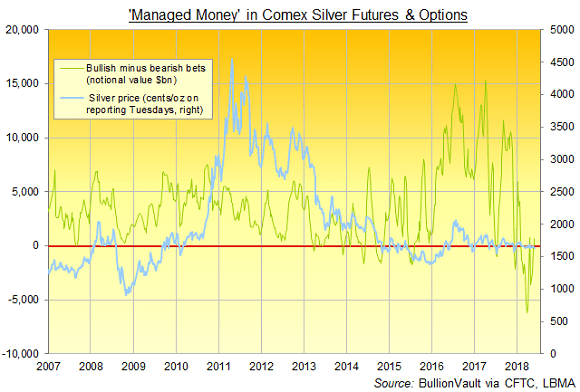
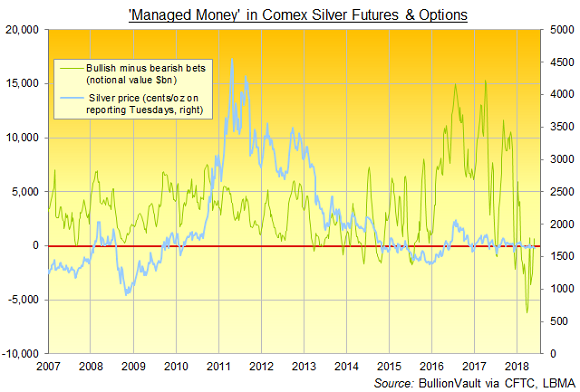
Latest data from US regulators the CFTC say that while the Managed Money category cut its net long position on gold derivatives by 5% overall last week, the balance of their bullish minus bearish betting on silver leapt four-fold, but only to stand at 16% of the last 10 years’ average.
 
Over 23 weeks so far in 2018, hedge funds and other money managers have bet net positive on silver prices in only nine.
 
Chart of Managed Money's net long position in Comex silver futures and options. Source: BullionVault via CFTC
 
“Everybody’s on the side-lines, waiting for the outcome of the Fed meeting,” said Gianclaudio Torlizzi, partner at consultancy T-Commodity in Milan, looking ahead to the Federal Reserve’s 2-day Federal Open Market Committee meeting starting on Tuesday – widely expected to see the FOMC raise interest rates for the second time this year.
 
Further policy decisions then follow from the European Central Bank on Thursday and the Bank of Japan on Friday.
 
“I’m pretty certain that gold and silver will survive yet another rate increase… and prosper, quite frankly,” counters Canadian billionaire and precious metal investor Eric Sprott.
 
Already arrived in south-east after walking out of the G7 summit, Trump on Sunday said to Singapore’s Prime Minister Lee Hsien Loong that he expects the first ever meeting of a US president with the leader of North Korea “to work out very nicely”.
 
“Expect the precious complex to see volatile trade this week,” warns the refining and finance group MKS in their precious metals note today, pointing to Trump-Kim as well as the Fed “and the ECB meeting with focus on comments regarding the future of QE” in the 19-nation currency union.
 
Gold prices for EU investors fell slightly below the € 1100 level Monday morning.
 
The size of the world’s largest gold-backed ETF, the SPDR Gold Trust (NYSEArca:GLD), fell by nearly 0.5% to 828 tonnes on Friday.
 
That marked the sixth weekly decrease in a row, with the number of GLD shares now in issue falling to the lowest since 22 February. 

Silver Prices +2% for Week as Gold 'Struggles' at $1300, G7 Set for 'Trade War' Row

SILVER PRICES held on track for a 2% weekly gain in London trade Friday, outpacing gold’s 0.3% rise in US Dollar terms as the yellow yet again failed to hold a break above $1300 per ounce.
 
“If gold is able to confirm a close above $1300, it could be able to gain up to the 200-day moving average at $1315,” reckons a note from the trading desk of Belgian refining and materials technology group Umicore. 
 
But “the metal still struggles to find a handle above $1300,” says the Asian trading team at Swiss refiners MKS Pamp, “and will need to consolidate above the figure to entice further interest.
 
“That said, underlying interest broadly sitting toward $1290-95 continues to provide an underlying level of interest.
 
“Silver has [meantime] found interest underneath $16.70 and will target a further leg higher.”
 
Silver prices held around $16.75 per ounce Friday while world stock markets fell ahead of this weekend’s G7 summit in Canada, set for a confrontation over the worsening ‘trade war’ between US President Trump and the other 6 developed-nation leaders.
 
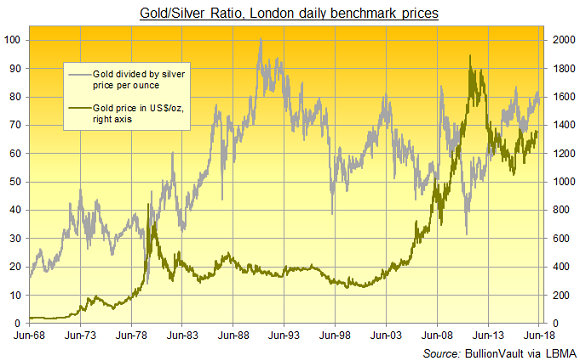
Comparing the silver’s relative pricing against gold, “The gold-silver ratio closed lower [on Thursday] at 77.42,” says the New York office of Scotia Mocatta – the global bullion bank now being wound down as part of parent company Scotiabank’s retreat from the precious metal market. 
 
“Support is at 77.36 – the Feb low,” says Scotia’s technical note on the Gold/Silver Ratio, looking for the figure to fall further as silver continues to outperform gold.
 
Chart of the Gold/Silver Ratio, daily London benchmarks. Source: BullionVault
 
Holding below 77.5 on Friday, the Gold/Silver is trading near its lowest reading in 4 months and stands more than 5% below April’s approach of early 2016’s twenty-year highs.
 
“Overall we forecast the silver price to average $17.40 [across all of] 2018, marking a 2% increase,” says the new Silver Focus from specialist analysts Metals Focus, launched last night in London and Mexico City.
 
“This still compares unfavourably to gold, which we expect to achieve an average 6% higher year-on-year in 2018 at $1330.”
 
On the data front Friday, and after new US consumer borrowing came in one-third below analyst forecasts with the weakest April growth since 2011, new figures today said Japanese bank lending slowed to 2.0% annual growth in May – its weakest pace of the last 4 years.
 
In contrast to the weak borrowing figures, “US wage inflation is set to take off in the coming months, just like Japan,” reckons strategist Albert Edwards at French investment bank Societe Generale, pointing to how last week’s US payroll data “highlighted the recent surge in the voluntary ‘quit rate’ index.
 
“Aka ‘take your job and shove it’ this index now sits at its highest level for 18 years…[What’s] most significant is the quit rate tends to lead wage inflation by around 6 months.”
 
Wth the US Federal Reserve watching for signs of wage-push inflation to guide its 2018 interest-rate hikes, “At a recent round table client dinner most participants identified accelerating US wages as the greatest risk to market stability in the near term,” Edwards warns.

Silver Price 'Will Top $20 in 2018', Platinum 'Will Regain $1000'

SILVER PRICES rose for a fourth day in London on Thursday, again beating both gold and platinum as world stock markets gained and Italy’s borrowing costs retreated further from last week’s spike to 2012 crisis levels.
 
Touching $16.78 per ounce just ahead of New York opening for trade, silver bullion traded 2.3% higher for this week so far.
 
Gold stood just 0.5% higher from last Friday’s finish at $1299, while platinum prices had added barely $3 per ounce to $907.
 
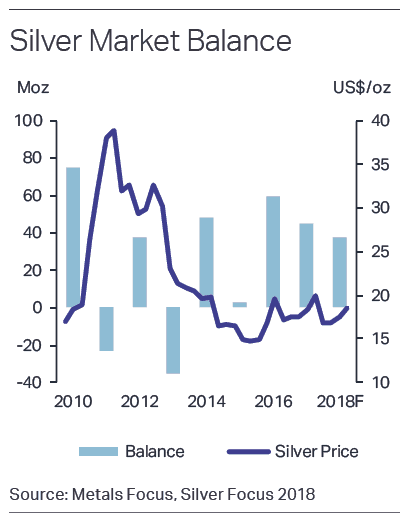
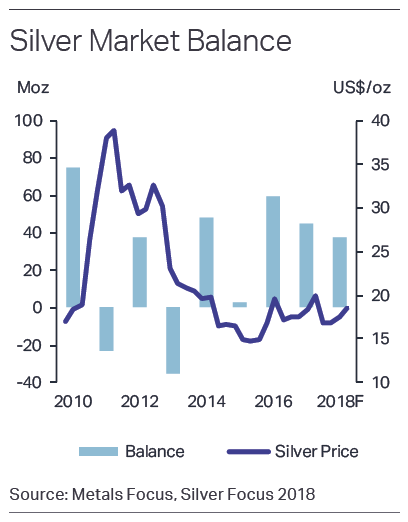
“Conditions across global financial markets [will] become more supportive for precious metals prices later this year,” reckons the new Silver Focus 2018 from specialist analysts Metals Focus, launching the report today in London and Mexico City.
 
“As a result, silver is likely to spend the last few months of 2018 trending upwards…[and] a venture above $20, even if only short-lived, is likely during the final quarter of this year.”
 
This comes despite “another year of oversupply” on Metals Focus’ forecasts, “albeit less so than during 2016-17.”
 
Chart of silver's global supply/demand balance, million Troy ounces. Source: Metals Focus
 
To balance global silver demand and supply in 2018, Metals Focus says “professional investors will once again be called upon to absorb a considerable level of excess” between industrial, jewelry and retail investment demand with mining and scrap supply.
 
“[But] there is plenty of scope for fresh investment inflows into silver,” the consultancy believes, “especially among institutional players…given the macroeconomic and geopolitical backdrop.”
 
The price of platinum will meantime “start a recovery this year, albeit a gradual one,” according to Rhona O’Connell, head of metal analysts GFMS at Thomson Reuters, today launching the new GFMS Platinum Group Metals Survey 2018.
 
Forecasting a rise above $1000 per ounce sometime in the second half, GFMS’ outlook “is predicated on a small deficit this year,” says O’Connell’s team, “fuelled by a contraction in supply, chiefly from the South African mining sector…[including] closures from some marginal operations…coupled with rising demand.”
 
Platinum has only traded above $1000 per ounce on 14 trading days so far in 2018.
 
No.1 platinum producer Implats (JSE:IMP) today said that its Zimplats subsidiary (ASX:ZIM) has settled a 5-year dispute with the government of Zimbabwe, agreeing to give up half of its land-holdings “in support of [new president Emmerson Mnangagwa’s] efforts to enable participation by other investors” in mining the world’s second-largest deposit of the metal.
 
US and Japanese platinum jewelry demand is set to “continue growing” according to a new report from the mining industry-backed Platinum Guild International, but demand from auto-makers – who use platinum to reduce harmful engine emissions – is under pressure as sales of diesel cars retreat.
 
“Diesel SUV sales are collapsing in Germany,” says a new report from the Center for Automotive Research, with sales of diesel-engine passenger vehicles falling from 48% of all new car registrations in the Eurozone’s largest economy to 33% since the ’emissions test cheating’ scandal broke at VW in 2015.
 
Meantime in Ankara on Thursday, the central bank of gold’s No.5 consumer nation Turkey hiked its key interest rate for the second time in 2 weeks, taking it to the highest since 2009 at 17.75% per annum.
 
The TCMB’s 7-day repo auction rate was just 8% until 24 May, while consumer-price inflation ran above 12% amid a plunge in Turkey’s Lira to fresh all-time record lows on the currency market.
 
The Lira rallied on Thursday, capping gold and silver prices in Istanbul’s wholesale market.
 
If Turkey does buy Russian-made S-400 air-defense missiles, fellow Nato member the United States has reportedly warned the government of Recep Tayyip Erdoğan – now seeking re-election in a snap poll on 24 June – it “should not use them”.
 
Turkey’s interest-rate move comes a day after the central bank of No.2 gold consumer India raised its key interest rate for the first time in 4 years.
 
That saw wholesale bullion prices in the key import hub of Ahmedabad sink to a $2.85 per ounce discount to global gold quotes according to trading exchange NCDEX.

Gold Price Hits 2-Week Euro Low as ECB Sees End of QE, 'Trade War' Threatens Global GDP

GOLD PRICES rallied back near $1300 per ounce on Wednesday but fell to 2-week lows for European investors as Eurozone bond yields rose after two key Euro central-bank officials said Frankfurt remains on track to start reining back its historic monetary stimulus.
 
Italian bond prices fell faster than other Eurozone debt, driving the yield spread over benchmark German Bund interest rates higher after the new right- and leftwing government’s prime minister, Giuseppe Conte, promised “radical change”.
 
Gold priced in the single currency dipped below €1100 per ounce, the first time since Italy’s new Eurosceptic coalition began trying to form a government in late-May. 
 
Head of the German Bundesbank Jens Weidmann today said it looks “plausible” that rising inflation data will allow the European Central Bank to end new QE purchases of government bonds by the close of 2018.
 
A key contender to replace Mario Draghi as ECB president next year, Weidmann last month called an interest rate hike in mid-2019 – the first since the ECB raised rates just before Lehman Brothers collapsed in 2008 – a “realistic” possibility.
 
Chief ECB economist Peter Praet meantime called annual pay growth of 1.9% across the 19-nation currency zone an “upsurge” in a speech on Wednesday, but noted that the central bank’s huge stockpile of long-dated government bonds “will continue to put downward pressure on longer-term interest rates well beyond the end of our net purchases.”
 
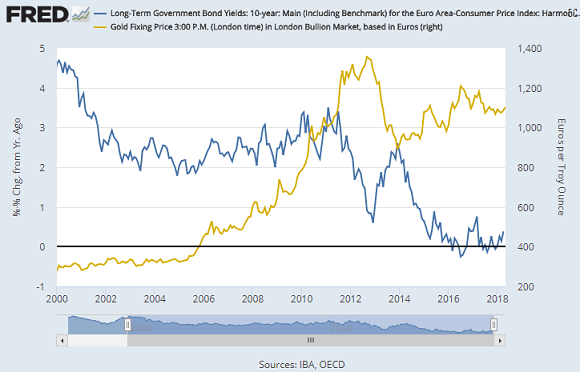
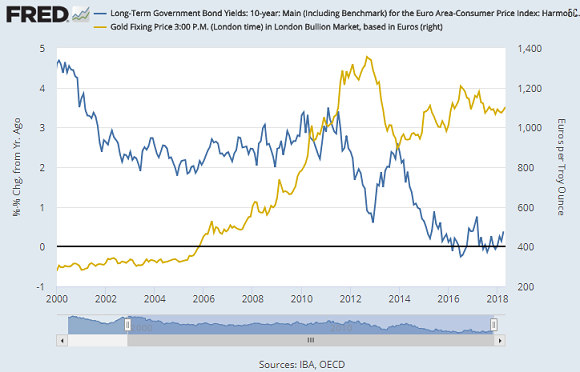
After accounting for inflation in consumer prices, the real yield on longer-term Eurozone bonds has over the last half-decade shown a strongly negative relationship with the direction of gold priced in the single currency.
 
Facing calls in autumn 2012’s Euro debt crisis for Greece, Spain or even ‘core’ member Italy to quit the single currency, the ECB vowed to do “whatever it takes” to preserve the union, moving first to quantitative easing and then cutting interest rates below zero on commercial bank deposits.
 
Euro-gold has since shown an average 12-month correlation of -0.48 with real Eurozone bond yields.
 
That figure would read +1.0 if they moved in lockstep together, or -1.0 if they moved exactly opposite.
 
Chart of inflation-adjusted Eurozone government bond yields vs. gold priced in Euros. Source: St.Louis Fed
 
“Global growth is expected to decelerate over the next two years,” forecast the World Bank yesterday, “as slack dissipates, major central banks remove policy accommodation, and the recovery in commodity exporters matures.”
 
“Rising debt levels make countries more vulnerable to higher interest rates,” warned World Bank development economics director Ayhan Kose, saying that emerging-market policymakers need to prepare for “financial market volatility as advanced-economy monetary policy normalization gets into high gear.”
 
With the Chinese Yuan strengthening to a 1-week high versus the Dollar on the FX market Wednesday, Shanghai gold prices rose more $6 per ounce above global quotes, the strongest premium since mid-May but still one-third below the typical incentive for new bullion-bar imports to the No.1 consumer gold consumer nation.
 
Wholesale prices in No.2 consumer India held a small $1 premium meantime, suggesting improved demand, but new data showed that bullion imports fell almost 40% in May from the same month last year.
 
“Anything that puts sand in the wheels of global trade is a risk to global growth,” says the World Bank report’s author Franziska Ohnsorge, calling “the threat of trade protectionism…a real risk.”
 
After six of the G7 group of developed nations rebuked 7th member the US on Saturday over the “negative impact” of its new tariffs ahead of this week’s meeting in the Quebec resort of La Malbaie, Canada, the European Commission today said it will impose tariffs on up to $3.4 billion of US imports as early as next month.
 
The governments of Britain, France and Germany have now also written to Washington asking that EU companies active in Iran are spared from the re-imposition of US sanctions against the Middle Eastern state over its nuclear research program.
 
For British investors, the UK gold price in Pounds per ounce today dipped to a 2-week low of £964 as Sterling rallied on the FX market despite fresh concerns over Brexit negotiations for a free trade agreement after March 2019.
 
Ahead of Brexit, “European governments are advising businesses not to use British parts in goods for export,” says Sky News, quoting a warning over ‘rules of origin’ problems from the Dutch authorities to manufacturers in the Netherlands.
 
The UK car industry has, according to Sky, “explicitly told the government” that it faces major problems exporting to the European Union after Brexit under the kind of arrangements currently proposed by Theresa May’s ruling Conservative Party.