Author Archives: City Gold Bullion

Gold Price Gains, Defies ETF Outflows as Brexit UK Confirms Inflation Jump

GOLD PRICES jumped at the start of New York trade Tuesday, reaching new 2-week highs in London’s wholesale market as commodities also rose together with global equities and emerging-market bond prices amid fresh news of growing inflation.
 
Silver and platinum prices also rose sharply as gold hit $1240 per ounce, its highest Dollar value since 2 March.
 
Gaining 1% from last week’s finish, gold prices have so far defied the continued drop in ETF holdings – now totalling 7 from March’s 14 trading sessions to date for the giant GLD trust fund, its worst run of outflows of 2017 so far.
 
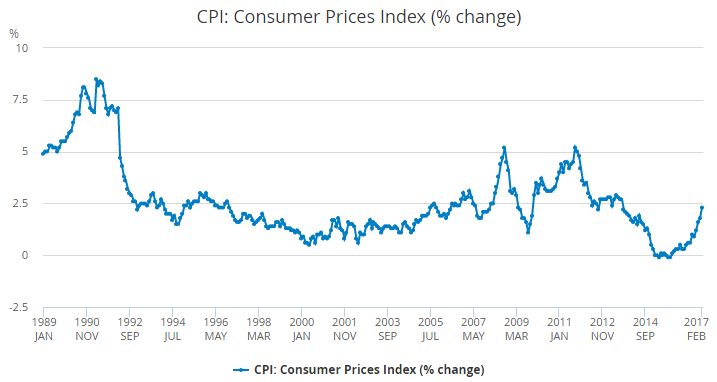
After Germany’s industrial product prices  yesterday showed their fastest annual inflation since 2011, the UK’s official data agency today reported the fastest rise in its Consumer Prices Index since 2013 at 2.3% per year.
 
Used to benchmark state pensions and benefits, as well as many private-sector wage increases, CPI inflation accelerated for the fourth month running, something not seen since the global financial crisis peaked in summer 2011, when Sterling gold prices also hit their current all-time high near £1200 per ounce.
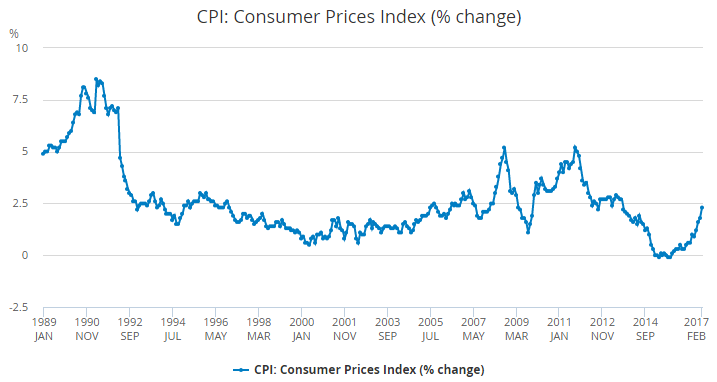
 
Chart of UK CPI inflation
 
Moving inversely to London’s FTSE100 once more – the only major world share index to fall Tuesday morning – the British Pound jumped 1 cent against the Dollar and hit a 2-week high versus the Euro.
 
It also pushed the gold price in Sterling over £11 below Monday’s brief spike to £1000 per ounce, made when the UK Government announced it will trigger Article 50 a week tomorrow, starting the 2-year countdown to Brexit from the European Union following last year’s referendum, won 51.9% to 48.1% against.
 
UK government debt prices fell following the inflation news, nudging 10-year Gilt yields up to 1.26% as German, US, Swiss and Dutch bond prices also slipped.
 
French bond yields retreated, in contrast, after last night’s televized debate ahead of April’s first round of the general and presidential elections saw anti-Euro, anti-EU Marine Le Pen fail to impress pundits in Tuesday morning’s press, with no clear ‘winner’ amongst the 5 candidates.
 
Gold’s overnight weakness against the Euro – retreating briefly below €1140 per ounce – was “possibly due to yesterday’s TV debate in France,” says a note from German financial service giant Commerzbank’s commodities team, “which flash polls suggest was won by the EU-friendly candidate Macron.”
 
Smaller Eurozone and emerging-market bond prices also rose after the People’s Bank of China reported the strongest confidence survey in 3 years amongst bankers and corporate bosses in the world’s second largest economy.
 
US investment bank Goldman Sachs meantime said today it will start moving staff out of London ahead of the UK’s Brexit from the EU.
2-Week High in Gold Price as G20 Drops 'Free Trade', UK Names Brexit Date, Big Russian Build-Up in Crimea

GOLD PRICES rose to a 2-week high on Monday morning in London before easing back as the US Dollar extended its drop and world stock markets also slipped following the weekend’s change to the G20 group of nations’ stance on protectionist trade policy, writes Steffen Grosshauser at BullionVault.
 
Downing Street today announced that UK Prime Minister May will formally start the countdown to Brexit by triggering Article 50 on Wednesday next week, officially notifying the rump 27-nation European Union and setting a final exit deadline of 29 March 2019.
 
Moscow meantime ordered what several observers called an “unprecedented” rush to military exercises in the former Ukraine province of Crimea, from which the government of Poland again asked the Kremlin to withdraw, while the UK said 120 of its troops have joined the Nato deployment in Russian-neighbor Estonia.
 
Finance ministers meeting in the German town of Baden-Baden repeated their warnings over competitive currency devaluations to try and boost exports, but US pressure saw a clause on “free trade” cut from the summit’s communique, along with a clause on funding anti-climate change programes.
 
Apparently refusing to shake hands with German Chancellor Merkel’s hand at a press conference Friday, US President Trump is due to join his G20 counterparts at the next summit in July.
 
The US Dollar today hit a near 6-week low on the FX market after last week’s widely expected interest-rate rise by the Federal Reserve, only its third hike of the last 11 years.
 
Dollar gold prices hit $1235 per ounce, the highest level since 6 March, before steadying around $1232.
 
That was still over $35 above gold’s low before Fed chair Janet Yellen disappointed hopes for a strong rate-rise outlook in her post-FOMC press conference.
 
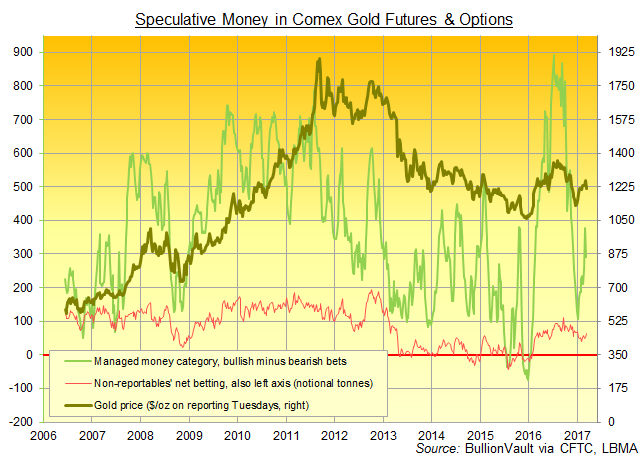
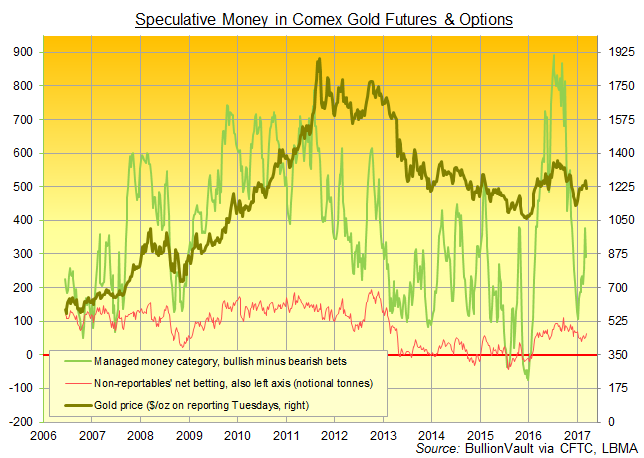
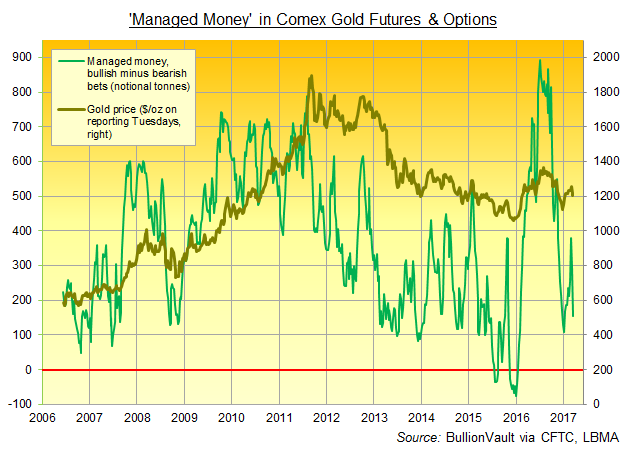
In the week preceding the Fed’s decision, new data said Friday, hedge funds and other ‘Managed Money’ traders cut their bullish betting on gold derivatives at the fastest pace since January 2016 
Chart of 'Managed Money' net spec' long position on Comex gold futures & options
 
“With concerns of a more hawkish Fed now easing, the outlook for gold looks a little bit more positive,” according to a note from Australian ANZ bank. 
 
Pegging resistance at $1237 per ounce, a further rise “could lead to a gain to $1243,” reckons Reuters technical analyst Wang Tao.
 
Meanwhile, Eurozone stock markets slumped from new 15-month highs on Monday, also pulled down by lower oil prices weighing on energy stocks and Deutsche Bank dropping over 4% as its Annual Report explained why the German financial giant needs to raise €8 billion to help overhaul its business structure.
 
The British Pound dropped to $1.23 on the Brexit Article 50 news, holding gold priced in Sterling up at £994 per ounce.
 
Having rallied 2% last week against the Dollar, silver again tracked gold prices and rose 6 cents to $17.46 per ounce, while platinum prices also added 0.4%.

Trump's 'Scorched Earth' Budget Sees Gold Bars +2.1% vs Rate-Rise Dollar, Euro Rate-Rise Rumor Quashed

GOLD BARS traded in London’s wholesale market rose back above $1230 per ounce Friday lunchtime, gaining 2.1% from before this week’s US Fed interest-rate rise as wrangling began in Washington over Donald Trump’s first budget proposals as US president.
 
The Euro held 2 cents higher for the week versus the Dollar at $1.0750, but retreated after spiking on a German newspaper report that a rate rise from the European Central Bank “could be on the way.”
 
“The ECB could…raise the deposit rate earlier than the prime rate,” Handelsblatt quoted Austria’s monetary policy chief Ewald Nowotny, suggesting that the ECB’s current €80 billion per month of new QE bond buying might also continue after the central bank moves to raise its current negative rate of interest paid to commercial banking reserves.
 
“This article’s headline was [then] corrected,” Handelsblatt said later on Friday, “to say the ECB could tighten monetary policy in a different way to the US Federal Reserve, rather than that a rate hike could be on the way.”
 
With the Euro retreating on the FX market, wholesale gold bars bounced back to €1144 per ounce, nearing the weekend with a 1.4% gain from last Friday’s finish.
 
Rising for the 9th week in 12 so far in 2017, that matches the Euro gold price’s mid-2016 run of weekly gains – when the UK’s Brexit referendum shocked world markets – and the best since early 2014.
 
Chart of large gold bars priced in Euros per ounce, Friday PM benchmark
 
“Our central scenario remains that no political earthquakes are likely in Europe this year,” says a new note on gold prices from Michael Haigh’s commodity team at French bullion market-making bank Societe Generale.
 
“Furthermore, with the prospect of the US Fed hiking by a total of 0.75 [percentage points] both this and next year…we expect the gold price to trend lower this year.
 
“We recommend selling rallies.”
 
The Fed’s “well-telegraphed rate hike…helped ensure another positive response from the markets,” says FX strategist Steven Barrow at Chinese banking giant ICBC’s Standard Bank, “with both bonds and stocks rallying.
 
“[But] investors need to remember that volatility-supressing Fed policy is not the main driver of financial markets anymore. Instead it is future fiscal policy…[now] far less predictable” under US President Trump.
 
Proposing $54 billion more defence plus $4bn to build a wall at the Mexican border while slashing health, social and diplomatic spending, Trump’s first Budget was accused overnight of being un-American by Democrats, a “scorched earth” attack on environmental programs, and also “draconian, careless and counterproductive” by one Republican Congressman.
 
Washington this week hit its legal “debt ceiling”, now set at Wednesday’s outstanding total of $19.4 trillion, as the suspension agreed by former president Obama and Congress in late 2015 expired.
 
That means “extraordinary measures” now apply, banning new borrowing to try and avoid a government shutdown before Trump and Congress reach a new deal.

Gold Prices +3% as Fed Rate Rise Lags Inflation, Dollar Falls, Greek Debt Deadlines Loom

GOLD PRICES rose further Thursday in London, gaining almost 3% in Dollar terms since the Federal Reserve raised US interest rates as expected yesterday, and also raised its forecast for interest-rate hikes ahead.
 
Continuing to re-invest the central bank’s $4 trillion QE holdings of US Treasury bonds as they mature, the Fed’s Open Market Committee now sees its key rate ending 2017 no lower than 1.4% versus 1.1% at the December meeting.
 
The Fed Funds rate will end 2018 between 2.1% and 2.9%, according to the FOMC’s March projections, higher from Dec’s range of 1.9% to 2.6%.
 
“Inflation has increased in recent quarters,” said Fed chair Janet Yellen, announcing the clearly-telegraphed rise in rates to a ceiling of 1.00%.
 
US headline inflation rose last month to a 5-year high of 2.7%.
 
With the Dollar falling again on the FX market this morning, Asian and European stock markets also followed Wall Street’s strong gains after the Fed announcement, driving the MSCI World Index to new all-time highs.
 
Major government bond prices retreated, pushing yields higher, while commodities rallied 0.4% from the last 6 week’s 7% drop.
 
Silver hit 4.3% post-Fed gains before falling back 15 cents from $17.56 ounce.
 
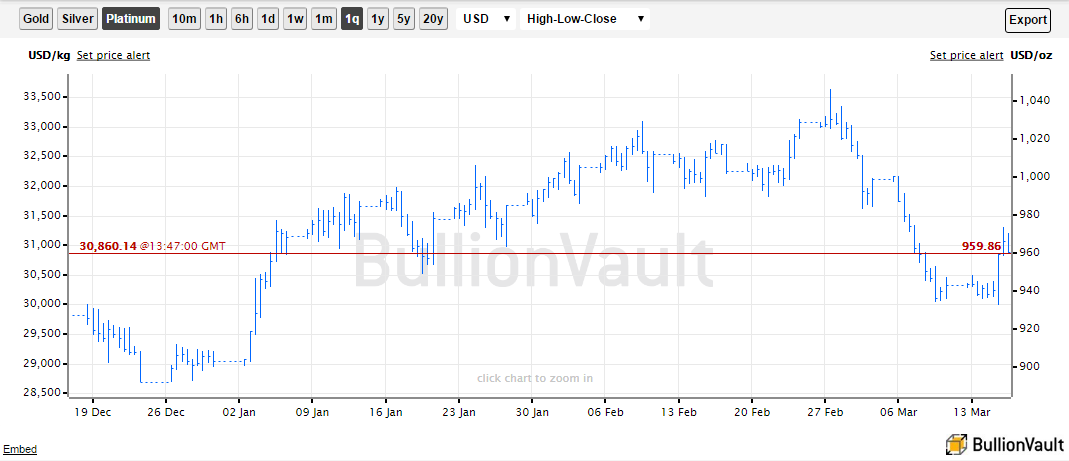
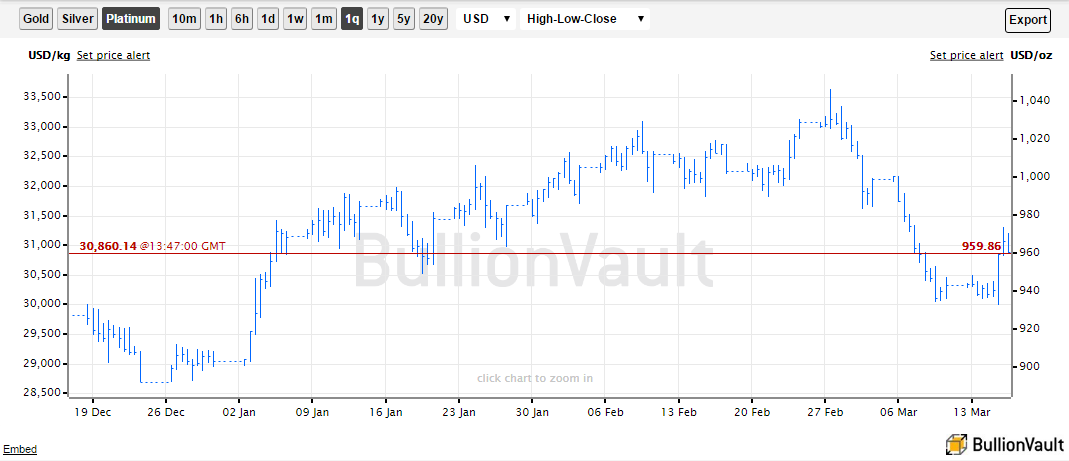
Prices to buy physical platinum in London’s wholesale market gained 4.4% from Wednesday’s 10-week lows, peaking at $973 before easing back $13 per ounce.
 
Chart of the USD platinum price, 3 months to 16 March 2017
 
The single-currency Euro meantime held its 1-cent jump versus the Dollar, trading at 5-week highs above $1.07 following the Fed announcement.
 
Results from yesterday’s general election in the Netherlands showed the anti-Euro Freedom Party moving from 3rd to 2nd place, pulling 13% of the vote against 21% for the incumbent Liberal Party – itself down by one fifth, but now set to form a coalition with other groups, including the GreenLeft party, which quadrupled its number of seats.
 
An exploding letter this morning injured one person at the International Monetary Fund’s HQ in Paris, a day after Germany’s finance ministry said it received a parcel bomb posted in Greece, since claimed by a radical anarchist group behind a series of arson attacks in Athens over the last 9 years.
 
The government in Athens, together with its IMF and Eurozone creditors, last month missed what had been called a critical “deadline” for agreeing a new deal, almost 7 years since the first bail-out package.
 
Calling European monetary union “more resilient than many think” yesterday, free-market think-tank the Cologne Institute for Economic Research last month said Greece’s poverty rate has risen 40% since the financial crisis of 2008.
 
With 2017 bringing a rash of debt repayment deadlines, and €7 billion due in July alone equal to almost 4% of Greece’s entire 2016 economic output, the Greek government has reportedly asked for €3bn from the World Bank, the United Nations’ agency dedicated to lending to developing nations.
 
Euro gold prices today spiked to 1-week highs above €1150, reversing one-third of the last fortnight’s 5.6% drop from gold’s highest level in 5 months against the 19-nation currency.
 
Gold priced in Sterling meantime rose briefly above £1000 per ounce , some 1.1% higher for the week so far, as the Queen gave royal assent to the Brexit Bill passed this week by Parliament.
 
The bill enables the Conservative Government of Theresa May – who said last April she would vote against Brexit in the UK referendum, warning it might prove “fatal to Union with Scotland” – to trigger Article 50 of the Lisbon Treaty and formally begin exiting the European Union.
 
May today repeated that a second Scottish independence referendum, now demanded by SNP leader Nicola Sturgeon, will not happen before the UK’s 2019 EU exit
 
The Pound then rallied, knocking gold £5 lower, on news that today’s “no change” decision on UK interest rates by the Bank of England was not unanimous.
 
Kristin Forbes, a US economics professor sitting as an external member, voted for a hike back to 0.50%, an all-time low before the 300-year old Bank cut its key rate in half last August following the Brexit referendum result.
 
Forbes and the rest of the Bank of England’s MPC did all vote however to maintain its £435 billion QE holdings of British government debt, plus up to £10bn of investment-grade corporate bonds.

Gold Prices 'Wait & See' Before Fed Rate Rise as Euro Bond Yields Ease on Dutch Election Poll

GOLD PRICES held below $1200 per ounce lunchtime Wednesday in London as the Netherlands began a raft of 2017 Eurozone elections and new monthly data showed US inflation hitting a 5-year high ahead of today’s Federal Reserve decision on interest rates.
 
Widely expected to take the Fed’s key rate to a ceiling of 0.75%, the March meeting will still leave returns to savers far below the 2.7% annual pace of inflation reported by Wednesday’s update to the Consumer Price Index.
 
Tuesday’s “narrow range day” left technical support “unchanged at $1191.10,” says bullion bank Scotia Mocatta’s New York office, pointing to the 61.8% Fibonacci retracement level of the gold prices’ January to February rise.
 
“The gold price has often found itself under pressure ahead of interest rate decisions,” says today’s daily commodity note from German financial services group Commerzbank, “only to gain in the end once the rate hike had been implemented.”
 
With the Fed’s March 2017 rate rise so clearly telegraphed in recent weeks, “The market will be more interested in learning during [Fed chair Janet Yellen’s] subsequent press conference how many other rate hikes might be on the cards,” Commerzbank says.
 
Should Yellen and her team repeat their previous 3-in-total forecast for 2017, traders “could see one of the factors weighing on the gold price fall away…[allowing] the focus to shift back to more political issues from tomorrow.”
 
“The majority of markets [have] decided to play wait-and-see,” says a credit-market note from French investment and bullion bank Natixis, pointing to the Fed meeting.
 
“Investors will also be looking closely at the result of the elections in the Netherlands, the first ones in a very busy Eurozone electoral calendar.”
 
A new opinion poll late Tuesday said anti-Islam, anti-Euro Geert Wilders of the Freedom Party has fallen sharply behind current Dutch prime minister Mark Rutte’s Liberal Party.
 
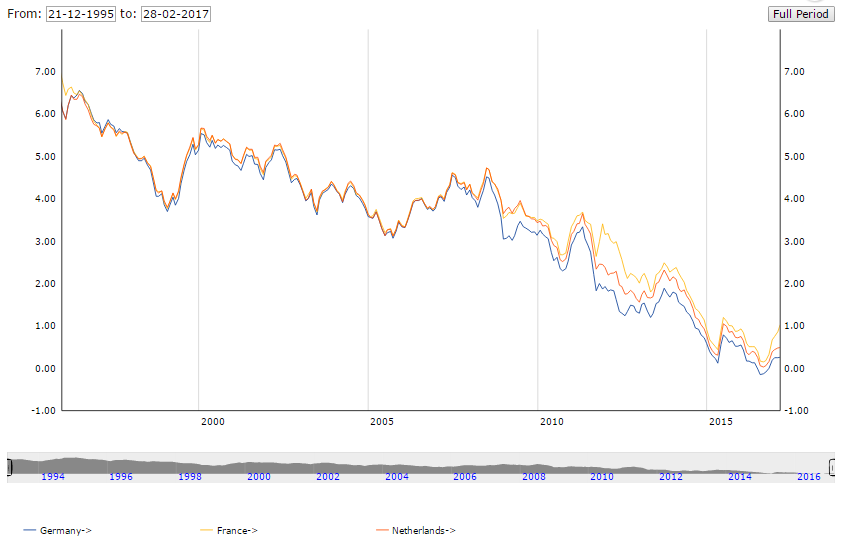
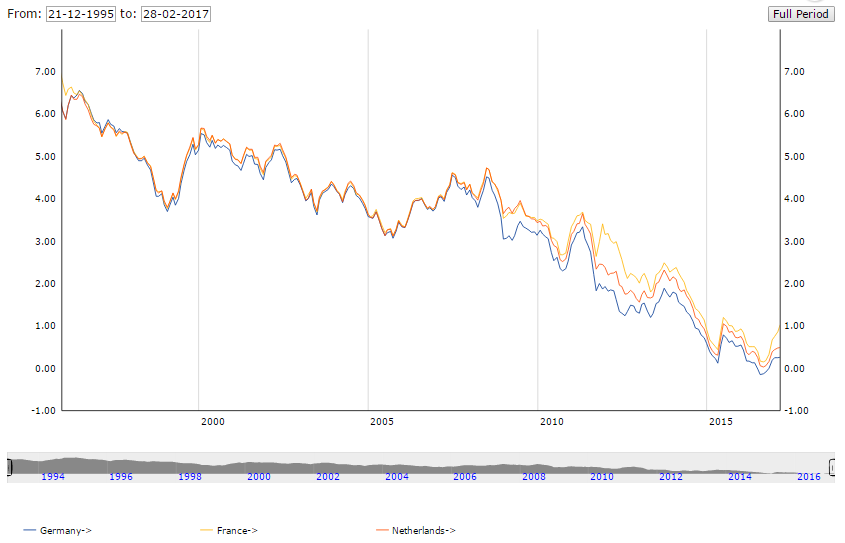
Dutch government bond yields fell further back as their prices rose, cutting 10-year yields from last week’s 13-month high at 0.74% and trimming the gap over German Bunds.
 
Chart of German (blue), French (yellow) and Dutch (orange) 10-year government bond yields. Source: ECB
 
French bond yields also retreated, dropping to 1.04% with 4 weeks to go before the first round of France’s general election.
 
“[A] Le Pen win remains unlikely, and Frexit even more so,” says a special Frexit report from French investment bank and bullion market-maker Societe General.
 
But there is “a tail risk that France elects a pro-Frexit president” during the April and then May rounds of the national elections, it adds, noting that Le Pen has promised to hold a referendum within 6 months.
 
“Even in the unlikely event of a ‘Yes’ vote to a Frexit referendum, the economic crisis that would likely result could well see France scrambling to reverse the decision.”
 
Gold prices for Euro investors held unchanged for the week so far on Wednesday at €1128 per ounce, roughly in the middle of the last 12 months’ range.
 
British prime minister Theresa May today told MPs that Scotland “will leave” the European Union whether or not a second independence referendum is held and won by the Scottish Nationalist Party before Article 50’s two-year countdown to Brexit ends in 2019.
 
Six months after the UK’s Brexit referendum result, unemployment fell in January to the lowest level since 1975 at 4.7% according to official data Wednesday.
 
May’s finance minister Philip Hammond meantime backed down on a tax-raising plan for National Insurance contributions announced only last week in his Budget which broke a 2015 manifesto pledge.
 
With the Bank of England expected to hold its QE money creation at £435 billion and its key interest rate at 0.25% tomorrow, 10-year UK government Gilt yields held at 1.22% on Wednesday.
 
UK inflation was last pegged at 1.7% per year by the Office for National Statistics.


Gold Bullion Holds $1200 as US Inflation Confirms 5-Year High Before Fed, But Crude Oil Sinks

GOLD BULLION gave back a 0.6% rally in London lunchtime Tuesday, retreating as new US data confirmed that tomorrow’s Federal Reserve decision on raising interest rates will come as price inflation rises at the fastest pace in 5 years.
 
Versus a rising US Dollar gold bullion touched $1207 per ounce before easing back, but held above Friday’s 5-week lows beneath the $1200 mark.
 
Silver prices meantime fell again below $17 per ounce, 
 
Led by crude oil and other energy costs, the US Producer Price Index – compiled by the Bureau of Labor Statistics to show the change in sales prices realized for domestic-made goods and services – jumped to 2.2% annual inflation in February, the fastest pace since March 2012.
 
Data for US Consumer Price inflation – last reported at a 5-year high of 2.5% per annum,  above the Fed’s 2.0% target – are due tomorrow, just before the Fed’s decision.
 
Analysts’ consensus forecasts predict a reading of 2.7% for February’s CPI, the fastest acceleration since Feb’ 2012.
 
Energy prices fell Tuesday however, with crude oil – after hitting 18-month highs in February – extending the last 3 weeks’ slump after new data showed Saudi Arabia reversing one-third of January’s cut last month.
 
Despite leading oil-cartel Opec’s quota cuts in late 2016, that took output from Saudi Arabia back above 10 million barrels per day.
 
Falling below $45 per barrel of US benchmark-grade WTI today, crude oil prices have now lost 13% since 23 February.
 
US Treasury bond yields also retreated Tuesday as energy prices fell, pulling the 10-year yield down from 20-month highs above December’s 2.60% peak, set when gold prices hit near 2016-lows at $1160 per ounce.
 
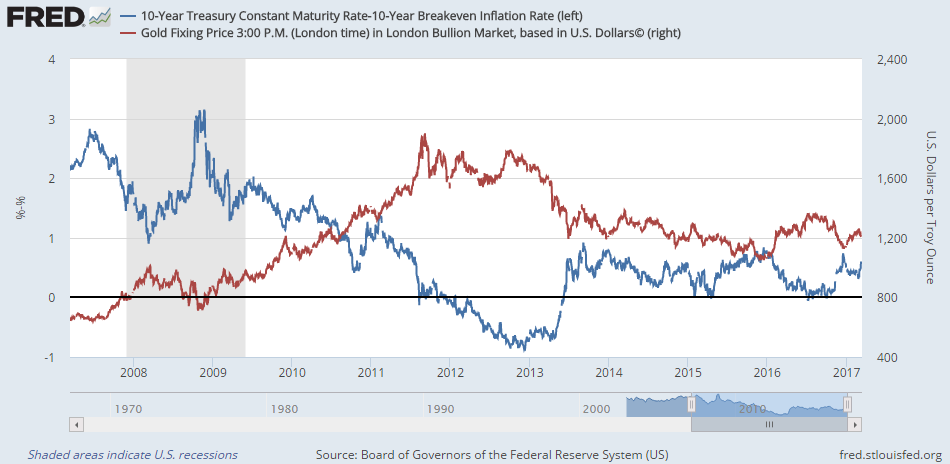
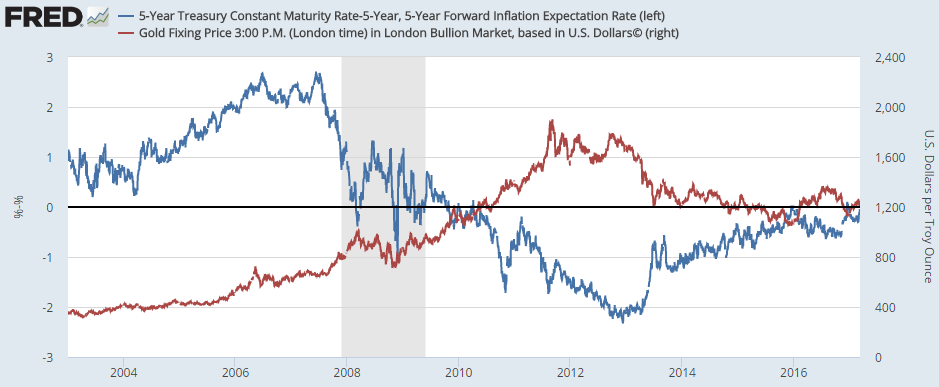
Adjusted for market-based inflation forecasts, real 10-year yields have yet to reach December’s 11-month highs above 0.74% per annum.
 
Chart of 10-year US T-bond yields adjusted by 10-year breakeven rates vs. gold price
 
Gold, silver and platinum prices remain in a bear market, according to a note from analysts at US investment bank Morgan Stanley, thanks to “stable global growth and proactive inflation management” by central banks led by the Fed.
 
Rival Goldman Sachs thinks investors should stay bullish on raw materials, because “concerns” over slower Chinese growth “are misplaced…
 
“The market needs a little patience to wait for the fundamentals to materialize.”
 
UK retail and investment bank Barclays (LON:BARC) also says it remains “bullish” on crude oil prices from here to 2020.
 
The Bank of England’s second most senior policymaker meantime resigned today after Charlotte Hogg, daughter of former MP and now unelected lord Douglas, admitted failing to disclose her brother’s investment banking job at Barclays (LON:BARC) – one of the 3 largest institutions overseen by the deputy governor’s team  – breaching a ‘conflict of interest’ rule she herself wrote.
 
The Bank of England is due to announce its latest rates and QE policy on Thursday, just as UK prime minister Theresa May has finally got approval from lawmakers to trigger the 2-year Article 50 exit from the European Union.
 
Gold bullion priced in Sterling today rallied back to last week’s finish at £990 per ounce as the Pound fell again on the FX market following the Brexit Bill being passed by Parliament.

Gold Prices Hold 'Psychological $1200' as US Fed Decision Trumps Brexit, Dutch Election

GOLD PRICES held above $1200 per ounce Monday morning in Asia and London, retaining a 4% drop for this month so far ahead of this week’s key central bank interest-rate decision from the US Federal Reserve, writes Steffen Grosshauser at BullionVault.
 
Wednesday will also see the Netherlands go to the polls, with the anti-Euro anti-Islam Geert Wilders’ Freedom Party projected to win a majority in the Tweede Kamer.
 
The UK may meantime trigger ‘Article 50’ to start 2 years of Brexit negotiations to quit the European Union.
 
Scottish nationalist Nicola Sturgeon today said her SNP party will seek a second referendum on independence from the UK, aiming to remain a member of the EU instead.
 
With Wednesday’s Fed hike now a 90% certainty according to futures market bets, other central banks’ decisions this week include the Bank of Japan, the Bank of England and the Swiss National Ban – all due on Thursday.
 
“The markets are focusing on when the Fed will next raise rates, plus the pace of its rate hikes,” says Masahiro Ichikawa, senior strategist at Sumitomo Mitsui Asset Management.
 
“So the tone of Fed chair Janet Yellen will be closely watched” in her post-decision press conference.
 
“People are now quite sure that [US] interest rates will go up,” agrees Yuichi Ikemizu, Tokyo branch manager at ICBC Standard Bank.
 
“Pretty much everything is discounted into the gold price [and it] looks like people are ready to buy gold below $1200…now a sort of psychological level.
 
“I think people got confounded after Friday’s move and the shorts are buying back now.” 
 
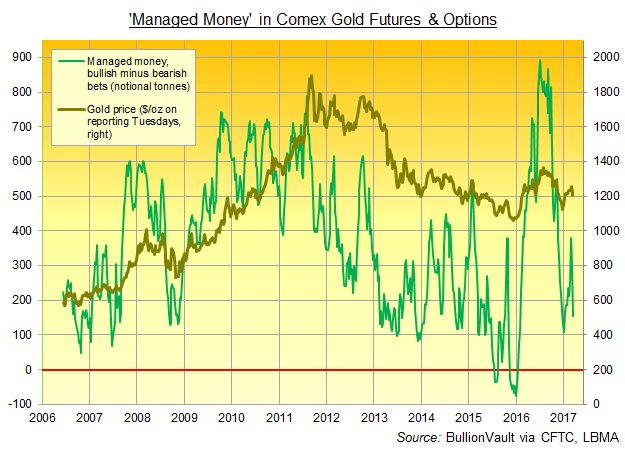
Short positions against gold prices amongst Money Managers rose sharply last week, according to US regulator the CFTC’s latest data.
Chart of Managed Money positioning in Comex gold futures and options
 
Together with a cut to bullish bets, that took the net speculative long position of that category of trader down by more than one fifth.
 
Hedge funds and other large speculators also cut their net long position in Comex silver for the first time since the end of last year.
 
Silver tracked gold prices Monday, rallyng to $17.10 per ounce after hitting a new 5-week low of $16.84 late Friday.
 
Platinum and palladium also rallied, gaining around 0.4% each.
 
Oil prices in contrast dropped to their lowest level in 3 months, with Brent crude oil falling further towards $50 per barrel despite oil cartel Opec’s efforts to curb global output.

Pre-Fed 'Profit-Taking' Hits Dollar on Jobs Surge, Gold Bullion Back Over $1200

GOLD BULLION bounced back above $1200 per ounce Friday lunchtime in London as the Dollar fell on what traders called ‘profit-taking’ following strong US jobs data ahead of next week’s expected interest-rate rise from the Federal Reserve.
 
Non-farm payrolls expanded by a much-stronger-than-expected 235,000 last month, the official estimate said, cutting the US jobless rate to 4.7% as average earnings accelerated to 2.8% annual growth.
 
The Dollar retreated half-a-cent against the single currency Euro, touching its lowest level in 3 weeks.
 
Having dropped 3.0% from Friday last week however, gold bullion still held a 5% loss versus the Dollar from end-February’s 3-month high at $1263.
 
Silver also bounced, briefly back above $17 per ounce from yesterday’s late 6-week low, as bond yields eased lower following this week’s 0.1 percentage-point rise in 5-year rates.
 
Physical platinum prices meantime rallied $7 per ounce off yesterday’s lows at $934, but held almost 6% down from last Friday’s finish near the lowest level since the first week of January.
 
“If you believe the Fed is already behind the inflation curve, then the market is even further behind,” says a note from London bullion clearing bank ICBC Standard’s strategist Tom Kendall.
 
“The US Fed’s latest end-2017 forecast for its key Fed Funds interest rate was 1.4%, Kendall says, “but the December Fed Funds future is trading at 1.26%.
 
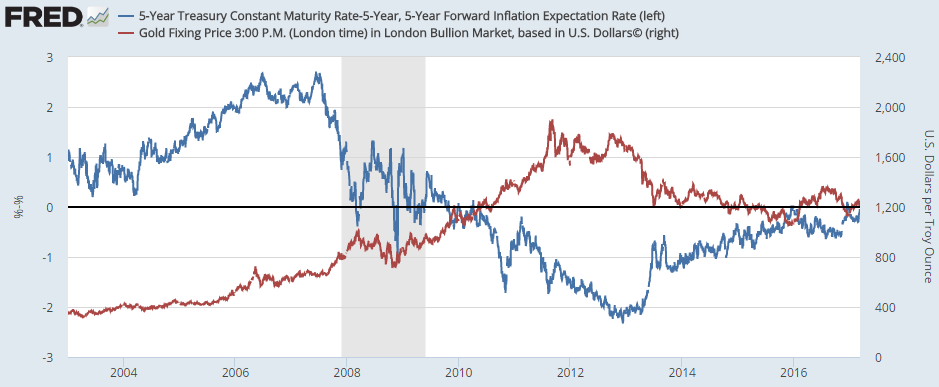
“The result of a repricing…would, all else being equal, be a sharp move upwards in real interest rates, and that would tend to weigh heavily on gold.”
 
Chart of gold price vs. real 5-year US T-bond yields, adjusted by market-based inflation forecasts. Source: St.Louis Fed
 
“The more flighty element of the [bullion] market is taking profits,” said the latest Metal Matters from precious metals clearer Scotia Mocatta’s New York team Thursday, “[because it] sees a rate hike as being bearish for gold prices.
 
“[But] we expect that once the rate hike is either out of the way, or delayed, bullish sentiment towards gold will return, as the market focuses on the geopolitical uncertainties that now lie close by.”
 
Alongside the US Fed rates decision next week, Wednesday will also bring the deadline date for President Trump agreeing to raise or suspending Washington’s “debt ceiling” at its current $20 trillion, plus the parliamentary election in key Eurozone member the Netherlands.
 
That race is currently neck-and-neck between current prime minister Mark Rutte‘s People’s Party for Freedom & Democracy and anti-European Union, anti-Islam Geert Wilders of the Party for Freedom.
 
Wednesday had also been named earlier this month as the UK Government’s target for firing the starting-gun on 2 years until Britain formally quits the EU – a deadline now likely delayed by the unelected House of Lords voting against Prime Minister May’s ‘Article 50’ bill and with the House of Commons still debating the finance ministry’s new Budget.
 
New data yesterday meantime said the United States added a record 15 gigawatts of new solar panel supply in 2016, almost doubling the previous record and adding more capacity from photovoltaics – in which silver is a key component – than any other source of energy last year.
 
“Far from collapsing” meantime, automotive demand for platinum – primarily used as a catalyst to reduce emissions from diesel engines – rose by 1% in 2016 according to new data from the mining-backed World Platinum Investment Council.
 
“In the largest diesel automobile market, Western Europe, demand was up for the fourth consecutive year…[now expanding] year-on-year in every quarter since the third quarter of 2015, when the VW scandal [about cheating emissions tests] started to unfold.”

Gold Prices Down 7 Days in 8 as Fed Rate Hike Risks '1994 Bloodbath' in Bonds, Over-Geared Debt

GOLD PRICES extended their slide Thursday lunchtime in London to 2.5% since Monday – the second such weekly drop in a row – as corporate debt and government bond yields rose again ahead of next week’s Federal Reserve decision on interest rates.
 
World stock markets held flat overall but commodity prices also dropped hard against the rising US Dollar, while silver hit new 5-week lows of its own, down nearly 7% from end-February’s high to trade below $17.20 per ounce.
 
The Euro currency – down 3% versus the Dollar from the start of last month – spiked but lost that half-a-cent bounce after the European Central Bank made no changes to its negative interest-rate or QE money creation policies, continuing to buy €80 billion of government debt every month.
 
Brent crude oil contracts meantime suffered their worst 1-day drop in over a year according to the Financial Times, falling towards $52 per barrel today.
 
Physical product from 5 out of 10 fields tracked by Reuters has already fallen faster than that benchmark so far in 2017.
 
Brent now faces “pivotal support at $50” according to a new technical analysis from French investment and bullion market-making bank Societe Generale.
 
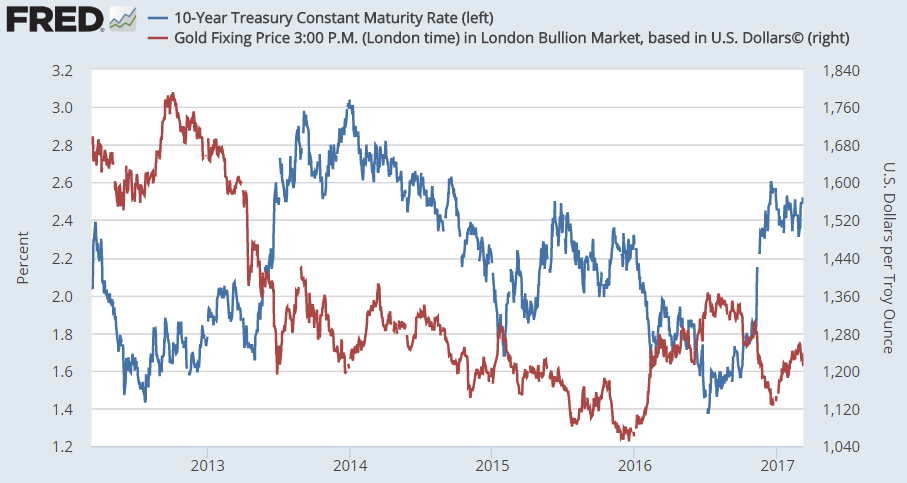
Looking at US interest rates, “The 10-year [Treasury] yield can rise above 3.25% and still [leave the bond’s price] in a bull market,” says SocGen’s global strategist Albert Edwards, warning that next week’s clearly flagged Fed hike to overnight rates risks a repeat of the 1994 bond “bloodbath”.
 
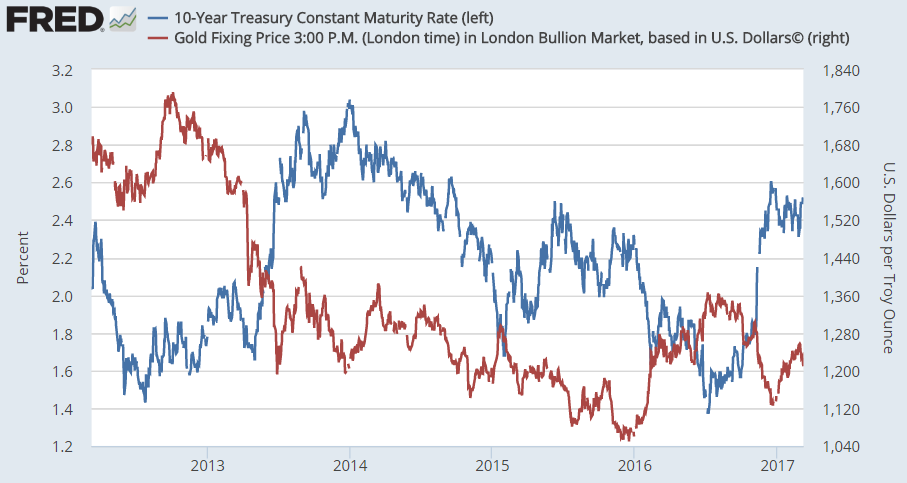
Chart of 10-year US Treasury yields versus Dollar gold prices
 
“The US Fed has created another massive credit bubble that will, when it bursts, lay the global economy very low indeed,” says Edwards, predicting that US yields will in time “converge with Japanese and European yields well below zero.”
 
First however, and with the Fed “having presided over one of the biggest corporate credit bubbles in US history,” the central bank’s sudden 2017 shift to “accelerated” rate hikes “will cause tremors in the Treasury bond markets, forcing rates up.”
 
“US investment-grade companies are the most leveraged since 2002,” noted Bloomberg columnist Lisa Abramowicz earlier this week, citing data from US investment bank Morgan Stanley that also says corporate cash holdings have sunk to the lowest level relative to obligations since the financial crisis and global economic slump of 2009.
 
“Leverage ratios typically peak in the wake of an economic downturn, when company incomes drop,” said Abramowicz.
 
“This time however leverage [has been] climbing as growth accelerates.”
 
The last time 10-year US Treasury yields touched 3.00% was December 2013.
 
Gold bullion then traded at $1214 per ounce, down by more than one quarter from the start of that year, which the 10-year yield began at 1.73%.
 
“Tighter monetary policy is not bullish [for gold prices],” says a new research note from US financial services giant Bank of America Merrill Lynch.,
 
“[But] inflation and a range of uncertainties – including European elections and protectionism – should support the yellow metal…[to] $1400 by year-end.”
 
Amongst the key consumer markets on Thursday, “Asian interest [in gold] was generally non-existent today,” said the bullion desk at Swiss refining group MKS Pamp.
 
“The speculative buying we have been seeing in recent sessions seems to have dried up…and the metal is likely to see further weakness around Friday’s [non-farm US jobs] print should the data follow the strong ADP performance.”
 
Dollar gold prices have now fallen for 7 in the last 8 sessions, retreating nearly 5% from 27 February’s 3.5-month peak above $1263 per ounce.

Gold Price Hits 5-Week Low as Dollar Gains on ADP Jobs Data, Trade Deficit 'Looms'

GOLD PRICES fell through what technical analysts called “immediate support” at $1210 per ounce Wednesday lunchtime in London as the US Dollar rose again after new data said the United States added far more new jobs than expected in February.
 
The private-sector ADP report said US payrolls expanded by 298,000 last month, beating consensus forecasts of 190,000.
 
World stock markets held flat overall as commodities slipped once again with government bond prices ahead of next week’s clearly-flagged US Fed rate rise.
 
Silver tracked the drop in gold prices, also falling to 5-week lows with a loss of 3.5% for the week so far.
 
“Fiscal policy is now the key driver of the Dollar,” says a note from Chinese-owned ICBC Standard Bank’s FX strategist Steven Barrow, predicting a further 10% gain in the Dollar in 2017 on “deficit expansion, lower taxes on repatriated profits, and a border tax.”
 
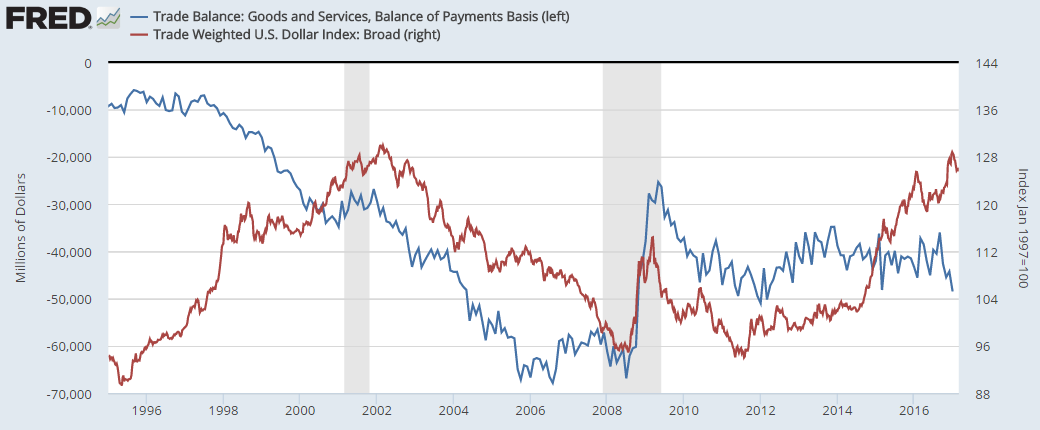
But “longer-term [its] prospects are not as rosy,” Barrow warns, with the US trade deficit “likely to widen, not improve, and that could send the administration on a mission to weaken the currency deliberately.”
 
New data yesterday put the US trade deficit at its widest in 5 years in January.
 
Chart of US trade deficit vs Dollar Index
 
Chinese gold prices had earlier caught up with Dollar-gold’s drop overnight, retreating to a 3-week low in Yuan terms but extending the premium – over and above London quotes – to $17 per ounce.
 
That was the highest incentive to new bullion imports since before late-January’s Lunar New Year holidays, suggesting solid demand in the world’s No.1 consumer nation.
 
Gold buying in India – pushed into the No.2 slot since 2013 – “will recover” this year according to mining-backed market development organization the World Gold Council after 2016’s collapse amid high import tariffs, new sales taxes and demonetization of 85% of the country’s cash.
 
“The down move should continue towards projections at $1200/1196,” reckons the latest technical note from French investment bank Societe Generale.
 
Having broken the 38.2% retracement of gold’s January to February rise, “New support comes in at 1191.10 – the 50% Fibo level,” said bullion bank Scotia Mocatta’s team last night, also pegging near-term support at the 50-day moving average around $1210.
 
The Fed Funds futures market “has now priced in an 88-90% chance of a rate hike later this month,” notes Swiss refining and finance group MKS Pamp’s dealing desk, “which has sapped the momentum of gold.”
 
Alongside rising Eurozone and US bond yields Wednesday, UK Gilt yields also rose, making the cost of borrowing more expensive to the government as UK finance minister Phillip Hammond raised his GDP growth forecast but warned there is “no room for complacency” about the economy as the 2-year process of quitting the European Union begins. 
 
The British Pound fell to 2-month lows as Hammond spoke, but Sterling gold prices still fell back below £1000 per ounce – a 3-year high when reached last June on the UK’s Brexit referendum result.