Author Archives: City Gold Bullion

Gold Prices Hit 30-Month Euro Low as Bank of Japan 'Defies' Everyone, Stays 'Ultra Easy' Before the Fed

GOLD PRICES fell below $1220 for the fourth time in a fortnight in London trade Tuesday, hitting new 30-month lows for Euro investors at €1038 as the Bank of Japan sparked volatility on the currency markets by tweaking its “continuous…powerful” QE money creation and asset-purchase program.
 
Vowing to suppress short- and long-term interest rates “for an extended period of time”, the BoJ confirmed rumors that it will allow 10-year Japanese government bond yields to move around its 0% target.
 
It also switched its stockmarket ETF purchases from trust funds tracking the smaller Nikkei index to the much larger Topix.
 
“[These] steps [seek] to alleviate the strain on banks and the market distortions stemming from its policy,” says Bloomberg.
 
But the BoJ will still buy some $53bn of equity ETFs this year, plus over $715bn of Japanese government bonds, and in “stick[ing] to ultra-easy money policy,” says the Wall Street Journal, Tokyo is “defying expectations“.
 
It also “defies [the] global move to roll back crisis-era stimulus” according to the Financial Times.
 
The US Federal Reserve starts a 2-day policy meeting today, with analysts expecting “no change” but a firm promise of further Dollar rate hikes ahead in Wednesday’s decision.
 
Last week the European Central Bank repeated its plan to end Eurozone QE by New Year 2019, and London analysts now put a 90% chance on the Bank of England raising UK rates this Thursday.
 
With the Dollar gold price falling in tandem with the Yen’s FX rate again today, the two assets’ correlation on a 5-week rolling basis has now risen above +0.8 so far this summer.
 
That statistical figure would read +1.0 if gold and the Yen moved perfectly in lockstep, or -1.0 if they moved exactly opposite.
 
On a 52-week basis, gold has now shown a consistently positive relationship with the USD/JPY exchange rate since February 2013 – the longest such stretch since gold and then FX exchange rates began floating in the early 1970s.
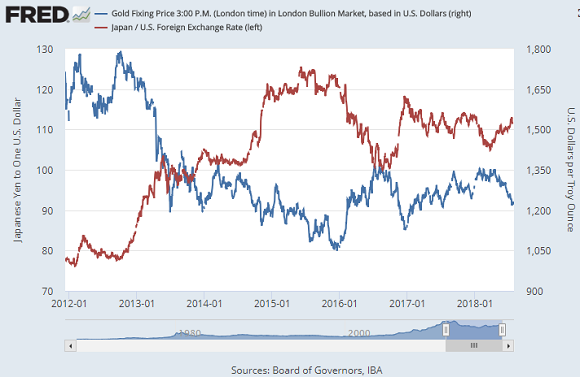
 
Chart of gold (blue, right) vs. USD/JPY (red, left). Source: St.Louis Fed
 
In US Dollar terms, spot bullion has now traded 1.4% high-to-low over the last week, but moved just 1.0% against the Japanese Yen.
 
London’s benchmark price has moved 1.0% against the Dollar over the last week, but Shanghai’s benchmark Yuan price has moved barely 0.3%.
 
Tuesday’s news meantime saw the Euro jump almost ¥1 to a 2-week high versus the Yen, and it also rose against the Dollar, nearing its strongest exchange rate in 3 weeks at $1.17.
 
Euro gold prices meantime sank to fresh 2.5-year lows at €1038 per ounce, falling over 8% from end-June’s 12-month high.
 
“I think that the momentum towards the 2.0% is firmly maintained,” said BoJ governor Haruhiko Kuroda of Tokyo’s target for annual inflation in consumer prices – last seen at 0.7% and failing to break 2.0% since the VAT sales tax hike of 2014.
 
“The markets expected the BoJ to show a much clearer path,” says Keiko Onogi, senior bond strategist at Daiwa Securities Co.
 
“There are [only] some small wording changes.”
 
Silver outpaced gold’s drop on the BoJ news, touching a 0.8% loss for this week so far at $15.40 before rallying 10 cents per ounce back to unchanged.
 
Platinum meantime outperformed the monetary precious metals, rallying to $833 to trade 4.9% above this month’s plunge to 14-year lows in US Dollar terms.
Record Bearish Bets Hit Gold Prices Ahead of Japan, Fed + UK Interest Rate Votes

GOLD PRICES dropped back on Monday morning in London ahead of several key central bank meetings this week, writes Steffen Grosshauser at BullionVault.
 
Rumors in Tokyo say the Bank of Japan may ‘tweak’ its QE asset purchase scheme Tuesday.
 
Supported by last week’s strong US GDP data, the Federal Reserve is then expected to restate its plan for 2 more rate hikes in 2018 on Wednesday.
 
The Bank of England is now widely expected to raise UK base rate by 0.25 points on Thursday.
 
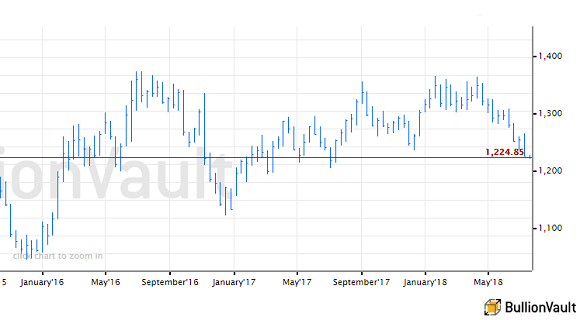
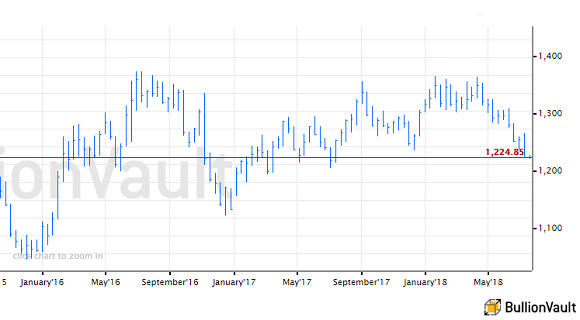
Gold today slipped 0.3% from last week’s close at $1224 per ounce but fell harder for non-Dollar investors, while silver traded in a narrow 10-cent range below Friday’s finish at $15.51.
 
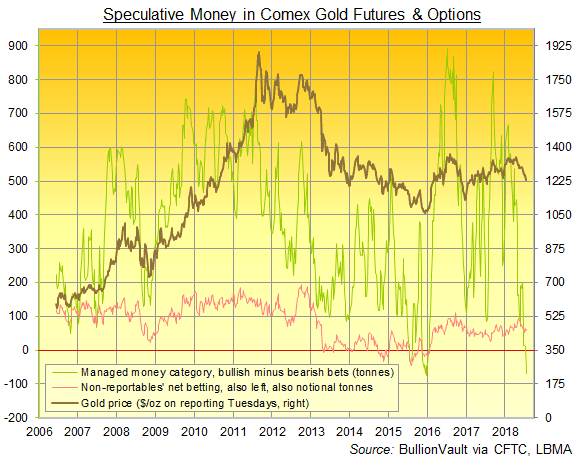
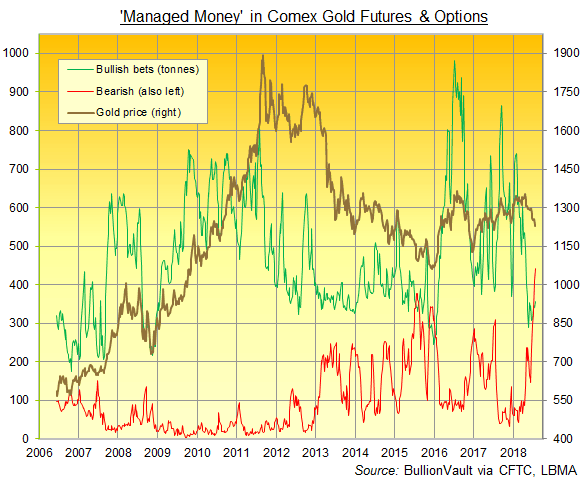
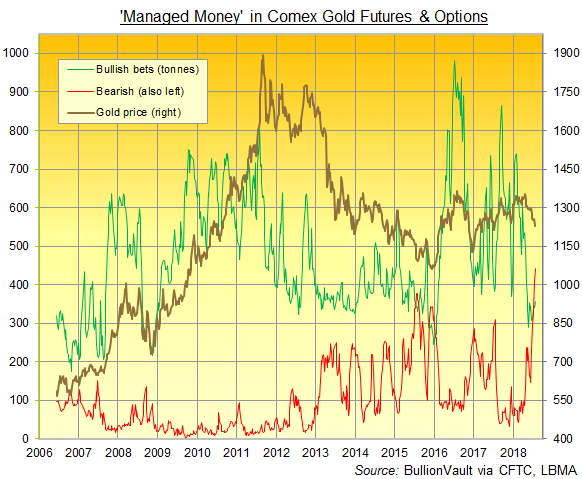
Ahead of this week’s central bank news, latest data released Friday said that hedge funds and other ‘Managed Money’ traders in Comex gold futures and options held a record net bearish position overall.
 
In the week-ending 24 July, those leveraged speculators increased their short position, net of bullish bets, by 23% to the equivalent of 84 tonnes of metal, the heaviest net negative betting since current records started in 2006, according to US regulator the Commodities Futures Trading Commission (CFTC).
 
Chart of Managed Money bull and bear bets on Comex gold futures and options. Source: BullionVault via CFTC
 
“Beyond the current weakness,” says a fundamental note from investment and London bullion market-making bank Standard Chartered, “we expect prices to recover as USD strength fades and strong seasonal demand materializes in India in September given the good monsoon forecast.”
 
“[Speculative] positioning remains heavily skewed to the short side,” says a trading note from Swiss refining and finance group MKS Pamp, “with non-commercial shorts remaining close to record highs.
 
“There could be a possibility of a relief rally on the horizon [but] we still believe it is very much a Dollar play.”
 
Most global stock markets started this week lower, with European shares drifting down from Friday’s 6-week high.
 
The British Pound meantime slipped against the Euro but rose versus the Dollar on Monday morning, edging the UK gold price in Pounds per ounce down to new 2018 lows just beneath £930.
 
The US Dollar earlier hit fresh 13-month highs against the Chinese Yuan, “putting pressure on gold prices” according to a trader in Hong Kong.
 
As Comex speculators extended their bearish betting last week, the SPDR Gold Trust (NYSEArca:GLD) held little changed in size, with investor demand growing the fund to need an additional 2 tonnes of backing at 800 tonnes, the second weekly gain in a row after four outflows. 

Gold Prices Down 7 Weeks in 9 as US GDP Jumps, EU Rejects UK Brexit Plan, China 'Needs to Open Up'

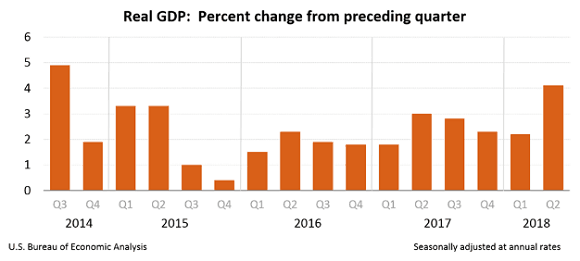
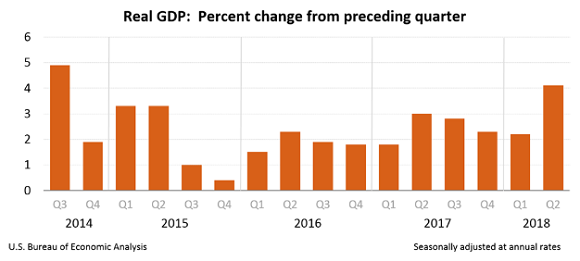
GOLD PRICES popped $5 but held on track for the 7th weekly drop in 9 against the Dollar on Friday after new US data matched analyst and President Trump’s forecasts with the fastest GDP growth since 2014.
 
Falling within $6 of last week’s 1-year low at $1211.89 this morning in London, gold prices then bounced above $1224 after the world’s largest single economy reported annual GDP growth of 4.1% for April to June.
 
That was in line with both Wall Street consensus and the “number with a ‘4’ at the front” suggested yesterday by Trump.
 
With domestic cost inflation slowing to 2.3% per year, “The acceleration in real GDP growth in the second quarter reflected accelerations in [personal consumption] and in exports,” said the Bureau of Economic Analysis.
 
Chart of US annual GDP growth. Source: BEA
 
The Dollar slipped following Friday’s GDP news but held near 1-week highs against the single Euro currency after the European Central Bank yesterday failed to give any new details about when it may look to start raising interest rates, currently negative for commercial lenders holding deposits with the ECB in Frankfurt.
 
Stock markets rose everywhere except China, where the CSI 300 index slipped to cut the week’s earlier 2.5% gain by two-thirds.
 
The Yuan last night rallied following rumors that state-owned Chinese banks were buying the currency with Dollars, only to fall to new 13-month lows in late Asian trade.
 
Fixing before the Yuan fell back, benchmark Shanghai gold prices ended the week at a premium of nearly $10 per ounce over London quotes – the strongest incentive for new imports into the metal’s No.1 consumer market since mid-May, and nearly 3 times this week’s previous average.
 
Mainland China’s gold imports through Hong Kong jumped over 40% last month from June 2017 to reach their highest level – net of exports – in 15 months.
 
China’s central bank may also be adding to its gold bullion reserves – now officially the 6th largest national hoard, pushed below Russia by Moscow’s consistent additions – reckons specialist analyst Philip Klapwijk of consultancy Precious Metals Insights in Hong Kong.
 
After starting and then stopping monthly reports of additional gold reserves in 2015, China “probably” finds a “strategic imperative to add some gold to reserves quietly bit by bit,” he tells Bloomberg.
 
Retreating to levels seen a decade ago, the Yuan is now “fairly valued” against the Dollar, said the International Monetary Fund in a new report today, adding that China is “one of the main beneficiaries of the global trading system[ and so] has a strategic interest in playing a leading role in defending it.
 
“[That] means accelerating China’s opening-up, maintaining progress in reducing the current account surplus, and continuing to seek to resolve trade disputes” – now led by US President Trump’s concerted attack on Chinese imports of goods.
 
After the European Commission’s Jean-Claude Juncker this week “ran circles” around Trump in a meeting to discuss US trade tariffs on EU goods, the UK Government was told yesterday to “[stop] wasting their time” trying to convince individual EU states to accept London’s proposed Brexit deal. 
 
“Maintaining control of our money, law and borders also applies to the EU customs policy,” said the EU’s chief negotiator Michel Barnier, using the UK’s own phrases.
 
UK Prime Minister Theresa May nevertheless flew to Vienna on Friday to meet the leaders of Austria and then the Czech Republic – EU member states where anti-EU parties have been gaining in recent polls.
 
The UK gold price in Pounds per ounce today slipped to new 2018 lows at £930 per ounce, dipping below March’s bottom.
 
Versus the Dollar, silver and platinum prices also fell with gold overnight, erasing the week’s prior 1.0% and 2.2% gains respectively.

Silver Auto-Demand Seen 4x Higher by 2040 as Trump 'Reprieves' Europe, Platinum +6% in 1 Week

SILVER slipped with other precious metal prices on Thursday in London, holding firmer than gold but weaker than platinum as Eurozone stock markets rose following US President Trump’s positive trade meeting with European Commission chief Juncker, plus a “no change” decision from the European Central Bank.
 
Trump overnight claimed his meeting with the EC president showed that the US and EU “truly love each other”, with both sides wanting to strengthen their “$1 TRILLION bilateral trade relationship – the largest…in the world.”

Great meeting on Trade today with @JunckerEU and representatives of the European Union. We have come to a very strong understanding and are all believers in no tariffs, no barriers and no subsidies. Work on documents has already started and the process is moving…

— Donald J. Trump (@realDonaldTrump) July 25, 2018

“China should really start to worry about Trump,” writes Financial Times columnist Edward Luce, saying that Europe’s “reprieve” will intensify US pressure on Beijing.
 
Looking at global silver demand, “2018 will be a challenging year for China’s solar market,” says the latest weekly note from specialist analysts Metals Focus, “as it takes steps to ultimately becoming a subsidy-free industry.”
 
Such “turmoil” is hitting the global photovoltaic market because other leading consumer nations are also looking to end ‘feed-in tariff’ subsidies, says Metals Focus.
 
“The slump in [solar cell] prices caused by oversupply will also force PV companies to restructure and accelerate their cost reduction roadmap to help survive during this transition period.
 
“[That means] for the short-term at least, silver PV demand may have peaked.”
 
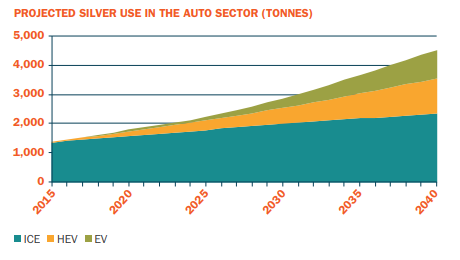
Automotive silver demand in contrast could quadruple over the next 20 years, says a new analysis from Thomson Reuters GFMS Rhona O’Connell, driven by “stellar growth” in demand for electric vehicles.
 
Chart of projected silver demand from global automotive sector, in tonnes. Source: Thomson Reuters GFMS for the LBMA's Alchemist magazine
2040 represents a “keystone” for government promises worldwide to ban sales of traditional internal-combustion engine vehicles, O’Connell notes.
 
By then, automotive use of silver could jump from 3% in 2015 to 15% of the metal’s total annual offtake according to GFMS’s analysis.
 
The European Central Bank meantime held its key deposit rate negative once more on Thursday, vowing again to press ahead with reducing and then ending its program of additional QE bond purchases by the end of 2018.
 
That left the Euro currency unchanged after losing half-a-cent to the Dollar on news of the Trump-Juncker meeting overnight,
 
Gold fell back to show a $1 loss for this week so far in Dollar terms at $1228 and also erasing yesterday’s 0.5% rise versus the single currency Euro to stand back at €1048.
 
Platinum prices have now risen 5.8% from last Thursday’s plunge to new 14-year lows in US Dollar terms.
 
Silver has risen 2.4% from that day’s 3-month low, while gold has gained 1.4%.


Gold Price Rallies as US Dollar + Real Rates Retreat But China's Yuan 'Back to 2008 Levels' to Fight Trade War

GOLD PRICES recovered or rose above last week’s closing level in terms of all major currencies on Wednesday, touching $1232 per ounce as the US Dollar slipped on the FX market and European equities fell ahead of Donald Trump’s meeting on trade with Jean-Claude Juncker.
 
“I have an idea,” tweeted the US President over night.
 
“Both the US and the EU drop all Tariffs, Barriers and Subsidies! That would finally be called Free Market and Fair Trade! Hope they do it, we are ready – but they won’t!”
 
European stock markets slipped Wednesday as the Euro rallied versus the Dollar following stronger-than-expected German economic sentiment surveys.
 
US bond prices rose, nudging longer-term Dollar interest rates down from 5-week highs.
 
Trump today also attacked China after announcing $12 billion in aid to US farmers hit by the tit-for-tat retailiation against the trade tariffs he has imposed on foreign imports – a sum dismissed by some agricultural groups as too small to cover the sector’s losses.

China is targeting our farmers, who they know I love & respect, as a way of getting me to continue allowing them to take advantage of the U.S. They are being vicious in what will be their failed attempt. We were being nice – until now! China made $517 Billion on us last year.

— Donald J. Trump (@realDonaldTrump) 25 July 2018

The Chinese Yuan today rose from 12-month lows against the Dollar, helping raise the Shanghai gold premium – over and above quotes for London settlement – by $1 from yesterday’s 10-month low of $2.60 per ounce.
 
That was still barely one third the typical incentive for new imports of gold into the metal’s No.1 consumer nation.
 
Household gold investment demand in China fell nearly 16% over the first half of this year says the Platts news and data agency, citing figures from Beijing’s China Gold Association.
 
“We’re starting to see signs of the physical market adjusting to these lower prices,” said analyst Suki Cooper of bullion market-making bank Standard Chartered today.
 
“We’re [also] seeing gross short positions [amongst Comex speculators] at record highs, which suggests that position is at an extreme.
 
“US retail investment demand has [also] started to pick up, with gold coin sales rising in May, June and July.”
 
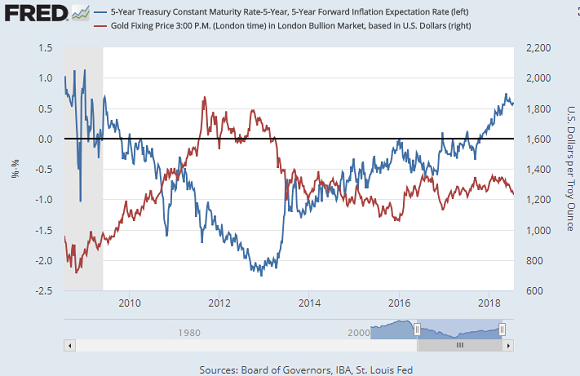
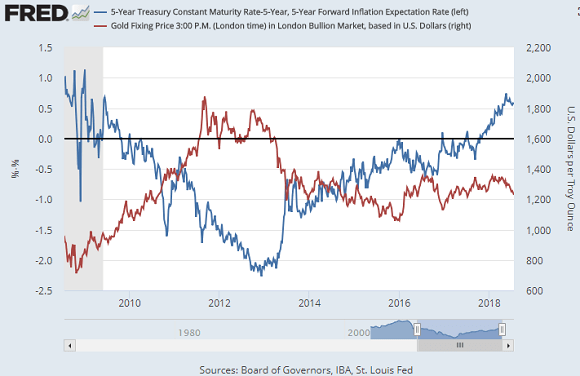
“If I look at the market at the moment,” said John Reade of the mining-industry’s World Gold Council recently, “the biggest drivers seem to be the US Dollar and real US interest rates.”
 
So with the Dollar rising as US interest rates also rose faster than market expectations of inflation, “I don’t find anything strange about these movements” in gold prices falling, Reade said.
 
Chart of gold price vs. 5-over-5 US bond yields. Source: St.Louis Fed
 
Analysis by BullionVault shows gold prices moving in the opposite direction to real US interest rates more than 60% of the time over the 10 years to end-2017.
 
That has fallen however to 40% so far in 2018, and across the 52 weeks to mid-April – when gold priced in Dollars touched the top of the last half-decade’s trading range even as real US rates jumped – the metal showed its strongest co-movement with inflation-adjusted 5-year yields since 2006.
 
“Against the Dollar,” says a note from Council on Foreign Relations’ senior fellow Brad Setser, “the Yuan is back where it was ten years ago even though China’s economy is far more productive and technologically sophisticated.”
 
Predicting that Beijing will seek “a controlled depreciation” rather than letting the Yuan float freely, “another 10% move would more than offset the projected impact of Trump’s [current] tariffs,” he concludes.
 
This week’s announcement of stimulus spending, plus the U-turn on tighter lending standards, has also seen the People’s Bank of China “intervening directly in the bond market to stimulate the economy,” says an economist quoted by the Nikkei Asia.
 
“China’s crackdown on widespread off-the-books lending, known as shadow banking, caused corporate bond defaults in the first half of 2018 to swell 40% in value year on year,” the paper says.
 
“A number of businesses with low credit ratings have abandoned plans to float debts.”


Gold Bullion Bounces After China's Yuan Sinks, Trump Tells Europe 'Tariffs Are Great!'

GOLD BULLION rallied against most major currencies Tuesday in London, recovering most of yesterday’s drop as the Chinese Yuan steadied from a new plunge on the FX market and US Dollar slipped back ahead of Donald Trump meeting the European Commission’s Jean-Claude Juncker amid the worsening ‘trade war’ spat over tariffs between the world’s two largest economic regions.
 
Gold bullion gained $10 from an overnight low of $1218 per ounce, hit as the Yuan set fresh 12-month lows versus the Dollar.
 
World stock markets also regained yesterday’s losses, taking Germany’s Dax index 1.4% higher after new data said manufacturing activity in Europe’s No.1 economy is outpacing its neighbors in July, expanded the fastest in 3 months.
 
China’s major share index meantime closed at a 1-month high on Tuesday, some 7% above early July’s plunge to 14-month lows, after Beijing announced a move to “pro-active fiscal policy”, pushing infrastructure projects and local government funding deals.
 
After cutting the amount of cash that banks need to hold back from lending last month, the People’s Bank of China on Monday injected ¥502bn ($74bn) of money into the banking system using short-term loans to commercial lenders.
 
Friday night saw the PBoC also grant a new “transition period” for financial insitutions to wind down high-risk investment products, seeking not to change “the tendency of financial deleveraging” according to one former policymaker, but aiming instead to “ease the market’s pessimistic expectations”.
 
Bullion landed in Shanghai today held unchanged in price as the Yuan sank, slashing its premium over global quotes below $3 per ounce – barely one-third the usual incentive for new imports into the world’s No.1 gold consumer nation.
 
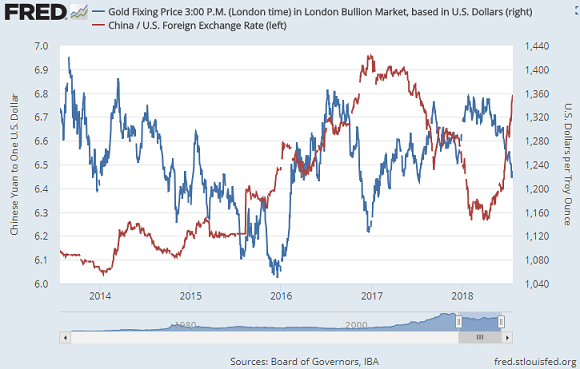
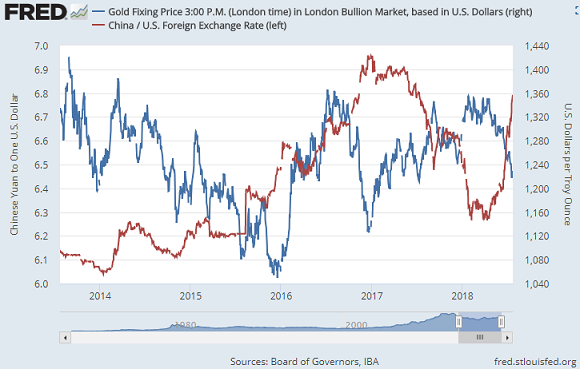
Chart of the US Dollar's Yuan exchange rate vs. the Dollar price of gold. Source: St.Louis Fed
 
The Yuan’s continued fall to 1-year lows “can no longer be explained as just the reversal of [early 2018’s] appreciation,” says FX specialist Brad Setser of the Council on Foreign Relations.
 
“[I] think the PBOC will have to show its hand soon, either by intervening to limit further moves against the basket (as it has done in the past)  or by sitting on its hands, only seeking to smooth big moves and allowing a further move down (and risking Trump’s ire).”
 
“The government is sending a clear signal that it is preparing to defend growth,” reckon analysts at Australian bank ANZ.
 
With Trump threatening tariffs on all Chinese imports in an interview last week, “It is now quite clear that Beijing has fully shifted its policy stance from the original deleveraging towards fiscal stimulus,” agrees Japanese brokerage Nomura, “underpinned by monetary and credit easing.”
 
After Donald Trump lambasted the European Union for hitting US-listed internet giant Google with a $5 billion anti-trust fine last week, the European Union is now preparing another list of US products to tax if the White House expands its list of EU exports now hit by a 25% tariff, the Financial Times reports.
 
“Countries that have treated us unfairly on trade for years are all coming to Washington to negotiate,” Trump tweeted earlier on Tuesday, saying that his tariff policy is working.

Tariffs are the greatest! Either a country which has treated the United States unfairly on Trade negotiates a fair deal, or it gets hit with Tariffs. It’s as simple as that – and everybody’s talking! Remember, we are the “piggy bank” that’s being robbed. All will be Great!

— Donald J. Trump (@realDonaldTrump) July 24, 2018

With gold bullion prices holding above last week’s new 12-month low of $1211 per ounce on Monday, the giant SPDR Gold Trust (NYSEArca:GLD) expanded by 0.5% as investors bought stock, growing to its largest size in almost 3 weeks after shrinking to a 1-year low amid gold’s recent 3% price drop.
 
Silver’s 10% price drop since mid-June, in contrast, has seen its largest such ETF – the iShares Silver Trust (NYSEArca:SLV) – expand by 4% to its largest size since July last year.
 
“Technically, gold is struggling very hard to recover and as long as the Dollar remains in charge gold is going to suffer,” Reuters quotes a trader in Hong Kong today.
 
The central bank of Turkey, the No.5 gold consumer nation, meantime left its key interest rate unchanged on Tuesday despite worsening inflation, defying analysts and sending the Lira down to new all-time lows on the currency market by holding in line with the express request of newly-empowered President Recep Tayyip Erdoğan.
 
The UK’s opposition Labour Party leader Jeremy Corbyn meantime declared that next March’s Brexit from the European Union offers economic benefits, telling business leaders he wants to set out a clear industrial policy, seek fewer imports, and encourage a weak Pound to boost exports.

Gold Price Steadies Near 1-Year Low as Trump Turns On Iran After the Dollar, Comex Specs Turn Bearish

GOLD PRICES held stable on Monday morning in London as the Dollar fell to a near 2-week low after President Trump lamented the US currency’s recent strength, writes Steffen Grosshauser at BullionVault.
 
With Trump tweeting a blunt warning to the theocratic government of Iran, gold rallied to touch $1234 in the early session before falling back to Friday’s close at $1229 per ounce, some 1.5% above the prior day’s 1-year low.

To Iranian President Rouhani: NEVER, EVER THREATEN THE UNITED STATES AGAIN OR YOU WILL SUFFER CONSEQUENCES THE LIKES OF WHICH FEW THROUGHOUT HISTORY HAVE EVER SUFFERED BEFORE. WE ARE NO LONGER A COUNTRY THAT WILL STAND FOR YOUR DEMENTED WORDS OF VIOLENCE & DEATH. BE CAUTIOUS!

— Donald J. Trump (@realDonaldTrump) July 23, 2018

Gold priced in US Dollars has now dropped around 10% since it hit this year’s high at $1365 in April.
 
“Comments over the weekend from Trump changed the environment somewhat, with the apparent push now to really weaken the US Dollar,” said Australian bank ANZ’s analyst Daniel Hynes.
 
“The current US administration has a clear preference for lower US Dollar rates and a weaker currency,” agrees Australia & New Zealand Banking Group strategist Daniel Been.
 
“This will keep markets wary of further strength in the US Dollar.”
 
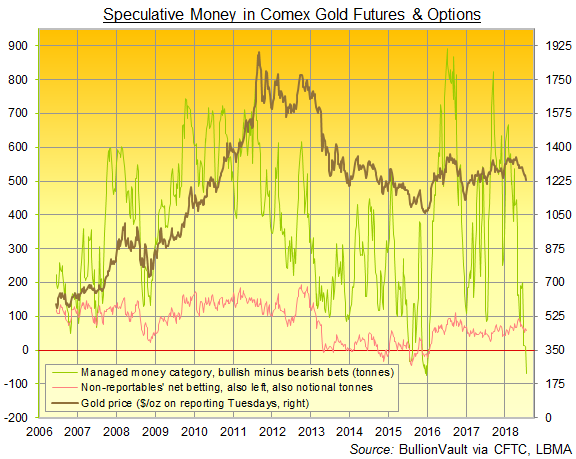
Ahead of Trump’s ‘weak Dollar’ comments last week however, hedge funds and other large speculative investors trading Comex gold futures and options flipped to holding more bearish than bullish contracts for the first time since January 2016, according to the latest data from US regulator the Commodity Futures Trading Commission (CFTC).
 
Last time the ‘Managed Money’ was net short Comex gold, the metal’s price finally bottomed from the 2011-2015 bear market and began turning higher.
 
Chart of Managed Money and Non-Reportables' net speculative long position in Comex gold futures and options. Source: BullionVault  via CFTC
 
Speculative positions on Comex silver were also net short in the week ending last Tuesday, with bullish betting among the Managed Money category declining for five consecutive weeks.
 
Platinum positioning was net negative for the 15th week running, leaving only palladium to show a net bullish position among speculators on the CFTC data.
 
Silver today steadied with gold prices around last week’s finish, slipping 8 cents to $15.43 per ounce.
 
Platinum prices meantime popped and retreated 0.8% to touch $835 per ounce, unchanged from last Monday’s start after plunging $20 mid-week to set fresh 14-year lows.
 
“USD optimism, trade and EM [emerging markets] angst have prompted investors to shun gold,” says a note from Canadian brokerage TD Securities, “dragging net positioning…lower…as money managers hold excessive shorts and are significantly underweight.
 
“A weaker USD and reversal in positioning should buoy the yellow metal.”
 
Whereas Asian stock markets closed mixed on Monday, all European markets were down, led by car stocks that were most affected by trade concerns. 
 
After the finance ministers and central bankers of the world’s 20 biggest economies failed to reach a trade agreement in Buenos Aires over the weekend, EU President Jean-Claude Juncker is set to travel to Washington this week in an attempt to persuade the US government to refrain from tariffs on European carmakers.

Gold Prices Rally But 'Floor Lower' as Trump 'Unhappy' with Fed, Beijing 'Warms' to Devalued Yuan

GOLD PRICES rallied 1% on Friday from yesterday’s new 12-month Dollar low of $1211 per ounce after US President Donald Trump attacked both China on trade and the Federal Reserve for raising  interest rates in an interview with CNBC.
 
“I’m not thrilled” about the Fed raising rates, Trump told CNBC anchor Joe Kernen in the first such comments from a US president since Ronald Reagan challenged Paul Volcker over his anti-inflation rate-hike policy of the early 1980s.
 
“All of this work goes into doing what we’re doing…and every time they want to raise rates again,” said Trump. “I am not happy about it.
 
“We have been ripped off by China for a long time,” Trump also told CNBC, threatening to impose tariffs on all $500 billion of China’s annual imports and adding that when he asked Beijing officials how this had been allowed to happen, they said “No one ever complained before”.
 
After winning the US election in late 2016, Trump repeatedly said the Dollar was “too strong” and spoke in favor of “low rate” policy at the US central bank.
 
This time last year “Lots of bad things happen with a strong Dollar,” the President said.
 
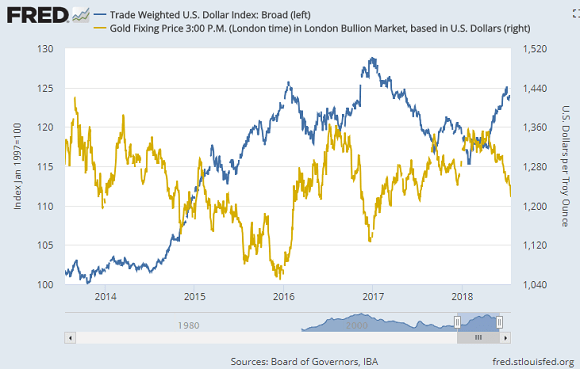
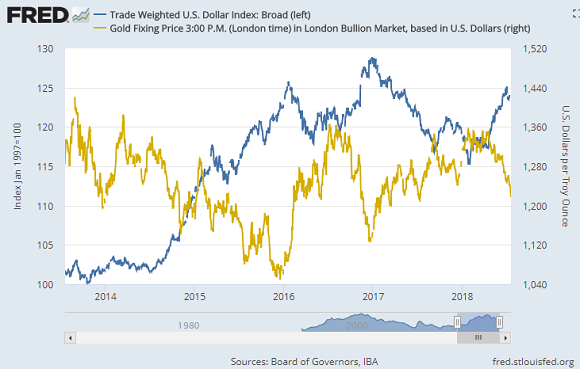
Chart of US Dollar broad index vs. gold priced in Dollars. Source: St.Louis Fed
 
With the Dollar today hitting new 12-month highs against the Chinese Yuan at ¥6.81, Beijing’s politburo “[has] become more amenable to a more rapid pace of depreciation than we initially assumed,” says strategist Sacha Tihanyi at brokerage TD Securities.
 
“We see ¥7.10 as our end of year target in 2018, with stabilisation at the end of Q1 next year at ¥7.20.”
 
Gold however traded flat in Shanghai trade Friday, cutting the premium for bullion landed in China to less than $3.75 per ounce above London quotes – less than half the typical incentive for new imports into the metal’s No.1 consumer market.
 
No.2 consumer market India today saw Rupee gold prices fall to the lowest level in 6 months, Reuters reports, but “there is no rush of consumers,” it quotes one Mumbai jeweler.
 
“They are waiting for bigger falls. In the coming weeks, demand could improve as festivals are approaching.”
 
“You normally would have a better floor for prices,” says Suki Cooper at London bullion market-making bank Standard Chartered, “[but] we’re in a physically weak period” of the year.
 
Giant gold-backed ETF the SPDR Gold Trust (NYSEArca:GLD) yesterday saw its first inflow of investor cash in nearly 4 weeks, taking the quantity of gold needed to back its shares up 4 tonnes to 798 tonnes.
 
Thursday’s drop in silver prices to new 12-month lows at $15.25 saw the giant iShares Silver Trust (NYSEArca:SLV) expand yet again, adding another 24 tonnes to reach 10,188 – the largest size since last summer.
 
“While sold in early Asian trade today, [silver] has continued to see underlying interest and has spent little time underneath $15.30,” says Friday’s trading note from Swiss refining and finance group MKS Pamp.
 
“Base metals are beginning to show signs of a recovery, which may buoy silver back toward $16 in addition to supporting a recovery to the white metals, notably platinum after the metal recovered back above the $800 pivot point.”
 
Platinum prices rallied the sharpest among precious metals on Friday, rising 3.1% from yesterday’s new 14-year lows in Dollar terms to reclaim $820 per ounce.
 
“Gold is facing a number of headwinds,” says Harry Tchilinguirian, head of commodity research at French investment bank BNP Paribas, pointing to “Dollar strength, the lack of inflationary pressures, and essentially a lack of investor appetite for the yellow metal right now.
 
“When rates are rising the opportunity cost is rising. Why hold an asset that doesn’t yield anything?”
 
Trimming its loss from last Friday’s finish to 1.5% in Dollar terms in London today, gold also fell week-on-week against all other major currencies except the British Pound, which fell hard on the FX market amid fresh wrangling over the Conservative Government’s proposed Brexit deal with the European Union.
 
“A suspicious mind might think [our] Remainer Chancellor [wants] to undermine Brexit and reduce confidence in a World Trade Deal,” said economist Patrick Minford at a dinner Thursday, repeating comments made by arch-Euro-skeptic politician John Redwood blaming the Treasury for the slowdown in UK economic growth.
 
Also lambasting the Bank of England for talking about raising UK interest rates, “It is almost as if they wanted to prove Project Fear right by slowing down growth,” an unnamed Cabinet minister apparently added.
 
The UK gold price in Pounds per ounce today rallied to £939 per ounce as Sterling fell, £1 shy of last Friday’s finish.
 
Leaving the EU would “mostly eliminate [UK] manufacturing” Minford predicted ahead of the Brexit referendum in 2016.
 
Redwood – strategist at the Charles Stanley brokerage which advised clients to cut UK exposure last year – warned pro-Remain business leaders in 2014 not to comment on the Brexit debate or find “the ‘get out’ campaign will then make life difficult for them.”


Gold Down Again, Platinum Hits New 14-Year Lows as Dollar Gains, Supply/Demand 'Unsupportive'

GOLD PRICES fell again but were outpaced by silver in London on Thursday, while platinum dropped to new 14-year lows as the surging US Dollar pushed industrial commodities lower.
 
Asian stock markets slipped as the Chinese Yuan also fell to new 12-month lows, tracking the slide in Dollar gold prices.
 
European shares fell 0.5% as the Euro dropped to its weakest Dollar value so far this month.
 
Gold has now lost 2.2% versus the Dollar since last weekend.
 
Silver has fallen harder, dropping 3.3% for the week so far to come within 25 cents of July 2017’s sixteen-month low this morning at $15.24 per ounce – down almost 10% for 2018 to date.
 
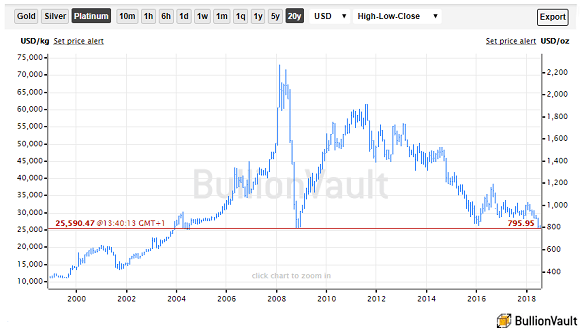
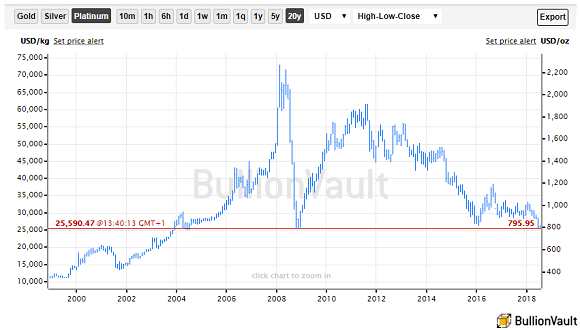
Platinum prices have fallen harder still, losing 3.5% this week alone to fall below $800 per ounce for the second time this month in London trade Thursday.
 
Platinum was last this cheap in July 2004.
 
Chart of platinum price in US Dollars, last 20 years. Source: BullionVault
 
“The increasingly negative tone towards platinum reflects several issues,” says the latest weekly note from specialist analysts Metals Focus, highlighting “unsupportive supply and demand conditions.”
 
No.1 platinum mining nation South Africa “faces growing margin pressure” as spot prices fall below production costs, “[but] we do not expect to see a meaningful cut in production this year,” Metals Focus says, blaming “[a] lack of apparent production discipline [plus] political headwinds…not least with headline unemployment in the country of around 27%.”
 
“In South Africa, the government will not let you cut shafts,” agrees portfolio manager Johny Lambridis at insurance giant Prudential’s South African investment arm, while on the demand side, European car-drivers are moving away from diesel vehicles – source for 40% of annual offtake in the form of catalysts to cut harmful emissions.
 
“We don’t have growth in [the] number of vehicles and effectively all you are doing [is] taking one catalytic converter [and] recycling it.
 
“Do you actually need South African platinum? So that is our concern.”
 
Light duty diesel vehicles in Europe are “by far the largest market for platinum automotive demand,” says Metals Focus, but they now face “ongoing and steep market share losses.”
 
Last month saw diesel vehicles account for 37% of new car sales in Western European, the consultancy says, quoting data from specialists LMC Automotive.
 
In June last year that figure was 45%.
 
“As such,” concludes Metals Focus, “the ability for the platinum price to strengthen will remain largely contingent on the trend in gold.”
 
Wednesday’s pause in the slump in precious metal prices saw the major gold and silver-backed ETF trust funds end the day unchanged in size.
 
The giant SPDR Gold Trust (NYSEArca:GLD) remains the smallest since last August, needing 794 tonnes of bullion to back its shares.
 
The iShares Silver Trust (NYSEArca:SLV) has in contrast swollen to its largest in 11 months as metal prices have fallen, needing almost 11,165 tonnes of bullion backing.
 
Industrial silver demand is booming in India, Bloomberg reports today, driving imports higher while gold jewelry demand struggles during the typically quieter summer months.
 
No.5 gold consumer nation Turkey yesterday ended its state of emergency two years after a failed coup attempt blamed on supporters of cleric Fethullah Gülen, and marked this week with a huge rally in Istanbul.
 
New anti-terror laws are now planned to replace those emergency powers.
 
President Recep Tayyip Erdoğan today filed a criminal complaint against 73 opposition politicians for sharing a cartoon about him on Twitter in support of university students arrested for carrying the picture on a placard.

Gold 'Set for More ETF Selling' as Dollar Price Breaks Lower, Support Seen at $1204

GOLD PRICES set new 12-month lows against a rising Dollar on Wednesday in London, touching $1222 per ounce as the US currency rose yet again following weaker-than-expected Eurozone and UK inflation data.
 
Excluding volatile fuel and food prices, the cost of living in the UK slowed to 1.9% annual inflation last month and retreated to 0.9% annual growth across the 19-nation single currency Eurozone.
 
Rising to a 9-month high versus the British Pound Wednesday morning, the Dollar also hit a 6-month high against the Japanese Yen after US central bank chief Jerome Powell said yesterday that strong jobs growth in the world’s largest economy means the Federal Reserve will continue “running [rate rises] smoothly” as it cuts back the “extra boost” of monetary stimulus made during the financial crisis a decade ago.
 
“People are selling emerging markets [and] commodities and buying the Dollar,” says Chinese bank ICBC Standard’s Tokyo manager Yuichi Ikemizu, “as it seems to be the most stable investment.
 
“As long as this trend continues, it’s a pretty tough situation for commodities.” Ikemizu said.  
 
China’s stock market today fell back towards last week’s 18-month lows while Bloomberg’s index of commodity prices fell to new 2018 lows, pulled down by crude oil and metals.
 
For gold prices, “New support comes in at $1204.90 – the July 2017 low,” says a technical note from bullion bank Scotia Mocatta’s New York office.
 
“Technically there is not a great deal of support now until we hit $1204.50,” agrees Swiss refining and finance group MKS Pamp, “[and] we expect a decent amount of resistance on any move back toward $1230.”
 
“The break lower will likely draw out further ETF selling over the coming days, so we suspect gold will remain under pressure in the near term.”
 
Chart of Dollar gold price. Source: BullionVault
 
The two largest US-listed gold ETFs – the SPDR Gold Trust (NYSEArca:GLD) and the iShares Gold Trust (NYSEArca:IAU) – have now shrunk for 3 months running, losing over 100 tonnes between them since end-April’s 18-month peak at 1,159 tonnes.
 
Betting that the US Fed will raise its key interest rate twice or more before 2018 ends has meantime risen to 61.3% of speculative positions on CME Group derivatives, up from 55.1% this time last month.
 
Fixing at a new 2018 low of $15.77 in London on Tuesday, silver prices today fell in spot bullion trade to the lowest level since last July at $15.40 per ounce.
 
Platinum prices retreated to $805.50 – barely $7 above this month’s ‘Tocom dump’ to 14-year lows.
 
China’s benchmark gold price meantime held unchanged in Yuan terms on Wednesday, matching July 2017 levels as the Chinese currency fell with gold to new 12-month lows versus the Dollar.
 
Compared to global quotes for London settlement, the premium for bullion landed in China – the world’s No.1 consumer market – edged further below $4 per ounce, less than half the typical incentive for new imports.
 
“Prices in the Indian market are still not very attractive for the buyer,” said the mining-backed World Gold Council’s P.R.Somasundaram to CNBC TV-18 today, explaining why demand in the No.2 consumer nation hasn’t responded to gold’s Dollar price slump.
 
Thanks to the Rupee falling even harder than gold versus the Dollar, “We have seen the price increase over 2% compared with 2017.
 
“So it has not acted as much as a catalyst as the 2013 price decline did when we saw huge demand upsurge.”