Author Archives: City Gold Bullion

Gold Prices Drop Again as Comex Specs Go Record Short, Trump-China Trade Wrangling Worsens

GOLD PRICES fell further on Monday morning in London against a firm Dollar amid new China-US trade wrangling while anti-immigration nationalists gained votes in Sweden’s general election but lagged well behind the main parties, writes Steffen Grosshauser at BullionVault.
 
The Krona rallied further from late August’s 9-year versus the Euro and Stockholm’s OMX 30 stock index rose 0.7% after Sunday’s result saw the Sweden Democrats win almost 18% of the vote, forcing the ruling coalition to invite discussions with the opposition about forming a left-right government.
 
Gold prices dropped to $1192 after it already fallen through what analysts called “key support” at $1200 again last Friday.
 
Silver and platinum, in contrast, started the week marginally higher, each rising by around 0.2% each.
 
“[Friday’s] strong US nonfarm payrolls led to some modest downward pressure on gold,” says National Australia Bank economist John Sharma .
 
“Going forward, as long as the Dollar is strong, gold will remain constrained.”
 
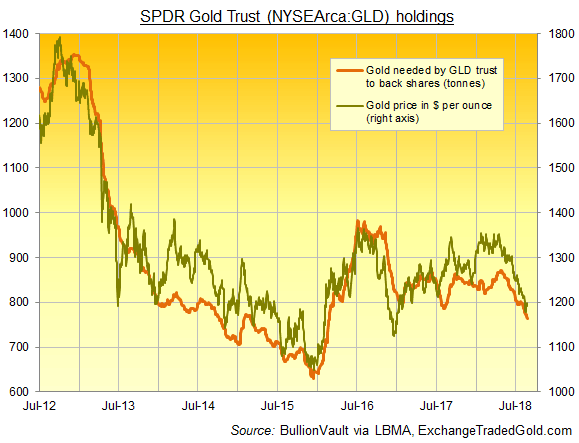
The giant gold-backed SPDR Gold Trust (NYSEArca:GLD) saw an outflow of nearly 10 tonnes last week. Holdings in gold ETFs worldwide have fallen by more than 124 tonnes since late April. 
 
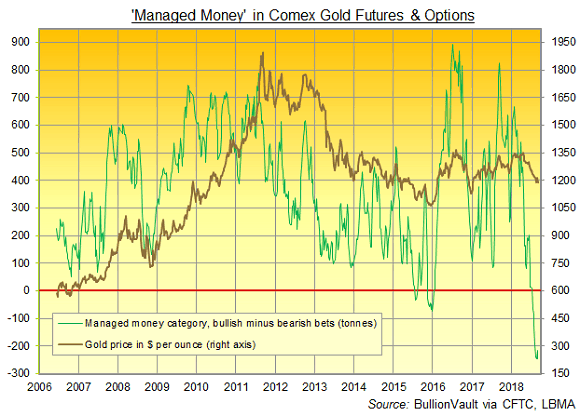
Latest data show that hedge funds and other leveraged speculators in Comex gold futures and options cut their bullish betting still further on gold as a group in the week-ending 4 September, but left their bearish betting unchanged.
 
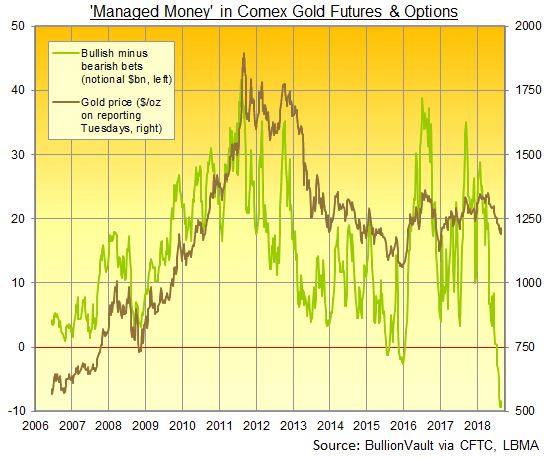
Overall, that pushed the net short position of Managed Money traders to a new all-time record.
 
Speculators also raised their net bearish betting against silver to a new series record, according to the data published since 2006 by US regulator the Commodities Futures Trading Commission (CFTC), and built a fresh all-time record short position against platinum prices too.
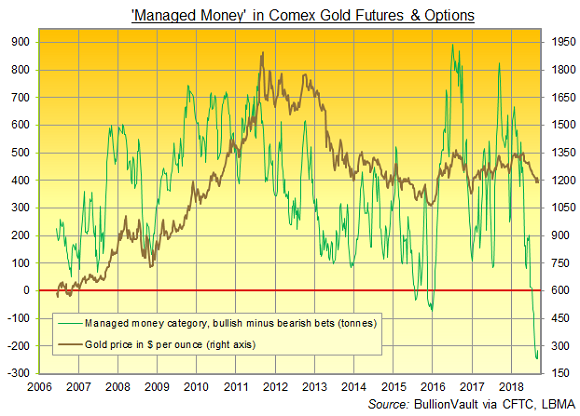
 
Chart of Managed Money net position in Comex gold futures and options, notional tonnes. Source: BullionVault via CFTC
 
US President Donald Trump at the weekend warned the government in Beijing of further tariffs on Chinese imports, in addition to the $200 billion-worth of good already set to be with new levies in the few next days.
 
That would amount to imposing duties on nearly all Chinese exports to the US. 

If the U.S. sells a car into China, there is a tax of 25%. If China sells a car into the U.S., there is a tax of 2%. Does anybody think that is FAIR? The days of the U.S. being ripped-off by other nations is OVER!

— Donald J. Trump (@realDonaldTrump) September 9, 2018

Beijing said it would respond accordingly if the United States took any new steps on trade.
 
Back in the financial markets, European equities held flat but Asian shares slumped again after Trump’s trade threats, extending the MSCI’s index of Asia-Pacific shares outside Japan’s worst weekly performance since mid-March.
 
Trump also warned suppliers of Apple (Nasadq: AAPL), the US-listed tech giant, to move their production to the US to avoid the tariffs. 
 
Crude oil meantime rebounded 0.5% from its biggest weekly loss in two months, pushed higher as US production stalled and further sanctions on world No.5 oil producer Iran are due to kick in from November.
 
With the Iranian currency already losing two thirds of it value since the return of US sanctions earlier this year, the central bank in Tehran has now given permission for licenced exchange offices to start importing gold along with foreign currency banknotes in an attempt to support the Rial against the rising greenback.
'Little Support' for Gold Bullion at $1200 as Fed 'Gets Restrictive', US Jobs Beat Forecasts

GOLD BULLION fell $5 per ounce from the $1200 mark Friday lunchtime in London after new US data showed stronger jobs growth than analysts forecast for the world’s No.1 economy.
 
Silver held firmer at $14.14, heading for a 2.8% weekly drop, but platinum prices fell with gold bullion to show a 1.3% loss from last Friday’s finish at $777 per ounce.
 
After figures yesterday put claims for US unemployment benefits near the lowest in half-a-century, Friday’s jobs data said the US added 201,000 jobs in August, some 5% above Wall Street’s expectations.
 
Global stock markets fell for a fourth day running, leaving only US equity indices higher from this time a month ago.
 
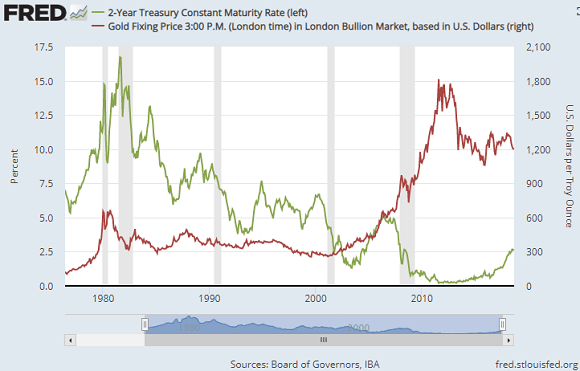
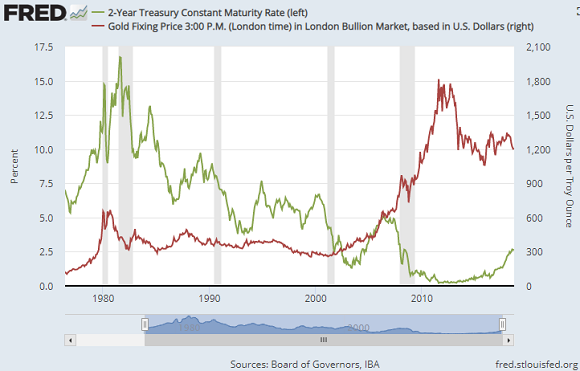
Government bond prices also extended their drop on the news, driving 2-year US Treasury yields back up towards last week’s decade highs at 2.68%.
 
Wholesale gold bullion was on track for a 0.7% weekly drop as New York trading began.
 
Chart of US 2-year Treasury yields vs. gold. Source: St.Louis Fed
 
“Gradually increasing [interest rates] over the course of this next year makes sense,” said 2018-2019 voting member Eric Rosengren of the Boston Fed to CNBC today.
 
“If things work out well for the economy, and that’s what I expect and hope, then we’ll be in a situation where we need to have somewhat restrictive policy over time.”
 
With a Fed hike at this month’s policy meeting now 100% certain according to betting on interest-rate futures, speculators have cut the likelihood of four or more rate hikes between now and September 2019 from 37% to below 25% over the last month on data from the CME derivatives exchange.
 
Over in the gold bullion market, “the short covering that drove the yellow metal higher on Thursday looks to have been exhausted,” said a note from Swiss refiners and finance group MKS Pamp overnight.
 
“Gold immediately turned well offered [in Asian trade]…breaking through $1200 with little in the way of support around the figure.
 
“Participants continue to fade any rallies through $1200 and until we see a sustained move…above USD $1215, it is difficult to hold long positioning.”
 
The Euro also fell versus the Dollar on the US jobs numbers, dropping almost 1 cent for the day after earlier data confirmed that economic growth across the 19-nation single currency zone slowed to 2.1% per year in the April-June quarter.
 
The UK gold price in Pounds per ounce meantime dipped towards August’s 31-month lows around £920 as Sterling jumped following news that the European Union’s chief Brexit negotiator Michel Barnier is “open” to discussing solutions to the issue of a “hard border” between the Republic of Ireland and Northern Ireland – a key stumbling block for avoiding a “no deal Brexit” next March.
 
The Pound however failed to reach the high above $1.30 touched last week after earlier comments from Barnier about agreeing a deal with Britain “such as has never been with any other third country.”
 
“Barnier sounds a little bit more conciliatory,” Reuters quotes one FX strategist today, “and this could mean perhaps a little bit more progress has been made.”
 
Barnier told UK lawmakers on Monday that “more than 80% of the Withdrawal Agreement has now been agreed on some major subjects…including citizens’ rights, the [UK’s] financial settlement [and] the transition period up until the end of 2020, [granted] at the request of the UK.”
 
Tuesday then saw the DExEU’s chief civil servant refused to confirm that temporary toilets are planned for March 2019 along the M20 highway in case of lorries queuing outside the key Channel port of Dover, but did say that private-sector suppliers working to prepare for a “no deal” crisis are under non-disclosure agreements.
 
US President Donald Trump is set to raise tariffs on goods from Japan, according to the Wall Street Journal, extending his push against importers including the European Union as the White House moves to declare No.1 trading partner China a “currency manipulator”.

GLD Shrinks But Gold Price Pops to $1205 as Trump Faces Down China and 'the Swamp'

GOLD PRICES popped higher on Thursday in London, erasing the last 2 weeks’ losses as global stock markets slipped lower once more and US President Donald Trump railed against claims that White House insiders are actively working against his agenda and policies.
 
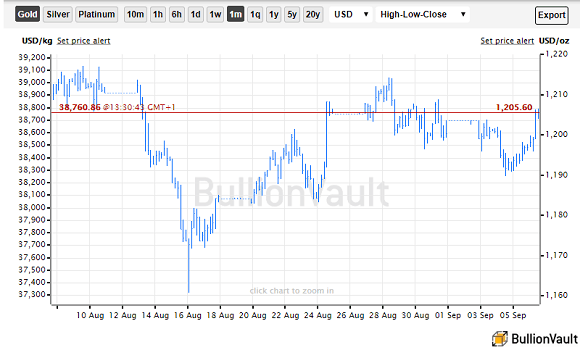
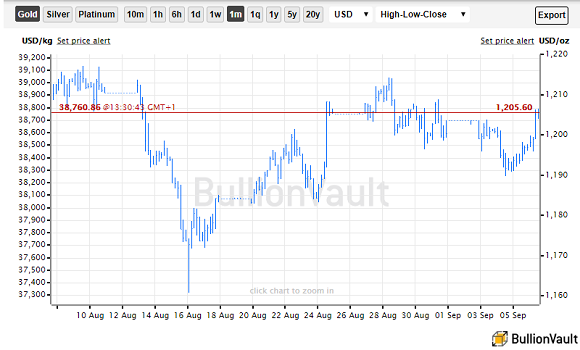
Trading at $1205 per ounce as New York opened for business, gold priced in other major currencies also rose, recovering £930 for UK investors and €1034 versus the single Euro currency.
 
Chart of gold priced in Dollars, spot price last 1 month. Source: BullionVault
 
Relative to London quotes, Shanghai premiums for gold delivered in the No.1 consumer nation held above $7 per ounce overnight as both the Yuan and gold steadied versus the Dollar.
 
With new tariffs already hitting $50 billion of annual imports into each other’s territory, the US is about to raise tariffs on a further $200bn of Chinese goods.
 
A group of US senators meantime wants to impose sanctions on any country which ceases to recognize Taiwan as an independent state – a growing trend in recent years, with the Communist authorities in Beijing apparently giving the Dominican Republic $3bn just before its change of allegiance to China in May.
 
Hoping to extend to Canada the revised Nafta free-trade deal agreed with Mexico last month, “The hope is that this puts a lot of pressure on the Chinas of the world to help us negotiate better reciprocal trade deals,” says Kevin Hassett, chair of Trump’s Council of Economic Advisers.
 
Trump himself meantime took to Twitter overnight to lambast the New York Times for publishing the claims of “active resistance inside the White House” to his policies from an anonymous “senior administration source”.

I’m draining the Swamp, and the Swamp is trying to fight back. Don’t worry, we will win!

— Donald J. Trump (@realDonaldTrump) September 6, 2018

Silver matched gold’s rally this morning, rising to $14.26 per ounce to bounce 1.6% from Tuesday’s plunge to the lowest Dollar price since January 2016.
 
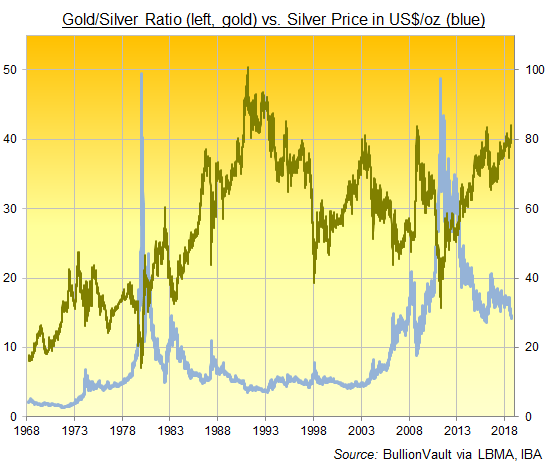
That kept the Gold/Silver Ratio around Wednesday’s new 23-year high, pricing one ounce of gold at 84.5 ounces of silver.
 
Now more than 50% more expensive against silver than its half-century average, gold has only been dearer on 579 days in history according to the Gold/Silver Ratio.
 
Silver’s drop of $1.20 per ounce over the last month has seen the iShares Silver Trust (NYSEArca: SLV) stall and shrink in size, edging back by 19 tonnes but still holding near early August’s one-year record of 10,274 tonnes.
 
That’s equal to two-fifths of annual world silver mine output.
 
Investor interest in the giant SPDR Gold Trust (NYSEArca: GLD) has shrunk by 10% as the gold price has lost $100 since mid-June, taking the quantity of bullion needing to back its reduced number of shares in issue down below 747 tonnes – the smallest since February 2016.
 
Globally the quantity of gold held for all gold-backed ETFs shrank by 40 tonnes over August to 2,353 tonnes – led by that drop in US trust funds – according to data compiled and published today by the mining industry-supported World Gold Council.
 
The third consecutive month of outflows, that took total gold ETF holdings to the lowest since November 2017, equal to some 71% of annual world mine output.


'Opportunity' to Buy Gold as BRICS Hit by Fed

PRICES to buy gold stabilized in London on Wednesday morning, trading $2 higher to $1194 per ounce even as the US Dollar pushed other currencies lower once more and global stock markets extended yesterday’s drop on Wall Street.
 
Commodity prices also retreated and the Chinese Yuan fell again versus the Dollar after China’s weak manufacturing surveys for August were followed by news of a slowdown in its services sector.
 
“I’m not looking for the emerging-markets cycle to turn until we get close to the end of the [US] Fed’s tightening cycle,” says Marc Chandler, head of currency strategy at financial services firm Brown Brothers Harriman in New York.
 
“Emerging markets are needing to import capital for current account and budget deficits. It’s hard to imagine how they’re going to compete with the US for the world’s savings.”
 
Current betting on this month’s Federal Reserve rates decision puts 99.8% odds on a hike, with more than half of all bets on next June’s Fed meeting now expecting a further hike by mid-2019.
 
“People are [also] now looking beyond idiosyncratic issues [in emerging markets] and more generally at spillover and contagion,” the Financial Times quotes one analyst, pointing to how last month’s sell-offs in Turkey and Argentina are spreading, hitting Indonesia on Wednesday and pulling the MSCI developing-market share index down 1.4% for the day and 4.4% lower from a week ago.
 
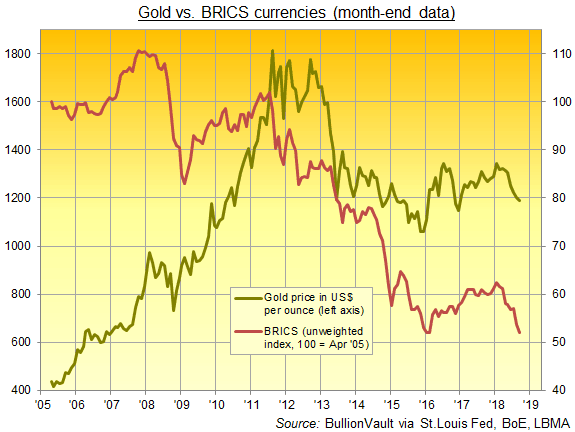
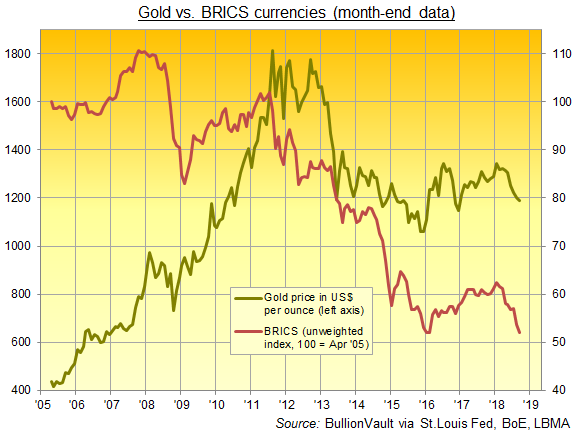
Measured on a simple unweighted index against the US Dollar, the currencies of Brazil, Russia, India, China and South Africa – christened the BRICS by then-Goldman Sachs economist Jim O’Neill in 2001 – are now trading just above the multi-year lows hit as the Federal Reserve began raising its interest rate from 0% at the end of 2015.
 
Chart of gold price in US$ vs. simple index of Brazil, Russia, India, China + South Africa currencies. Source: BullionVault
 
“On balance,” says the latest weekly analysis from specialists Metals Focus, “while a stronger Dollar may act as a headwind for gold, we still believe that the economic backdrop will eventually become supportive of higher gold prices.
 
“A notable decline in emerging markets could lead to spill over effects on industrialised markets, at a time when trade tensions are already raising concerns about global growth.
 
“In particular, as US GDP growth starts to slow, this should see US equities lose momentum and trigger some rotation towards gold.”
 
High-net worth investors in Asia should be looking to increase their personal holdings of gold according to nearly two-thirds of financial advisors polled in the region by research firm Hubbis on behalf of brokerage INTL FC Stone.
 
Out of 174 private banks, family offices and wealth management advisers surveyed earlier this year, 62% recommend raising allocations to gold – perhaps to one-tenth or more of a portfolio – while 38% advise against it.
 
“Gold has sold off over the past few months as US Dollar interest rates have increased,” the South China Morning Post quotes Chris Land, a senior associate in Hong Kong at financial advisory Holborn, “so there is more opportunity to buy.
 
“For clients who don’t have an allocation of gold in their portfolios, now is time to increase that.”
 
Returning from Labor Day’s end to the summer vacation season, New York’s S&P500 index closed Tuesday 0.5% below last week’s fresh all-time high.
 
Asian and European stock markets fell harder today, taking Hong Kong nearly 2.0% lower and Paris down 1.0% with a potential widening of US trade tariffs “still the major factor affecting the markets” according to one equity strategist.
 
Silver prices also steadied with gold today after falling within 1 cent of $14 per ounce on Tuesday.
 
That still put the gray metal at its cheapest value relative to gold since spring 1995.

Gold -$10 But Gold/Silver Ratio Breaks 2008 Peak as Emerging Markets Crisis Spreads

GOLD PRICES outpaced a drop in world stock markets on Tuesday in London, dropping $10 per ounce from the US Labor Day weekend as the Dollar resumed its climb versus other currencies but reaching its highest value against silver since March 1995 as the gray metal sank on the bullion market.
 
Emerging-market currencies fell hard again as data showing GDP growth in Brazil stalled in the second quarter was followed by news that South Africa has slipped into recession.
 
Struck by the exodus of 2.3 million citizens to escape hyperinflation now running at 1 million per cent per year, Venezuela’s socialist government today ordered commercial lenders to keep 100% of their required reserves on deposit at the central bank, killing all new lending as President Nicolás Maduro offers “gold-backed” certificates to savers. 
 
No.10 silver-mining nation Argentina also “took steps” to defend its Peso currency, the New York Times reports, slashing the number of government ministries and imposing a new tax on exports, with President Mauricio Macri saying “This is not just another crisis. It has to be the last.”
 
Silver prices today hit 21-month lows at $14.16 per ounce, driving the Gold/Silver Ratio of the two precious metals’ prices up past the 2008 crisis peak to reach 84.5 
 
The ratio has averaged 55.5 ounces of silver per 1 ounce of gold over the last half-century.
 
Chart of Gold/Silver Ratio, daily London benchmarks. Source: BullionVault via LBMA
 
“The emerging market economic crisis is making currencies very weak and benefiting the Dollar,” Reuters quotes Hong Kong dealer Peter Fung at Wing Fung Precious Metals, “which continues to pressure gold.
 
“Gold should track the Dollar’s movement very closely and interest rate expectations too are weighing on the metal.”
 
Trading at $1193 as New York dealing began today, gold priced in Dollars has now fallen in 9 of the last 12 weeks – the same number as the US currency’s broad trade-weighted index has risen on the forex market.
 
Priced in other major currencies gold was little changed Tuesday from Monday’s quiet session, slipping to €1032 for Eurozone investors and holding above £930 for UK investors as the Pound lost value yet again. 
 
UK construction activity fell hard in August from July’s 14-month high, the new PMI survey from data providers IHS Markit said today.
 
Presenting the latest Bank of England Inflation Report to Parliament later on Tuesday, current chief Mark Carney was set to be quizzed by lawmakers over rumors he has been asked to stay in the role beyond 2019’s Brexit from the European Union.
 
Gold priced in Australian Dollars held little changed Tuesday from Monday after the Reserve Bank of Australia kept its key interest rate unchanged at a record low of 1.5% for the 25th month in a row, saying this should “support the Australian economy.”
 
Now the No.2 gold-mining nation behind China, Australia’s output over the last 12 months has hit a 20-year high according to consultancy Surbiton Associates, totalling 310 tonnes.
 
Formerly the world’s No.1 gold mining nation, South Africa has seen output slide to position No.6 over the last 20 years.
 
Last month the National Union of Mineworkers (NUM) declared a dispute over wages with the country’s top 4 gold-mining companies.
 
The Mexican Peso – currency of the top silver mining nation – fell hard on Tuesday, helping support metal prices for local producers.

Gold Price Flat at $1200 for Labor Day as Bears Ease Back, US Jewelry Sales Beat Coin, Bar Demand

LABOR DAY 2018 saw global gold bullion prices edge back to $1200 per ounce in quiet trade on Monday, down 0.3% for the day, as US markets stayed closed for the end-of-summer holiday.
 
Asian and European equities ticked lower, also in quiet trading, as crude oil rose to 2-month highs and the other precious metals held firmer than gold.
 
Silver slipped 3 cents per ounce to $14.51 by mid-afternoon in London as platinum prices added 50 cents from Friday’s finish to trade at $788.
 
Betting against silver prices by hedge funds and other ‘Managed Money’ traders last week grew for the 4th week running on Comex futures and options, approaching April 2018’s record-heavy levels according to US regulator the CFTC’s data series.
 
Managed Money betting against platinum meantime reached a new record, with that group’s bearish positions outnumbering its bullish bets for the 21st week in succession.
 
Comex gold contracts have, over the last 10 years, seen the Managed Money group of traders average a positive weekly bet equivalent to $16.2bn of metal.
 
That fell to a negative bet worth a record $9.4bn in mid-August, before easing to -$8.4bn last week.
 
Chart of Managed Money net speculative position in Comex gold futures and options, notional contract value. Source: BullionVault via CFTC
 
As gold prices fell last month, imports of gold bullion to No.2 consumer nation India through the key hub of Ahmedabad rose to an 8-month high, the Times of India reports.
 
Year-on-year comparisons would be skewed however, says Haresh Acharya – national secretary of the Bullion Federation of India – by August 2017’s weak levels, hit by last year’s implementation of new GST sales tax.
 
Following August’s rise, and despite the looming Hindu wedding and festival season, “Jewellers are [now] cutting purchases,” one news-wire quotes a dealer in Mumbai.
 
“They think the Rupee could recover and local prices could fall again.”
 
US jewelry retailer Tiffany & Co. (NYSE: TIF) has meantime seen growing sales, reports South Africa’s Independent Online, beating analyst forecasts with its latest results and raising its full-year forecast.
 
US gold jewelry demand overall last Christmas hit its strongest quarterly levels since at last 2010, according to data compiled by specialist analysts Metals Focus for the mining-backed World Gold Council.
 
In the year to end-June 2018, total sales rose 9.3% from the previous half-decade average, totaling more than 126 tonnes.
 
US gold bar and coin demand, in contrast, fell 61% from its prior 5-year average to total just 26 tonnes on Metals Focus’ data.
 
Sales of US gold Eagle coins by the US Mint fell over 38% last month from July, according to data compiled by Reuters.
 
Meantime in No.1 consumer market China on Monday, premiums above London quotes for bullion landed in Shanghai rose towards $8 per ounce, just shy of typical levels after sliding below $3 earlier this summer.
 
Currency trading was also quiet, but Sterling fell – helping the UK gold price in British Pounds per ounce recover half last week’s £10 loss at £932 – amid fresh wrangling in the ruling Conservative Party over next March’s Brexit from the EU.
 
London’s official proposal for a Brexit deal is simply unacceptable, the EU’s chief negotiator Michel Barnier says.

Gold Bullion Hits Longest Dollar Price Drop Since 1989 as GLD Shrinks Again

GOLD BULLION prices held above $1200 per ounce for US Dollar investors in London trade Friday but neared the end of August lower for the fifth month running.
 
Matching the worst runs of gold’s 1990s’ bear market, that stretch has only been beaten once – back in 1989 – since benchmark London bullion prices were allowed to float half-a-century ago.
 
“The ongoing outflows from ETFs, record high speculative shorts and upbeat US economic data are still the major headwinds for gold and signify the recovery might be short- lived,” Reuters quotes Religare Securities analyst Sugandha Sachdeva in New Delhi.
 
“Sustaining higher prices looks difficult in the near term,” she tells Mint.
 
Even with retail gold demand in the No.2 consumer market now “picking up” ahead of the coming Hindu festive season, “gold is selling at a premium of [just] $1 per ounce in [India’s] domestic market” reports the Economic Times today.
 
“We might not see investment demand for gold in the upcoming festive season,” reckons jewelry tycoon Joy Alukkas of the eponymous chain store. “It will only be jewellery sales.”
 
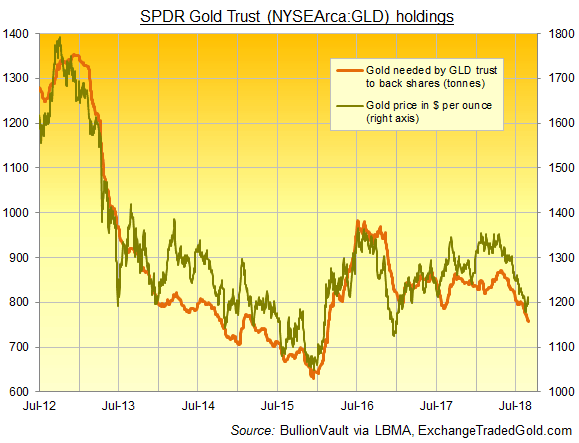
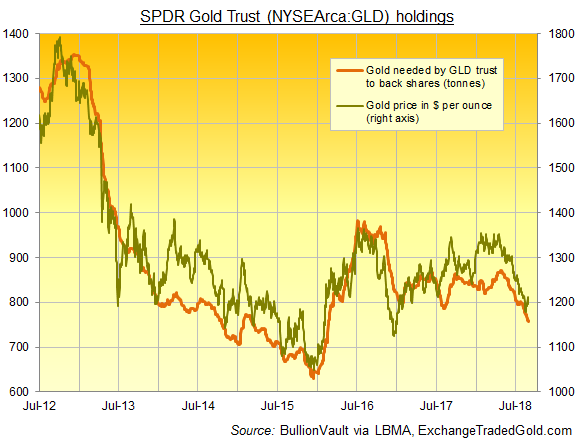
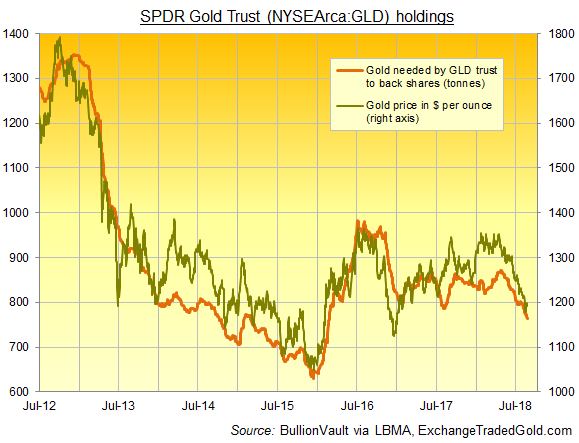
Over in the United States, the giant SPDR Gold Shares (NYSEArca: GLD) saw net liquidation yet again on Thursday, shrinking for the 15th of 22 sessions in August to need fewer than 758 tonnes of bullion backing, the lowest since late-February 2016.
 
Chart of GLD bullion backing. Source: BullionVault via ExchangeTradedGold.com
 
After US data yesterday said the Federal Reserve’s preferred measure of inflation has risen to its target pace for the first time in 6 years, new data on Friday showed inflation in the 19-nation Eurozone – the world’s largest currency bloc by economic output – slowing this month, also now running at 2.0% per annum.
 
The Euro erased the last of this week’s earlier 0.8% gain versus the Dollar on the news, trading back below $1.1650 and holding the gold bullion price for French, German and Italian investors just above €1033 per ounce.
 
Down €4 from last Friday’s finish that was €10 above mid-August’s 31-month low.
 
UK gold prices in Pounds per ounce meantime held at £927, just £2 above the lowest Friday finish since December 2016.
 
Asian and European equities extended yesterday’s drop on Wall Street, pulling Japan’s Topix index almost 7% lower for 2018 so far while the EuroStoxx 50 traded almost 3% down from New Year.
 
Overall the MSCI World Index of global stock markets fell for a second day running after coming within 2.5% of January’s record peak on Wednesday, thanks to the new all-time US highs.

Gold Price Support 'Firm at $1200' as US Inflation Hits Fed Target 1st Time in 6 Years

GOLD PRICES rose back to last week’s closing level around $1205 per ounce in London on Thursday as new US data put inflation up in line with the Federal Reserve’s official target for the first time since spring 2012.
 
The personal incomes and outlays report for July said the cost of living rose 2.3% per year, just ahead of analyst forecasts, with the Fed’s preferred measure of “core PCE” prices reaching 2.0% annual inflation.
 
Silver lagged the rally in gold prices, holding almost 1% down from last Friday’s finish at $14.69 per ounce, as global stock markets extended the day’s earlier falls from multi-month highs.
 
The PCE inflation news saw the Dollar pause this week’s retreat from mid-August’s 17-month peak.
 
Ahead of the long US Labor Day weekend, Wall Street equity futures pointed lower after President Trump again praised this year’s rise to fresh record highs in US stocks.

The news from the Financial Markets is even better than anticipated. For all of you that have made a fortune in the markets, or seen your 401k’s rise beyond your wildest expectations, more good news is coming!

— Donald J. Trump (@realDonaldTrump) August 30, 2018

With gold prices down nearly 8% for 2018 so far, “US-China trade tensions and US interest rate expectations remain the key drag on the yellow metal,” says the latest weekly note from specialist analysts Metals Focus.
 
Betting on next month’s Federal Reserve meeting puts near-certain odds on a rate rise to 2.00%, but betting on the Fed voting to keep rates there in December – rather than hiking again – has edged up from 27% to 31% since this time last month according to data from the CME derivatives group.
 
Policymakers should keep the economy’s current position “firmly in mind” when assessing risks and uncertainty, says a Fed research paper published this month, suggesting a more aggressive rate-rising policy amid this summer’s raft of strong US data.
 
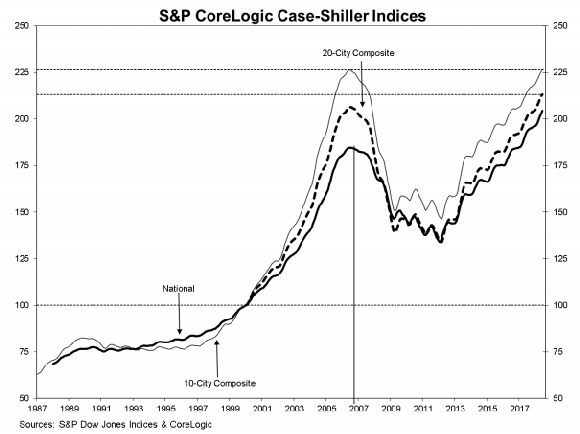
A rise in US house prices to new all-time highs however – breaching the peaks immediately prior to the subprime and then global financial crash of a decade ago – has now coincided with 7 months of falling demand from the same period last year, new figures showed Wednesday.
 
Chart of US home prices. Source: S&P Case-Shiller indices
 
“Resistance [in gold prices] remains unchanged at $1213.20,” says a technical note from bullion bank Scotia Mocatta’s New York office, pointing to “the 50% Fibo retracement level of the July high-to-August low range.
 
“Support is firm at $1200.70…[but] momentum remains negative.”
 
Earlier in Asia on Thursday, “We are seeing selling from the Chinese banks,” said a note from Swiss refining and finance group MKS Pamp’s trading desk, with the Dollar’s rise versus the Yuan “helping put gold under pressure.”
 
Shanghai premiums, over and above London quotes, slipped back beneath $7 per ounce after rising near more typical incentives for new imports into the No.1 consumer market for the first time in a month on Wednesday.

Gold Price Drop Spurs India Festive Demand But Kerala Disaster 'Will Boost Selling'

GOLD PRICES held little changed in Dollar terms alongside global stock markets on Wednesday, trading back in line with last week’s finish at $1204 per ounce as commodities rose together with longer-term interest rates on major government bonds.
 
Tuesday’s rally in US gold prices failed to stop the giant SPDR Gold Trust (NYSEArca:GLD) suffering more net redemptions as shareholders quit the stock.
 
Shrinking for the 14th trading day of 20 so far in August, the GLD ended last night needing fewer than 760 tonnes of bullion backing – the smallest quantity in 30 months.
 
Gold prices in India – the metal’s No.2 consumer nation, now about to enter its peak demand season of post-harvest weddings and the Diwali festival – today edged back as the Indian Rupee bounced from its new all-time record lows versus the Dollar.
 
Reporting a jump in retail gold demand, “We usually see this kind of momentum in October,” The Times of India quotes one Chennai jewelry brand owner.
 
“The last month was slow owing to high [Rupee] prices [but now] Indian prices are also dropping and customers are buying earlier.”
 
“Wedding buying has already started,” agrees another jeweler.
 
Last Sunday marked the Hindu festival of Raksha Bandhan, celebrating family and often involving gifts including gold.
 
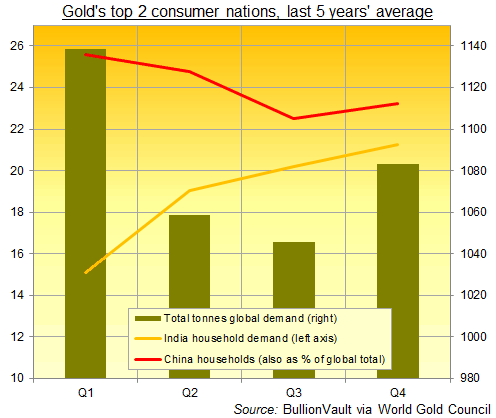
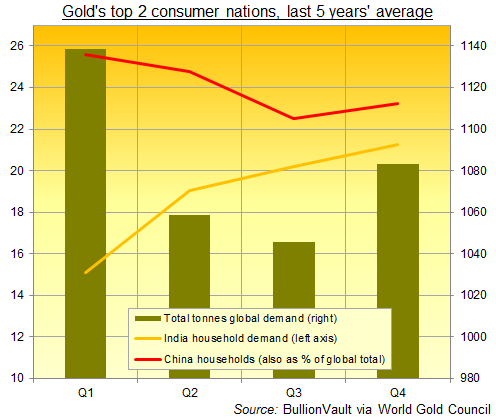
Chart of China and India gold demand as percentage of global total. Source: BullionVault via Gold.org
 
India’s heaviest single gold-buying state of Kerala, however, was hit last week by the worst flooding in a century in India, with perhaps 450 dead and electricity still cut off for 80% of the population.
 
“The usual spend of 200 grams to 1 kilogram of gold per wedding in Kerala may drop 50% in the next month,” Bloomberg quotes B. Govindan, president of the All Kerala Gold & Silver Merchants Association.
 
Household borrowers in the disaster-hit state may meantime find a “sympathetic view” on their gold-loan repayments, The Economic Times says, reporting initiatives among major lenders.
 
“Kerala accounts for 6.4% of our total gold loan portfolio,” says Manappuram Finance’s managing director V.P.Nandakumar, forecasting a rise in gold selling or pledging by families needing to raise or borrow money after the flooding.
 
“We will be promoting loans with zero processing fees,” says smaller lender Unimoni, also extending loans with longer terms out to 360 days in Kerala – typically the in No.2 global consumer India.
 
Looking ahead to Diwali – which falls in early November 2018 – digital payments service Paytm forecast yesterday that its gold gifting app will see 1.5 tonnes of transaction volume over India’s upcoming festive season, claiming a 70% share of the digital market.
 
India’s total household gold demand between October and December has averaged 230 tonnes across the last 5 years according to data compiled by specialist analysts Metals Focus for the mining-industry backed World Gold Council.
 
Already backed by Japanese telecoms giant Softbank and China’s Alibaba retail and banking empire, Paytim’s parent company One97Communications is also now part-owned by US investment legend Warren Buffett’s Berkshire Hathaway.

Gold Prices Rally vs Falling Dollar as Debt and Migration Dominate EU Politics

GOLD PRICES hit 2-week highs against a falling US Dollar on Tuesday as world stock markets extended their rally towards or above January’s all-time record highs.
 
Political tensions worsened in Europe over both government budgets and immigration, while US President Donald Trump hailed a revamped Nafta trade agreement with Mexico which doesn’t include fellow North American nation Canada.
 
The new deal “in no way” represents a payment from Mexico to the US for building Trump’s long-announced border wall says Mexican foreign minister Luis Videgaray.
 
Silver followed gold prices higher against the Dollar but fell back harder after touching $15 per ounce for the first time since 15 August.
 
Reaching $1214 per ounce before easing back, gold priced in Dollars today gained 4.6% from mid-August’s plunge to 31-month lows at $1160 per ounce.
 
Latest data show speculators holding record-large bearish bets against gold prices rising on Comex futures and options.
 
Exchange-traded funds backed by gold have continued to shrink, with the giant SPDR Gold Trust (NYSEArca:GLD) ending Monday at its smallest size since February 2016, needing fewer than 765 tonnes of bullion to back its shares in issue.
 
Chart of GLD gold backing vs. spot price. Source: BullionVault via ExchangeTradedGold.com
 
Shanghai gold premiums edged higher to $5.60 per ounce versus London quotes on Tuesday, but still held one-third below average levels.
 
With London re-opening for business after the August Bank Holiday, gold prices then held flat from last week’s finish for Euro and UK investors as the Dollar slipped on the forex market.
 
Borrowing costs for both the UK and Italy jumped even as the Pound and Euro rose however, with political wrangling in both countries focused on their relationship with the European Union.
 
Ten-year UK Gilt yields rose to 1.44% after the UK’s pro-Brexit ex-minister Boris Johnson at the weekend called Prime Minister Theresa May’s current plan for exiting the EU next March “absolute insanity [in] allowing [London] to be bullied by EU negotiators.”
 
Current UK Brexit secretary Dominic Raab meantime said “freedom of movement will have to end” between the UK and the remaining 26 EU nations even if concessions are made in other areas of the negotiations.
 
Italian bond yields meantime spiked to 3-month highs, nearing levels seen amid the left-and-right-wing coalition’s formation, after deputy prime minister Luigi Di Maio said Rome’s spending deficit this year could exceed the European Union’s official limit of 3% of gross domestic product.
 
Di Maio also threatened to veto the EU’s own 7-year budget plan, withholding Rome’s contribution, unless Brussels backs down over Italy’s refusal to accept 150 migrants now held on a coast guard ship near Sicily.
 
Violence meantime broke out again in east German city Chemnitz last night as anti- and pro-immigration protesters clashed following the arrest of an Iraqi and a Syrian over the murder on Saturday of a Cuban-German attending a street festival.
 
The Italian government guarantees a 7% annual return to private motorway operator Autostrade – owner of the Morandi Bridge in Genoa which collapsed and killed 43 people this month – reports newspaper Corriere della serra today.
 
Rejecting calls last week for re-nationalization of Italy’s motorways, minister of the interior Matteo Salvini will today meet with Hungary’s right-wing prime minister Viktor Orbán in Milan, saying that 
“I do not think we’ll spend too much talking about immigration.
 
“On that, we agree: maximum protection of external borders.”