Author Archives: City Gold Bullion

Gold Trading 'Risks ETF Sell-Off' as Risk Appetite Grows But Fed Rates Stuck at 0.5%

GOLD TRADING in London edged prices higher from a new 2-week low hit against the weakening US Dollar overnight Wednesday in China and Asia, as global stock market extended their recovery from start-July’s Brexit shock lows to 3.5%.
 
Oil prices eased back but silver held above last week’s closing level, trading at $20.35 per ounce as New York opened for business.
 
London’s FTSE100 share index has now traded 10% higher already this month, reaching the highest level in almost a year.
 
German Bund prices continued to slip Wednesday, edging the benchmark 10-year yield up to minus 0.05%, its least negative level since 23 June, the day before the UK’s Brexit referendum result was announced.
 
US Treasury bonds rallied however, edging 10-year yields down from Tuesday’s 3-week closing high at 1.51% per annum.
 
Betting on US interest-rate futures now sees zero chance of a hike from the current 0.50% level at the Federal Reserve’s next meeting, on 27 July.
 
September’s Fed meeting now has a 1-in-8 chance of a hike, the CME’s FedWatch tool shows, with trader positioning putting a 0.1% chance on the US central bank’s key rate reaching 1.00% before March 2017.
 
The Fed’s own forecasts came into 2016 saying it would reach 1.375% by end-2016.
 
“Global geopolitical and economic concerns will help keep US interest rates on hold,” writes Jonathan Butler in his latest weekly analysis at Japanese conglomerate Mitsubishi, “and therefore maintain a favourable real rate environment for bullion.”
 
Short-term however, “Increased risk-on market sentiment…has led gold to come off its recent highs” as money managers trading US gold futures and options trimmed their most bullish position in history.
 
“We believe there is considerable downside risk for gold if money managers slash long positions or increase short exposure further,” says Butler.
 
Moreover, some of the 440 tonnes of gold added to ETF trust-fund holdings so far this year “may also not prove to be all that sticky if investor risk appetite increases further.”
 
Giant ETF the SPDR Gold Trust (NYSEArca:GLD) yesterday saw shareholder liquidation worth 16 tonnes of bullion backing, the sharpest 1-day shrinkage since December 2015’s new 6-year lows in the gold price, immediately after the US Fed finally raised its key interest rate to the current ceiling of 0.50%.
 
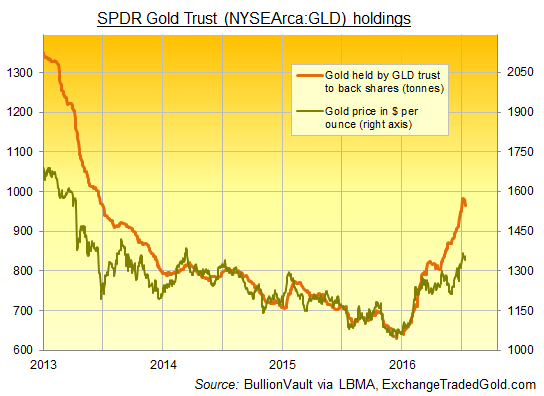
The GLD has still expanded by one-half so far in 2016, adding 322 tonnes of metal – equal to 10% of last year’s record-high global mine output.
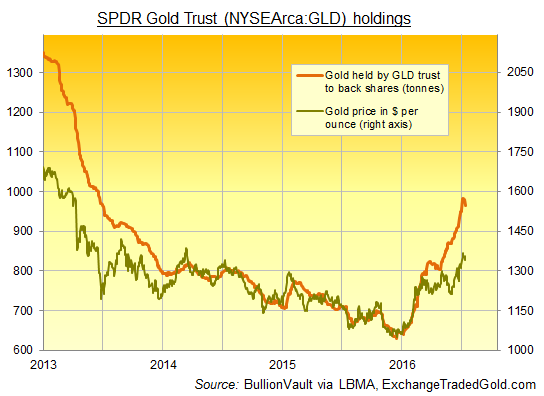
Chart of the bullion held to back SPDR Gold Trust (NYSEArca:GLD)
 
Recovering one-third its 3.5% drop from Monday morning’s new 2-year high of $1375 per ounce, gold held flat Wednesday against most other major currencies as the Dollar slipped on the FX market.
 
Forex trading in the Yen, however, saw gold prices also recover for Japanese investors, rising back towards yesterday’s new 4-month highs as the ‘safe haven’ currency dropped back.
 
China’s benchmark gold price hit new July lows in Yuan terms at Wednesday afternoon’s auction in Shanghai, but it held a $2.75 per ounce premium to equivalent Dollar quotes for London settlement.
 
Shanghai trading in China’s main gold contract held firm, but was again overtaken by the value of trading in silver.
 
Selling its precious metals trading and London vaulting business to China’s ICBC bank this spring, UK retail and investment bank Barclays apparently quit the officially-regulated LBMA Gold Price benchmarking process on 10 June, according to sources.
 
With ICBC joining the process last month, that means 13 institutions are now involved at the twice-daily auction says FastMarkets.
 
Wednesday morning’s “fixing” saw 7 of those banks submit orders to buy and sell, finding a price of $1340 per ounce on volume 10% below the April-June average.

Gold Bullion Falls as Brexit UK Gains PM, Italy Banking Rescue 'Near', India Demand Sinks

GOLD BULLION fell hard in Asian and London trade Tuesday, erasing most of last week’s 1.8% gain versus the US Dollar as stockmarkets surged everywhere except London, where allies of new UK prime minister Theresa May said she won’t “rush” to start Brexit negotiations with ex-European Union partners when she moves to 10 Downing Street on Wednesday.
 
Silver prices held firmer than gold bullion, trading in line with last week’s closing level as crude oil jumped almost 3% to lead a strong rebound in commodities.
 
Major government bonds meantime retreated in price, pushing yields sharply higher again from last week’s new record lows.
 
“Alongside the Brexit question, the crisis among Italian banks is another factor that is lending support to gold prices,” said a note earlier from German financial services giant Commerzbank.
 
The International Monetary Fund on Monday voiced its “concerns [about] the bail-in of retail investors” if Italy’s banking sector – saddled with €360 billion of sour loans ($399bn), equal to one-fifth of the major Eurozone nation’s annual GDP – has to raise cash by taking money off depositors.
 
A rescue deal with EU partners is “absolutely within reach” said Italian prime minister Matteo Renzi today.
 
Milan’s MIB stock index rallied 3% Tuesday, rising further from its immediate post-Brexit 3-year lows as banking shares bounced alongside their bond prices.
 
Gold bullion dropped near 1-week lows for both US and Eurozone investors on Tuesday at $1347 and €1214 per ounce respectively.
 
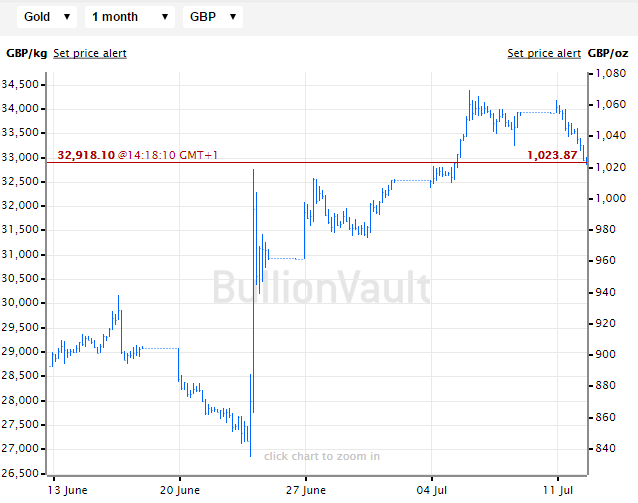
Priced in Sterling, gold bullion retreated to £1022 per ounce – 3-year high when first touched immediately after the UK’s Brexit result in June’s EU referendum, but down some 4.5% from last week’s finish.
 
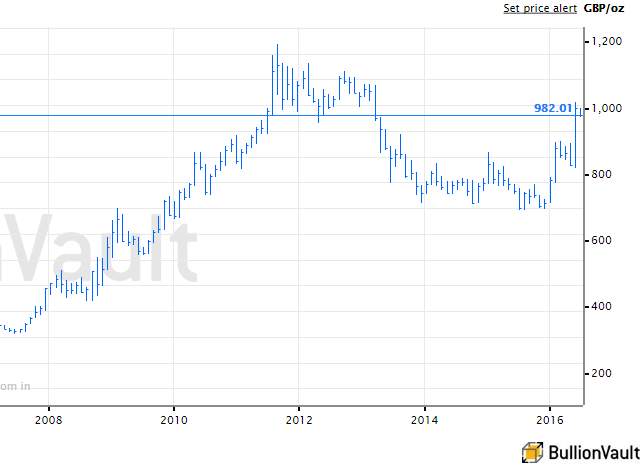
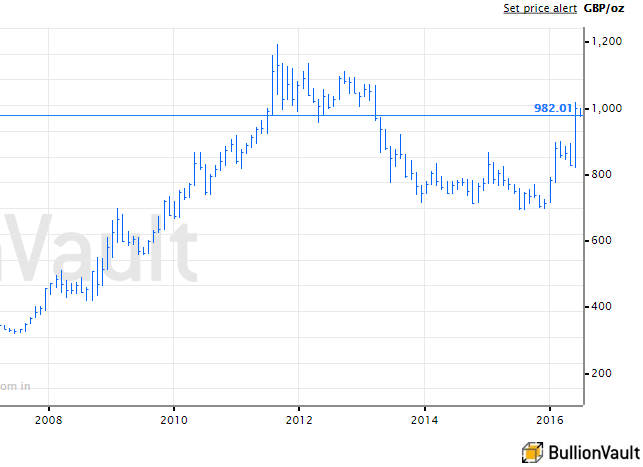
Chart of the gold bullion spot price in British Pounds Sterling, last month
 
Faced with near record high Rupee prices, legal imports of refined gold bullion bars to India fell over 40% during the first 6 months of 2016, reports the Business Standard today, with January to June seeing just 210 tonnes landed in the world’s No.2 gold consumer nation.
 
India’s gross gold imports totaled 1,066 tonnes in 2015 according to analysis from specialists Metals Focus.
 
“January saw imports of 75 tonnes of gold,” says today’s Business Standard report, “after which it has been averaging 27-30 tonnes a month.”
 
The key southern Indian festival of Akshaya Tritiya in May “also failed to improve demand.”
 
Discounts on gold bullion to global quotes last week hit a record $100 per ounce equivalent said Reuters’ India news agency last week, and are still being “heard above $70 this week,” says the specialist Platts news and data agency today.
 
“High spot prices continue to deter local investors,” it adds, with gold bullion’s near-record high price for Indian households now achieving what govermment schemes could not.
 
The Japanese government is meantime set to cut its 2016 GDP growth forecast in half, according to “sources”, delaying a hike in VAT sales tax because of the economic uncertainty spurred by the UK’s vote to leave the European Union last month.
 
After Japan’s Asahi Refining (TYO:5857) last year bought the remaining North American gold and silver processing plants of former world-leader Johnson Matthey Plc (LON:JMAT), privately-owned Tanaka Holdings today said it is buying privately-owned Swiss refiner Metalor for an undisclosed sum.
 
“Metalor and Tanaka have highly complementary business strategies,” said Tanaka CEO Akira Tanae, pointing to the Swiss-based company’s specialisms in scrap recovery, refining and high-purity bullion products.
 
“Tanaka is mainly active in Asia,” said Metalor’s press release, “while Metalor also has a strong presence in Europe and the Americas.
 
“In addition…Tanaka is a global leader in low-grade refining, bonding wire for electronics, platinum equipment for glass smelting, and electrical contacts for the automotive industry.”
 
Tanaka currently has one plant accredited for the wholesale gold market’s Good Delivery list, owned and maintained by the London Bullion Market Association.
 
Metalor, which will continue to operate under the Metalor name, has four.

Gold Price Slips 1% as World Stockmarkets Surge on 'Stimulus Bets', Pokemon Go Adds 65% to Nintendo

GOLD PRICES fell over $15 per ounce against the Dollar on Monday, retreating to $1351 per ounce before regaining half that 1.1% drop as world stock markets surged and commodity prices rose on what headline writers worldwide called “stimulus hopes” across Asia and Europe.
 
“China June inflation eases further, more policy stimulus anticipated,” said Reuters at the weekend after the world’s No.2 national economy reported the slowest consumer price inflation in 6 months at 1.9% per year for June, stronger than analyst forecasts but down from 2.0% in May.
 
Abe to give order for new stimulus package,” said the Nikkei Asia Review overnight after Japan’s ruling coalition grew its Upper House dominance in Sunday’s election.
 
Japanese gaming giant Nintendo’s share price (TYO:7974) has risen 65% since the new Pokemon Go app was launched free last week, recovering from 1-year lows.
 
“Global stocks rally, markets look for more stimulus,” says Reuters, echoed by CNBC, Deutsche Welle and other news-sites ahead of this Thursday’s South Korea and Bank of England decision on interest rates.
 
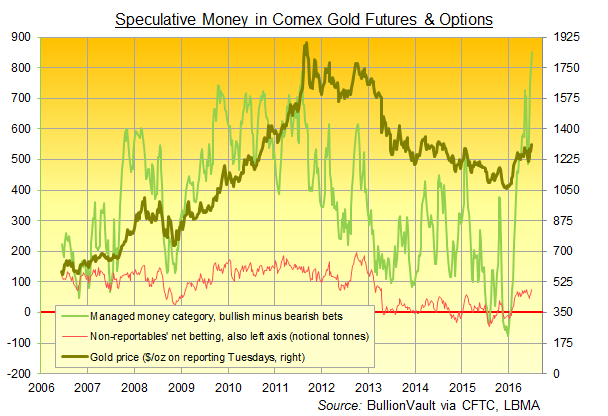
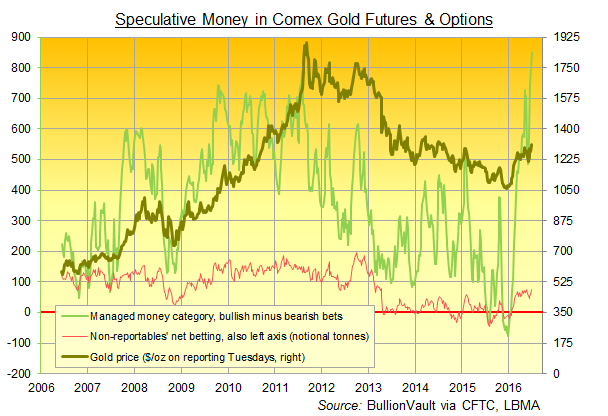
Latest data show hedge funds and other money managers taking the largest bullish bets on gold futures and options ever in the week-to-last Tuesday.
Chart of speculative money in Comex gold futures & options via CFTC
 
Since the UK’s Brexit vote, “Korea quickly proposed a supplementary budget, Taiwan cut rates by 12.5 basis point, and China has let the CNY weaken,” note analysts at French investment and bullion bank Natixis.
 
The British Pound meantime steadied as the UK’s ruling Conservative Party was left with just 1 candidate, current Interior Minister Theresa May, to replace failed Brexit Remain campaign leader David Cameron as prime minister. 
 
That helped debt gold priced in Sterling to £1040 per ounce, almost 3% below last week’s new 3-year highs.
 
“Bank of England poised to slash interest rates to shore up economy,” says The Daily Telegraph, echoes by the Financial Times, The Guardian, the BBC and the rest of Britain’s media – although a blog at the British Bankers’ Association urges “caution”, as post-Brexit data have yet to start coming in, and the current 0.5% record low leaves little room for consumers or businesses to grow their borrowing in response to a cut.
 
New York’s S&P500 index of the largest US-listed stocks today touched new all-time highs, driven by “growth optimism, stimulus bets,” according to Bloomberg.
 
Major government bond prices retreated, edging yields higher from new all-time record lows, while industrial and agricultural commodities rose.
 
Silver led the charge, rising almost 2% to touch $20.67 even as gold prices fell, but holding 3.5% below last week’s sudden spike to 2-year highs.
 
Analysts at US financial services giant Citi now see gold prices averaging $1250 in 2017, with a 1-in-5 chance of “a possible severe exacerbation of already elevated US and global growth concerns” sending that up to $1440 per ounce.
 
“Gold should rally towards $1400 this year,” says a ‘top trade’ highlighted for clients of French investment bank Societe Generale – also advising they sell copper as China’s economy weakens – “as the US Fed is unlikely to hike this year after the Brexit vote.”

Gold Price Shrugs Off US Jobs Surge, Holds Best Friday Close Since March 2014 as Traders Back Interest Rate Cuts

GOLD PRICES whipped violently Friday on news of the strongest growth in US employment since October, recovering all of a sudden 2% plunge to head for the highest weekly close since March 2014 as traders continued to bet that the Federal Reserve won’t raise interest rates anytime soon.
 
The US government’s first estimate of June’s net addition to non-farm payrolls came in at 287,000 – almost as far ahead of Wall Street forecasts as May’s 6-year low was beneath them.
 
“A very strong jobs figure will trigger some short term pain for gold prices,” said Swiss refining and finance group MKS’s trader James Gardiner before the news.
 
“However, the underlying uptrend should prevail in the medium term.”
 
May’s strike by workers at telecoms giant Verizon had cut 37,000 jobs off the Bureau of Labor Statistics’ previous payrolls report.
 
“Largely reflecting” their return, the BLS said today, employment in the TMT sector rose 28,000 in June.
 
Already the weakest monthly jobs growth in 6 years, May’s figure was today revised down from 38,000 to just 11,000.
 
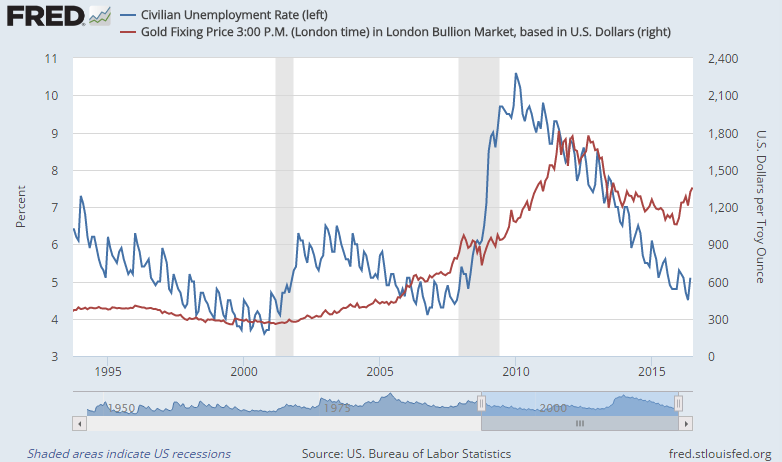
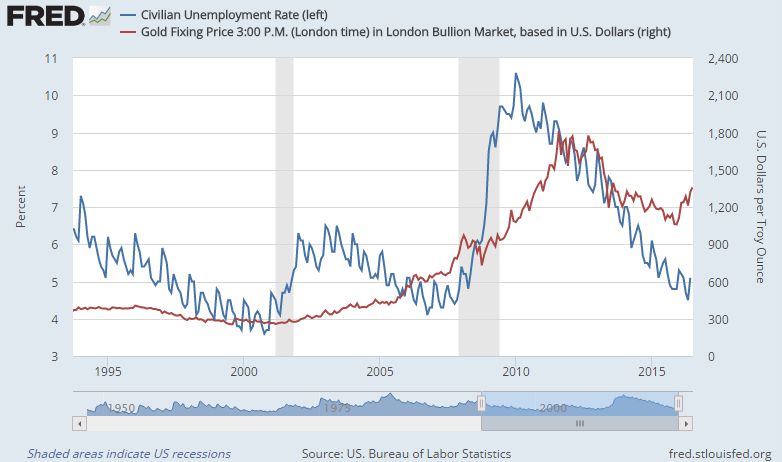
The US unemployment rate rose to 5.1% from May’s 8-year low of 4.7%.
 
Chart of US unemployment rate vs gold prices
 
US interest-rate traders now see zero chance of a rate-rise from the Federal Reserve anytime before December, with the odds of a cut at the July meeting – reversing December’s first and only hike since 2005 – now priced at 1-in-27.
 
Analysts at Germany’s troubled Deutsche Bank financial services group now put the odds of a US recession at 60%.
 
The Eurozone’s negative deposit rate – now at minus 0.40% – is meantime higher than the yield offered by one-third of the 19-nation currency union’s government debt, making those bonds ineligible for the European Central Bank’s QE asset purchases stimulus.
 
UK consumer confidence following the Brexit vote sank in the first week of July, dropping at the fastest pace in 21 years according to opinion pollsters Gfk.
 
Top-end UK grocer and consumer goods chain John Lewis today warned the plunge in Sterling could become a “big issue…if inflation gets into the value chain.”
 
Inflation expectations have leapt according to Gfk’s survey.
 
The Bank of England, however, is now expected to cut its base rate at next Thursday’s meeting, with financial traders now seeing a 1-in-3 likelihood that the Bank will cut to zero by end-August according to retail stockbrokers Hargreaves Lansdown.
 
Major mortgage lenders this week cut their home-loan rates in anticipation a cut to Bank of England base rate.
 
Gold prices will rise 10% by end-2017 according to US investment and retail financial services group Bank of America Merrill Lynch, calling for $1500 gold.

Gold Bullion Surge 'Out of Steam', Silver Erases 7% Jump But Brexit Weighs on Fed Before US Jobs Data

GOLD BULLION slipped $15 per ounce from yesterday’s new 3-year highs at $1375 in London trade Thursday morning, dropping as European stock markets rallied despite the UK’s continued paralysis over starting Brexit negotiations with the remaining European Union.
 
Average UK house prices rose 8.4% per year in June to new record highs, said the Halifax mortgage lender today – the slowest pace since last summer.
 
Seven commercial property investment funds have now shut the door to clients selling following the Brexit vote, with another charging a 17% redemption fee.
 
A vote to Leave by the UK would pose “significant” risks to growth across the 19-nation Eurozone, the European Central Bank policy team agreed at their start-June meeting, notes released today showed.
 
“I am beginning to think the [gold] rally is running out of steam and may be due for a pullback,” says a note from David Govett at brokers Marex Spectron in London.
 
“We need some fresh impetus to continue higher…Unless more dire news comes out of the UK or elsewhere, I suspect there may be some profit taking ahead of the weekend.”
 
“The yellow metal continues to feed off global uncertainty,” agreed the Asian dealing team at Swiss bullion refining and finance group MKS overnight.
 
“However the focus now shifts to Friday’s [US jobs] NFP print for an indication as to whether May’s 38,000 result was just an aberration or a sign of cracks starting to appear in the US recovery.”
 
The worst monthly US jobs data in 6 years, the release of May’s first Non-Farm Payrolls estimate saw Dollar gold prices jump 2% as traders scaled back their bets that the US Federal Reserve would raise interest rates.
 
Today’s private-sector ADP estimate put June’s net jobs growth at 172,000 – ahead of Wall Street forecasts and ahead of its 168,000 estimate for last month.
 
Betting on US interest-rate futures ahead of the Fed’s July meeting in 3 weeks’ time now puts the odds of “no change” above 97%, with no chance of a raise and a small possibility of a cut.
 
After the giant SPDR Gold Trust (NYSEArca:GLD) reported its largest 1-day inflow of metal since May 2010 for Tuesday – the day after the US Independence Day holiday – the ETF’s reported total was cut 0.3% on Wednesday.
 
All told, gold-related ETF trust funds now hold some 2,000 tonnes of bullion, says Bloomberg.
 
That equals two-thirds of 2015’s record global gold mining output.
 
The giant iShares Silver Trust (NYSEArca:SLV) meantime added almost 150 tonnes yesterday, jumping to its largest size since end-2014.
 
Unlike the major gold ETFs between 2012 and 2015, silver-backed trust funds continued to expand and then held firm as prices fell.
 
Silver ETF holdings now stand around 40% of 2015’s record-high global mine output.
 
Silver prices on Thursday again retreated faster than gold, erasing the last of this week’s earlier 6.9% surge to 2-year highs above $21 per ounce.
 
Gold prices in Shanghai today held near Wednesday’s new 3-year highs above CNY290 per gram.
 
That held the Shanghai premium, over and above London quotes, at $2 per ounce – in line with the typical incentive offered to new imports into China over the last two years.
 
New data showed Thursday that the People’s Bank of China added 16 tonnes to state gold bullion reserves in June, taking its hoard to 1,823 tonnes.
 
June’s daily average Dollar price rose 1.4% from May, setting the highest monthly average since August 2014.

Gold Price in GBP Only Ever Higher on 203 Days as Brexit Spurs $1400 Call

GOLD PRICES in GBP touched new 3-year highs at £1070 per ounce on Wednesday as the British Pound sank to new 3-decade lows on the currency market amid a fresh plunge in world stock markets, commodity prices and government bond yields.
 
Sterling’s Dollar value (GBP/USD) sank to $1.28 in overnight Asian trade, while gold prices shot higher in heavy Shanghai trade.
 
Sovereign debt from across the developed West today offered new record-low returns to buyers, with the total now paying negative rates – and guaranteeing a loss of value to investors on redemption – reaching towards $10 trillion.
 
Ten-year US Treasury bond yields fell to new record lows of just 1.35% per year.
 
Shares in German financial services giant (and former London bullion-market maker) Deutsche Bank meantime hit a new all-time low, halving from the start of the year, while German 10-year Bund yields fell towards new record negative returns of -0.20% per annum.
 
London’s FTSE100 share index fell 1.6%, less badly than Frankfurt and Paris, but the more UK-focused 250 index extended its post-Brexit drop to 10%.
 
Insurance firm Aviva yesterday joined its Standard Life and M&G competitors in shuttering a UK real-estate investment fund to investor withdrawals.
 
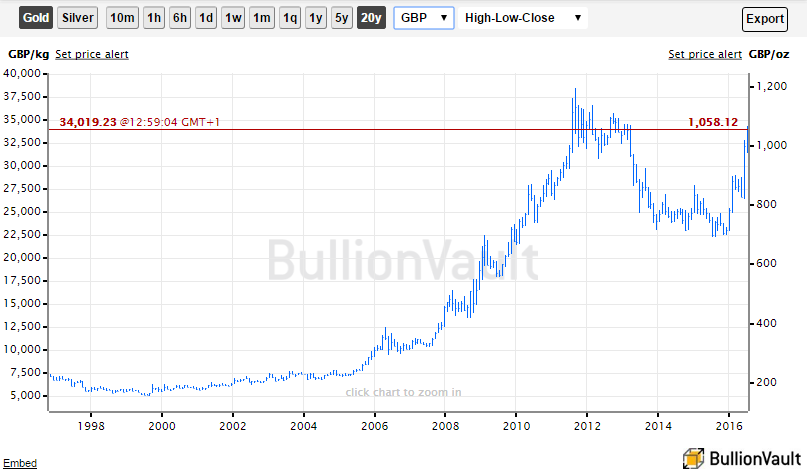
Gold priced in GBP has only ever traded higher than Wednesday’s AM benchmark on 203 working days, split between summer 2011 to spring 2012, and then late 2012 to spring 2013’s historic precious metals crash.
 
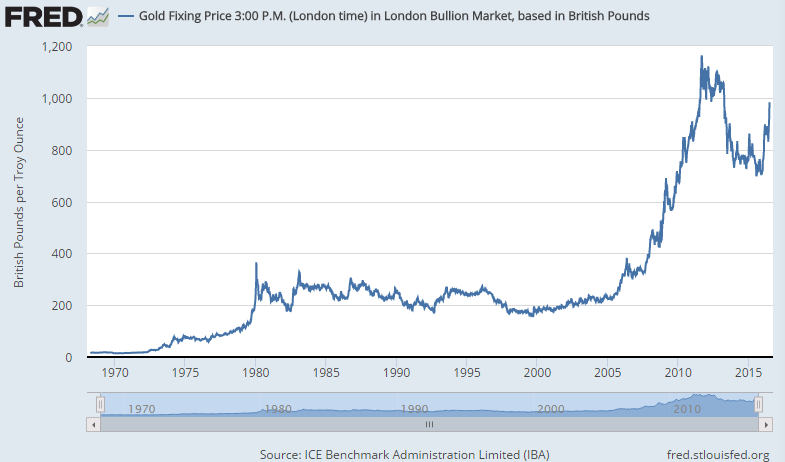
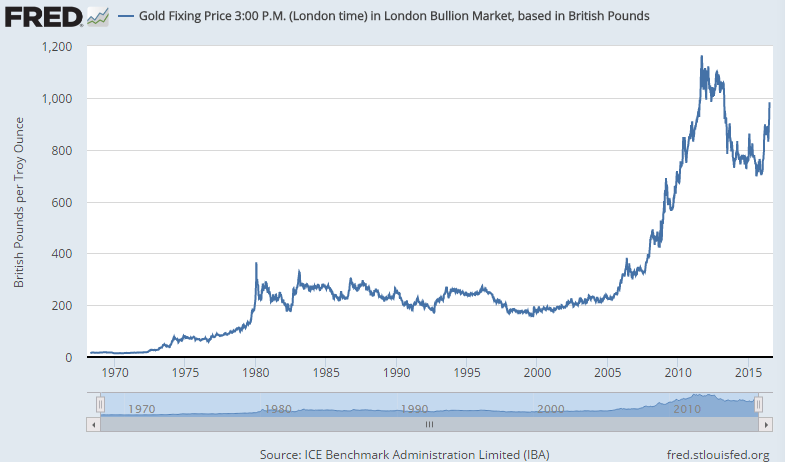
Chart of the gold price in GBP British Pounds, last 20 years
 
With UK prime minister David Cameron set to stand down after losing the Brexit vote, and his Labour opposite Jeremy Corbyn already losing a parliamentary party vote of no confidence, the long-delayed Chilcot Report into the 2003 invasion of Iraq today said former PM Tony Blair went to war “before peaceful options for [Baghdad’s] disarmament were exhausted,” backed by “flawed intelligence and assessments.”
 
“We have been flagging the upside risks to our [previous gold price] views for some time now,” says a note from Swiss bank and bullion market-maker UBS’s London analyst Joni Teves.
 
“The UK’s vote to leave the EU further underpins gold‘s macro narrative, reinforcing the themes of further dovish shifts in monetary policies, consequently lower yields, and heightened uncertainty.”
 
Now hiking her second-half 2016 gold price forecast in Dollars to $1400, Teves was already the most bullish professional in the London Bullion Market Association’s 2016 forecast competition at New Year, predicting a full-year average of $1225.
 
Tuesday’s PM benchmark in London took 2016’s average to date up to $1223 per ounce, already 11% above of 2015.
 
Only Martin Murenbeeld of Dundee Economics in Australia forecast a peak 2016 price above yesterday’s PM benchmark, predicting an annual average of $1135 with a high of $1375.

Gold Price Below 2-Year High as All Swiss Bond Yields Go Negative, Post-Brexit Bank of England Warns China on 'Stimulus Bubble'

GOLD PRICES edged briefly back above $1350 in London Tuesday lunchtime, recovering an overnight drop of $13 per ounce but failing to re-test Monday’s failed attempt at making fresh 2-year highs as world stock markets fell, bond prices jumped, and the British Pound sank to new multi-year lows despite a vow that the Bank of England’s post-Brexit plan “is working”.
 
US Treasury bond prices rose to push the yield offered by 10-year debt down to new all-time lows at 1.36% per annum.
 
Gold priced in Yen struggled to hold last week’s finishing level as the Japanese currency also rose with the Dollar on the FX market, as did the ‘safe haven’ Swiss Franc.
 
Swiss government bond prices rose so high, the yield offered to new buyers fell below zero on all of Bern’s debt, including on 30-year and 50-year bonds.
 
“The Bank has a clear plan,” said Bank of England governor Mark Carney at a press conference today, again inviting a contrast with Westminster’s lack of political leadership following the Brexit referendum while presenting the central bank’s latest Financial Stability Report.
 
“We are rapidly putting its main elements in place,” Carney said as he announced a £150bn cut in the UK banking sector’s total required reserves. “And it is working.”
 
The Pound then fell below its Brexit crash lows however, dropping to its weakest level in 3 decades versus the Dollar and the lowest level against the Euro since October 2013, losing almost one-fifth from last summer’s 8-year highs.
 
One chart in the Bank of England’s new report today shows UK household debt surging from 50% of income in 1980 to 132% in 2016.
 
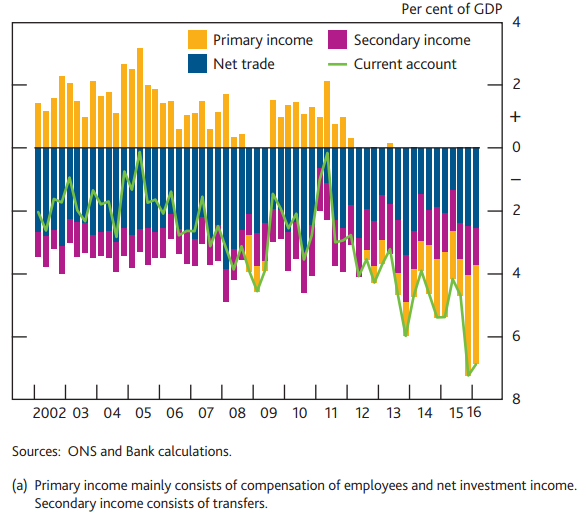
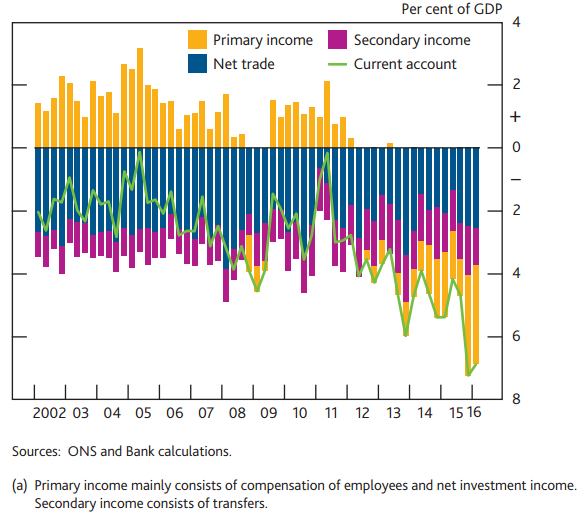
The UK’s current account deficit with the rest of the world has also yawned to record levels, although Carney said the collapse in Sterling “should” help to reduce it as imports become more expensive and exports more competitive overseas.
Chart of UK current account deficit from Bank of England's July 2016 Financial Stability Report
 
Monday saw insurance and asset-management giant Standard Life suspend redemptions from its £2.9bn ($3.8bn) UK property fund, which last week led a write-down of values across the sector, blaming the Brexit vote for spurred investor selling.
 
Back in the gold market, China’s premium over London quotes fell to $2 per ounce in Shanghai on Tuesday, its lowest level since the discounts of Brexit Friday and Monday on 24 and 27 June.
 
“The government is allowing speculation by providing cheap financing,” said respected independent China economist Andy Xie, speaking last week to MarketWatch.
 
“[China] is riding a tiger and is terrified of a crash. So it keeps pumping cash into the economy. It is difficult to see how China can avoid a crisis.”
 
Silver trading in Shanghai today leapt once more, again overtaking volumes in the SGE’s main gold contracts amid what several commentators have said is just the latest in a series of speculative bubbles for China’s household savers and traders.
 
After spiking to a sudden 2-year high above $21 per ounce in Asian trade Monday, silver prices retreated 4 times faster than gold overnight in Asia today, dropping more than 4% against the Dollar before rallying slightly to recover last week’s closing level at $19.76 per ounce.
 
“The [Bank of England] has previously highlighted the risks from rapid credit growth in China,” said the new report from Mark Carney’s team in London today.
 
“Though policy stimulus measures look to have stabilised the economy in the near term, that has been associated with even more rapid growth of credit, increasing financial fragility over the medium term.”

Silver Trading Surge Crushes Gold/Silver Ratio as Brexit Spurs Central-Bank QE Expectations

SILVER TRADING sent prices shooting higher overnight Monday, touching 2-year highs above $21 per ounce as Asian stockmarkets also rose sharply amid talk of fresh central-bank stimulus to avoid economic damage from the UK’s Brexit vote to leave the European Union.
 
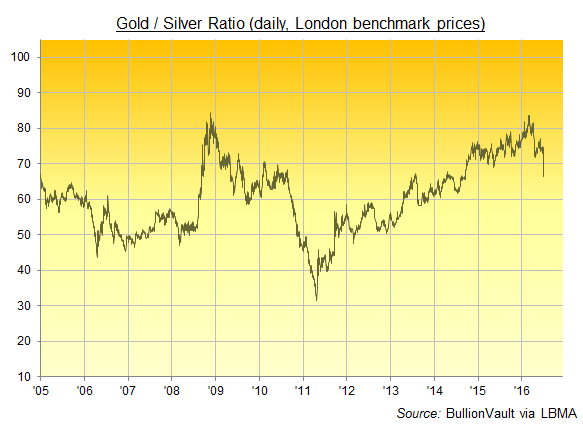
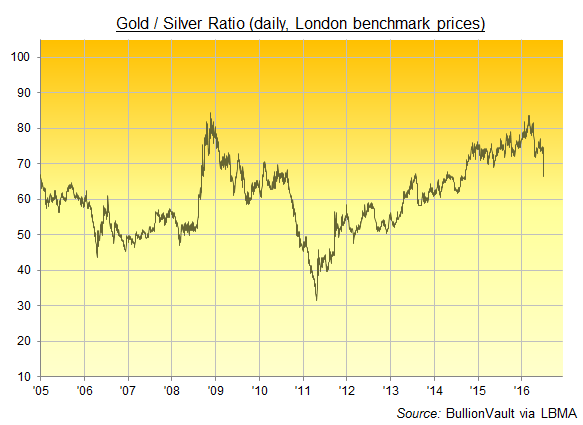
That crushed the Gold/Silver Ratio of the two precious metals’ relative prices to its lowest level since 2014, down sharply from January’s fresh 7-year highs.
Daily chart of the Gold/Silver Ratio, basis London benchmark, last decade
 
“Had we been in the London or NY time zone,” says a trading note from David Govett at brokers Marex Spectron in London, “it is highly unlikely that [silver] would have risen as far.
 
“Asia is a time zone with very little liquidity, especially on a Monday morning and this has without doubt added to the ferocity of the move.”
 
But having been overtaken Friday by the value of silver trading in Shanghai, spot gold surged back on Monday, with turnover jumping to the second highest ever, some 40% below Brexit Friday’s new record.
 
Shanghai’s silver trading held steady near record levels.
 
After the Bank of England said it stands ready to re-start QE money creation and bond purchases after the Brexit vote, “I am concerned that, in their quest to boost asset prices, central banks around the world have created another credit-induced gigantic asset bubble,” said Swiss money manager Marc Faber to CNBC.
 
“Precious metals will likely outperform cash and other financial assets in years to come,” Faber said. “Investors should accumulate here, or on any weakness…”
 
Rising gold prices already meant India’s official imports – the world’s largest behind China – fell by more than 50% during April to May compared with the same period last year, new figures show.
 
With gold-backed trust fund vehicles expanding quickly once more, speculation by hedge funds and other non-industry players in Comex gold futures and options rose again last week to another record level, data from US regulator the CFTC said Friday.
 
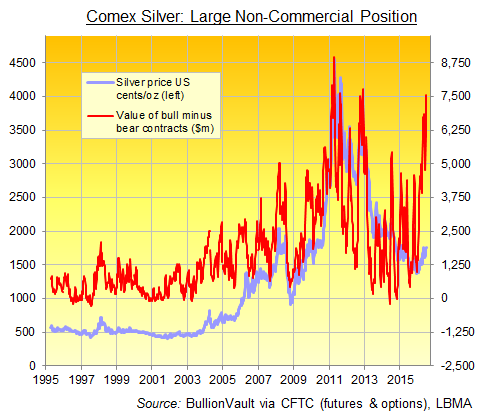
Speculation in silver also rose to another fresh record by number of contracts, approaching the all-time peaks of 2012 and 2011 in Dollar value.
Chart of Large Speculators' net long position in Comex silver futures and options combined
 
UK construction activity shrank at the worst pace since the depths of the 2009 global financial crisis in June, a new PMI survey from the Markit data agency said Monday.
 
Some 80% of responses by purchasing managers in the building sector were collected before 24 June’s result.
 
This week brings US jobs data for June with the private-sector ADP estimate on Wednesday, and then the official government estimate for non-farm payrolls on Friday.

Gold +24% in H1, Silver Hits 2-Year $19 High as Brexit Pushes UK to New QE

GOLD and SILVER both headed for new multi-year weekly closing highs in London trade Friday, extending their strongest 6-monthly gains since summer 2011 after the UK’s Bank of England said it is poised to start new quantitative easing money-creation and bond-buying in response to last week’s ‘Leave’ decision in the Brexit referendum.
 
Having repeatedly warned that Brexit risked causing recession for the world’s fifth largest national economy (now No.6 thanks to the Pound Sterling’s plunge), BoE governor Mark Carney last Friday said £250 billion stood ready to support UK banks and markets.
 
Plan beats no plan,” he said Thursday – widely taken as a jibe at UK politics’ fast-worsening infighting and paralysis – but “monetary policy cannot immediately or fully offset the economic implications of a large, negative shock.”
 
Priced in either British Pounds or the single Euro currency, gold bullion today headed for its highest weekly finish since 5 April 2013, the week before precious metals began their worst price crash in 3 decades.
 
Trading above £1000 per ounce Friday morning, gold bullion in June recorded its strongest monthly rise for UK investors since August 1982, gaining 18.8%.
 
UK finance minister George Osborne this morning abandoned his target of reaching a balanced budget by 2020.
 
Chart of gold priced in Sterling, weekly finish at London PM benchmark
 
Silver broke sharply higher overnight, rising through $19 per ounce to join gold bullion near 2-year highs in Dollar terms.
 
A close on Friday above $1336.50 in London trade would mark gold’s highest weekly finish since March 2014.
 
Swiss investment and London bullion bank UBS now forecasts a price above $1500 per ounce by early 2017.
 
“I am not prejudging the views of the other independent [Bank of England committee] members,” Carney said in his detailed speech Thursday, “[but] the economic outlook has deteriorated and some monetary policy easing will likely be required over the summer.” 
 
The Pound fell hard as Carney spoke, touching $1.32 but holding above Monday’s new 31-year low of $1.30 – over 13% below its level before the Brexit referendum result became clear.
 
The Bank of England today holds £375 billion of UK government debt, maintaining its total holdings by buying more Gilts with the money from maturing bonds since additional quantitative was last made in July 2012.
 
UK base rates have now been held at a record low of 0.5% since March 2009.
 
Consumer-price inflation was last reported at 0.3% per year for May, but inflation expectations as measured by the Gilt market shot to 12-month highs on a half-decade horizon this week, above the Bank of England’s 2.0% target, as the likelihood of fresh QE, plus Sterling’s fall, drove traders to buy inflation-protected government debt.
 
With gold prices closing June 24% higher in Dollar terms for 2016 so far, UK fund managers Schroders yesterday said it will launch a new gold-mining investment fund, claiming that after “15 years of underperformance relative to the gold price, producers have become very cheap and are discounting gold prices significantly less than current spot.”
 
Major mining stocks have already jumped 154% higher from January’s record lows on the Philly Gold/Silver Index (XAU).
 
New data yesterday showed UK business investment shrinking than first estimated in Q1, down 0.6% from the end of 2015.
 
Consumer price deflation in Japan’s capital Tokyo held at 0.5% per year last month, first-flash estimates said overnight.
 
China’s Caixin survey of manufacturing managers’ sentiment worsened in June, its PMI index said Friday morning, holding negative for the 16th month running.

Gold Prices Steady as 'Brexit = Lehmans', Worst 'Yet to Come', Chaotic UK Parliament Debates Lindsay Lohan Tweets

GOLD PRICES held tight at this week’s opening level on Thursday in London, trading at $1317 per ounce as the rebound in Western stock markets stalled and the leadership race for both the UK’s ruling and opposition political parties grew yet more fractious.
 
The US Dollar and Japanese Yen eased further back however from last week’s ‘safe haven’ surge following the UK’s shock Brexit vote.
 
Major government bond prices also eased, edging 10-year US Treasury yields up to 1.50% per annum from this week’s new 4-year lows.
 
The British Pound meantime continued to edge higher on the FX market, but held 10% down from this time last week.
 
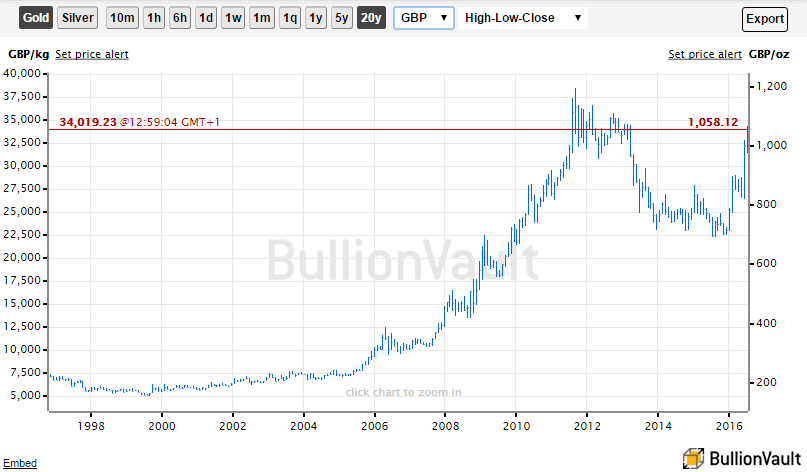
Gold prices for UK investors held above £980 – a level first seen 5 years ago this week, barely two months before gold’s all-time Sterling price peak some 21% higher.
 
Chart of gold priced in British Pounds, last 20 years
 
“The worst is yet to come,” reckons currency strategist Marc Chandler at US bank Brown Brothers Harriman, saying “it may take a few weeks before the shock feeds into economic reports.”
 
With Britain’s political leadership in turmoil after the Brexit result, “Sterling’s [small] gains do not appear to reflect fundamental developments,” says Chandler. 
 
Five MPs today threw their hat into the ring to replace current Conservative Party leader and UK prime minister David Cameron.
 
Presumed front-runner Boris Johnson – former Mayor of London, and a key Brexit campaigner – pulled out of the race after his pro-Leave partner Michael Gove stunned political pundits by declaring his own bid for the job, saying Johnson “cannot provide…leadership.”
 
Political betting moved to make Home Secretary Theresa May the odds-on favorite for both the Tory and government leadership.
 
Britain’s opposition Labour Party meantime saw former minister Angela Eagle declare she will stand against current leader Jeremy Corbyn, who lost a vote of no confidence amongst parliamentary colleagues by a landslide on Tuesday.
 
British MPs attending the House of Commons today discussed Twitter comments made last week by US actress and celebrity Lindsay Lohan.
 
“A number of commentators have sought to reassure investors that the events of last week were not ‘a Lehman moment’,” writes Geoff Candy at investment professionals’ site Portfolio Adviser today, “[because] Brexit is not a financial event” but a political move.
 
“But a vote by the UK to leave the European Union was a powerful blow against globalisation,” Candy notes, “and investors should be prepared for its impact.”
 
Brexit has “unleashed” a crisis of asset-price falls and deflation, legendary speculator George Soros today told the European Parliament in Brussels.
 
“This has been unfolding in slow motion, but Brexit will accelerate it. It is likely to reinforce the deflationary trends that were already prevalent.”
 
Commodity prices, however, are set to end June with the largest quarterly rise since 2010, gaining 13% on average according to the Bloomberg Commodity Index but still halving their peak of 2011.
 
Britain’s largest bank, bullion market maker and vault operator HSBC, meantime confirmed its headquarters will stay in London on Thursday, repeating a decision taken in February.