Author Archives: City Gold Bullion

Gold Bullion Jumps Before Fed Rate Decision on 4% Plunge in US Durable Goods Orders, But Top ETF Shrinks Again

GOLD BULLION rose in a tight trading range Wednesday in London, regaining last week’s close of $1325 per ounce after new US data – released before today’s July interest-rate decision from the Federal Reserve – showed orders for fridges, washing machines and other durable goods sinking 4% in June, the worst drop in almost two years.
 
Major government debt yields fell as stockmarkets rose with bond prices and the Yen retreated from Tuesday’s spike after Japanese prime minister Abe announced a new stimulus package worth $265 billion.
 
Gold bullion also rose for Eurozone investors, also reclaiming last week’s finish at €1205 per ounce, but silver rose faster, breaking back above €18 per ounce and also jumping 1.1% against the Dollar to reach $19.89.
 
Silver’s largest bullion-backed exchange-traded fund, the iShares Silver Trust (NYSEArca:SLV) ended yesterday with its holdings unchanged at 10,842 tonnes, equal to one-third of last year’s total global demand.
 
But Tuesday saw the giant SPDR Gold Trust (NYSEArca:GLD) lose gold bullion for the third time in 4 sessions and the seventh time in the last 3 weeks – the most consistent run of net investor liquidation from the world’s largest such vehicle since mid-April.
 
The GLD has only shrunk on 27 out of 142 trading days (19%) so far in 2016, growing instead on 69 days (49%).
 
Across the previous 3 years, the GLD added metal on just 101 of a total 755 trading days (13%), shrinking 297 times (33%).
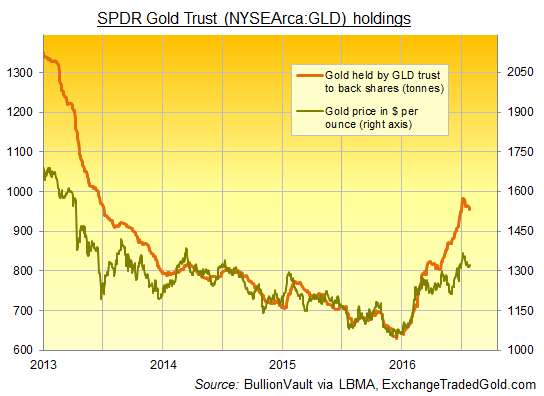
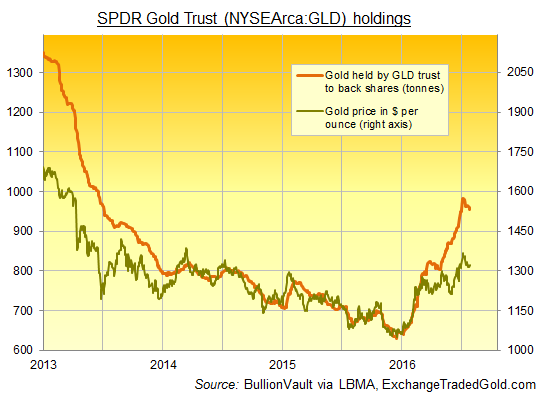
Chart of the GLD's reported gold backing to 26 July 2016
 
Exchange-traded gold trust demand outweighed buying from the world’s top two consumer markets of China and India in the first half of 2016, notes the Business Standard, summarizing yesterday’s new 2016 Gold Survey Update from specialist analysts Thomson Reuters GFMS.
 
India’s traditionally huge market has seen “crazy low” gold demand so far in 2016, industry executives agreed at a conference in Agra last weekend.
 
“China’s total gold demand remained in freefall in the second quarter,” says the latest GFMS report, thanks to a “cocktail of factors” including economic weakness, rising living costs, and worsening unemployment in the manufacturing sector all hitting discretionary spending.
 
China’s gold consumption fell almost 8% in the first half of 2016 compared to the same period last year, dropping below 529 tonnes according to the state-owned Shanghai Securities News, apparently citing data from the government-mandated China Gold Association.
 
That contrasts with a 12% rise in gold bullion imports through Hong Kong, showing that “gold demand in China has picked up again noticeably in the second quarter after getting off to a subdued start to the year,” says analysis from German financial services group Commerzbank.
 
Mining output from China – the world’s top producer since 2007 – held firm at 229 tonnes, Shanghai Securities News adds.
 
Gold prices in Shanghai today fixed unchanged from Tuesday afternoon, but cut their premium over comparable London quotes to $1.30 per ounce as the Yuan steadied on the currency market, gaining half-a-per-cent from mid-July’s new 5-year lows against the Dollar.
 
The British Pound meantime held flat – buoying gold bullion prices at last week’s finish of £1008 per ounce – despite UK economic output growing 0.6% in Q2 from the first 3 months of the year according to new data from the Office for National Statistics.
 
All that growth came in April, ahead of end-June’s Brexit result in the UK’s referendum on leaving the European Union, according to analysis from independent consultancy Capital Economics.
 
UK retail sales then fell at the fastest pace in more than 4 years in July, according to one business group’s latest survey.
 
“Orders placed on suppliers dropped at the quickest pace since March 2009” – the crash low in world stockmarkets after Lehman Brothers collapsed – the CBI’s new Distributive Trends Survey goes on.
 
The UK Government yesterday raised 50-year debt at a negative real yield of 1.3% per year on inflation-linked bonds.
 
“The debt issue was oversubscribed, attracting offers of £10.1bn,” says money manager site FundStrategy, “with 93% of buyers coming from the domestic UK market.”
Gold Prices Slip as Yen Jumps, GLD Shrinks, India Demand 'Crazy Small', China Imports Retreat

GOLD PRICES retreated from an overnight rally in London trade Tuesday, dropping back below $1320 and hitting 2-week lows vs the Yen as the Japanese currency soared on speculation that the Bank of Japan won’t unleash extra stimulus in Friday’s policy announcement.
 
Betting on US interest-rate futures again put the odds of a rise to 0.75% at Wednesday’s Federal Reserve meeting at less than 1-in-20.
 
China’s main stock index rose 1.2% but held below mid-July’s new 2016 highs, while Japan’s major equities lost 1.4% as the Japanese currency rose at its fastest pace since the UK’s late-June Brexit referendum result, pushing the gold price over 3% below  last week’s 4-month highs.
 
London’s largest shares edged higher, but property shares fell again after UK real estate developer Capital & Counties Properties Plc (LON:CAPC) – already trading 40% below last summer’s all-time high – fell 4% as it wrote off £200 million of a £1.6bn land holding in West London, blaming the Brexit result for lower expected sales and property prices.
 
“A fairly soft start to the week for gold,” says the Australian trading desk of Swiss refiner and finance group MKS, “the metal coming under early selling pressure from both spec[ulative] and Asian physical [traders].”
 
“The first half of 2016 had seen a dramatic change in the rhythm and flows of the gold industry, even long before Brexit,” says the latest quarterly update on demand and supply from specialist analysts Thomson Reuters GFMS.
 
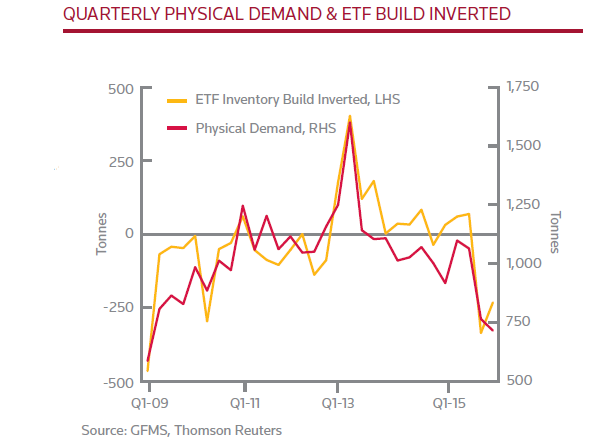
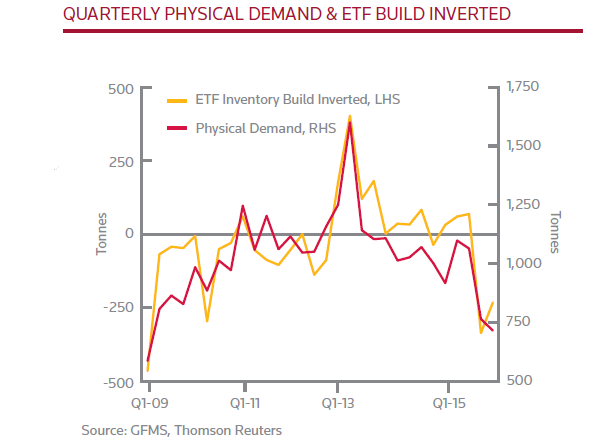
Contrasting with investment demand for gold-backed ETF vehicles – which set a new half-yearly record in the first 6 months of 2016 – overall phyical demand “was down by more than a fifth year-on-year to a seven-year low, with Asian offtake being exceptionally weak,” GFMS says.
 
Chart of ETF gold demand vs physical offtake from GFMS' Gold 2016 survey update Q2
A new industry event in India – formerly the world’s No.1 consumer market – heard at the weekend that inflows have collapsed in 2016 so far thanks to a mix of high duty, near-record prices, and changing household spending.
 
“It’s crazy how small the amounts moving are,” the Platts news and data agency quotes one senior logistics manager at the the inaugural Bullion Federation conference in Agra.
 
“You find me someone [who’s making money in India],” added a senior banker – “it’s impossible.”
 
Indian prices have, so far in 2016, averaged a discount to London of $22 per ounce according to Platts.
 
Gold imports to China through Hong Kong last month fell 40% or more according to new data released Tuesday morning, dropping to 69 tonnes.
 
That still shows a 69% annual increase for net imports year-to-date however.
 
“Jewelry consumption usually comes down when prices rise,” Bloomberg quotes Jiang Shu, chief analyst at the Shandong Gold mining company’s financial management division.
 
“As we can see, domestic demand isn’t that strong. Jewelry holdings per capita are at the global average, so there’s not much room to grow.”
 
Chinese Yuan gold prices this month hit 3-year highs, before retreating as the Dollar price has dropped 4% from its peak at $1375 per ounce.
 
Monday saw the world’s largest gold ETF, the SPDR Gold Trust (NYSEArca:GLD) shrink by 0.5% to 958 tonnes as shareholders liquidated positions, retreating further to its smallest size in July from the 2-year peaks hit mid-month.

Gold Bullion falls as markets wait for central banks’ decisions this week.

GOLD PRICES slipped 0.4% on Monday in London against the dollar  as world stock markets traded cautiously ahead of the FED and BOJ meetings this week, writes Atsuko Whitehouse at BullionVault.

The Nikkei share average climbed at the start but ended flat. FTSE 100 marked near one- year highs before turning negative after the publication of the CBI’s industry survey.

DAX gained 0.63% and but the CAC 40 was down 0.06% in afternoon activity. In early trading the Dow Jones was down 0.44%.

The Dollar index hit a 4 month high last Friday of 97.59 but has slipped slightly to 97.39 this morning.

The Federal Reserve will deliver its latest policy decision this Wednesday.

“Markets have recently repriced somewhat higher the chances for rate hikes this year, with around a 25% market-implied probability by September, and just over a 45% probability by December,” Ethan Harris, economist at Bank of America notes, reported the Financial Times.

Mr Harris continued, “We would not expect the July FOMC statement to materially change those probabilities, as we do not anticipate any substantive changes: the Fed is still watching the post-Brexit data evolve and should remain cautious overall.”

On Sunday a communique issued by the G20 ministers at the end of the two-day meeting in China said Brexit had added to uncertainty in the global economy where growth was “weaker than desirable”. It added that members, however, were “well positioned to proactively address the potential economic and financial consequences”.

“In light of recent developments, we reiterate our determination to use all policy tools – monetary, fiscal and structural – individually and collectively to achieve our goal of strong, sustainable, balanced and inclusive growth.”

The Bank of Japan meets this Friday to decide whether to apply yet more economic stimulus.

Last week The Governor of the Bank of Japan Haruhiko Kuroda ruled out the idea of using “helicopter money” – or directly underwriting the budget deficit – to combat deflation in an interview, recorded in mid-June by BBC.

After these remarks and also the ECB not changing financial policy the Dow Jones Average fell more than 79 points on 22nd July.

Following early July’s all-time record high Hedge funds and other money managers last week cut their bets for a second straight week. However, it still remains close to all-time highs.

As for Silver, Net long positions on US commodity exchange COMEX jumped 7% in the week to 19th July, setting a fresh record.

Silver price in US dollar on Monday morning also dipped 1%.

The gold/silver ratio hit near a two year low of 65.64 on 14th July but is rising to 67.64 London lunch time. 

Gold Price Reclaims £1000 as UK Moves to 'Reset Austerity' with QE, 'Helicopter Money' Forecast Worldwide

GOLD PRICES headed for a second weekly fall against the Dollar today, down 1.1% from last Friday’s finish but recovering almost all this week’s 2.1% drop against the Pound as analyst chatter over new QE and ‘helicopter money’ grew after survey data said the UK economy is contracting at the fastest pace since the global financial crisis of early 2009 following the Brexit vote to leave the European Union.
 
The British Pound sank 1.5% – but held above the new 31-year lows of a fortnight ago – after Markit’s first-flash PMI report for July recorded the series’ steepest ever decline on both the Composite Output index and the Composite New Orders index.
 
New export orders, however, rose for the second month running, reaching near 2-year highs “mainly linked to the sharp drop in the sterling exchange rate,” according to Markit.
 
Gold prices for UK investors rose sharply to £1010 per ounce, just below last week’s finish at £1013.
 
New UK chancellor Philip Hammond said he will “reset fiscal policy” if data continue to worsen following the Brexit vote.
 
Hammond’s boss, new UK prime minister Theresa May, has already abandoned the previous Conservative leadership’s long-delayed aim of achieving a balanced budget by 2020 through its “austerity” program of cutting government spending.
 
On monetary policy, “The Bank of England has not done anything as yet,” notes Steve Barrow, FX strategist at investment and bullion bank ICBC Standard, “which says much about the relative robustness of the banking sector compared to some past crises.
 
“But action seems certain in August,” Barrow adds, forecasting a rate cut to new all-time historic lows of 0.25% in base rate plus up to £100 billion new quantitative easing – a rise of over 25% from the £375bn of government bond-buying already done.
 
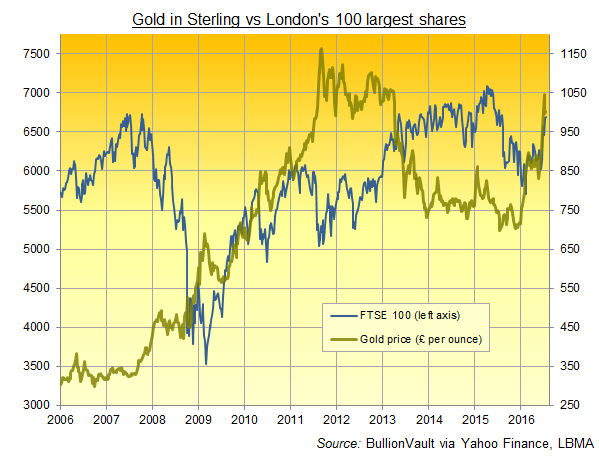
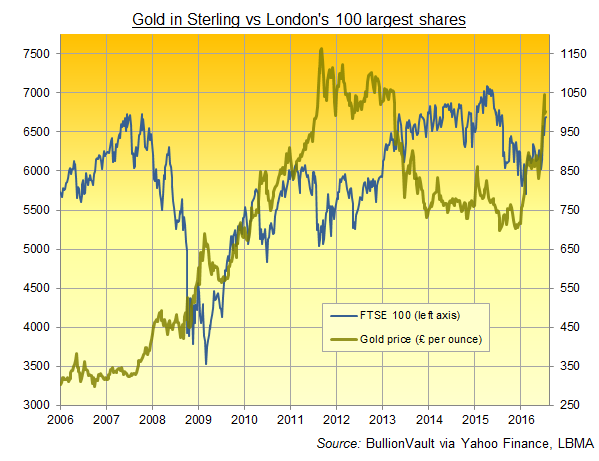
The gold price in Sterling today traded 68% higher from when the Bank of England first began QE in March 2009, and held little changed above £1000 per ounce from when the last “injection” was made in July 2012.
 
London’s FTSE100 share index has meantime risen 71% and 19% over those periods.
Chart of the gold price in Sterling vs London's 100 largest shares
“I always thought the next global recession would force central bankers to climb into their helicopters,” says French investment and bullion bank Societe Generale’s strategist Albert Edwards, referring to economist Milton Friedman’s 1969 coinage of ‘helicopter money’ for central banks creating money and handing it straight to government, consumers or business.
 
“But we are getting mighty close to the abandonment of all pretence of monetary rectitude…A brave new world of direct, off-balance-sheet monetary alchemy awaits.”
 
Speculating on last week’s visit by former US Fed chairman Ben Bernanke’s to the Bank of Japan’s Haruhiko Kuroda – news which “pushed macro-[economic] scribblers into a frenzy of excitement,” says Edwards – “at last the [money] copters are being readied and central bankers can drop this disingenuous flimflammery of whether or not their QE easing programmes are really monetisation,” he concludes.
 
To date, the distinction between quantitative easing and helicopter money has been that QE money will eventually be withdrawn and cancelled as the central bank sells the assets bought with it.
 
After 15 years of QE and now applying negative interest rates to commercial banks, “We are only halfway to the exit from deflation,” Japanese prime minister Shinzo Abe told Bernanke in Tokyo last week. “We want to be steadfast in accelerating our breakaway.”
 
In 1999, whilst still a Princeton professor and before joining the Federal Reserve, Bernanke famously attacked the Japanese government and central bank for “self-induced paralysis” a decade on from the Tokyo real estate and stockmarket crash.
 
“Some intragovernmental cooperation would be required,” Bernanke said, if the Bank of Japan was going “to rain money on the population” as he advised – a policy he then suggested the US could utilize to defeat the risk of deflation in a 2002 speech as Fed governor, some seven years before he began QE as head of the US central bank.
 
Like the Dollar gold price – trading at $1324 lunchtime Friday in London – gold priced in Euros meantime halved the week’s earlier 1.9% drop, holding above €1200 per ounce as Asian stock markets closed lower but Western equities ticked up.
 
Having discounted all likelihood for some weeks, betting on US interest-rate futures now sees a 2.4% change of the Federal Reserve hiking its key rate for a second time in 7 years to 0.75% at its meeting next week.
 
Those odds rise to almost 1-in-5 for the Fed’s September meeting.

Gold Investment Slows, Soft Summer 'Risks $1300' But Bond Defaults 'Will Spike' as Japan, Eurozone Deny Fresh Stimulus

GOLD INVESTMENT prices rose from 3-week lows but struggled to hold gains versus major currencies on Thursday as world stock markets retreated from new all-time highs amid news that neither Japan nor the Eurozone plan to add more monetary stimulus for the time being.
 
Briefly topping $1320 per ounce, €1200 in Euros and £1000 for UK investors, gold edged back at lunchtime in London as the European Central Bank announced no change to either its QE bond-buying or zero refinancing rate, nor a further cut to its 0.4% negative interest rate on commercial bank deposits.
 
European equities meantime slipped for the first session in five as commodity prices edged higher with major government bond yields.
 
Investment gold had earlier sunk 1.1% versus the Yen, briefly falling below ¥4,500 per gram as the Japanese currency soared following a BBC interview with Bank of Japan chief Haruhiko Kuroda in which he ruled out printing and giving money to government or business – so-called ‘helicopter money’ – to try and end 27 years of asset-price, GDP and consumer-price deflation.
 
The Yen then slipped, and gold rallied, as the BBC said the interview was recorded in mid-June, before the UK’s Brexit referendum result.
 
“In quiet [summer] conditions,” says a note from global investment and London bullion bank HSBC’s James Steel, “the gold market may gravitate to the vicinity of large round numbers, with $1300 the closest and most obvious.
 
“[But] there may be limits to further declines. Geopolitical risks remain. This should help cushion [gold prices].”
 
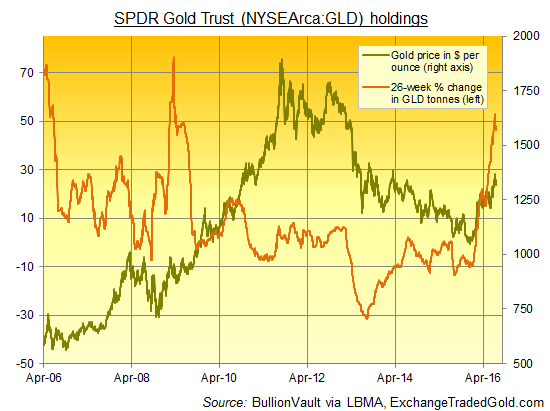
A key investment vehicle for money managers wanting exposure but not ownership of gold, the giant SPDR Gold Trust (NYSEArca:GLD) ended yesterday reporting 865 tonnes of gold held to back its shares – a failure to grow for more than two weeks not seen since April.
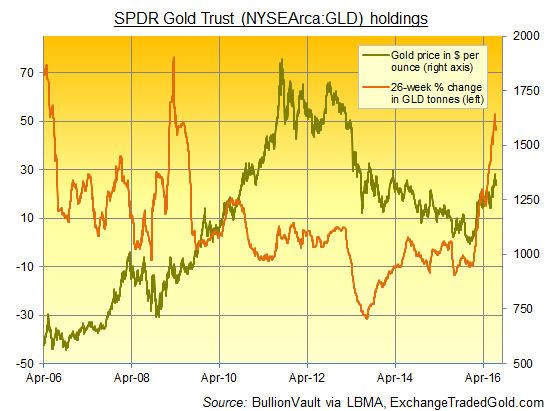
Chart of the SPDR Gold Trust's reported bullion backing, 26-week percentage change
 
The GLD remains 50% larger from the end of 2015 however, with demand for the shares growing at its fastest pace since the US and world stock markets hit 13-year lows in early 2009.
 
“A correction in global credit markets is unavoidable,” said the S&P ratings agency on Wednesday, warning that “nearly half of corporate debt issuers are estimated to be highly leveraged.”
 
That risks a “spike” in defaults, “likely through the next few years.”
 
Looking at Italy’s €360 billion of sour banking loans, “The scale of Italy’s economy would make any crisis a Greece-on-steroids drama,” says the latest weekly analysis from specialist bullion analysts Metals Focus, looking at the potential impact on gold investment and prices.
 
“During a recent field trip to Italy [however], locals were typically quite sanguine about the whole matter, hinting that international press coverage has often been exaggerated and that ‘problem’ not ‘crisis’ is the better description.”
 
A referendum on constitutional reform scheduled for October “is expected to turn into a vote of confidence on [Prime Minister Matteo] Renzi and on the EU’s handling of the economic crisis,” says EUobserver.com, pointing to growing support for the left-leaning 5 Star Movement and even an EU exit following the UK’s June decision. 

Gold Mining Output Rising, Spending 'Relaxed' on 2016 Jump But Stocks Drop with Bullion Price

GOLD MINING stocks slipped as bullion prices fell to 3-week lows in London on Wednesday, while broader equities rose globally and the Euro fell ahead of tomorrow’s European Central Bank decision on QE and negative rates for the 19-nation single currency zone.
 
Gold mining stocks retreated after earnings season began with a raft of strong results from non-US producers, with executives vowing to keep increasing output.
 
Gold priced in the US Dollar dropped below $1320 per ounce in wholesale trade, and slipped beneath €1200 for Euro investors – a 3-year high when first reached on the UK’s Brexit referendum result on leaving the European Union in June.
 
Turkey’s central bank has meantime “stepped in very effectively to provide liquidity” to local financial markets since the weekend’s failed apparent coup attempt in Ankara and Istanbul, said IMF chief economist Maury Obstfeld last night.
 
“We would anticipate in our baseline that things will settle down.”
 
With 21,000 teachers and lecturers already sacked, and all foreign travel by university academics now banned, the Moody’s ratings agency downgraded the credit status 17 Turkish banks as the Turkish airforce launched its first attack on rebel PKK Kurdish separatists since the weekend’s coup attempt.
 
The US Dollar today pushed the Euro down near 1-month lows beneath $1.10 ahead of Thursday’s ECB decision and press conference.
 
US Treasury bond prices eased back, nudging yields on Washington’s 10-year debt up at 1.59% per year.
 
“The strong rally in gold [so far in 2016] is symptomatic of a world beset by uncertainty,” says South African investment bank Investec’s Hunter Hillcoat.
 
“With approximately one quarter of all government bonds having negative yields, a non-interest bearing asset class appears increasingly attractive…Gold therefore remains our favoured commodity exposure in these challenging and uncertain times.”
 
“Despite strong recent gains,” writes Tocqueville gold-mining stock fund manager John Hathaway, “we believe that the current alignment of politcal and economic factors is unusually compelling.
 
“In our view, substantal gains lie ahead.”
 
“The overall trend is up,” says Bill Beament, managing director at Australian gold miner Northern Star Resources Ltd (ASX:NST), reporting full-year output at the top end of its half-million-ounce forecast range, “because of what’s happening with the…economies around the world.”
 
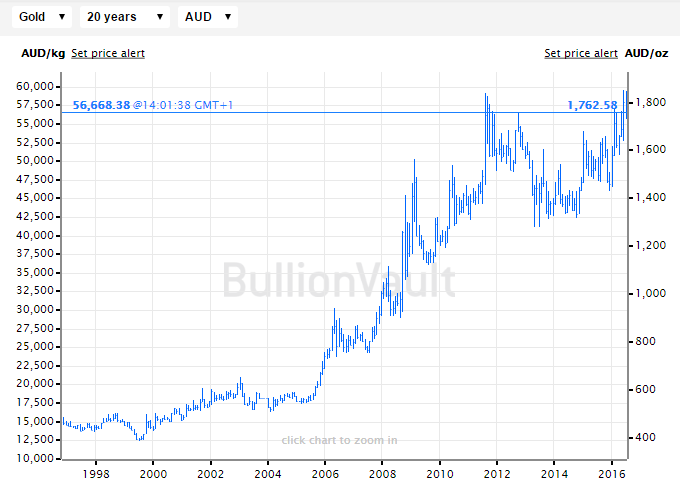
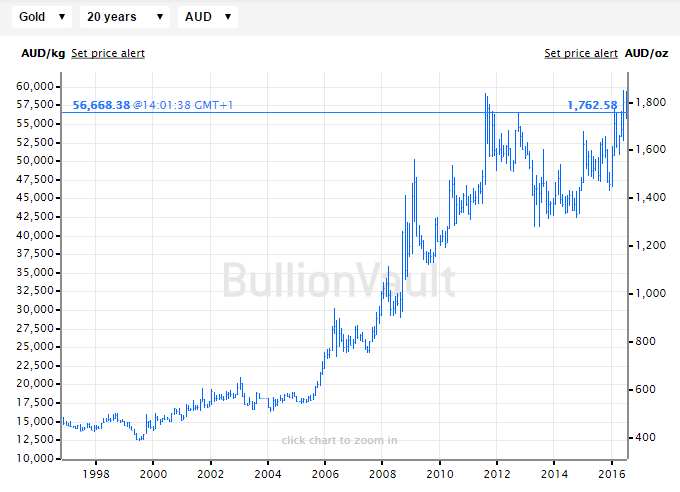
Priced in the Australian Dollar, gold bullion ended its slump from the 2011 peaks in spring 2013, rising 15% by the start of 2016 and now setting new all-time highs after the UK’s Brexit referendum result. 
 
Chart of the gold price in Australian Dollar terms, last 20 years
 
Northern Star’s stock price has almost doubled in 2016 to date, and nearly trebled in the last 12 months.
 
South African No.1 Gold Fields yesterday reported a 2.7% rise in second-quarter output.
 
“With gold prices posting the best first half in almost four decades,” says Canada’s Financial Post, “the coming round of earnings reports may provide signs miners are preparing to ease their collective death grip on spending…[after] deferring projects, curtailing operations and otherwise slashing costs and debt as prices declined for three years in a row.”
 
Analysts had forecast that global gold mining output would fall in 2016, dropping from the last seven consecutive years of new record highs.
 
“Scattered producer hedging by non-US companies continues,” says the latest precious metals analysis from China’s ICBC Standard Bank team in London, pointing to metal borrowing and sales by mining producers to lock in current prices.
 
South African producer Harmony Gold (JSE:HAR) is now hedging one-fifth of its production for the next two years, locking in an average price of ZAR682,000 per kilo – a record high price in Rand terms.
 
London-listed silver mining giant Fresnillo (LON:FRES) meantime said Wednesday morning it expects full-year output to rise 6%.
 
Silver prices doubled today’s 1.4% drop in gold, retreating near 2-week lows at $19.50 per ounce.
 
Shares in Fresnillo have almost trebled so far this year, but dropped 4.5% by early afternoon Wednesday.

'Radical Uncertainty' Post-Brexit Holds Gold Firm as Nato No.2 Turkey 'Warns' US Over Coup 'Mastermind'

GOLD BULLION held firm against a rising US Dollar on Tuesday, bucking a small drop across commodities and global stock markets as claims and counterclaims continued over the weekend’s apparently failed coup attempt in Turkey.
 
German economic confidence sank on the latest ZEW survey, dropping to its worst level since late 2012 following the UK’s Brexit vote to quit the European Union on 23 June.
 
Brexit could cost the 19-nation single currency Eurozone 0.5 percentage points of GDP growth in 2017, the European Commission said, while the same “severe scenario” could see a cumulative 2.6 percentage point hit to the UK’s own economy.
 
Turkey’s central bank meantime cut its key lending rate for a fifth month running, driving the Lira further down towards 2013’s all-time lows on the FX market, even as the CBRT said it will maintain a “tight monetary policy stance” amid rising inflation expectations.
 
That drove gold bullion prices for savers and investors in what used to be the world’s No.4 consumer nation back towards this month’s fresh all-time record highs above TRY 128 per gram.
 
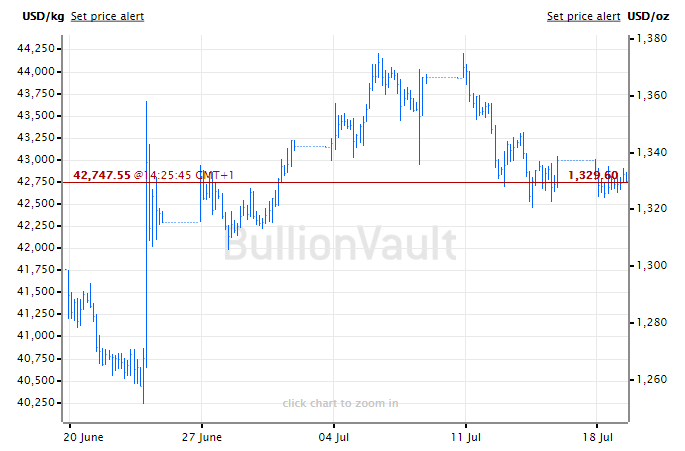
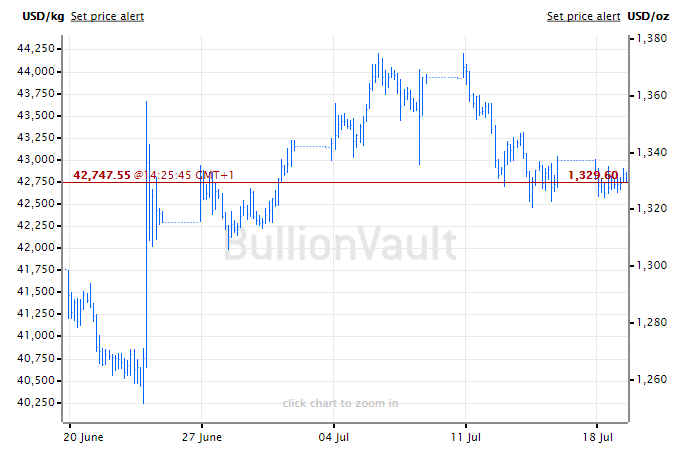
Trading at $1330 per ounce Tuesday lunchtime, gold bullion in Dollars “is now fully priced relative to US real interest rates, and the implied probability of a Fed rate rise this year has fallen close to zero,” says the latest analysis from Ton Kendall at China-listed ICBC’s Standard Bank commodities unit in London.
Chart of the gold bullion price in US Dollars, last 1 month
“Nevertheless, any correction is unlikely to be too deep. A drop…back to the $1280/60 area would likely be well bid, both from investors who missed the initial punch over $1300 and from parts of the jewellery market.”
 
More broadly, “We seem to be entering an era where politics again dominates economics in shaping market outcomes,” says a new analysis from bond-fund giant Pimco economist Joachim Fels.
 
“Radical uncertainty may be even more acute today than it has been over the past several decades,” says Fels, quoting a phrase coined by former Bank of England chief Mervyn King.
 
Following Turkey’s apparent coup attempt at the weekend, a total of 103 generals and admirals have now been detained, according to the Anadolu news agency.
 
With 2,500 battle tanks and 340 attack helicopters, Turkey – formerly the world’s No.4 gold consumer market, but overtaken by Germany – is the second-heaviest armed member of Nato behind the United States.
 
Prime Minister Binali Yıldırım today repeated Turkey’s demand that Washington extradite self-exiled opposition cleric  Fethullah Gulen, warning that “Turkey may question its friendship with the US.”
 
Deemed the “mastermind” of Friday night’s failed coup, Gulen again rejected Ankara’s accusations, suggesting that the violence was staged by supporters of elected President Tayyip Erdogan to enable a “witch hunt” of opponents.
 
Erdogan last night told US broadcaster CNN that instituting the dealth penalty for the plotters “could not be ruled out” – something which officials from the European Union were quick to remind Ankara is illegal under the region’s Human Rights legislation, potentially blocking any hope of Turkey joining the economic zone.
 
Sporadic violence meantime continued, with 3 police officers shot dead in the Black Sea province of Trabzon while pro-government rallies in predominantly Sunni Muslim Turkey’s eastern region of Malatya warned not to antagonise the minority Shia group of Alevi adherents.
 
Electrical power to the US airbase at Incirlik, from where drones and fighter jets leave to strike the Islamic State group in neighboring Syria, remained cut off for a third day Monday, according to the USA’s European Command spokesman.
 
Gold bullion for UK investors meantime recovered last week’s closing level at £1114 per ounce as the Pound weakened.
 
UK inflation rose in June towards an 18-month high, touching 0.5% per year on official data before the impact of Sterling’s post-Brexit slump to 3 decade lows on the forex market reached High Street prices.
 
A lawyer for the UK government today said new Conservative Party leader and prime minister Theresa May will not trigger Article 50 – officially marking the start of the UK’s exit – before the start of 2017.

Gold Prices Lose Turkey Coup Spike as Equities Gain, Hedge Funds Cut Bets, GLD Shrinks

GOLD PRICES fell to $1325 per ounce Monday morning in London, retreating as world stock markets edged up to new all-time highs after the weekend’s failed military coup in Turkey, writes Steffen Grosshauser at BullionVault.
 
Holding above last Thursday’s 2-week low, gold prices traded 0.6% below late Friday’s spike, made as the initial news broke during the typically quiet end to US electronic trading after the New York Comex closed.
 
With over 200 dead, 3,000 soldiers arrested together with as many judges and lawyers, and a further 8,000 police officers suspended, the Turkish government blamed the attempted coup on supporters of exiled moderate cleric Fethullah Gulen.
 
Gulen in turn accused President Tayyip Erdogan’s government of launching the coup as a ‘false flag’ operation, the better to start a putsch against opposition leaders.
 
Gold prices ended Friday with the first weekly decline in seven as stronger US retail sales and an uptick in consumer price inflation saw traders grow their betting that the Federal Reserve will raise interest rates at its September meeting.
 
The central bank’s next economic policy meeting will take place 26-27 July. http://www.bloomberg.com/news/articles/2016-07-18/gold-extends-decline-a…
 
“The better US data on Friday clearly got people starting to think the Fed could actually hike this year,” says Wayne Gordon, executive director for commodities and foreign exchange at Swiss bank and bullion market-maker UBS.
 
“It’s not something that the market has priced, but certainly it will be a negative event for gold.”
 
“The market has yet to deal with the political uncertainty going into the 8 November [US] presidential election,” counters Benjamin Wong, foreign exchange strategist at Singapore’s largest bank DBS, which also foresaw this year’s gold rally.
 
“Gold has seen four major bull markets since 1970: this is another one.”
 
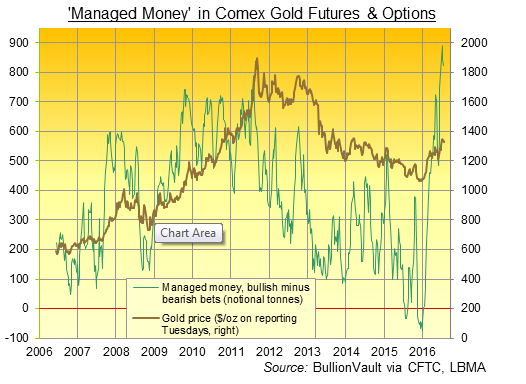
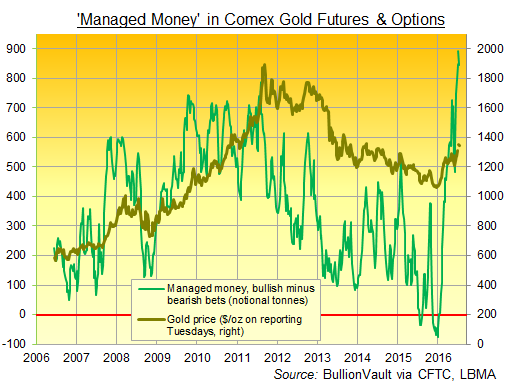
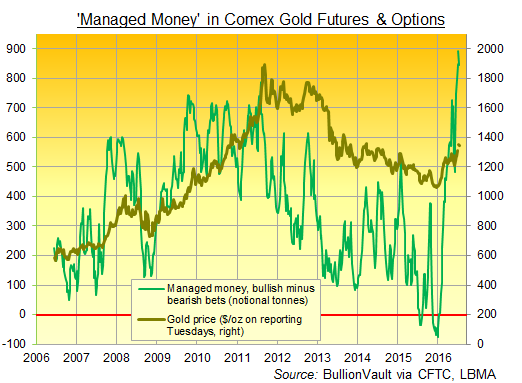
Hedge funds and other money managers last week cut their bets on a rising gold price and grew their bearish bets as a group, new data showed late Friday.
 
That trimmed the “Managed Money” category’s net speculative position in Comex gold futures and options from start July’s latest new all-time record high.
Chart of CFTC data on Managed Money category of Comex gold futures and options positioning
 
The SPDR Gold Trust (NYSEArca:GLD), the world’s largest exchange-traded gold-backed trust fund, also shrank as shareholders sold, cutting the bullion needed to back the trust fund’s value by 1.9%.
 
Taking the GLD down below 963 tonnes of backing, that was the sharpest weekly outflow since the trust shrank to 6-year lows when the US Fed finally raised its key interest rate to 0.50% last December.
 
The world’s largest silver-backed ETF in contrast – the iShares Silver Trust (NYSEArca:SLV) – grew another 2% last week towards new 5-year records above 10,842 tonnes.
 
Silver tracked and extended the drop in gold prices on Monday however, falling back below $20 per ounce – a 2-year high when first reached on July 4 – with a 1.7% loss from the weekend.

Gold & Silver Miss 7th Weekly Gain as S&P Sets New Highs, Indian & Coin Demand Drop

GOLD and SILVER headed for their first weekly fall in 7 on Friday in London, dropping to $1330 per ounce and $20.20 respectively as world stock markets slipped back.
 
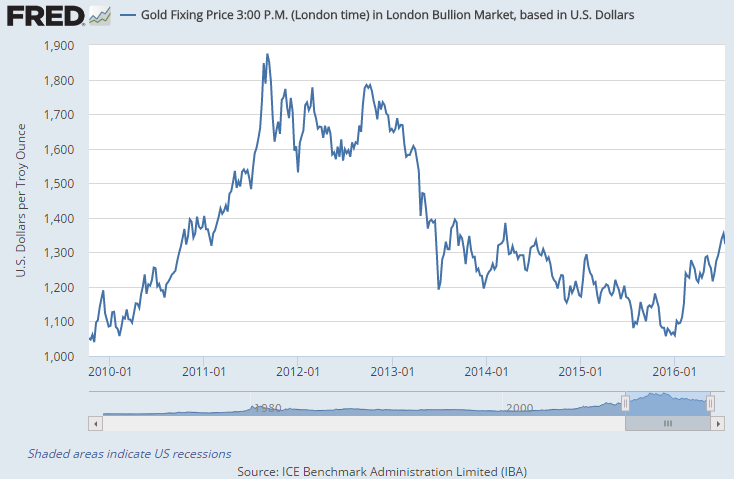
Rallying 0.6% from yesterday’s 2-week low, gold priced in Dollars was on track Friday to miss matching the 7-week run of gains seen as the metal neared its current all-time highs above $1900 per ounce in summer 2011.
 
Silver held closer to last Friday’s 2-year highs, outpacing gold’s 1% gain for July so far with a near-8% rise.
 
New York’s S&P500 index has now risen 3 weeks running, setting another new all-time closing high on Thursday.
 
Eurozone government bond prices slipped as details of the attacker in Thursday’s Bastille Day truck atrocity emerged, and energy and base metals ticked higher.
 
Food commodities fell, with corn prices dropping 1.6% to stem this week’s rally from late-June’s 20% plunge from 2-year highs.
 
Chart of Dollar gold price, weekly finish at London benchmark
 
“Retail [jewelry] demand is unlikely to pick up unless prices correct sharply,” says one Indian wholesaler quoted by Reuters today, with another telling the newswire that investors in India – formerly the world’s No.1 consumer market – “started selling as soon as gold prices went above 30,000 Rupees [per 10 grams].”
 
Reaching that level on gold’s global price surge amid the Brexit referendum shock, Indian prices have held at these near-record levels so far in July.
 
“Strong Indian or Chinese gold demand will rarely help drive prices materially higher,” says the latest Precious Metals Weekly from specialist analysts Metals Focus.
 
“However, this misses their key role in helping to provide a solid floor for the gold price.”
 
India’s silver market is glutted with supply, Bloomberg reports, citing estimates from Metals Focus’ analyst Chirag Sheth that imports “probably slumped by about 40% from [the record highs of] a year earlier in the first half,” with total 2016 imports likely to retreat by almost one-third.
 
Western investors trading price-tracker the iShares Silver Trust (NYSEArca:SLV) have expanded the fund’s silver backing by 2% this week, taking the bullion held towards 5-year highs at 10,842 tonnes.
 
But giant Western gold-tracking vehicle the SPDR Gold Trust (NYSEArca:GLD) has shrunk in contrast, now losing 20 tonnes from early July’s three-year record high holdings of 982 tonnes.
 
“Soaraway silver [looks] ill at ease with fundamentals,” says the latest precious metals analysis from French investment and bullion bank analyst Robin Bhar, warning that silver’s “sharp price gains [are] unlikely to be maintained.
 
“Given that gold and silver prices have hit their highest levels since 2014, sales [of bullion coins] by the US Mint could begin to soften over the coming months. Indeed, sales in June contracted 5% for gold and a steep 41% for silver bullion coins.”
 
Gold prices fell overnight in Chinese Yuan terms in Shanghai, but extended their premium over London quotes to more than $5 per ounce at the city’s official benchmarking auction.

Gold Prices Sink to 2-Week Low as Brexit-UK Gets No Rate Cut or New QE from Bank of England

GOLD PRICES fell to 2-week lows against all major currencies bar the Japanese Yen in London trade Thursday as the Bank of England surprised the markets by holding UK interest rates and its QE bond-buying scheme unchanged in response to late-June’s Brexit result in the referendum on leaving the European Union.
 
Falling to $1322 per ounce as Western stock markets rose once again, gold priced in Dollars has now lost almost 4% from Monday’s new 2-year high.
 
Gold had already fixed at its lowest Yuan price since 1 July at Shanghai’s afternoon benchmarking auction, with Swiss refinery MKS’s Asian desk reporting strong “selling interest [also] during early London trade.”
 
Silver was firmer once more, slipping only a little below last week’s finish to hold at $20.12 per ounce as New York trading began.
 
The Bank of England’s monetary policy committee defied analysts and market expectations with only 1 member of the 9-person team – economist and former bond strategist Gertjan Vlieghe – voting to cut rates from their current 0.5%, already the lowest ever rate since the Bank opened more than 3 centuries ago.
 
Sterling jumped to touch 2-week highs on the forex market, but then eased back as traders read the accompanying statement and 11 pages of minutes from yesterday’s meeting, concluded before new UK finance minister Philip Hammond was announced by prime minister Theresa May, herself only moving into No.10 Downing Street on Wednesday.
 
“Were the Bank going to do more quantitative easing,” notes SkyNews economics reporter Ed Conway, “it would have needed the Chancellor‘s approval…[but] at the time there was no Chancellor.”
 
“Most members of the Committee expect monetary policy to be loosened in August,” the Bank of England says.
 
“The precise size and nature of any stimulatory measures will be determined during…August.”
 
Gold priced in Sterling immediately sank £20 per ounce as the Pound recovered all of July’s losses to the Dollar on the news.
 
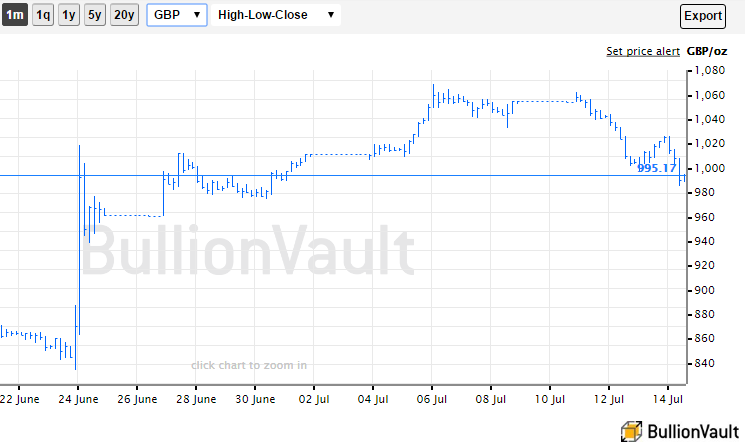
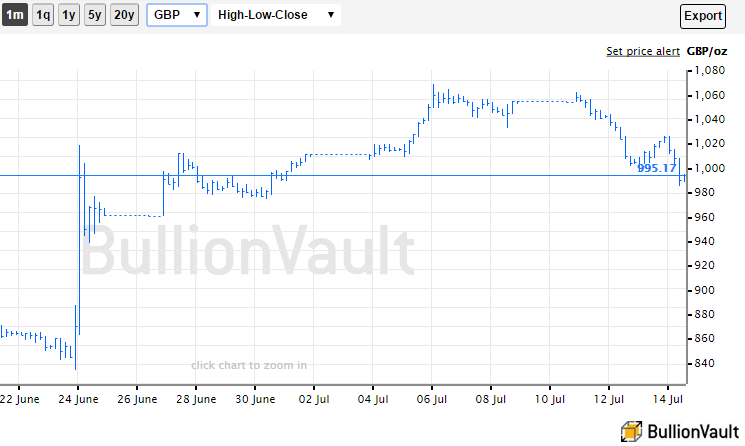
Chart of the gold price in British Pounds, Brexit vote to Bank of England's July decision
 
Dropping through £1000 for the first time this month, gold then rallied above £990 – a sudden 3-year high when reached by the spike of Brexit Friday – as the Pound then eased back.
 
London’s stockmarket erased an earlier 1% gain as the UK rate decision was announced, but Frankfurt and Paris pushed 1.5% higher for the day.
 
‘Safe haven’ currencies the US Dollar, Japanese Yen and Swiss Franc all slipped lower again on the FX market.
 
Major Western government bond yields all edged higher, suggesting lower investor tension, as their prices also retreated.
 
Betting on US interest rates now says there’s no chance of the Federal Reserve raising its key rate when it meets in a fortnight, and a 1.2% chance it will reverse last December’s hike instead.
 
The probability of a hike to 0.75% in September, however, jumped overnight from 1-in-10 to stronger than 1-in-6, with a 5% chance that the Fed’s ceiling on US rates will be raised to 1.00% by end-2016.
 
Although the UK is heading for only a short recession, reckons asset-management giant Blackrock’s CEO Larry Fink, the Brexit shock will reduce GDP growth by 0.5 percentage points or more for the next 5 years according to his economists.
 
But “even if the negative scenario holds,” says Nobel economist, Princeton professor and New York Times columnist Paul Krugman, “the pent-up investment spending that was put on hold should come back.
 
“This doesn’t just mean that the hit to growth is temporary: there should also be a bounce-back, a period of above-normal growth.”
 
UK house sales and prices both fell markedly on June’s Brexit result, the Royal Institution of Chartered Surveyors said Thursday, with RICS monthly survey saying that buyer enquiries fell for the 3rd month running to the lowest level since 2008, while 1-year price expectations amongst surveyors turned negative in London and eastern England.