Author Archives: City Gold Bullion

Gold Prices Rise Before Fed as Yen Defies Bank of Japan's Urgent New Inflation Plan

GOLD PRICES rose sharply against all major currencies except the Yen on Wednesday, touching 1-week Dollar highs ahead of the US Fed’s long-awaited September decision on interest rates as world stock markets rose after the Bank of Japan removed all time limits on its QE money-creation scheme and vowed to push inflation above its 2.0% target.
 
Chinese gold prices fixed higher on quiet volume before the Dollar price hit almost $1330 per ounce in London trade.
 
Silver prices rose faster, adding almost $1 per ounce from last Friday’s finish to hit 2-week highs of $19.72, as crude oil rallied for a second day, pulling broad commodity indices 0.8% higher against the Dollar ahead of the US Fed’s announcement, due at 13:00 Washington time (UTC -4).
 
Leaving its deposit interest rate at -0.1% and keeping QE asset purchases at ¥80 trillion per year ($780bn), the Bank of Japan on Wednesday said this summer’s “comprehensive assessment” of policy has led to a new regime of “Quantitative and Qualitative Monetary Easing with Yield Curve Control”.
 
Specifically, it will target keeping 10-year government bond yields at zero per cent while easing the rules for which other assets to buy at what prices, and removing all time-frames for ending its QE program.
 
The Bank also made a new “commitment to overshooting” its inflation target of 2.0% per year, vowing to “expand the monetary base…to shift peoples’ entrenched deflationary mindset…at the earliest possible time.”
 
Tokyo’s Topix stock index jumped 2.7% while Japanese government bond prices fell, briefly pushing 10-year JGB yields above zero for only the second time in 6 months before they retreated to offer new investors -0.04% per annum.
 
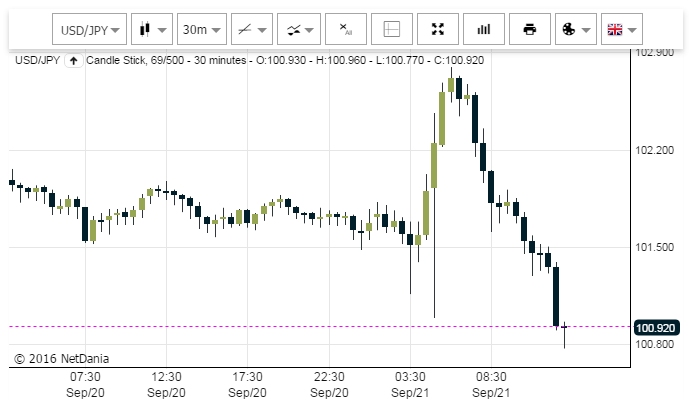
Gold priced in Yen initially jumped 1.6% as the Japanese currency weakened on the FX market.
 
But gold bullion for Japanese investors then retreated as the Yen swiftly reclaimed that drop, and the Dollar fell to new 4-week lows at ¥100.
 
New data today said Japanese exports fell almost 10% per year in August, the 11th consecutive monthly decline.
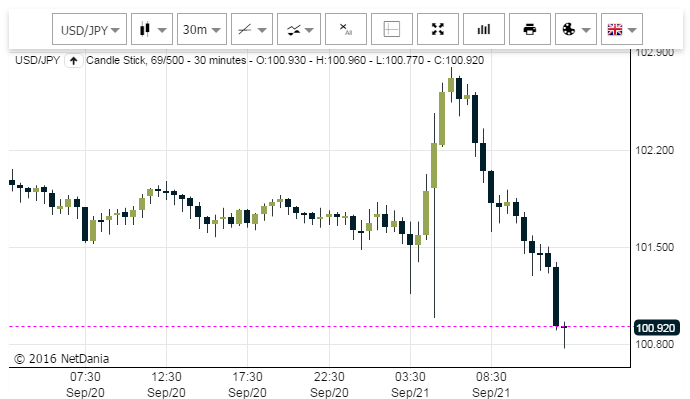
 
Chart of USD/JPY on 21 September 2016 from HIFX
 
“The Bank of Japan [is] seemingly gambling on the idea that US Treasury yields will rise as the Fed tightens policy,” says a note from Chinese-owned ICBC Standard Bank’s FX strategist Steven Barrow.
 
“So its decision to anchor 10-year JGB yields at zero could prove a masterstroke…potentially a clever way for the BoJ to lift dollar/yen while not falling foul of G20 accusations that it is engaged in currency manipulation.”
 
The Bank of Japan’s inflation target “overshooting promise [in contrast looks] somewhat odd,” notes University of Birmingham economics professor Tony Yates.
 
“No new [policy] instruments. Why should new higher target work when old one not hit?”
 
Ahead of the Fed decision meantime, “Support [in gold prices] is at $1306,” says technical analysis from Russell Browne at bullion bank Scotia Mocatta’s parent Scotiabank, pointing to the 100-day moving average of the gold price, “while resistance is at 1333 (50 day MA).
 
“The metal appears to be consolidating within this range over the last 7-8 days. Momentum has picked up slightly.”
 
“Within [gold’s recent] mildly descending channel,” says Stéphanie Aymes, head of technical analysis at French investment and London bullion market-making bank Societe Generale, “[the] lower limit at $1307/$1300 remains a key support area”, marking the neckline of an inverted head & shoulders pattern identified earlier in 2016’s strong gold price rally.
 
Below the gold price’s pre-Brexit high of $1297 “[sits] the 2016 uptrend [now] at $1266 which protects key support at $1200-1192,” notes weekly technical analysis from German financial group Commerzbank.
 
But with the metal now “comfortably back above the major support zone of $1300-1305,” says a trading desk note from Swiss refiners MKS Pamp, “markets [are] continuing to gear up for what will likely be some marked volatility” around the Fed announcement.
Gold Bullion 'Very Thin' as US Fed Meets, $2.2bn Failure Hits China's Bond Market

GOLD BULLION held flat in quiet trade Tuesday as the Federal Reserve began its key 2-day September meeting on US interest rates and a court in China approved the first bankruptcy of a borrower in the country’s $5.4 trillion interbank bond market.
 
Already rescued by the state-owned China Development Bank in 2015, state-owned metals producer Guangxi Nonferrous filed for bankruptcy in March, and will now be liquidated owing $2.2 billion to 108 creditors, according to the Caixin news service.
 
Interbank dealing in Chinese corporate debt, estimated at 70% of all bonds outstanding in the world’s No.2 economy, was opened to foreign institutions this spring, with Western banks keen to give their clients access on what one portfolio manager called “probably the most significant event in the history of capital markets.”
 
Gold bullion priced in Yuan held above Monday’s 3-month lows on quiet volume at the Shanghai Gold Exchange, but China’s official benchmark rose to a premium of more than $5 per ounce above equivalent Dollar quotes in London – more than twice the typical incentive to importers.
 
China’s main stock markets meantime edged lower ahead of tomorrow’s Bank of Japan and US Fed policy decisions, but European equities rose.
 
Crude oil prices slipped back. Silver bullion held more Monday’s extended bounce, but slipped 10 cents from overnight 1-week highs at $19.30 per ounce.
 
“With the Fed unlikely to raise rates and the BoJ prepared to extend stimulus [and] negative rates,” says the latest bullion-price analysis from Jonathan Butler at Japanese conglomerate Mitsubishi, “the medium-term outlook remains positive for gold – but it could be a rough ride as Wednesday’s policy announcements are digested.
 
“Any bounce in gold from rates remaining on hold could be eroded by hawkish-sounding wording that keeps a December rate rise in play.”
 
“Liquidity is very thin and as such, we will no doubt see a few silly moves, but on the whole…sit back, make yourself comfortable, and wait for the fireworks,” says a trading note from financial and gold bullion brokers Marex Spectron in London.
 
“Stocks are saying [the Fed will] hike,” says celebrity analyst and trader Jim Cramer at TheStreet, “but all the percentages say there won’t.
 
“So if there isn’t, I think there’s gonna be a really nice rally [in equities].”
 
“It looks like, at a minimum, there’s going to be at least a good deal of dissension on the board,” notes James Paulsen, chief investment strategist at Wells Capital Management, the wealth division of top US bank Wells Fargo.
 
“We believe the data have met the Fed’s threshold,” says a research note from investment and former London bullion bank Barclays, “[and so] retain our outlook for a rate hike in September.”
 
But looking at the gold bullion market, a separate Barclays’ note says that “Investor concerns about the stability of the global economy, uncertainty in financial markets and a desire to hedge against unexpected events, are unlikely to dissipate any time soon.
 
“Consequently, investor demand for gold, at an all-time high this year, is likely to persist in our view.”

Gold Prices 'Volatile', ETF & Comex Bets Shrink as US Fed and Bank of Japan Meet

GOLD PRICES traded higher from the lowest close in more than two weeks on Monday morning in London, while the Dollar weakened at the start of a potentially pivotal week of long-awaited policy meetings at the US Federal Reserve and the Bank of Japan, writes Steffen Grosshauser at BullionVault. 
 
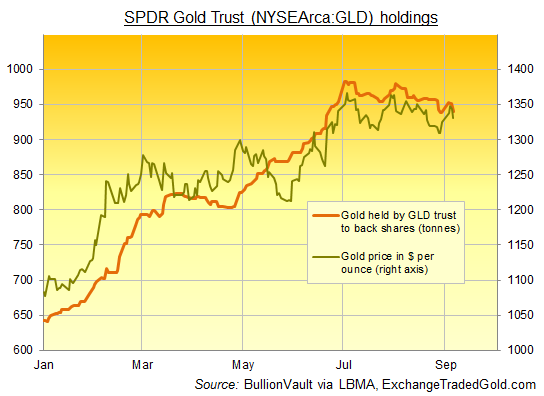
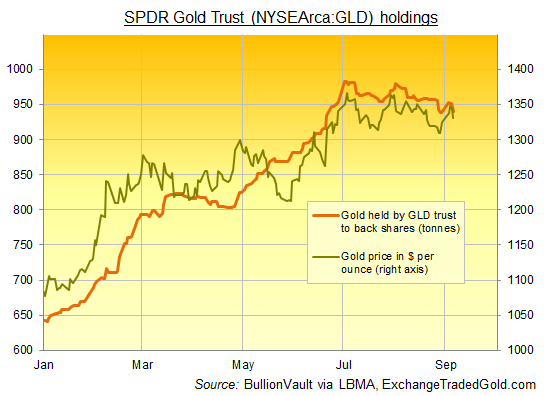
Holdings of the giant SPDR Gold Trust (NYSEArca:GLD) were up 1.1% to 942.61 tonnes on Friday’s price drop, but global gold ETF holdings remain down from August’s 3-year high, heading for their biggest monthly decline this year.
 
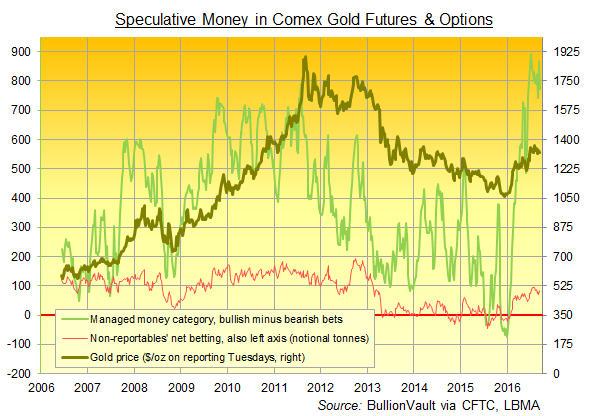
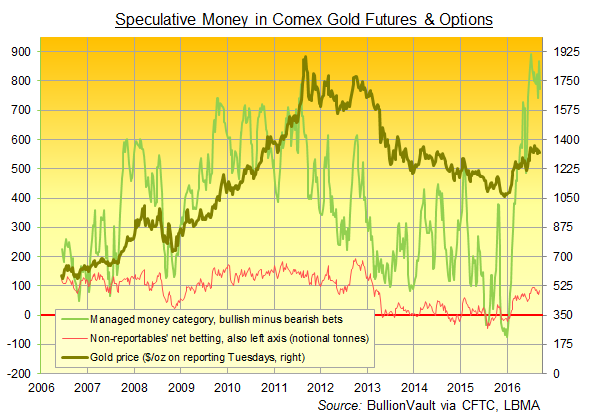
Hedge funds and other large speculative players cut their net betting on higher gold prices by more than 10% last week – the most in three months – according to Friday’s latest data from US regulator the Commodity Futures Trading Commission’s report on Comex positioning.
Chart of Managed Money and Non-Reportable Comex traders' net bullish gold betting on futures and options combined
 
With Chinese investors and traders returning to the market after their Mid-Autumn Festival break, gold prices rose from $1310 to $1318 per ounce Monday before giving back half that move.
 
The US Dollar dropped around 0.4% against its major peers on the FX market following the weekend’s bombings in New York and New Jersey.
 
Betting on interest-rate futures today put the probability of a US rate hike at the Federal Open Market Committee (FOMC) meeting this Tuesday and Wednesday as low as 1-in-8 but expectations for an increase in December were above 50%.
 
“A rise in rate would be a major market shock,” says a note from analysts at National Australia Bank.
 
“Expect gold prices to be extremely volatile towards the [Fed] meeting,” says Barnabas Gan, analyst at Singapore-listed bank OCBC.
 
The FOMC meeting will coincide with the Bank of Japan’s monetary policy meeting this Wednesday, where many analysts expect the central bank to ease their policy further and push interest rates even deeper below zero and grow its QE asset-buying program.
 
European and Asian stocks also rose Monday ahead of those central bank meetings, while Brent crude oil was spurred more than 0.5% higher amid talks about an Opec deal on limiting output and reports of fighting around Lybian oil ports.
 
Silver followed and extended the move in gold prices, surging nearly 2% to up to $19.18 per ounce.
 
Resistance remains at $19.30, according to Scotiabank’s daily market commentary on Friday.
 
The precious metals’ rally this year was “completely justified”, RBC Capital Markets commodity strategist Christopher Louney told CNBC, calling it a “kind of perfect storm for gold” but warning investors not to expect a return to the $1375 per ounce highs seen this summer.
 
“We had Brexit, we had uncertainty, we had volatility, we had very low yields, we had so many things going on in the markets that were in gold’s favour.”

Upturn in US Inflation Sees Gold Price Near 3-Month Low, Indian Discount Narrows on 'Record' Harvest

GOLD PRICES retreated near 3-month lows in London on Friday, rallying just $2 per ounce from $1306 as world stockmarkets fell with commodities following stronger-than-expected US inflation data ahead of next week’s Federal Reserve interest-rate decision.
 
The Bank of Japan also meets to announce policy next Wednesday, with analysts split over whether it will expand or reduce its sub-zero rate and QE asset purchase programs after two decades fighting negative inflation and poor economic growth.
 
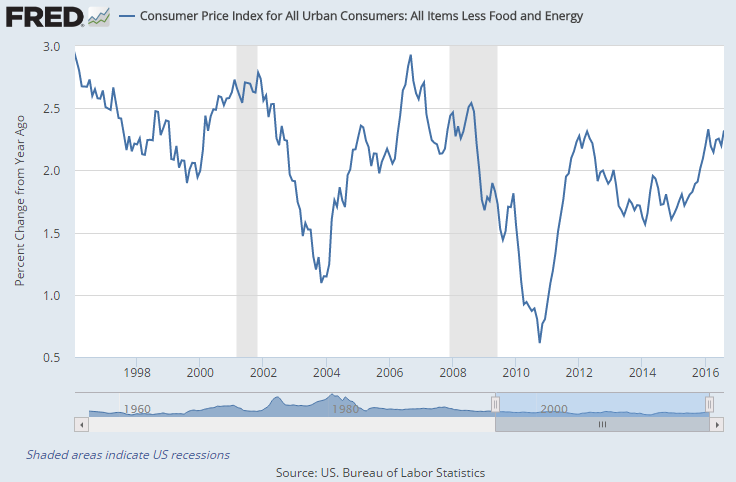
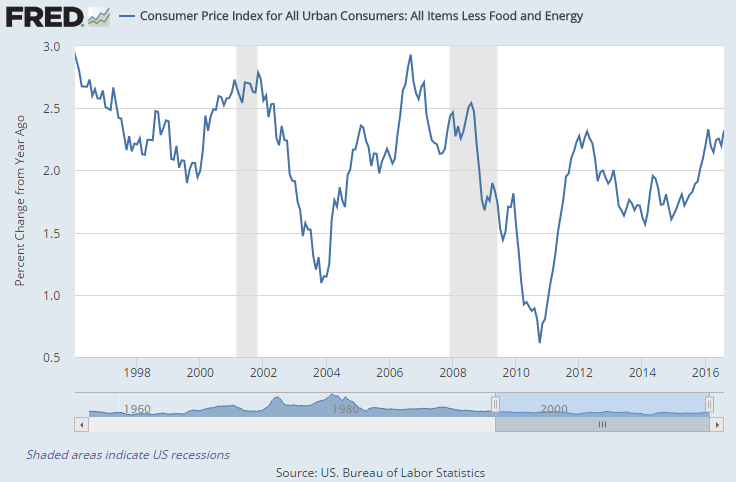
US consumer prices, excluding energy and food costs, rose 2.3% in August from 12 months before, matching February’s 4-year high.
 
Chart of US CPI annual inflation, minus food and energy costs. Source: St.Louis Fed
 
European equities lost 1.5% for the day, heading for their worst week since May, while US crude oil contracts fell to 1-month lows beneath $43 per barrel.
 
Silver followed gold prices lower, dipping below $18.70 per ounce to trade over 7% beneath last week’s 1-month high.
 
Major government bond prices held firm however, keeping 10-year US Treasury yields below this week’s new post-Brexit high of 1.73%.
 
“Uncertainty is likely to continue to breed volatility until after the Fed and BoJ meetings,” said a note Thursday from precious metals strategist Tom Kendall at Chinese-owned investment and bullion bank ICBC Standard in London.
 
“Once those are out of the way…a relief rally in fixed income seems far more likely than a descent into the abyss. In which case gold should be lifted as real yields slip lower once again.”
 
“All other things being equal,” agrees a note from the precious metals analysts at investment and bullion bank HSBC, “a decline in rate-hike expectations should be bullish for gold.
 
But that means the last 2 days’ “drop in [bond] yields should have supported gold more than it did…[suggesting] there is more to gold’s sluggishness.
 
“Some of this,” says HSBC, “may be traced to weak physical demand” from key gold-consuming nations.
 
Gold imports to Turkey – formerly the world’s No.4 heaviest buyer, but now behind Germany – almost halved in July from June, said data this week from Borsa Istanbul, “down over three-fold from 15.1 tonnes a year earlier” notes specialist news and data providers Platts.
 
Gold imports to India – formerly the world No.1 but now behind China as the government launches a raft of schemes to deter household demand – meantime showed a 77% slide in August from 12 months before in US Dollar terms, the Press Trust reports, totaling only $1.1 billion.
 
“Total official gold imports declined to 60 tonnes in April-July,” the PTI adds, “much lower than 250 tonnes in the year-ago period.”
 
This year’s monsoon rains – a key driver of rural incomes through crop yields – are now heading away from the subcontinent after reaching 95% of average levels.
 
“Two consecutive years of deficient monsoon rainfalls have taken their toll on…rural spending,” noted market-development organization the World Gold Council in its latest global demand trends report.
 
This year’s improved rainfall “is good news for farmers,” agriculture minister Radha Mohan said at a press conference yesterday.
 
“I am sure we will have record production this year.”
 
“[Gold buying] enquiries are increasing and volumes sold are picking up, but remain limited,” Platts quotes a dealer in the major import point of Ahmedabad, adding that domestic gold prices – relative to international quotes – have risen in southern Indian states to a discount of just $7 per ounce.
 
Over-supply and poor demand saw Indian gold prices – most typically quoted at a premium to London wholesale bars – trade at what the Reuters news-wire called a “record” discount of $100 per ounce in July.

Gold Bar Smuggling Blamed for India's 2016 Price Discount, London Vaults Regain 1/3rd 2013-15 Outflow

GOLD BAR prices traded in a tight $7 per ounce range Thursday in London, recovering a drop to $1318 overnight as US bond yields eased lower and betting on a US Fed interest-rate hike at next week’s meeting held the odds below 1-in-7.
 
The Shanghai Gold Exchange was closed for China’s mid-autumn festival, re-opening Monday.
 
Asian stock markets closed lower, but European equities held flat – and London shares rose – after the Bank of England left UK interest rates at last month’s new all-time low of 0.25% and continued to target record-high QE bond holdings of £435 billion, financed by the creation of new central-bank money.
 
Wholesale gold bar prices for UK investors rose back above last week’s closing level, reaching £1003 per ounce.
 
A report in India’s Economic Times meantime blamed this year’s heavy discounts to global prices in the world’s No.2 consumer gold market on large smuggling supplies, now apparently being shut down by tighter customs’ checks. 
 
“From March we observed a 50-60% drop in official imports of bullion,” ET quotes James Jose, secretary at India’s Association of Gold Refineries and Mints – “[a] gap taken care by the grey market that offered 5% discount from the daily international rate…killing the official gold sector and draining government revenues.”
 
With “beefed up” security checks at airports and other entry points, “Hopefully by the end of this month the discount will disappear” from its current 1% level, Jose says.
 
But rather than naming smuggled supplies, “high gold prices have not only led to a drop in jewellery demand,” counters the latest weekly note from specialist analysts Metals Focus, “but have also contributed to increased levels of recycling and dishoarding.
 
“The impact on Australian-Indian trade in particular has been quite stark, with shipments having effectively disappeared in recent months.”
 
Shipments to the UK in contrast – barely featuring in 2015 – have accounted for almost half of all Australia’s outbound shipments on the IHS Markit data charted in Metals Focus’ latest Precious Metals Weekly.
 
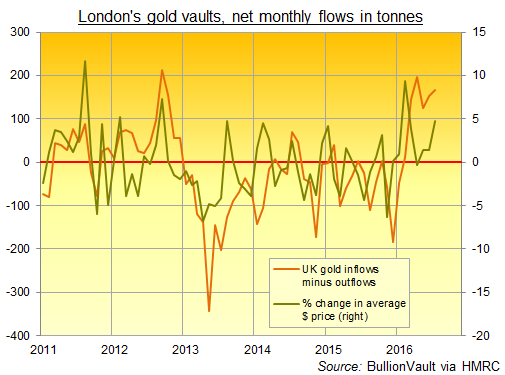
All told – and with little consumer or industrial demand to speak of – the UK saw net gold imports total 750 tonnes in the first 7 months of 2016, recovering one-third of the huge 2013-2015 outflows.
Chart of net UK gold imports vs US Dollar gold price change month on month
 
With the vast bulk of these bars delivered to London’s specialist vaults for market-ready storage, this year’s flow again maps changes in the quantities of bullion needed to back exchange-traded trust fund vehicles such as the SPDR Gold Trust (NYSEArca:GLD), which vaults at HSBC Bank in London.
 
In contrast to India’s plunge, “Australian deliveries to China have fallen by 9% year-on-year,” Metals Focus goes on, “[a] relatively small [and] surprising decline given the sharp decline in Mainland China’s gold jewellery fabrication.”
 
Gold bar inflows to China – itself the world’s No.1 gold-mining nation since 2007 – have held firmer than consumer demand thanks to importers wanting to meet their official quotas each month or risk losing them, says a recent article from ICBC Standard Bank strategist Tom Kendall.
 
Declining consumer demand has also met a boom in gold’s use in financial deals, Kendall says, as lower-cost bullion loans and leases become attractive to non-gold borrowers.

Gold Bar Smuggling Blamed for India's 2016 Price Discount, London Vaults Regain 2/3rds 2013-15 Outflow

GOLD BAR prices traded in a tight $7 per ounce range Thursday in London, recovering a drop to $1318 overnight as US bond yields eased lower and betting on a US Fed interest-rate hike at next week’s meeting held the odds below 1-in-7.
 
The Shanghai Gold Exchange was closed for China’s mid-autumn festival, re-opening Monday.
 
Asian stock markets closed lower, but European equities held flat – and London shares rose – after the Bank of England left UK interest rates at last month’s new all-time low of 0.25% and continued to target record-high QE bond holdings of £435 billion, financed by the creation of new central-bank money.
 
Wholesale gold bar prices for UK investors rose back above last week’s closing level, reaching £1003 per ounce.
 
A report in India’s Economic Times meantime blamed this year’s heavy discounts to global prices in the world’s No.2 consumer gold market on large smuggling supplies, now apparently being shut down by tighter customs’ checks. 
 
“From March we observed a 50-60% drop in official imports of bullion,” ET quotes James Jose, secretary at India’s Association of Gold Refineries and Mints – “[a] gap taken care by the grey market that offered 5% discount from the daily international rate…killing the official gold sector and draining government revenues.”
 
With “beefed up” security checks at airports and other entry points, “Hopefully by the end of this month the discount will disappear” from its current 1% level, Jose says.
 
But rather than naming smuggled supplies, “high gold prices have not only led to a drop in jewellery demand,” counters the latest weekly note from specialist analysts Metals Focus, “but have also contributed to increased levels of recycling and dishoarding.
 
“The impact on Australian-Indian trade in particular has been quite stark, with shipments having effectively disappeared in recent months.”
 
Shipments to the UK in contrast – barely featuring in 2015 – have accounted for almost half of all Australia’s outbound shipments on the IHS Markit data charted in Metals Focus’ latest Precious Metals Weekly.
 
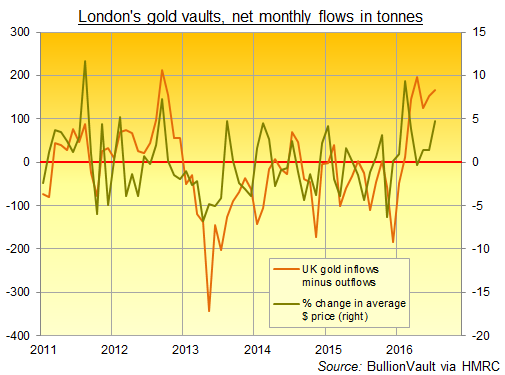
All told – and with little consumer or industrial demand to speak of – the UK saw net gold imports total 750 tonnes in the first 7 months of 2016, recovering one-third of the huge 2013-2015 outflows.
Chart of net UK gold imports vs US Dollar gold price change month on month
 
With the vast bulk of these bars delivered to London’s specialist vaults for market-ready storage, this year’s flow again maps changes in the quantities of bullion needed to back exchange-traded trust fund vehicles such as the SPDR Gold Trust (NYSEArca:GLD), which vaults at HSBC Bank in London.
 
In contrast to India’s plunge, “Australian deliveries to China have fallen by 9% year-on-year,” Metals Focus goes on, “[a] relatively small [and] surprising decline given the sharp decline in Mainland China’s gold jewellery fabrication.”
 
Gold bar inflows to China – itself the world’s No.1 gold-mining nation since 2007 – have held firmer than consumer demand thanks to importers wanting to meet their official quotas each month or risk losing them, says a recent article from ICBC Standard Bank strategist Tom Kendall.
 
Declining consumer demand has also met a boom in gold’s use in financial deals, Kendall says, as lower-cost bullion loans and leases become attractive to non-gold borrowers.

Gold Bullion 'Positive on Stupid Politicians' as China Bank Lending Jumps, Helicopter Money Urged

GOLD BULLION rallied $8 per ounce from yesterday’s 1-week low of $1315 on Wednesday morning as world stock markets steadied from their latest drop following stronger-than-expected bank lending data from China.
 
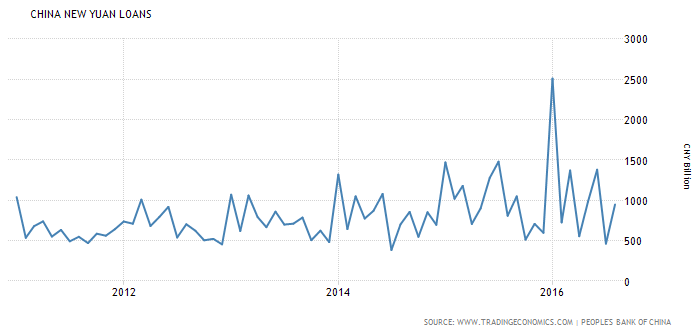
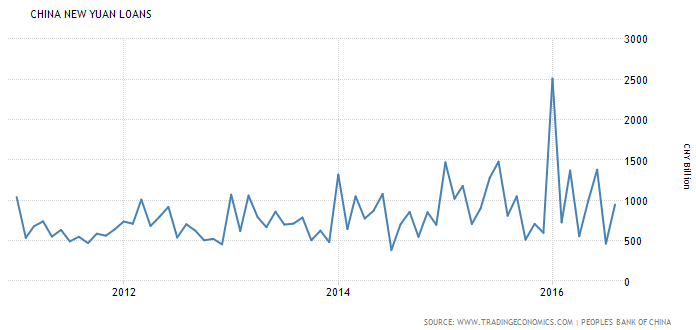
The People’s Bank said new lending in the world’s second-largest economy – and its largest gold bullion consumer – jumping 13% year-on-year in August, the fastest pace since March.
Chart of China new bank lending by month. Source: TradingEconomics via PBoC
 
Some 70% of August’s new lending went to household borrowers, rather than corporate loans.
 
Western government bond prices rallied, edging 10-year US Treasury yields down from their highest level since before the UK’s Brexit referendum in late June at 1.73%.
 
European stockmarkets stabilized after Wall Street closed 1.5% lower overnight, but ahead of next week’s US Federal Reserve decision on Dollar interest rates, global equities held some 2.5% down from this time last month.
 
“Gold is an option on the ineffectiveness, dare I say the stupidity of politicians,” said New York financial advisory Pension Partners’ CIO Edward Dempsey to CNBC overnight.
 
“The long end of the [interest-rate] curve is starting to sniff out a lot of fiscal stimulus [and] there’s a lot of populism [in Western politics] which will equal stimulus.
 
“[That] would be not very good for all that negative-yielding long debt but would be positive for gold.”
 
Ahead of Thursday’s Bank of England rate decision, “Attachment to the belief that the policy [interest] rate is all-powerful…stems from a fear of the redundancy of monetary policy,” writes fund manager and economist Eric Lonergan.
 
“This is erroneous. Monetary policy must simply be used to raise aggregate demand in other, more direct, ways,” says the author of 2014’s Money, which called for central banks “to be given helicopters” – a reference to the idea of creating and gifting money directly to government or private households to boost growth, rather than using it to buy assets under central banking’s current Quantitative Easing schemes.
 
India is meantime expected to report its first current account surplus with the rest of the world since 2007 for this calendar quarter, reports Reuters today, thanks primarily to lower imports of oil and gold.
 
India’s formerly world-leading gold demand sank in Q2 from the same period last year, according to data compiled by specialist analysts Thomson Reuters GFMS, with the traditionally strong Akshaya Tritiya festival proving “uneventful” for retailers and failing to stem the quarter’s 56% year-on-year drop in jewelry buying.
 
India’s gold investment demand also fell, down 40% year-on-year. The strongest period for gold bullion and jewelry demand is scheduled to peak with end-October’s Diwali festival.
 
UK data meantime showed a record 74.5% employment rate amongst the working-age population, while average wage growth slowed to 2.3% per year in the 3 months to July, just after the Brexit referendum.
 
Employment in the UK public sector fell to 16.5% of the working population, a record low down from 20% a decade ago.
 
Public spending on private-sector contracts almost doubled however during the 5 years of the Conservative-Liberal coalition government starting 2010.
 
Although dipping slightly in the first 6 months of 2016, UK government outsourcing in I.T. and business procesing rose 55% by cost in the second-half of 2015 according to data from management consultancy and ‘solutions’ firm Arvato.
 
January to June this year saw local governments across the UK raise expenditure on private-sector services by 84% compared with the same period in 2015.
 
Elsewhere, Russian-based VTB Bank – the country’s second largest lender according to newswire reports – has secured a deal to sell 15-20 tonnes of gold bullion into China over the next 12 months.
 
The world’s second-largest gold miner, Russia has faced US and EU sanctions over the Ukraine crisis, with Moscow’s central bank stepping in to buy 75% of 2014 and 2015’s domestic bullion output.

Gold Price Slips Despite Vix Volatility Jump, Hedges Equity Risk 'When You Need It'

GOLD PRICES slipped back towards yesterday’s 1-week low of $1321 per ounce Tuesday in London even as world stockmarkets fell with commodities and the US Vix volatility index rose once again.
 
Gold prices rallied late Monday after US Federal Reserve governor Lael Brainard called for further delays to a second Fed rate hike, rather than switching from ‘dove’ to ‘hawk’ ahead of next week’s September meeting and decision.
 
Asian stockmarkets failed Tuesday to extend Wall Street’s post-Brainard rally, and European equities reversed earlier gains as New York re-opened.
 
Government bond prices paused their rally after Friday and Monday’s hard sell-off, capping 10-year US Treasury yields at their highest level since the UK’s shock Brexit referendum result of late June at 1.67%.
 
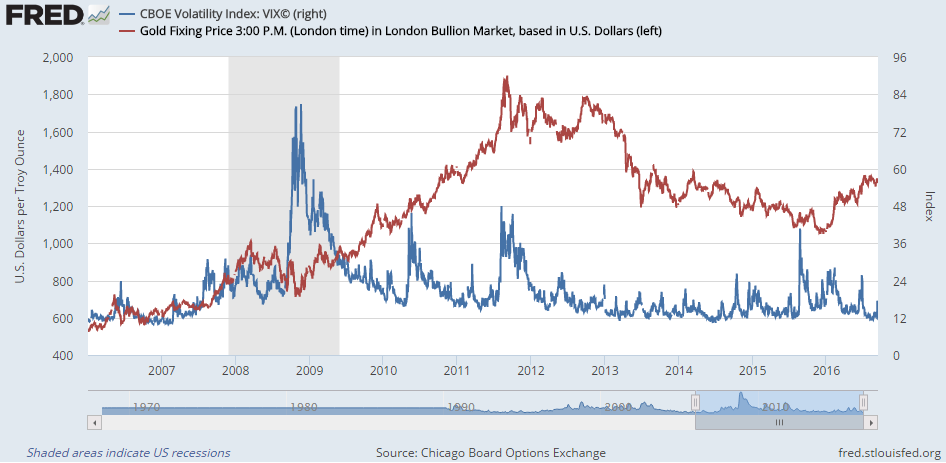
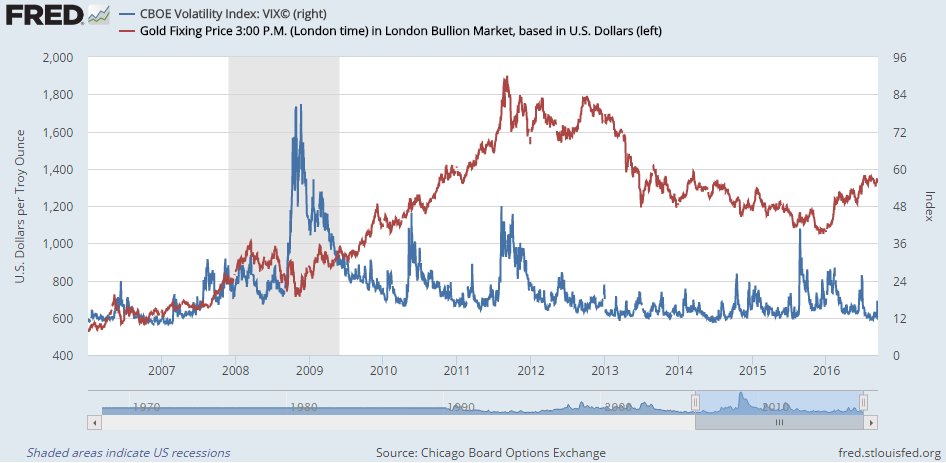
“Wall Street’s ‘fear gauge’ has jumped to the highest since late June,” notes Jonathan Butler, precious metals strategist at Japanese conglomerate Mitsubishi, referring to the ‘Vix’ volatility index of US equity options traded on the CBOE exchange.
 
“[Yet] gold has failed to benefit much…perhaps indicating that despite an equity market sell-off many investors see gold as susceptible to central bank policy.”
 
Chart of the Vix volatility index vs gold prices, last 10 years, from St.Louis Fed
 
Volatility in US equities remains “unsustainably low” says finance giant Blackrock’s head of asset allocation Russ Koesterich. “[So] I would be reluctant…to sell some or all of [my] holdings in the precious metal.
 
“Changes in the VIX Index – a measure of US equity volatility – explain nearly 20% of the variation in the relative return between gold and the S&P 500 Index,” Koesterich explains, adding that on data back to 1994 “when volatility rose, gold outperformed the S&P 500 price return by roughly 2% on average.”
 
Most notably, “Gold’s value as a hedge has historically been most pronounced during those periods when you need it the most,” Blackrock’s analysis concludes, with gold beating the S&P 500 three-quarters of the time and by an average 5% when the Vix rose from already high levels.
 
Volatility today edged higher to read above 16 on the CBOE’s Vix index, just below its 5-year average.
 
Gold traded 4% below its average daily price since this time in 2011.
 
With 10-year German Bunds meantime offering 0.02% annual yield to new buyers, the share of Eurozone government debt paying negative rates “has fallen back below 50% after a sell-off triggered by investor disappointment at the European Central Bank’s meeting last week,” says news-wire Reuters.
 
“That is down from 55% in early July [when] Britain’s vote to leave the European Union posed a threat to global growth.”
 
The recent sell-off in stocks and bonds marks “a loss of confidence in the ability of central banks…to regenerate inflation,” says Harvard professor – and advocate of banning cash to enable more negative rates – Ken Rogoff, speaking to Bloomberg Television on Tuesday.
 
“It may be true that global risk sentiment remains broadly stable,” says a gold investing recommendation from French bank Credit Agricole.
 
“[But] a large part of that stability was due to rising liquidity expectations [thanks to central bank QE and rate cuts] rather than better global growth prospects.”

Gold Prices 'Robust' as Fresh Fed Speech Fears See Bonds, Stocks Drop

GOLD PRICES were little changed Monday morning in London while a rate-hike panic hit other major financial markets after last week’s hawkish Fed comments – plus the sudden announcement of a speech today by a key voter – sparked a big shift in expectations for next week’s meeting, writes Steffen Grosshauser at BullionVault. 
 
Friday’s global sell-off in stocks and bonds resumed, extending Wall Street’s slump after Boston Fed president Eric Rosengren said higher rates are needed to stop the US economy from overheating. 
 
Fed governor Lael Brainard meantime scheduled a sudden speech for later today, spurring trader chatter that she also wants to alert the markets to a shift from her previously dovish view.
 
Shares in Europe and Asia headed for their biggest loss since the aftermath of the UK’s Brexit vote in June, with Hong Kong’s Hang Seng going down 2.6%, as government bond prices fell, driving 10-year US yields to their highest since that referendum shock at 1.68%.
 
In contrast, gold prices – typically seen as sensitive to monetary policy expectations – hardly changed from Friday’s close in Dollar terms, and rose against non-US currencies.
 
Hedge funds and other large speculative players increased their net long positions in Comex gold contracts to a 9-week high in the week to 6 September, according to data released Friday by US regulator the Commodity Futures trading Commission.
 
But now “expectations are increasing about a potential hike in rates this September,” said ANZ analyst Daniel Hynes.
 
“That alone will see investors reduce their long positions over the coming days.” 
 
Gold bullion holdings to back the value of the SPDR Gold Trust (NYSEArca:GLD), the largest ETF gold product, fell 1.1% to 939.94 tonnes last Friday as gold prices fell 0.8%, suffering the third consecutive day of losses.
Chart of SPDR Gold Trust bullion holdings
 
Trading in a range between $1325 and $1330 per ounce ahead of Brainard’s speech on Monday – the last Fed opinion before the September meeting – gold prices rose back above £1000 per ounce for UK investors and €1180 for Eurozone buyers.
 
“Gold, which has seen comparably mild pullback over the past few sessions, was again more robust than its counterparts [i.e. other precious metals] today,” writes Swiss refining and finance group MKS in their daily note.
 
“Yet we suspect there may be some more volatility ahead with Brainard’s speech today.”
 
Silver prices initially held firm with gold and then rallied to regain most of a 1.8% drop, bouncing higher from $18.72 per ounce.
 
“The importance for gold in these [Fed member] comments lies in the reaction of the forex and US bond markets,” says a note from bullion market maker HSBC in London.
 
“With a still relatively low likelihood of a September rate rise priced into the market, a hawkish speech […] would very likely put bullion come under distinct selling pressure,” says the bank’s analyst James Steel. 
 
“On the other hand, a markedly dovish speech may not be especially bullish for gold, as the market, at least up until Mr.Rosengren’s speech, had ascribed a relatively low probability to a September rate rise.”

US Gold Investing Flows 'Driving Price' as Fed 'Dove' Calls for Rate Hike

GOLD INVESTING prices retreated with world equities, commodities and government bond prices Friday in London, slipping to 3-day lows of $1344 per ounce against a rallying US Dollar but holding on track for 0.8% weekly gains after a formerly ‘dovish’ US Fed president warned of “growing risks” from a further delay in raising interest rates.
 
Previously called “a solid dove” in favor of keeping rates low, “There are longer-term risks…compounded if delays in tightening earlier [then] require more rapid increases later in the cycle,” said Boston Fed president Eric Rosengren in a speech in Massachusetts.
 
Crude oil dropped 2% for the day and silver prices shed the last of this week’s previous 3.5% gains – dropping back to $19.45 per ounce – as the EuroStoxx 50 index lost 0.5% from last Friday.
 
Ten-year US Treasury bond yields rose to the highest level since the UK’s shock Brexit referendum result in late June at 1.65%.
 
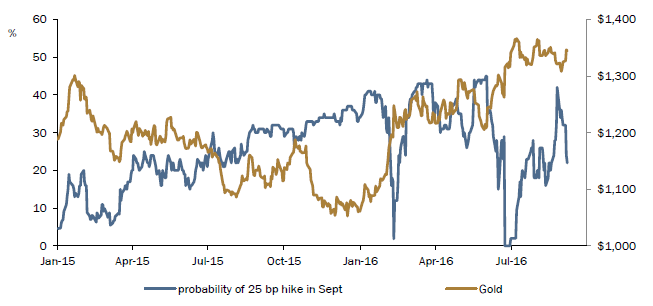
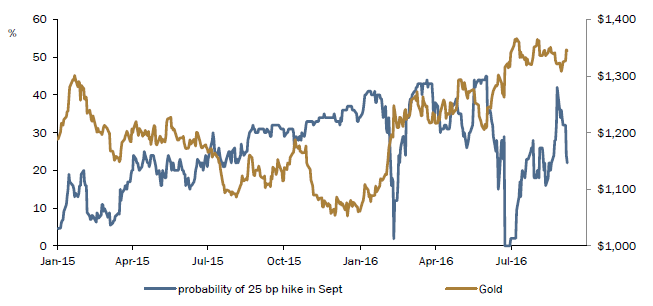
Betting on US Dollar interest-rate futures today put the likelihood of a hike at the Federal Reserve’s September meeting in 2 weeks’ time up to 27% from 18% yesterday.
Chart of September 2016 US Fed rate-hike expectations vs gold price. Source: ICBC Standard Bank
“Tighter US monetary policy is still a key risk” for gold investing says Tom Kendall, head of precious metals strategy at Chinese-owned investment and bullion bank ICBC Standard Bank in London, but after the recent run of weaker economic data “the risk has been deferred to December, or more likely Q1 2017.”
 
Finding “few reasons to be short” of gold or other precious metals right now, Kendall’s latest quarterly outlook predicts “some upside but no fireworks” for the bullion market.
 
Contrasting gold investing with consumer demand, this year’s strong price gains to date remain “indebted” to US money managers, ICBC Standard’s chief precious metals strategist warns, risking a sharp price drop if investing flows reverse, especially from exchange-traded trust fund vehicles.
 
Analysis from investment and bullion market-making bank Societe Generale this week said a drop in ETF holdings – driven by shareholder selling – would take gold prices back towards late-2015’s six-year lows if 2016’s inflows were entirely reversed.
 
Surging at the fastest pace since 2009, “Monthly changes in ETF flows have far exceeded the rate of Chinese gold imports for much of this year,” adds Kendall at ICBC Standard Bank.
 
But “with the Indian [jewelry] market slowly normalising and the risk of a US rate rise rapidly diminishing again,” he concludes, “we continue to expect gold to break the $1400 level sooner rather than later.”
 
After China reported stronger-than-expected imports for August and only a 2.8% drop in exports – the slowest annual fall since April – new data today said consumer-price inflation in the world’s largest gold-buying nation eased to 1.3% last month, the slowest pace in well over a year.
 
Germany’s exports sank 10% year-over-year in July, while France’s industrial output shrank 0.6% from June but its government budget deficit widened.
 
The Euro erased half of this week’s earlier gains on the FX market, pushing prices for currency-union savers wanting to start gold investing back up to last Friday’s finish at €1188 per ounce.