Author Archives: City Gold Bullion

Gold Prices Climb as LBMA Delegates’ Forecast $1347.40 for 7% Rise in 12 Months Time

GOLD PRICE in US Dollars rose to $1261 per ounce on Tuesday morning as the US Dollar weakens and Asian & European share prices advance while crude oil price is edging back, writes Atsuko Whitehouse at BullionVault.

The Dollar index, which measures the U.S. dollar’s value relative to a basket of currencies, is down 0.25% to 97.64 after recording 7 months high yesterday. 

Asian stocks finished up at the end of today’s trading; Nikkei 225 up 0.38%, Hang Seng up 1.52% & Shanghai Composite up 1.40%.
 
European stocks were also higher this Tuesday lunchtime; FTSE up 0.89%, DAX up 1.10% and CAC up 1.11%.
 
Crude oil prices made minor gains on Tuesday following an overnight decline, December Brent crude on London’s ICE Futures exchange rose 0.8%, to $51.92 a barrel.
 
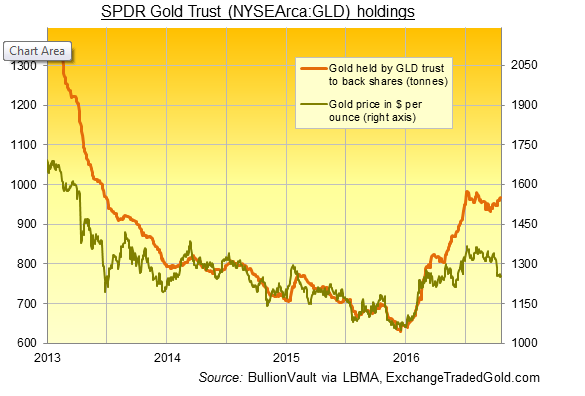
Holdings of SPDR Gold Trust, the world’s largest gold-backed exchange-traded fund (ETF), rose for a third straight session on Monday. They grew 0.18 percent at 967.21 tonnes. 
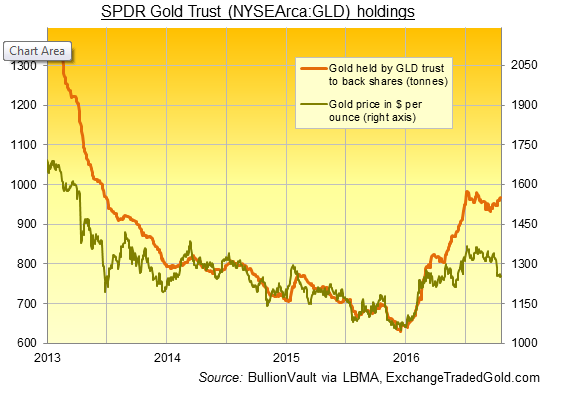
 
SPDR gold trust (NYSEArca;GLD) holdings
Yesterday, Commerzbank reported on its Commodities Daily, the CFTC statistics on the positioning of speculative market participants showed that, in the last two reporting weeks, net long positions were decimated by around 42%, the most pronounced position reduction in a two week period since the data series began ten years ago. 
 
It went on to say ‘We believe that this will ease the selling pressure from this side, however. What is more, because we assume that gold demand will pick up in Asia in the coming months, we expect the gold price to stabilise and then recover.’
 
On China’s gold demand, Roland Wang, managing director for China at the World Gold Council (WGC), told Reuters yesterday “We believe we (China) may keep a certain level of about 900-1,000 tonnes of annual consumption (in 2017), but it may face some challenges especially on the jewellery side and also it depends on the price and China’s own economic situation,” on the fringes of an industry conference in Singapore.
 
Wang also said jewellery traders were seeing “more demand for gold bars since late September” with investors seeking alternate investment options amid China’s housing market curbs.
 
China’s gold demand reached 984.5 tonnes in 2015 according to WGC’s Gold Demand Trends Full Year 2015.
 
London Bullion Market Association (LBMA) delegates gather on the last day of its annual conference in Singapore today. Delegates at the conference have forecasted that the average gold price in 12-months time will be $1347.40 per ounce, a 7% rise from today while silver is expected to hit $20.90, nearly a 12% rise.   The last year’s forecast at the LBMA conference in Vienna was $1159.88 for gold.
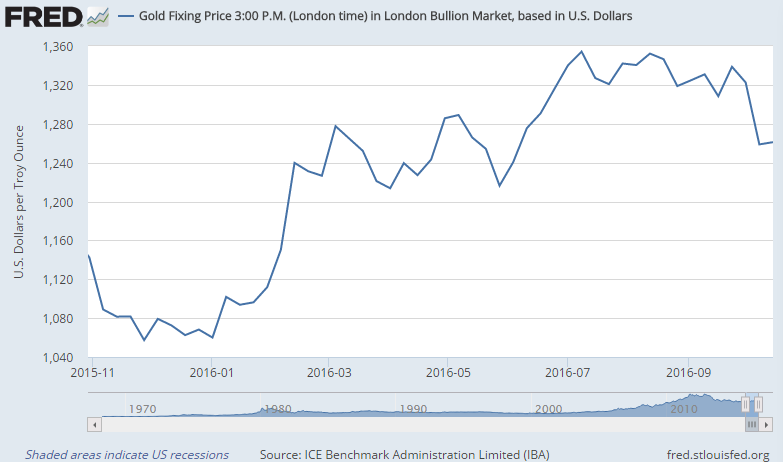
Gold Price Trends 'Downwards' in Short Term, LBMA Launches Consultation for Singapore Gold Price

GOLD PRICES rose slightly on Monday morning in London, as the US Dollar lost earlier gains and European and Asian shares fell, writes Steffen Grosshauser at BullionVault.

Gold traded in a narrow range between $1250 and $1256 per ounce on Monday, after it fell nearly 0.6% to a 1-week low of $1246 last Friday and closed the week at $1251.

“Because the possibility of a December rate hike is increasing, generally, the trend of gold price is downwards but in the short term we think that there could be relatively a mild technical correction,” said Jiang Shu, chief analyst at gold mining group Shandong, who sees gold reaching $1270 in the short term before sharply falling back on expectations of a US rate hike.

Bart Melek, head of commodity research at Toronto Dominion Bank, expects gold to dip below $1200 if the Fed raises interest rates, before the metal rallies to levels as high as $1350 again next year.

Federal Reserve President Janet Yellen signalled the needs for aggressive steps to boost the slow economic recovery at the Boston Fed’s annual research conference last Friday. Yellen stated that “it is even more important for policymakers to act quickly and aggressively in response to a recession”, although she did not provide the Fed’s timetable for rates.

“In the Fed’s case, this might amount to running the gauntlet of higher inflation with a very slow pace of monetary tightening,” said Ric Spooner, chief market analyst at CMC Markets in Sydney. 

While speculation of a longer than expected easy monetary policy stance driving the 30-year bond yield to a 4-month high, the US Dollar index, which measures the greenback against a basket of other major currencies, fell slightly back below 98 after it touched 98.16 – the highest it has been since March.

In other precious metals, silver moved around last week’s close of $17.42 per ounce while palladium was up around 1% and platinum rose 0.8% after dropping to a 7-month low of $923 last Friday.

Precious metals ETFs saw a strong inflow and the holdings of the world’s largest gold-backed ETF, the SPDR Gold Trust (NYSEArca:GLD), grew almost 0.7% to 965.43 tonnes last week.

In contrast, hedge funds and other leveraged speculators reduced their net long positions in Comex gold and silver contracts by further 25% in the week to 11 October – a level last seen in March, as shown by the latest CFTC data.

The London Bullion Market Association (LBMA), the organisation that oversees the wholesale bullion markets in London, joined the Singapore Bullion Market Association (SBMA) and the Intercontinental Exchange Inc. (ICE) in launching a feasibility study on a “Singapore LBMA Pre-AM Gold Price”. This was announced by Lim Hng Kiang, minister for trade and industry and deputy chairman of the Monetary Authority of Singapore at the LBMA annual conference in Singapore.

The potential new price would be in addition to the LBMA AM and PM gold price benchmarks which are set in London. This would also close the gap between the closure of the US market and the opening of the London market, which would allow participants in Asia – including top consuming nations like China and India – to trade during their own business hours, reducing the risk of intraday price volatility and facilitating a timely settlement.

ICE which runs the daily London gold auction said it would also launch a London gold daily futures contract in February next year. ICE wants to use the central clearing that is planned to go live next March.


Gold Bullion 'Risks Drop to $1200' But 'Slow Fed' Buoys Outlook, 'Hard Landing Looms' in China

GOLD BULLION dropped through $1250 per ounce for the first time since last week’s 4-month low in London trade Friday lunchtime as the Dollar rose again following better-than-expected US retail sales data.
 
China’s key gold price had earlier held firm, trading $5 above London quotes for the fourth time since the market returned from the autumn Golden Week vacation.
 
World stock markets had earlier risen sharply but major government bond prices slipped, nudging the yield offered to new buyers higher again
 
Ten-year UK Gilt yields meantime jumped to 1.15% as prices fell to 5-month lows and the British Pound fell towards its lowest weekly close since April 1985.
 
New prime minister Theresa May today met the head of Japanese automaker Nissan over fears it may shut production in north-east England – costing 7,000 jobs – as a result of the UK’s Brexit decision to quit the European Union.
 
Gold bullion held at £1020 per ounce for UK investors, gaining 1% for the week.
 
Priced in US Dollars, gold however neared its lowest Friday finish since early June below $1250 per ounce.
 
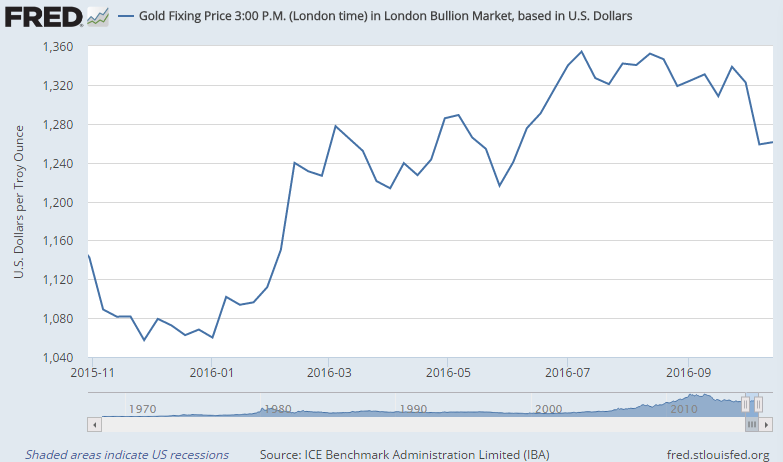
Chart of USD gold price, Friday finish at LBMA Gold Price auction
 
“Depending on the outcome of the [US presidential] election…if there are [new] polices that would have distortive effects [then] we’ll have to respond,” said non-voting Federal Reserve member Patrick Harker of the Philly Fed on Thursday.
 
“I don’t know which way that will go.”
 
Betting in the US interest-rate market currently puts the chance of a November hike below 1-in-11, jumping to 3-in-5 for December but still forecasting a 90% chance that the Fed Funds rate will remain below 1.00% this time next year.
 
“A slow moving Fed and a moderate pickup in inflation,” reckons a new note from Swiss bank UBS’s wealth management division, “should push real interest rates deeper into negative territory in 2017.
 
“Historically, this has acted as a powerful driver of higher gold prices.”
 
“I’m not a gold bug,” says former hedge-fund manager and investment news entrepreneur Raoul Pal, “[but] as we get to negative interest rates, gold is a good place to park your cash.” 
 
“This is the currency I would choose now.”
 
Short term however, “[technical] indicators remain bearish and I am biased to the downside,” says the latest chart analysis from bullion market maker ScotiaBank, “as long as gold closes below $1267.75.”
 
“The market needs to break meaningfully past $1303, [the] early-September low, to suggest potential,” says an Elliott Wave analysis from US investment bank and bullion market maker Goldman Sachs.
 
“The next downside level to watch is 38.2% retrace [of the 2016 upmove] at $1250. A break lower will open up risks to 50% retrace [around] $1200.”
 
Shanghai’s exchange-traded gold market again saw moderate volumes overnight, but the city’s benchmark auction fixed for the fourth time this week with a premium to London prices above $5 per ounce – twice the typical incentive for bullion imports to the world’s No.1 consumer nation.
 
“A healthy premium [in] China gold prices is encouraging physical purchases and is evidence of good demand,” says London bullion clearing bank HSBC’s analyst James Steel.
 
But “the Chinese economy has become increasingly reliant on credit to sustain its rapid expansion,” warns a new note from weekly magazine The Economist‘s Intelligence Unit, whose south-east Asia director Andrew Staples will chair a panel debate on “potential pathways for precious metals” at next week’s LBMA conference for the global bullion industry, held this year in Singapore.
 
“Economic growth will slow from 6% in 2017 to 4.2% in 2018, a deceleration that will be widely perceived as a hard landing…A painful readjustment will come sooner rather than later.” 
 
Pre-Diwali demand in India – the former world No.1 private gold buyer – has meantime seen a “pick up” says the Reuters news-wire, with this year’s discount to London prices falling to a 9-month low as jewellers report stronger consumer interest.

Gold Prices 'Will Fall in 2017' Says Top Forecaster as US Fed's 'Close Call' Weighs on Stocks

GOLD PRICES held right at last week’s closing level in London trade Thursday lunchtime, as Asian and European stock markets extended yesterday’s slip in US equities following publication of minutes from the Federal Reserve’s latest “no change” interest-rate meeting.
 
Amongst the 7-in-10 voting members backing “no change” on 21 September, “several stated that the decision was a close call,” the minutes said, but were swayed by comments widely assumed to have come from Fed chair, Janet Yellen.
 
“The economic expansion has plenty of room to run,” said New York Fed President William Dudley in a speech Wednesday, justifying the hold at 0.5% and repeating a phrase used by Yellen in her post-decision press conference last month.
 
New data released at the start of US trading today put jobless benefits claims in the world’s largest economy at a fresh 42-year low for last week.
 
Commodities prices slipped but silver prices held steady, trading just shy of unchanged for the week so far at $17.48 per ounce.
 
“As the US economy continues to steadily improve, so will the Fed raise rates,” says a new note from French investment and bullion bank Natixis’ precious metals analyst Bernard Dahdah.
 
“Higher rates and yields increase the opportunity cost of holding gold…[and] we see the share of investor [gold] demand returning to 8% of the total” – the pre-2008 level, well below the 2012 peak of 23%.
 
The best gold price forecaster in trade body the LBMA’s 2015 survey, Dahdah now cuts his average 2016 forecast $20 per ounce to $1256 from the sharp upwards revision of July, made after the metal rose steadily from a 6-year low of $1045 last winter, jumping to reach $1375 in the wake of the UK’s Brexit referendum shock this summer.
 
Dahdah had initially predicted gold would fall below $1000 by April 2016.
 
“We see prices averaging $1180 in 2017 and then dropping to $1100 in 2018,” Dahdah goes on, with Chinese demand failing to rebound “unless gold prices collapse” while Indian demand is seen rising only “mildly” as the No.2 consumer nation’s high import tariffs “continue weighing” on demand.
 
Shanghai Gold Exchange volumes rose Thursday and the premium above London spot prices jumped to almost $6 per ounce at the SGE’s daily benchmark fixing, well over twice the typical incentive to importers.
 
With India’s gold imports already 60% lower in 2016 year-to-date however, gold sales in its western state of Maharashtra were poor on Tuesday’s Hindu festival of Dussehra, the Hindustan Times reports.
 
Ahead of the key Diwali festival and wedding season at the end of this month, “Gold prices are highly prohibitive,” says Mumbai Jewellers Association vice-president Kumar Jain, with “many buyers postponing their purchases.”
 
Asian stock markets closed Thursday 0.8% lower overall after new data said China’s trade surplus shrank by nearly one-fifth in September from August, with exports down 10% and imports down 2%.
 
Fixing at a 3-day high of $1258 per ounce, London’s benchmark gold auction again saw prices cut before finding a balance of buying and selling Thursday morning, with the quantity offered for sale again holding firm as the quantity wanted rose sharply on slightly lower suggested prices.

Gold Price 'Under Pressure' Before Fed Minutes, 2016 Uptrend 'Over'

GOLD PRICE losses of 0.5% for the week were reversed Wednesday lunc htime in London, with the metal rallying in a tight range as world stock markets extended yesterday’s 1.2% loss in New York.
 
Silver also rallied from a drop to 3-session lows as the gold price bounced to $1255 per ounce, but the white metal struggled to regain $17.50 per ounce.
 
Government bond prices also slipped, as did commodities, with minutes due out later on Wednesday from the US Federal Reserve’s September policy meeting, when the Fed voted 7-3 to hold rates at a ceiling of 0.5% for the ninth month running after finally raising from zero after 7 years in December 2015.
 
Dissenting voter Esther George, president of the Kansas Fed, was due to give a speech as New York markets opened.
 
“We don’t conduct monetary policy with any eye to political outcomes,” said New York Fed president and voting member William Dudley when asked about November’s presidential election this morning.
 
US Fed member Lael Brainard “is being spoken of as…Treasury secretary in a Hillary Clinton administration” reports the Financial Times.
 
“Very dull markets in precious at the moment,” says David Govett at brokers Marex Spectron in London, “[but] I suspect that the [Fed] minutes will just reinforce the probability of a December rise.
 
“We may see some [further] pressure on the precious complex later.”
 
“This year’s uptrend is over,” says a note from Dutch bank ABN Amro’s precious metals and FX analyst Georgette Boele, pointing to gold’s failure to hold its 200-day moving average and cutting her end-2016 gold price forecast by almost 10% to $1200 per ounce with a further fall to $1150 now forecast for 2017.
 
“We have revised downwards our gold price forecast because we think that investors will continue to liquidate.”
 
Gold bullion holdings for exchange-traded trust funds – an increasingly favored vehicle for fund managers so far this year – held steady Wednesday, with the giant SPDR Gold Trust (NYSEArca:GLD) retaining October’s 1.2% growth to date against the gold price’s 5% fall.
 
Shanghai trading volumes eased further overnight, with the premium in China – the world’s No.1 miner, importer, consumer and central-bank buyer – falling to $3.35 per ounce over London quotes at the city’s afternoon benchmark fix.
 
One third above the Shanghai Fix’s historical average incentive to importers, that was the lowest since late September, before last week’s long National Day vacation.
 
Chinese bullion and jewelry shops have “slashed” gold prices since the end of Golden Week, the China Daily reported on Tuesday, reflecting both the $50 per ounce drop in world prices from before the holidays but also to counter how “people are less interested in purchasing gold bullion as an investment product,” according to one Beijing retailer.
 
Gold imports to India – the former No.1 consumer, with zero domestic mine output – meantime sank almost 60% year-to-date compared with January-September 2015 says chambers of commerce group Assocham.
 
“Going forward, the festive demand [due with Diwali at end-October] will get a further push from the wedding season…the main contributor to gold consumption in India,” says Assocham in a new paper.

Gold Bullion Back Below 200-DMA, Drop 'Targets $1200' as Stocks, Bonds Rise with Dollar

GOLD BULLION erased the last of yesterday’s $10 rally in Asian and London trade Tuesday, drifting back to last week’s 4-month closing low at $1255 per ounce as world stock markets rose with bond prices.
 
Silver also retreated to last week’s finish, moving in a 20 cent range either side of $17.60 per ounce.
 
The UK’s FTSE100 index rose to new records above its December 1999 peak as the Pound sank to just 90 cents vs the Euro, down from 75c before the Brexit referendum result.
 
The Pound’s fall helped buoy gold bullion for UK investors above £1020 per ounce, some 42% higher for 2016 to date.
 
The US Dollar Index meantime rose to its strongest since July on the FX market, helping push crude oil back from Monday’s new 1-year high after Moscow said Russia may join the Opec cartel member states in trimming output to support world prices.
 
“Spot gold has recently failed at the 2011-2016 downtrend,” says senior analyst Axel Rudolph at German financial services firm Commerzbank in its latest Bullion Weekly Technicals. 
 
With the metal falling through the average price of the last 200 days on Rudolph’s charts, “Attention has now reverted to support at the $1236.30 late-June low, a drop through which will target the March, April and May lows as well as the October 2015 high at $1208,” he says.
 
“There the gold price may find support.”
 
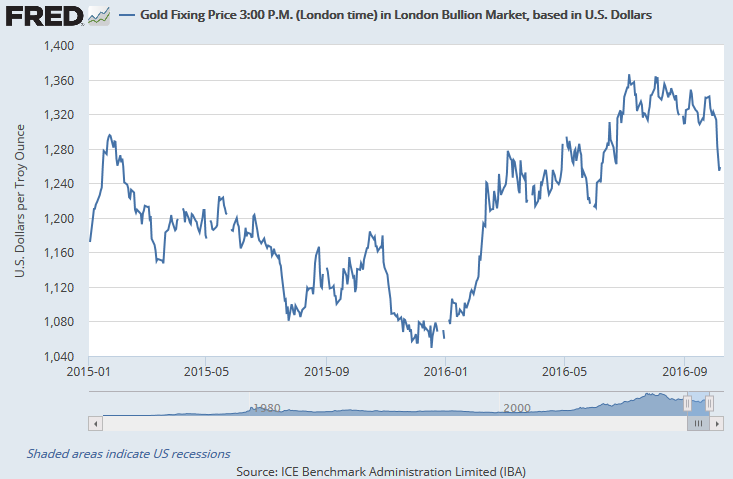
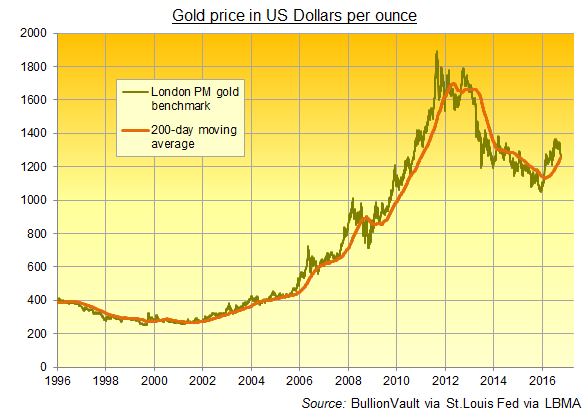
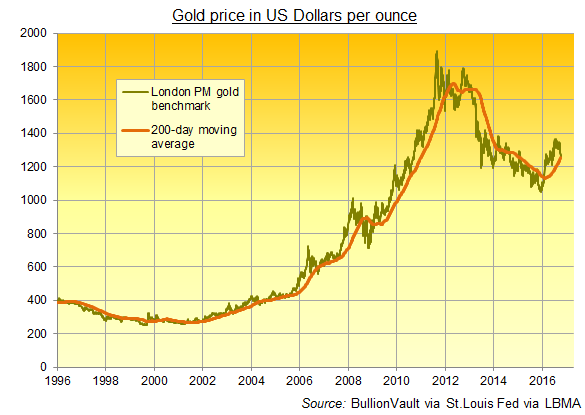
Chart of gold price, London PM benchmark 2016
 
Ahead of Tuesday’s 3pm London benchmarking auction, gold’s 200-day moving average came at $1256.50 per ounce.
 
This morning’s London benchmark auction saw almost 3 times as much gold offered for sale as wanted to buy at the opening suggestion of $1257.20 per ounce.
 
The volume of bids jumped but asks only retreated a little as the auction then reduced the suggestion and found a balance of buying with selling at $1256.40 per ounce.
 
“A rebound could take place,” says the latest technical analysis from French investment and bullion market-making bank Societe Generale.
 
“However, it will likely be a corrective rebound…and the [downwards] correction could extend towards $1200.”
 
“I see gold targeting the $1200 level,” agrees Russell Browne in New York for bullion market-maker and London benchmark participant Scotiabank, noting that – on the front-month US futures contract – gold closed Monday “for the third day in a row below the 200-day moving average closing at 1258.50.”
 
Yesterday’s “return of the Chinese” after the week-long National Day holidays saw “some decent buying,” says a note from Swiss refining and finance group MKS, but “turnover was however a little more limited than usual.
 
“I think some traders may have expected this to be a little higher, given that the spot market was $50 below where Chinese traders last saw it.”
 
Tuesday’s volume on the Shanghai Gold Exchange was muted again, but the benchmark Shanghai Gold Fix’s premium over comparable London quotes rose to $5.85 per ounce, extending its run of sizeable incentives for bullion importers.
 
Government bond prices rallied meantime Tuesday, nudging 10-year UK Gilt yields back below 1.00% – a record low when first breached immediately after the Brexit referendum result.
 
German Bund yields also retreated as prices rose, but held above the zero level cross for the first time in history this summer.

Gold Prices Steady After Worst 1-Week Drop Since 2014, China's Yuan Cut to 6-Year Low

GOLD PRICES rose against all major currencies on Monday morning before easing back in London, rallying from a 4-month Dollar low as the US currency slipped but the Chinese Yuan – now part of the International Monetary Fund’s SDR basket – fell hard on China’s return from the Golden Week holidays, writes Steffen Grosshauser at BullionVault. 
 
The Yuan was fixed by Beijing’s central bank at its lowest level versus the Dollar since September 2010.
 
The US Dollar index ticked 0.2% lower following the acrimonious US presidential election debate overnight between Democrat and former First Lady Hillary Clinton and the Republicans’ property mogul candidate Donald Trump.
 
Western stock markets rose and major government bond prices slipped.
 
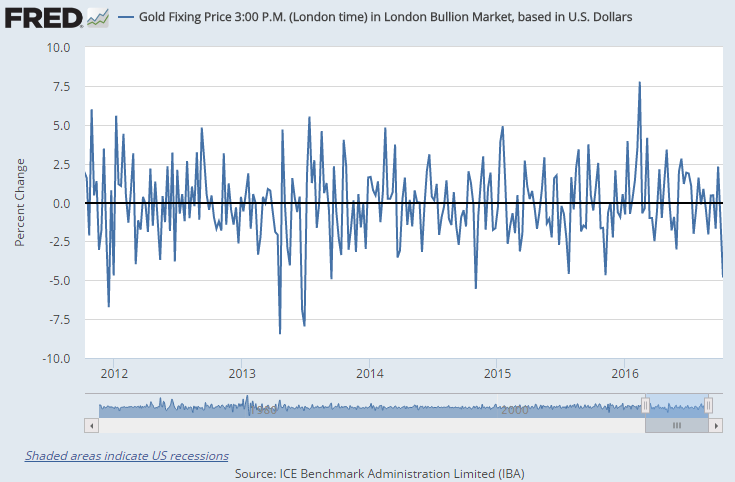
Gold prices rose $5 per ounce from last Friday’s 3pm benchmark in London to touch $1264, recovering from its worst weekly loss since 2014.
 
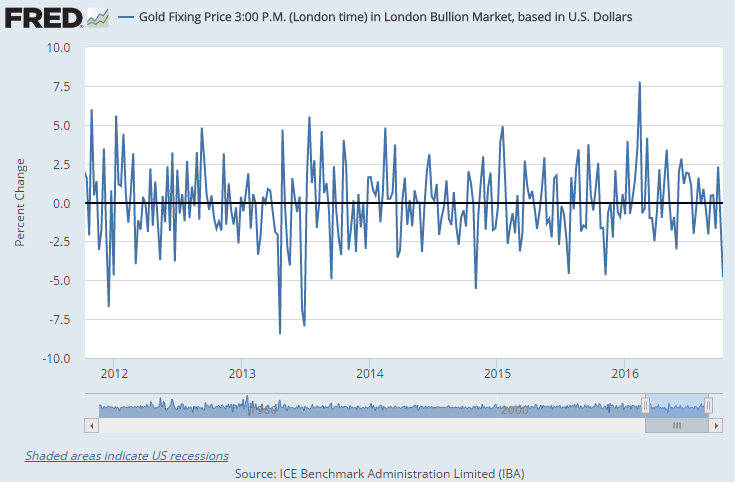
Chart of gold's 3pm London benchmark price on Fridays, percentage week-on-week change
 
Japan and Hong Kong stayed closed due to public holidays, but Chinese traders returned to the market to find gold prices 4.5% lower from before their week-long National Day break.
 
“We expect gold to remain buoyant, looking for support around $1250 following Friday’s encouraging move…on the less than impressive US jobs data,” commented Swiss refining and finance group MKS’s trading desk on Monday morning.
 
“Gold prices are quite appealing after the recent correction,” said Richard Xu, a fund manager at China’s biggest gold exchange-traded fund HuaAn Gold.    
 
“In China, what we see today is that there is some demand to buy gold following its dip.”
 
“Early buying was evident from both speculators and physical traders,” confirmed Alex Thorndike, senior precious metals dealer at MKS Pamp, “with investors expecting the return of the Chinese – after a week-long break – to see some decent buying.”
 
Other precious metals rose faster, silver gaining around 1.5% to $17.75 per ounce while platinum rose 0.5% after dropping to a 6-month low of $946 last Friday.
 
“If investors are looking for the next US president to create stability in the markets, it’s not going to happen,” said former US Representative Ron Paul. 
 
However, “talks related to the presidential election don’t count,” thinks Mark To, head of research at Hong Kong’s Financial Group Wing Fung. 
 
“Once elected most candidates follow the same practices. They don’t opt for extreme measures like they promise in their campaigns.” 
 
New data released after Friday’s close meantime showed bullish betting in Comex gold futures and options swinging sharply lower as prices fell through summer 2016’s floor at $1300 last Tuesday.
 
Net of bearish bets amongst Money Managers, the speculative long position shrank by 21%, its second sharpest retreat of the year so far.
 
Meanwhile, global holdings of bullion-backed exchange traded funds grew to the highest since 2013 after last week’s drop in gold prices.
 
The world’s largest gold-backed ETF, the SPDR Gold Trust (NYSEArca:GLD), rose 1.2% to 958.90 tonnes last Friday.

Gold Prices Regain 'Key' 200-Day Moving Average After Weak US Jobs Data

GOLD PRICED in US Dollars rose Friday back above its 200-day moving average – a ‘key’ technical level according to several analysts – after new US jobs data came in weaker than expected.
 
The US jobless rate rose to 5.0% in September according to the Bureau of Labor Statistics’ non-farm payrolls estimate, up one-tenth of a percent from the early 2008 lows reached this summer.
 
Gold prices rallied to $1261 following the news, $10 above the 4-month low hit as Asian trading began overnight with China still shut for the end of its National Day holiday week.
 
China’s Shanghai Gold Exchange will re-open Monday to find Dollar gold prices almost 5% below Friday last week. 
 
Thursday saw the LBMA Gold Price auction – the global benchmark for physical bullion – fix below its 200-day moving average for the first time since February down at $1254.50 per ounce.
 
The average of gold’s previous 200 days proved solid support for the 125% gain from late 2008 to autumn 2011.
 
It then capped gold’s rallies during the last 12 months of its 45% bear market from 2011 to end-2015.
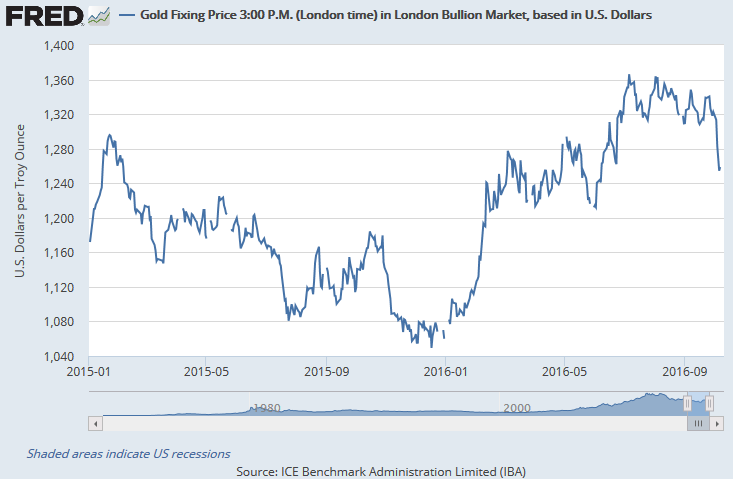
Chart of daily gold price and 200-day moving average
 
“Needless to say, our forecasts are currently under review,” says Dutch bank ABN Amro’s latest precious metals analysis, having turned bullish in February (when prices had gained 15% from December’s 6-year low) and then raising its price forecasts again in July (when prices hit a 2-year peak at $1375).
 
“[While] we expect the long-term uptrends to remain in place…gold prices need to bottom out around $1257 and silver prices around $17.10 per ounce, where the 200-day moving averages come in.
 
“If gold and silver prices break below these levels, this year’s uptrend is over.”
 
“Next major support is evident at $1258 per ounce,” agrees precious metals analyst Robin Bhar at French investment and bullion market-making bank Societe Generale in London – “the location of the influential 200-day moving average.
 
“Should this level be broken then this year’s uptrend could be in danger of unravelling.”
 
But “key will be whether this sell-off prompts bargain hunting and unleashes pent-up physical demand,” Bhar says, adding that while India’s festival and wedding season – peaking with Diwali at the end of October – will come after a slump in year-to-date demand, it also comes after an “above average” monsoon, likely boosting  rural incomes.
 
“A lower gold price in Indian Rupee terms should also boost demand…[already] evidenced by a much narrower discount to [London wholesale] prices of $1-2 per ounce, compared with a [domestic Indian] discount as high as $75 in July.”
 
“Our recent visit to the trade fair in Delhi,” said this week’s precious metals note from specialist consultancy Metals Focus, “suggested a level of optimism for the remainder of this year.”
 
Rising consumer and investor demand will likely cushion gold’s fall, says a new note from US investment bank and bullion market-maker Goldman Sachs’ commodities chief Jeff Currie.
 
“We would view a sell-off substantially below $1250 as a strategic buying opportunity.”
 
Gold priced in Sterling meantime spiked more than 5% higher overnight as the Pound spiked down to fresh three-decade lows on the FX market at the start of Asian trading.
 
Hitting £1048 per ounce, gold priced in GBP then retreated but held above £1015 per ounce to show a small gain for the week and a 17% gain from June 23rd, Brexit Eve.

Gold Prices 'Negative' But 2016 Gains 'Still Valid' as Fixing Lawsuits Proceed in New York

GOLD PRICES fell to fresh 15-week lows at $1260 per ounce Thursday afternoon in London, trading over 4% down from last weekend as European stock markets slipped for the second day running. 
 
Silver also gave back an overnight rally, dropping below $17.60 to trade almost 8% down for the week so far.
 
Crude oil was unchanged just shy of $50 per barrel as analysts debated the likelihood of Opec cartel member states breaking the new output ceiling, agreed in principal last week in Vienna.
 
“Support in the near term comes in at $1258.40…[the] 200-day moving average,” says a technical analysis from Scotiabank (TSE:BNS), the parent of bullion market-maker Scotia Mocatta now facing a lawsuit in Manhattan over alleged ‘manipulation’ of former global benchmark prices, the London Gold Fix and Silver Fix.
 
“The 2016 [gold price] uptrend has been severed,” says technical analyst Karen Jones at Germany’s Commerzbank of this week’s gold price chart.
 
“The rebound…is viewed as corrective only [now that] spot gold has failed at the 2011-2016 downtrend located at $1350 and eroded the 2016 uptrend.
 
“This is quite negative price action.”
 
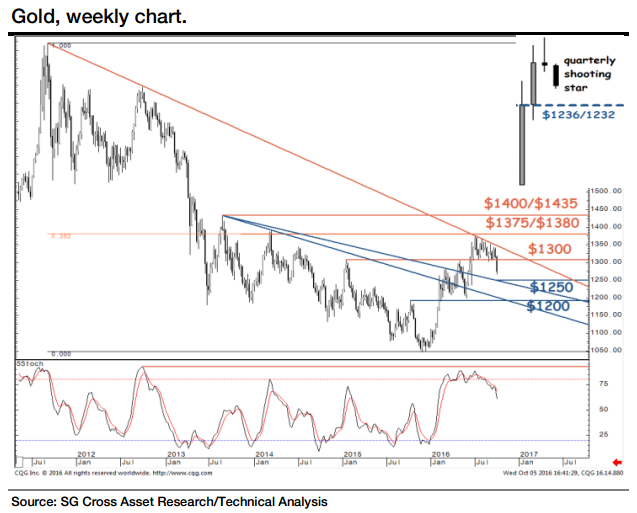
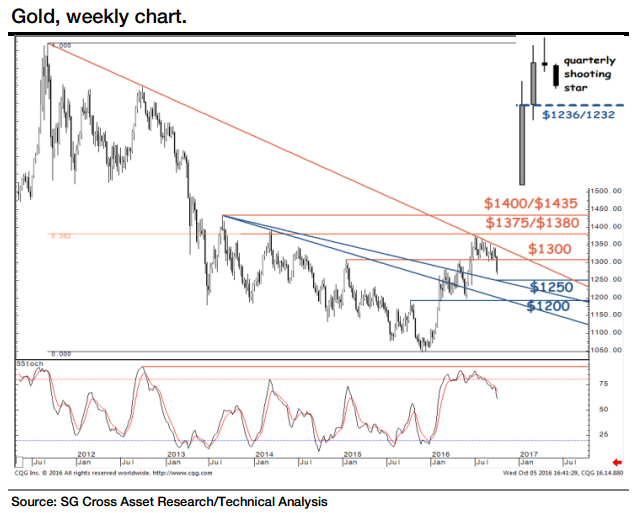
But “Gold achieved a significant bottom late 2015 and formed a large base,” says updated technical analysis from French investment bank and bullion market-maker Societe Generale (EPA:GLE) – also facing the Gold Fix lawsuit in New York.
 
“Breach[ing] above a down-sloping trend drawn since 2013 [gold prices in 2016 made] an impressive rally spanning over nearly seven months.”
 
This year’s break “above that resistance line is still valid,” SocGen says, repeating its longer-term target of gold’s August 2013 highs of $1400-1435.
 
“[If] downward momentum gains further traction, [that former downwards] trend line since 2013 [now] at $1200 should act as a floor.”
Weekly gold price chart from Societe Generale
 
Meantime in Manhattan, both SocGen and Scotiabank will face anti-trust and manipulation claims – together with Barclays Bank (LON:BARC) and HSBC Holdings (LON:HSBA) – after US District Judge Valerie Caproni decided to allow a lawsuit brought by a group of investors to move forward against members of the now defunct London Gold Fixing Limited, alleging unlawful restraint of trade from January 2006 to December 2012.
 
Germany’s Deutsche Bank (ETR:DBK) – which spurred the Gold and Silver Fixes’ replacement by quitting in January 2014 – settled with the plaintiffs for an undisclosed sum this April.
 
“From the gold plaintiffs’ standpoint, [gaining leave to proceed is] very substantial victory,” Reuters quotes one of the investors’ legal team, first brought together when 18 separate suits were consolidated in summer 2014.
 
Swiss bank UBS this week had its role in the claims dismissed, having noted in summer 2015 that it had never been a member of London Gold Market Fixing Limited.
 
“Plaintiffs strain to oppose dismissal by misreading their own complaint and drawing inapt comparisons to unrelated conduct outside the gold fix setting,” UBS told the court, “offer[ing] nothing beyond ‘labels and conclusions’ and facts showing at most merely parallel conduct” – phrases repeated by Judge Caproni in this week’s decision to dismiss.
 
Claims against HSBC and Scotiabank will also now move forward regarding the Silver Fix after Caproni said the plaintiffs had sufficiently alleged – “albeit barely” – that they together with Deutsche Bank had violated US antitrust law from 2007 to 2013.

Gold Prices 'Could Rally Fast' After Slump on 'Bleeding Obvious' Central-Bank Comments

GOLD PRICES set new 15-week lows for Dollar, Euro and Yen investors on Wednesday, extending yesterday’s 3% plunge to touch $1267 per ounce as world stock markets fell for a second session running after a US Fed member said interest rates should be higher, and the European Central Bank tried to dampen speculation that it will soon ‘taper’ its monthly QE money creation scheme.
 
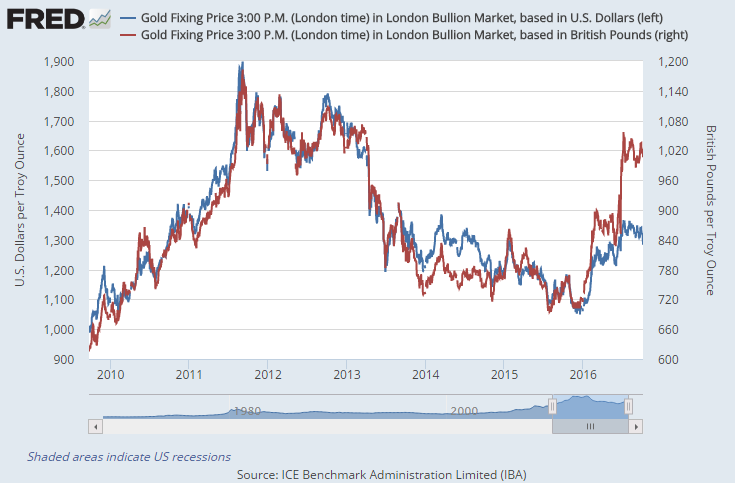
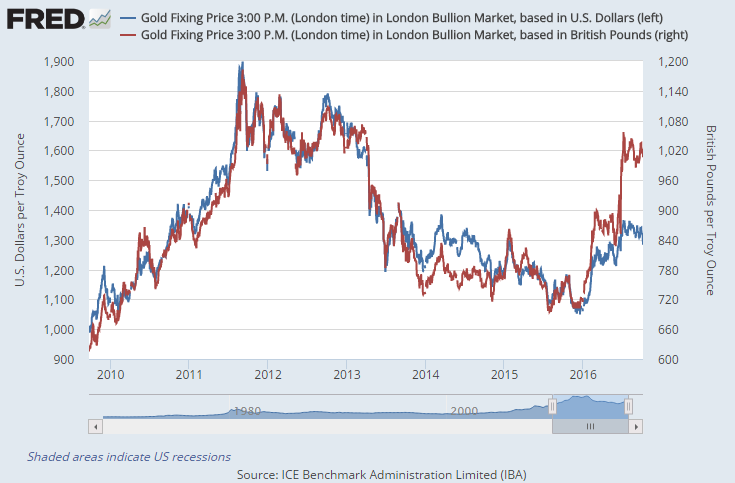
Only gold priced in Sterling held firm, trading above £1000 per ounce – a 3-year high when first reached on the UK’s shock Brexit referendum result – as the British Pound fell to new 31-year lows on the FX market amid policy speeches from the ruling Conservative Party’s new prime minister, Theresa May, and her cabinet.
 
Aso-called “hard Brexit” from the European Union’s single market could cost 75,000 jobs and £10 billion ($13bn) in tax revenues from the City of London, said one financial consultancy today.
 
Chart of gold priced in Sterling (left) vs gold priced in US Dollars. Source: St.Louis Fed via LBMA
 
“I would have dissented” at the Federal Reserve’s September meeting, said non-voting member Richmond Fed President Jeffrey Lacker yesterday – the only dissenter voting to raise when the US central bank surprised analysts and traders by not hiking in September 2015.
 
Pre-emptive increases in the federal funds rate are likely to play a critical role in maintaining the stability of inflation,” he said.
 
A separate rumor reported by Bloomberg News meantime said Tuesday that the European Central Bank – currently creating €80 billion per month for QE asset purchases, and charging commercial banks 0.4% per year on excess deposits – has agreed that, when quantitative easing ends it will end slowly, with new QE being ‘tapered’ rather than halted abruptly.
 
“The report was stating the bleeding obvious,” says a trading note from commodity and bullion brokers Marex Spectron in London.
 
“However nowadays, just words on paper or screens are enough for the herd to stampede.”
 
“The front-month gold futures contract recorded its biggest daily loss in nearly three years,” says a commodities note from Germany’s Commerzbank, with “trading volume on the futures market more than twice” its recent average.
 
Gold prices falling “below the 100-day moving average and the psychologically important $1300 mark resulted in wide-scale liquidation of long positions,” it goes on, but the current “lower price level is likely in our opinion to attract buyers.
 
“We do not expect any further significant price fall.”
 
The ECB has meantime “put a lot of emphasis on its forward guidance,” says economist Frederik Ducrozet at Swiss private bank Pictet, but “we believe that QE tapering will not start before Q4 2017, and we still expect the ECB to announce that asset purchases will be extended by six months at the same €80bn monthly pace until September [next year]” when the current schedule ends in March.
 
“We are still a long way off ‘Taper Time’,” agrees today’s credit markets’ update from French bank Natixis, noting that while German and other European government debt prices “underwent a substantial correction” on Tuesday’s report, the futures contract in Bund yields “then rebounded when ECB chief Mario Draghi pointed out that the bank’s monetary policy council had not discussed tapering.”
 
“As quickly as gold fell, gold could rally back,” reckons economist Barnabas Gan at the Singapore branch of Oversea-Chinese Banking Corp.
 
“Weak inflationary pressures [capping interest-rate expectations] may once again lift gold prices back to their previous shine.”
 
Back in Birmingham, England, new UK prime minister May today said that “A change has got to come” to monetary policy “and we are going to deliver it” after the Bank of England’s low rates and QE money creation meant “people with assets have got richer, people without them have suffered; people with mortgages have found their debts cheaper, people with savings have found themselves poorer.”
 
But “it’s unlikely that any domestic factor, whether monetary policy or anything else, can be the predominant influence on longer-term real interest rates,” said Bank of England deputy-governor for monetary policy Ben Broadbent in a speech at the Wall Street Journal’ss offices in London, “as these are determined globally.
 
“It’s hard to believe central banks were doing much else than simply following a similar decline in the neutral rate of interest – the level consistent with stable inflation.”
 
Silver meantime tracked gold prices near 4-month lows as the start of US trading approached Wednesday, extending its Dollar-price drop to 15% from Brexit’s peak of early July to trade below $18 per ounce.