Author Archives: City Gold Bullion

'Witches' Brew' Sees Gold Price Over $1300, Jobs Data Miss Badly Before Fed Rate Vote & US Election

GOLD PRICES rose to 1-month highs above $1300 per ounce Wednesday in London, gaining for the fourth day running ahead of November’s Federal Reserve decision on Dollar interest rates – its last before the bitter US presidential campaign peaks with next Tuesday’s vote. 
 
World stock markets fell again as new opinion polls showed Republican candidate Donald Trump gaining on Democrat Hillary Clinton to tie in the race for the White House.
 
Commodities also fell as crude oil sank back towards $45 per barrel.
 
Other precious metals moved higher with gold prices, but platinum lagged the yellow metal’s 2.0% jump for the week so far to trade at $995 per ounce.
 
Silver doubled gain in gold prices to hit $18.63, its own new 1-month high.
 
“A witches’ brew of economic and political factors continue to make the macro case for gold,” writes Jonathan Butler in his latest Precious Metals Weekly at Japanese conglomerate Mitsubishi, pointing to “ultra-loose global monetary policy to the US presidential election” and citing gold’s role “as a portfolio diversifier and tail risk hedge.”
 
Gold and the other precious metals however “face headwinds” Butler adds, with the US Fed’s much-anticipated December rate hike supported by Monday’s “healthy core PCE inflation reading of 1.7%.
 
“Provided Friday’s non-farm payroll data do not move lower, this will also be supportive of a December hike.”
 
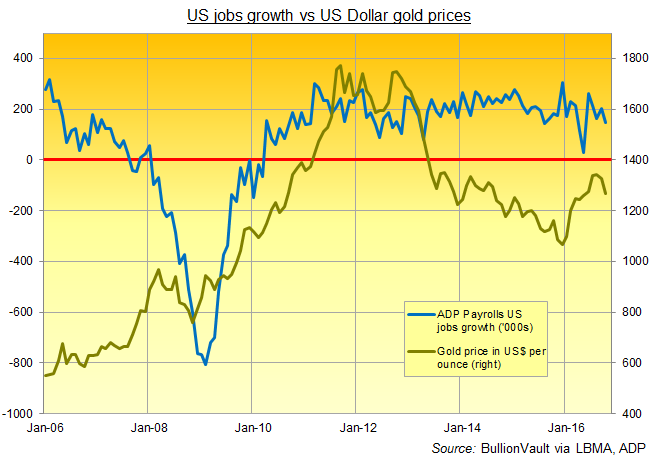
US jobs data from private-sector payrolls service ADP today badly missed Wall Street forecasts, coming in with 147,000 net growth for last month – the weakest October since the US was last in recession in 2009.
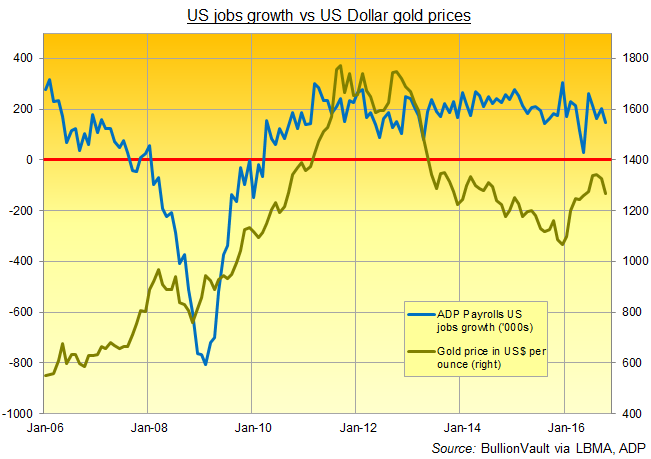
Chart of gold prices vs US jobs growth on ADP's monthly report
 
“What will be closely looked at is the wording of [today’s] accompanying [Fed] announcement,” says London brokerage Marex Spectron, with “any affirmation” of a December hike likely to “see a dip in the gold price.
 
“But this should be bought with the election looming.”
 
Gold prices “surged higher overnight in light of a possible Trump victory,” says a trading note from Swiss refining and finance group MKS, as US polls also “weighed on equities and gave the precious a firm bid.”
 
“At the same time, risk aversion has risen noticeably,” says the commodities research team at Germany’s Commerzbank, highlighting the 4-month closing low in US equities on Tuesday.
 
“Although Clinton is still considerably ahead when it comes to the key electoral votes, next Tuesday could prove more of a nail-biter than had been thought just a few days ago.
 
“[This echoes the UK’s] Brexit referendum at the end of June, when gold surged by nearly 10% within just a few days after the vote.”
 
Dollar gold prices twice rose above the $1300 level in the weeks approaching the UK’s decision on quitting the European Union, slipping back before June 23rd’s vote but then surging to $1375 in the weeks after that shock result.
Gold Bullion at 1-Month High as CME Joins London Futures Contract Race

GOLD BULLION jumped to 1-month highs against a weakening US Dollar in London trade Tuesday, touching $1288 per ounce as Comex futures rose in New York and major Western government bond prices fell, driving yields higher ahead of tomorrow’s US Fed decision on interest rates, following much stronger-than-forecast Chinese manufacturing data.
 
London and European share prices also slipped as gold bullion rose 0.9% for the week so far.
 
Both the official NBS and private-sector Caixin/Markit PMI readings jumped to 51.2, up from barely-growing levels of 50.4 and 50.2 respectively.
 
US personal consumption expenditures for September yesterday showed a larger-than-expected rise in prices, up 1.2% from a year before.
 
Looking at copper prices – often seen a key marker of global economic strength and inflationary pressure – “The lack of investment [in mining] over the last three years will be felt increasingly over the next three,” says a note from Chinese-owned bullion bank ICBC for base-metals traders attending the London Metal Exchange’s LME Week.
 
“In our view, the lows of the cycle are in, and while it may be slow and steady in 2017…copper may well spring some surprises further down the line.”
 
After the LME – working with five banks, one proprietary trading house, and the mining-backed World Gold Council – in August announced plans to launch a London gold futures contract 30 years after a previous attempt was shut, US-based exchange group the CME – provider of the heavily-traded Comex precious metals contracts – today announced the launch of what it calls ‘London Spot Gold Futures’.
 
Planned for 9 January next year, the CME’s contract should launch before the LME’s LMEprecious platform, scheduled for “the first half of 2017.”
 
Competitor exchange ICE – administrator of the LBMA Gold Price benchmark, replacement for the century-old London Gold Fix since 2015 – said last month it will launch a New York-cleared futures contract for London-settled gold in February 2017, expressly to enable more direct participants in that daily auction, over and above the 13 banks currently needing lines of credit with each other individually.
 
The LME has since 2014 administered the London-based platinum and palladium benchmark price auctions. The CME has since 2014 administered the replacement of the century-old Silver Fix, working with data providers and news-wire Thomson Reuters, which today announced the loss of 2,000 jobs – some 4% of its global workforce – in a bid “to streamline its business.”
 
“Our new contracts will provide traders with streamlined access to the London spot market via the safety and transparency of cleared, exchange-traded futures contracts,” says CME Group’s head of precious metals, Miguel Vias.
 
“We believe [this] has the potential to create an even stronger link between the world’s two largest pools of precious metals liquidity, namely benchmark Comex Gold and Silver futures and the London spot markets.”
 
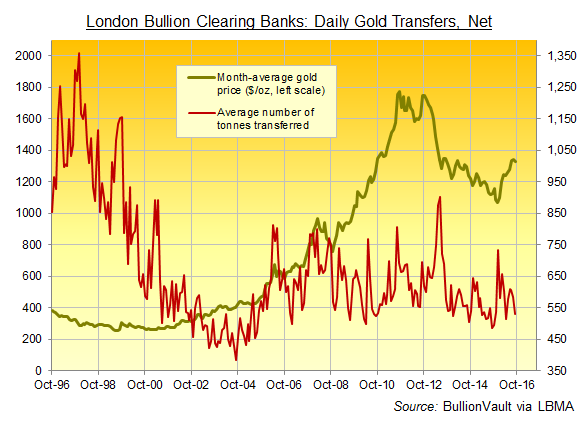
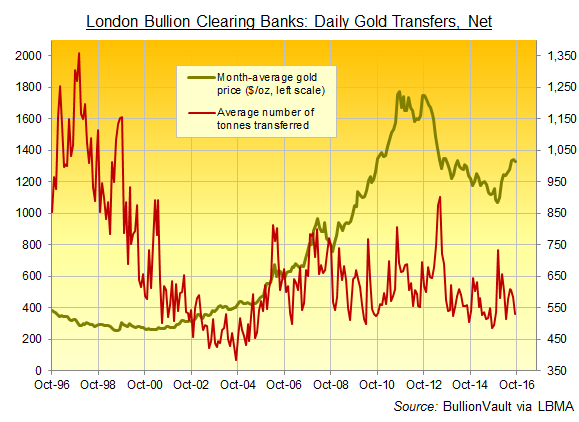
New data released Monday said that London’s gold bullion market – which remains ‘over the counter’ (OTC), with each buyer and seller contracting directly with each other – saw an average 529 tonnes settled between the accounts of the five member banks of the London Precious Metals Clearing Limited (LPMCL) in September.
Chart of daily average London gold transfers between 5 member banks of LPMCL
The lowest figure since April and 10% below the previous 2016 average to date, that volume stood 9% higher from September 2015.
 
It likely represents only a fraction of London trading in wholesale gold bullion bars, variously estimated at three, five or nine times as large in total – the vast bulk “unallocated” as a credit on the buyer’s account, rather than physically delivered.
 
The CME meantime saw gold futures contracts representing 595 tonnes of bullion change hands on a daily average basis in September, some 37% higher from the same month in 2015.
 
Registered stockpiles of bullion, available for delivery against maturing Comex gold contracts, yesterday totaled less than 12% of that figure, with actual physical settlement only a fraction of that number again.
 
“It is very difficult to create a second market trading the same thing if the first one is already successful,” said senior London metals trader John Wolff of the LME’s mid-1980s gold futures contract in a 2016 interview.
 
“Clients want to trade where the liquidity is.” 
 
“The Achilles heel,” agreed fellow London Bullion Market Association founder Robert Guy in separate comments in 2012, “was the lack of domestic investor and speculator interest, without which no futures market can survive.”

Gold Prices Firm, Silver Near 4-Week High But Clinton-FBI Boost 'May Not Last'

GOLD PRICES traded near $1275 per ounce on Monday morning in London, holding firm against a strong US Dollar as stock markets fell amid US presidential candidate Hillary Clinton’s demands for details of the FBI’s latest probe into her private emails to be made public before next week’s election, writes Steffen Grosshauser at BullionVault.
 
Major government bond prices rose everywhere except Italy, where prime minister Matteo Renzi – facing a confidence vote in November’s referendum on constitutional change – vowed to “rebuild everything” destroyed by the weekend’s most powerful earthquake since 1980.
 
Energy prices meantime fell after the Opec cartel of the world’s biggest crude oil producers failed to agree on supply cuts.
 
Gold prices jumped over 1% late Friday to the highest level in nearly four weeks after the US Federal Bureau of Investigation said it has reopened its investigation of Hillary Clinton’s use of a private email server during her time as secretary of state.
 
Hedge funds and other money managers had already raised their net long positions in Comex gold for the first time in four during the week-ending last Tuesday, new data released by US regulators the CFTC showed late Friday.
 
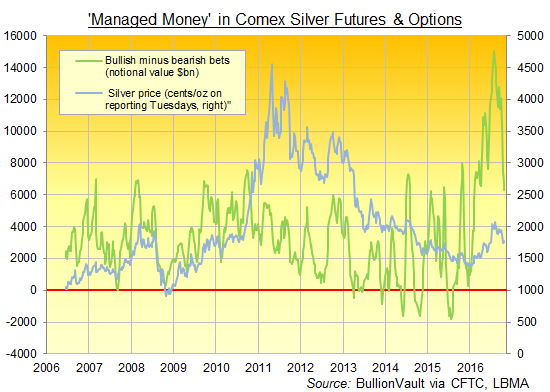
At the same time, the ‘Managed Money’ category of traders cut their bullish betting in Comex silver contracts for the fourth week running, down to the lowest “net long” position since early February.
Chart of 'Managed Money' net speculative long position in Comex silver futures & options
 
Silver prices held firmer than gold on Monday, trading just 10 cents below Friday’s late pop to 4-week highs of $17.92 per ounce.
 
With her Republican rival Donald Trump having previously slipped badly in opinion polls, around 1% of Clinton supporters are now less likely to vote for her, suggests a survey by pollster CBS/YouGov.
 
“The FBI headlines startled a somnolent gold market, driving bullion higher on concerns that a late October surprise could suddenly bolster Trump’s sagging fortunes,” says Tai Wong, metals trading director at Canadian brokerage BMO Capital Markets. 
 
“The rally may not last though, as we are at the two-minute warning and Clinton is ahead by two scores, so it would require a truly shocking revelation to derail her chances.”
 
“Investment demand for gold should pick up towards the US presidential elections given the higher suspense ongoing in the [Clinton] issue,” an analyst at ANZ bank wrote on Monday.
 
“Gold has now held key technical support and looks set for further gains,” confirmed trader Jason Cerisola at Swiss refiner MKS Pamp. 
 
Retailers in India – formerly the world’s No.1 consumer gold market – meantime reported brisk sales over last week’s Diwali festival, culminating Sunday.
 
“Consumers are back in the market and retailers are all geared up to meet this demand,” says the mining industry-backed World Gold Council’s India director Somasundaram PR.
 
With India’s jewelry demand for 2016 to date down over 40% from the first 9 months of last year, “The level of activity only shows that things have come back to normal in trade as well as at the consumer level,” Somasundaram claims.

Libya Rejects Selling Gold Bullion, China Imports +10% on 2015 But World Jewelry Demand 'Appalling'

GOLD BULLION rallied but failed to regain yesterday’s 3-week highs in Asian and London trade Thursday morning, holding little changed for the week against a rising Dollar at $1268 per ounce as world stock markets slipped once again.
 
Reviewing its new July-to-September data, “For the third successive quarter physical demand for gold remained at pitiful levels,” says the latest analysis from specialist research team Thomson Reuters GFMS, “down 30% year-on-year in Q3.”
 
Gold bullion’s jump to multi-year highs at the start of the third quarter – following the UK’s shock Brexit referendum result – drove more investment money into derivatives and gold-backed ETF trust funds, says GFMS, but that “only exacerbated the appalling state of physical demand.
 
“The two largest markets, India and China, saw jewelry consumption down 41% and 27% respectively year-on-year…2016 appears set to record a seven-year low in China and a 13-year low in India.”
 
China’s net imports of gold bullion through Hong Kong – still the major port of entry ahead of Beijing and Shanghai according to local commercial bank sources – totaled almost 45 tonnes in September, Bloomberg reports, up from the news-wire’s figure for August but more than half the level of the same month last year.
 
Year-to-date however, China’s gold bullion imports through Hong Kong now stand 10% ahead of the first 9 months of 2015.
 
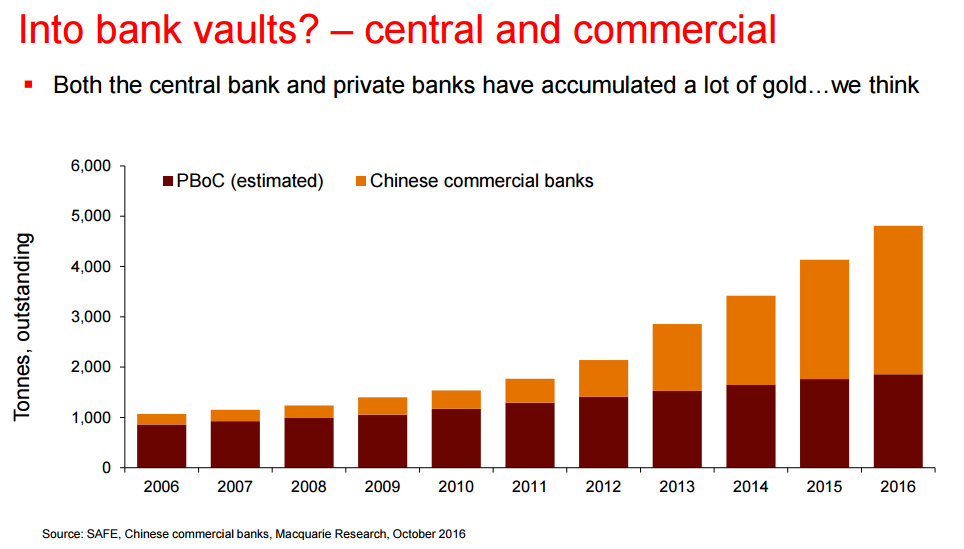
“The surge of 2013 saw payback in 2014,” said Australian bank Macquarie’s precious metals analyst Matthew Turner at last week’s 2016 London Bullion Market Association conference, “but China’s gold bullion imports have been consistently high since.”
 
Comparing his own estimates of China’s total supply availability against the lower estimates of Chinese gold demand from specialist research groups, “This gap has arisen in the last three to four years,” Turner went on, suggesting that the discrepancy is explained by growing central bank and also commercial Chinese bank bullion holdings.
 
Chart from Macquarie's Matthew Turner of China's bank gold holdings
 
Libya’s UN-appointed head of the presidential council, Fayez Al-Sirraj, meantime told an interview with Libyan TV that the embattled state could sell some of its physical gold bullion reserves – the world’s 29th largest national hoard – to “solve the cash shortages” in the north African country.
 
“We have rejected such a demand,” countered the Central Bank of Libya’s governer Al-Seddiq Al-Kabeer today, “as it would rid us of strategic reserves. Without them, Libya’s last economic defense would collapse.”
 
Libya’s reported gold reserves last changed in late 2011, reduced by almost one-fifth to 116 tonnes as four-decades’ dictator Muammar Gaddafi used bullion to pay mercenary troops defending his regime after the Arab Spring spread and led to rebellion in the oil-rich north African state.
 
Gadaffi’s birthplace, the coastal town of Sirte – also scene of his death 5 years ago – today neared liberation from the self-declared caliphate of ISIS according to US media reports, with Western and Arab coalition forces continuing airstrikes.

Gold Price 'Resilient' as Dollar Rises, Beijing Curbs Yuan Selling, Pound Whips on 'Hard Brexit' Talk

GOLD PRICES slipped $5 per ounce from 3-week highs in London trade Wednesday morning, but held a 0.4% gain for the week so far at $1271 as world stock markets extended Wall Street’s late losses and the US Dollar continued to rise.
 
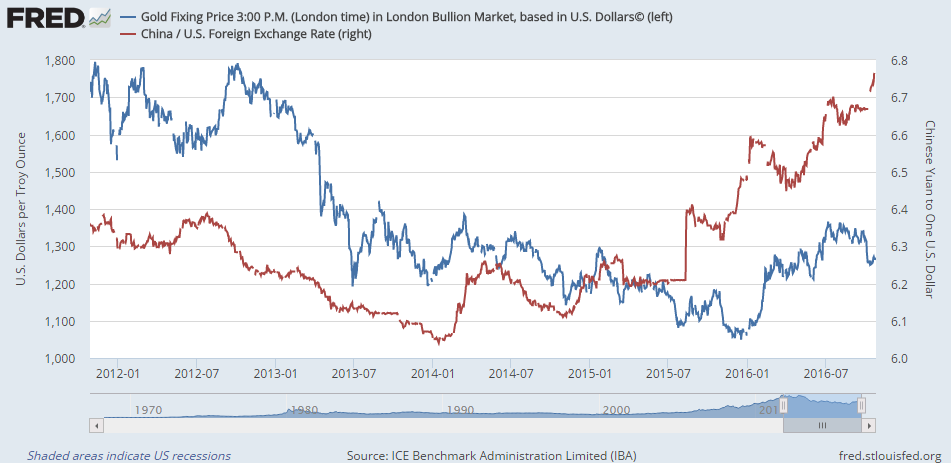
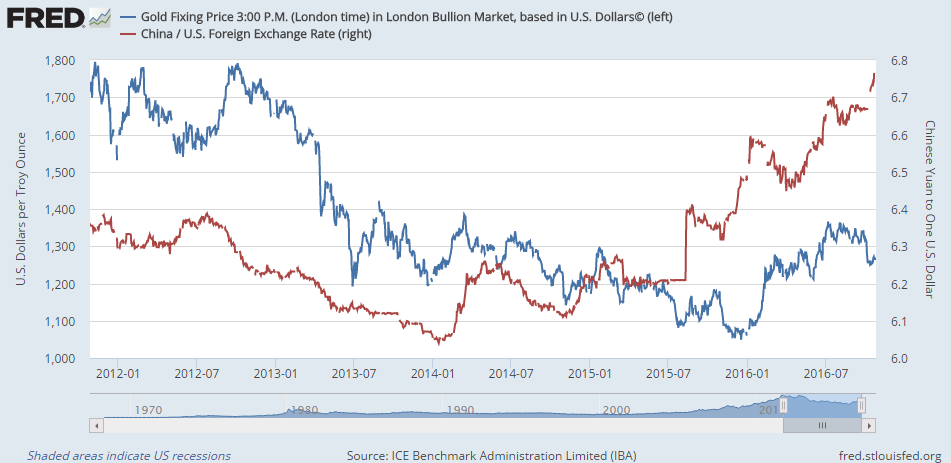
The Dollar touched fresh 6-year highs versus the Chinese Yuan, but Shanghai gold prices rose faster, holding the premium for bullion landed in the world’s No.1 consumer country at $5 per ounce above quotes for London settlement.
 
One day after China’s top central banker Yi Gang wrote an editorial in Beijing’s People’s Daily warning “speculators” to stop selling the Yuan, the State Administration of Foreign Exchange has imposed exchange controls to block capital outflows, says the Nikkei Asian Review, capping how much foreign currency banks in key economic regions led by Shanghai and Guangzhou can trade with customers.
 
“These limits, though ostensibly up to banks’ discretion, are set by negotiation with authorities and so are essentially directed by the government,” the Nikkei says, quoting a ‘source’.
 
“A gag order has been imposed surrounding the measures, the source said.”
 
Chart of USDCNY and gold priced in Dollars, last 5 years
 
“The Chinese currency has stayed stable against a basket of currencies,” said People’s Bank chief Yi in his article after the Yuan dropped 1.5% versus the Dollar over the last two weeks, “and its volatility was far below other emerging market currencies.”
 
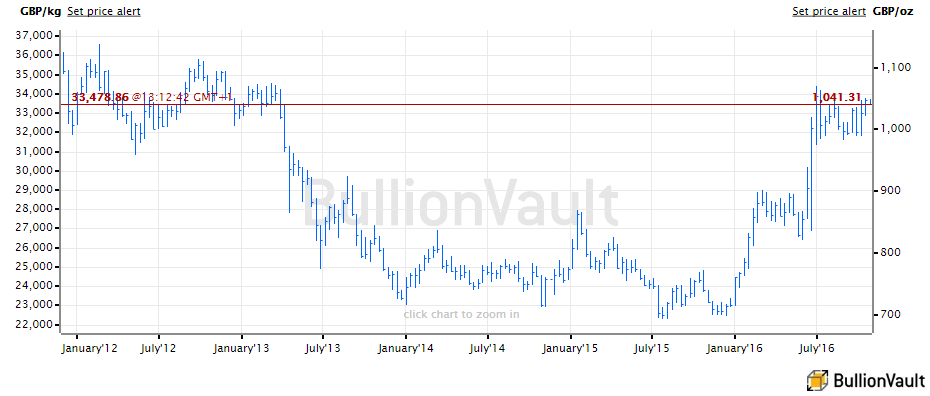
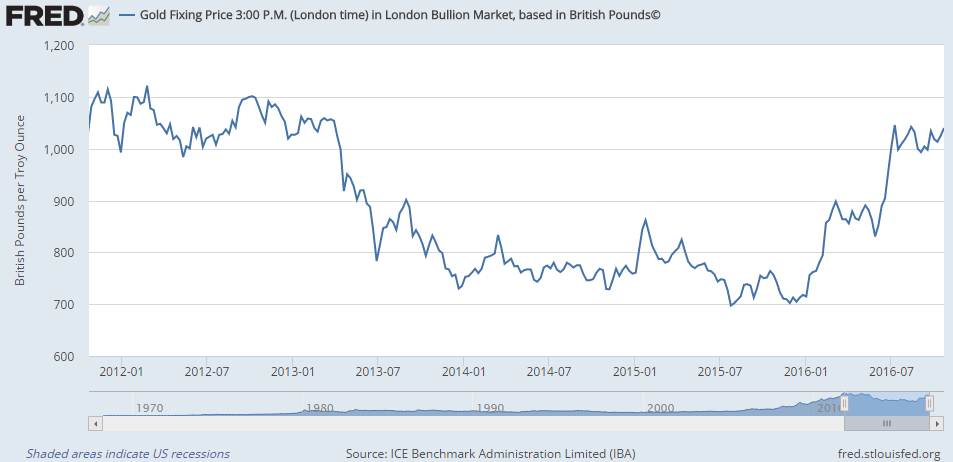
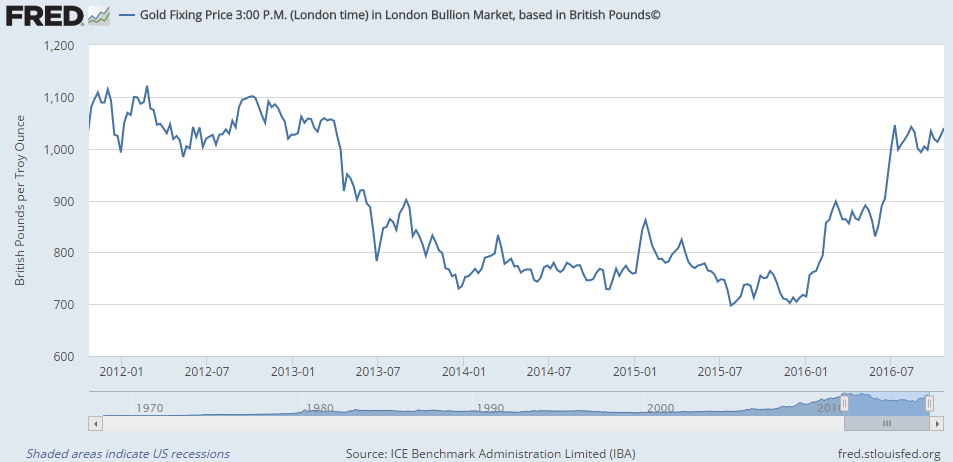
British Pound gold prices meantime retreated £10 on Wednesday morning from an overnight spike to £1050 per ounce – the highest since early July’s 3-year post-EU referendum peak – as Sterling whipped on the FX market amid questions to new prime minister Theresa May over her government’s supposed “hard Brexit” strategy.
 
Chart of the gold price in British Pounds
News-wire reports today attribute the rising gold price to growing Indian demand ahead of next week’s Hindu festival of Diwali.
 
“The metal [has seen] solid physical interest toward $1260,” says a trading desk note from Swiss refining and finance group MKS Pamp.
 
“To put things into perspective, Friday’s ETF outflow was the largest daily decline since mid-2013 [but] when coupled with the Greenback’s eight-month high [that] shows a high level of resilience within the gold market.”
 
“Gold is staging [an] expected rebound,” says a technical analysis from French investment bank and bullion market maker Societe Generale.
 
Gold prices “closed [Tuesday] above the 200-day [moving average], at $1273,” says a technical analysis from Scotiabank, the bullion market maker.
 
“New resistance comes in at $1284…Support is at $1267.80 [per ounce].”

China's Gold Investing Seen Rising But Jewelry Sales Plunge, India 'Dead' as Yuan Sinks

GOLD INVESTING prices rose back near $1270 per ounce in London trade Tuesday, gaining some 0.3% for the week so far as world equity prices rose, major government bonds slipped, and the ‘offshore’ Yuan – known as CNH, traded outside China, and so moving more freely than the onshore CNY – set new lifetime lows against the Dollar.
 
Asian stock markets rose outside China, and commodity prices edged near 3-month highs.
 
The Dollar also gained against other emerging-market currencies such as the Turkish Lira, and held near multi-month highs versus the Euro, Sterling and Japanese Yen as well.
 
The plunging Yuan may curb the US Federal Reserve’s comments on raising interest rates, forcing the Fed “to rein in some of its more hawkish rhetoric because of the strong Dollar, negative risk feedback loop,” according to French bank BNP Paribas’ FX strategist Sam Lynton-Brown.
 
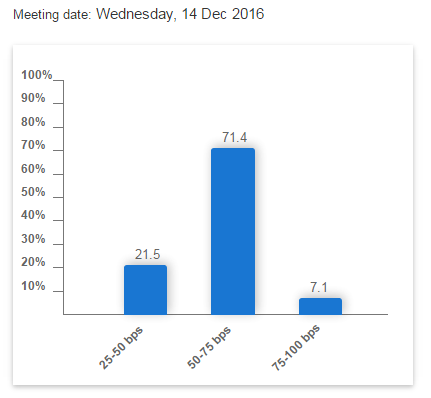
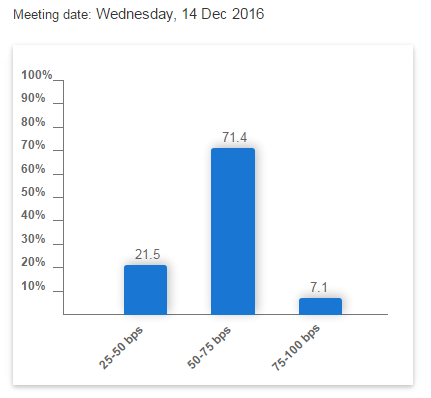
Betting in US interest-rate futures now puts just a 9% chance on the Fed raising next month, immediately after the US presidential election, but the overwhelming view is for a hike to 0.75% at the central bank’s December meeting.
Chart of US interest-rate futures betting for the Fed's 14 December 2016 meeting
 
Overtaking India as No.1 consumer in 2015, China may see gold demand increase “as a way to hedge potential currency depreciation in the face of capital controls,” reckons US investment bank Goldman Sachs in a new analysis, pointing to the Chinese Yuan’s new 6-year lows on the FX market.
 
Gold investing in China may also benefit “as a way of diversifying away from the property market,” the Goldman analysts say.
 
But jewelry sales in China have sunk in 2016 to date, diving by 17% at the mainland’s No.1 retail chain Chow Tai Fook (HKG:1929) during the 3 months ending September, and falling 37% globally for competitor Luk Fook (HKG:0590) on a same-store basis.
 
“There has been slight improvement in gemset sales in Hong Kong and Macau,” says Japanese brokerage Daiwa’s analyst Jamie Soo, quoting management comments, and mainland Chinese sales apparently improved during the Golden Week holiday in early October.
 
India’s gold demand will meantime fall to the lowest full-year total in 2016 since the global financial crisis of 2009, according to a sample of 5 jewelers and traders polled by the Bloomberg news-wire.
 
“There’s not much you can do…The whole industry is suffering,” Bloomberg quotes 6th-generation retailer Saurabh Gadgil, saying that discounts and promotions have failed to stop 2016 becoming the worst year he’s known since taking charge of P.N.Gadgil Jewellers in 1999.
 
“In my 33 years in the market, physical demand has never been this dead,” the news-wire also quotes Swiss-based refining and finance group MKS Pamp’s chairman Marwan Shakarchi.
 
“It’s a sign the government is serious about cracking down on black money” – meaning undeclared assets and illegal transactions now trapped by the Income Disclosure Scheme and PAN tax card rules imposed early in 2016.
 
“Indians now have 1.1 billion mobile phones,” said Shekhar Bhandari, senior EVP and business head for global transaction and precious metals at Kotak Mahindra Bank (NSE:KOTAKBANK), during last week’s India panel discussion at the London Bullion Market Association’s annual conference, held in 2016 in Singapore.
 
“This digital shift gives rural people the chance to use formal banking products,” Bhandari said, adding that the government’s drive for “financial inclusion” could pose a challenge to physical gold’s traditional role as a savings vehicle.
 
Kotak today reported a 43% rise in quarterly profits from a 17% rise in the bank’s net interest income.

Gold Prices Rise After GLD Shrinks Fastest Since 2013 Crash, Comex Specs Back to March

GOLD PRICES rose above $1270 per ounce Monday lunchtime in London, extending last week’s first gain in four as the Dollar retreated from a fresh 8-month high on the FX market, write Steffen Grosshauser and Adrian Ash at BullionVault.
 
This week brings key third quarter US GDP data, seen by many analysts as crucial to a Federal Reserve rate hike in December following next month’s presidential election. 
 
World stock markets ticked higher, as did major government bond prices, while crude oil fell back towards $50 per barrel.
 
Silver bullion outpaced the 0.4% rise in gold prices to touch near 2-week highs at $17.80 per ounce.
 
Friday saw bullion holdings at the world’s largest gold-backed exchange-traded fund vehicle – the SPDR Gold Trust (NYSEArca:GLD) – shrink 1.7% to 953.56 tonnes as shareholders liquidated stock.
 
Only the second daily outflow from the GLD so far this month, that 16.6 tonne redemption was the heaviest drop in that ETF since gold’s worst price crash in three decades of April 2013.
 
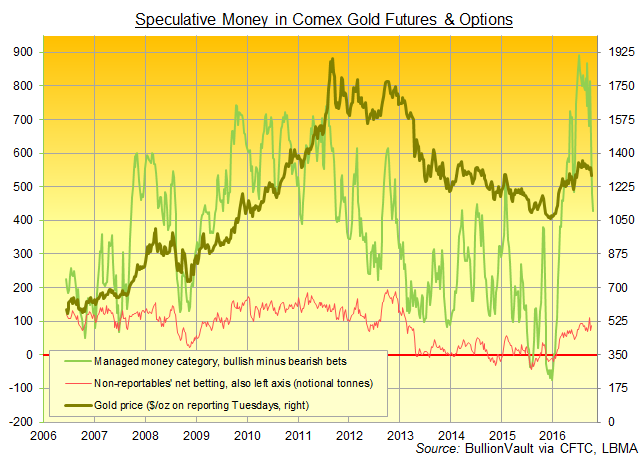
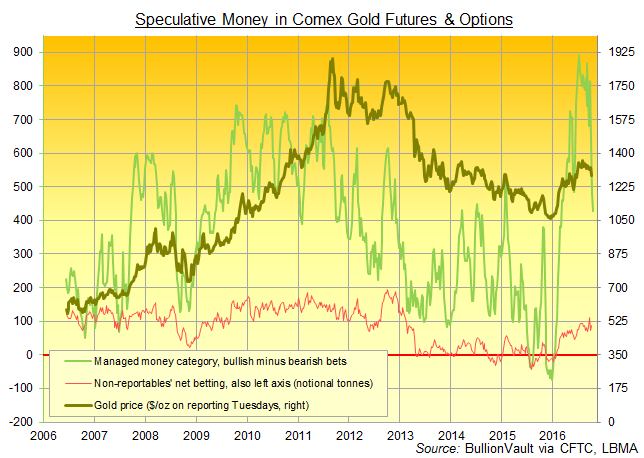
Speculative traders in Comex gold futures and options meantime cut their bullish bets, net of bearish bets as a group, to the lowest size since March last week according to data released by regulator the CFTC late Friday.
Chart of Managed Money and Non-Reportables' net bullish betting on Comex gold futures and options
 
The ‘Managed Money’ category cut its net bullish position for the third time running in the week-ending last Tuesday, reducing it to the equivalent of 426 tonnes.
 
‘Managed Money’ accounts ended 2015 with net bearish bets overall, equivalent to 75 tonnes’ worth of derivatives contracts, as prices hit new 6-year lows at $1045 per ounce.
 
Their ‘net spec long’ position then hit a record high at 892 tonnes in July, just as gold prices peaked at $1375 per ounce following the UK’s Brexit referendum shock.
 
Comex silver speculators meantime cut their betting to April levels, but the giant iShares Silver ETF (NYSEArca:SLV) needed near-record quantities of bullion backing, totalling some 11,395 tonnes.
 
“People are watching the US elections and [economic] data is on the positive side, favourable for a rate hike,” reckons Hareesh V, research head at India brokerage Geofin Comtrade Ltd.
 
“As long as prices stay below the $1300 mark, the downward trend might continue. Prices need to break convincingly above the $1300 level for a strong upside movement.”
 
This week brings third-quarter GDP growth figures from the United States, Eurozone and UK.
 
Today sees four US Fed policymakers gives speeches.
 
Non-voting member John Williams, president of the San Francisco Fed, said Friday that “this year would be good” for a rate rise to follow the December 2015 move after 7 years at zero, with further “gradual” increases in 2017.
 
“The Fed is going to increase the rates by a little bit but not excessively,” counters hedge fund legend Mark Mobius of the Templeton Emerging Markets Fund, “and there is no guarantee that a rise in interest rates will put people off.
 
“A lot will depend on the real rates,” says Mobius, forecasting a 15% rise in gold prices before the end of next year.

Gold Bars Go to $6 Premium in China as Yuan Hits Fresh 6-Year Lows on Capital Outflows

GOLD BARS traded in London’s wholesale market steadied against the rising US Dollar Friday, heading for a solid weekly gain versus all major currencies as the Chinese Yuan hit fresh 6-year lows on the FX market.
 
Premiums for gold bars settled in Shanghai ended the week $6 per ounce above comparable London quotes, well over twice the typical incentive to new imports of bullion to the world’s No.1 consumer market.
 
World stock markets meantime stalled while energy prices rose and major government bond prices ticked higher, but the rate of interest offered by Germany’s 10-year government debt continued to hold above zero.
 
That extended to 2 weeks the longest period of positive Bund yields since they first broke below zero just before the UK’s Brexit referendum on quitting the European Union in late June.
 
Gold bars meeting trade body the LBMA’s Good Delivery standards rose to €1162 per ounce Friday, almost recovering summer 2016’s post-Brexit floor, lost a fortnight ago.
 
Gold priced in British Pounds meantime rose just shy of £1040 per ounce, nearing its third highest weekly close of the last 3.5 years.
 
Chart of gold priced in British Pounds per ounce, Friday finish at LBMA Gold Price benchmark
 
“[The falling Yuan] is the key global story to focus on, not the Pound,” says French investment and bullion bank Societe Generale’s global strategist Albert Edwards.
 
“With the Chinese economy set to slow noticeably over the next six months as the authorities restrain yet another housing bubble, it is the global deflationary impact of a weak Renminbi that we need to watch closely.”
 
Outbound transfers of Chinese Yuan “surged to a record in September” says Bloomberg News today, quoting official Beijing data today showing a net outflow worth almost $45 billion.
 
The most since Beijing’s SAFE department for FX management began reporting in 2010, that jumped 60% from August and cannot be explained by trade flows according to US investment bank and London bullion market-maker Goldman Sachs, suggesting capital flight by investors.
 
“Depreciation concerns have re-emerged,” reckons economist Tommy Xie at Oversea-Chinese Banking Corp. in Singapore. “Worry [is] that China will allow higher volatility after SDR inclusion, which is actually happening now.”
 
SDRs – meaning Special Drawing Rights – are an international accounting and FX reserves unit for central banks.
 
Delayed from January 2015, and cutting the British Pound’s share of the SDR basket by 30%, the Chinese Yuan was added to the basket’s other components of Dollars, Euros and Yen at the end of September.
 
Last month’s fresh 6-year lows in the Yuan saw gold bullion bars imported to China and Hong Kong from the key refining point of Switzerland fall sharply from September 2015, new data said Thursday.
 
Swiss bullion flowed most into the UK – more typically an exporter to Switzerland of large gold bars, then converted into high-grade kilobars for the Asian investment and jewelry fabrication markets.
 
Friday morning saw global spot quotes for London settlement fall 0.7% in Dollar terms from early Thursday, but Yuan prices on the Shanghai Gold Exchange slipped only 0.2%.
 
That drove the benchmark Shanghai Gold Fix – at which bars are offered and bid at a range of prices until buying and selling come into balance – up to a $6 per ounce premium over London, even as the Yuan reached new 6-year lows on the FX market.
 
The Yuan has now lost over 10% of its Dollar value since end-2013’s two decade high.

Gold Bullion Firm, China & India Premiums 'Do Matter to Prices' as ECB Silent on QE

GOLD BULLION held above $1270 per ounce Thursday lunchtime in London, trading $20 higher for the week so far as China’s key market held firm and Indian prices rose to a premium above the global benchmark for the first time since January.
 
The Euro currency jumped to 2-day highs against the Dollar at $1.10 after the Eurozone central bank made no changes to its QE and negative interest-rate policies, and chief Mario Draghi told a press conference that the committee did not discuss extending QE bond purchases beyond the March 2017 deadline set a year ago.
 
That briefly reversed almost all of yesterday’s 0.8% rise in Euro gold prices, taking the metal back down to €1150 per ounce – a level first reached in mid-2011, lost in spring 2013, touched when the Euro crashed on the end Switzerland’s Franc pegging, and regained by the 2016 rally in May.
 
Asian stock markets had earlier risen with major government bond prices, while gold bullion in China traded up to its highest price on the Shanghai Gold Exchange since before the Golden Week holiday starting end-September.
 
That held the premium for Shanghai gold, over and above the global benchmark of bullion settlement in London, at $3.50 per ounce – an incentive to new imports some 30% above the average.
 
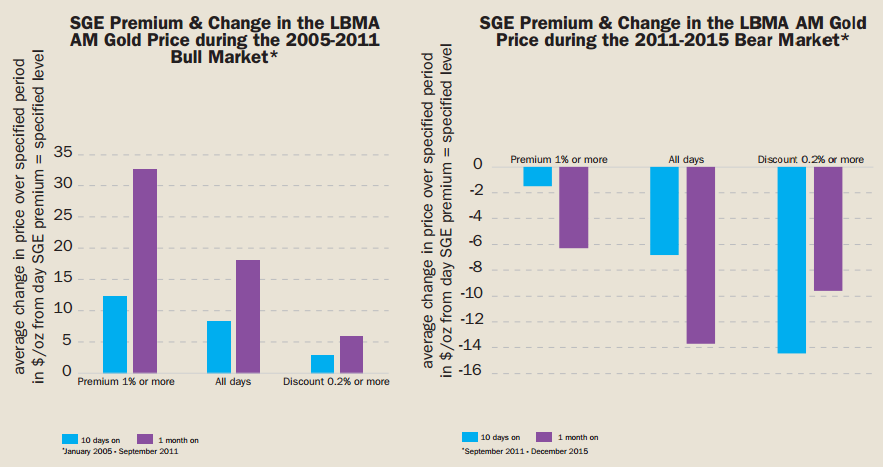
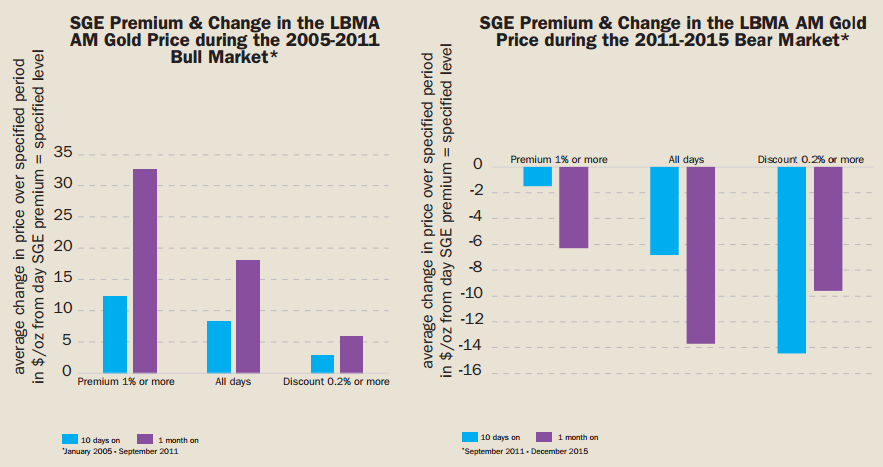
“SGE premiums have a modest but positive and statistically significant impact on future gold price moves,” suggests new research from London-HQ’ed specialist consultancy Metals Focus, published this week in the London Bullion Market Association’s quarterly Alchemist magazine.
 
“Although the relationship is far from straightforward,” explains Metals Focus‘ Research and Consultancy Manager Neil Meader – formerly Head of Precious Metals Research & Forecasts at Thomson Reuters GFMS – “monitoring SGE differentials remains important…particularly if, as we believe, investor sentiment can be influenced by the underlying physical market.”
 
Chart of SGE gold premium over London prices, and the Dollar gold price reaction 1 month later
 
“Some [investors’] enthusiasm,” Meader adds, has been “seemingly cooled by India’s currently sluggish bullion imports and the hefty loco-Mumbai discount.”
 
India’s gold prices finally rose yesterday back above London quotes for the first time in 9 months, according to the Reuters news-wire, with bullion imports to the former world No.1 consumer nation also estimated at the strongest since January as end-October’s coming Diwali festival and wedding-season demand reduces the over-stocking suffered by jewelers throughout 2016 to date.
 
Re-making charges on transforming a family’s existing jewelry into a new piece have been slashed by up to 50% according to The Economic Times, as the trade tries to ease this year’s 10% Rupee price rise and ongoing taxation issues.
 
“The [recent] drop in gold price will definitely drive demand this festive season,” the ET quotes market-development group the World Gold Council’s India director, Somasundaram PR.
 
India’s committee on General Sales Tax – aimed at simplifying the country’s huge range of GST and other charges – meantime met for a third day on Thursday, with gold one of the many “demerit” items likely to meet a higher rate of overall taxation when the GST is announced, alongside the government’s “comprehensive” gold policy, sometime early in 2017.
 
Alongside India’s apparent collapse in gold bullion imports and price premium, 2016 has seen growing reports of heavy smuggling to meet continued demand wanting to avoid tax, with two women detained by Air Intelligence in Mumbai overnight for carrying and not declaring more than $200,000-worth of gold and electronics on a flight from Bahrain.

Gold Prices Jump Above 'Resistance' After LBMA Conference, China's GDP Growth 'Not All Good News'

GOLD PRICES touched 2-week Dollar and Euro highs above $1270 per ounce Wednesday lunchtime in London, as US bond prices slipped, global stock markets held flat, and wholesale bullion traders worldwide got back to work after the market’s premier annual conference ended last night in Singapore.
 
The London Bullion Market Association conference “is often a time of general quiet in [gold] markets,” says a note from Swiss refining and finance group MKS Pamp, “with a number of traders and industry heavyweights off their desks.”
 
“Resistance is in the $1266.10-1267.80 area,” a technical analysis had said late Tuesday from bullion market makers Scotiabank, “which is the 200-day moving average.”
 
$1264 per ounce represented “first resistance” on French bank Societe Generale’s latest gold-price analysis, now turning bullish again after forecasting a drop towards $1200 last week.
 
The Chinese Yuan meantime edged back Wednesday from new 6-year lows on the FX market, but the Shanghai gold premium still fell below $4 per ounce against global quotes for London settlement an incentive for wholesale imports typically around $2.50.
 
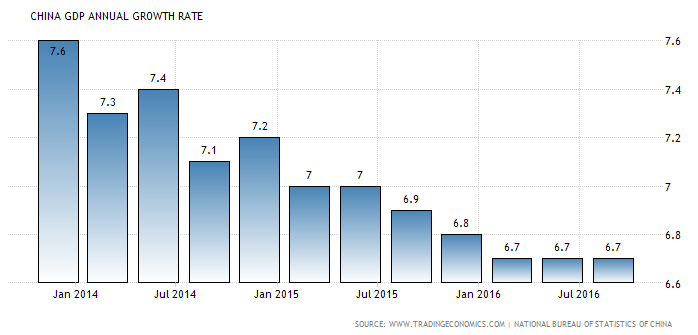
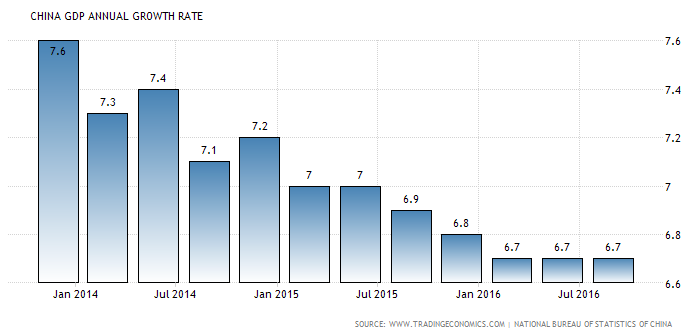
China’s economy grew 6.7% per year in the third quarter of 2016, the government said today, exactly in line with analysts’ forecasts and exactly matching the rate of GDP growth from the second quarter.
 
China’s total industrial output missed forecasts for September, slowing to 6.1% year-on-year growth, but total retail sales rose ahead, growing 10.7% per year.
Chart of China's quarterly GDP, annual growth, via TradingEconomics.com
 
“That isn’t all good news,” said The Economist magazine’s Andrew Staples, director of its south-east Asia analysis, in a speech given Tuesday – ahead of the new Q3 data – to the London Bullion Market Association’s annual conference, held this week in Singapore.
 
“At some point there’s going to be a reckoning” which new government stimulus cannot beat by adding yet more debt, Staples told LBMA delegates, forecasting a drop in China’s GDP growth to 4.2% by 2018 – “not far off a hard landing.”
 
The world’s No.1 gold consumer, China will see its annual growth in demand for the metal slow to 4% between 2016 and 2020, the Ministry of Industry & Information Technology (MIIT) said overnight, slowing from during the previous 5 years.
 
Attendees of the LBMA event yesterday ended the conference by forecasting on average that gold prices will be 7% higher this time next year, when the LBMA’s next annual conference will be held in Barcelona.
 
Delegates were more bullish still on other precious metals, predicting silver up 20% at $20.90, platinum up 13% at $1055, and palladium over 17% higher at $752.50 per ounce.