Author Archives: City Gold Bullion

GLD Adds Most Gold Bars Since Sept. But Price Caught in 'Tug of War'

GOLD BARS traded in London’s wholesale market rallied from yesterday’s 1-week lows to trade around $1280 on Thursday, regaining $5 per ounce as world stock markets again rose with commodities after a late sell-off in US trade.
 
Despite analyst chatter over this weekend’s apparently “four-horse race” in the French presidential election, the Euro rose to new 3-week highs against the Dollar, pushing the price of large gold bars for single-currency traders down almost 3% from Monday morning’s spike to 8-month highs at €1221 per ounce.
 
Gold priced in Sterling held lower again, down 3.3% from this week’s top to trade beneath £1000 per ounce as the UK’s snap General Election campaign got underway.
 
“The tug of war continues between safe haven buying ahead of the French elections and technical selling,” says a market note from German refiners and gold bar manufacturers Umicore.
 
“With geopolitical issues starkly affecting gold prices, price trajectory outlook becomes inherently hazy,” says economist Barnabas Gan at OCBC Bank in Singapore.
 
“The current environment will be risky enough to sustain prices for now,” reckons Kirill Kirilenko, an analyst at metals consultancy CRU in London, “but come October if none of these events evolve into something bigger, then we could see prices back down to $1200…especially if the Federal Reserve continues to tighten interest rates.”
 
US secretary of state Rex Tillerson today accused Iran of “alarming ongoing provocations” in the Middle East, warning that it was “travel[ing] the same path as North Korea.”
 
The US central bank should start selling its QE Treasury-bond holdings “relatively soon,” said non-voting member Eric Rosengren of the Boston Fed yesterday.
 
“I expect normalization will be gradual,” countered Vice Chairman Stanley Fischer in a speech to the IMF this morning, with “a gradual and ongoing removal of accommodation…both to maximize the prospects of a continued expansion in the US economy and to mitigate the risk of undesirable spillovers abroad.”
 
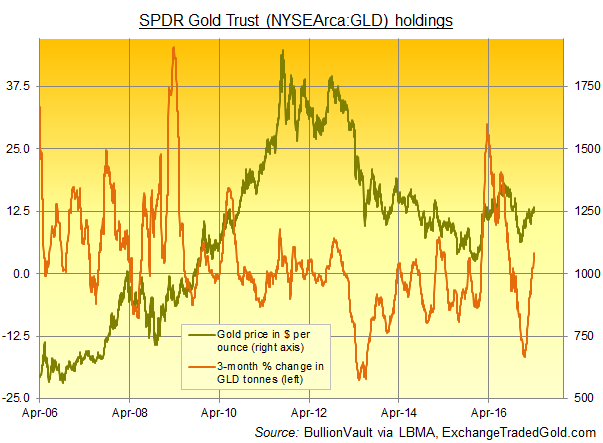
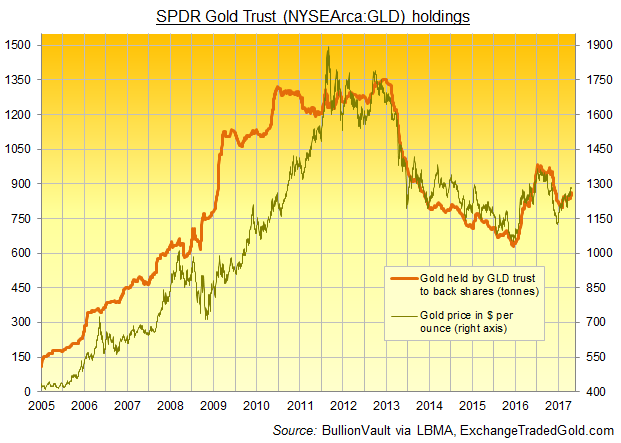
The giant GLD gold ETF yesterday grew its shares in issue, expanding the amount of bullion bars needed to back its value by almost 12 tonnes – the heaviest 1-day inflow since September – to a total of 860 tonnes, a 4-month high.
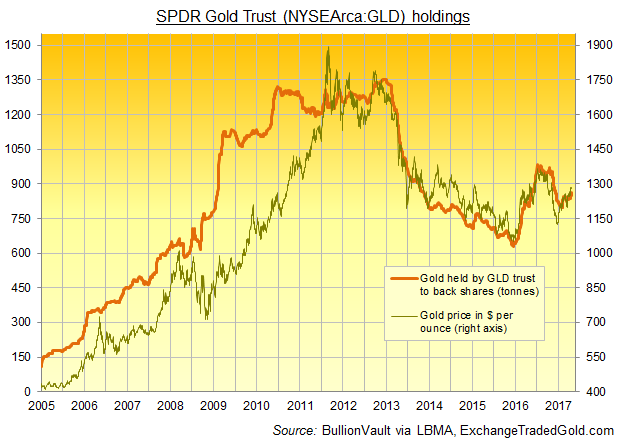
Chart of GLD gold ETF bullion bar backing vs. daily metal price, 2005-2017
 
The SLV silver ETF, in contrast, ended Wednesday needing 10,149 tonnes of metal, down half-a-per-cent from the start of this week and near its smallest size in a year.
 
Silver prices held Thursday around $18.20 per ounce, cutting last week’s 3% gain in half.
 
Noting how Fed chair Janet Yellen recently said the US central bank “is doing pretty well” in meeting its dual mandate of low inflation and a strong jobs market, “The increasing volume of central bank hubris may…explain the recent breakout of gold to the upside!” says ‘perma-bear’ strategist Albert Edwards at French investment bank and bullion-bar market maker Societe Generale.
 
“It is this sort of comment that has led Marc Faber to want to short central bankers – the only way being to buy gold.”
Gold Bullion Slips Again from 'MAJOR' Hurdle of 2011 Downtrend as IMF Raises Global GDP Forecasts

GOLD BULLION priced in Dollars retreated on Wednesday from its second attempt in 3 days to break the 6-year downtrend starting at 2011’s record peak, as world stock markets and commodities steadied after yesterday’s drop amid a higher outlook for world economic growth from the IMF.
 
Analysts at Germany’s Commerzbank last week called the $1291 level, where gold’s 2011 downtrend now comes in, “MAJOR resistance”.
 
Falling back $8 per ounce to $1284, gold bullion fell harder in other currencies’ terms as the US Dollar slipped on the FX market.
 
London’s FTSE-100 bucked the rally in Western stock markets and fell again as the UK Parliament voted on Prime Minister May’s call for a snap election in June – widely seen as a vote on her approach to Brexit – making it the worst-performing major index of the last month outside Japan.
 
“Momentum in the global economy has been building since the middle of last year,” says the Washington-based International Monetary Fund’s latest forecast today, raising its 2017 global GDP prediction to 3.5% growth.
 
All regions are then forecast to see stronger growth again in 2018 except the Eurozone, UK and Japan.
 
The single Euro currency today touched a new April high near $1.0737, knocking the price of gold bullion for German, French and Italian back below €1200 per ounce – a 7-month high when broken last week.
 
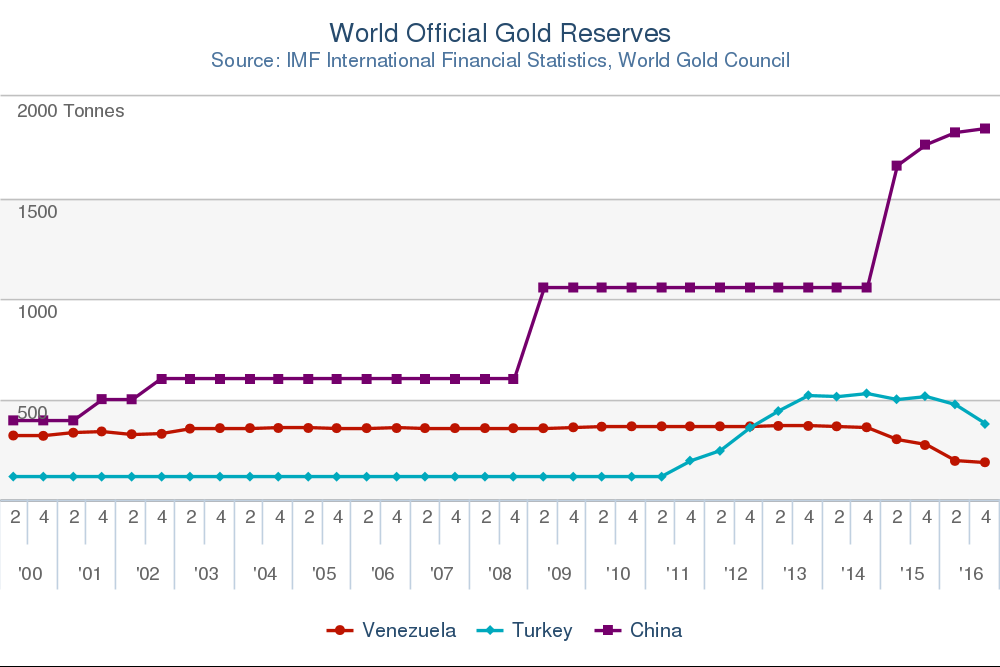
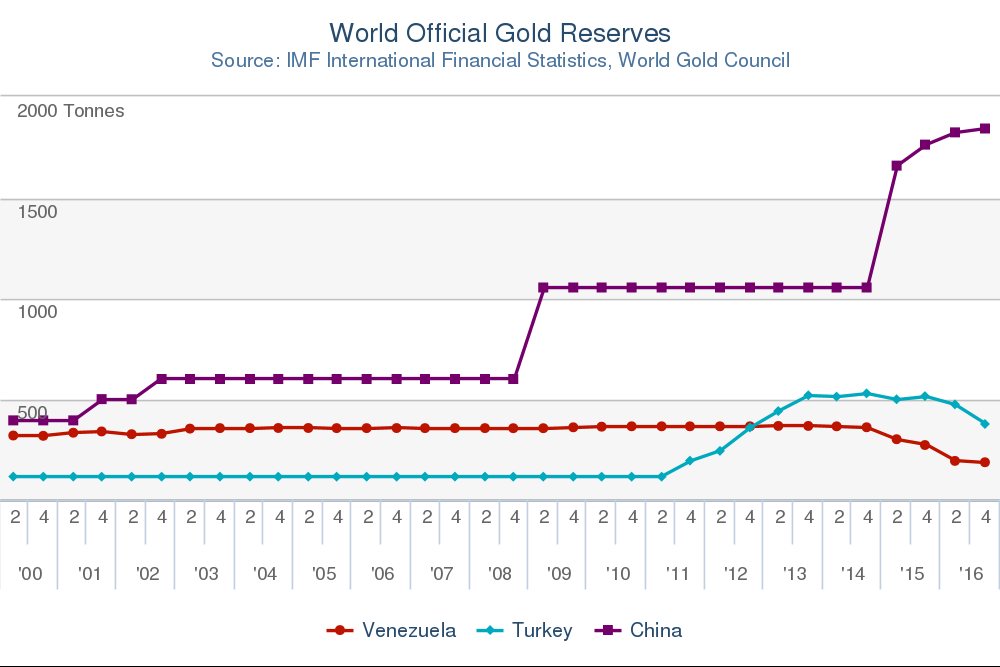
Forecast meantime to follow last year’s 18% drop in GDP with a 7.4% drop in 2017, Venezuela must not be allowed to swap its remaining 187 tonnes of gold for cash in a deal with Wall Street banks, says a letter to several top lenders from the Latin American country’s National Assembly President Julio Borges.
 
With inflation hitting 800% this New Year and daily protests against the elected Socialist government of Victor Maduro now turning violent, “I have the obligation to warn you that by supporting…a gold swap you would be taking actions favoring a government that’s been recognized as dictatorial by the international community,” Borges tells Goldman Sachs, Citi, and other leading US investment banks.
Chart of officially reported gold reserves, quarterly data for China, Turkey, Venezuela. Source: World Gold Council
 
Now with around $7.7 billion of bullion – moved in 2011 from London to Caracas by late Socialist leader Hugo Chavez amid threats of international sanctions against his expropriation of foreign-owned assets – Venezuela currently holds just $10.3bn in total central-bank FX reserves, a 15-year low according to Bloomberg.
 
The GDP of world No.6 gold consuming nation Turkey will expand 2.5% this year on the IMF’s new forecasts, slowing from 2016 but then expanding 3.3% in 2018.
 
Turkey’s outlook is “clouded by heightened political uncertainty,” the IMF says, plus “security concerns and the rising burden of foreign-exchange-denominated debt caused by the Lira depreciation.”
 
Dozens of opposition protestors in Istanbul and were arrested overnight, the New York Times reports, as the government of President Recep Tayyip Erdogan moves to squash dissent over the weekend’s controversial referendum, officially showing 51.4% to 48.6% in favor of giving the President sweeping new powers after last year’s failed coup.
 
Prime Minister Binali Yıldırım today called opposition party the CHP’s refusal to accept the result “illegitimate”.
 
World No.1 gold mining, consumer and importing nation China will meantime expand its GDP by 6.6% this year, the IMF’s new report says, higher from October’s estimate of 6.2% for 2017 growth reflecting “stronger-than-expected momentum…[and] continued policy support in the form of strong credit growth and reliance on public investment” by the Communist Party dictatorship.
 
Shanghai gold prices fixed at 1-week lows on Wednesday, slipping 1% from Monday’s new 5-month high in Yuan terms.
 
That cut the premium for gold bullion inside China to $6 per ounce above comparable London quotes, the lowest in 6 weeks and $3 below the average incentive to new Chinese imports since the state-backed Shanghai Gold Exchange launched its twice-daily benchmark price 12 months ago today.

Gold Prices Slip $10 After Breaking Downtrend as UK's May Seeks Brexit Mandate, N.Korea Threatens US

GOLD PRICES held $10 per ounce below yesterday’s spike to new 5-month highs as London’s bullion market re-opened for business after the long Easter weekend on Tuesday, trading at $1285 amid fresh geopolitical headlines, cited by analysts as driving this month’s 3% gain to date.
 
Gold prices have been “closing in on trend lines drawn from the all-time high in 2011…[now] at $1290,” said French investment bank Societe Generale’s technical analysts before the Easter weekend.
 
After Turkey’s referendum result narrowly backed President Erdogan’s push for greater powers, UK Prime Minister Theresa May today called a snap General Election for early June – widely seen as an attempt to win a “mandate” for her “hard Brexit” approach to negotiating Britain’s exit from the European Union.
 
The British Pound rose to a 10-week versus the Dollar and a 7-week high against the Euro, squashing the gold price for UK investors over 2% lower from Easter Monday’s early spike to new 5-month highs at the start of Asian trade.
 
London’s stock market led European equities lower, dropping 1.5% from last Thursday’s close as the EuroStoxx index of the region’s 50 largest shares lost 1%.
 
With European bourses and the London gold market shut Monday for the long Easter weekend, the number of Comex futures contracts changing hands yesterday fell 25% from the previous 3 trading days’ average, dropping to the fewest in a week.
 
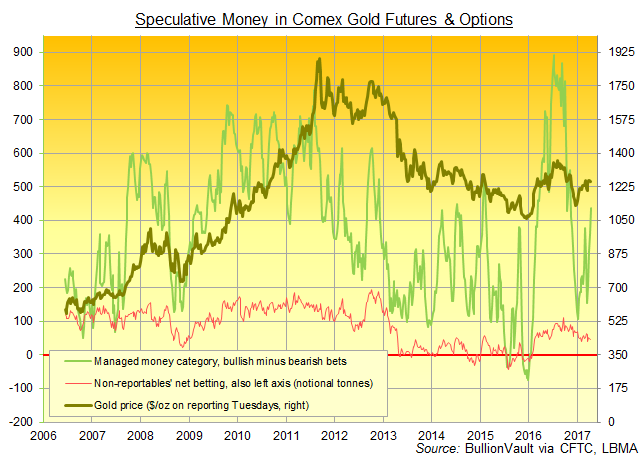
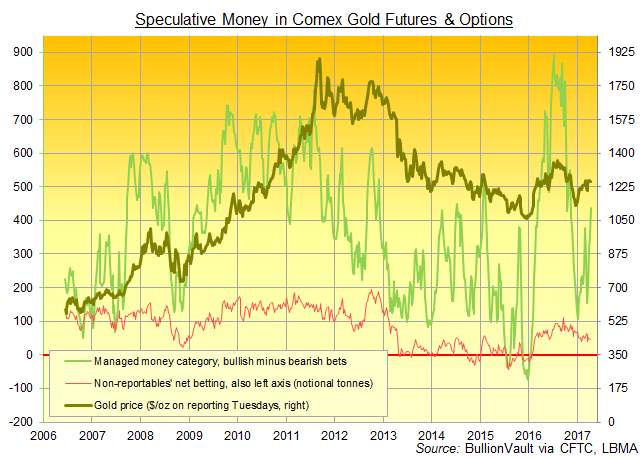
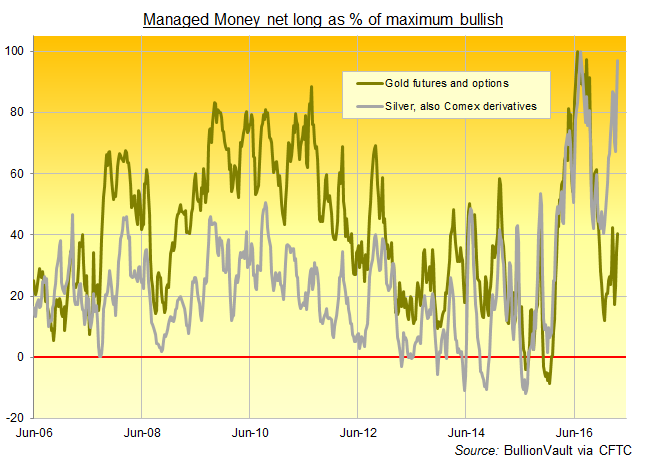
Latest data show money managers growing their bullish betting on Comex gold futures and options, net of bearish bets, to the highest level last week since Donald Trump won the US election last November.
Chart of CFTC data for Comex gold futures and options net positioning
 
The net speculative long position in silver grew faster, however, setting a new all-time high by number to reach the equivalent of 15,732 tonnes of metal.
 
US regulator the CFTC’s data for last Tuesday say the Managed Money category’s net speculative long position was worth just over half the notional value of Comex gold’s net speculative long. That compares to a historical average of one fifth.
 
By notional value, silver’s net speculative long amongst the Managed Money category of traders reporting to US regulator the CFTC was 6% below its peak by value of last July.
 
Gold’s net spec long was 58% below its peak by value of August 2011.
 
Platinum’s managed-money position was meantime worth just 4% of its all-time peak by value of January 2013.
 
Shares in issue for both the largest gold and the largest silver-backed exchange-traded trust funds meantime held unchanged on Monday.
 
That left the GLD gold ETF needing a 2017 high of 849 tonnes in bullion backing. The iShares Silver Trust (NYSEArca:SLV) in contrast needed near a 12-month low at 10,201 tonnes.
 
Tuesday morning’s LBMA Gold Price in London – the twice-daily global benchmarking auction – met little demand at an opening ‘spot’ gold price suggestion of $1286.50, but then found a balance with strong offers to sell at $1285 per ounce.
 
Parameters around the process are currently being “reviewed” by independent administrators IBA after last Tuesday afternoon’s process closed “almost 1% away from the prevailing…indicative…price” amid Trump’s stand-off with the Kremlin in Moscow over Russia’s support for the Assad regime in Syria.
 
“If the USA encroaches upon our sovereignty,” said North Korea’s vice-foreign minister Han Song-ryol to the BBC this weekend, “then it will provoke our immediate counter reaction and if it is planning a military attack against us, we will react with a nuclear pre-emptive strike by our own style and method.”
 
“With investors still considering the fluid situation between North Korea and the US,” says a note from Swiss refining and finance group MKS’s Asian trading desk, “as well the upcoming French election, there is no doubt strong underlying interest supporting [gold prices] around current levels.”
 
Slipping in the opinion polls, French presidential candidate Marine Le Pen said yesterday she would if elected put a “moratorium” on immigration to “stop the delirium” which saw the number of asylum seekers to France rise 20% last year from 2015.
 
Shanghai gold prices today retreated 0.5% from Monday’s new 5-month high at China’s afternoon benchmarking auction.
 
Coupled with a drop in the Yuan’s exchange-rate value, that held the premium over global Dollar quotes for London settlement beneath $8 per ounce – the lowest since immediately after the Chinese New Year holidays ended at the start of February.
 
Gold premiums in India – the No.2 gold consumer nation – have slipped back into negative territory as global prices have risen, Reuters reported late last week, following a strong rebound in demand from 2016’s hard fall.

Gold Price 'Within $5' of Breaking 2011 Downtrend on Comex Frenzy, Yen Correlation, But Physical Demand AWOL

GOLD PRICES jumped to new 5-month highs above $1286 per ounce Thursday morning but curbed their gains for non-Dollar investors after the US currency fell hard on President Trump’s comment that the greenback “is getting too strong.”
 
Despite easing from the 13-year highs reached immediately after Trump’s election last November, “Partially [this strength] is my fault because people have confidence in me,” Trump told the Wall Street Journal.
 
“But that’s hurting [exports] – that will hurt ultimately.”
 
The Dollar rebounded today from sudden overnight 1-week lows against the Euro and Sterling, but regained barely half-a-Yen from its lowest level versus the Japanese currency since Trump’s victory over Hillary Clinton.
 
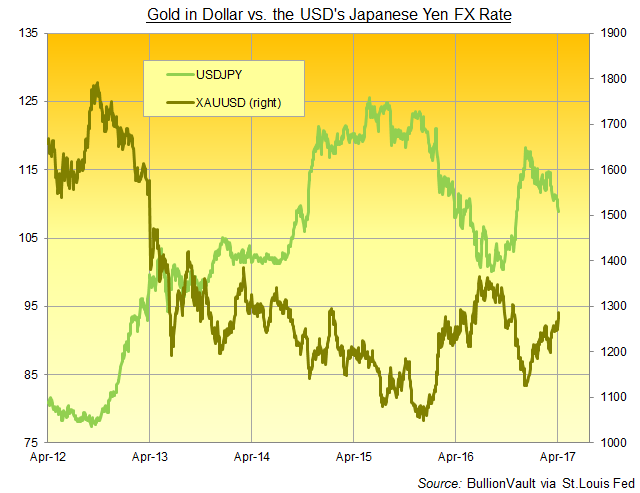
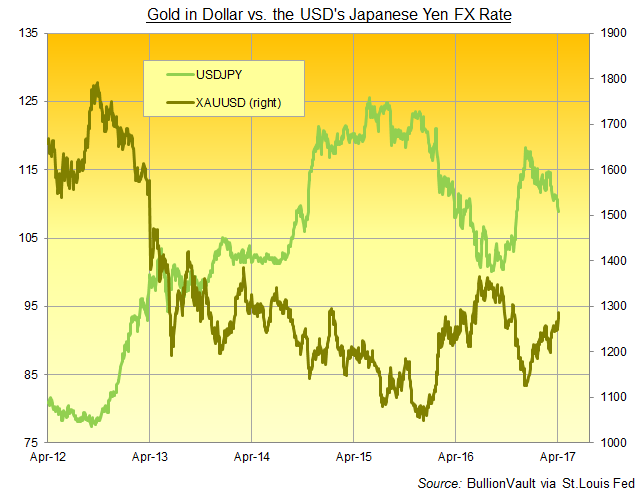
Dollar-gold prices have become increasingly correlated in 2017 against the USD/JPY currency cross in, with the rolling 1-month relationship falling to a near-perfect inverse correlation of -0.991 last week.
 
That has curbed the gold price in Yen at just 5-week highs of ¥4,518 per gram today, defying US and other hedge-fund traders expecting to extend gold’s potential by buying it “in Yen terms”.
 
Chart of USDJPY vs. the Dollar price of gold
 
After weak demand hit the global benchmark LBMA Gold Price auction amid Tuesday’s $20 jump in spot prices, one major bullion bank today told BullionVault it has seen mining-producers selling gold on the current surge.
 
Its traders now see gold’s near 6-year downtrend – a line it has failed to break above since the $1920 peak of September 2011 – coming in around $1290 per ounce.
 
European stock markets meantime fell for the fourth session running on Thursday, with the Euro Stoxx 50 index trading 1.5% below end-March’s 18-month high.
 
Major government bond prices rose in contrast, pushing 10-year US Treasury yields down to their lowest since Donald Trump won the US election last November at 2.24%.
 
With 10-year US yields touching 30-month highs above 2.60% only at the end of March, “End of the Golden Age?” asked a note late last week from French investment and bullion bank Natixis.
 
Metals analyst Bernand Dahdah repeated his average 2017 gold price forecast of $1150, predicting “pressure” from 3 more US Fed rate hikes, plus a move to QE tapering by the European Central Bank, now expected in September.
 
The ECB at its March meeting already trimmed money creation and spending on Eurozone government debt from €80 billion to €60bn per month.
 
Gold has now averaged $1223 over the first 15 weeks of the year.
 
“As a watchdog, gold has failed to bark,” says today’s new edition of the weekly Economist magazine, printing an article apparently written just before Tuesday’s jump.
 
“Buying bullion is really a bet that…events escalate in the Middle East and North Korea or that central banks lose control of monetary policy,” The Economist says. And so “the metal has not performed as well as it might have done given the geopolitical headlines.”
 
Tuesday saw Comex volume in bullish gold options – the most leveraged derivative contracts, exposing the holder to price swings for just a few cents on the Dollar – jump to 10 times Monday’s total according to Bloomberg.
 
Trading in Comex gold futures had already risen 16% in the first 3 months of this year compared to Q1 2016, driven by volatility in US interest-rate expectations according to senior economist Tatsufumi Okoshi at Nomura Securities.
 
Gold prices yesterday marked the 4th anniversary of the start of Spring 2013’s historic crash by rising another 1.7% at the London benchmarking auction to reach $1274 per ounce – a new 5-month high.
 
Demand to buy gold in this physical market was weak yet again however, with Thursday’s AM auction then attracting just half the interest to buy as there was to sell at an opening price of $1287 before finding a balance almost $1 per ounce lower.
 
Giant gold ETF the SPDR Gold Trust (NYSEArca:GLD) ended yesterday needing 842.4 tonnes of bullion backing, unchanged from Tuesday’s growth in the number of shares in issue to a 5-week high.
 
Gold prices in Shanghai closed Thursday at a $10 premium to London quotes, edging higher from the lowest incentive for new imports to the world No.1 consumer nation since immediately after the Chinese New Year holidays.
 
Silver also broke higher to its best in 5 months on Thursday, moving through $18.50 for the first time since Trump’s election.
 
Platinum continued to lag however, rising to only 1-week highs at $977 per ounce.
 
That widened platinum’s historic discount to gold prices back out to $310, the greatest gap since last October’s run to a record $340 per ounce.

London 'Fix' Price Catches Up with Spot Gold as Stocks Fall Amid Trump-Putin Geopolitics

SPOT GOLD PRICES touched new 5-month highs against a falling US Dollar at $1275 per ounce in London on Wednesday, with the LBMA Gold Price benchmark fixing at its highest level since Donald Trump won the US presidential election last November.
 
European stockmarkets erased an early bounce, but commodities pushed higher with government bond prices.
 
Silver nudged above $18.40 per ounce in Asian trade overnight, but held shy of last week’s 1-month top 7 cents higher.
 
Both the giant GLD gold ETF and the SLV silver trust fund added metal as their number of shares in issue grew amid Tuesday’s price jumps, linked by analysts today to the rising geopolitical stand-off between Trump’s White House and Russian president Putin‘s Kremlin over the war in Syria.
 
Looking at other currencies, gold priced in Yen has gained 3.5% so far in 2017.
 
The Dollar price of gold has risen 3 times as fast, adding 10.6% since New Year’s Eve.
 
This morning’s LBMA Gold Price auction in London – the global benchmarking process now regulated in UK law – saw demand rise 20% from the last 3 months’ average at a fixing of $1272.30 per ounce, the highest wholesale gold price since 10 November 2016.
 
Tuesday’s 3pm benchmarking auction had found zero demand from wholesale market dealers at the opening price of $1265.75, finally achieving a match between supply and demand – aggregated by bullion banks and dealers from their own client and in-house orders – down at $1252.90 per ounce.
 
Already jumping 1.3% from midday in contrast, live spot quotes for gold bullion were untouched by the drag from the LBMA price – administered since the 2015 demise of the century-old ‘London Fix’ by benchmark specialists IBA – trading $12 higher above the global benchmark as it found a clearing price at 3:04pm.
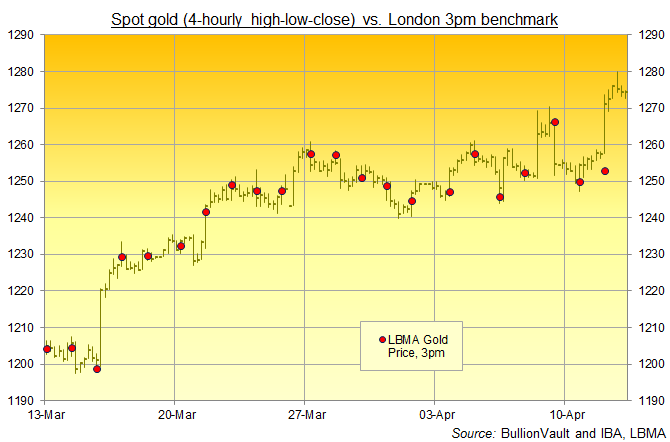
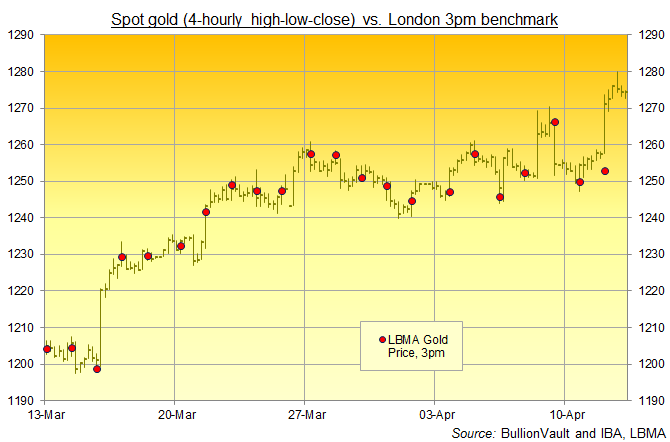
Chart of spot gold prices, 4-hourly high-low-close, versus 3pm LBMA Gold Price benchmark. Source: BullionVault, IBA, LBMA
 
Over the last month, the 3pm LBMA Gold Price has fixed on average 0.30% above the lowest point of London’s afternoon spot trading, and some 0.25% below that 4-hour period’s high.
 
Tuesday saw the benchmark fix 0.37% beneath the spot market low and fully 1.63% beneath the afternoon spot high at $1273.69 per ounce.
 
Blaming a worsening lack of market-maker liquidity thanks to ever-stricter regulations, “It’s not just happening in the precious metals markets, it is happening across all commodities,” reckons consultancy CPM Group head Jeff Christian.
 
“We saw this trend starting in 2001 and in the last 15 to 16 years t has only gotten worse.”
 
Again this morning, only 5 direct participants out of 13 approved for the LBMA Gold Price entered orders into the auction, with another 8 sitting on the sidelines.
 
Over-strict regulations were also blamed in February 2016 for an LBMA Silver Price which fixed almost 6% below live spot quotes.
 
That set a new 6.5-year low for silver prices, even as spot quotes held 7% higher from end-2015.
 
Tuesday’s gold price jump reflects a “tug-of-war between heightened geopolitical risks and… despite a weak US payroll number last Friday…a strong underlying global economy,” says a note from US investment bank (and LBMA Gold Price participant) Goldman Sachs.
 
Coming just inside the benchmark Gold Price auction’s tolerance for an imbalance between supply and demand of 10,000 Troy ounces, Tuesday’s quarter-tonne of net selling was bought by all the direct participants, “shared out among [the full 13] equally,” according to the LBMA’s website explainer, “irrespective of whether they entered interest into the auction or not.”
 
Chinese gold prices also hit their highest rate since early November in Yuan terms on Wednesday, but cut their premium over London quotes to $9 per ounce at the Shanghai PM Fix.
 
Almost 3 times the historic average, that offered the smallest incentive for new bullion imports to the world No.1 gold consumer nation since immediately after the new year of the Rooster began on the Chinese Lunar calendar at the end of January.


Gold Price Jumps Through 'Resistance' as Trump Says US Will Go Alone vs. N.Korea, G7 Rebukes UK Over Russia

GOLD PRICES rose above what analysts called ‘technical resistance’ to break $1260 per ounce Tuesday afternoon in London as Donald Trump’s switch in foreign policy against Syria and North Korea again made headlines worldwide.
 
After the unilateral US action against Syria’s Assad regime last week, President Trump said he will “solve” the rogue Asian state and its nuclear-weapons ambitions with or without China’s help.
 
Pushing US policy against Assad-supporter Russia, UK Foreign Secretary Boris Johnson meantime failed to get the support of other G7 developed-nation leaders in adding new anti-Moscow sanctions.
 
Russia’s increasingly Twitter-busy Embassy to London then mocked Trump’s U-turn on avoiding foreign conflicts, tweeting that “Napoleon brought [Russian troops] to Paris, Hitler to Berlin.
 
“Nowadays powers tend to self-destruct – USSR and now US?”
 
Rising again above the 200-day moving average of daily prices, gold also moved above its end-February high at $1264 broken by Friday’s brief spike following the US cruise missile strikes on one of Assad’s airforce bases.
 
Western stock markets cut earlier gains, while US Treasury bonds rose in price, pushing yields down to 2.33% on 10-year debt – the lowest since gold prices hit that peak 5 weeks ago.
 
Russian yields in contrast hit 2-week highs as prices for Ruble debt fell.
 
Silver followed gold prices higher, rising again above $18 per ounce after sinking from its own 5-month high late Friday.
 
China’s Yuan earlier neared 1-month lows versus the Dollar, while the gold price in Shanghai held a $12 per ounce premium to London quotes.
 
Just shy of 2017’s average Shanghai premium to date, that was nearly twice the average incentive offered to new imports into the world’s No.1 consumer nation across 2016.
 
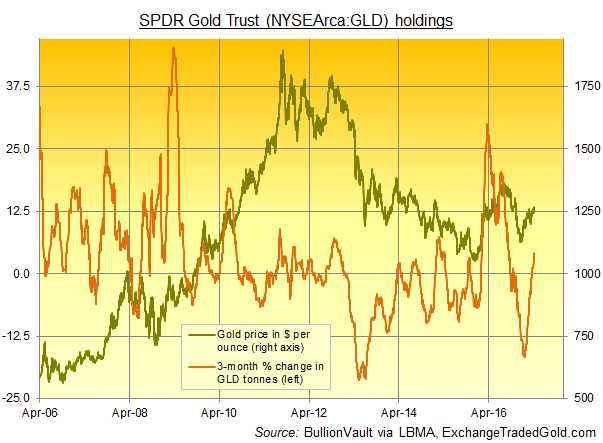
With gold prices losing 1.3% on Monday from Friday’s 5-month high at the London benchmark auction of $1266 per ounce, the giant SPDR Gold Trust (NYSEArca:GLD) grew in 0.2% size, needing another 1.8 tonnes of bullion to back its value as the number of shares in issue increased.
 
That took the GLD’s holdings to 838 tonnes, the largest since last month’s US Fed decision of 15 March, when prices shot higher from what was then a 5-week low.
Chart of SPDR Gold Trust (NYSEArca:GLD) bullion backing in tonnes, 3 monthly change in per cent
 
“Donald Trump is losing his scariness and [even] in the Eurozone there is now a sense of optimism breaking through,” Reuters had earlier quoted Thomas Gitzel, chief economist at Liechtenstein-based private bank VP, noting the latest economic sentiment data for the 19-nation single currency union.
 
Eurozone economic optimism has risen to its strongest since December 2015, according to the ZEW survey, with Germany’s index reading surging well ahead of analyst forecasts.
 
Economic optimism amongst small US business owners held in March near its strongest level since early 2005‘s record high, the NFIB survey said Tuesday, having leapt around Donald Trump’s victory in last November’s presidential election.
 
“I think we have a healthy economy now,” said Fed chair Janet Yellen at an event in Ann Arbor, Michigan on Monday.
 
“Yellen says era of stimulative monetary policy is ending,” according to the Wall Street Journal, reporting the Fed chief’s speech.
 
“[The] Fed’s focus has shifted to holding growth gains,” adds Bloomberg.
 
“[Gold price] resistance remains unchanged at $1257.20,” said bullion bank Scotia Mocatta’s New York team overnight, pointing to the 200-day Moving Average.
 
Tuesday’s wholesale bullion trading saw London benchmark the LBMA Gold Price find just 5 direct participants in the final round, with the other 8 approved banks and brokerages – now able to trade centrally-cleared contracts at the auction, removing the need for one-on-one relationships and credit lines with each and every other DP in a move aimed at boosting engagement – not entering any demand and supply into the process.

Gold Prices Drop $20 from 5-Month 'Geopolitics' High as Silver ETF Shrinks, Comex Speculation Nears Record

GOLD PRICES moved further below Friday’s sudden 5-month high on Monday despite growing geopolitical tensions over Syria and North Korea, under pressure from a stronger US Dollar, writes Steffen Grosshauser at BullionVault.
 
The Dollar rose to a 1-month high against the Euro while crude oil rebounded another 1% after Friday’s spike and sell-off.
 
Gold slipped from last week’s Comex finish at $1254.30 per ounce – itself 1.3% beneath Friday’s jump to $1270 on news of US airstrikes against Syria’s Assad government – to dip below $1250.
 
Silver prices meantime fell from $18 to $17.90 per ounce as this holiday-shortened week began, retreating almost 3.5% from Friday’s spike.
 
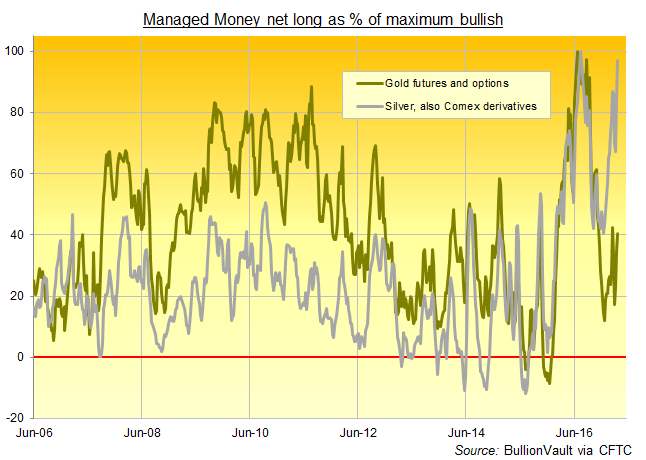
Latest data from US regulator the CFTC show that, before last week’s jobs data and surprise US policy switch on Syria, hedge funds and other money managers grew their bullish betting on Comex silver futures and options to the second largest size ever net of that group’s bearish bets.
 
Gold’s net speculative position, in contrast, was just two-fifths the size of its record peak – also set like silver’s in summer 2016.
Chart of gold and silver's net speculative long position, Managed Money traders, as a percentage of the largest-ever week. Source: BullionVault via CFTC
 
Friday also saw the exchange-traded iShares Silver Trust (NYSEArca:SLV) shrink at the fastest pace in at least 3 years, with shareholders liquidating 346 tonnes of the trust’s physical silver backing.
 
That took the SLV ETF‘s total holdings below 10,000 for the first time since March 2016.
 
“Unexpected geopolitical events typically have only a short-lived effect on gold,” said a note from bullion market-makers ICBC Standard Bank’s strategist Tom Kendall late Friday.
 
“But the other two pillars…of monetary policy and physical demand…look very solid at present.”
 
Friday’s weak US jobs data likely “reinforced dovishness ” at the Federal Reserve, says Kendall, while India’s local gold prices “[are] below last years average [and] we expect March import figures to be a pleasant surprise to the wider market.”
 
But “I don’t think gold can have a further upside,” says Mark To, head of research at Hong Kong’s Wing Fung Financial Group, because while rate hike expectations “have come down, the direction of monetary tightening [is] quite clear.”
 
“Resistance was tested at 1257.60,” said Friday’s technical analysis from bullion bank Scotia Mocatta’s New York office, pointing to the gold price’s 200-day Moving Average.
 
That only made Friday’s late drop all the more “disappointing” according to another technical analyst quoted by CNBC.
 
Meantime on the geopolitics front Monday, Iran and Russia said in a joint statement that they will “respond with force” if the US again attacks their ally President Bashar al-Assad of Syria.
 
After the US struck Assad facilities it blamed for last week’s Sarin gas attack on the rebel-held town of Idlib, US Secretary of State Rex Tillerson said Sunday that other states, including North Korea, could face attacks “if they violate international norms [or] agreements.”
 
US aircraft carrier strike group Carl Vinson is currently on the way towards the Korean Peninsula from Singapore.
 
“The risks of a conflict have certainly grown, and that should keep the Dollar supported against most Asian currencies,” reckons Gao Qi, foreign exchange strategist at investment bank and bullion market maker Scotiabank’s Singapore offices.

US Airstrikes on Syria See Gold Investing Price Hit Post-Trump High, Makes 'Double-Top' on Weak Jobs Data

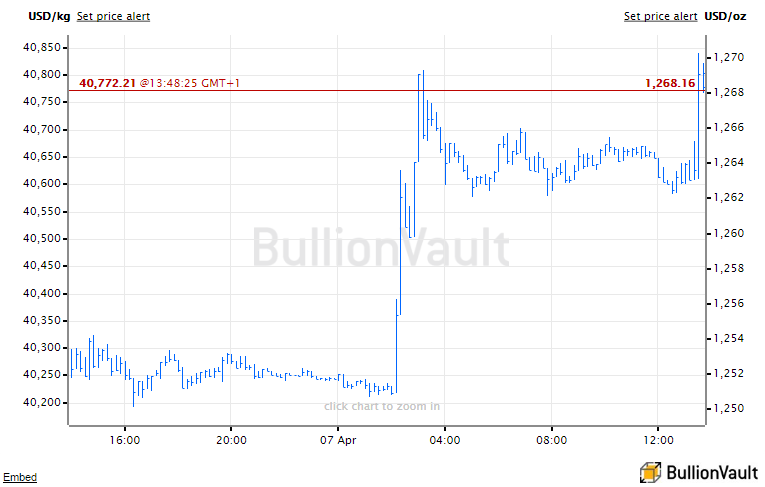
GOLD INVESTING prices twice jumped to $1270 per ounce on Friday, first as the US military bombed Assad-regime facilities in Syria after this week’s chemical weapons attack on Idlib, and then as US jobs data said the world’s largest economy added just 98,000 jobs in March.
 
That saw the gold price for US investors touch its highest level since the day of Donald Trump’s victory in the White House election last November.
 
Both times, wholesale gold investing bars then retreated to $1264 per ounce – the late-February peak now called “key resistance” by several price-chart analysts.
 
Way below economists’ forecasts of 180,000 non-farm payrolls growth for last month, the Bureau of Labor Statistics’ first estimate was barely half the average March addition of the last 7 years, since the global financial crisis of 2008-2009.
 
The jobless rate fell however to 4.5% last month, the lowest level since the US housing slowdown began hitting hedge funds betting on subprime mortgage investment bonds in May 2007.
 
Investing in gold futures and options had already spiked the price up to $1269 per ounce overnight, adding nearly $20 per ounce inside 1 hour of the US airstrikes in Syria, authorised by the new US President’s sudden U-turn against the Assad regime.
 
Chinese gold prices extended their premium over London bullion quotes to $12.75 per ounce at Shanghai’s afternoon ‘fixing’ benchmark, offering the strongest incentive this week to new imports into the world No.1 consumer nation.
 
Chart of spot gold bullion prices, 7 April 2017. Source: BullionVault
 
“The 200-day Moving Average at $1259 has proved significant resistance for gold,” said a technical analysis from French investment bank Societe Generale yesterday, also highlighting the multi-month peak of 6 weeks ago, some $5 above there.
 
Looking back to that late-February high, “The formation of a Double Top on hourly charts further gives evidence [that] $1259/1264 remains a key level,” the note said.
 
Friday in Moscow, “Putin [says] this kills US-Russian relations,” said Moscow’s state-run Pravda news agency, reporting the suspension of Russia’s “deconfliction” agreement with the US to avoid mid-air collisions and conflict in their separate efforts to destroy the ISIS group in Syria.
 
“Undoubtedly,” added Russia’s Foreign Ministry, “the US military action is an attempt to distract attention from…actions conducted by the US-led coalition [in which] hundreds of civilians have been killed and a humanitarian catastrophe has been gathering pace.”
 
In London, “Where will it all end?” asked former UKIP leader and Brexit victor Nigel Farage – now a radio talk-show host in London, rather than UK ambassador to Washington as Trump had suggested – saying that “Whatever Assad’s sins, he is secular,” as opposed to religious-inspired terrorists.
 
Welcoming the US action after this week’s Sarin gas attack on civilians in Syria’s opposition-held city of Idlib, foreign minister Mevlut Cavusoglu of neighboring Turkey – formerly the world No.4 gold buying nation, now down to 6th – meantime said he “[won’t be] diplomatic at all” in telling the United States it needs to stop supporting Kurdish separatists the YPG, also now fighting ISIS in the Syrian conflict.
 
Even with Russia and the US split, “You’ve got two superpowers competing over a terrorist organization,” Cavusoglu said.
 
“If our allies leave us alone in the fight against [Kurdish] terrorism…we’ll continue on our own.”
 
Following last year’s failed coup attempt in Ankara, Turkey on April 16 will hold a controversial referendum on giving President Erdogan sweeping new powers.
 
Opinion polls currently show a 53.3% vote for ‘No’ nationwide, but ‘Yes’ rises to 70% in Erdogan’s key support-base region of Central Anatolia.

Gold Prices Firm After US Jobs Data as Fed Creeps Towards Unwinding $4trn QE

GOLD PRICES in London’s wholesale market slipped on Thursday against a rising Dollar, but held onto $10 per ounce of a $15 overnight rally as minutes from the Federal Reserve’s latest policy meeting pointed to the unwinding of the US central bank’s $3.6 trillion QE asset purchase program.
 
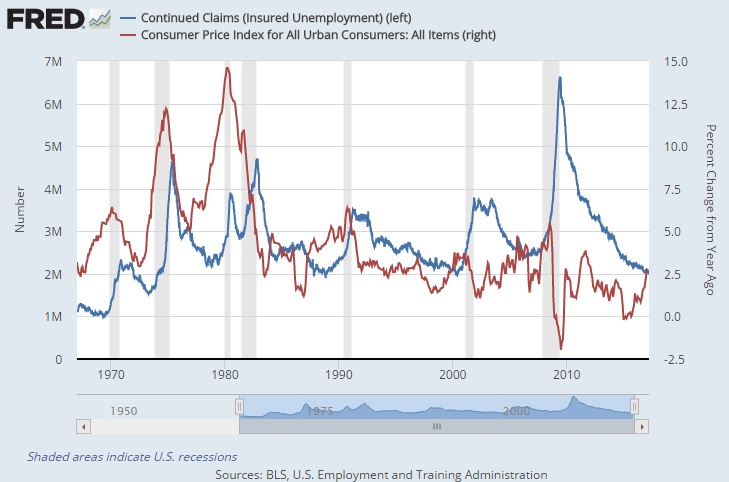
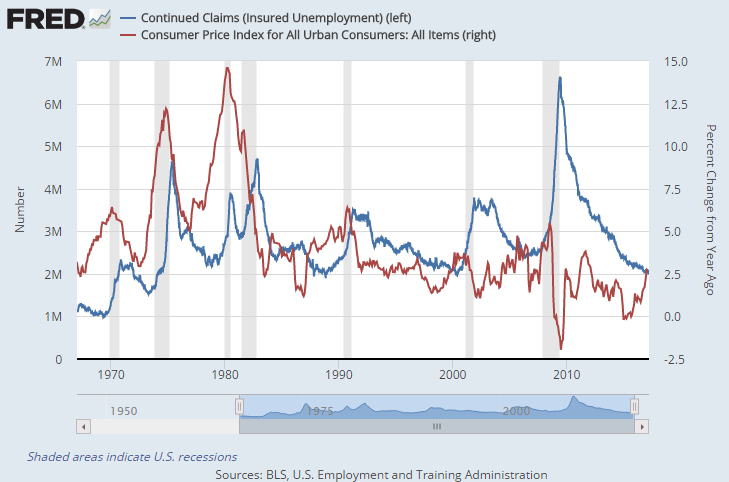
After the private-sector ADP report suggested tomorrow’s official non-farm payrolls estimate for March could beat Wall Street forecasts by 40%, new data today said the number of people claiming jobless benefits for the first timee fell again last week, extending the longest run below 300,000 since 1970.
 
With continuing claims back down to their 4-decade floor around 2 million, that looks like “full employment” according to the Reuters news agency.
 
The second half of the Fed’s mandate – targeting inflation at 2.0% per year – meantime rose above that level for the first time in 5 years at last count.
 
Chart of US continuing jobless benefit claims and CPI annual inflation
 
Notes from the Fed’s mid-March decision – when it voted to raise interest rates to a ceiling of 1.00% – said policymakers discussed various targets for starting to unwind the central bank’s quantitative easing program, begun when the financial crisis exploded in 2008.
 
Almost 4 years after gold prices sank at their fastest pace in three decades amid the ‘Taper Tantrum’ spurred by Fed hints about not adding any new QE to the near-$4 trillion done by 2013, “most participants anticipated that…a change to the Committee’s reinvestment policy would likely be appropriate later this year,” according to the March minutes.
 
“The number of years we’re thinking about just based on the arithmetic is something like 5 years,” said San Fran Fed President John Williams to reporters today, commenting on how long it might take to let the existing portfolio of QE-paid bonds to mature.
 
US stock markets slipped for the second day running and Treasury prices rose with commodities, nudging yields lower.
 
Large bullion bars traded at $1253 as Thursday’s PM gold price benchmark auction approached – some $8 below Monday’s near 5-month high – but silver fell further, dropping back below last week’s finish at $18.27 per ounce.
 
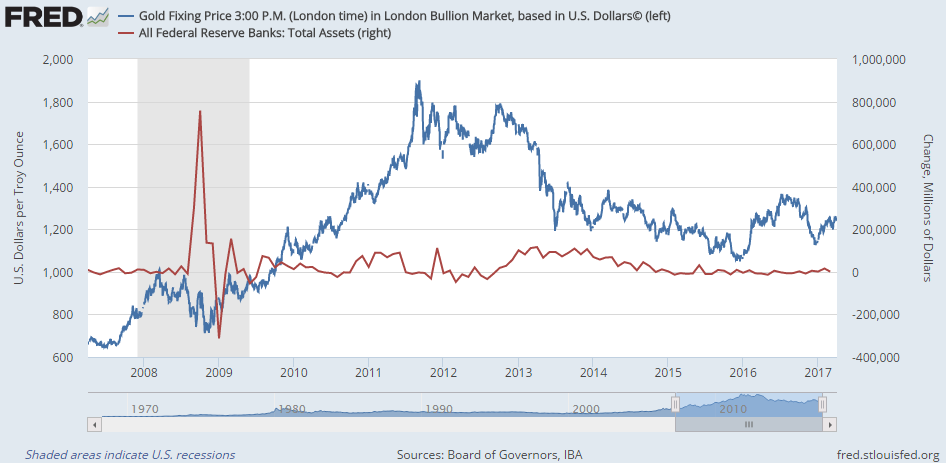
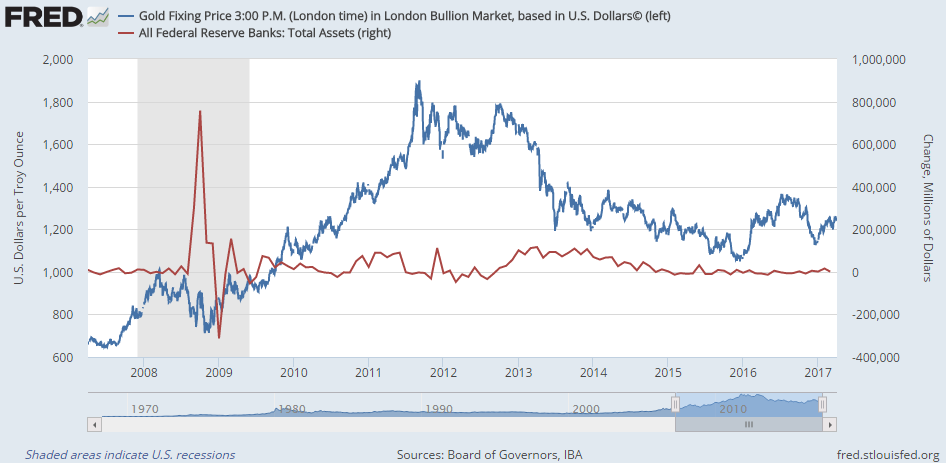
Gold prices have, over the last 10 years, averaged almost precisely a zero correlation with weekly changes in the size of the Fed’s balance-sheet, and shown a small but negative correlation on a monthly basis.
 
“The timing [for unwinding QE] should be based on a quantitative threshold or trigger tied to the…federal funds rate,” said several Fed members at the March meeting, with “most” attendees expecting to make further “gradual increases” on proof of economic strength.

Gold Price Down 1% as Fed's Lacker Resigns Over 2012 QE Leak, ECB 'Talks Taper'

GOLD PRICES erased this week’s earlier 1% gains to slip back below $1249 per ounce in London wholesale trade Wednesday as world stock markets edged higher and the US Dollar rose despite the shock resignation of Richmond Federal Reserve Bank President Jeffrey Lacker.
 
With the official non-farm payrolls estimate due Friday, new employment data from private-sector ADP Payrolls today said the US added 263,000 jobs in March, well ahead of Wall Street’s 187,000 consensus forecast and extending the 2% per year growth seen since the US jobs market bottomed in March 2010.
 
With gold prices losing over $13 from Tuesday’s near 5-month high, silver followed gold lower, also retreating to last week’s finish against the Dollar at $18.28 per ounce.
 
Platinum prices in contrast held firmer, rising to a 1-week high of $970 before easing $5 per ounce.
 
Reputed as a ‘hawk’ on interest rates, Jeffrey Lacker twice dissented from all other policymakers during the Richmond Fed’s last tenure on the FOMC, voting to raise from 0% in both September and October of 2015.
 
The so-called ‘Medley case’ – the first known leak of Fed information since 1988 – saw a hedge-fund advisory tell its clients on 3 October 2012 secret details of the previous month’s Fed meeting, one day before public minutes from that vote were due for disclosure.
 
“Due to the highly confidential and sensitive nature of this information,” Lacker now says, “I should have declined to comment and perhaps have ended the phone call” in which he apparently revealed that – with the Fed’s monthly money creation raised to $85 billion per month by QE3 – the central bank would resist extra stimulus either side of November’s US presidential election, but would likely increase the pace of QE again in New Year 2013 as jobs growth slowed.
 
2013 in fact saw then-Fed chairman Ben Bernanke talk instead about “tapering” the Fed’s monthly bond-buying QE, spurring the famous “taper tantrum” which whacked fixed-income, commodities and emerging market assets and saw gold prices fall 25% in the second quarter, their fastest loss in 3 decades.
 
QE tapering didn’t begin until 2014, ending when the Fed’s new monthly bond-buying reached zero 12 months later. It continues to re-invest the money from maturing bonds today.
 
Chart of Federal Reserve Banks' total assets, monthly change, versus Dollar gold price
 
Lacker’s resignation “was negotiated with law enforcement officials” after 13 years in the job according to CNBC, and “no charges will be filed” by the Department of Justice according to his lawyer.
 
Already set to retire on 1 October, Lacker had “become [an] increasingly marginal figure…one of the least influential” according to Fed watcher Josh Zumbrun of the Wall Street Journal.
 
Retreating to £1000 per ounce in Sterling terms, gold prices today held just above last week’s finish even as the Pound rallied against the Dollar.
 
But gold prices fell harder on Wednesday versus the Euro, erasing the week’s previous 1.1% gain to trade at €1171 per ounce.
 
“The ECB is clearly preparing for exit talk and for tweaks to its forward guidance,” reckons private-bank Berenberg’s economist Florian Hense, quoted by Bloomberg ahead of tomorrow and Friday’s speeches from 3 key policymakers at the European Central Bank, now creating €80bn of new money per month to buy Eurozone government bonds and other assets.
 
“Policy makers are not only answering questions about [QE tapering] but actually talking about it themselves.”