Author Archives: City Gold Bullion

Gold Prices Drop $10 from 'Cusp of Nuclear War' Peak, BTC Breaks $4,000

GOLD PRICES slipped $10 per ounce from last week’s 2-month highs on Monday morning in London as the US Dollar rallied and global stock markets rose on what analysts and pundits called a retreat in nuclear tensions between the US and North Korea, writes Steffen Grosshauser at BullionVault.
 
Crypto-currency Bitcoin meantime spiked to new all-time record highs above $4000, doubling inside 1 month after dropping by one-third from 11 June’s then all-time high of $3000.
 
Gold today edged down to $1281 per ounce after hitting the highest level since 7 June on Friday amid the belligerent rhetoric between the governments in Washington and Pyongyang, plus a lower-than-expected rise in US consumer prices for July.
 
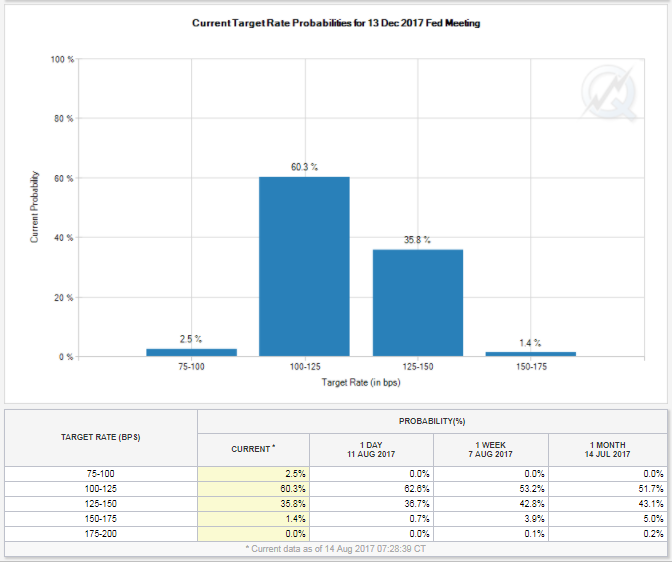
With betting on a September rate-hike from the US Federal Reserve falling to zero, betting on rates being higher by the end of 2017 has sunk from 43% a month ago to 35% today according to the CME Group’s analysis of interest-rate futures.
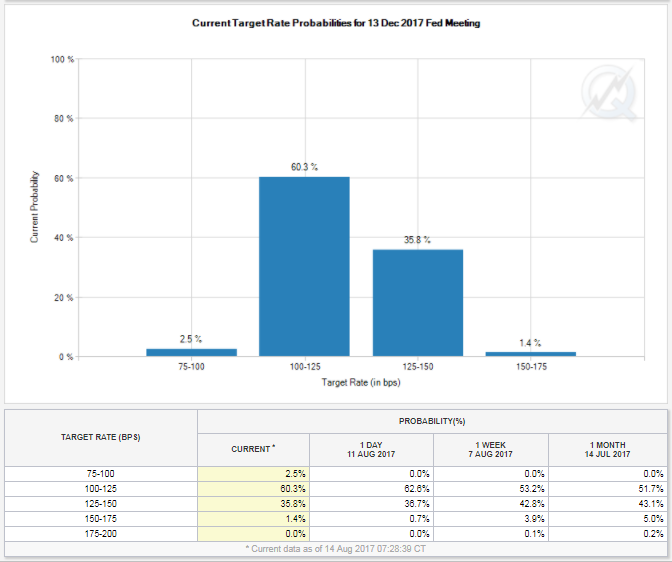
 
Chart of market-derived probabilities of US Fed decision at December 2017 meeting
 
“I’ve heard folks talking about that we’re on the cusp of a nuclear war,” Central Intelligence Agency Director Mike Pompeo said on Fox News Sunday.
 
“[However] I’ve seen no intelligence that would indicate that we’re in that place today.”
 
“We’re not closer to war than a week ago,” agreed national security adviser H.R. McMaster on ABC’s This Week.  “But we are closer to war than we were a decade ago.”
 
“Although more aggressive rhetoric between the US and North officials would temporarily boost gold prices,” reckons John Davies, Global Commodities Strategist at risk and business  consultancy BMI Research, “we see outright military action as unlikely and upward pressure on gold prices stemming from the confrontation as limited.”
 
Betting by speculative traders on rising gold prices has already risen last week before Wednesday’s upturn in the US-North Korea standoff, according to data released Friday by US regulators the CFTC.
 
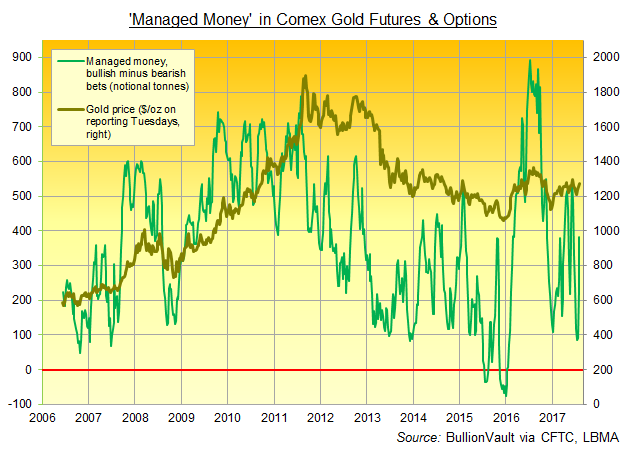
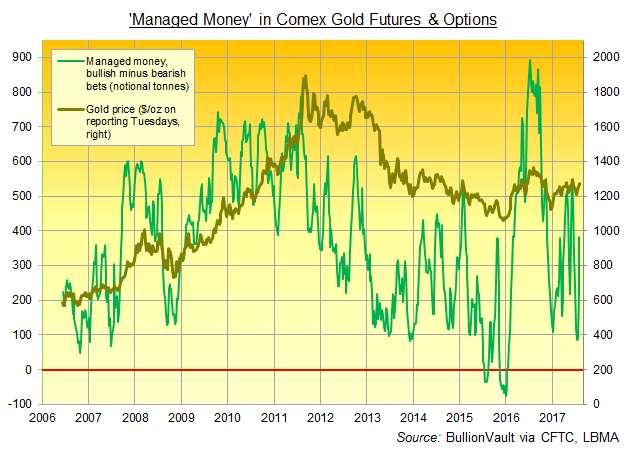
Net of bearish bets, the Managed Money category of traders in Comex gold futures and options raised their bullish bets by 12% from a week earlier, reaching the largest net speculative long position since mid-June saw gold prices make their previous retreat from $1290 per ounce.
 
While bullish bets actually grew only 2%, bearish bets were slashed by more than 30% for the third week in a row.
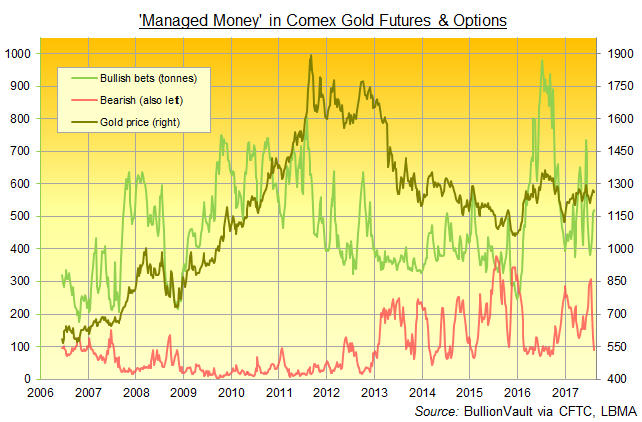
 
Chart of Managed Money's gross long and short positions in Comex gold futures and options. Source: BullionVault via CFTC
 
After President Donald Trump last week tweeted repeated threats of “fire and fury” against Pyongyang if it dares to launch missiles towards the US island and militrary base of Guam, he spoke at the weekend with counterpart Xi Jinping of China – the only major trading partner of neighboring North Korea.
 
Xi asked that “relevant parties should maintain restraint and avoid words that exacerbate tensions”. 
 
“Prospective risks are now rising and do not appear appropriately priced in,” said Ray Dalio, founder of the $160 billion Bridgewater Associates hedge fund, last week.
 
Global political risks plus surging demand from consumer-nations China and India could send gold prices jumping to $1360 per ounce within three months, says Russian investment bank VTB Capital JSC’s head of precious metals Evgeny Ananiev, before climbing to a 4-year high of $1400.
 
Silver meantime tracked and extended the move in gold prices on Monday, first rallying to $17.22 per ounce before retreating below last week’s close of $17.12.
 
Platinum fell hard, down $16 after hitting a 5-month high at $990 last Friday.
Gold Prices Spike on US Inflation Miss, Highest Friday Finish Since Trump Elected Amid N.Korea Nuclear Stand-Off

GOLD PRICES spiked and then retreated Friday afternoon in London but matched their highest weekly close since before Donald Trump was elected US president last November as the odds of a Federal Reserve rate-hike in September were slashed to zero after July’s consumer-price inflation data came in below analyst forecasts.
 
With Trump’s North Korea nuclear stand-off continuing, gold bullion prices this week recorded their sharpest gain since early February after the President said his prior threat of “fire and fury like the world has never seen” was “maybe” not strong enough to deter Pyongyang from attacking the US island and military base of Guam.
 
“Military solutions are now fully in place, locked and loaded, should North Korea act unwisely,” Trump tweeted Friday.
 
“Hopefully Kim Jong Un will find another path!
 
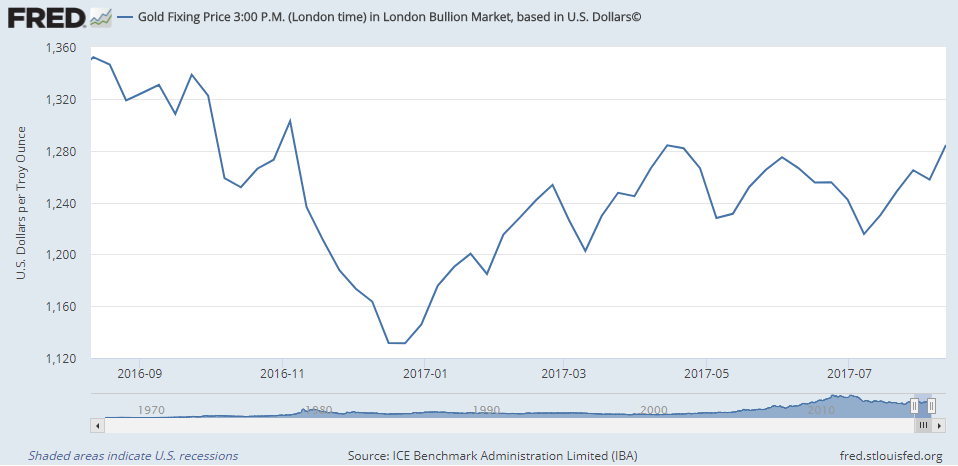
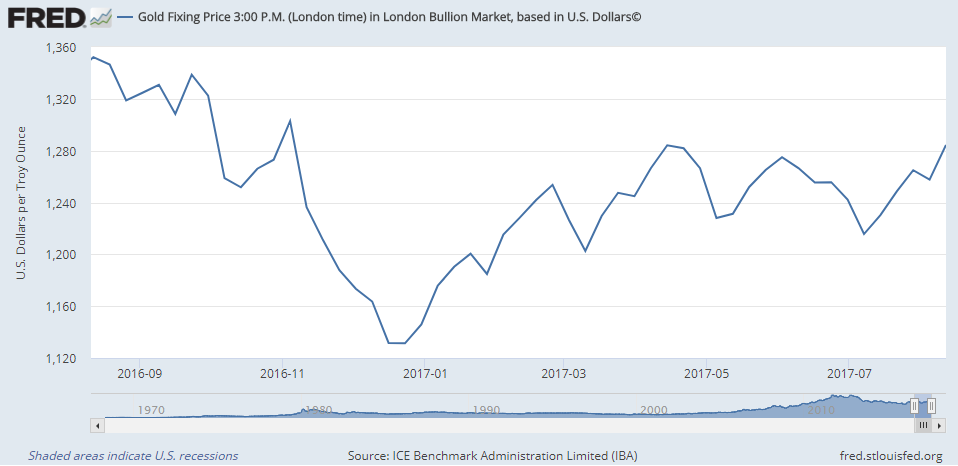
Fixing at $1284.40 per ounce at the 3pm LBMA benchmarking auction, gold prices this week rose 2.1% from last Friday afternoon.
 
Chart of LBMA Gold Price, 3pm Fridays over 12 months to 11 August 2017
 
The Euro spiked as the Dollar fell after the release of July’s CPI inflation data, but lagged last week’s 31-month highs above $1.19 by almost a cent.
 
That still knocked the gold price for Eurozone investors back below €1090 per ounce, but it held 2.7% higher from last Friday at the global 3pm LBMA benchmarking in London – the sharpest weekly gain since October last year.
 
“Gold remains in demand as a safe haven and is still on the up,” said Friday morning’s commodities note from German bank Commerzbank.
 
But giant gold-backed trust fund the GLD failed to grow again Thursday, holding at its smallest size in nearly 18 months.
 
In contrast, trading volumes in Comex gold options jumped to 1-month highs as the total number of Comex gold futures underlying them – contracts which rarely see any physical bullion demanded in preference to cash – swelled by 3%.
 
“Gold opened [Friday] on the bid in Asia and traded quickly to the [session’s] high of $1288.40,” says Swiss refining and finance group MKS Pamp’s trading team.
 
With Dollar prices rising however, the premium for bullion already in Shanghai – central hub for the world’s largest gold consumer market – “pulled back to $3 over loco London,” MKS adds, “which sparked a short-sell off in China.
 
“However, the market looks well supported around $1285.”
 
Eastern stock markets fell for a second day Friday, erasing the week’s prior gains on the MSCI Asia Pacific index.
 
European stock markets then cut earlier losses and Wall Street opened higher after July’s US inflation data said inflation rose to 1.7% per year, just below analyst forecasts.
 
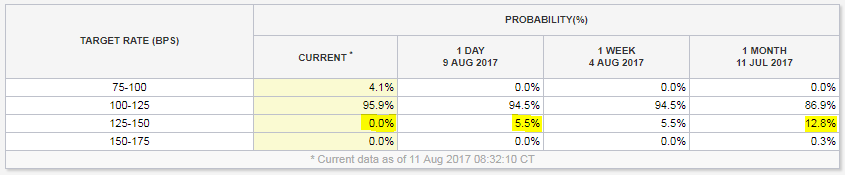
Betting on the US Fed’s September interest-rate decision however shifted to a near-96% certainty of “no change”.
 
The odds of a hike from the current ceiling of 1.25% evaporated entirely according to interest-rate trading tracked by the CME’s FedWatch tool
 
Table of US interest-rate probabilities for Fed's September decision. Source: CME futures trading
 
“Our longer term bias is bullish,” said Commerzbank’s latest weekly technical analysis of gold prices, “but this will only be confirmed on a break and weekly close above $1295.79” – the gold spot price peak of early June.
 
“[Gold] is now closing in on a multi-year trend line resistance at $1291/1295,” says the technical analysis team at French investment bank Societe Generale, “[but] short term the upside is likely to remain capped.
 
“$1260/1256 should be near-term support.”

Gold Bar Prices Jump as 'Safe Haven' Dollar Beats Euro + Sterling for Only 9th Week of 2017 So Far

GOLD BAR prices in the global wholesale market jumped Thursday afternoon in London as weaker-than-expected US inflation data followed a fresh threat from North Korea of firing missiles – possibly nuclear – towards the US island territory and Asian military base of Guam.
 
Priced in Dollars, large gold bars came within $10 of June’s 7-month high above $1295 per ounce, rising 1.2% from the same time last week at Thursday afternoon’s London gold benchmarking.
 
That was outpaced however both by gold in Sterling (+2.1%) and gold in Euro terms (+2.2%), marking only the 9th time out of 32 weeks ending Thursday so far in 2017 that the US Dollar rose on the FX market against both Pounds and the single currency.
 
“The escalation of rhetoric between [President Trump and Pyongyang] may see further safe-haven inspired gains for gold in the coming days,” says Jonathan Butler at Japanese conglomerate Mitsubishi.
 
“The latest flare up,” adds FX strategist Steven Barrow at Standard Bank, “has [also] given a boost to so-called haven currencies…the Dollar, the Yen and Swiss Franc.
 
“But in our view all these ‘haven’ currencies are in longer-term downtrends [and their current] buyers will have to assume that the present geopolitical concerns will not only persist but also mushroom into something much more sinister.”
 
Despite Wednesday’s added geopolitical tensions, investors trading the SPDR Gold Trust (NYSEArca:GLD) yesterday held the giant gold-backed ETFs outstanding shares unchanged for the second day running near an 18-month low.
 
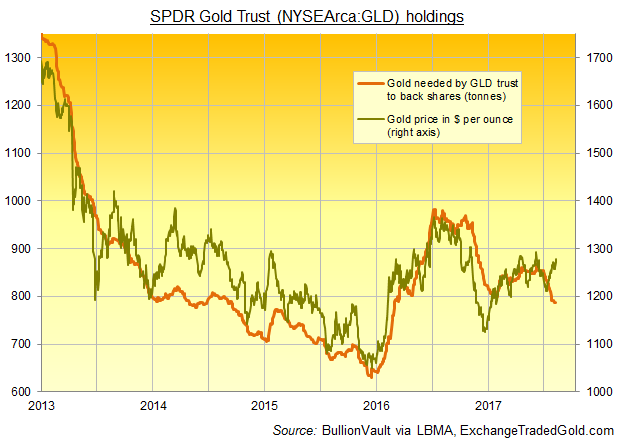
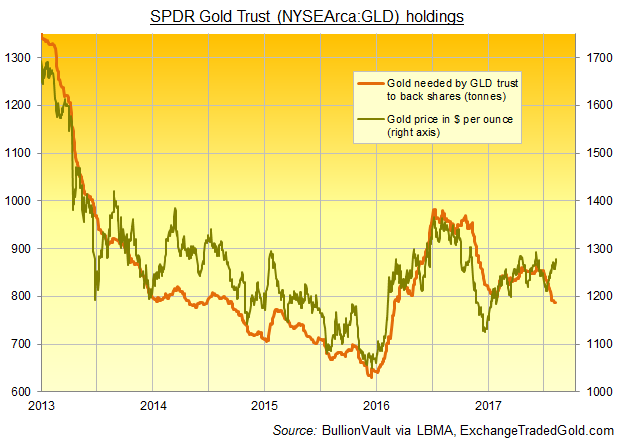
That left the GLD needing 786 tonnes of gold bullion bars to back its value, compared with a top above 1,350 tonnes as US quantitative easing was raised to its peak in late 2012.
 
Since the GLD was launched in late 2004, its size has shown a rolling 4-week correlation of +0.41 with the Dollar price of large gold bars, a statistically significant positive relationship.
 
That figure would read +1.0 if the GLD’s size moved absolutely in lockstep together.
 
It has fallen as far as -0.95 over the last month, the strongest negative correlation since Spring 2011, just before gold shot to its current all-time highs at $1900 per ounce and began a 4-year decline of 45%.
Chart of SPDR Gold Trust (NYSEArca:GLD) bullion backing vs. Dollar gold price. Source: BullionVault via ExchangeTradedGold.com
 
With US consumer-price inflation data due Friday, today’s US producer-price data said corporate input costs slipped 0.1% in July from June – the sharpest 1-month drop since August 2016 – as services and energy charges fell.
 
Analysts had forecasted a 0.1% monthly rise.
 
“If as expected [Friday’s CPI report] shows an uptick towards the 2% annual inflation level,” says Butler at Mitsubishi, “it could lead to a rally in yields and damage gold.
 
“Equally, a stalling of inflation could push back expectations of rate rises and help bullion.”
 
Chinese gold prices had earlier ended the day 0.8% higher in Shanghai, capped by a surge in the Yuan on the currency market to its strongest Dollar value since October last year.
 
That pushed the Shanghai gold premium – over and above the global benchmark of London bullion bar quotes – back beneath $8 per ounce, some 15% below the typical incentive offered to new imports into the world’s No.1 consumer nation.
 
Latest data say that China’s gold jewelry demand fell between April and June to the lowest quarterly total since 2012.

Gold Jumps Amid Trump-N.Korea Threats as Stocks Fall Again from Record, Platinum Cuts Discount

GOLD PRICES jumped to 8-week highs versus a rising Dollar on Wednesday as new data showed US wages remain sluggish while President Trump repeated his willingness to use nuclear weapons against North Korea after Pyongyang threatened to strike the United States’ bomber base on Guam.
 
Gold prices had already recovered last week’s losses for US, Euro and UK investors after Trump threatened “fire and fury like this world has never seen” overnight, but held flat for Swiss and Japanese investors as the Franc and Yen joined in what newspaper and wire editors agreed was a move to “safe haven” assets.
 
Oil rose back to end-July’s 2-month highs against the Dollar, nearing $50 per barrel of US crude, as zinc prices rose further towards 9.5-year highs at the London Metal Exchange following the surge in Chinese steel prices.
 
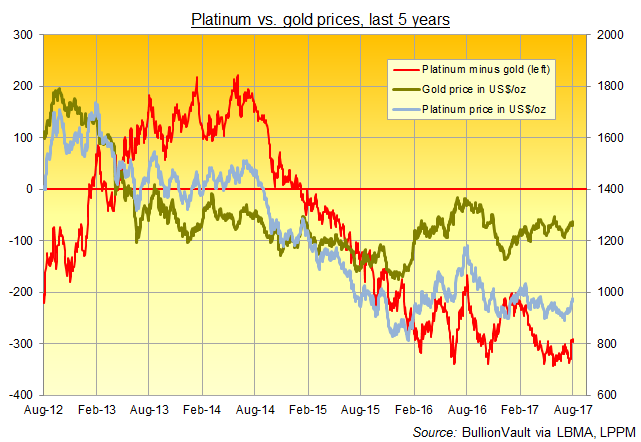
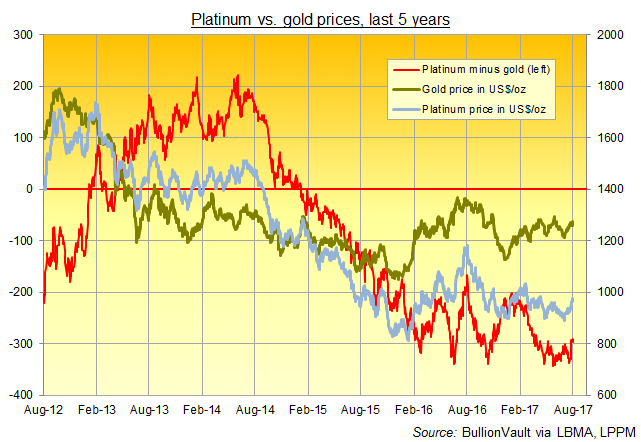
Primarily used in diesel catalysts to clean engine emissions, platinum extended its outperformance of the other precious metals, rising to its highest price since mid-April at $980 per ounce.
 
That held platinum $295 per ounce below gold prices, extending the smallest discount since March 2017 for what was on average a premium above gold of $185 over the previous 25 years. 
 
Chart of platinum vs. gold prices, last 5 years. Source: BullionVault via LBMA, LPPM
 
“It was a generally orderly ascent for bullion,” says Swiss refining and finance group MKS Pamp’s trading team of the gains immediately following North Korea’s comments about Guam and Trump’s first reply, “punctuated by a brief stop-loss run [for bearish traders closing their bets] through Tuesday’s high print.”
 
“I think this is going to continue to provide a little bit of support,” Reuters quotes Australian bank ANZ’s analyst Daniel Hynes, “but not enough to push prices significantly higher from here.”
 
But “the [gold] market is certainly not positioned for some form of attack or, God forbid, war,” says David Govett in his latest trading note for brokers Marex Spectron.
 
“Back in January 1991, in the run up to the first Gulf war, gold had steadily risen for months. The very day the [US-led coalition] attack was launched, the price fell $40 in a straight line.
 
That “very quick 10% move,” says Govett, “prov[ed] the old adage of buy the rumour, sell the fact.”
 
World stock markets meantime marked the 10th anniversary of interbank credit markets freezing as US subprime mortgage bond losses threatened major institutions by falling over 1% for a second day running after setting new all-time highs on the MSCI World Index on Monday.
 
New data today said China’s consumer-price inflation missed analyst forecasts with its slowest July reading since the global economic slump of 2009 at 1.4% per year.
 
Japanese machine tool orders retreated from June’s jump, new figures said, while Australian home-building and home-loan growth also missed consensus predictions.

Gold Bullion Gains as Base Metals Jump, Dollar Falls with US Consumer Credit Growth

GOLD BULLION halved last week’s loss against the Dollar Tuesday lunchtime in London, rising to $1265 per ounce as the US currency fell once again on the FX markets and base metal prices jumped to a series of multi-year highs.
 
Silver also rallied with gold bullion – gaining 10 cents per ounce to trade at $16.40 and recovering one-fifth of last week’s drop – while platinum prices pushed up to their highest since April at $975.
 
After Chinese steel prices hit 4 years highs on Friday, zinc prices today rose almost 4% in Shanghai trade as London copper contracts held near 2-year highs.
 
“Of the major commodities,” Reuters quotes analyst Daniel Hynes at Australia’s Macquarie Bank, “only coal has failed to record strong year-to-date growth rates in [Chinese] imports.”
 
New data Tuesday however showed China’s exports slowing hard in July as the Dollar fell towards 3-year lows.
 
So too did international sales of goods from Germany – the other major surplus country previously named by President Trump’s economic team as “currency manipulators”.
 
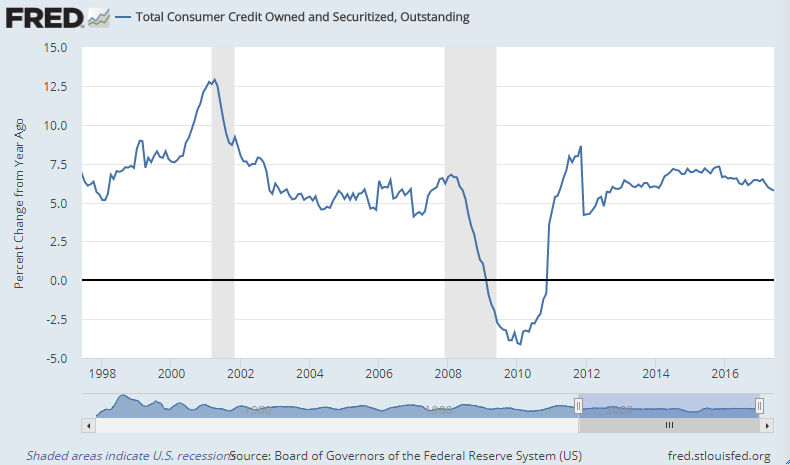
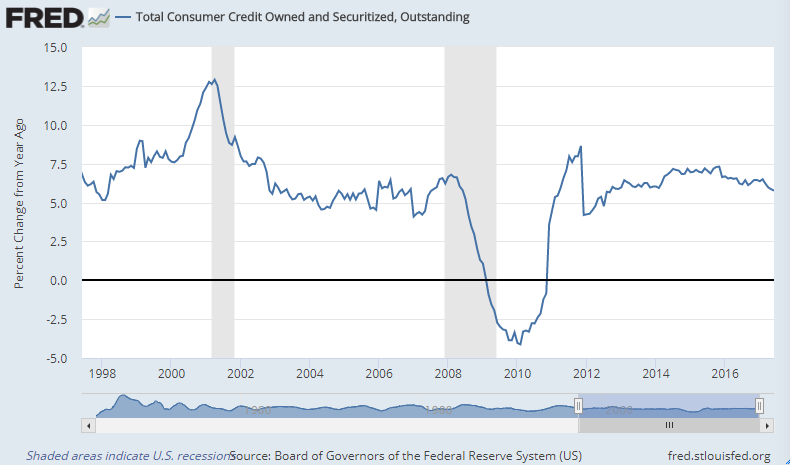
Data released Monday showed US consumer debt growing in June at the slowest annual pace since 2012.
 
Chart of US consumer credit. Source: Federal Reserve
 
“Recent data indicate that real US GDP growth remains consistent with the low-growth regime of recent years,” said US Federal Reserve Bank of St.Louis president James Bullard in a speech Monday.
 
“US inflation has [also] surprised to the downside,” said Bullard – not a voting Fed member until 2018 – “[and so] the current level of the policy rate is likely to remain appropriate over the near term.”
 
The odds of a rate hike at September’s US Fed meeting have sunk from 1-in-8 this time last month ago to less than 1-in-70 today according to betting on futures contracts tracked by derivatives exchange the CME Group.
 
World stock markets held flat overall Tuesday morning after Wall Street closed last night at fresh all-time highs.
 
The Chinese Yuan meantime rose to its highest USD value since October after Beijing reported the largest trade surplus in 6 months.
 
Annual growth in China’s total exports sank from 11.3% in June to just 7.2% in July, but imports growth fell from 17.2% per year to 11.0%, helping the country’s trade surplus grow to equal $47.9 billion.
 
Tuesday’s rising Yuan squashed the Shanghai gold premium, over and above comparable London bullion quotes in Dollars, back below the equivalent of $5.80 per ounce – near last week’s 9-month low for the incentive to new imports into the world’s No.1 consumer nation.
 
India’s recent discounts on gold bullion vs. London prices have meantime “disappeared” reports the Economic Times, “as jewellers have started restocking” ahead of the traditionally strong autumn festival season “[and] market sentiment turns positive.”
 
Besides the waning shock of India’s new 3% GST sales tax on gold – introduced at the start of July – falling local gold prices “due to strengthening of the Rupee…[have] also helped consumers take interest,” says the paper.

Gold Price Flat After US Jobs Shock, 'Risk Aversion Missing' as N.Korea Condemns UN Nuclear Sanctions

GOLD PRICES held flat Monday morning against the Dollar as the US currency reversed some of last week’s bounce amid fresh threats of nuclear conflict from North Korean’s government, writes Steffen Grosshauser at BullionVault. 
 
After falling to a 10-day low of $1254 late Friday – and seeing its first weekly decline in four on stronger-than-expected US job data – gold today traded in a narrow $3 range around last week’s close of $1258.
 
The US Dollar meantime cut into Friday’s bounce from 15-month lows of 0.8% – the greenback’s biggest 1-day rise so far this year – after July’s official estimate of non-farm payrolls came in much stronger than analysts forecast.
 
“The jobs data was very good, gold is pressured,” said Richard Xu, fund manager at China’s biggest securitized gold investment vehicle, HuaAn Gold. 
 
Ahead of last week’s US jobs data, hedge funds and other ‘Managed Money’ traders in Comex gold futures and options grew their bullish betting by 63% net of the same group’s bearish bets, taking it back up to the level of mid-June, according to the latest data from US regulator the Commodities Futures Trading Commission (CFTC).
 
Chart of Managed Money net speculative position in Comex gold futures and options. Source: BullionVault via CFTC
 
Speculative betting on higher silver prices also increased, reaching the highest since mid-June after turning net bearish overall for the first time since August 2015.
 
The world’s largest gold-backed exchange-traded fund, the SPDR Gold Trust (NYSEArca:GLD), ended the week unchanged in size after shrinking to its smallest in 17 months.
 
Another drop below the current support level at $1255 could see gold prices decline further to the next support at $1247, reckons Reuters technical analyst Wang Tao.
 
Resistance remains unchanged at $1274, according to Friday’s Marketwatch note from at bullion market-maker Scotiabank.
 
Major government bond yields meantime held flat overall on Monday, with 10-year US Treasurys offering 2.27%, a little below that long-term interest rate’s level of a week ago.
 
Eurozone equities slipped as the single currency rose back towards 31-month highs versus the Dollar despite German industrial production showing its first fall this year on June’s data.
 
Monday ended higher however for Asian stock markets including South Korea’s Kospi and Japan’s Nikkei indices despite increasing tensions over neighboring North Korea’s nuclear ambitions.
 
Dictator Kim Jong-un vowed at the weekend to retaliate and make “the US pay a price” for new sanctions unanimously imposed on Pyongyang by the UN Security Council on Saturday.
 
Aimed at deterring the isolated country’s nuclear weapons research, the sanctions could cut North Korea’s annual export revenues by a third.
 
“There is not much other geopolitical uncertainty in the world, no extreme events,” reckons Xu at HuaAn Gold. 
 
“That’s why risk-aversion is subsiding and gold prices aren’t doing well.”
 
In other precious metals on Monday, silver edged lower and touched $16.14 per ounce – the lowest point since 20 July – while platinum held steady after rallying more than 3% to the highest level since 24 April last Friday. 
 
Crypto-currency Bitcoin climbed to an unprecedented high of more than $3200 on the CoinDesk Bitcoin Price Index (BPI).

GLD Shrinks Like 2011 Peak Before US Jobs Data Send Gold Prices -0.6% for Week

GOLD PRICES sank 0.6% against the Dollar on Friday as the US reported stronger-than-expected jobs data for July.
 
New York’s stock markets opened the day lower as the Dollar rallied from its latest 31-month lows to the Euro and bond prices fell, pushing longer-term interest rates higher.
 
Non-farm payrolls expanded by 209,000 last month, the Bureau of Labor Statistics said, beating analyst forecasts of 183,000 with June’s figure also revised higher.
 
Having recovered last week’s finish of $1269 on Friday morning, Dollar-priced gold dropped $7 immediately after today’s new US jobs data.
 
Gold prices had previously risen 3.9% from 1 month before, the fastest rolling 1-month rate of gain since start-June’s peak at $1295 per ounce.
 
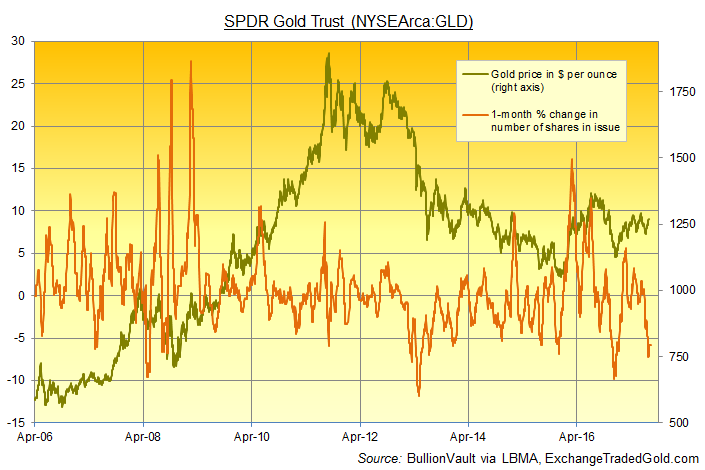
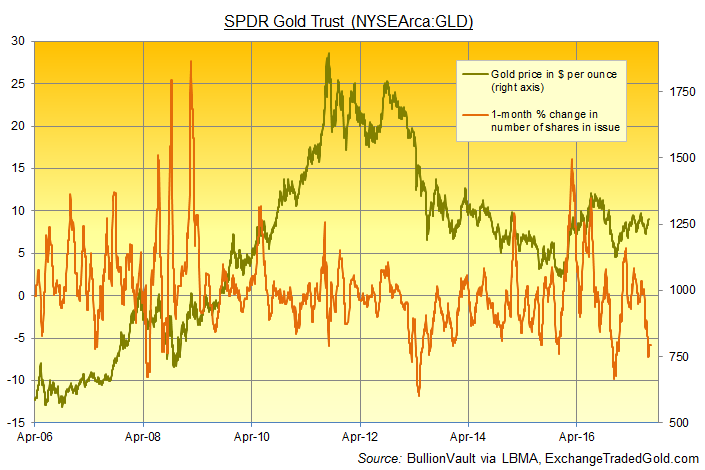
Across the 1-month period ending Thursday however, the world’s largest exchange-traded gold investment vehicle – the giant SPDR Gold Trust (NYSEArca:GLD) – shrank by 5.8%, the fastest drop in the number of shares in issue since New Year.
 
Outside the start of 2017, the only month of similar gold price gains to see heavier investor liquidation of the GLD ETF was the 1-month period ending 7 September 2011 – the day that gold prices began their drop from all-time record highs above $1900 per ounce.
Chart of rolling 1-month percentage change in number of shares in issue in the GLD ETF. Source: ExchangeTradedGold
 
“Near term we would allow for some slippage to the $1250/30 zone ahead of further strength,” said this week’s technical analysis of gold prices from German financial services group Commerzbank.
 
“The market has eroded…the June high [at $1295]…and as a result implies a test of the [July] 2016-2017 downtrend at $1282 and a return to the top of [this year’s] range.
 
“Our longer term bias is bullish, but this will only be confirmed on a break and weekly close above $1295.”
 
Friday’s US jobs data also said the unemployment rate slipped to 4.3% last month, its lowest July reading since the year 2000. Annual wage growth held at June’s 2.5% rate.
 
“The private sector is approaching full employment across the skill set spectrum,” Bloomberg quotes US brokerage Jefferies LLC’s chief economist Ward McCarthy.
 
After reporting second-quarter GDP up 2.6% per year after inflation last week, the Bureau of Economic Analysis meantime said the US trade deficit shrank in June to $43.6 billion, with exports rising as imports fell.
 
June saw the US Dollar trade at its cheapest value against the world’s other major currencies since May 2016.
 
“The key determinant for direction [in gold prices] will likely fall to the USD,” said Friday’s trading note from Swiss refiners and finance group MKS Pamp.
 
“[The Dollar] currently sits on a number of key support levels in [index] terms as well as against the Euro and Yen.”
 
Despite the US currency trimming its week-on-week drop versus the Euro after today’s jobs data, Euro gold prices still headed Friday afternoon for a 1.3% weekly drop at €1065 per ounce. 
 
Earlier Friday in China, Shanghai gold premiums rose earlier from yesterday’s 9-month low near $5 per ounce, rising to offer new importers $6.20 over London quotes – still one third below the typical incentive for bullion inflows to the world’s No.1 gold mining, importing and consumer nation.

Gold Price Erases 1.6% Loss for UK Investors as BoE Sinks Sterling

GOLD PRICE losses of $10 per ounce for this week so far were almost entirely erased in London trade Thursday lunchtime, taking the metal back up to $1268 as global interest rates eased back and crude oil edged higher once more.
 
The UK gold price in Pounds per ounce meantime jumped to £965, reversing almost all the week’s previous 1.6% drop as Sterling sank on the FX market after the Bank of England announced that its Monetary Policy Committee voted 7-2 to hold the UK’s key interest rate at an all-time record low of 0.25%.
 
Out of 328 central-bank policy decisions made worldwide so far in 2017, only 73 have seen a change to interest rates.
 
Excluding the US Fed and its impact on Dollar-tracking authorities such as Qatar and Hong Kong, only 6 hikes were made, with 46 decisions to cut.
 
Across the same number of decisions in the last 7 months of 2016, 60 changes were made, with a total of 27 hikes and 33 cuts.
 
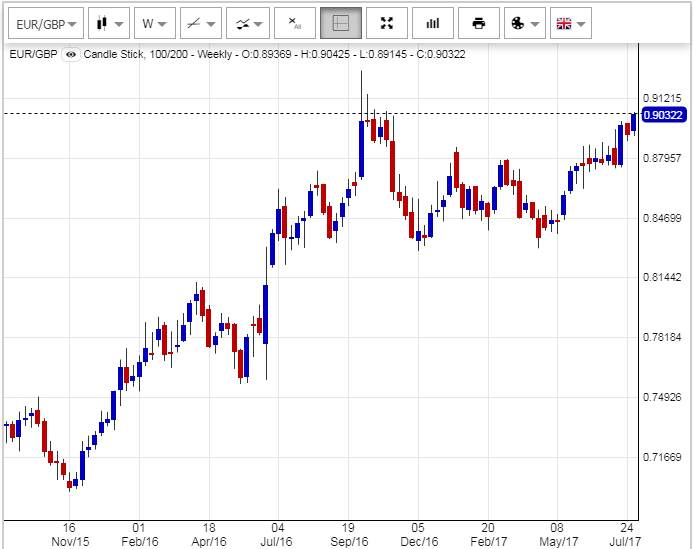
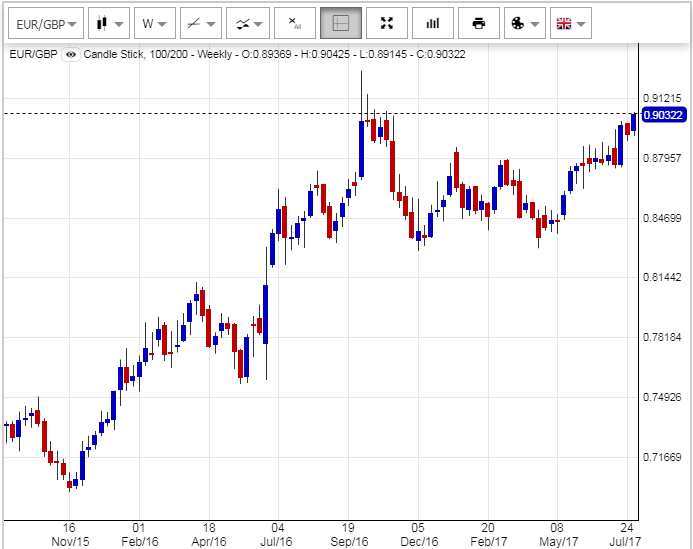
Chart of Euro's value in British Pounds, weekly candles. Source: NetDania
 
External Bank of England members Ian McCafferty and Michael Saunders – both private-sector economists – today both voted to raise rates for the second month running.
 
Voting to stick at 0.25%, and replacing 3-times ‘hawk’ Kristin Forbes, new external member Silvana Tenreyro of the London School of Economics found in a 2013 research paper on US rates – now due for its third publication – that “contractionary policy shocks have more powerful effects than expansionary shocks.”
 
Despite forecasting today that UK consumer-price inflation – already above its 2% target in June at 2.6% per year – will “rise further in coming months and…peak around 3% in October,” the Bank’s MPC also voted unanimously to keep its QE holdings of government debt at £435 billion, and also to boost its Term Funding Scheme by the extra £15bn alloted to it by the Treasury before it ends as planned next February.
 
“This scheme was announced last August [and] supports consumer borrowing by lowering the cost of debt…in the wake of the Brexit vote,” explains the Financial Times.
 
The Bank’s own director for financial stability, Alex Brazier, last week warned of a “spiral of complacency” on UK consumer debt in a speech in Liverpool.
 
Thursday’s fresh drop in the British Pound saw London’s FTSE100 share index of mostly global corporations rise by 0.7%, bucking weakness across Asian and European equities.
 
Gold priced in the single-currency Euro meantime bounced off new 3-week lows hit overnight but held 1.2% down for the week so far at €1067 per ounce.

China Gold Demand +10% But India 'Offers Little Support' as Price Slips vs Weaker-Still Dollar

GOLD PRICES slipped $5 per ounce from last Friday’s 8-week closing highs against the Dollar in Asian and London trade on Wednesday before new data said the US economy added fewer jobs than expected in July.
 
With the Dollar gold price bouncing from $1265, non-US currency prices fell harder however, touching 1-week lows for UK investors and hitting near 2-week lows against the Euro as the Dollar extended its slide to new 15-month lows versus the world’s other major currencies.
 
Preceding Friday’s official non-farm payrolls estimate, today’s private-sector ADP report said the US employers added 173,000 jobs last month, the weakest July growth since 2013.
 
“Volumes remain fairly light across all precious metals over the past few sessions as we sail deeper into the summer doldrums,” said Wednesday’s Asian trading note from Swiss refiners and finance group MKS.
 
“Opportunistic sellers still linger on rallies and cap moves higher, edging the yellow metal lower.”
 
On the forex market today the Euro hit a new 133-week high against the Dollar above $1.1850 and the British Pound rose to its strongest in 43 weeks near $1.3250, despite new data showing the weakest UK construction-sector activity in 11 months during July.
 
India’s Rupee had earlier hit 2-year highs ahead of the Reserve Bank’s widely expected decision to cut interest rates across the world’s No.2 gold consumer nation to the lowest level since 2010 at 6.0%.
 
That saw Rupee gold prices fall to 2-week lows on MCX futures contracts. 
 
“Given the introduction of the GST [sales tax on physical gold] in India there is a relative hiatus in imports to that crucial market at present,” said last week’s first-half 2017 update from precious metal analysts Thomson Reuters GFMS, “and this is leaving gold prices susceptible to softness.
 
“Not least [this is because] it is often Indian demand that responds positively to price weakness.”
 
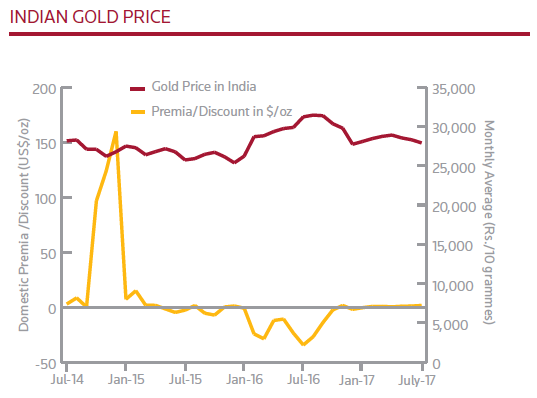
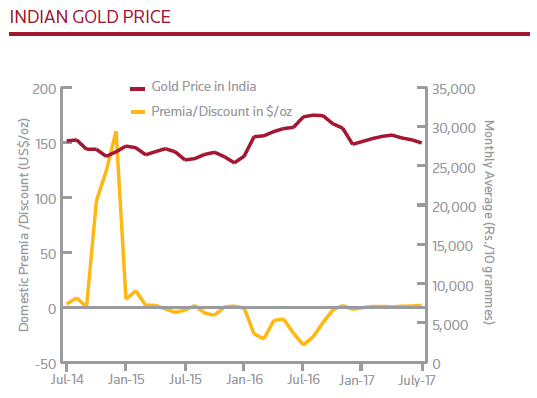
Having popped back to a brief premium as consumers brought forward demand ahead of 1 July’s new sales tax, retail gold prices in India last week fell to the widest discount below London quotes in 7 months, according to Reuters, equal to $4 per ounce after accounting for India’s 10% import duty.
 
Chart of Indian Rupee gold prices and domestic premium/discount to London wholesale quotes. Source: Thomson Reuters GFMS Gold Survey 2017 H1 Update
 
Gold demand in No.1 consumer China rose almost 10% year-on-year in the first-half of 2017, new data from Beijing-backed trade body the China Gold Association said Friday, driven by investment purchases.
 
Speaking at an industry conference in Shanghai, vice-chair Zhang Yongtao said Chinese demand for jewelry was virtually unchanged between January and June, but demand for gold bars jumped by 51%, cannibalizing some coin demand, which fell 61% from the same period last year.
 
Trading volume on the Shanghai Gold Exchange – the only legal route for gold bullion into private circulation – slipped 4.6% from the first-half of 2016, said Zhang.
 
Turnover in Shanghai Futures Exchange contracts sank by almost 48%.
 
Premiums for Shanghai bullion at today’s SGE gold price benchmarking fell to their lowest level compared to London bullion quotes since April at barely $6 per ounce, one-third below the typical incentive offered to new imports.

Gold Price 'Breaks Critical Downtrend' on Monthly Chart But Fed's 'Anti-Trump' Stance a Risk

GOLD PRICE gains of $5 per ounce reversed in London trade Tuesday lunchtime, pulling the metal back from 7-week highs at $1270 but holding above what one analyst identifies as a “critical” trendline against the US the Dollar.
 
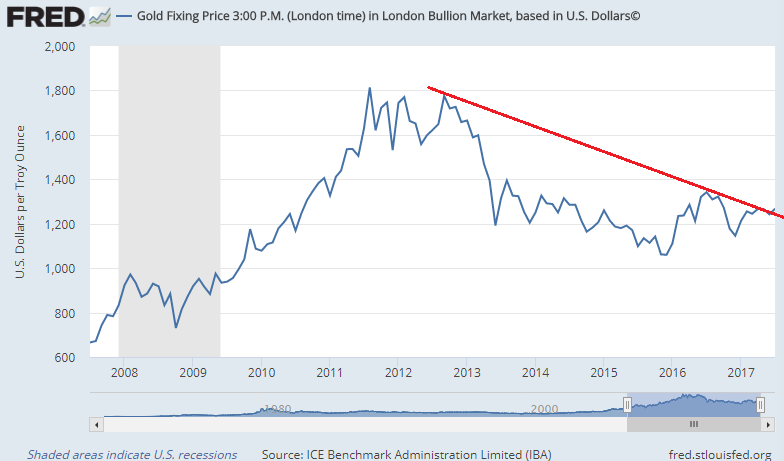
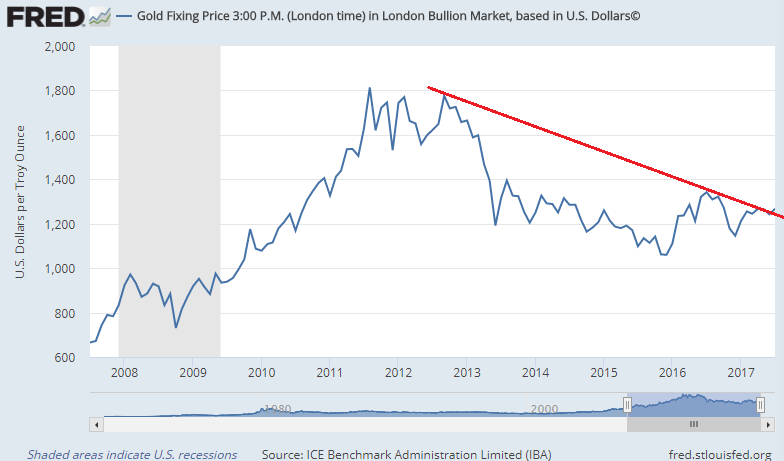
“Gold is at a critical juncture,” says strategist Jonathan Butler at Japanese conglomerate Mitsubishi in his latest weekly report, “having just broken out of a long-term downtrend by closing above the monthly trend line that can be traced back to the all-time high of 2011.”
 
Chart of month-end Dollar gold prices, London PM benchmark, last 10 years with 2011-2017 downtrend. Source: BullionVault via St.Louis Fed
 
“Trend line resistance in force since the all-time high in 2011 [now comes in] at $1286/1295,” counters a daily chart analysis from French investment and bullion market-making bank Societe Generale.
 
A break of that level “would be seen as a significantly advanced bullish signal and would propel gold towards $1315…and $1356,” says SocGen’s technical team.
 
Meantime, “Gold is in danger of short term profit taking,” says Butler, “and if US jobs and PMI data [due Wednesday through Friday] show strength this week a resurgent Dollar will weigh on prices.”
 
The Dollar bounced Tuesday from yesterday’s new 31-month lows below $1.18 per Euro as new US inflation data came in just ahead of analysts forecasts and despite strong economic data from the 19-nation single currency union.
 
Growing 2.1% per year in Q2, the Eurozone’s gross domestic product matched its strongest expansion since the start of 2015. 
 
Ahead of this week’s US jobs data, betting on September’s Federal Reserve policy meeting now sees a near 99% chance of “no change” from the current interest-rate ceiling of 1.25%, sharply higher from the 82% probability suggested by futures-market speculation this time last month.
 
But “we view [the Federal Reserve’s] forthcoming quantitative tightening to be a key downside risk for gold,” warns Butler, pointing to the link between Treasury bond yields and the price of non-interest bearing bullion.
 
“A change in market sentiment in the weeks ahead towards pricing in a rate rise in the fourth quarter,” he says, “alongside monetary tightening [as the Fed starts to unwind its current $4.5 trillion holdings of US debt] may rattle the bond markets and gold in the way that the taper tantrum did in 2013.”
 
“Yellen is…a very partisan Democrat,” says former merchant banker and now financial author Martin Hutchinson, “[and] she has regarded the world in a very different way since Donald Trump was elected President.
 
“To her, he is clearly unworthy to benefit from her magic beans of monetary stimulus. Hence, she withholds them.”
 
Approving of Yellen as a “low-interest-rate person” last week, Trump also said he’s considering Gary Cohn to lead the Federal Reserve when Yellen’s first term ends in 2018.
 
CEO of US investment bank Goldman Sachs until joining the White House as director of the National Economic Council this January, “We just had a cabinet meeting,” Cohn told reporters Monday, “[and] the president is 100% committed to getting tax reform done this year” – a major key election pledge so far unrealized.