Author Archives: City Gold Bullion

'Buy Gold' Urges Marc Faber as Brexit Means 0% Chance of Fed Rate Hike

BUY GOLD prices held around last week’s 2-year closing high in Dollar terms Wednesday morning as the US currency slipped on the forex market and world stockmarkets extended their rally from last week’s Brexit bombshell.
 
Commodity prices rose 0.7% on average, and the single Euro currency edged up towards $1.11 as the Dollar fell, rallying 2 cents from this week’s new 3-month low.
 
London’s largest 100 shares had by lunchtime recovered three-quarters of Friday-to-Monday’s 5.6% plunge, but the more UK-focused FTSE250 index remained almost 9% below its pre-Brexit level.
 
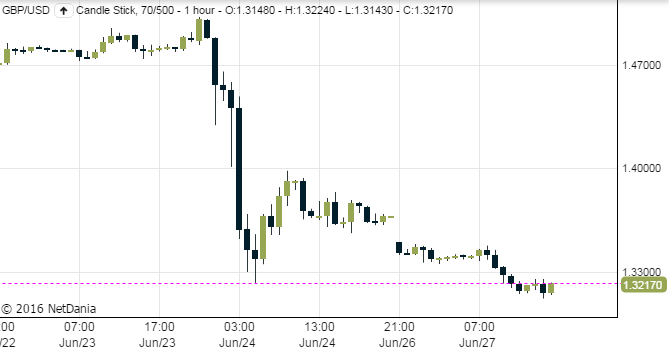
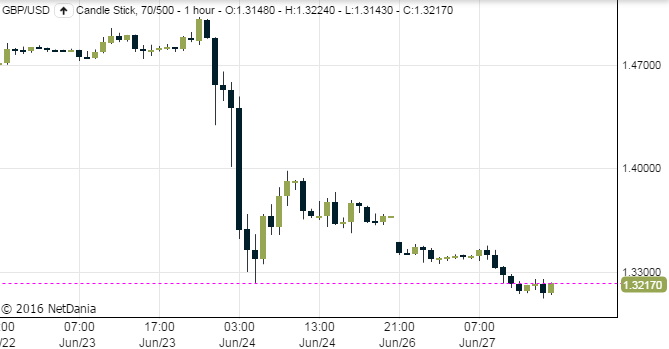
The Pound Sterling meantime rallied above $1.34, regaining 3 cents from Monday night’s new 31-year low but still holding a drop of more than one-tenth.
 
That curbed prices to buy gold with British Pounds at £980 per ounce, some 2.6% above Brexit Friday‘s afternoon benchmark of £955 – the highest Friday finish since April 2013 – as UK government Gilt yields held at record lows beneath 1.0% per year.
 
Economists now put the UK’s forecast 2017 GDP growth at 0.4% on average, down from a 2.1% average forecast a fortnight ago, according to Consensus Economics.
 
“The mildly up sloping channel on [gold’s] daily chart at $1315/$1307, which also happens to be the inverted Head and Shoulder confirmation level, will be a test of character,” says Stéphanie Aymes’ technical analysis team at French investment and London bullion market-maker Société Générale.
 
“In the event of a downside breakout, a deeper retracement would then occur towards $1284.”
 
After gold priced in Dollars formed “a doji on [Monday’s] candlestick chart…highlight[ing] indecision among buyers and sellers,” says Russell Browne at Canada-based ScotiaBank’s New York office, “the metal appears to be consolidating and I remain neutral.”
 
“Resistance is at $1358.50 [Friday morning’s Brexit high] and support remains unchanged at $1304…the May high.”
 
Looking at the fundamentals, “We believe that Britain’s forthcoming exit from the EU will, on balance, remain positive” for investors choosing to buy gold, says the latest weekly note from specialist analysts Metals Focus.
 
“A number of milestones lie ahead for the exit process, and market volatility around them should encourage safe haven buying. Faced with this backdrop…the Fed is likely to take an even more dovish approach.”
 
The US Federal Reserve shows zero chance of raising its key lending rate from the current 0.5% until November at the earliest, according to betting on interest-rate futures contracts Wednesday morning.
 
“If Brexit is used as an excuse,” said legendary ‘contrarian’ investor Marc Faber to Bloomberg in Hong Kong overnight, “the central banks will print more money, QE4 in the US is on the way, and the depreciation in the purchasing power of currencies will continue.
 
“In that situation, you want to own some gold.”
 
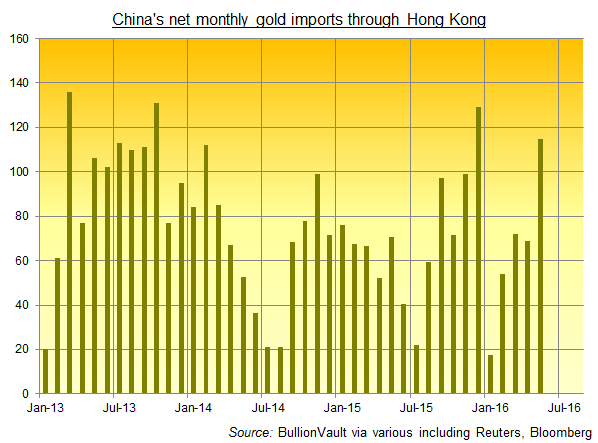
China’s demand to buy gold – now the heaviest in the world, overtaking India – saw imports through Hong Kong jump in May to a net 115 tonnes.
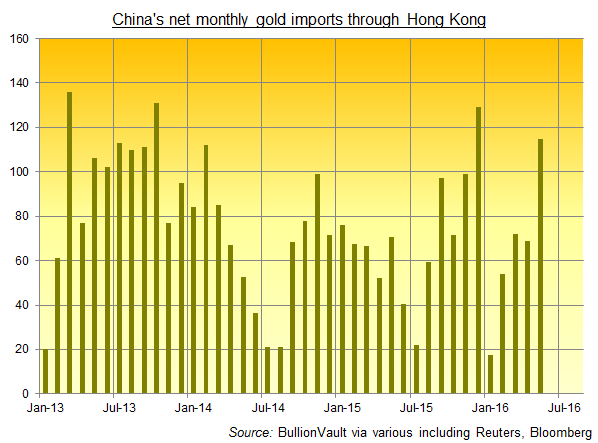
Chart of China's net gold imports through Hong Kong, monthly tonnes, 2013-2016
 
That took the running 12-month total to 846 tonnes, the fastest annualized inflows so far in 2016.
 
Weighing over 51% more than the last 3 years’ monthly average, it was also the largest June inflow from Hong Kong to China since at least 2011 on available data.
 
Indian households wanting to buy gold are currently finding up to 5% discounts below world prices thanks to an increase in smuggling to avoid import duty and sales tax, reports the Business Standard.
 
Legal supplies are trading at 2.5% discounts.
Gold Prices Retreat on 'Profit Taking' as Stocks Rally, EU 'Flies On 1 Wing'

GOLD PRICES retreated up to 4% from last week’s multi-year Brexit highs versus major currencies Tuesday, testing $1305 per ounce in US Dollars as world stock markets rallied and government bonds eased back from new records.
 
French and German stock markets rallied back towards Friday’s closing level, reversing yesterday’s further 3% drop.
 
London’s domestically-focused FTSE250 index also rose, but recovered only one-fifth of its 14% Brexit plunge so far to 18-month lows.
 
“The flight to safety since Friday is only likely to have further elevated the long positioning,” says the latest weekly note from Japanese conglomerate Mitsubishi’s London precious metals analyst Jonathan Butler, pointing to last week’s record-high speculative bullish betting on gold and silver.
 
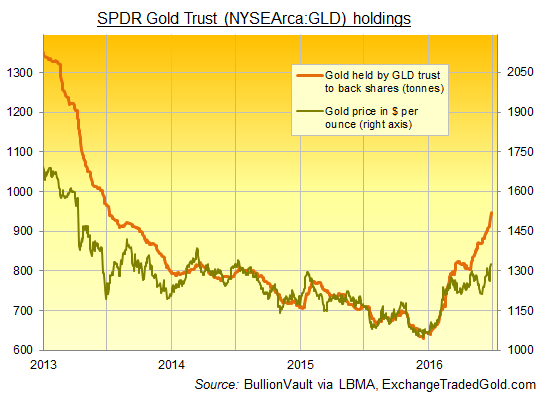
“[That] brings the threat of profit taking in the near term, particularly if risk-off sentiment fades,” he adds, also warning that the surge of investors holding exchange-traded trust fund vehicles related to gold prices may unwind if they “go in search of yield as the economic picture becomes clearer.”
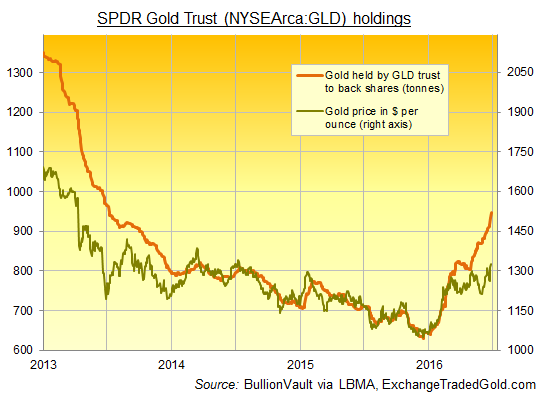
Chart of gold prices vs. SPDR Gold Trust (NYSEArca:GLD) bullion backing in tonnes
 
But while such factors could “result in downside for gold, [Mitsubishi’s] basic assumption is that investors will continue to turn to gold as a risk hedge in the short to medium term.”
 
Gold prices in China edged back Tuesday from yesterday’s new 3-year highs, fixing at the equivalent of a $6 per ounce premium to London spot quotes at the afternoon benchmarking in Shanghai.
 
That reversed the rare but severe Shanghai gold discounts of $10 and $3 seen Friday and then Monday.
 
Trading volume in the Shanghai Gold Exchange’s main spot contract meantime held at twice its typical level, but was only one-third the new record set last Friday as news of the UK’s Brexit vote result broke.
 
Politically meanwhile, and asking victorious UKIP member of the European Parliament Nigel Farage “Why are you here?” on Tuesday, European Commission president Jean-Claude Juncker said the UK should “clarify its position…as rapidly as possible”.
 
With British prime minister David Cameron refusing to trigger Article 50 after he campaigned and lost for Remain last week, a successor may not be in place until early September his Conservative Party said Monday.
 
For the wider EU, the Brexit result “[has] cut off one of our wings but we are still flying towards new horizons,” Juncker continued in a speech to the European Parliament today, vowing to “fight…for a united Europe”.
 
UK GDP growth will slow to “around zero in the second half of 2016 and into early 2017,” reckons Swiss bank UBS’s London economist David Tinsley.
 
Ratings agency S&P yesterday cut its long-term view on the UK from the highest ‘triple-A’ level to ‘AA’, saying that the Leave result “will weaken the predictability, stability, and effectiveness of policy-making in the UK.”
 
A ‘risky trinity’ of rising debt levels, low productivity and little room for central-bank rate cutting means “this huge Brexit shock [threatens to] wreak havoc for the Pound and asset prices,” says Chinese-owned investment and bullion bank ICBC Standard Bank’s FX strategist Steven Barrow.
 
“Some semblance of recovery could occur if the UK [central bank] can save the economy from recession. Unfortunately we are not too hopeful.”

Gold Prices Extend Brexit Bombshell Surge as 'Stable' Markets Sink Yet Again

GOLD PRICES pushed up but held below Friday’s Brexit jump to new multi-year highs in London trade Monday, as Western stock markets sank once again following the UK referendum’s decision to quit the European Union.
 
Gold on Friday made its highest weekly close in London’s wholesale trade since July 2014 against the Dollar, and rose again today despite strong selling pressure at the benchmark LBMA Gold Price auctions.
 
Prices in Sterling meantime saw a rise back above £1000 per ounce of gold in wholesale trade – a level last seen in spring 2013 – as UK prime minister David Cameron said there will not be a second referendum despite 3.7 million people signing an online petition at Parliament’s official website.
 
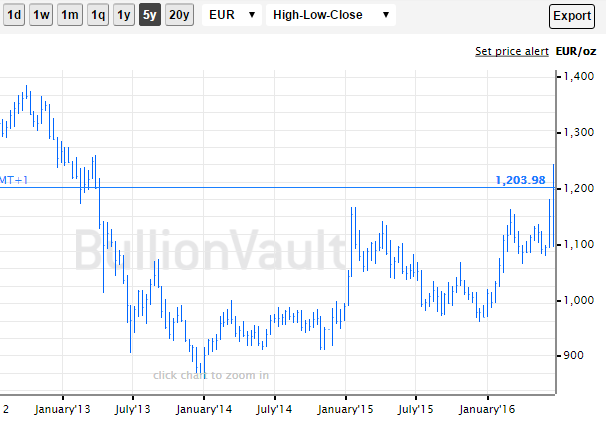
Gold priced in Euros touched €1200, a level first seen amid the crisis of summer 2011.
 
“With strong uncertainty around the stability of Europe, and the the Fed unlikely to raise rates before December, we have revised upwards our forecasts,” says Bernard Dahdah at French investment and bullion bank Natixis.
 
The best forecaster in 2015’s professional LBMA competition – picking the annual average gold price down to the dollar at $1160 – Dahdah saw his 2016 highest-price forecast of $1300 per ounce beaten on Friday.
 
“We now see gold averaging $1275 this year,” says Dahdah – some 31% above his previous forecast of $970 – with a “messy divorce between the UK and Europe” perhaps helping the annual average to reach $1400.
 
“[Alternatively] the negative economic impact on the UK and European economies [may] not really materialize [and] we return to business as usual [with] gold prices averaging $1200 during H2 of this year.”
 
Claiming that Friday’s financial turmoil had passed, “Project Fear is over. People’s pensions are safe. The markets are stable. The Pound is stable. It’s all very good news,” said former London mayor, key Brexit campaigner and possible Cameron-replacement in the ruling Conservative Party Boris Johnson in a morning statement.
 
Chart of British Pound to US Dollar from HIFX
 
The Pound then sank a further 2 cents to new 31-year lows against the Dollar, while shares in giant retail bank Barclays and the part-nationalized RBS were suspended after sinking 15% by lunchtime.
 
UK government bond prices pushed higher again, as did all major sovereign debt, pushing 10-year Gilt yields below 1% for the first time in history.
 
Ten-year US Treasury yields fell to 1.46%, only just above summer 2012’s all-time record lows.
 
German Bund yields fell to new record lows of minus 0.12% per annum on Berlin’s 10-year debt.
 
“The immediate aftermath of the UK referendum result continues to be positive for gold,” says a note from commodity analysts at Chinese-owned banking giant and London vault operator ICBC Standard Bank, “with the metal advancing from Friday’s close against all major [currencies].
 
“With yields already low and under further pressure globally, the opportunity cost of holding gold continues to diminish.”
 
“The political situation also remains unstable outside the UK,” says a note from commodity analysts at German financial services firm Commerzbank, pointing to “the repeated parliamentary election in Spain” which failed to win a majority for the incumbent People’s Party, leaving acting prime minister Mariano Rajoy to try and build a new coalition.
 
“Speculative financial investors significantly expanded their net long positions again before the ‘Brexit’ referendum,” Commerzbank adds.
 
Net betting on Comex silver contracts also set a fresh all-time record last week, according to data from US regulator the CFTC.

Gold Holds Multi-Year Highs as Brexit Shock Hits Eurozone Worst

GOLD‘s Brexit jump to fresh multi-year highs against all major currencies bar the Japanese Yen faded London lunchtime on Friday, but prices held firm as US stockmarkets prepared to open the day sharply lower amid the global rout in risk assets.
 
London’s FTSE share index rallied to a 4.7% loss thanks to mining stocks, but German and French stock markets stood some 8% lower as the afternoon began.
 
As crude oil and other commodities also fell, surging bond prices meantime drove German Bund yields down to new record negative levels at -0.08% on Berlin’s 10-year debt.
 
Ten-year US Treasury yields sank one-fifth of one percent to new 4-year lows at 1.54%.
 
Gold priced in Dollars held above last Thursday’s spike to 2-year highs at $1315 per ounce, some 3% below its $100 spike overnight.
 
Silver had lagged the jump, adding 20% to its 2.5-year peak of $18.32 against gold’s 22% move in the Dollar.
 
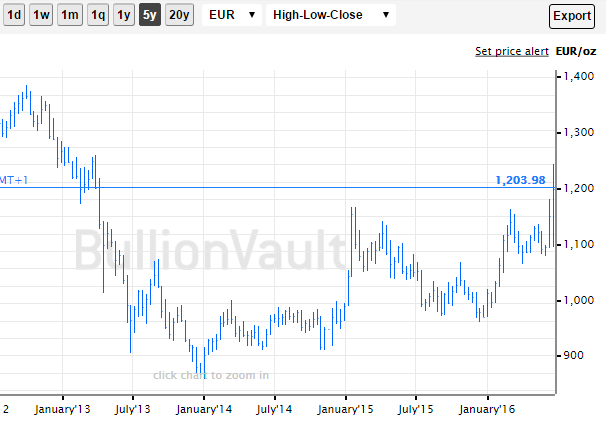
Gold priced in the single Euro currency meantime held at 3-year highs of €1200 per ounce.
 
Chart of the gold price in Euros
The 3 presidents of the European Council, Commission and Parliament, plus the Union’s current president, today called for the UK to trigger Article 50 of the Lisbon Treaty and formally announce its withdrawal “as soon as possible, however painful that process may be [with] no renegotiation [rather than] unnecessarily prolong uncertainty.”
 
UK Independence Party leader Nigel Farage said he expected the Netherlands, Austria and other EU members to seek an exit too.
 
“We [also] want be in charge of our own country, our own money, our own borders, and our own immigration policy,” said Dutch anti-immigration MP Geert Wilders.
 
Thursday’s Brexit vote led this morning to the resignation of UK prime minister David Cameron, plus calls for another referendum on Scottish independence, as well as a vote of no confidence in UK opposition party Labour’s leader Jeremy Corbyn, who also backed Remain.
 
“Britain has rarely looked more divided or ill at ease with itself,” said an editorial in a special Financial Times‘ lunchtime edition.
 
UK voters backed Brexit by 52% to 48% on a turnout just above 3-in-4.
 
After gold priced in Sterling dropped 10% Thursday from last week’s spike to 3-year highs, British Pound bullion prices leapt 22% overnight – their fastest gain in recorded trading – to touch £1019 per ounce.
 
“We need to be prepared for the potential for a greater level of volatility in financial markets than we have seen since the end of the financial crisis of 2008-2009,” said UK fund manager Edward Bonham Carter of the giant Jupiter group.
 
After the Bank of England offered £250 billion ($340bn) in immediate liquidity support to UK banks and markets, the Swiss National Bank confirmed it had “intervened” in the currency market overnight to try and suppress the Franc by selling it.
 
Gold prices in Swiss Franc terms leapt to new 3-year highs overnight.

Gold Prices Jump Fastest-Ever vs Pound on Brexit 'Carnage'

GOLD PRICES leapt at their fastest-ever pace against the British Pound in Asian trade Friday as the UK’s referendum on membership of the European Union showed a 52% vote in favor of leaving.

Pro-Remain prime minister David Cameron resigned. Anti-EU UKIP party leader Nigel Farage called for 23 June to become a national holiday – “Independence Day” – and said other EU member states led by the Netherlands and Austria could follow.

Global stock markets tumbled, with UK banking and home-building shares losing up to 55% at the start of London trade.

Marking a $100 range and spiking by 4am London time to $1358 per ounce – a new 2-year high – the gold price in Dollars then retreated to last week’s peak at $1315.

Gold prices for UK investors jumped 22% overnight as the Pound sank to three-decade lows on the FX market, touching a 3-year high at £1019 before also retreating, down to £953 per ounce.

“It is now highly likely that the Fed will be unable to hike rates this year,” said ICBC Standard Bank precious metals strategist Tom Kendall.

Besides the likely move to new QE and lower rates from other major nations, “That alone will be supportive of gold.”

“Inevitably…some market and economic volatility can be expected as [the Brexit] process unfolds,” said Bank of England governor Mark Carney in a statement.

“[The Bank] stands ready to provide more than £250bn of additional funds through its normal facilities.

“[But] there will be no initial change in the way our people can travel, in the way our goods can move or the way our services can be sold.”

“Other safe haven assets have also done well on investor risk aversion,” says Jonathan Butler at Japanese conglomerate Mitsubishi, pointing to the Japanese Yen hitting near-2 year highs versus the Dollar and rising US Treasury bond prices pushing 10-year yields to new 4-year lows.

Ten-year UK Gilt yields fell 0.28 percentage points to new record lows near 1% per year.

Crude oil dropped almost 4%.

“There are some caveats” for gold prices warns Kendall at ICBC Standard Bank.

“The strengthening Dollar will be something of a headwind; speculative positions on Comex are already at record levels; short-term volatility will keep many bullion dealers and jewellery buyers on the sidelines for now.

“Producer hedging will become increasingly attractive.”

Silver prices also jumped to 2-year Dollar highs above $18.30 per ounce overnight, but lagged gold’s sharper gain.

Gold Prices Drop 10% in GBP from Brexit Peak as 'Remain' Vote Expected

GOLD PRICES touched 2-week lows against the Dollar on Thursday, and fell harder against the Pound and Euros, as financial markets rose amid growing expectation that the UK will vote Remain in today’s Brexit referendum on staying in the European Union.
 
Eurozone stock markets jumped over 2% as gold prices dipped below $1260 per ounce – down over 4% in US Dollar terms from last Thursday’s 2-year high.
 
London’s FTSE100 index lagged Frankfurt and Paris, but rose 1.5% for its fifth daily gain in succession off last Thursday’s 4-month lows.
 
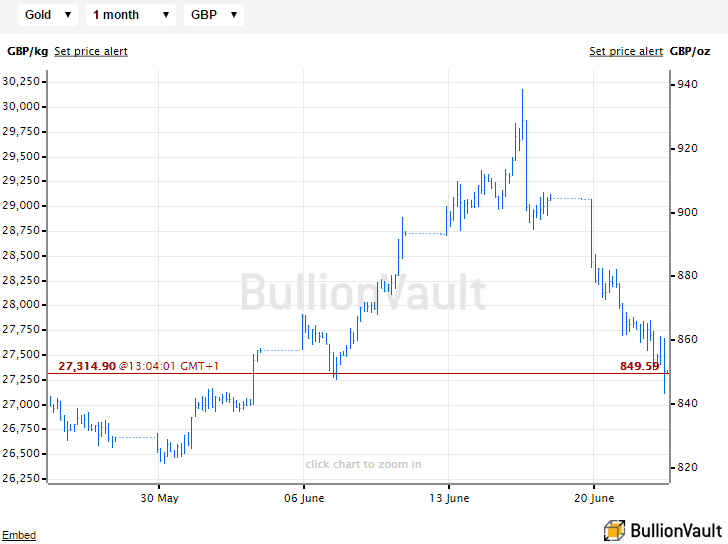
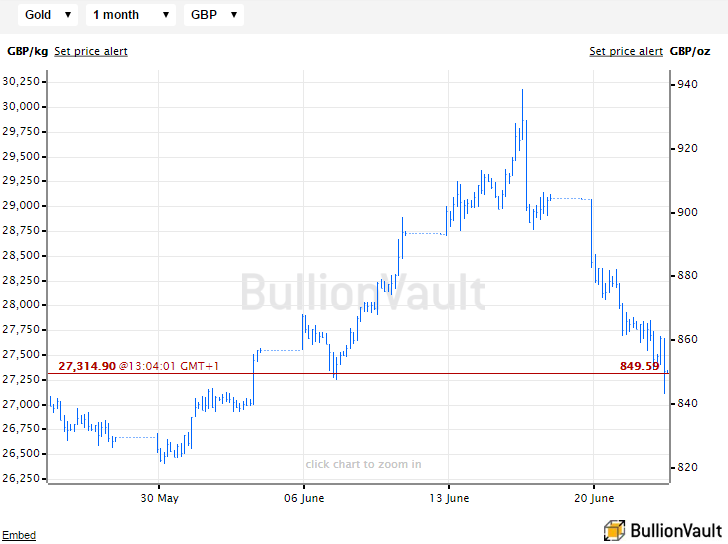
Gold priced in Sterling fell yet again as the Pound rose on the FX market, dropping over 10% from last Thursday’s sudden 3-year high at £938 to dip below £845 per ounce.
 
Chart of gold priced in British Pounds, June 2016
 
The last opinion poll taken before today’s voting began put the Leave vote at 48% with Remain at 52%.
 
Some 17% of voters, however, remain undecided according to a separate telephone poll published Wednesday.
 
Results are due to start around midnight London time, 2 hours after polls close, with a clear verdict by 5am Friday.
 
Today’s rise in Sterling was widely read as a growing bet on a strong Remain vote, with some commentators citing ‘exit polls’ privately run for London hedge funds.
 
“Whilst the referendum has had an influence on gold prices in the last two weeks,” reckons UK fund manager George Cheveley at investment bank Investec, “the effect has been small compared to the impact of US interest rate and US Dollar moves over the past few months.
 
“Negative real rates, the US election and Chinese debt levels are also worrying investors.”
 
Shanghai gold prices steadied overnight, edging higher from 2-week lows even as the Chinese Yuan rose on the FX market.
 
That reversed yesterday’s $3 per ounce discount on Chinese gold versus international prices to a $5 premium at the benchmark Shanghai Gold Price auction.
 
“[Bullish gold bets] have started to correct,” said a note from Canada-based bullion bank Scotia Mocatta, “but the net long fund position is still large, so further profit-taking may follow.
 
“ETF investors continue to buy and there have not been many redemptions – this suggests sentiment remains bullish.”
 
Investor demand for shares in gold ETF market-leader the SPDR Gold Trust (NYSEArca:GLD) expanded yet again on Wednesday, extending its growth 1.7% since prices hit 2-year Dollar highs a week ago to need 915 tonnes of bullion backing – the largest quantity since September 2013.
 
The leading silver ETF in contrast – the iShares Silver Trust (NYSEArca:SLV) – has shrunk by more than 200 tonnes since mid-June to 10,360 tonnes, its smallest size since start-April’s then 16-month high.

Gold Prices Hit 2-Week Low as Brexit Odds Shrink to 1-in-4 But Banks Fear Volatility

GOLD PRICES retreated further on Wednesday in London as stock markets rose amid speculation that the UK will vote to stay in the European Union in tomorrow’s “Brexit” referendum, writes Steffen Grosshauser at BullionVault.
 
After falling nearly 2% on Tuesday – the biggest 1-day loss in a month – gold prices today touched a 2-week low of $1261 per ounce before trading around $1265 as UK and Asian equities edged higher.
 
Opinion polls still put the “Remain” and “Leave” camps very close, but bookmakers say the chances Britain will choose to leave the EU have shrunk to about one in four according to betting on the Brexit referendum.
 
“With the Brexit vote now less than 48 hours away, participants seem to be positioning for a ‘Remain’ vote. However, if the ‘Leave’ does win, there could be a ‘+3 figure’ gain in gold,” Swiss refiner MKS Group’s trader James Gardiner said in a note, referring to a possible rise of “safe-haven” gold of at least $100 per ounce.
 
Ole Hansen, Head of Commodity Strategy at Saxo Bank, also sees gold being “propelled towards $1400” in case of a Brexit.
 
“In case we see a ‘Leave’, we probably would see the upper end of our trading range which would be $1,350. But if we see a ‘Stay’ I think gold will see further uncertainty and may fall back towards the $1,200 level,” reckons Dominic Schnider of UBS Wealth Management in Hong Kong.
 
“We expect the re-positioning of investors holding long Brexit-related gold positions will drive volatility higher,” added French investment and London bullion bank Societe Generale.
 
However, “the main issue is not the threat of volatility but uncertainty about regulations,” summarizes Garry Jones, CEO of the London Metal Exchange, when considering the possible impact of Friday morning’s outcome. 
 
Holdings in the giant SPDR Gold Trust (NYSEArca:GLD) rose nearly 0.4% to 912.33 tonnes on Tuesday, the highest since September 2013.
 
Silver, in the meantime, tracked gold and fell slightly to $17.24, unchanged from this time last week.
 
Financial traders expect high volatility in all financial markets going into Friday morning’s Brexit result, with major banks warning on possibly poor liquidity and wide trading spreads between buy and sell prices in foreign-exchange to stocks, bonds, commodities and precious metals markets.
 
Bank of America-Merrill Lynch expects a 10% decline in equities if the UK decides to leave the EU. According to billionaire investor George Soros, the same result could trigger a more than 20% plunge of the British pound. 
 
US Federal Reserve chair Janet Yellen was meantime due Wednesday to resume her regular 2-day testimony to Congress, , while European Central Bank president Mario Draghi will speak in the European Parliament later today.
 
After the Fed’s decision to keep rates unchanged at its latest FOMC meeting, gold prices rose over $100 and reached a 2-year high on 16 June.
 
“All eyes in the gold market are on the Brexit vote,” says Thorsten Proettel, a commodity analyst at the German Landesbank Baden-Wuerttemberg.
 
“The odds of an out-vote have come down since late last week. Even rates expectations are taking a back-seat to what is happening in the UK.”

Gold Bullion Retreats as Fading 'Brexit' Odds See Sterling Jump

GOLD BULLION fell hard in London trade Tuesday, extending the last 2 sessions’ drop from multi-year highs as the British Pound jumped but stock markets failed to repeat yesterday’s strong rally on new polls showing Thursday’s UK referendum on EU membership will reject Brexit.
 
Touching $1315 per ounce last week, gold priced in the US Dollar today retreated to $1270, dropping 2.5% from yesterday’s start.
 
Oil prices led another 1.5% drop in broader commodity markets, while silver slipped 1.5% from last week’s finish to trade at $17.22 per ounce.
 
Eurozone government bond yields edged up but US Treasury yields slipped to 1.67%, holding well above last Thursday’s 4-year low at 1.57%.
 
“With the ‘remain’ campaign now seemingly back in the lead,” says strategist Jonathan Butler at Japanese conglomerate Mitsubishi, “gold has retreated, Sterling has advanced the most since 2008, and equity markets have rallied.
 
“Choppy trading is likely in the days ahead…A vote to remain is likely to be short-term bearish for gold…A leave vote may well see gold rally strongly.”
 
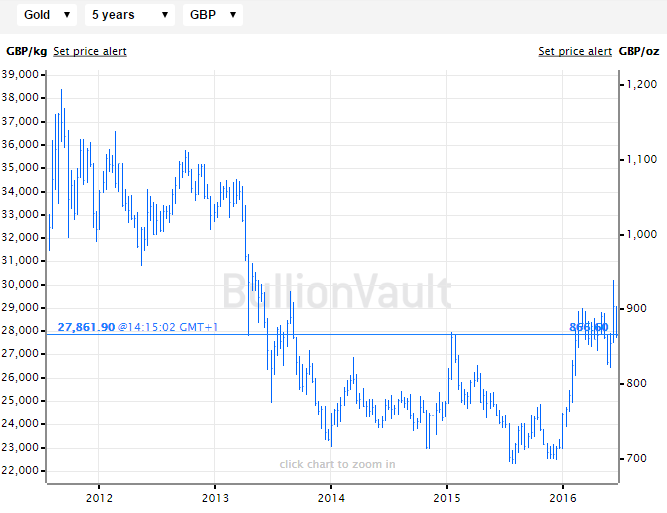
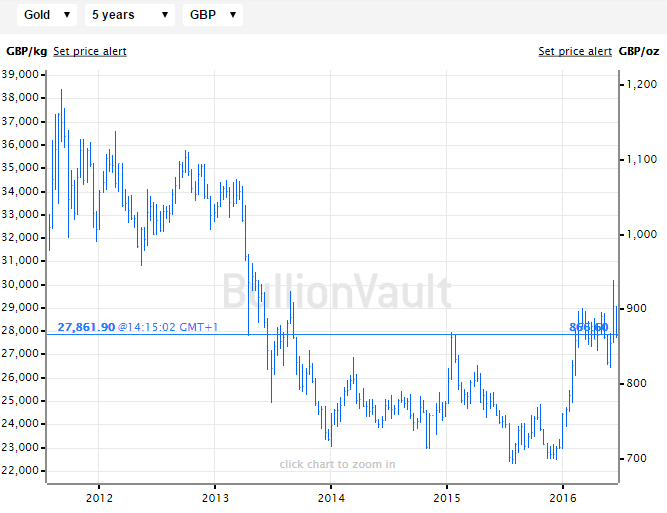
With the British Pound jumping to new 2016 highs overnight, gold bullion sank to £861 per ounce for UK investors, a drop of almost 8% from last Thursday’s 3-year high.
 
Price of gold bullion in British Pounds, last 5 years
Shanghai gold bullion prices fixed unchanged from Monday in Yuan terms, but a fall in the Chinese currency slashed their premium to international Dollar quotes almost to zero.
 
UK bookmakers Ladbrokes said betting on Thursday’s vote – due to show a clear result around 5am Friday – now puts the odds of Remain at 82%.
 
One new opinion poll meantime said the Remain camp’s lead is widening but another left it “too close to call”.
 
On a Brexit vote “we expect prices to rise by as much as 10% to $1400,” says a note from French investment and bullion market-making bank Societe Generale, “with follow-through strength extending to the rest of the precious metal sector.
 
“[But] if the British vote to remain in the EU, we are likely to see the gold price retreat when the dust settles, particularly given the lack of physical support from key markets in Asia so far this year.”
 
“It is not a given that we will see a significant gold correction, even if the UK voters decide to stay in the EU,” counters a commodities trading note from Canada-based TD Securities, explaining how “once the market takes stock after the referendum” investors will still find many major government bonds yielding less than zero.
 
“A dovish outlook from the [US Fed’s] FOMC, with possibly only one hike this year, should continue to be a catalyst for strong gold markets.”

Gold Price Sinks as Brexit Loses Lead in UK Polls, Wipes £50bn onto FTSE

GOLD PRICES sank 1.5% versus a falling US Dollar in Asian and London trade Monday morning, extending Friday’s fall from multi-year highs as world stock markets surged after UK opinion polls showed the Brexit campaign losing momentum ahead of Thursday’s referendum on membership of the European Union.
 
Having gained less last week, silver fell less on Monday, trading just 0.5% lower from Friday’s finish by lunchtime in London’s wholesale bullion market. 
 
Eurozone and London shares jumped 3.5% on average, adding £50 billion to the value of the UK’s FTSE 100 index, as the Pound jumped back to $1.46 on the FX market.
 
Falling from just below $1300 to trade beneath $1280 per ounce, gold prices touched 2-year Dollar highs at $1315 last Thursday – the day that UK politician Jo Cox was murdered, spurring a halt to campaigning by both Leave and Remain leaders.
 
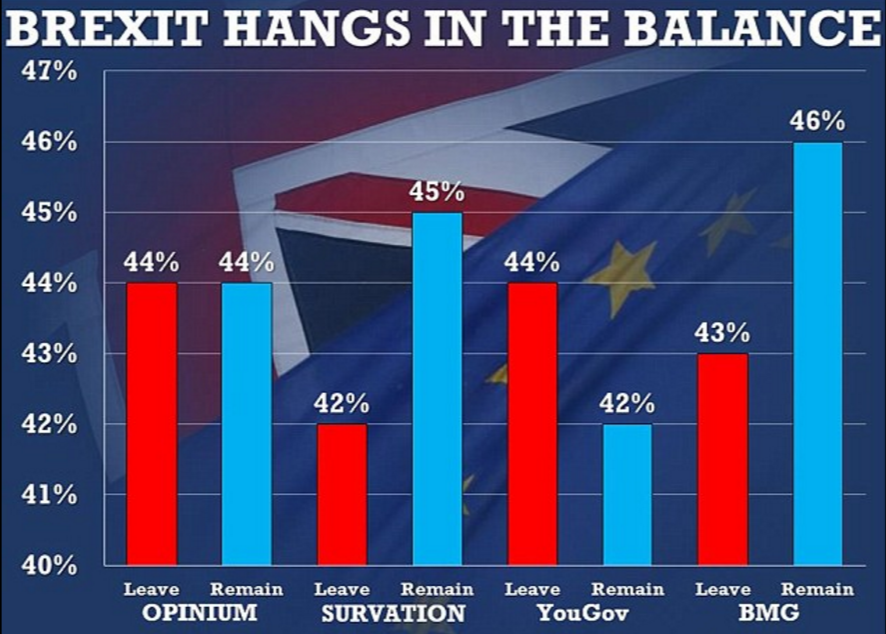
The latest opinion polls now either put Leave and Remain neck and neck, or give the status quo a good lead.
 
Chart of recent Brexit opinion polls via the Daily Mail
 
“Clearly this is helping calm the financial markets again somewhat,” say analysts at German financial services group Commerzbank, “as a result of which gold is currently in less demand.
 
“That said, the referendum will doubtless be the dominant theme this week…Uncertainty over the outcome should lend support to gold.”
 
Studying failed independence referenda in Quebec and Scotland, says German financial services group Deutsche Bank’s strategist Jim Reid, “The Leave lead might need to be more than 5% for there to be high confidence that this will be the final result.”
 
Priced in British Pounds gold has now lost 7% from Thursday’s 3-year high at £939 per ounce, and lost over 4% from €1189 per ounce in Euros.
 
Priced in the Japanese Yen, gold has now halved 2016’s early gains, adding 5.5% from New Year’s Eve.
 
As the People’s Bank of China said it poured the equivalent of $38.5 billion into domestic money markets last week, the Chinese Yuan fell sharply on Monday from a rally to 1-month highs versus the US Dollar.
 
That earlier strengthening had seen Shanghai gold prices fix at the equivalent of $1300 per ounce, even as London settlement was quoted nearer $1283.
 
US brokerage INTL FC Stone has raised the downpayment charged to clients trading gold, silver, Sterling and Euro derivatives, demaning 200% of the minimum margin required by exchange provider the CME Group.
 
“The recent surge in support for the Remain camp may have an influence on US monetary policy,” Bloomberg quotes Australian bank Macquarie’s analyst Matthew Turner in London, “with a win likely to give the Fed greater scope to increase rates sooner rather than later.”
 
Last Thursday’s jump to $1315 per ounce came after the US Federal Reserve held its key interest rate at 0.5%, citing this week’s Brexit referendum as one reason for caution.

Gold Prices Sink from 'Shooting Star' High as UK Brexit Campaign Paused, Stockmarkets Rally

GOLD PRICES edged higher but held sharply below yesterday’s multi-year highs on Friday, as world stock markets extended an overnight rally and major government bonds eased back amid a suspension of campaigning in the UK Brexit referendum on quitting the European Union.
 
Ending the week 1.3% higher in US Dollar terms at $1280 per ounce, gold traded over 3.5% below Thursday’s 3-year high against the British Pound.
 
Shanghai gold prices ended the week 1.7% below Thursday’s 3-year high on near-record volumes, fixing with a premium to global spot quotes of $2.80 per ounce on Friday afternoon.
 
With UK campaigning for next week’s Brexit referendum suspended after Thursday’s murder of pro-Remain opposition MP Jo Cox, the International Monetary Fund’s managing director Christine Lagarde told an audience in Vienna, Austria that membership of the EU has helped make Britain a “dynamic and vibrant economy.”
 
News of the murder and suspension coincided Thursday with a sharp reversal across financial markets, as New York stock markets rallied, bond prices eased back and gold dropped almost $40 per ounce from the day’s earlier 2-year high.
 
“Profit taking and a pullback in the US Dollar saw gold dive sharply,” says one trading desk.
 
“Good selling flows out from both Asia and Europe on the earlier rallies.”
 
“There was a complete shift in sentiment among market participants in the late afternoon,” says Eugen Weinberg’s team of commodities analysts at German financial services group Commerzbank.
 
“Gold responded by shedding all of its gains again, and actually closed trading around 1% down.”
 
“A shooting star formation on the candlestick chart indicates a possible bearish reversal,” says Russell Browne in his daily technical analysis for Canada-based bullion bank Scotia Mocatta.
 
“Short-term,” agrees gold market-maker Societe Generale’s technician Stephanie Aymes, “gold has formed a Shooting Star…[and] the candle also engulfs previous two days of price action.
 
That “indicates profit taking in near term and defines resistance at $1300, the previous opens/closes,” Aymes goes on, highlighting what she calls “some red flags for continuation of short-term uptrend.”
 
“In contrast to consensus,” says the Commodities Weekly from Chinese-owned investment and bullion bank ICBC Standard Bank, “we think gold might suffer in the short term in the event of a Leave result,” pointing to a likely rise in the US Dollar, plus falling oil prices, driving real inflation-adjusted bond yields higher.
 
Moreover, “in previous episodes of severe financial market stress gold has been positively correlated with other assets, at least for a short time, as liquidity dries up, spreads widen and margin calls proliferate.”
 
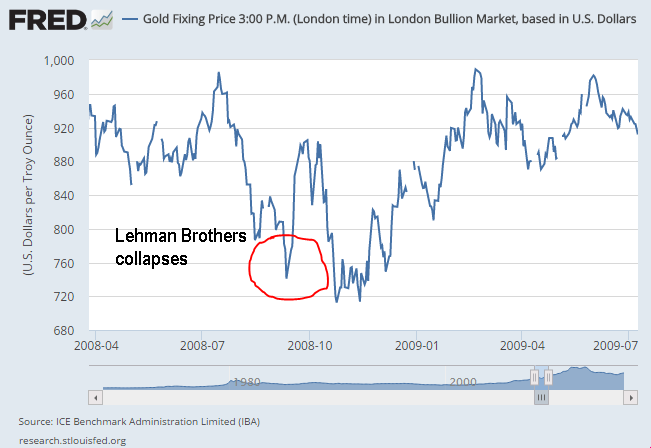
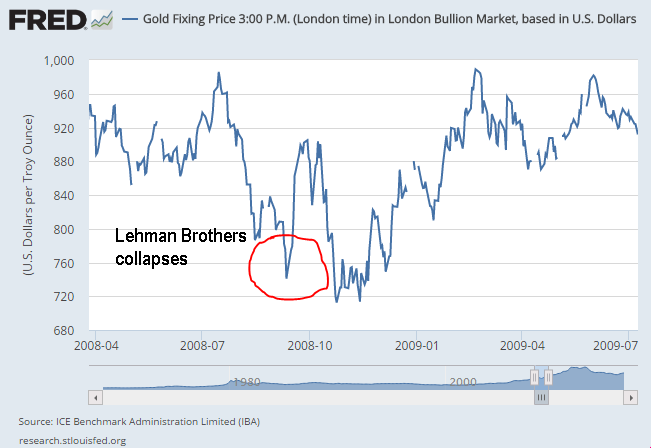
Already highly volatile over spring and summer 2008, gold jumped 23% against the Dollar within 2 weeks of Lehman Brothers collapsing in September that year, but then sank to new 12-month lows over the following month, losing more than one-fifth of its value as world credit markets froze and equities dropped.
 
Chart of the USD gold price, autumn 2008
 
A crisis-led drop on a Brexit vote, says ICBC Standard, would be “short-lived but potentially sharp – the [speculative] market is currently heavily biased to the long side.”
 
Further ahead, gold’s 2016 rally to date has lasted longer than previous pullbacks since the top of summer 2011, says Aymes at SocGen, “giving credence to sustainability of rising trend.
 
“The pattern clearly indicates signs of a long-term bullish reversal after an elongated downtrend of 5 years.”