Author Archives: City Gold Bullion

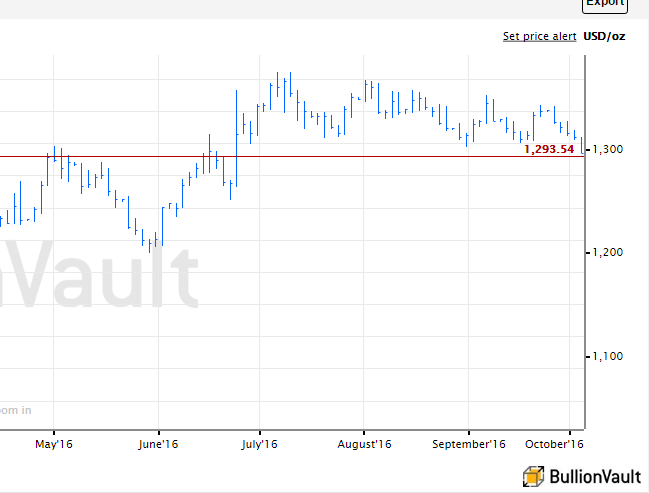
Gold Prices Break Below Summer 2016 Floor at $1300

GOLD PRICES fell below $1300 per ounce for the first time in 15 weeks in London Tuesday lunchtime, hitting their lowest level since late-June’s UK Brexit referendum as world stock markets rose with bond prices and commodities fell.
 
Silver fell with gold prices, but held 15 cents above its August low of $18.40 per ounce.
 
Having dissented from the 6-3 majority and voted for a September rate hike, US Federal Reserve member Loretta Mester yesterday affirmed her view that a second rise after last December’s “lift off” now looks “compelling”.
 
US jobs data for September are due from the private-sector ADP estimate tomorrow, and then from the Bureau of Labor Statistics on Friday. 
 
“Gold is closing in on pivotal support of $1307 [to] $1300,” said an earlier technical analysis from Stephanie Aymes’ team at French investment and bullion bank Societe Generale, staying bullish and forecasting a rise to $1352 or higher over the next 1-3 months.
 
“Gold continues to trade near the bottom of its range,” said a morning trading note from David Govett at London brokers Marex Spectron, pointing to “murmurings of Fed rate rises in December or even as soon as November.
 
“I would not be surprised if we break lower.”
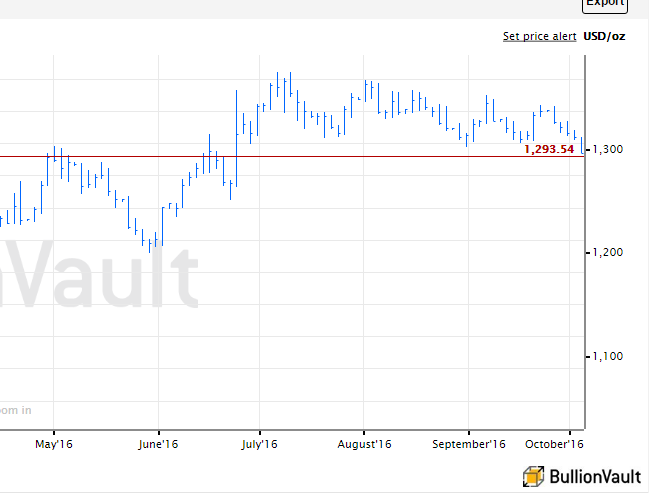
 
Gold prices break below 2016 floor at $1302 per ounce
 
With China closed all week for the National Day holidays, gold prices slipped overnight in Asian trade, dropping towards the summer’s floor near $1300 per ounce for the fifth time since the Brexit result saw the metal surge to 2- and 3-year highs against most major currencies.
 
Dollar gold prices then sank 1.1% inside 30 minutes as the start of US trading drew near.
 
Only the British Pound price of gold held above its summer 2016 floor, trading in the middle of its post-Brexit range, some 3.2% above August’s low.
 
“A financial environment characterized by low inflation and weak global growth will likely sustain accommodative central bank policy and historically low real yields, supporting the precious metals sector,” reckons a note from commodity analysts at troubled German financial services giant Deutsche Bank.
 
“While we expect the Fed to hike rates in December,” says a note from Swiss bank and bullion market maker UBS, “we continue to think US long-end real yields [after accounting for inflation] have room to fall further, supporting our positive gold view.”
 
“What ultimately matters for gold are real rather than nominal yields…[and] the market’s perception on whether the Fed is behind or ahead of the curve.”
 
“Central bank policy is driving markets and keeping asset prices high,” says Suzanne Hutchins of the UK’s Newton Real Return fund, “but this could all break down as it is stretching fiat currency to its limit.”
 
Hutchins now holds 11% of her clients’ £9 billion in gold-backed ETF trust funds and gold mining stocks. The fund currently shows a 16% gain from 2013 to outperform its ‘targeted absolute returns’ investment fund benchmark, but is dead-flat for both the last 1 and 3 months on data from TrustNet.
 
Bullion needed to back the number of shares outstanding in giant gold ETF product the SPDR Gold Trust (NYSEArca:GLD) held unchanged Monday at 947 tonnes, a 3-year high when reached the day immediately after the UK’s Brexit referendum decision on quitting the European Union.
Gold Prices Trade in Narrow Range while Markets Focus on Easing Deutsche Bank Fears and Pound Slumping Near 3-Decade Low

GOLD PRICES traded sideways on Monday morning in London, despite gaining equities and ebbed concerns about Deutsche Bank, writes Steffen Grosshauser at BullionVault.

The metal traded in a narrow range around $1316 per ounce, after it fell to a 1-week low of $1313 last Friday following news that Deutsche Bank was close to reaching a settlement with the US Department of Justice over a case related to the mis-selling of mortgage-backed securities business in the run-up to the 2008-9 financial crisis. 

The bank may now end up paying $5.4 billion to the US authorities, less than half of the initially $14 billion requested by the regulators, reported French news agency Agence France-Presse on Friday.

The news about the settlement raised optimism and risk appetite among investors and lead major equity benchmarks upward, after previous fears over an insolvency of Germany’s biggest bank sent jitters across international financial markets and drove the bank’s shares to a record low.

Gold was side-lining as “everything seems to have calmed down substantially including Deutsche Bank and OPEC production cuts,” said Jeffrey Halley, senior market analyst at Canadian-based currency data provider Oanda. 

“Gold had previously saw an underlying bid after the Deutsche Bank situation caused a sell-off in equities and risk-off sentiment,” noted Swiss refining and finance group MKS Group on Monday morning.

Deutsche Bank and its impact on investors’ sentiment is considered by analysts to remain one of the main drivers for the markets this week, as a changed sense of crisis is likely to affect the risk appetite and demand for considered more defensive assets such as gold.

“We see no major investor enthusiasm for gold and prices may have to ease to test the $1300-$1310 level before support materializes,” wrote analyst James Steel of bullion bank HSBC in a note. “Gold’s best near-term chance of a rally would more likely come from an oil surge or a deterioration of the financial situation in Europe,” added Steel. 

Silver followed gold, trading in a narrow range of $0.30 around last week’s close of $19.17 per ounce. Palladium was down 0.2% after reaching a 7-week high last Friday.

Speculative hedge funds and other non-industry players in Comex gold raised their net long positions for the first time in three weeks in the week to 27 September.

Holdings of the world’s largest gold-backed ETF, the SPDR Gold Trust (NYSEArca:GLD), fell 0.13% to 947.95 tonnes on Friday. 

The British Pound slipped against all of its 31 major peers after Britain’s Prime Minister Theresa May announced she would start the process of withdrawal from the European Union by the end of March 2017. The currency slumped 0.9% – the most in 2 weeks – and fell towards the 3-decade low that it reached in the days after the ‘Brexit’ referendum. The currency has already lost around 13% of its value against the US Dollar so far this year.

British shares were boosted by a weaker Sterling, as stocks of exporting UK companies rose, helping the UK’s FTSE 100 Index rise 0.9% to reach its highest level since June 2015.

Meanwhile, most other European stocks started the year’s last quarter little changed. Trading volumes were expected to be low, due to German markets being closed today and China celebrating the week-long National Day holiday.

“We’re getting a bit more clarity about the shape Brexit will take,” said Vasileios Gkionakis, head of global currency strategy at UniCredit Research. “A ‘hard Brexit’, which means more restricted access to the single market, seems to be increasingly the most likely scenario,” he said.

“Confirmation from the Prime Minister yesterday that Article 50 will be triggered by the end of March 2017 superficially provides some more clarity for investors on the timing of the Brexit process, but in practice not much has changed,” said Ian Williams, economist at stockbrokers Peel Hunt.

“The much discussed two-year negotiation period is a minimum, and there are many unpredictable political events scheduled across the rest of the EU during that period,” explained Williams.

Gold Prices Trade in Narrow Range while Markets Focus on Easing Deutsche Bank Fears and Pound Slumping to 3-Decade Low

GOLD PRICES traded sideways on Monday morning in London, despite gaining equities and ebbed concerns about Deutsche Bank, writes Steffen Grosshauser at BullionVault.

The metal traded in a narrow range around $1316 per ounce, after it fell to a 1-week low of $1313 last Friday following news that Deutsche Bank was close to reaching a settlement with the US Department of Justice over a case related to the mis-selling of mortgage-backed securities business in the run-up to the 2008-9 financial crisis. 

The bank may now end up paying $5.4 billion to the US authorities, less than half of the initially $14 billion requested by the regulators, reported French news agency Agence France-Presse on Friday.

The news about the settlement raised optimism and risk appetite among investors and lead major equity benchmarks upward, after previous fears over an insolvency of Germany’s biggest bank sent jitters across international financial markets and drove the bank’s shares to a record low.

Gold was side-lining as “everything seems to have calmed down substantially including Deutsche Bank and OPEC production cuts,” said Jeffrey Halley, senior market analyst at Canadian-based currency data provider Oanda. 

“Gold had previously saw an underlying bid after the Deutsche Bank situation caused a sell-off in equities and risk-off sentiment,” noted Swiss refining and finance group MKS Group on Monday morning.

Deutsche Bank and its impact on investors’ sentiment is considered by analysts to remain one of the main drivers for the markets this week, as a changed sense of crisis is likely to affect the risk appetite and demand for considered more defensive assets such as gold.

“We see no major investor enthusiasm for gold and prices may have to ease to test the $1300-$1310 level before support materializes,” wrote analyst James Steel of bullion bank HSBC in a note. “Gold’s best near-term chance of a rally would more likely come from an oil surge or a deterioration of the financial situation in Europe,” added Steel. 

Silver followed gold, trading in a narrow range of $0.30 around last week’s close of $19.17 per ounce. Palladium was down 0.2% after reaching a 7-week high last Friday.

Speculative hedge funds and other non-industry players in Comex gold raised their net long positions for the first time in three weeks in the week to 27 September.

Holdings of the world’s largest gold-backed ETF, the SPDR Gold Trust (NYSEArca:GLD), fell 0.13% to 947.95 tonnes on Friday. 

The British Pound slipped against all of its 31 major peers after Britain’s Prime Minister Theresa May announced she would start the process of withdrawal from the European Union by the end of March 2017. The currency slumped 0.9% – the most in 2 weeks – and fell towards the 3-decade low that it reached in the days after the ‘Brexit’ referendum. The currency has already lost around 13% of its value against the US Dollar so far this year.

British shares were boosted by a weaker Sterling, as stocks of exporting UK companies rose, helping the UK’s FTSE 100 Index rise 0.9% to reach its highest level since June 2015.

Meanwhile, most other European stocks started the year’s last quarter little changed. Trading volumes were expected to be low, due to German markets being closed today and China celebrating the   week-long National Day holiday.

“We’re getting a bit more clarity about the shape Brexit will take,” said Vasileios Gkionakis, head of global currency strategy at UniCredit Research. “A ‘hard Brexit’, which means more restricted access to the single market, seems to be increasingly the most likely scenario,” he said.

“Confirmation from the Prime Minister yesterday that Article 50 will be triggered by the end of March 2017 superficially provides some more clarity for investors on the timing of the Brexit process, but in practice not much has changed,” said Ian Williams, economist at stockbrokers Peel Hunt.

“The much discussed two-year negotiation period is a minimum, and there are many unpredictable political events scheduled across the rest of the EU during that period,” explained Williams.

Gold Bullion Halves Weekly Drop as Deutsche Bank Blames 'Rumors, Speculators', China Starts Holiday Week

GOLD BULLION halved the week’s earlier 1.4% losses Friday in London, rising to $1327 per ounce as the rout in Germany financial giant Deutsche Bank’s shares worsened, global stock markets fell back with commodity prices, and China began its week-long National Day holidays.
 
Deutsche Bank’s stock was already 40% down for 2016 before the US Department of Justice recommended a $14 billion settlement in mid-September over the sale of mortgage-backed derivatives.
 
DBK has since dropped another 20% to near all-time record lows.
 
CEO John Cryan today told staff that DBK’s stock has become the target of “rumors” and “hefty speculation” by traders.
 
The government of Pakistan meantime said it “completely rejected” India’s claim of “surgical strikes” made Wednesday against terrorists across their joint border, while New Delhi said it has evacuated some 10,000 people living near the disputed Line of Control in Kashmir.
 
Thursday’s 1% drop in US stockmarkets was followed by a 1.5% drop in European shares, pulling them down to 2.5% losses for the month of September as Deutsche Bank led the drop.
 
Gold priced in Euros held 1.1% higher from end-August meantime, rising sharply as the single currency fell on the FX market and regaining three-quarters of this week’s earlier 1.7% drop towards its post-Brexit floor beneth €1170 per ounce.
 
Chinese gold bullion quotes ended September 0.7% higher for the month in Yuan terms, fixing at Friday afternoon’s Shanghai benchmark with a premium over equivalent Dollar quotes in London of more than $5 per ounce – over twice the typical incentive to importers.
 
Financial markets in the world’s No.1 gold consumer and No.2 economy will now stay closed until Monday 10 October for the Golden Week holidays, starting with tomorrow’s National Day.
 
The government-backed China Travel Academy estimates tourism spending will rise 14% to reach a new Golden Week record of $72 billion.
 
Spending some $18.5bn on jewelry, bars and coins between January and July, households across China, Hong Kong and Taiwan bought 1 in every 5 ounces of gold sold worldwide during the first half of this year, according to data compiled for the World Gold Council.
 
“There was some good buying from the Chinese ahead of the holidays,” Reuters quotes Hong Kong traders Lee Cheong Gold Dealers, “and we need to see if this holds next week.”
 
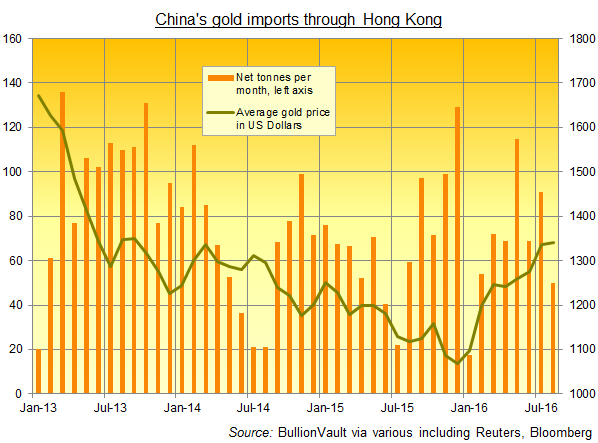
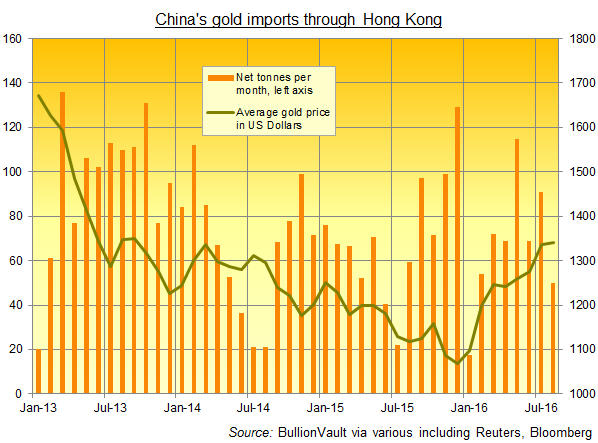
Gold bullion imports to China through Hong Kong – by far still the major point of entry according to a Chinese bank executive BullionVault spoke to this week – fell 45% in August from July, recording the lowest level since January according to analysts at Germany’s Commerzbank.
Chart of China's gold bullion imports through Hong Kong. Source: BullionVault
 
But “we don’t see this decline as particularly bearish,” says a note from Australia’s Macquarie Bank, analyzing China’s broader gold bullion imports data.
 
“Chinese gold imports tend to be weak when the price is high, and August saw the highest monthly average price for nearly three years.”
 
Mainland China’s manufacturing activity held flat again this month, the Caixin PMI survey said Friday morning.
 
Separate data from neighboring Japan meantime showed household spending in the world’s 3rd largest economy shrinking yet again in August, while the jobless rate ticked higher and consumer-price deflation accelerated to 0.5% per year.
 
Silver tracked and extended the rebound in gold bullion on Friday, recovering almost all of the week’s earlier 4% drop to trade at $19.64 per ounce.

Gold Prices Slip Despite India 'Surgical Strikes' in Pakistan as Oil Jumps on Opec Output Deal

GOLD PRICES slipped below $1320 per ounce for the third time in two days Thursday in London, trading 1.1% down for the week so far despite escalating tensions between nuclear powers India and Pakistan as world stock markets rose after the Opec nations meeting in Algiers agreed to curb the oil cartel’s annual output by some 2%.
 
Only India’s stockmarket bucked the rise in equities, closing 1.5% down at a 1-month low after New Delhi said a series of “surgical strikes” across the disputed Kashmir border with Pakistan had killed 38 terrorists and 2 Pakistani soldiers.
 
Islamabad disputed the claim, but said India had “deliberately escalated tension”.
 
Silver slipped towards $19.00 per ounce as gold prices fell.
 
“Yen slumps as investors shun havens following Opec accord,” said a headline on Bloomberg, as the Japanese currency fell to 1-week lows at ¥101.50 per Dollar.
 
Domestic Indian gold prices had earlier slipped following the Opec news according to data at Sify. The Rupee then fell to 1-week lows as Mumbai traders reported central-bank sales of Dollars to support the currency.
 
Wednesday, India pulled out of November’s upcoming South Asian Association for Regional Cooperation meeting – scheduled in Islamabad – after confronting Pakistan’s envoy to New Delhi with “proofs of cross-border origins” for September 18’s terrorist attack on Uri in Kashmir, which killed 18 Indian soldiers.
 
That followed India’s killing of militant separatist leader Burhan Wani in July.
 
As the start of US trading approached Thursday, crude oil trimmed its earlier 6% surge to $49 per barrel of Brent crude following news of the Opec deal.
 
“It’s nonsense,” commented former US Pentagon chief and now private-equity advisor David Petraeus overnight.
 
“Oil prices never should have gone up. The Saudis will continue to pump. So will the Iraqis and the Libyans if they can.”
 
Inflation in Germany’s consumer price index rose to 0.5% annualized in September, a 16-month high led by this month’s slowdown in energy price falls, new data said Thursday.
 
Ahead of next month’s key Diwali festival meantime, the Indian action “is negative for the economy” of the world’s second-heaviest gold consumer nation, said FX trading chief Ashtosh Raina at HDFC Bank in Mumbai.
 
“Any strike, any tension across the border is definitely going to hurt sentiment.”
 
“While India is no China,” said a new economic outlook from US bank Citi researchers this week, “[it] is becoming the third-largest oil consumer and importer of oil.
 
“As India’s base rises, so too should its global commodities’ impacts,” the report claims, saying that 8% annual GDP growth to 2021 will also support gold demand from the world’s second most populous nation.

Gold Bullion 'Vulnerable' Below $1335 as US Fed & Euro Interest-Rate Policies Challenged

GOLD BULLION held in a tight range Wednesday morning in London, trading $10 below the previous 3 sessions’ floor of $1335 per ounce as European stock markets rose and government bonds eased back ahead of a raft of central banker speeches, including Fed chair Janet Yellen testifying to US lawmakers on financial regulation.
 
European Central Bank chief Mario Draghi meets later today with German politicians, with allies of Berlin chancellor Merkel set to demand “clear answers on what monetary policy has achieved, apart from an expansion of joint liability in the Eurozone.”
 
Besides Yellen’s appearance on Capitol Hill, four other members of the FOMC are due to speak.
 
“It is getting harder and harder to justify [US] interest rates being so incredibly low given where the economy is and where it is going,” said San Francisco Federal Reserve Bank president John Williams in an interview Tuesday.
 
A non-voting member of the FOMC until 2017, “I would support an interest rate increase,” he said.
 
“[Gold price] momentum has declined,” says a technical analysis from market-maker Scotiabank’s Russell Browne, now “neutral as long as gold closes below $1335.”
 
That level – formerly offering “support” to gold bullion after last Wednesday’s no-change decision from the Fed – will now act as “resistance” says Scotia.
 
“Comments from the [Fed] and the central bank’s own forecasts effectively put markets on notice that a December rate hike is likely,” says the latest weekly analysis from Jonathan Butler at Japanese conglomerate Mitsubishi.
 
“[That] could weigh on bullion in the weeks ahead [but] gold will also be sensitive to economic and political uncertainty leading up to the US presidential election…and can be expected to live up to its traditional role as a risk hedge.”
 
“We have a lot of political risk in the market right now,” US investment bank and London bullion market maker Goldman Sachs’ chief commodity analyst told CNBC overnight, “so gold has a strategic purpose.
 
“Gold is a hedge against politicians.”
 
“Gold will remain one of the major beneficiaries in the current backdrop,” agrees Societe Generale’s Robin Bhar, contrasting precious metals with base metals – now prey to China’s slowing economy – in his latest outlook for the French investment and bullion market-making bank.
 
“Heightened volatility and lingering uncertainty will keep investors’ risk appetite in check…[but] the elevated level of long speculative positions indicates that gold remains in a highly vulnerable state.”
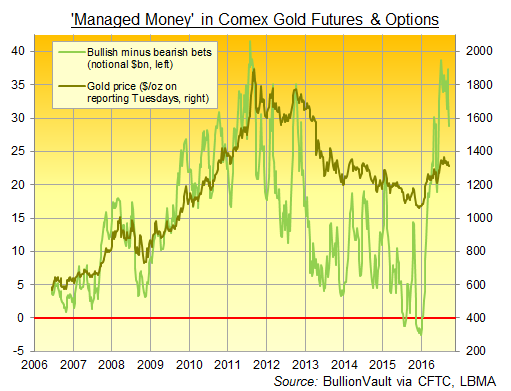
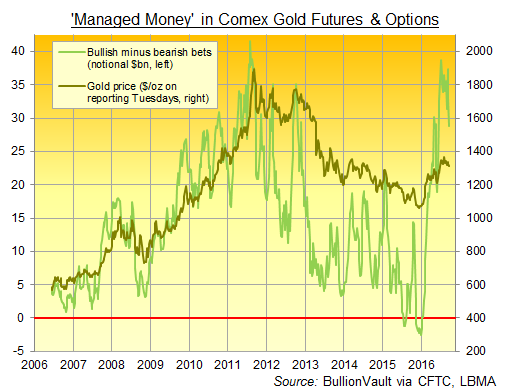
Chart of Managed Money net long in gold futures & options, notional Dollar value. Source: BullionVault via CFTC
 
Latest data say speculative interest in Comex gold futures and options fell hard before the Fed’s non-decision last Wednesday, taking the drop from July’s near-record high to more than 25% net of bearish bets amongst that group.
 
By value however, net speculative long positions remained twice as large as the last decade’s average.
 
“Even slight improvement in investors’ enthusiasm [for stocks and higher-risk bonds] could trigger massive long liquidation and reverse gold’s impressive gains,” says Bhar.
 
Commodity prices steadied on Wednesday, with US crude oil above $45 per barrel as producer cartel Opec’s meeting in Algiers to discuss an output cap entered its third day.
 
Silver bullion steadied at $19.15 per ounce, having fallen harder than gold on Tuesday, dropping to 1-week lows some 3.5% below last Friday’s finish.

Gold Mining 'Needs New Discoveries' as M&A Rejected on Bad Memories, 2016 Price Jump

GOLD MINING stocks slipped Tuesday morning in London and bullion dropped to 3-session lows beneath $1333 per ounce as media pundits declared Hillary Clinton the winner of last night’s US presidential debate with Donald Trump.
 
Gold prices in China – the world’s No.1 gold mining, importing and consumer market – held firm overnight, fixing at the Shanghai Gold Exchange little changed from before the weekend, but edging down to a $2.85 per ounce premium above comparable Dollar quotes for metal settled in London.
 
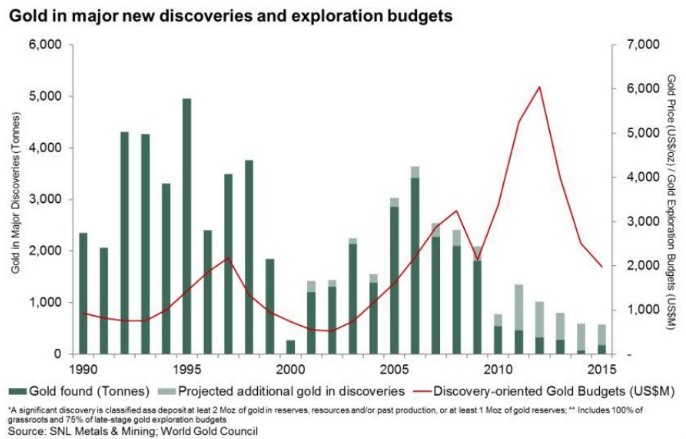
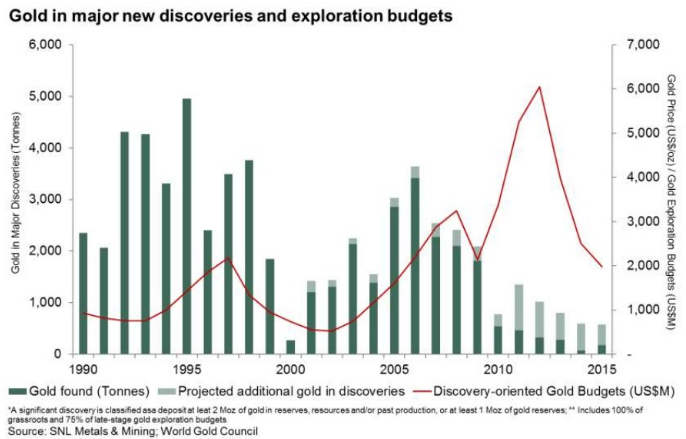
“To keep the gold industry supplied we need to discover 90 million ounces a year,” said gold mining CEO Mark Bristow of Randgold Resources (LON:RRS) to journalists in Johannesberg yesterday, “[but] we are only discovering 10 million to 15 million ounces a year.
 
“We either have to discover more quality ounces or reduce the life of mines.”
 
Chart of global gold-mining discoveries vs exploration spending 1990-2015 from John Mulligan at World Gold Council
 
Delegates to the mining-focused Denver Gold Forum last week agreed that the industry is looking for “organic growth”, rather than repeating the mergers and acquisitions boom of the bull market ending 2011.
 
“That was a failed experiment,” news-wire Reuters quotes Kelvin Dushnisky, president of world No.1 gold mining firm Barrick (NYSE:ABX), saying the miner wants “value over volume” after the huge debts saw big write-downs as last decade’s M&A boom met the gold price’s steep fall from 2012-2015.
 
M&A deals have slowed hard in 2016 as gold mining stocks have soared in price, rallying 190% from January’s near-record lows to July’s 3-year high, but remaining well over 50% below the sector’s 2011 peak on the PHLX Gold/Silver index (INDEXNASDAQ:XAU).
 
The sector has retreated 15% on the XAU index as gold bullion has slipped 3% from the post-Brexit high of $1375 per ounce.
 
Work at Barrick’s Veladero site in Argentina – its 3rd largest producing project – has meantime been suspended this month following a chemicals spill.
 
A similar spill last year saw Veladero “blockaded by locals” reports long-time analyst Lawrie Williams.
 
Explaining why Randgold walked away from a joint-venture with AngloGold Ashanti (JSE:ANG) to develop the Obuasi project just 3 months after it was first announced, “We were very concerned about illegal mining and the lack of government support to deal with [it],” said CEO Bristow on Monday.
 
“We have made many attempts to invest in Ghana, but we were rattled by the political interference. The social risks was enormous.”
 
Last December’s decision showed how “Randgold remains financially disciplined,” said analysts at South African-based investment bank Investec, “but a negative is that medium-term growth options remain lacking.”

Gold Prices 'Supported' by Trump-Clinton Debate as Deutsche Bank Sinks, China Risks Grow

GOLD PRICES edged lower on Monday morning in London, while the Dollar reduced earlier losses but world stockmarkets fell hard ahead of tonight’s US presidential debate between the Democrats’ Hillary Clinton and Republican candidate Donald Trump, writes Steffen Grosshauser at BullionVault.
 
Shares in Deutsche Bank touched new quarter-century lows after a weekend magazine report that Berlin’s Chancellor Merkel has ruled out any rescue for the German financial giant, now facing a $14 billion fine from US regulators.
 
Former IMF and now Harvard economist Kenneth Rogoff meantime warned that slowing Chinese growth poses the greatest threat to global financial stability.
 
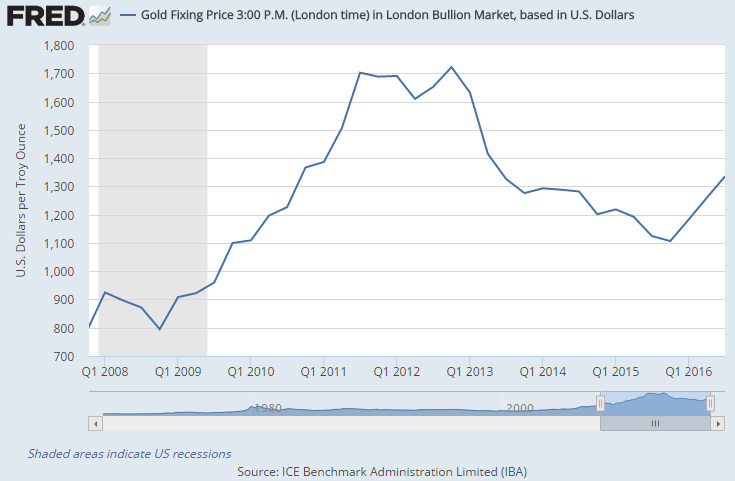
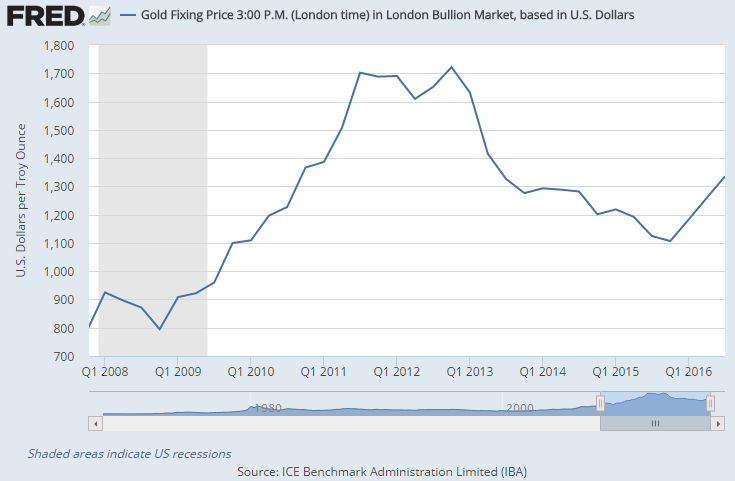
Slipping from Friday’s close of $1337 per ounce after its biggest weekly gain in two months, gold prices traded in an $8 range, but were still set for a third quarterly advance in succession – the longest rally since 2011 when prices reached a record high of $1900 per ounce.
 
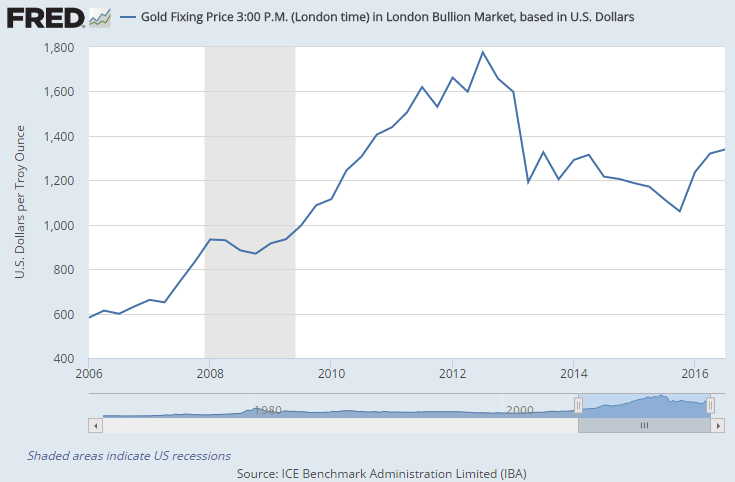
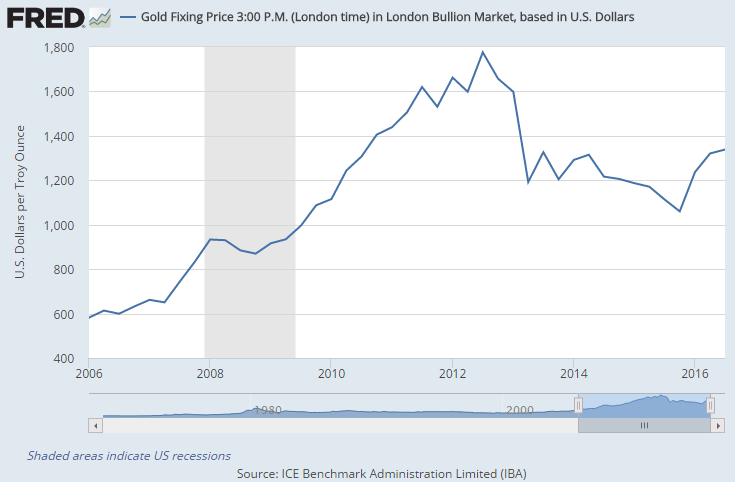
Chart of US Dollar gold price, quarter end, 2006-2016
 
The first of three televised debates between US presidential contenders Trump and Clinton will take place on Monday evening local time and could be one of the most-watched events in US TV history. 
 
“If Trump is perceived to have an improved probability of winning the Presidential race, that is likely to be supportive of gold prices,” says a note from National Australia Bank’s analyst Vyanne Lai.
 
“Generally Trump’s presidential candidacy is associated with more extreme policy measures and more volatility in the geopolitical landscapes.”
 
“Polls have started to tighten ahead of the US presidential election,” says US financial giant Citigroup, forecasting a rise to $1425 per ounce should Trump win.
 
Meantime Monday, “we expect gold to continue to hold its recent $1330-1340 range in the lead up to the presidential debate,” said Swiss refiner MKS Pamp overnight in Asian trade.
 
Silver tracked gold prices, extending the loss to 0.8% to $19.45 after it already lost almost 1% on Friday.
 
Both platinum and palladium also fell around 1%. Base metals also dropped 0.5% on average.
 
European and Asian shares fell hard as Deutsche Bank sank, but crude oil rebounded 0.6% to around $47 per barrel as major oil producers in the Opec cartel met in Algiers to discuss output reductions.

Gold Bullion 'Testing Downtrend' as Fiscal Deficits, Money Printing Urged by Pundits, Asset-Fund Chief

GOLD BULLION dropped $10 per ounce from yesterday’s 2-week highs on Friday in London, falling to $1333 per ounce before turning higher as global stock markets fell but bond prices rose following this week’s “no change” decision on US rates from the Federal Reserve and the Bank of Japan’s switch to unlimited QE monetary stimulus.
 
Silver cut its weekly gain to 5.4% after nearing 1-month highs above $20 per ounce on Thursday.
 
Adding 1.8% from last Friday’s finish, gold bullion held bang in the middle of its post-Brexit range between $1302 and $1375 as New York trading began.
 
“Central banks have been doing their best to pep up [global economic] demand,” says The Economist magazine’s lead editorial.
 
“Now they need help…the most urgent priority is to enlist fiscal policy. The main tool for fighting recessions has to shift from central banks to governments.”
 
“Austerity is causing too much pain,” wrote veteran financial journalist and columnist Anthony Hilton in last night’s London Evening Standard.
 
“The only way we…the US, as well as Europe, can hope to revive demand and stimulate growth is for the Government to show leadership in building more roads, houses, airports and rolling out high- speed broadband – investing in infrastructure – even if it has to borrow or print the money to do so.”
 
“If whoever wins the [US] presidency focuses more on fiscal policy,” says Laurence Fink, CEO of giant asset-management group Blackrock – forecasting a possible 15% drop in stock values without it – “you could find ways of re-igniting the economic conditions of the world, which will help the capital markets.”
 
Looking at US Dollar gold prices, “The rally has packed a lot of punch in the last couple of days, and the market may need to consolidate,” say a note from investment and London bullion clearing bank HSBC’s precious metals team.
 
But HSBC sees “no compelling reason to change” its outlook for no further Fed rate hikes this year, with only 1 rise in 2017.
 
“This scenario gives gold more room to the upside.”
 
Touching $1343 per ounce at Thursday’s high, gold was “testing a downward trend line from July forming on the daily chart” says technical analysis from London bullion market maker and clearing bank ICBC Standard Bank.
 
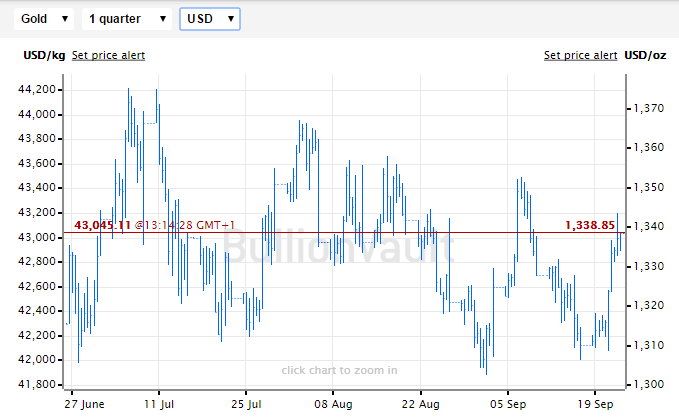
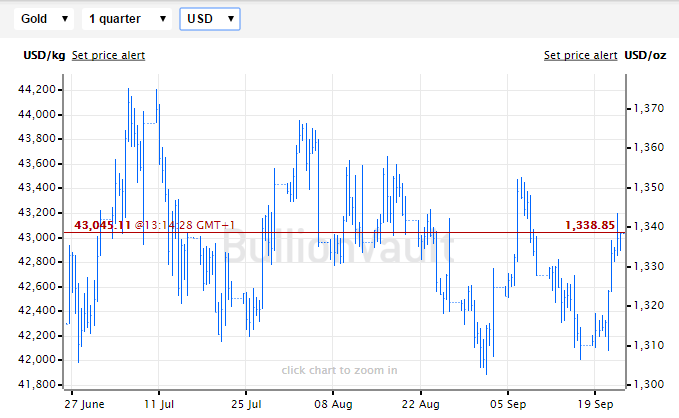
Chart of US Dollar gold bullion price, summer 2016
 
Gold bullion meantime headed for a 1.6% weekly rise against the Euro, a 2.4% rise versus the Pound Sterling, and a 1% gain in Canadian Dollar and Swiss Franc terms.
 
The Japanese Yen however held the metal just 0.7% higher from last Friday’s finish, as the currency continued to defy the Bank of Japan’s active new inflation policy – announced Wednesday – at an exchange rate of fewer than ¥101 per US Dollar.
 
Vowing to keep creating new money to buy government bonds and other assets without limit, the BoJ already owns one-third of Tokyo’s record government debt – now on track to reach 250% of the country’s economic output in 2015.

Gold Price Heads for Another $75 Quarterly Gain as Fed Holds Rates, UN Warns of 'Crisis Part 3'

GOLD PRICES held near 2-week highs in London on Thursday, trading at $1335 per ounce as world stock markets rose sharply following the US Federal Reserve’s “no change” decision on interest rates but a new United Nations report warned of a “third phase” in the global financial crisis, with a crash in emerging markets threatening to follow the Eurozone debt crisis of five years ago and the banking crash of 2008.
 
Commodities gained for a sixth session running while silver extended the move in gold prices, spiking within 2 cents per ounce of $20 – a two-year high when first reached in July.
 
Government bond prices also rose across the board, pushing 10-year US Treasury yields down to 2-week lows at 1.64% and dropping benchmark Brazilian debt yields to just over 12% per annum.
 
“Gold will really be interesting when people stop asking what the Fed is going to do, and begin asking, who is the Fed and what can they know?” said Jim Grant of the Grant’s Interest Rate Observer newsletter to CNBC overnight.
 
Recommending a “reduction of risk profile” in client portfolios for the coming 3 months, French investment bank and bullion market maker Societe Generale maintains its fourth-quarter average gold price forecast of $1350 per ounce, predicting a rise to $1375 in Q1 2017.
 
Each calendar quarter of 2016 has so far added $75 to the average gold price, by far the most consistent rate of change on modern records.
 
A repeat in Q4 would take the next 3 months’ average price to $1411.
 
Chart of quarterly average gold price
 
“We see scope for contagion [across emerging-market currencies] should Mr.Trump prevail” in November’s US presidential election says SocGen’s note, advising clients to buy the VIX volatility index to anticipate wilder swings in US stockmarkets.
 
“While the current [global financial] situation seems less ominous than in 2008, it is proving more difficult to manage,” says the United Nations’ new Trade & Development 2016 report, warning that failing growth in many developing countries “now [poses] a real danger of a third phase of the financial crisis which began in the United States housing market in late 2007 before spreading to the European sovereign bond market.”
 
Corporate debt in emerging economies now exceeds $25 trillion, says the UNCTAD report, and “Damaging deflationary spirals cannot be ruled out,” especially amongst commodity producer nations faced with continued falls in natural resources’ prices.
 
Giant Chinese bank ICBC is cutting the base metals team at its ICBC Standard Bank division, Reuters reports, part of an “ongoing cost-cutting” drive according to sources.
 
The Opec oil-producers’ cartel “could be ready” meantime to agree a cap on output to try and raise prices when it meets next week in Algiers, says the Iraqi delegation’s head negotiator.
 
Beijing has summoned key coal-mining chiefs to a sudden meeting Friday in a bid to address China’s supply problems – apparently caused by the government’s crackdown on inefficient output – which have pushed the price of coking coal needed by the steel industry more than 110% higher since July.