Author Archives: City Gold Bullion

Gold Bars Hit $33 Premium in Shanghai Before US Fed Vote, Traders 'Expect Rally'

GOLD BARS in London’s wholesale market held around $1160 per ounce in quiet trade Wednesday, rising back to last Friday’s 44-week closing low ahead of what analysts expect to prive “a fairly anticlimactic” US Fed decision to raise Dollar interest rates.
 
Entering 2016 with its first hike after 7 years at zero, the Federal Reserve’s policy committee forecast 4 rises this year, delaying until today a 0.25 percentage point hike to a ceiling of 0.75% on the Fed Funds rate.
 
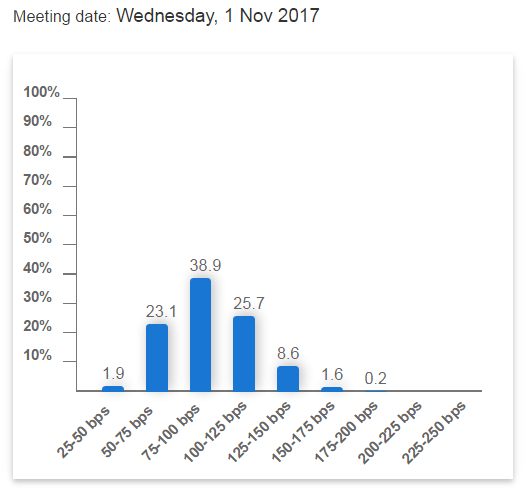
The chances of a further delay with a “no change” decision today have jumped from less than 5% to almost twice as much in the last week, according to the CME’s FedWatch tool tracking bets on US interest-rate futures.
 
Almost two-thirds of bets on November 2017 rates see only 1 further hike after today, if at all.
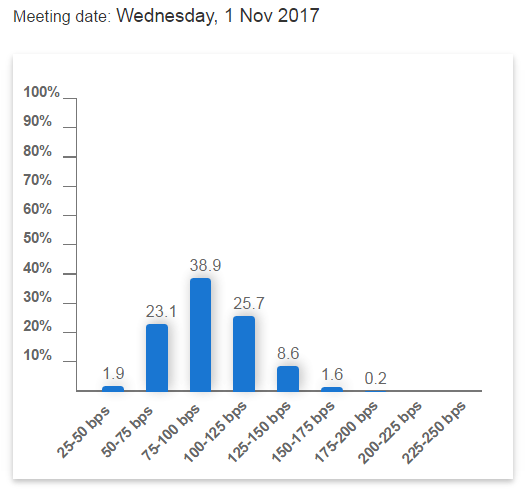
Chart from the CME of positioning in Fed Funds futures contracts
 
“Persistent offers apparent above $1160 leading into the FOMC decision today,” says Alex Thorndike, senior precious metals trader for Swiss-based gold bar refiner and finance group MKS in a note.
 
“[But] having a chat with a few traders over the past week, many are expecting a re-run of last year – a lurch lower after [the Fed announcement] but then a rebound in the weeks following.
 
“If for any reason however the Fed stays their hand and leaves rates on hold…there would be a sharp rally for gold with an immediate test of $1200 likely.”
 
“The reality is,” Bloomberg meantime quotes Robin Bhar, analyst at French investment bank and bullion bar market-maker Societe Generale, “the Fed’s expected hike should be pretty much priced in.”
 
Beyond that in 2017, “Yellen’s hands are tied and will be until there’s more policy certainty from incoming president [Donald Trump].” 
 
US Treasury debt ticked higher in price again early Wednesday, nudging yields down once more from last week’s 18-month highs.
 
“Amid the surge in US and European bond yields,” says Bhar’s colleague at SocGen, macro-strategist Albert Edwards, “my attention is drawn to…the Bank of Japan’s revamped monetary policy.”
 
Now targeting a zero yield on 10-year Japanese government bonds, “The BoJ will have to work very hard indeed if, as seems likely, US 10-year yields continue to drift up to 3%.
 
“The printing presses will go into overdrive and the Yen will plunge, both against the Dollar and against the Euro,” predicts Edwards, reminding clients that the last time this happened, “Yen weakness dragged down the whole Asian currency complex and ultimately forced the Chinese to devalue.”
 
Shanghai gold bars today set new 3-year highs above London prices, with the premium for wholesale bullion landed in China breaking the equivalent of $33 per ounce at the city’s afternoon benchmarking auction as reports continue to say Beijing is restricting the number of import licenses it issues ahead of the key New Year festive season, aiming to curb outflows of capital and stem weakness in the Yuan currency.
 
“This year’s softness in [China’s] physical demand – particularly in the jewelry segment – could extend” into 2017 says a note from major global shipper, Swiss bank UBS. Against that however, its analysts also point to “macro uncertainty and currency volatility [with] a backdrop of relatively limited investment alternatives” for households in the world’s No.1 gold consumer nation.
 
Gold No.2 consumer nation India is meantime showing a slight return of gold demand after the shock demonetisation of its largest banknotes, says German financial giant Commerzbank’s commodities analysts.
 
But “it is doubtful whether this will immediately result in higher gold imports given that jewellery manufacturers are still likely to have large quantities of gold in stock following the high gold imports in October and November and the collapse in gold demand in recent weeks.”
Gold Prices Steady as Bond Yields Retreat, UK Inflation Rises, Ahead of US Fed Rate Decision

GOLD PRICES held $10 per ounce above yesterday’s new 10-month low in London on Tuesday, trading at $1162 as bond prices ticked higher, nudging US Treasury yields down from fresh 18-month highs ahead of tomorrow’s Federal Reserve decision on interest rates.
 
New data late Monday showed the US federal deficit tripling in November from October’s shortfall between receipts and spending.
 
Fiscal year 2016 already showed a 34% jump from 2015, according to the New York Times, with current plans – before Donald Trump’s tax-cutting and infrastructure promises – set to add an extra $8.6 trillion to Washington’s outstanding debts over the next decade on Congressional Budget Office forecasts.
 
A rebound in the Chinese Yuan today pushed Shanghai gold premiums to fresh 3-year highs at $32 per ounce above London quotes, after new figures said China’s retail sales and industrial output both rose faster than expected in November.
 
Consumer-price inflation in Germany and Spain both read zero from a month before according to their national statistics agencies, lagging analysts’ forecasts for a rise in the cost of living.
 
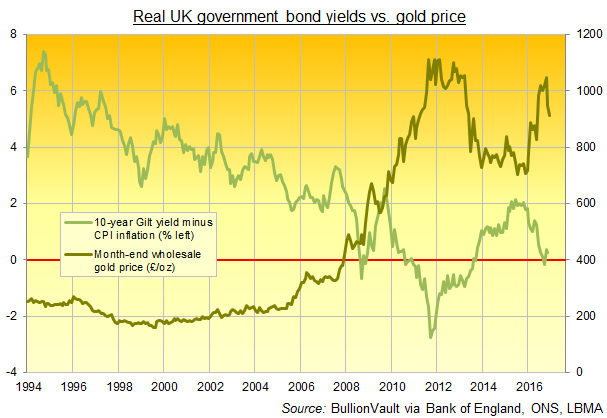
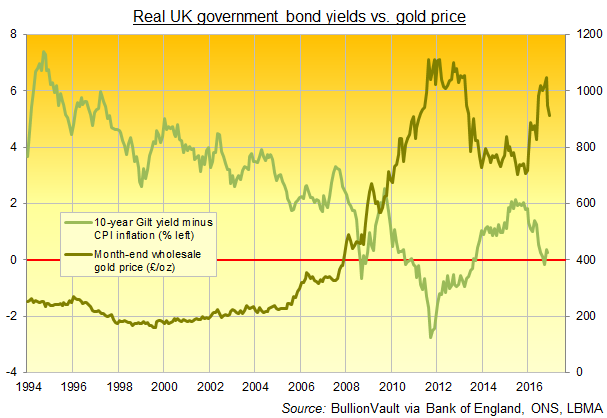
With the British Pound falling to 3-decade lows after the Brexit referendum vote however, new UK data in contrast today showed consumer prices rising 0.2% per month for a 1.2% rise in the year-ending November, the fastest annual pace since October 2014.
 
Back then, 10-year government bonds offered 2.28% annually to investors.
 
Gilts maturing in 10 years’ time today offered 1.42% per annum, cutting the real yield offered to new buyers to barely 0.2%  after last month’s CPI inflation.
Chart of real UK government Gilt yields (after CPI inflation) vs. Sterling gold price. Source: BullionVault
 
“Recent gold weakness coincides with nominal [US bond] yields at the year’s highs,” says a note from Swiss investment and bullion bank UBS ahead of Wednesday’s near-certain Fed rate hike.
 
“Real yields [are] also creeping higher while US equities hold at record levels.
 
“[But] ultimately, we think that gold around these levels offers long-term value and would expect any further moves south to start attracting strategic investment interest.”
 
The giant SPDR Gold Trust (NYSEArca:GLD) shrank again Monday, with shareholders liquidating GLD stock for the 19th in 25 sessions – the worst run since Spring 2013 saw the worst quarterly drop in Dollar gold prices on record.
 
US stock market futures pointed higher ahead of Tuesday’s opening, while large-cap Eurozone equities rose for the 7th session running.
 
Gold priced in the single Euro currency today rallied back to €1093 per ounce, some €15 above last week’s new 8-month low.
 
Gold prices for UK investors tested last week’s post-Brexit low of £910 per ounce, down 15% from July’s 3-year highs.
 
Brent crude oil meantime neared 18-month highs at $56 per barrel, despite estimates that individual member states in the Opec cartel have ramped up production ahead of January’s cut in agreed quotas, aimed at boosting prices by cutting supply.
 
Silver rallied from a brief dip back below $17 per ounce, outperforming the gold price once more.

China's Gold Market Premium Hits $31 as London Price Hits New 10-Month Low on Comex, ETF Sell-Off, India Frozen

GOLD MARKET losses to new 10-month lows against the Dollar at $1151 were reversed Monday afternoon in London, with prices rallying $10 per ounce as a drop in China’s stockmarkets saw Western equities hold flat overall.
 
Asian gold markets had earlier seen the metal break below what technical analysts called “support” at last week‘s double-low of $1157 per ounce.
 
Silver held firmer overnight, jumping over half-a-dollar to near last Wednesday’s 3-week high above $17.20 per ounce.
 
The giant SPDR Gold Trust (NYSEArca:GLD) shrank in size every day last week as shareholders liquidated their positions, retreating by almost 100 tonnes since Donald Trump’s victory in the US presidential election.
 
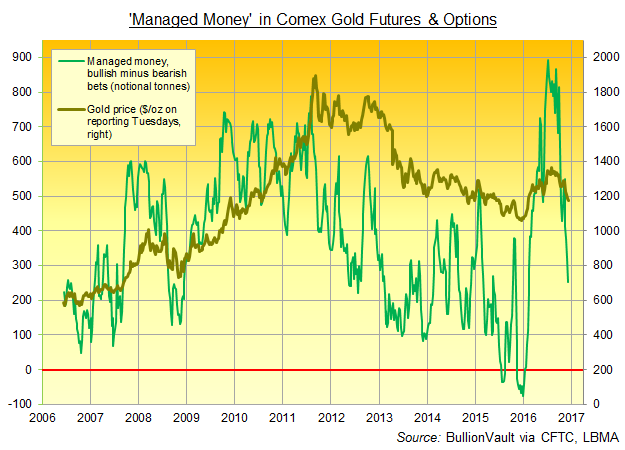
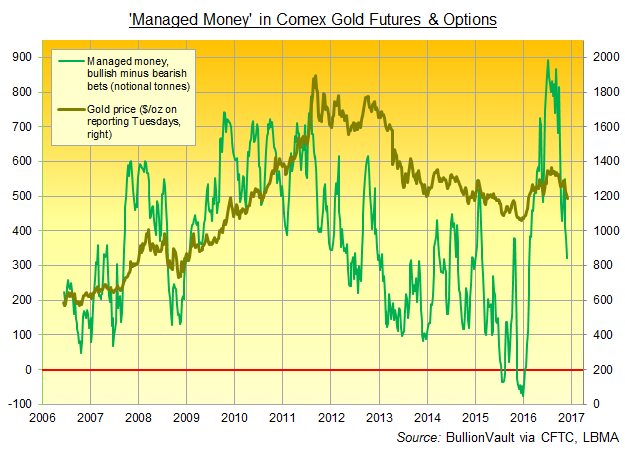
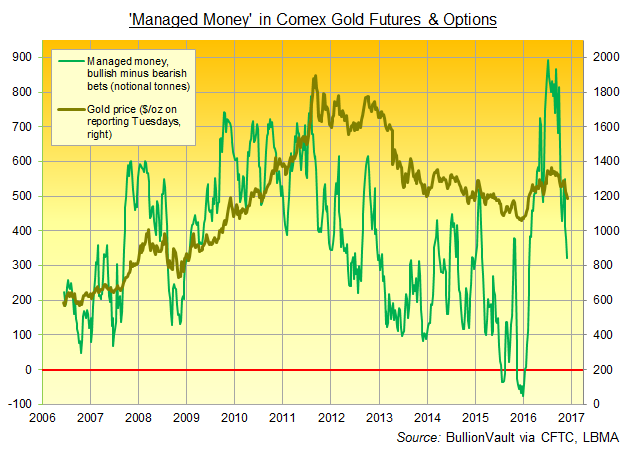
The so-called ‘Managed Money’ category of traders in Comex gold futures and options  last week cut their bullish bets back to the 10-year average, but raised their bearish bets that gold market prices will fall to the highest level since start-February, well over twice the last decade’s average level.
 
Net-net, that saw their “net speculative long” in Comex market futures and options drop for the 4th week running, falling below the 10-year average after holding above for 40 weeks in succession.
Chart of Managed Money net spec long in Comex gold futures and options. Source: CFTC
“Daily indicators are close to a floor,” says a note from the chart analysts at French investment bank and bullion market makers Societe Generale. “However signs of rebound are still awaited.”
 
“With an interest-rate increase a near certainty,” says a note from Swiss refining and finance group MKS’s trading desk, “the risk continues to build to the topside and we look toward $1150 to restrict further downside moves.”
 
For now however, “Early interest out of Shanghai supported gold around $1155 during Asian trade,” the note from MKS says, “[but] the continued elevated premium against loco-London gold once again [provided] underlying support, rather than…a distinctive bid for the metal.”
 
Shanghai gold market prices today slipped 0.6% against the Yuan at the city’s benchmarking price auction, but global quotes for London settlement meantime traded over 1% in Dollar terms.
 
That drove the Chinese premium, for metal already landed in Shanghai, to almost $31 per ounce above the international standard of London settlement – the highest level since October 2013, when falling gold prices met strong demand from what is now the world’s No.1 consumer.
 
Today in contrast, this Chinese gold market premium is the result of tighter supply – not demand – says analyst Jonathan Butler at Japanese conglomerate Mitsubishi, pointing to how China’s worsening capital outflows have seen Beijing impose new exchange controls, reducing the number of gold import licenses issued.
 
“Calling the bottom of the gold market is proving challenging,” Butler writes in his latest weekly note, “since the traditionally gold-supportive factor of physical demand in India [is also] largely absent at present.”
 
India’s shock demonetisation of its largest banknotes – worth 86% of all currency in circulation, and aimed at forcing black market and undeclared cash holdings into regulated, taxable bank accounts – may knock up to 2 percentage points off its world-beating GDP growth, last seen at 7.7% between July and October.
 
Tax authorities in the world’s No.2 consumer gold market have meantime compiled a list of bullion dealers and jewelers they believe made “suspicious” sales following the ban, accounting them before the deadline and also failing to collect customers’ individual tax account numbers.
 
Axis Bank – India’s third-biggest private sector lender, and its No.1 gold importer – said at the weekend it has frozen the deposit accounts of several jewelers and gold dealers after suspending 19 employees over accusations of helping to launder ‘black money’ acquired illegally beyond the demonetisation deadline.
 
Central bank the Reserve Bank of India took the unusual step Monday of formally denying rumors that Axis faces losing its banking license over the allegations.
 
The government of Venezuela today announced the cancellation and replacement of its largest banknotes – already worth less than US$0.02 each – in what Caracas called an attack on ‘mafia hoarding’ but which analysts had expected amid the Socialist Latin American state’s 1,500% annual inflation rate.

China Curbs Gold Buying as US Stocks & Dollar Rise Before Fed

PRICES to buy gold in London’s wholesale market headed for a 1% weekly drop Friday, slipping to $1166 per ounce as the US Dollar extended its gains following Donald Trump’s US presidential victory, denting currencies worldwide including China’s Yuan ahead of next week’s Federal Reserve decision on interest rates.
 
US stockmarkets rose further from yesterday’s new all-time highs, while commodity prices also gained and bond prices slipped – nudging longer-term interest rates higher.
 
Silver prices held above $17 per ounce, adding 1.7% from last Friday for US Dollar buyers.
 
The Fed is almost certain to raise its key Dollar interest rate ceiling to 0.75% next Wednesday according to futures market bets.
 
Despite the falling Yuan – now down near 8.5-year lows to the Dollar – Chinese premiums to buy gold, over and above London prices, held at $29 per ounce at Friday afternoon’s Shanghai Gold Fix.
 
That was just shy of last month’s 3-year highs, as traders continue to report a cut in the number of import licenses issued by the authorities, apparently seeking to stem outflows of capital to buy gold, and help halt the Yuan currency’s extended decline.
 
Indian prices in contrast remain at a $5 discount to London, Reuters reports, as demand to buy gold in the former No.1 consumer nation continues to sag amid the national cashflow crisis sparked by the Modi administration’s shock demonetisation of the country’s largest banknotes 4 weeks ago.
 
“Everything’s against gold at the moment,” says a Bloomberg story, noting the metal’s “fifth consecutive weekly loss, the longest run since November 2015, as the Federal Reserve gears up to raise rates.”
 
Western money managers continued to quit gold positions this week, with the giant SPDR Gold Trust (NYSEArca:GLD) now shrinking on 17 of the 21 trading days since Donald Trump won the US election.
 
That’s the worst run of GLD shareholder liquidation since the 32 out of 35 trading-day outflows ending 28 May 2013 – midway through gold’s sharpest ever quarterly price drop.
 
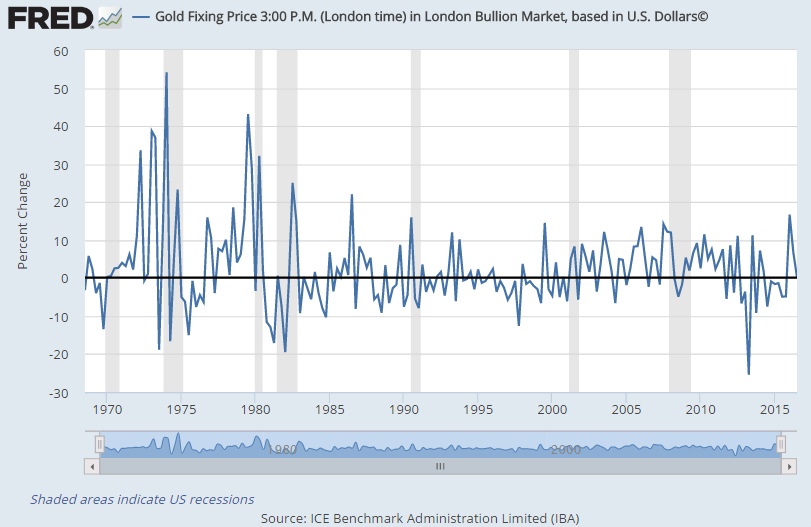
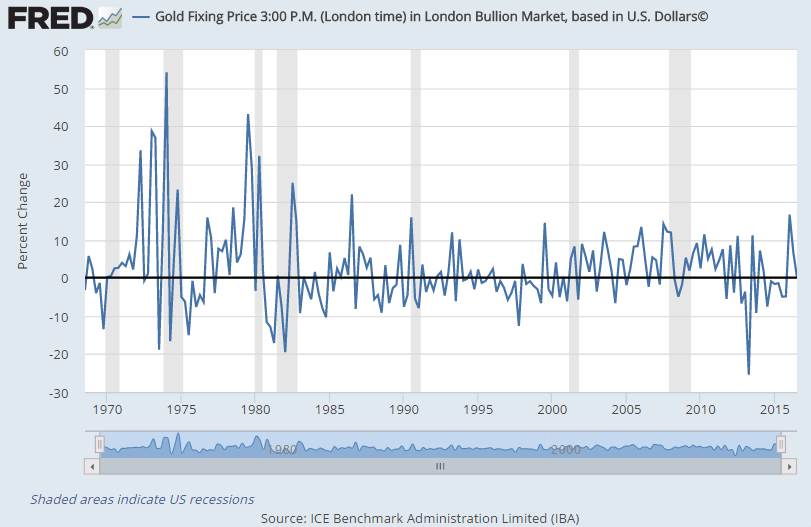
Currently losing 11.6% for Q4 2016, gold prices today headed for their 10th worst quarterly drop of the modern period.
 
Starting from last December’s 6-year low following the Fed’s first rate hike from zero, the opening 3 months of 2016 saw the strongest quarterly gain since 1986 at 16.7%.
 
Chart of gold's quarterly percentage price change (London PM benchmark)
 
“With the US Fed most likely to raise interest rates next week by 25 basis points, the firmer Dollar is a very, very strong factor to limit any rally,” reckons Barnabas Gan, economist in Singapore for Oversea-Chinese Banking Corp, and apparently closest to calling Q3’s zero per cent change in gold prices amongst analysts polled by the Bloomberg news-wire.
 
Price to buy gold with Dollars will hold around current levels in early 2017, Gan predicts, but lose $25 per quarter to end next year back at $1100.
 
Gold priced in Euros meantime held yesterday’s rise back above €1100 per ounce on Friday, unchanged for the week as the single currency fell following the European Central Bank’s decision to extend quantitative easing right through 2017.
 
Rallying 2.5% from Monday’s drop to 8-month lows to stand 14% higher from New Year, the gold price in Euros has now halved its 2016 gains compared to July’s peak at €1244 per ounce.
 
Back in China, and after restricting Dollar purchases as early as January 2016, both state-owned and private commercial banks are now offering bonus rates to customers selling US Dollars for Yuan and charging higher fees to Yuan sellers.
 
Chinese airlines have cut their Dollar-denominated loans – needed to buy foreign-made aircraft – switching to Yuan bonds or other currencies, Air Transport World reports.
 
Some foreign companies are meantime being blocked from remitting dividends abroad according to the Financial Times.
 
Now the world’s No.1 mining, central-bank buying, and consuming nation, China saw its notionally Communist government actively encourage private demand to buy gold as prices slipped from their all-time record highs 5 years ago.
 
China’s demand to buy gold bullion will next peak in January as the key Chinese New Year holidays approach.

2017 Looking 'Friendly' for Gold Prices on Trump's Threat to US Credit Rating as ECB Extends But Cuts Euro QE

GOLD PRICES fell back 0.7% after reclaiming last week’s closing level versus the Dollar once again in London lunchtime Thursday, dropping to $1170 per ounce as the US currency continued its post-Trump victory gains amid a surprise change in policy from the European Central Bank.
 
Central bank for the 19-nation Euro currency zone, the ECB left its key interest rates unchanged – including the 0.4% per year now charged, rather than paid, on commercial banks’ deposits with the Frankfurt-based authority – and extended its QE program from the previous March 2017 deadline as expected.
 
But now looking to December 2017 “or beyond as necessary”, the ECB will only create and spend €60 billion of new money per month, down from €80bn at present.
 
“Is that taper or not?” asked puzzled analysts, referring to the US Federal Reserve’s 2014 reduction of monthly QE creation and spending.
 
Looking at January’s inauguration of new US president Donald Trump meantime, “Exuberance will last into the first weeks of the new administration,” forecasts a new analysis from commodities and bullion market-maker ICBC Standard Bank today, “but expect animal spirits to run out of gas by mid-year.
 
“Fresh credit ratings agency concern is a possibility that is not yet being discussed,” it says, noting that “some Trump campaign proposals resemble the Bush-era tax bills – widespread personal rate and corporate tax cuts.
 
“Anticipation of reflationary fiscal measures may keep gold under pressure in Q1 but the debt ceiling and budget deficit will dominate headlines by H2 – that will recreate a gold-friendly environment.”
 
Arguments over raising the US government’s legal ‘debt ceiling’ limit on total borrowing saw Washington’s credit status downgraded from the top AAA rating for the first time in 70 years in August 2011, coinciding with gold’s surge to its current all-time record high above $1900 per ounce.
 
US federal debt was then revised up from “negative” to “stable” at one notch below triple-A by both the S&P and Moody’s ratings agencies in June 2013 – just as gold completed its worst quarterly price drop in 3 decades – and upgraded back to “AAA stable” by analysts at both Fitch and DBRS in spring 2014.
 
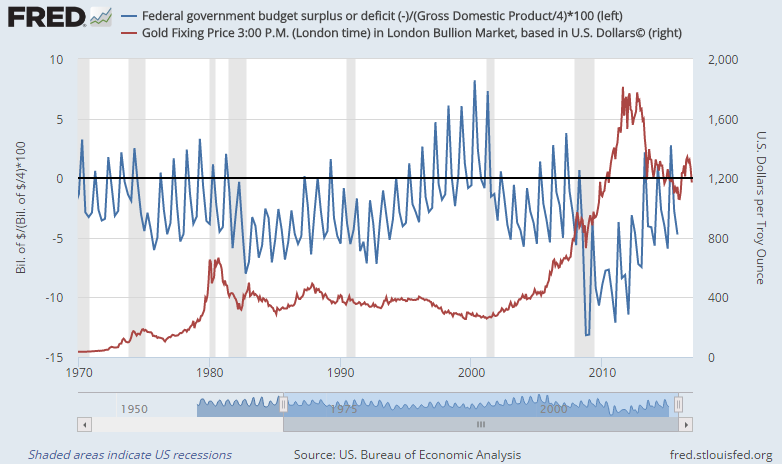
Chart of US federal deficits as a percentage of GDP (quarterly) vs. the gold price per ounce
 
Looking meantime at interest rates ahead of next week’s US Federal Reserve decision, “what matters to US GDP growth [is that] the consumer is king,” ICBC Standard Bank goes on.
 
So with US bond yields rising sharply, “Q1 may be as good as it gets [for economic optimism, because] a continuation…would squeeze disposable income growth and pose a threat to mortgage lending and real estate activity.”
 
Led by longer-dated US Treasury yields, mortgage interest rates have surged since Trump’s victory, with the cost of 30-year home loans leaping from the summer’s near-record lows to more than 4.0% last week.
 
Facing “an uncomfortable year” ahead in 2017, the US Fed is “unlikely to get the opportunity to hike more than twice,” says ICBC Standard Bank.
 
Less than one-third of betting on Fed interest-rate futures for November 2017 currently sees more than 1 hike following next week’s near-certain rise to a ceiling of 0.75%.
 
Elsewhere, Bloomberg News reported overnight that global benchmark auction the LBMA Gold Price will now accept new and changed orders from so-called “indirect” participants.
 
With US-listed brokerage INTL FC Stone apparently the first non-member to do so on Monday, this means that clients of the 13 banks currently meeting online to try and identify the single price which clears the most business can now respond to the auction’s suggested price as it moves higher or lower.
 
This electronic auction’s century-old predecessor – the London Gold Fix, which the new process seeks to replicate – relied on client orders changing “in running” to balance supply and demand across the market.
 
The Fix ended in 2015 after its sister benchmark, the London Silver Fix, saw one of its 3 direct member participants, Deutsche Bank, quit the process amid allegations of “market abuse” across its commodities, interest rates and currencies divisions.
 
The London Silver Fixing Limited – the private business owned by the former auction’s direct members – is being sued in an “anti-trust” lawsuit in New York, a suit in which Deutsche Bank has already settled, sharing with the plaintiffs what their lawyers this week asserted is “smoking gun” evidence of conspiracy “with other large market makers…like…HSBC [and] UBS.”

Gold Price Pops $5 as Bond Yields Retreat, 95% Certainty of US Fed Rate Hike

GOLD PRICES popped $5 per ounce higher to recover last week’s finish at $1177 at the start of New York trade on Wednesday, rallying as world stock markets also rose with government bond prices.
 
Betting in the futures market now puts 95% certainty on the US Federal Reserve raising its key interest rate for the first time since last December’s “lift-off” from 7 years at zero.
 
Today’s rise in bond prices saw 10-year US Treasury bond yields retreat to 2.37%, the lowest rate in a week, as crude oil fell again but base metals rose.
 
For the year to date, gold priced in US Dollars neared Wednesday afternoon’s London benchmark auction 11% higher from the start of 2016, but some 15% below early July’s peak of $1375 following the UK’s Brexit referendum decision.
 
Silver also popped higher early afternoon in London, rising 2.5% from the day’s earlier Asian quotes to break above $17 per ounce for the first time in 3 weeks.
 
“Momentum is steady but weak,” says bullion market maker Scotiabank’s daily technical analysis of gold and silver prices.
 
“Still bearish…risk remains to the downside.”
 
“All in all,” writes broker Marex Spectron’s David Govett in London, “the feeling is one of complete indifference” amongst professional traders such as money managers and hedge funds.
 
“I cannot bring myself to recommend selling this on the lows [but] I intend to remain side-lined for the time being ahead of [next week’s US Fed] FOMC meeting.”
 
With private investor demand to buy gold jumping to a 5-year high in November on BullionVault, retailers in the United States have raised their re-stocking from coin manufacturer the US Mint to the highest level since 2011 so far in 2016 according to CoinNews.net.
 
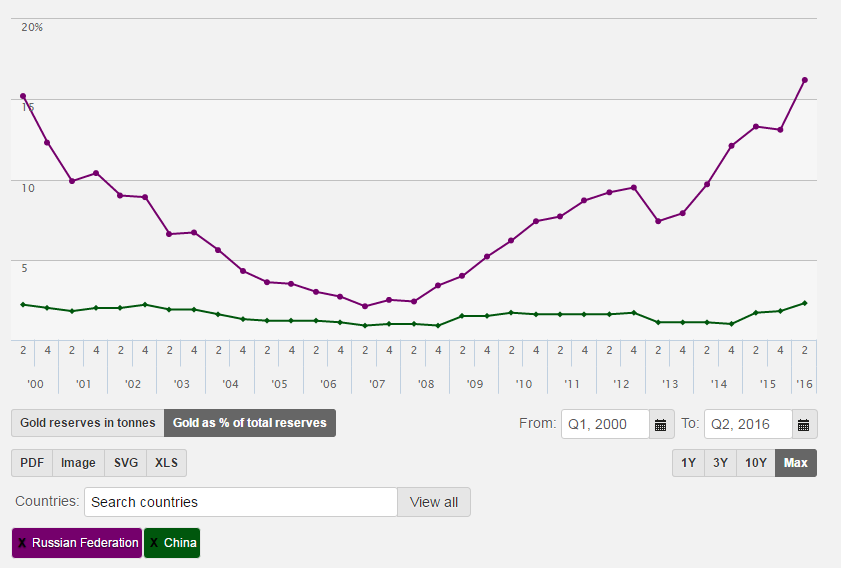
Russia’s central bank – the second heaviest official buyer of the 21st century to date – meantime added another 48 tonnes to its reserves last month, according to Austria’s Die Presse online, meaning that in the last 2 years Moscow has grown its bullion reserves by almost one half to 1,542 tonnes.
 
That’s equivalent to 6 full years of Russia’s domestic gold mining output – the 3rd largest after China and Australia’s – currently struggling to reach international markets amid US and European sanctions over the Crimea crisis against its commercial banking sector.
 
Chart of gold bullion as percentage of national FX reserves, China (green) and Russia (purple). Source: World Gold Council
 
No.1 gold buyer the People’s Bank of China added no bullion last month, contrary to internet claims that it has also “jump[ed] at golden opportunity” of lower US Dollar prices.
 
Shanghai’s benchmark gold price today held firm from Tuesday, but a dip in the Yuan vs. the Dollar on the FX market meant the Chinese gold premium – the incentive offered to importers over and above comparable quotes in London, heart of the world’s wholesale market – retreated $1 from yesterday’s new 3-year high above $26 per ounce.
 
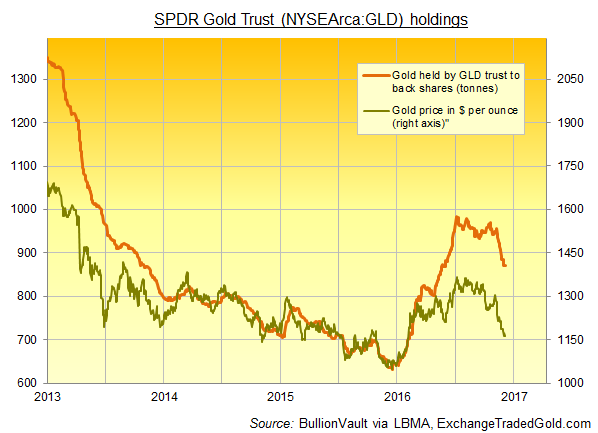
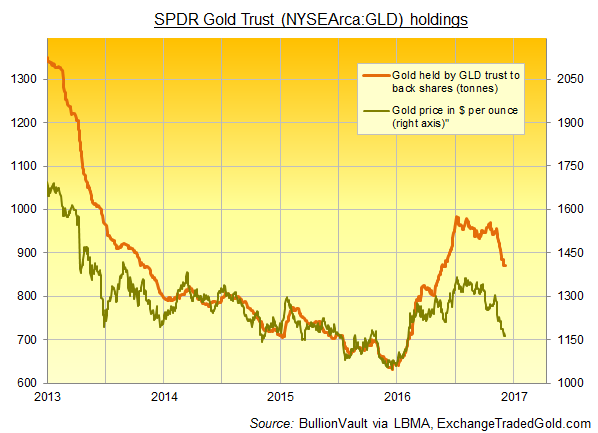
Tuesday afternoon’s $10 rally in the global LBMA Gold Price benchmark for metal settled in London saw shareholdings in the giant SPDR Gold Trust (NYSEArca:GLD) – the world’s largest gold-backed exchange-traded fund – stay unchanged at a 7-month low of 869 tonnes.
 
That’s still larger by more than one-third from the 7-year low in GLD holdings hit as investors liquidated shares when the US Fed made its first hike to interest rates from zero in mid-December 2015.

Gold Bars' Premium Hits 3-Year High in China as Base Metals 'Break Downtrends'

GOLD BARS traded in London – heart of the world’s wholesale bullion market – rallied $15 per ounce from yesterday’s new 9-month low on Tuesday as the US Dollar weakened and major government bonds edged higher.
 
At Shanghai’s official benchmarking auction overnight in China, where the authorities are apparently curbing import licenses ahead of the heavy New Year demand season, premiums for gold bars rose Tuesday to new 3-year highs at $27 per ounce over quotes for London settlement .
 
The world’s No.1 consumer nation, China likely influences global gold prices through the incentive for new bullion bar imports which this differential offers, according to research from specialists Metals Focus, “although the relationship is far from straightforward.”
 
The Dollar then retreated Tuesday on the FX market after new data showed the US’s worst October trade deficit since 2012, with labor costs rising faster but productivity lagging analyst forecasts on the Q3 GDP figures.
 
“We expect the upward trend to resume in 2017,” says a new gold price outlook from German financial services giant Commerzbank.
 
“The headwind from US Dollar appreciation and the rise of bond yields should abate, and investment demand should pick up again also given the numerous risk factors.”
 
Money managers’ favored vehicle the SPDR Gold Trust (NYSEArca:GLD) again saw shareholder liquidation on Monday, needing one-third of a tonne less to the back the value of its stock, now below 870 tonnes – equivalent to some 28% of annual world mining output.
Chart of gold bar prices vs. GLD backing. Source: ExchangeTradedGold.com
 
Besides gold investing demand – now at 5-year highs amongst self-directed investors wanting physical metal – Commerzbank also expects 2017 to see “noticeably” stronger gold bar, coin and jewelry demand from consumers in Asia after this year’s sharp falls.
 
No.2 consumer India has seen gold demand sink this fall amid the shock demonetisation of the largest banknotes, plus rumors of a crackdown on undeclared ‘black money’ purchases and even a potential limit on legal holdings of the metal.
 
US Treasury bond prices meantime ticked higher Tuesday for only the 7th time in the last 24 trading days, holding 10-year yields down at 2.39% – sharply higher from the 1.85% offered to new buyers on the eve of Donald Trump’s presidential election win.
 
Western stock markets rose, cutting the EuroStoxx50 index’s loss for 2016 to 6.5% after Italian prime minister Matteo Renzi lost the weekend’s referendum on constitutional reform, while commodity prices slipped, led by energy and base metals.
 
Last week’s Opec oil cartel agreement to reduce quotas now needs each member state to cut output in reality, notes the Reuters news-wire.
 
Aluminium has still broken an 8-year downtrend in prices however, says a new chart analysis from French investment and bullion market-making bank Societe Generale, while copper has broken up through a 5-year downtrend.
 
For gold bullion, which failed to break its downtrend starting mid-2011 with both the Brexit and then US election spikes of June and November respectively, “Daily indicators are close to a floor,” says SocGen’s technical team, “[but] signs of rebound are still awaited.”
 
Gold priced in Australian Dollars meantime rose Tuesday back to last week’s closing level at A$1574 per ounce – unchanged from this time last year – after the Reserve Bank in Sydney held its key interest rate unchanged at a record low 1.5%, repeating that “inflation is expected to remain low for some time.”

Gold Price Hits 6-Month Euro Low as Renzi Loses Italy Vote, Hedge Funds Slash Bullish Comex Bets

GOLD PRICES fell to new 6-month lows against the Euro on Monday, dropping below €1190 per ounce for the first time since early June even as the single currency rose following Matteo Renzi’s defeat in the Italian referendum on reforming the constitution.
 
Priced in US Dollars held above last week’s new 9-month lows, finding a floor at $1162 – down over 15% from early July’s post-Brexit peak – after initially spiking to $1188 per ounce.
 
Bond yields rose again as major government debt prices continued their fall, with 10-year Italian bonds offering over 2.03% per annum – sharply higher from the record-low 1.04% seen in August.
 
The Eurozone’s third largest member by GDP, Italy rejected Renzi’s call to reform and reduce the power of the Senate by a margin of 20 percentage points, leading the prime minister – with less than 3 years in power, the 4th longest-serving in Italy since 1990 according to the BBC – to resign as promised.
 
After an initial drop, the Euro rallied from near last month’s 2-year lows to the Dollar, while wider Eurozone stock markets rose.
 
Italy’s MIB index, in contrast, fell 1.2% on the day, weighed down by banking shares facing growing worries over bad debts and weak balance-sheets.
 
The Bahrain-based Accounting and Auditing Organisation of Islamic Financial Institutions meantime issued details of its new Shari’ah standard for gold investment products, agreed by scholars on its Shari’ah Board last week and aimed at enabling Islamic investors to trade contracts representing physical gold, as well as traditional coins and bars.
 
The world’s largest gold-backed exchange-traded fund – the SPDR Gold Trust (NYSEArca:GLD) – “will probably qualify,” reckons Shari’ah scholar Mohd Daud Bakar, speaking at a press conference to launch the initiative in Arab financial center Dubai on Monday.
 
“We fully expect to announce imminently that GLD does qualify,” Bloomberg quotes Natalie Dempster, managing director for Central Banks and Public Policy at the mining-industry backed World Gold Council, which sponsored the new initiative and is also sponsor of the GLD through its World Gold Trust Services LLC subsidiary.
 
Launched in 2004 and the world’s No.1 exchange-traded trust fund by value at its 2011 peak – briefly overtaking the US stock market tracking SPY ETF –  the GLD shrank in November at its worst monthly pace since April 2013, when gold began its sharpest crash in more than three decades.
 
Shrinking by 75 tonnes as shareholders liquidated GLD stock last month, the trust fund added almost 9 days global gold-mining supply to the market, beginning December with its smallest holdings since end-May at 870 tonnes.
 
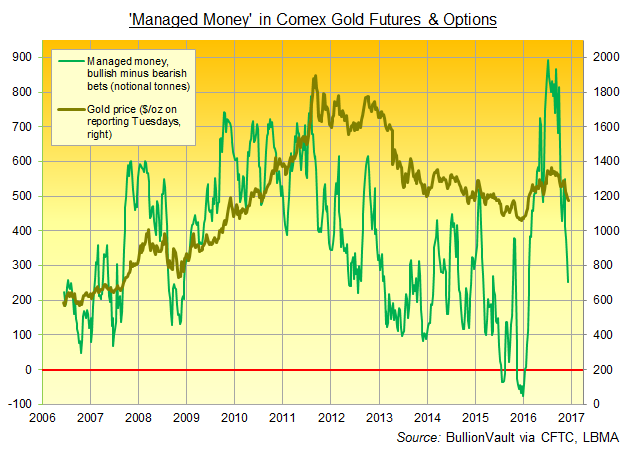
Speculative players in US Comex gold futures and options meantime slashed their net bullish betting by almost one-third in the 5 weeks ending last Tuesday, new data from US regulator the CFTC showed after Friday’s close.
Chart of Managed Money's net spec long in Comex gold futures and options, tonne equivalent
Cutting their ‘net spec long’ to the equivalent of 321 tonnes of bullion at cash prices, hedge funds and other players in the CFTC’s Managed Money category have now slashed their bullish bets on gold derivatives, net of bearish the group’s bearish bets, by 64% from early July’s new all-time record high, reached just after the UK’s Brexit referendum shock.
 
“A progressive stride for the Islamic finance industry,” according to AAOIFI secretary-general Dr.Hamed Hassen Merah, the new Shari’ah standard for gold investment products will most likely not be able to approve derivatives – such as Comex futures or options – where no metal is necessarily involved.
 
Bullish silver bets held by the Managed Money category of futures and options traders retreated by the equivalent of only 1 tonne last week net of bearish bets, CFTC data show, down to only a 5-week low.
 
That was still 46% down from July’s new record peak however.
 
Silver prices held firmer than gold on Monday, edging 45 cents higher from late-November’s 5-month lows to trade at $16.60 per ounce.

New 10-Month Low But Top Gold Price Forecaster Sees $1300 in Early 2017 as Italy, Austria Vote

GOLD PRICES recovered $10 per ounce from a new 10-month low at $1160 set in Asian trade Friday, heading for a 1.1% weekly loss in London as the Dollar held below this week’s new 13-year highs following new US jobs data in line with analyst forecasts.
 
The official non-farm payrolls report said the US added 178,000 jobs in November, cutting the unemployment rate to its lowest since May 2007 at 4.6%.
 
With Dollar gold prices lower overnight, China’s benchmark price in Yuan fixed well above quotes for London settlement once again, offering a $25 per ounce premium amid restrictions on import licenses from the central bank ahead of the No.1 consumer country’s key buying period, peaking with the Chinese New Year on 28 January 2017.
 
No.2 gold consumer India has seen prices in its so-called ‘grey market’ retreat 23% from the sudden spike of 9 November when the government suddenly banned the largest denomination banknotes, with dealers and customers reportedly too scared of tax inspectors amid the Modi administration’s crackdown on black-market money.
 
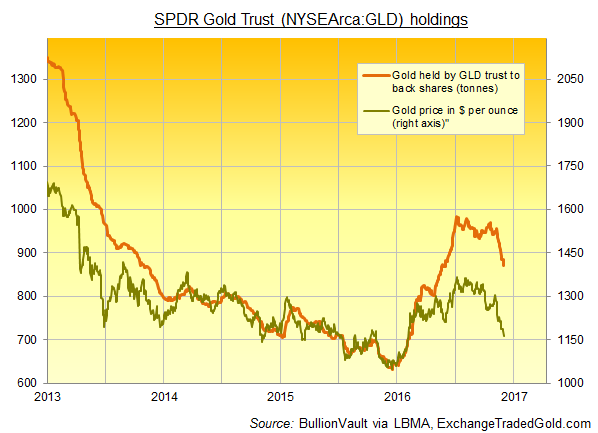
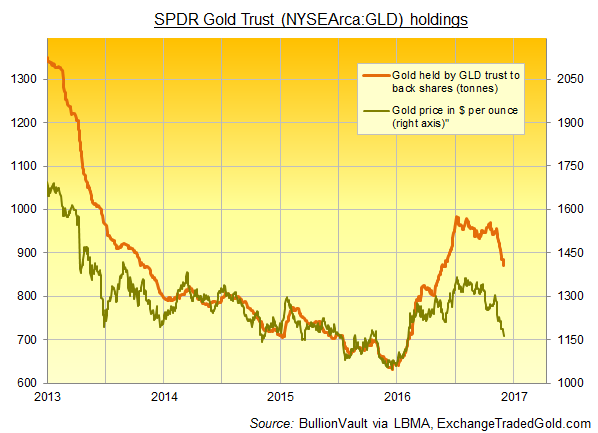
Western fund managers and other investors in gold ETFs meantime cut their holdings yet again on Thursday, liquidating 1.5% of the SPDR Gold Trust (NYSEArca:GLD) to reduce its bullion backing by 112 tonnes from July’s three-year high. 
 
That’s equivalent to 13 days of global gold mining output.
Chart of SPDR Gold Trust (NYSEArca:GLD) bullion holdings vs. price
 
“Given that the [gold] market has already moved and positions have been adjusted,” says analyst Joni Teves at Swiss bank and bullion market maker UBS, “we think any further downside from here is likely to be relatively more contained.
 
“Gold is now looking attractive around these levels…The rationale for holding gold from a strategic standpoint remains intact, in our view.”
 
The most bullish forecaster for 2016 in January’s London Bullion Market Association competition, Teves predicted an average price of $1225 per ounce – more than 11% above the 30 other professional analysts’ average forecast.
 
With 30 days remaining until 2017 begins, gold has averaged $1256.72 this year to date.
 
Last year’s LBMA winner, Bernard Dahdah of French bank Natixis, forecast an average 2016 gold price of $970 per ounce.
 
Teves at UBS now sees prices rising to $1300 “in the months ahead…against the backdrop of lingering macro uncertainty…easy monetary policy or [a] risk-off scenario.”
 
Creating and spending €80 billion per month to buy Eurozone government bonds and other securities, the European Central Bank will extend that quantitative easing for a further 6 months from the current deadline of March 2017 when it meets to set policy next week, according to a poll of analysts published Friday by the Reuters news-wire.
 
Italy votes Sunday in a referendum on constitutional reform now widely seen as a ballot on Prime Minister Renzi’s economic policies.
 
A finance conference last week saw only 3% of attendees back the Renzi government’s plan for resolving the €360bn of “problematic debts plaguing the balancesheet of Italian banks,” reports the Financial Times.
 
Austria also goes to the polls Sunday to elect a new president, re-running the ballot from May when Green Party leader Alexander van der Bellen narrowly defeated Norbert Hofer from the rightwing nationalist Austrian Freedom Party, only for the result to be annulled over voting irregularities.
 
Hofer has said he’ll give Austrians a referendum on leaving the European Union if Turkey joins – a process now “all but dead” according to The Economist magazine after President Recep Tayyip Erdogan’s mass arrests, sackings and shutdown of independent media in the wake of July’s failed coup.
 
The Turkish Lira hit fresh all-time lows on the FX market Friday after Erdogan – blaming “someone’s tricks” and urging households to buy the currency, as well as gold – said there’s “no option” but to cut interest rates, repeating his demand than Ankara’s independent central acts to try and revive the economy of the world’s 5th largest gold consumer nation.

China + India Block Demand to Buy Gold, Price Extends Worst Slump Since 2013 Crash

BUY GOLD prices fell to new 9-month lows in London on Thursday, extending their steepest 1-month decline since the crash of spring 2013 as Western stock markets also fell with government bond prices, pushing interest rates higher ahead of mid-December’s US Fed policy decision.
 
Ten-year US Treasury yields traded above 2.40% as New York opened for business – well over two hikes of 25-basis points higher from before the election of Donald Trump – as commodities rose again, pushing crude oil back above $50 per barrel following yesterday’s Opec cartel agreement on cutting production.
 
Rumors that Beijing has restricted the number of import licenses for bullion continued to spread, dampening households’ ability to buy gold in the world’s No.1 consumer market.
 
Reports from world No.2 consumer India meantime said the “cash crunch” following November’s shock move to ban 500 and 1000-Rupee notes – worth 86% of all currency in circulation – has squashed demand to buy gold amid the key Hindu wedding season by as much as three-fifths.
 
Apparently aiming to slow the outflow of currency from China, “[Beijing’s] effort to slow down imports of gold reminds us of similar Indian efforts,” says a note from French investment and bullion bank Natixis.
 
“Having both countries, which account to around half of the world’s demand for gold, put brakes on imports at the same time is of particular concern for gold prices next year.”
 
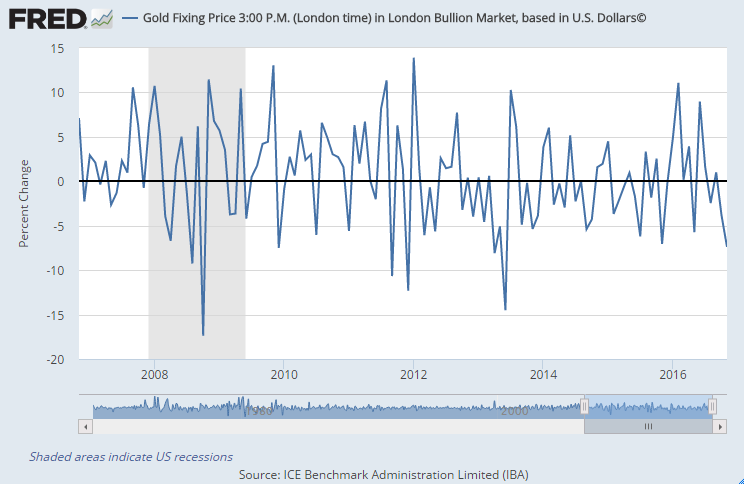
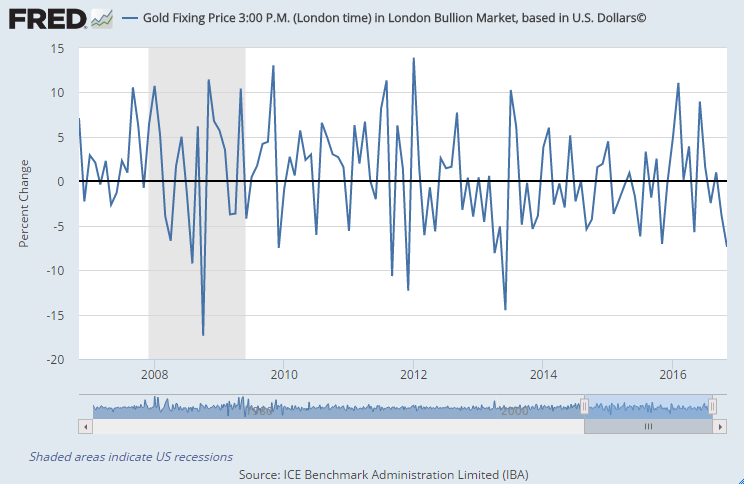
Prices to buy gold in large, wholesale bars fell 7.4% in November from the end of October – the steepest decline since June 2013 capped the metal’s worst quarterly drop in three decades.
 
Chart of US Dollar gold prices, London PM benchmark, month-end percentage change
 
Exchange-traded trust funds backed by gold – a key investment vehicle for US money managers wanting to buy exposure to the metal – have now shrunk 14 trading days running, says data from Bloomberg.
 
Ahead of US president-elect Donald Trump’s inauguration on 20 January, “We will be closely watching [his] economic plan,” says Bernard Dahdah at Natixis.
 
“We could potentially see rates in 2017-18 rise at a quicker pace, due to inflationary pressures…and this could potentially lead to a stronger Dollar and weaker gold prices.”
 
With the US Fed now certain to raise its key Dollar interest rate to a ceiling of 0.75% on 14 December according to betting on CME futures contracts, gold bullion has also fallen hard against all other major currencies, losing almost 3% this week so far against the British Pound to trade at £923 per ounce on Thursday.
 
Prices to buy gold with Pounds Sterling hit a 3-year peak of £1070 in the two weeks after the Brexit referendum on 23 June saw the UK vote to leave the European Union.
 
Wholesale prices for Eurozone investors to buy gold have now halved their 2016 gains, retreating from their Brexit highs of €1244 per ounce to dip through €1100 for the first time since 22 June on Thursday.