Author Archives: City Gold Bullion

Gold Trading 'Bullish' at $1180 as China Challenges Trump Over Taiwan, Mexico

GOLD TRADING saw prices again outpace the rising US Dollar on Monday, nearing Friday’s 4-week highs above $1180 per ounce as world stock markets fell, government bond prices rose, and crude oil sank more than 2%.
 
“Short term gold is staging expected rebound,” says a new technical analysis from French investment bank and bullion market maker Societe Generale, with its “initial target at $1181” now achieved while “$1200 remains a key resistance.”
 
“Resistance is at $1191,” counters the latest trading analysis from Canada-based bullion bank Scotia Mocatta’s New York office, calling gold prices “bullish [as] momentum remains positive” with $1165 offering “near-term support”.
 
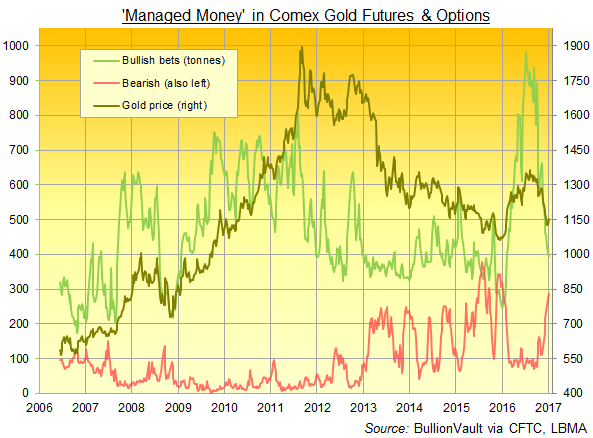
New data released Friday evening said that hedge funds and other money managers trading Comex gold futures and options came into 2017 only slightly more positive as a group on than end-December’s 11-month low.
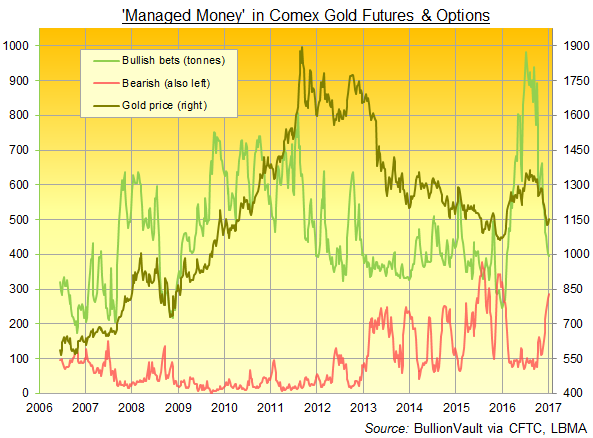
Chart of CFTC's Commitment of Traders data for gold, Managed Money category
 
“The yellow metal continues to benefit from physical demand,” says Swiss refining and finance group MKS in a trading note, pointing to “Asian interest and a pull-back in ETF outflows” after the relentless exchange-traded trust fund liquidation of gold following Donald Trump’s victory in November’s US presidential election.
 
Again attacking global auto-makers which import vehicles to the US market on Twitter today, Trump has acknowledged intelligence reports claiming that Russian hackers had attempted to interfere with November’s elections, according to a spokesperson.
 
Russia’s crude oil output fell by 0.9% so far in January, sources quoted by Reuters claim, in line with Moscow’s commitment to assists the Opec oil cartel’s lower quotas, aimed at supporting prices.
 
US production continues to rise however, with the Baker Hughes count of oil rigs rising last week to 665, the highest since end-2015 and two-thirds larger than last June’s 7-year low.
 
“If Trump reneges on the one-China policy after taking office,” says Beijing-controlled website Global Times meantime, commenting on Taiwan leader Tsai Ing-wen’s contact with the US president-elect, “the Chinese people will demand the government to take revenge. 
 
“There is no room for bargaining.”
 
Global Times elsewhere says that Trump’s series of tweets warning auto-manufacturers to build cars for the US market in the US “a valuable opportunity for Chinese automakers to expand into Mexico.”
 
Shanghai gold premiums rose Monday back towards $20 per ounce, offering a sizeable incentive to new imports ahead of the key Chinese New Year holidays.
 
The People’s Bank failed to add any gold to its bullion reserves for a second month running in December, new data showed meantime, passing up the metal’s 10-month Dollar discount as capital outflows saw China end 2016 with a drop of almost 10% in its official reserves of foreign exchange assets, down to a 5-year low of $3.01 trillion.
 
Meantime in India – former No.1 gold consumer nation, now set to report tax revenue from gold imports down by one half in 2016 – lenders are reporting a rising default rate amongst borrowers using gold as collateral to secure cheaper rates, a sign of economic stress amongst middle-class families following the shock demonetisation of the country’s largest banknotes in November, according to The Hindu newspaper.
 
The sudden cancellation of 86% of currency in circulation – aimed at killing forgeries, so-called ‘black money’ and tax evasion – has also hit India’s digital economy, according to Money Control, as “private funding dried up for unlisted players [and] the listed players are expected to be impacted by demonetisation.”
Gold Price Gains 1.4% in New Year 2017 as US Wages Jump Fastest Since 2009

GOLD PRICES fixed at Friday’s benchmark auction in London with a gain of 1.4% for the first week of 2017, retreating from yesterday’s 1-month highs as the US Dollar rallied following mixed US jobs data.
 
US non-farm payrolls grew last month by 156,000 on the Bureau of Labor Statistics’ first estimate, some 12% below Wall Street’s average forecast and the weakest December since 2013.
 
November’s figure was however revised sharply higher, contrasting with the unchanged estimate from payroll services provider ADP in its data release Thursday.
 
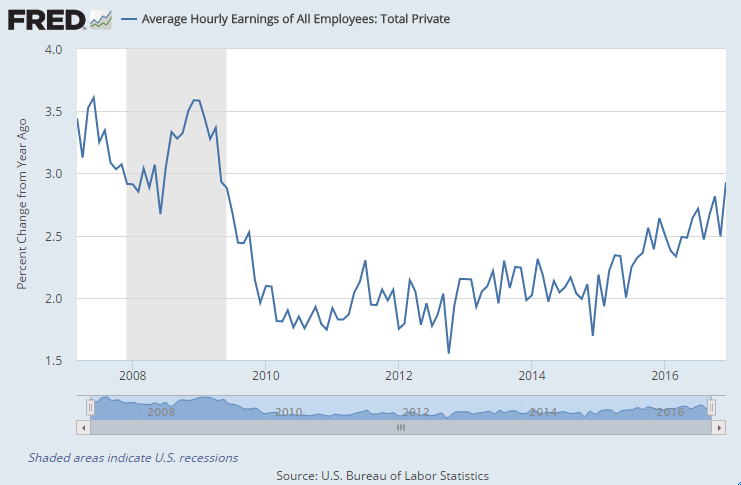
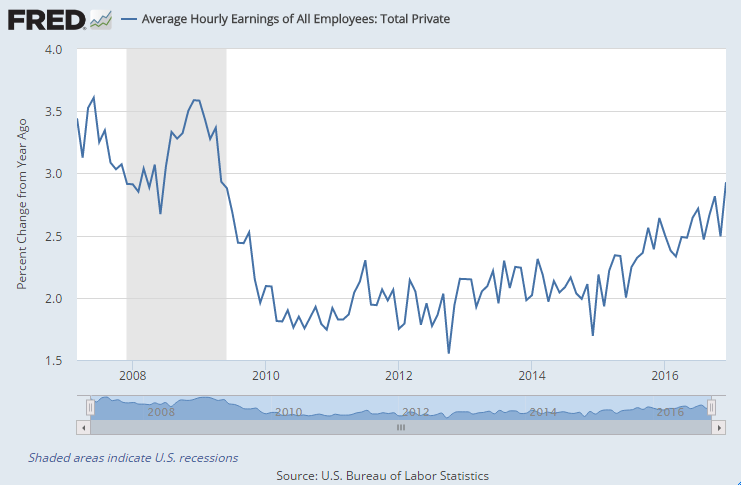
Year-on-year, US wage growth meantime hit 2.9% on today’s BLS data, the sharpest annual rise since spring 2009.
 
Chart of US average wage growth, year-over-year
 
Gold prices traded around $1175 per ounce late Friday afternoon in London, some $10 below Thursday’s high, while silver held at $16.25 – some 3.6% above last week’s finish to 2016.
 
Yesterday saw the SPDR Gold Trust (NYSEArca:GLD) – the largest gold-backed exchange-traded trust fund – shrink even as bullion prices rose once again, with shareholders liquidating for the 27th in 38 sessions since Donald Trump won the US election, reducing the quantity of bullion needed to back the GLD’s shares to a new 9-month low of 813.6 tonnes.
 
The GLD has now lost 15 tonnes – equivalent to almost 2 days of global gold mining output – since bullion prices bottomed at $1125 per ounce, their lowest in 10 months, on 20th December.
 
Since then, traders betting that prices would fall further after the Federal Reserve followed Trump’s victory with its second hike to US interest rates have lost 10% on the ProShares UltraShort Gold ETF (NYSEArca:GLL).
 
“Most factors that boosted precious metals in the first half of last year are very likely to remain relevant throughout 2017,” says the latest Precious Metals Weekly from specialist analysts Metals Focus – “the most important [being] concerns [over] the Fed’s interest rate policy.”
 
“Despite the hawkish sentiment, nominal rates will almost certainly remain historically low…and negative in real terms [with] inflation creeping up, albeit modestly.”
 
Politically meantime, US president-elect Donald Trump’s victory “is still, on balance, seen as a positive towards US growth,” says Metals Focus, “[but] we believe that eventually the new President’s ‘wild card’ approach will proliferate global uncertainties…boost[ing] safe haven demand.
 
“Finally, in our view there remain significant risks of equity market corrections.”
 
Global stock markets held flat overall on Friday, keeping New York’s S&P500 index on track to start 2017 with a 1.4% weekly gain.
 
Government bond prices retreated after the US wage data, however, pushing 10-year US Treasury yields 5 basis points higher from yesterday’s 1-month low of 2.35%.
 
Noting the retreat in both US bond yields and the Dollar so far in 2017, “We think this is probably a false dawn for gold,” says analysis from Chinese-owned bullion clearer ICBC Standard Bank today.
 
“A more sustainable turn is likely to have to wait until mid-year,” says ICBC Standard’s precious metals strategist Tom Kendall, by when he expects disappointment with Trump, plus a new argument over needing to raise the US federal government’s debt ceiling limit, to “dominate the news flow.”
 
The most bullish 2016 average price forecaster by $20 per ounce at $1225, analyst Joni Teves of Swiss financial group and bullion bank UBS was today declared the winner of last year’s predictions competition for the London Bullion Market Association.
 
Most recently forecasting a 2017 average of $1350, Teves was shy of the 2016 outcome by over $25 per ounce.

Gold Bullion Up Again in New Year 2017, GLD Yet to React as Weak Jobs Hit Dollar, T-Bonds Rally with China's Yuan

GOLD BULLION prices hit fresh 1-month highs on Thursday, trading above $1177 per ounce as the Dollar slipped again after weaker-than-expected US jobs data and the Chinese Yuan extended its New Year 2017 rally on the currency market.
 
London’s FTSE100 equity index of global corporations touched another fresh record high before edging back.
 
New York’s S&P500 last night tried but failed for the third time to break early December’s closing record-high above 2171 points.
 
Today’s private-sector ADP Payrolls estimate said US businesses added 153,000 jobs in December, badly shy of the 215,000 average analyst forcast.
 
Commodity prices rose again Thursday, with Europe’s benchmark Brent crude nearing an 18-month high of $57 per barrel.
 
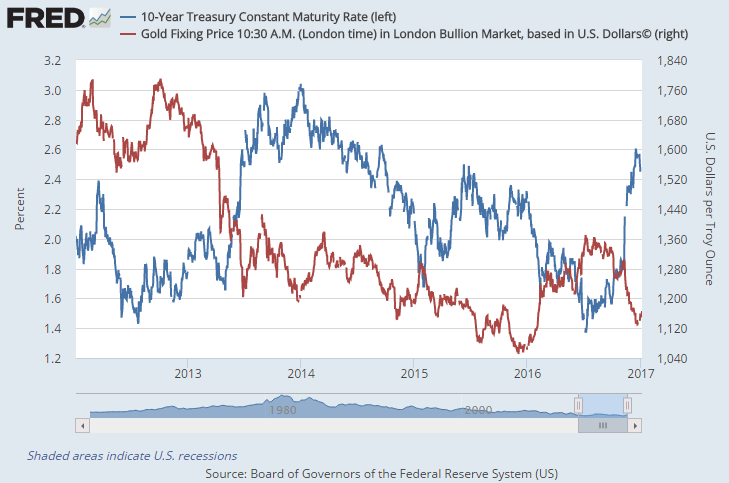
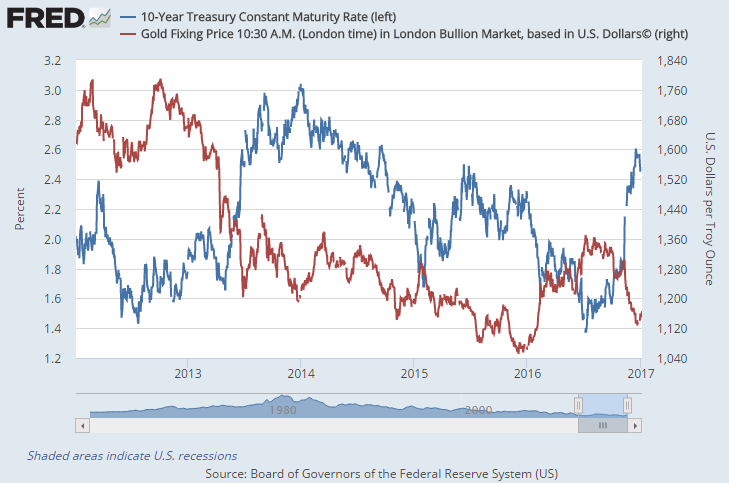
US government bond prices also continued their New Year’s rally, pushing the yield offered by 10-year Treasurys down to 2.43% as New York opened.
 
Ten-year US yields have now retreated 17 basis points from the 2-year high of 2.60% hit 3 weeks ago, after the Federal Reserve raised its key interest rate for only the second time in more than a decade.
 
That drop in yields – caused by bond prices rising from December’s sell-off – is the fastest retreat since last July’s plunge to new all-time record lows of 1.37%, hit in the aftermath of the UK’s shock Brexit referendum result.
 
Chart of 10-year US Treasury bond yields vs. Dollar gold prices
 
Shanghai gold prices meantime fixed Thursday at ¥264 per gram for the 4th session running as the Yuan rose to 1-month highs on the FX market, defying what Reuters calls “one of the central bets of global investors for 2017” as Beijing moves to stem capital outflows and defend the Chinese currency.
 
With overnight interest rates jumping to 8-year highs in Hong Kong, “They have kick-started a move that has washed out short-term speculative money,” the news-wire quotes $20 billion FX trading fund Millennium Global’s Richard Benson.
 
With Yuan prices unchanged but Dollar gold jumping, Shanghai premiums on gold bullion – over and above comparable London quotes – retreated Thursday below $20 per ounce for the first time since late November, when Beijing was reported tightening restrictions on new import licenses ahead of the key Chinese New Year festive season.
 
The year of the Rooster will begin on Saturday 28 January, with financial markets closed for the following week’s holiday, often dominated by travel and shopping.
 
Thanks to the Spring Festival of ‘pin yin’, China’s private demand for gold bars, coins and jewelry has on average risen 21.3% in the first quarter of the last 5 years from the previous 4 quarters’ average according to data compiled for market-development organization the World Gold Council.
 
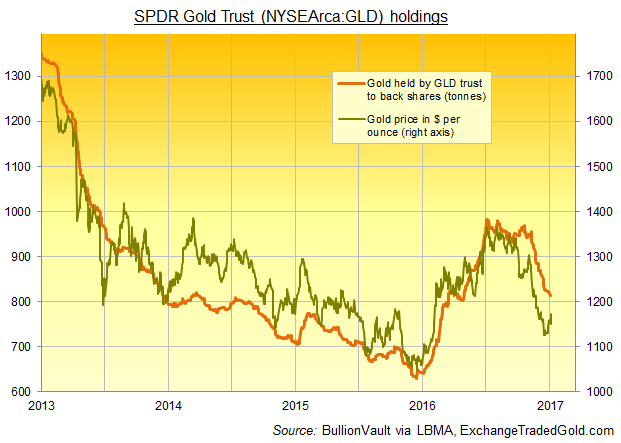
Western investors yesterday kept their shareholding in the giant SPDR Gold Trust (NYSEArca:GLD) unchanged as prices rose, stemming the ETF’s near 2-month liquidation.
 
The GLD hasn’t seen a net inflow of gold bullion to back its shares in issue since 9 November, the day of the US election.
Chart of the SPDR Gold Trust (NYSEArca:GLD) bullion backing vs. gold's benchmark price
 
With gold bullion prices falling some 9% since Donald Trump’s victory, investor liquidation has shrunk the GLD by nearly 15%, taking its holdings down to 813 tonnes – the smallest quantity since last May.

Gold Prices Near 4-Week High as China Boosts Yuan, Euro Inflation Pops, UK Borrows Like 2005, US's Trump 'Key to 2017'

GOLD PRICES rose against all major currencies bar the Chinese Yuan on Wednesday, nearing 4-week highs versus a falling US Dollar at $1165 per ounce as crude oil rose to new 18-month highs above $55 per barrel.
 
The Yuan meantime rose sharply from its new 6-year lows after Beijing raised its key reference rate and global news-wires quoted un-named sources saying that the politburo is “preparing contingency plans” to stem capital outflows, including an order to force state-owned companies to sell Dollars for the Chinese currency.
 
Beijing’s foreign exchange reserves have sunk to 2011 levels – albeit still the world’s largest at $3 trillion, almost three times No.2 Japan – as the People’s Bank tries to slow the Yuan’s decline, injecting a monthly record of $104 billion into the banking system through its Medium-Term Lending Facility in December alone.
 
Chinese gold prices were barely changed this morning from Tuesday, but with the Yuan rallying on the currency markets, that widened the Shanghai premium above international quotes to $25 per ounce, some 10 times the typical incentive to new imports.
 
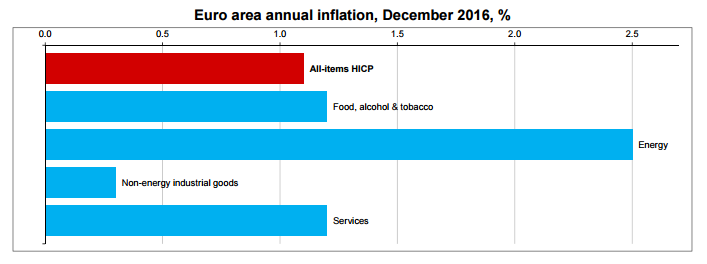
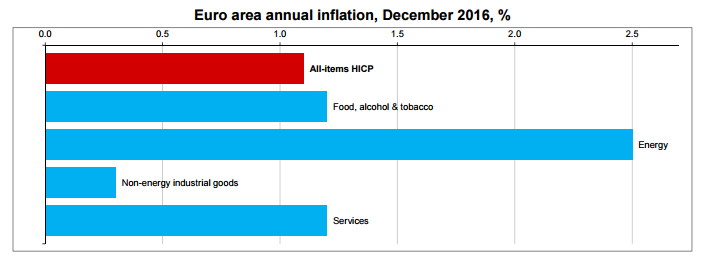
London’s FTSE100 index meantime edged back from yesterday’s new all-time high and Eurozone equities retreated from a fresh 13-month peak as the Eurostat data agency said consumer-price inflation across the 330 million citizen currency union jumped from 0.8% to 1.1% per year in December, led by 2.5% jump in energy costs and a 2.1% jump in unprocessed food.
 
Excluding those ‘volatile’ items however, the Eurozone’s ‘core’ inflation rate still moved up from 0.8% to 0.9% per year, the fastest pace since July.
 
Chart from Eurostat of contributions to December 2016 HICP
 
Following Tuesday’s fresh trade war spat between Beijing and US president-elect Donald Trump, “Trump’s actual policy delivery and his stance against China are critical to the Dollar and Yuan direction in 2017,” says Asian FX strategist Ken Cheung at Mizuho Bank in Hong Kong.
 
“The US is [also] going to remain the key to gold price movements,” says David Govett at bullion brokers Marex Spectron in London, “with eyes on the Fed, the Dollar and of course the incoming president.
 
“Regardless of your thoughts on him, [Trump] is very unpredictable and…will keep the world on tenterhooks with his every tweet and utterance.
 
“I believe will give gold a boost from time to time…[but] I see a range trading year for gold [between] $1100-1300…unless something awful happens.”
 
Separate data Tuesday put consumer confidence in France at the highest in 9 years, while unsecured lending to UK households jumped last month at the fastest pace since 2005 and new orders for UK construction companies grew at the fastest in almost a year, the Markit data agency said in its latest PMI survey.
 
US factory activity hit a two-year high in December, the Institute for Supply Management said yesterday, while spending on new construction hit the highest in a decade.

'True Safe Haven' Gold Prices Firm vs. Rising Dollar as Trump Argues Trade War with China

GOLD PRICES returned from the New Year 2017 holiday to track the rising Dollar on Tuesday, pushing higher against non-US currencies as Washington’s president-elect Donald Trump was rebuked by Beijing over his threat to start a trade war with the world’s second-largest economy.
 
Gold prices held tight around last week’s close of $1151 per ounce, rising to 1-month Euro highs above €1110 as world stockmarkets gained but government bond prices fell again, nudging interest rates upwards.
 
Gold prices in Shanghai held firm overnight versus China’s Yuan, offering importers a $24 per ounce premium above comparable London quotes – down sharply from the new 3-year highs hit amid tighter import licensing by Beijing before Western dealers shut for Christmas, but still 10 times the average incentive of the last 3 years.
 
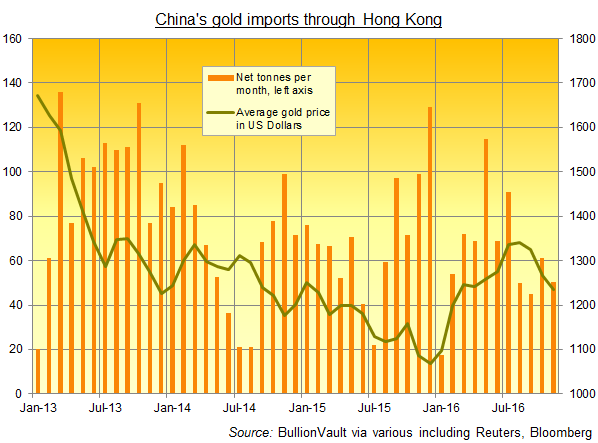
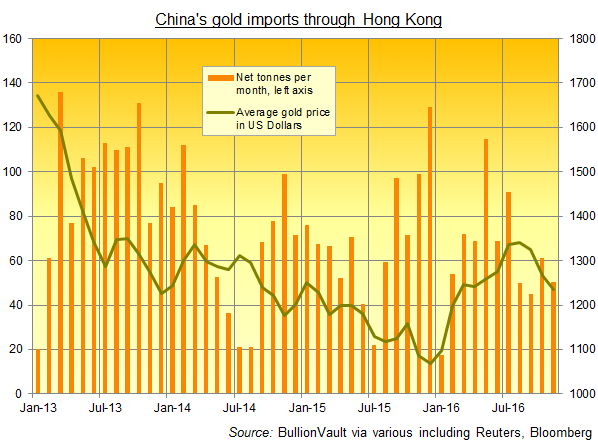
Data released last week put China’s net gold bullion imports through the key conduit of Hong Kong at the lowest since last January in November.
 
On an annualized basis, however, Hong Kong’s net shipments to China – the world’s No.1 gold consumer, importer and mining producer – held 3.5% ahead of 2015.
Chart of gold bullion imports to China through Hong Kong (tonnes, net of exports)
 
Last Friday saw “decent buying flows out from Asia as gold traded at multi week highs,” says a note from German financial services group Commerzbank.
 
“2017 is likely to remain a volatile trading year for gold with US Dollar strength to be investors’ focus again.”
 
Gold prices rose 9.1% in 2016 against the Dollar as the US currency rose towards 14-year highs on the FX market.
 
“Chinese New Year demand is expected to support the metal over the short-term,” says a gold price note from Swiss refiners and finance group MKS Pamp, “[but] consolidation above $1160 will be required for a run higher.”
 
Gold’s underlying trend “is bullish [but] momentum is negative,” counters the last technical analysis of 2016 from bullion bank Scotia Mocatta’s New York office, “remain[ing] biased to the downside as long as gold closes below 1173.50” per ounce.
 
After Beijing’s official FX reserves fell to 6-year lows at end-2016 as money continued to leave, the government today announced new currency exchange rules, requiring banks to report all client FX trades above CNY 50,000 (currently $7,000) from July – rules which do not represent “capital controls” according to the state-run Xinhua news agency.
 
Cash outflows from Hong Kong, plus a withdrawal of cash liquidity from the Chinese banking system, were meantime blamed Tuesday for a spike in short-term interest rates in the city’s financial markets, repeating a move seen at the start of 2016.
 
“Anyone fancying a trade war with China might have missed their best opportunity,” Xinhua reports elsewhere, apparently targeting US president-elect Donald Trump and quoting Beijing officials saying that “the Chinese economy has already passed the stage of being vulnerable to such actions” thanks to shifting away from needing ever-greater exports to support economic growth.
 
Due to take power in less than 3 weeks’ time, Trump today tweeted that “China has been taking out massive amounts of money & wealth from the US in totally one-sided trade” and added that US-listed General Motors (NYSE:GM) should “make [cars] in USA or pay big border tax!” on its Mexico-made vehicles.
 
Reuters says Trump’s transition team have asked US border agencies to assess their capacity to build new walls and barriers, as well as expanding migrant detention facilities, in line with his campaign promise to cut immigration from Mexico.
 
“As bonds are no longer a safe haven,” says the Global Asset Allocation Strategy team at French investment bank and bullion market maker Societe Generale, “our quantitative portfolio recommends cash to protect portfolios in risk-averse periods.
 
“We also consider gold and Japanese bonds – protected by the [Bank of Japan’s zero-yield] policy – to be true safe assets for 2017.”
 
With gold imports to non-mining No.2 consumer India meantime estimated down to the lowest since 2003 for last year as a whole, leading dealers in the sub-continent now predict a one-third drop in 2017 household demand from 2016’s depressed levels according to local media, as the cash crunch caused by the government’s shock demonetisation of the largest banknotes continues to dent spending and confidence.


Gold Bars +9.1% in 2016 vs. Almighty Dollar, Lag S&P for 5th Year Running

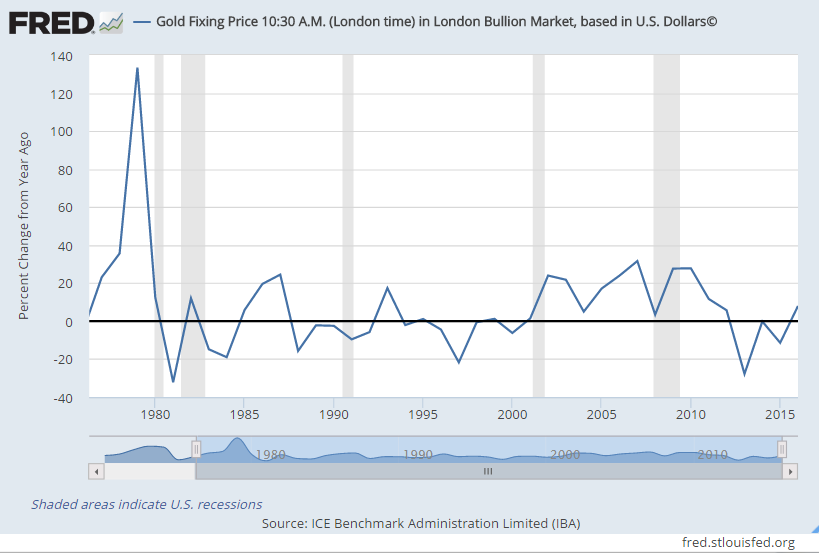
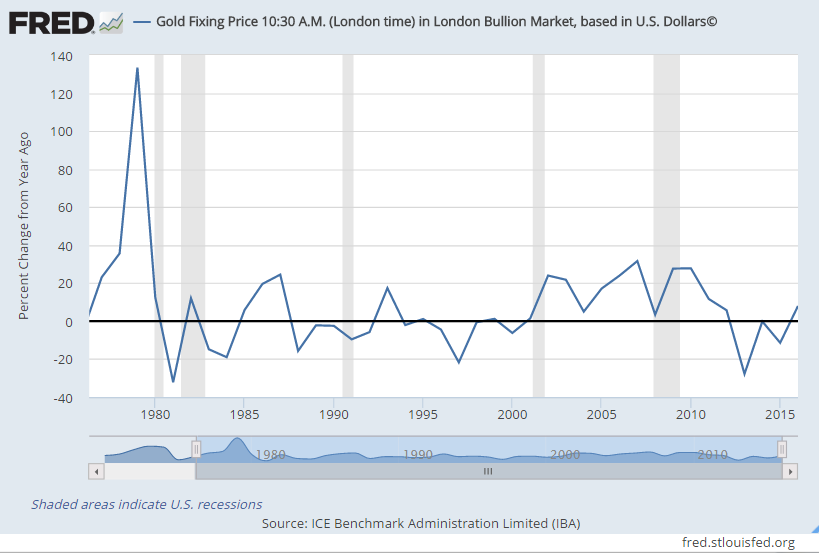
GOLD BARS traded in London – heart of the world’s wholesale bullion market – closed 2016 at $1159.10 per ounce Friday morning, gaining 9.1% for the year.
 
Also ending 3 years of losses, silver bullion meantime fixed at Friday’s midday London auction at $16.24 per ounce, some 18.2% higher for 2016 as a whole, its strongest gain since 2010’s rise of 80%.
 
The US Dollar meantime neared its fourth successive annual rise on the foreign exchange market, nearing the 2002 peak against a trade-weighted basket of other currencies.
 
US equities were headed for a 10.0% annual gain, with the S&P500 index opening Friday just shy of mid-December’s new all-time record high.
 
That meant gold lagged the US stock market for the 5th year running after beating it throughout 2005-2011.
 
This year’s rise in wholesale gold bar prices was the strongest annual gain since 2011’s rise of 11.7%, and ended the metal’s worst losing streak since the 5-year run ending 1992.
 
Chart of US Dollar gold price's annual percentage change, London AM Fixing
 
Priced in British Pounds – itself down 15% for the year on the FX market after June’s surprise Brexit referendum decision to quit the European Union – wholesale gold bullion bars ended 2016 higher by 31.2%, the ninth sharpest annual gain for UK investors since prices were cut loose from their currency pegs by US president Richard Nixon abandoning the last vestige of the global Gold Standard in 1971.
 
US Treasury bonds today held unchanged, keeping the yield offered by 10-year debt at 2.47%.
 
A little higher from end-2015’s level of 2.27%, that put longer-term US interest rates markedly above early July’s new record low of 1.37%, hit in the wake of the Brexit shock.
 
Latest data today put gold trading volumes between the clearing members of the London bullion market at $6.2 trillion for the 12 months ending November – a rise of 16.4% from 2015 and the fourth largest value since records began in 1996.
 
Analyst estimates say the total quantity of gold traded through London may stand 3 to 5 times larger, although a survey of all London Bullion Market Association members in Spring 2011 put the multiplier nearer 10 times.
 
Post-trade reporting for all trading members will become mandatory in 2017, with the data gathered to help show the wholesale gold bar market’s true size and liquidity to regulators.
 
New trading size limits were this week applied to contracts on the Shanghai Gold Exchange – the only legal route for gold bars into China, the world’s No.1 consumer market – with analysts guessing that the half-tonne limit aims to stop institutional investors selling too quickly and depressing prices.
 
The Chinese Yuan finished 2016 at its lowest end-year value since 2007, but the Shanghai price of high-purity 1-kilo gold bars still finished at a $23 per ounce premium to comparable London quotes, some 10 times the typical incentive offered to wholesales amid reports of tighter restrictions on new import licenses.
 
Households in former No.1 gold consumer nation India will meantime see the deadline pass for depositing 500 or 1000 Rupee notes into a formal bank account after the Modi administration’s shock demonetisation of early November, aimed at curbing so-called ‘black money’ and tax evasion.
 
Out of the $230 billion-worth of notes cancelled – well over four-fifths of all currency in circulation – some 90% has now been deposited into the banking sector.
 
The resulting cash crunch nationwide – causing “a trail of devastation [for] farmers, workers, small shopkeepers, low-income households and businesses” according to the Economic Times today – initially spurred a jump in demand for gold bars and jewelry, and has now hit the industry badly, with the drop in sales spreading to the gift and gold jewelry trade in neighboring Dubai, a major offshore center for Indian travellers to shop, according to dealers.
 
Indian government estimates had reckoned that around 20% of the notes were held illegally and so would remain hidden, expiring worthless.

Gold Prices Muted as Markets in 'Holiday Mood', Investors Await More US Data

GOLD PRICES moved in a tight $4 range on Thursday in London as investors await the release of key US data. Q3 US GDP data, initial jobless claims and durable goods order figures will be released later on Thursday. Gold price in dollar terms at 12 pm in London was $1130. The market has already been described as being in a “holiday mood.”

Global stocks fell this morning as US shares finished in the red yesterday after thin trading volume. Crude oil also extended its losses below $53 per barrel amid supply increase.

T-bonds market stabilised after a sell off as long-term yields reached a two-year high.

The dollar index, measuring the strength of the greenback against a basket of other major currencies, slipped from a 14-year peak reached on Tuesday.

After an initial retreat at the beginning of the week, the USD/EUR pair bounced back Tuesday midday to reach $1.04670 on Thursday morning, erasing this week’s drop as Eurozone consumer confidence rose.

Since Wednesday afternoon gold for Euro investors has fallen shedding €10 per ounce to trade at €1083 per ounce.

The world oldest bank and 3rd largest Italian commercial and retail institution Banca Monte dei Paschi di Siena SpA was heading for nationalisation as there was not sufficient investor interest in buying their stocks. The Italian government was preparing a €20-billion rescue package for the country failing banks, according to Bloomberg.

Monte dei Paschi shares didn’t open on Thursday in Milan and has lost 87% of their value since the beginning of the year.

European Central Bank said in an economic bulletin on Thursday that “growth appears to be holding up in advanced economies and seems to have bottomed out in emerging market economies.”

Gold prices for UK investor popped up from an early dip on Thursday morning, at £916, marking a rise of 0.9% on the week so far. 

Silver prices were range-bound like gold prices in dollars and down 1.42% on the week, at $15.88 per ounce this morning.

Former French Minister of the Economy and current EU Commissioner for Economic and Financial Affairs, Taxation and Customs Pierre Moscovici proposed to reinforce checks on cash, prepaid card and precious metal movements from outside the Union yesterday, in an attempt to block terrorist and other criminal funding capabilities on the continent.

We are back next week, meantime our trading platform is open 24/7, our holiday opening times are here.

Gold Prices Down, Dollar Near 14-Year Highs After Fed's Yellen Speaks, Berlin Atrocity

GOLD PRICES fell on Tuesday lunch time as the dollar bounced back towards 14-year highs, boosted by upbeat comments by the Federal Reserve Chair Janet Yellen last night after yesterday’s incidents in Turkey and Germany.

“You are entering the strongest job market in nearly a decade,” Yellen told graduates at the University of Baltimore on Monday.

“It seems like she is acknowledging the continued improvement in the jobs market. That’s pretty consistent with what she and other policymakers have been saying,” said Eric Viloria, currency strategist at Wells Fargo Securities in New York told Reuters.

Police in Berlin said terrorism was probably behind last night’s lorry attack that killed 12.  Chancellor Angela Merkel commented this morning that it would be hard to bear if the attacker was a migrant given shelter in Germany.

Last month Merkel said she will be seeking a fourth term as Chancellor in 2017 against the backdrop of a surge in the far-right and the pressures caused by the influx of more than one million migrants.

The Ankara policeman, who killed the Russian ambassador to Turkey Andrei Karlov yesterday, was apparently protesting Russia’s involvement in Syria’s Aleppo crisis.

The dollar index, which measures the greenback’s value versus the euro, yen and four other currencies, is up 0.27 percent at 103.420 at Tuesday lunch time.

The greenback climbed broadly but its gains were strongest against the yen, which slid around 1 percent after the Bank of Japan kept monetary policy unchanged. The yen had surged along with the Swiss franc on Monday in the wake of the attacks in Turkey and Germany.

The 10-year USD yield fell back to 2.57%, after briefly soaring to 2.64 % last Thursday and after hitting its highest since September 2014.

European stocks rise to 2016 highs as Italian banks swung higher after news the county’s government is preparing a bailout package for struggling banks.

The gain came as the government said late Monday it would seek parliamentary approval to borrow up to €20bn (£17bn) to support its fragile banking sector and potentially rescue Monte dei Paschi di Siena, the country’s third-largest bank.  The bank needs to raise €5bn in fresh capital by the end of the month.  If it cannot arrange a private sector bailout, a state rescue may come as early as this week.

Italy’s FTSE MIB index rose 0.73% outperforming other major European stock bench marks.  Germany’s Dax 30 index, climbed 0.14%, France’s CAC 40 index gained 0.47% and FTSE199 is up 0.38% at Tuesday lunch time.

Outflows from gold ETFs continue. Gold ETFs increased their holdings from 1050 tonnes at the beginning of the year to 2003 tonnes just before the US presidential result.  It is now 1798 tonnes 40 days later, according to Bruce report of Yuichi Ikemizu, ICBC Standard Bank Tokyo Branch Manager.

Holdings of the SPDR Gold Trust, the world’s largest gold-backed exchange-traded fund, fell 1.06 percent, the 22th down day of 27 trading days to 828.10 tonnes on Monday.

Silver Bullion Falls Harder Than Gold Price 1st Week in 4, 'Big Risk' of More ETF Selling

SILVER BULLION rallied but struggled to hold above $16 per ounce on Friday in London as gold bounced $10 from yesterday’s new 40-week lows against the US Dollar.
 
Losing 4.7% from last Friday’s finish, silver doubled the weekly loss in gold bullion – its first weekly underperformance in four.
 
“We see an increasing risk of investor selling,” says Swiss private bank Julius Baer of gold, silver and the other precious metals, “and prices may well undershoot heading into next year.
 
“Due to its very high dependence on investment demand, gold is most susceptible…We estimate that a 100-tonne decline in the holdings of physically backed gold products lowers prices by around 3.5%.
 
“If holdings returned to the levels seen earlier this year, prices could drop another 15% from today’s levels.”
 
Western money managers cut their exposure to gold bullion prices again on Thursday, extending the worst run of exchange-traded trust fund outflows since the 2013 crash.
 
The largest bullion-backed ETF, the SPDR Gold Trust (NYSEArca:GLD), yesterday shrank by another 7 tonnes – just less than 1 day’s global gold mining output.
 
Taking the GLD’s holdings down to 842 tonnes as shareholders liquidated 0.8% of the stock, that cut its 2016 addition below 200 tonnes from last New Year’s Eve, down from 340 tonnes at the early July peak following the UK’s Brexit referendum vote.
 
The largest silver ETF also shrank as investors sold out on Thursday, with the iShares Silver Trust (NYSEArca:SLV) needing 10,534 tonnes of bullion backing at the close – equal to some 38% of annual world mining output.
 
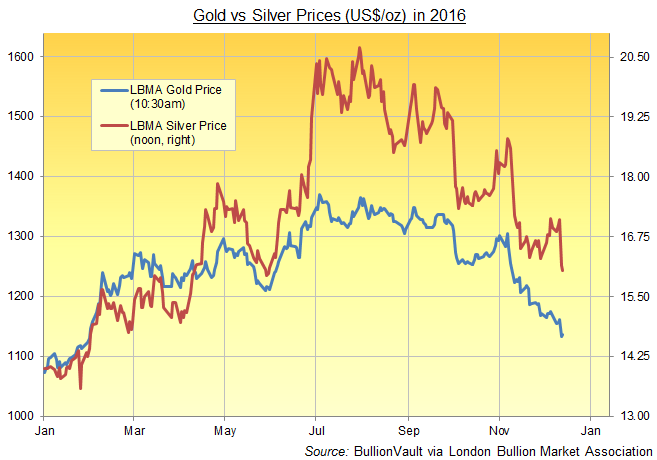
Overtaking gold’s gains in April, silver prices added 48% from New Year at early July’s peak of $20.71, while gold bullion peaked with a gain of 28% at $1375 per ounce.
 
Silver has since cut its 2016 gains to 14% – well over twice gold’s 5.6% year-to-date return – fixing just above $16 per ounce at midday in London today.
Chart of London benchmark gold and silver prices in 2016. Source: BullionVault via LBMA
 
Chinese gold prices ticked down Friday to the lowest since April, fixing in Shanghai at 261 per gram shortly before the Yuan sank to a new 8.5-year low versus the Dollar.
 
That relative strength in Yuan prices helped pushed the Shanghai gold premium, over and above Dollar prices for London settlement, out to new 3-year highs at $40 per ounce.
 
Ahead of the key Chinese New Year season for consumer demand, dealers and analysts report that Beijing is restricing gold import licences, curbing inflows – and so boosting domestic prices versus global quotes – in an attempt to stem outflows of capital, seen dragging the Yuan further down.
 
Government bond prices meantime rallied Friday morning from the last 5 weeks sharp losses, nudging the annual yield offered by 10-year US Treasuries down from this week’s 30-month highs above 2.60%.
 
Commodities held flat overall, with US Nymex crude oil contracts rising back above $51 per barrel but copper falling again to trade almost 5% below early December’s 18-month high.

Gold Prices Sink Back to Feb', Silver -7.5% as US Fed Sees 3 2017 Rate Hikes, Bond Yields 'Break 35-Year Downtrend'

GOLD PRICES sank to new 10-month Dollar lows Thursday as the US currency surged and Asian stock markets followed Wall Street lower after the Federal Reserve raised its key interest rate for the second time in 12 months.
 
With the gold price losing $35 per ounce to $1126 between the Fed announcement and lunchtime today in London, analysts claimed the rate rise “was priced in” but gold’s drop reflected shock at the Fed’s outlook for more rate hikes in 2017.
 
Commodities meantime fell over 1%, with US crude oil falling back near $50 per barrel, as government bond prices fell everywhere, pushing longer-term interest rates higher.
 
Giant gold-backed investment fund the SPDR Gold Trust (NYSEArca:GLD) shrank Wednesday by the equivalent of almost one day’s entire global gold-mining output, retreating as shareholders liquidated to the smallest size since mid-May at 849 tonnes.
 
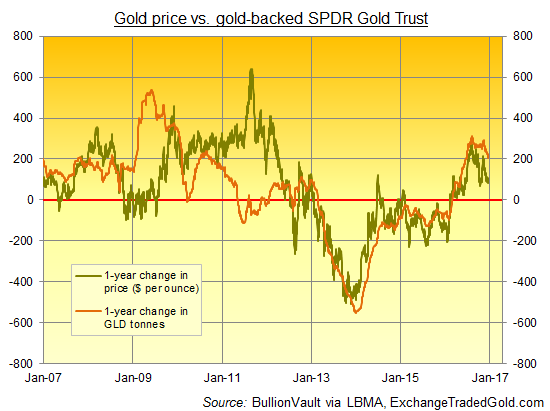
Shedding 12 days-worth of global mine output over the 5 weeks since Donald Trump’s victory in the US election, the GLD has now gone 25 trading days without any inflows, the longest stretch since the Fed’s first rate-hike from zero after 7 years in December 2015.
 
Gold prices then touched $1045, the lowest since early 2010, before jumping 14% by the end of January this year and rising again to $1375 in the aftermath of the UK’s Brexit referendum of late June.
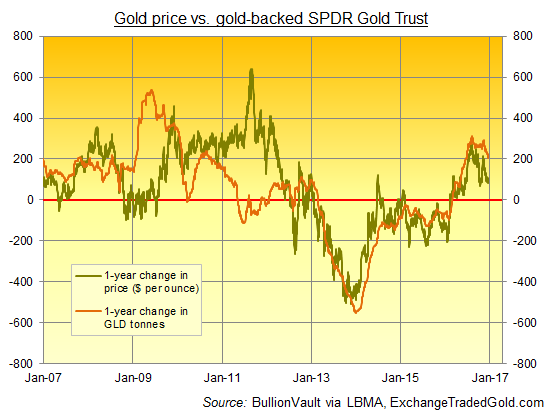
Chart of GLD gold holdings, year-on-year change in tonnes, versus y-o-y change in US Dollar gold price per ounce. Source: BullionVault via LBMA, ExchangeTradedGold.com
 
Like gold priced in Dollars, the Japanese Yen today reversed all its gains versus the US currency back to start-February’s level, while the Euro cracked through its floor at $1.0450 to hit its lowest USD value since December 2002.
 
That buoyed the gold price above last week’s 6-month low of €1078 per ounce.
 
Silver meantime sank 7.5% versus the Dollar from before the Fed announcement – more than twice the drop in gold prices – hitting near-7 month lows at $15.92 per ounce.
 
“The sell-off in [gold] ETFs is the result of lack of investor appetite,” says Australasian bank ANZ’s analyst Daniel Hynes.
 
“The weak physical markets in China and India are not really helping gold.”
 
“What gold is really reacting to,” Reuters also quotes Swiss bank UBS’s analyst Joni Teves – this year’s best gold price forecaster – “is the anticipation of three rate hikes next year instead of two.”
 
Raising rates from zero for the first time in 7 years last December, the Fed’s policy-making committee came into 2016 forecasting 1.4% interest rates by year-end, with rates rising again in 2017 to 2.4% and then 3.3% by end-2018.
 
Wednesday’s projections now see the Fed Funds rate at 1.4% by end-2017 – a whole year later than the forecast 12 months ago – with a rise to just 2.1% by end-2018.
 
“The pressure on gold is understandable if you look at yields, if you look at the Dollar,” Teves goes on.
 
“As long as yields are high, gold is going to struggle.”
 
Jumping as prices fell, 10-year US Treasury yields today rose to the highest since September 2014 at 2.60%, meaning that “the [35-year] bull run is definitely over” in US bond prices according to technical analyst Louise Yamada.
 
“Prices of bonds are going to go down and you are going to lose your capital,” says Yamada to Bloomberg News, which illustrates its story with a chart of 10-year yields showing the downtrend as a line joining 1981’s top at 16% to the last 3 years’ peaks.
 
The 10-year yields record lows of 1.45% in July 2012 and then 1.40% in July 2016 now mark a large “double bottom” Yamada adds, showing what technical analysis of price charts calls a strong “reversal pattern” pointing to a major upturn ahead.
 
Betting on Fed Funds futures contracts now predicts a third US central bank hike to overnight rates in June 2017, taking the ceiling to the highest since Lehman Brothers collapsed in September 2008 at 1.00%.
 
Government bonds worldwide fell hard with US Treasuries overnight, with Chinese sovereign debt prices dropping ‘limit down’ to suspend trading.
 
Shanghai gold prices held firm against the Yuan, which fell to its lowest Dollar value since before the Lehman Brothers’ collapse of late 2008.
 
With Beijing now restricting gold import licenses, that buoyed the Shanghai premium – over and above London quotes for gold in Dollars – to a new 3-year high at $38 per ounce.