Author Archives: City Gold Bullion

Bearish Betting on Silver Creates 'Short-Term Contrarian Play' as Gold Slips, Trump Whacks Tech Stocks

GOLD PRICES edged lower against a rising US Dollar in London trading on Tuesday morning, erasing one-third of Easter Monday’s near-$20 gain as European stock markets caught up with Wall Street’s latest fall, dropping 0.5% by lunchtime.
 
With analysts blaming US President Trump’s trade war with China and latest Twitter attacks on e-tailing giant Amazon for the drop in world stock markets, major government bond prices held steady, keeping the yield offered by benchmark 10-year US Treasury debt near its lowest level since end-January at 2.74%.
 
Prices for industrial, energy and agricultural commodities steadied after Monday’s drop, but silver also retreated with gold prices, holding in the middle of its last 2 months’ trading range at $16.55 per ounce.
 
Platinum prices fell harder, dropping back near last week’s new 2018 lows at $929 per ounce.
 
After new data Monday showed manufacturing growth slowing in China, new surveys today said Germany slowed again in March from December’s all-time peak on the Markit PMI index, while the UK gave its weakest quarterly reading in a year.
 
Yesterday’s ISM manufacturing index in the US missed analyst forecasts, and “critically, orders sagged to a 7-month low and production touched a 5-month low,” notes economist David Rosenberg at Canadian wealth management firms Gluskin Sheff.
 
But input costs on the ISM’s Prices Index leapt, with no US industrial sector reporting a decrease in prices compared to February as March gave the most inflationary reading since April 2011 set the 5th highest figure since the end of the 1970s.
 
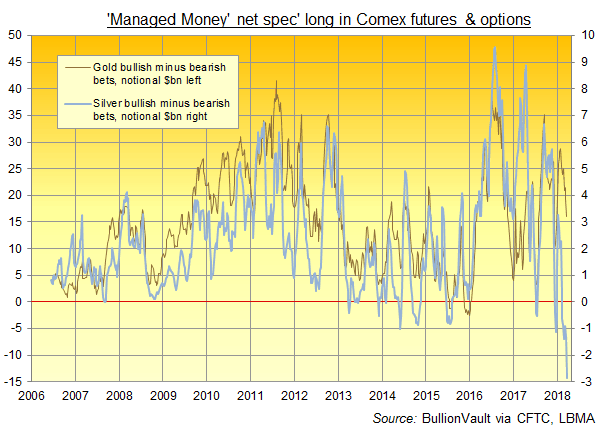
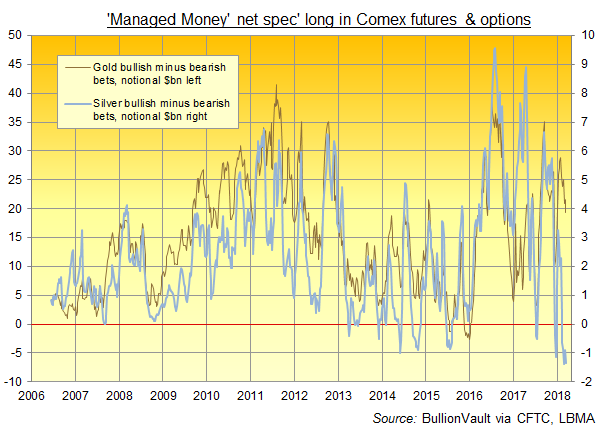
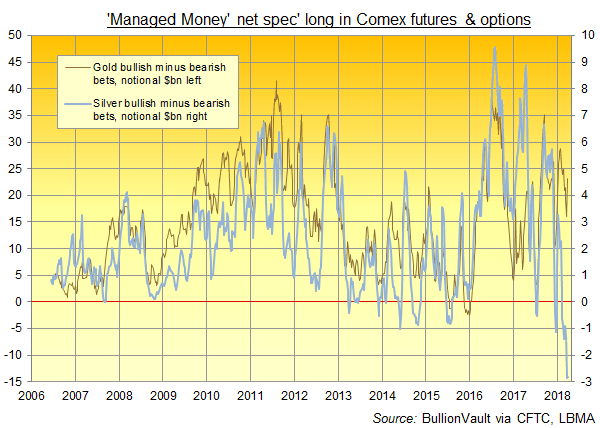
That month saw silver prices come within 50 cents of 1980’s all-time peak at $50 per ounce, with bulllish betting on Comex futures and options by hedge funds and other money managers setting what was then a new record net of that group’s bearish bets at a notional $6.7 billion.
 
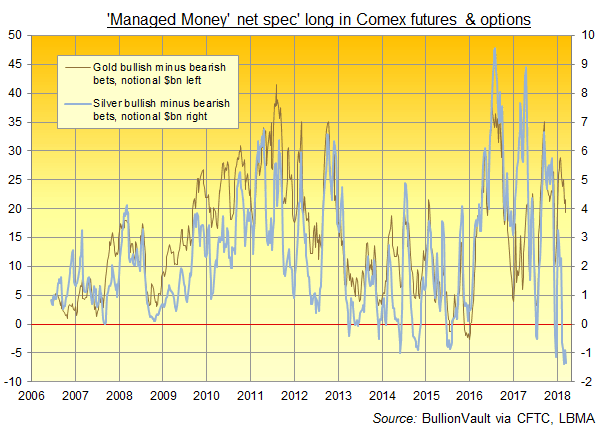
Last week in contrast saw the Managed Money hold a net bearish position on Comex silver contracts for the 7th week running, the longest net negative stretch since late 2014 with a notional value of -$2.8bn.
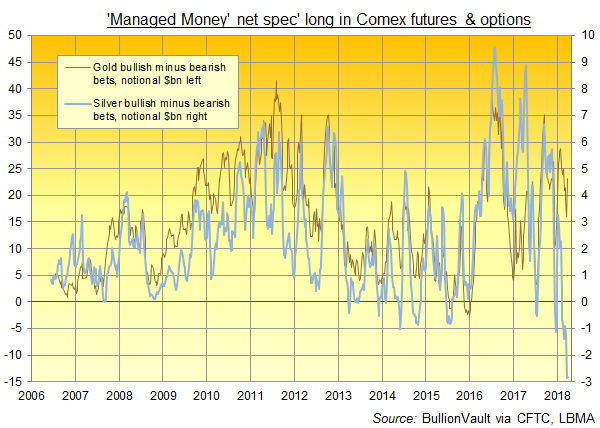
 
Chart of Managed Money category's net speculative Comex positioning on gold vs. silver, notional $bn. Source: BullionVault  via CFTC
 
In stark contrast to silver, Comex gold last week saw Managed Money speculators slash their bearish bets by one third and grow their bullish bets by more than a quarter.
 
Together that grew the Managed Money’s net speculative long position by 41.9%, the largest weekly jump since August.
 
“[The silver] positioning is not extreme,” says a note from China-owned commodity house and London bullion clearing bank ICBC Standard.
 
“To classify in that bracket would arguably require money managers to hold an unprecedentedly large short. But [it] clearly creates the scope for a [short term] positioning driven correction…[especially] when considered against money managers’ positioning in gold.”
 
The Gold / Silver Ratio of the two precious metals’ prices continued to hold above 80 on Tuesday, putting gold near its most expensive versus silver since the early 1990s.
 
“In the very short-term,” says ICBC Standard’s note, “we think there is a case for a reversal…but over time we see few reasons to believe that the ratio is subject to any kind of cap.”
 
Dipping below $1337 per ounce by lunchtime in London, gold priced in the US Dollar stood 2% below late January’s 18-month peak.
 
The broad US stock market has since lost 10% from then, when the S&P 500 index set a new all-time record high.
 
From the peak of the Nasdaq 100 on 12 March in contrast – since when the tech-stock index has also now lost 10% – gold today traded 1.3% higher.
 

T-Bond Yields Up, Gold Up for Longest Stretch Since 2006 as S&P Falls for 1st Quarter in Nearly 3 Years

GOLD PRICES slipped to new 1-week lows against most major currencies on Thursday in London, but held on track for the highest close to a calendar quarter in 5 years in US Dollar terms.
 
Crude oil retreated again from Tuesday’s new 2018 highs and silver fell harder than gold prices, dropping to $16.24 and losing over 4% for 2018 to date.
 
Platinum prices erased all but 0.6% of this quarter’s previous $100 per ounce jump to slip below $935.
 
With London and New York set to shut Friday for the long Easter weekend, gold dropped back to $1324.50 per ounce on the last trading day of March.
 
That cut the gain from New Year’s Eve to 2.1% but showed a 6.4% rise from end-March 2017 – the strongest annual Q1 gain since 2012.
 
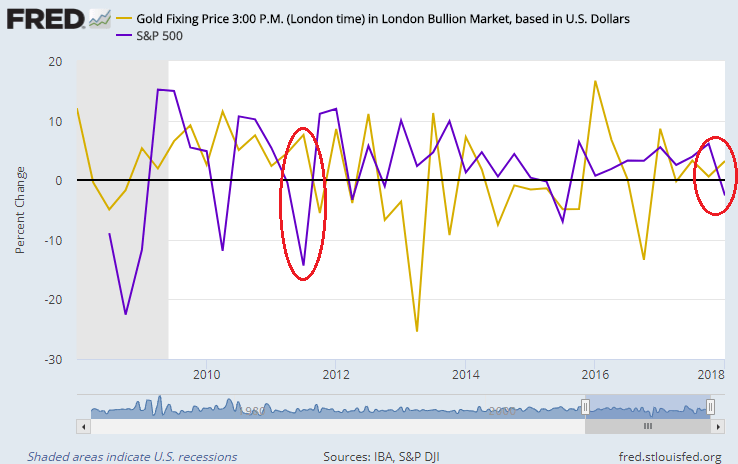
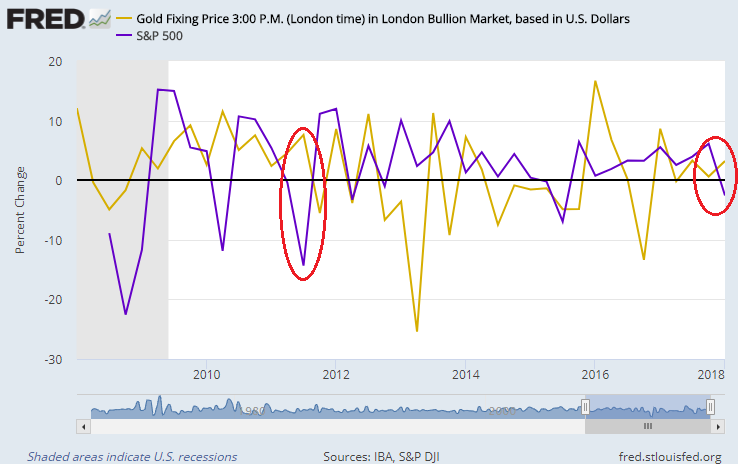
The US stock market in contrast was on track for a 2.5% loss for 2018 to date as New York opened today – its first quarterly drop since mid-2015 and the first time stocks fell as gold rose since Q3 2011.
 
Chart of S&P500 index vs. Dollar gold prices. Source: St.Louis Fed
 
Asian and European stock markets rallied again on Thursday from this month’s hard sell-off.
 
But Japan’s Topix index still held on track for a 6.2% quarterly drop while the EuroStoxx 50 neared a 4.3% loss for 2018 to date.
 
Major government bond prices meantime held onto their recent gains, keeping the interest rate offered by medium-term German Bunds and UK Gilts near the lowest levels since January.
 
Interbank borrowing costs for 3-month Dollar loans have in contrast now risen 37 trading days in a row according to Bloomberg data, the longest such run since 2005.
 
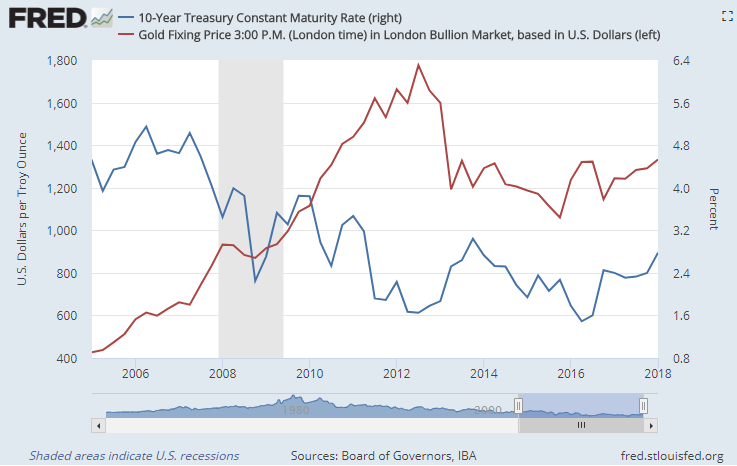
Like gold, the benchmark 10-year US Treasury yield has also now risen 3 calendar quarters in succession.
 
That’s the longest run that US bond yields have risen alongside Dollar gold prices since mid-2006.
 
Chart of 10-year US Treasury bond yields vs. Dollar gold prices. Source: St.Louis Fed
 
With the US Federal Reserve widely expected to follow this month’s rate hike with another in June, “The Fed generally tightens rates until something breaks,” says the latest ‘Alternative View’ on global strategy from the always gloomy Albert Edwards at investment bank Societe Generale.
 
“Since 1950 there have been 13 Fed tightening cycles,” says the SocGen note, citing Gluskin Sheff strategist David Rosenberg, “and 10 of them ended in recession, while the others have often ended in emerging market blow-ups, like the 1994 Mexican Peso crisis.”
 
Bad loan levels for smaller US banks are “surging” says Edwards. “The breaking point for the economy may come sooner than the Fed and [stockmarket] bulls expect.”
 
New UK data from the Office for National Statistics meantime said today that British households accumulated more debt than assets in 2017 – the first such negative move in the sector’s net wealth since current records began in 1987.
 
Yesterday’s sharp drop in Dollar gold prices – down over $30 from Tuesday’s 5-week high – saw the giant SPDR Gold Trust (NYSEArca:GLD) hold unchanged in size, needing an 8-session low of 846 tonnes of bullion to back the ETF’s shares in issue.
 
Yuan gold prices fell overnight in China but less steeply than global Dollar quotes, pushing the premium for metal delivered in Shanghai to almost $11 per ounce – the largest incentive for new imports into the No.1 gold consumer nation of 2018 so far.
 
Rupee gold prices in No.2 consumer India also rose relative to global Dollar quotes this week Reuters reports, “on an improvement in demand for weddings and hopes that retail purchases will rise next month” for the Hindu festival of Akshaya Tritiya.
 
Wholesale bullion prices in the import hub of Ahmedabad rose to $0.50 per ounce after accounting for India’s 10% gold import duty, the largest incentive for new inflows for 2 weeks.

Silver Piles Up in Warehouses Amid FANGs Sell-Off, Gold-Silver Ratio Near 2-Year High

GOLD BULLION again dipped to $1340 per ounce Wednesday morning in London and silver prices also re-touched their lowest since Friday as world stock markets extended yesterday’s 1.7% drop in US equities.
 
Commodity prices fell for a second day as US bond prices jumped again, pushing the yield offered by 10-year US Treasury debt down to 2.76% – the lowest rate since early February.
 
While gold yesterday touched 5-week highs against the Dollar at $1356 – heading for its highest quarterly finish since the 2013 gold crash – silver prices managed only a 2.5-week high, dipping today to $16.46 to head for a 2.6% loss from New Year 2018.
 
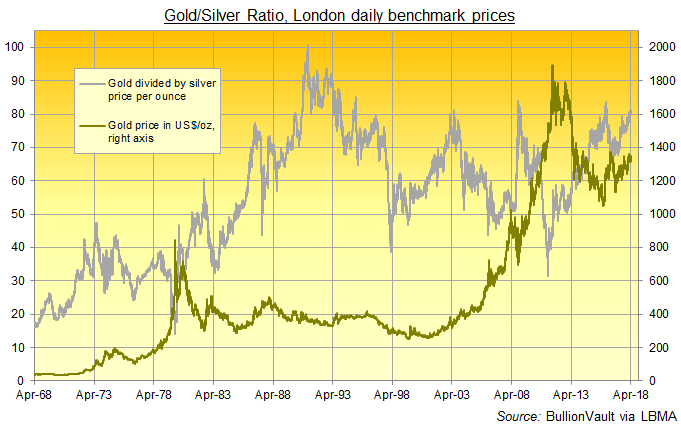
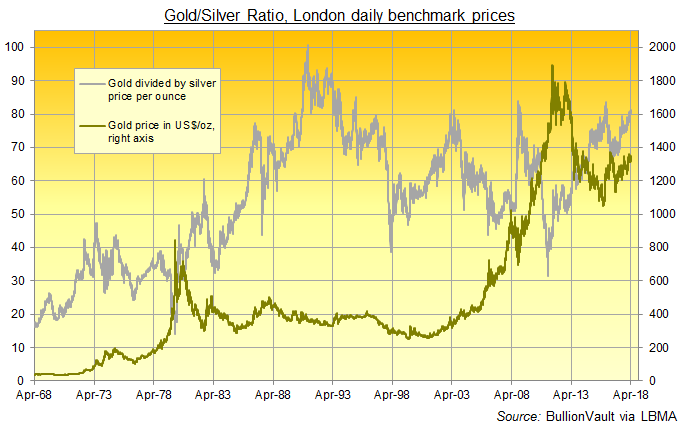
With silver easing back in lock-step with gold today, the Gold/Silver ratio – which measures how many ounces of silver you could get for an ounce of gold – held at 81.3, just shy of this month’s peak.
 
“Resistance is at 81.86,” says London bullion clearing bank Scotia Mocatta’s New York office in a technical note, pointing to that 2-year high.
 
“Support is at 80.27 – the 23.6% Fibo retracement level of the Jan-March rally” in gold’s value relative to silver.
 
Chart of Gold/Silver Ratio using London daily benchmarks. Source: BullionVault via LBMA
 
With industrial use accounting for 55% of annual demand according to Washington-base trade group the Silver Institute, consumption of the metal is more exposed to poor economic growth and sentiment than gold, which now finds only 10% of demand from industrial applications.
 
Last time the Gold/Silver Ratio held above 80 was in 2016, when the growth rate in world No.2 economy China slowed.
 
Before that was during the financial crisis in 2008, with all-time highs above there set during the global economic recession of the early 1990s.
 
“There’s just not many people looking to buy silver at this point in time,” MarketWatch last week quoted Walter Pehowich, senior vice-president at US precious metals wholesaler Dillon Gage, pointing to the recent jump in the quantity of silver stockpiled in Comex approved depositories in the United States.
 
Silver holdings in London’s specialist wholesale vaults grew by 11% in the 12 months to November, the latest data available from trade body the London Bullion Market Association.
 
“Short covering is likely to have occurred during the recovery of prices,” says the latest weekly note from strategist Jonathan Butler at Japanese conglomerate Mitsubishi, because “before [last week’s rate-hike] news from the Federal Reserve, silver futures investors became extremely bearish.
 
“Gross short positions [were] the highest since July 2017 and 95% of that all-time high. [That] pushed the net long book [in speculative futures contracts] to a fresh all-time low…in danger of the market going net short.”
 
Counting both silver futures and option contracts, the Managed Money category of Comex speculators last week held their most bearish position on record.
 
“Evolving within a choppy consolidation, silver has so far defended the upward sloping trend drawn since December 2015 at $16.20/16.01,” says a technical analysis from French investment and London market-making bullion bank Societe Generale.
 
“That also represents the lows of February and the [Fibonacci number] 76.4% retracement from December last year.”
 
Tuesday saw the collective share price of the so-called FANGs – Facebook, Apple, Netflix and Google – suffer their worst ever 1-day plunge, dragging the tech-stock Nasdaq index down to its worst 1-day drop since 2016.
 
Wednesday’s share-price drop knocked 1.0% off Tokyo, 2.5% off Hong Kong and 1.8% off Shanghai.
 
European equities stood 1.0% lower by late-morning in Frankfurt, trading over 5% down from this time last year on the EuroStoxx 50 index.
 

'Politics Driving' Gold Spike But 'Glass Half Full' Stock Rebound Sinks Price $15, GLD Shrinks

GOLD PRICES slipped from an overnight spike to fresh 5-week highs against the falling US Dollar on Tuesday, dropping 1.1% as world stock markets jumped, extending yesterday’s strong rebound on Wall Street.
 
After suffering its worst week since gold prices peaked in 2011, the US stock market yesterday recorded its strongest 1-day gain since late 2015, with the Dow Jones index showing its third-ever largest points gain.
 
Tuesday’s jump in equity prices added 2.7% to Japanese shares and 1.9% to Germany’s stock market, cutting their losses from this time last month to around 4%.
 
London’s FTSE100 of primarily global stocks rose almost 2.0% for the day even as the Bank of England – widely expected to hike UK interest rates at its next meeting – warned that “a loosening of credit conditions” in mortgage lending to higher-risk borrowers may force it to take “targeted policy action“. 
 
“Investors are still viewing this as a glass half-full market and a constructive economy,” says Seattle asset group US Bank Wealth Management’s Rob Haworth, “so it’s not surprising to see them buy on value here, buy on dips to try to rebuild their positions.”
 
Gold prices dropped $15 by lunchtime in London having touched $1356 per ounce overnight in strong Asian trade.
 
Monday afternoon’s price of $1352.40 had marked gold’s highest benchmarking since late-January’s 17-month highs, some 3.0% higher from one week before.
 
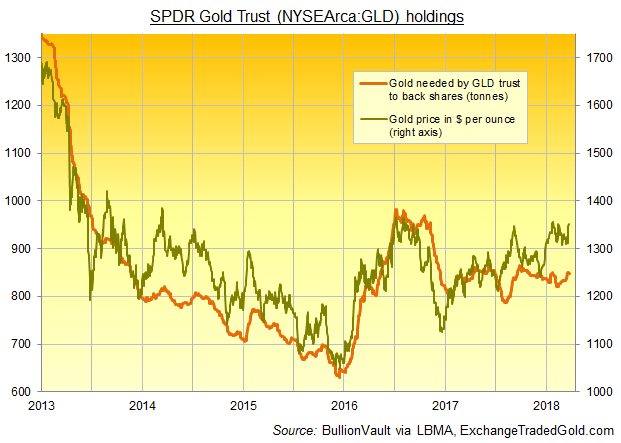
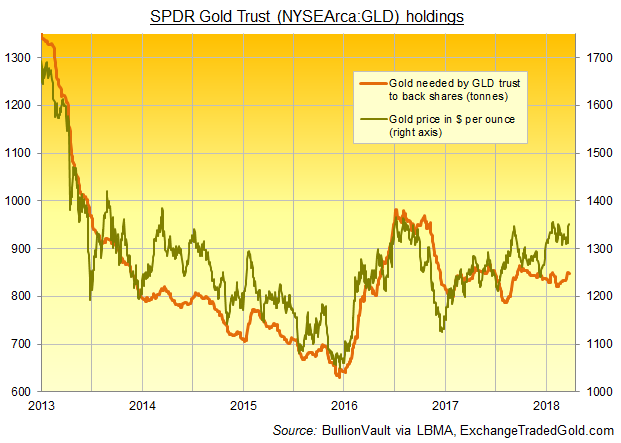
But investment through giant trust fund proxy the SPDR Gold Trust (NYSESArca:GLD) shrank however, needing 3 fewer tonnes of bullion to back the value of its shares in issue.
 
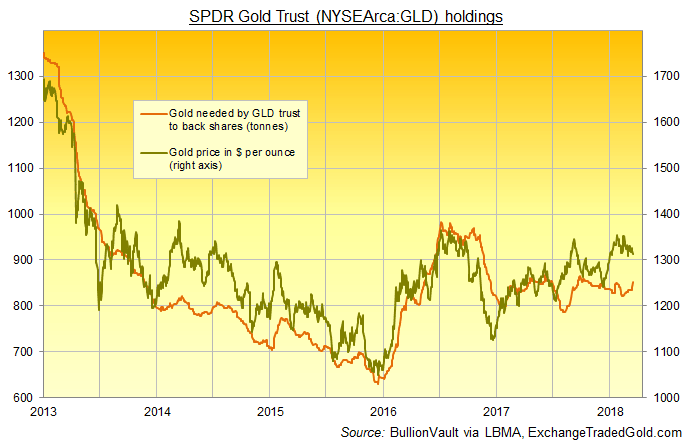
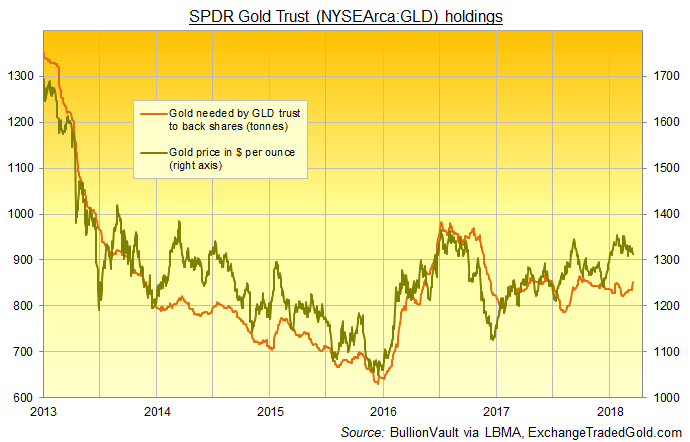
The GLD’s holding last week reached a 5-month high of 850 tonnes as gold prices fell towards their lowest levels of 2018 to date.
 
Chart of SPDR Gold Trust (NYSEArca:GLD) bullion backing in tonnes. Source: BullionVault via ExchangeTradedGold
 
“The latest political tensions [have been] pushing the prices of precious metals,” reckons a note from Belgian refining group Umicore‘s trading desk, pointing to the United States’ expulsion of 60 Russian diplomats over the Skripal nerve agent poisoning in Britain.
 
The Russian foreign ministry today reproached the US and other nations for not delaying their action amid news of 64 deaths in a fire at a shopping mall in the Siberian city of Kemerovo.
 
Press reports on Tuesday meantime speculated that North Korea dictator Kim Jong-un visited Beijing at the weekend as part of denuclearization talks ahead of potentially meeting US President Donald Trump.
 
The Dollar fell sharpest against the Chinese Yuan on Tuesday, hitting new 2.5-year lows at its weakest since Beijing devalued its currency in August 2015.
 
That failed to stop the Shanghai gold premium – the incentive for new imports into China, and so a measure of supply vs. demand in the No.1 consumer nation – recovering towards their typical level at $8.35 per ounce.
 
Major government bond prices meantime rose again on Tuesday, pushing longer-term interest rates further below their recent multi-year high.
 
Most industrial commodities also rose, but silver and platinum prices followed gold lower after spiking to 3-week and 2-day highs respectively, also trading back around last week’s closing levels of $16.58 and $949 per ounce.

Gold and Silver Jump, Burning Comex Shorts as Dollar Falls, Stocks Bounce Amid US-China 'Trade War' Detente

GOLD PRICES rose and silver jumped against a falling US Dollar on Monday in London, trading near 5-week and 3-week highs respectively as global stock markets bounced amid negotiations between the US and China to avert a ‘trade war’ between the world’s two largest economies, writes Steffen Grosshauser at BullionVault.
 
Gold overnight in Asian trade touched $1350 per ounce before falling back to Friday’s close at $1347 only to reach $1352 in London trade.
 
Silver meantime touched jumped to $16.76 per ounce, pulling the Gold/Silver ratio – which measures how many ounces of silver you could get for an ounce of gold – a little lower from a 2-year high of 81.
 
After Beijing retaliated against US President Donald Trump’s raft of import tariffs last week, Treasury Secretary Steve Mnuchin said Sunday he’s working with Beijing counterparts to cut the United States’ huge trade deficit with China.
 
“We’re having very productive conversations with them,” Mnuchin told Fox yesterday.
 
The US Dollar remained under pressure, extending its fall to a 5-week low on the FX market as the ‘safe-haven’ Japanese Yen slipped back from a 16-month high.
 
Euro gold prices slipped Monday from their highest Friday close in 10 weeks, edging back to €1086 per ounce.
 
Asian equity markets were mixed, but most European shares advanced as crude oil dipped below $70 per barrel – a 3-year high when reached this January.
 
The New York stock market opened higher from its worst 1-week drop since September 2011 – the month when Dollar gold prices hit their all-time peak of $1920 per ounce.
 
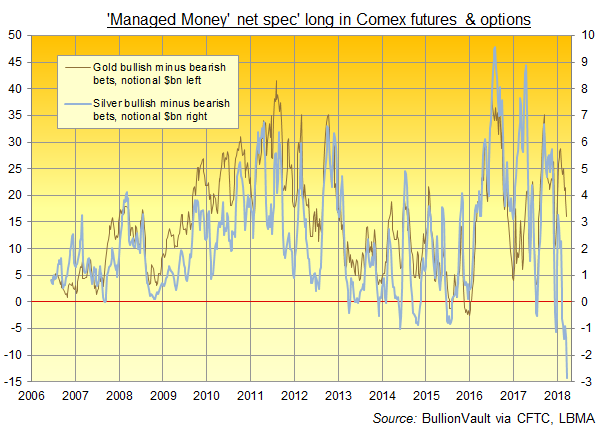
Ahead of last week’s jump in gold prices, hedge funds and other large speculative investors decreased their net-long position in Comex gold derivatives by 16%, according to the latest Commodity Futures Trading Commission (CFTC) data, cutting it to the smallest since end-December.
 
Managed Money speculators in Comex silver contracts meantime extended their net negative position, taking it to the largest bearish bet since current records started in 2006.
Chart of Managed Money net speculation, notional USD, on gold vs silver derivatives. Source: BullionVault via CFTC
 
“On the surface, it looks like the ETF holders got it right,” reckons Frances Hudson, a strategist at UK’s Aberdeen Standard Investments, pointing to last week’s rise in the share issuance by exchange-traded funds backed by gold.
 
The size of the world’s largest gold-backed exchange-traded fund, the SPDR Gold Trust (NYSEArca:GLD), grew by 10 tonnes to reach a 5-month high of 850 tonnes.
 
“It could just be they’re using gold as a hedge against things that hit the headlines and maybe the hedge funds haven’t been focused so much on political news.”
 
“Much of what gold will do this week will be headline-driven, with trade news being front and centre,” said brokerage INTL FCStone’s analyst Edward Meir.
 
“A mild early session bid tone to the bullion during Asian trade on Monday, and was soon extinguished by resting offers around $1350, as participants looked to take profits ahead of key resistance levels,” noted precious metals trader Sam Laughlin at Swiss refining and finance group MKS Pamp.

Gold Jumps as 'Trade War' Hits Stocks, 11-Year Record in Link with Interest Rates

GOLD PRICES rose sharply against all major currencies on Friday, recovering even last week’s 1.5% drop in Japanese Yen terms while stocks and shares fell worldwide as Beijing hit back at Washington with plans for new import tariff rates on US goods arriving in China.
 
President Trump’s new $60 billion tariffs on a raft of Chinese imports to the US may be met with $3bn of tariffs on 128 US products, Beijing’s state-run Xinhua news agency said, “including pork, wine, and seamless steel tubes.”
 
After Wall Street sank 2.9% on Thursday – its 6th worst day of the last 5 years – the Shanghai stock market today lost almost 3% while Tokyo’s Nikkei index lost 4.5% for the day, closing almost one-tenth lower for 2018 so far.
 
London and Frankfurt fell less steeply, but both held over 4% down from this time last year.
 
Global equities have now dropped over 8% in US Dollar terms from January’s fresh all-time record high on the MSCI World Index.
 
That month’s gold spike to $1365 – approaching the highest Dollar prices since early 2014 – stands less than 1.5% above today’s spot-market high.
 
Major government bond prices meantime gave back a little of yesterday’s gains on Friday, edging longer-term US interest rates back up to 2.84% on the 10-year Treasury bond.
 
Following Wednesday’s widely-expected hike to the Federal Reserve’s key overnight rate, any move to “more aggressive tightening late in the year will [only] be because of a growing inflation threat,” TheStreet today quotes George Milling-Stanley, gold strategist at fund giant State Street Global Advisors.
 
“That will continue to leave real rates at low levels and will prove to be positive for gold.”
 
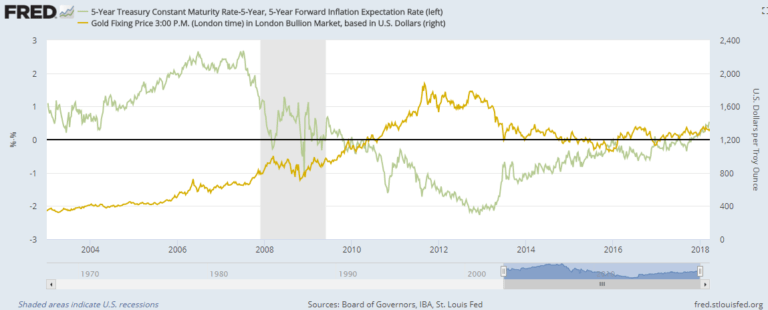
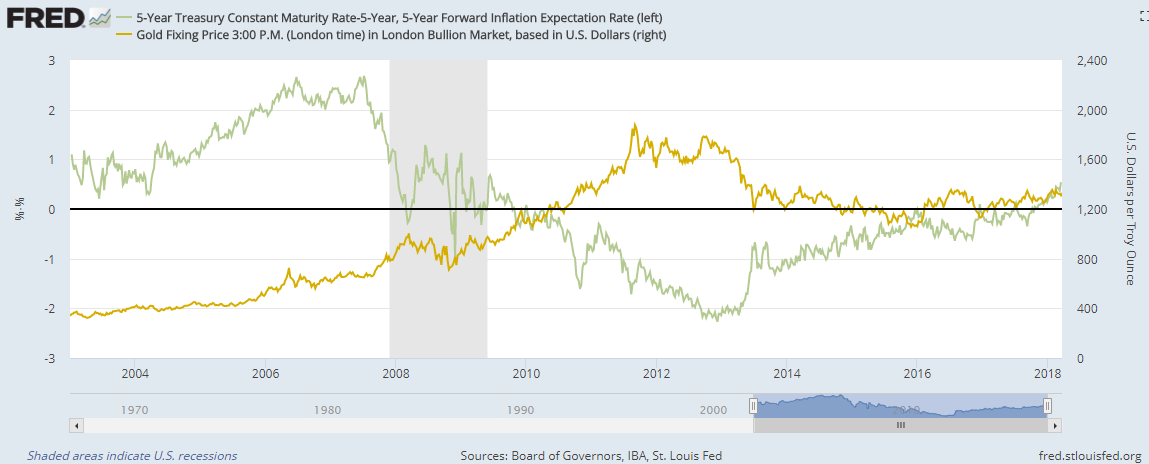
Gold prices typically move in the opposite direction to interest rates, showing an average correlation on a 52-week basis of minus 0.44 since 2003 with inflation-adjusted 5-year US bond yields.
 
That figure would read +1.0 if they moved in lockstep higher and lower together, or -1.0 if they had moved exactly opposite across the last 15 years.
 
Over the last 52 weeks however, gold’s co-movement with real rates has flipped to a correlation of +0.43 on BullionVault’s analysis today – the strongest positive connection since the end of 2006, when US home prices began to turn south, destroying sub-prime mortgage bond investments and –helping spur the global financial crisis of 2007-2012.
 
Chart of Dollar gold prices vs. inflation-adjusted 5-year US Treasury bond yields. Source: St.Louis Fed
 
Silver today re-touched Wednesday’s 1-week highs above $16.60 per ounce, recovering last week’s 1.5% drop to the lowest Friday finish of 2018 so far.
 
Platinum prices were more muted, halving last week’s 1.5% drop to reach $957 but ceding its crown to gold as the best-performing precious metal of 2018 so far.
 
Last year’s star, palladium has dropped 7.6% since 1 January.
 
Silver is also down, dropping 2.0% since New Year, while platinum stood 3.1% higher for 2018 to date at lunchtime in London on Friday.
 
Gold priced in the Dollar had gained 3.4%.
 
“A trade war will harm both the US and Chinese economies,” Reuters quotes Chinese mining giant Shandong Gold’s chief analyst Ji Ming.
 
“Any harm to the US economy will depreciate the Dollar, pushing gold higher.”
 
Gold prices also rose sharply outside the US currency however on Friday, jumping to regain almost all of last week’s loss for British investors and trading at the highest since January’s peaks in terms of the Euro.
 
Shanghai gold prices also neared January’s highs in the Yuan, closing 1.5% up for the week and holding the premium for gold landed in China – the largest consumer nation – at $8 per ounce above London quotes, just below the typical incentive offered to new imports.

Gold Prices Hit 2-Week Highs as Fed Sees No Inflation, Interbank Rates Spike Amid 'Trump Trade War' Fears

GOLD PRICES rose against all major currencies bar the Japanese Yen on Thursday, gaining after the Federal Reserve raised its key Dollar interest rate as expected but world stock markets fell amid what analysts called anxiety over US President Trump’s anti-free trade policies.
 
Dollar priced gold rose above $1330 per ounce and Euro gold prices reversed all of March’s previous 1.5% drop to trade at €1080.
 
The UK gold price in Pounds per ounce erased this week’s drop to the lowest since mid-December to trade back at £942 per ounce as the Bank of England held its key policy rate at 0.5%, more than two whole percentage points below the rate of consumer-price inflation.
 
Asian stock markets meantime closed lower and European equities then tumbled, losing over 1.5% on average ahead of a 12:30 announcement in Washington when Trump will unveil what an aide called “actions [against] China’s state-led, market-distorting efforts to force, pressure, and steal US technologies and intellectual property.”
 
Giving the shortest post-Fed-vote press conference yesterday since these quarterly briefings began in spring 2011, “There is no sense in the data that we are on the cusp of an acceleration of inflation,” said Powell, contrasting the “theory” of a strong jobs market leading to higher wages and prices with what the Fed currently sees.
 
Betting on Fed funds futures was little changed Thursday morning from before the March decision, with the consensus still matching the Fed’s own forecast for a total of 3 rate rises in 2018.
 
Bond prices rallied sharply however as global stock markets fell, driving longer-term interest rates lower as commodity markets retreated.
 
But “the acceleration in [costs in] the private borrowing market is the story of the year, not the Fed,” said US investment bank Morgan Stanley’s chief Asia strategist Jonathan Garner to Bloomberg this morning.
 
“That’s a key reason why [stock] markets have struggled.”
 
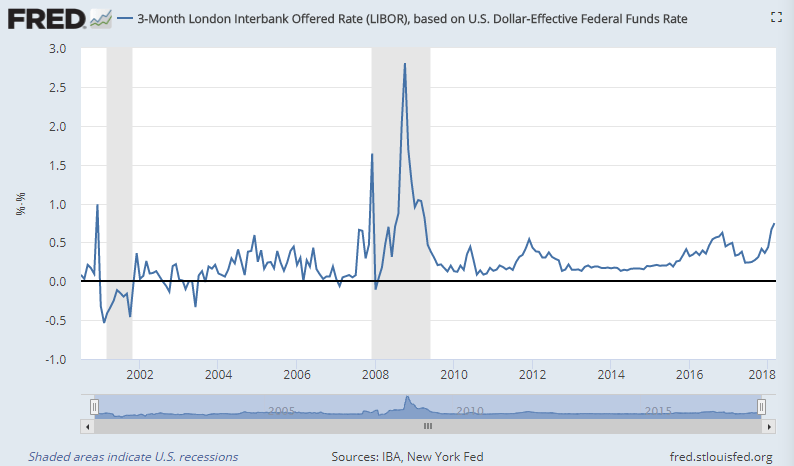
Last week already saw the gap between interbank lending costs and the US Fed’s overnight target rate rising at its fastest quarterly pace since late 2008’s global financial crisis, widening by half-a-percentage point from the turn of this year.
 
Three-month Libor today hit 2.2%, a full percentage point higher from this time last year.
 
This may be signalling an incipient squeeze in the offshore Dollar funding markets,” says London Telegraph economics editor Ambrose Evans-Pritchard, “the culprit that caused the 2007-2008 crisis to metastasize.
 
“[But] some say the recent move is a technical blip linked to US tax reform.  It is certainly not at acute danger levels yet.”
 
Chart of 3-month LIBOR minus the effective Fed Funds rate. Source: St.Louis Fed
 
Gold rose Thursday back towards the 2-week high of $1336 hit overnight following the US Fed’s decision.
 
Silver held at $16.50, some 2.3% above Tuesday’s 3-month low but still only halving last week’s drop.
 
Platinum prices retreated to $953, up 1.2% from Monday’s 11-week low to trade in line with last Friday’s finish.
 
“A full-blown trade war [looks] unlikely at this point,” says the latest weekly analysis from specialist consultants Metals Focus, but it “could have wider implications for global markets and for the gold price.”
 
Should the US impose yet more tariffs, tit-for-tat retaliation by China and the EU could weaken the Dollar “and benefit gold” by hurting the United States’ own export sales, Metals Focus says.
 
Worsening relationships could also “damage global trade and growth,” hurting world stock markets and spiking volatility, again boosting gold investment.
 
“Third, muted economic growth would most likely result in a slower pace of Fed rate hikes,” Metals Focus says, and “a shallower rate hike trajectory would be constructive for gold.”
 
European Union trade commissioner Cecilia Malmstrom yesterday said the 28-nation economic zone is likely to get an exemption from the United States’ new tariffs on steel and aluminum imports.
 
But for China, “In the front line would be firms with significant exposure to the US, mostly in the tech and consumer sectors,” reckons a note from French investment bank Societe Generale.
 
Shanghai’s stock market today slipped 0.8% to 2-week lows while on-shore gold prices in the world’s No.1 gold consumer nation rose to 2-week highs.

Gold: Fed Rate Hike 'Priced In' But 'Silly Moves' Due on Powell's 1st Presser

GOLD PRICES rose against all major currencies ahead of the Federal Reserve’s much-expected hike to Dollar interest rates on Wednesday, regaining last week’s $10 loss to trade above $1322 per ounce for US investors.
 
Silver regained half of last week’s 1.5% loss to reach $16.45 as the broader commodity markets also rose, as did longer-term US Treasury bond yields, taking the 10-year rate up to 2.90%, just 5 basis points beneath mid-February’s 4-year high.
 
European government bond yields rose more steeply on the day but held further beneath their recent highs, with UK and German 10-year rates touching 1.55% and 0.60% respectively.
 
“A [Fed] rate hike is largely priced in,” says Swiss bank and London bullion clearing provider UBS of current gold prices, “[so] there’s scope for a short-term relief rally in gold, which typically occurs after a Fed rate hike.
 
“But a hawkish tone could limit those prospects.”
 
“Jerome Powell’s first press conference post-FOMC as Fed chairman will be even more closely scrutinized than the rate announcement itself,” agrees a note from London brokerage Marex Spectron.
 
For gold prices, “Expect thin and nervous markets ahead of this, followed by some pretty silly moves.”
 
“While there can be no doubt about a 25-basis point rate hike,” says French investment and bullion bank Natixis, “the question is whether the [Fed’s forecasting] dots will be revised upward and will point to 4 rate hikes this year compared to 3 currently.”
 
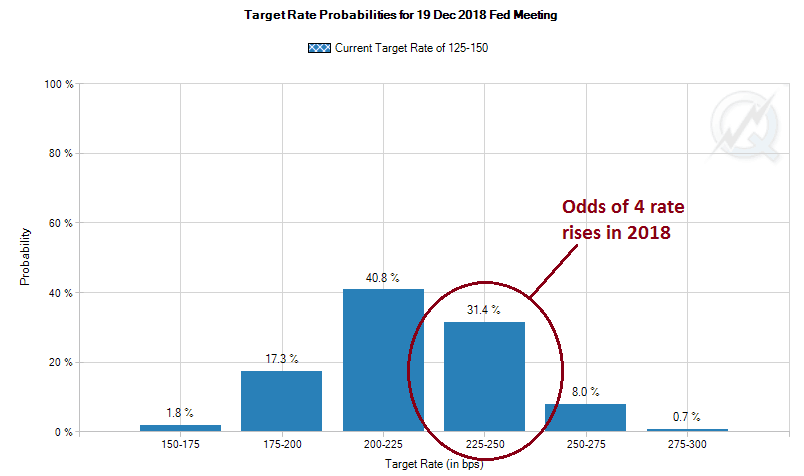
Latest data from derivatives exchange the CME Group say that speculative betting on Fed funds futures now puts the odds of a rate-rise to 1.75% at today’s meeting at 97.2%, up from 81.7% this time last month.
 
Another rate hike in June is now seen as 84.4% likely (up from 58.5% a month ago) while September’s meeting will take rates up again according to 52.2% of current betting (jumping from 37.3% a month ago).
 
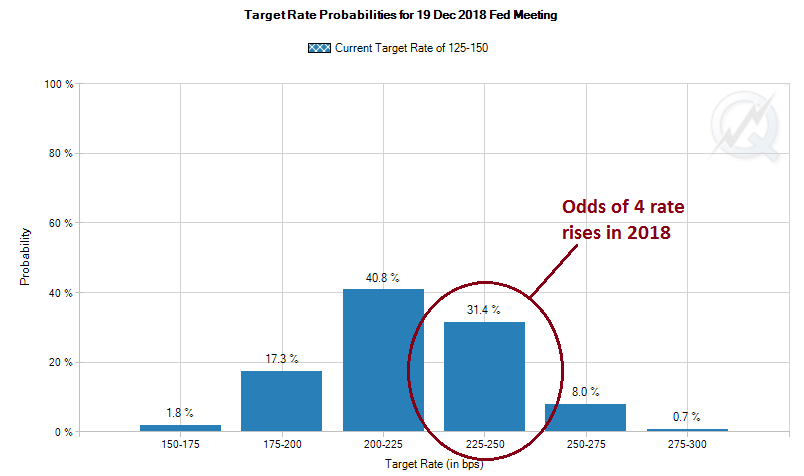
A fourth 2018 hike in December looks less certain however, with only 31.4% of betting through the CME predicting that Fed rates will end the year at 2.50%.
 
Even so, that likelihood has leapt from 21.7% this time last month.
 
Chart of Fed Funds forecasts derived from futures positioning. Source: CME Group
 
Longer-term, “Expectations are for gold to remain within the established range, struggling to break the highs seen in the past couple of years,” UBS’ bullion analysts go on, relaying sentiment from speaking to Swiss and New York investor clients.
 
“Most of those we spoke with give gold credit for its resilience to higher rates, yet also recognise that much of this has likely been due to US Dollar weakness.
 
“A few see gold pulling back below $1300, but a sharp and sizeable collapse in prices was not deemed likely.”
 
“Physical interest out of China continues to keep price action buoyant,” says a trading note from Swiss refiners MKS Pamp.
 
“As we head toward Wednesday’s FOMC rate decision, bullion has managed to edge away from the early March low of $1303 and the 100-[day moving average] of $1305.
 
“Both continue to act as strong supportive levels should the greenback see interest” and the Dollar rise around the Fed’s decision.
 
“Gold seems to have established a floor at multi-month graphical levels of $1302/1300, also the 100-day Moving Average,” agrees the technical analysis team at French investment and bullion market-making bank Societe Generale.
 
Gold’s 100-day moving average actually comes nearer $1305 says bullion clearing bank Scotia Mocatta’s New York office, adding that “momentum indicators are bearish.”

GLD and SLV Grow, Coin Dealers 'Awash' with Metal as Gold and Silver Fall Ahead of the Fed

GOLD PRICES rallied for the second time in two sessions from a dip below $1310 per ounce in London on Tuesday, holding onto a slight gain for 2018 to date against the Dollar ahead of tomorrow’s US Federal Reserve decision on interest rates, widely expected to bring the first of four quarter-point hikes this year.
 
World stock markets steadied as Facebook (Nasda:FB) held onto yesterday’s 12% plunge as founder and CEO Mark Zuckerberg was summoned by the UK Parliament‘s inquiry into ‘Fake News’ in relation to data consultants Cambridge Analytica’s apparent abuse of FB’s user privacy.
 
Silver extended the dip in gold prices, touching its lowest Dollar level since 22nd December in wholesale bullion trade at $16.13 per ounce.
 
Versus the British Pound, silver prices fell to £11.55 – the lowest since just before the UK’s shock Brexit referendum result of June 2016 – as Sterling rose again amid the expulsion of 23 Russian diplomats and their families over the Skripal nerve agent poisoning.
 
With the UK Government today under attack from so-called Brexiteers over its “transition” exit deal with the European Union, new data said Tuesday that consumer-price inflation in the world’s 5th largest national economy slipped back to 2.7% per year in February, retreating further from November’s 5.5-year high of 3.1% as “the price of petrol and food played a key part” in lowering the rate of growth.
 
Tuesday’s trading however saw Brent crude oil rise back towards the highest since January’s 3-year highs, rising above $67.50 per barrel.
 
Major government bond prices fell, edging 10-year US interest rates up to 2.88% and reversing last week’s move.
 
Giant gold-backed investment vehicle the SPDR Gold Trust (NYSEArca:GLD) meantime reported its heaviest 1-day growth since 18th January for Monday, with its sharpest month-on-month growth since 1st September at 2.8%.
 
On a rolling 22-day basis, the size of the GLD is now moving more strongly opposite to gold prices than any time since October.
 
Showing a median correlation from launch in 2003 to late 2017 of +0.42 with month-on-month changes in the gold price, the size of the GLD has switched to a -0.17 correlation with gold prices over the last half-year.
 
Chart of GLD gold ETF backing in bullion vs gold price. Source: BullionVault
 
Data for end-December put the proportion of GLD shares held by investment institutions and professional fund managers at 39.8%, the highest level since the UK’s Brexit referendum shock of Q2 2016.
 
“Those investors who bought and held gold out of fear of economic chaos have been pulling back from gold,” said a recent presentation from US-based consultancy CPM Group, “while investors more interested in capital appreciation have been buying.”
 
Reporting dismal US retail investment gold coin and small-bar demand in its latest market update, “Some might argue that the US Mint has become a victim of its own success,” say specialist analysts Thomson Reuters GFMS, “and every coin it sold in its [global financial crisis] glory days was in fact a golden nail in its own coffin.
 
“We don’t want to take it that far, but do acknowledge the unwillingness of the North American retail market to absorb more newly fabricated metal…A lot of trading has shifted to the secondary market, where discounts to newly fabricated products [have] retreated to unprecedented lows.”
 
Turning to silver coins, “Wholesalers are currently awash with inventory,” said longstanding coin dealers Asset Strategies International in a note to clients on Monday.
 
In contrast, the largest silver-backed ETF – the iShares Silver Trust (NYSEArca:SLV) – has swollen in size by 1.8% as silver bullion prices have fallen 8% from late-January’s 4-month highs, needing almost 200 tonnes extra of bullion to back its shares in issue.
 
All told, the SLV ended Monday needing 9,942 tonnes of bullion backing – the largest size since prices fell below $16 per ounce in mid-December.

Putin Landslide and Brexit 'Deal' Sees Gold Price in GBP Hit 3-Month Low Ahead of US Fed and BoE Rate Decisions

GOLD PRICES extended their losses on Monday morning in London after Russian President Vladimir Putin scored a landslide election victory ahead of interest-rate decisions by the US Fed and the Bank of England this week, writes Steffen Grosshauser at BullionVault. 
 
Already down 0.8% last week, gold priced in the Dollar slid to its lowest level since 1 March even as the US currency dropped on the FX market, falling from $1314 to $1307 per ounce to hold below its 100-day moving average – a key technical level for some analysts.
 
The UK gold price in British Pounds per ounce meantime sank to its lowest since mid-December at £931 per ounce as Sterling rose amid news of a Brexit “transition deal” between London and Brussels, extending elements of the UK’s current relationship from March 2019 to December 2020.
 
Tensions between the UK and Russia worsened however after British foreign secretary Boris Johnson claimed that Moscow revived its Soviet-era chemical weapons program sometime in the last decade, with the nerve-agent attack on former spy Sergei Skripal and his daughter Yulia “overwhelmingly likely” to have been ordered by the Kremlin.
 
Vladimir Putin was re-elected as Russian president by a landslide on Sunday, albeit with observers reporting several instances of vote-rigging.
 
With betting that the US Federal Reserve will raise Dollar interest rates at its meeting on Wednesday now above 94%, hedge funds and other large speculators cut their bullish bets on gold derivatives last week, new data said late Friday.
 
Net of the group’s bearish bets, the bullish position of Managed Money traders on Comex gold futures and options shrank 10% last week to the smallest net long position this year, according to US Commodity Futures Trading Commission (CFTC) data.
 
The Managed Money category held onto a net bearish position on silver for the 5th week running, the longest since mid-2015.
Chart of Managed Money category's net betting in US$bn (notional total) on Comex gold and silver derivatives. Source: BullionVault
 
In contrast to derivatives betting, the largest gold-backed ETF, the SPDR Gold Trust (NYSEArca:GLD), expanded last week to need 6.5 tonnes more gold backing, ending Friday with 838 tonnes.
 
The giant iShares Silver Trust (NYSEArca:SLV) has now regained all of the 230-tonne outflow seen on January’s sharp price rise, needing 9,922 tonnes to back its ETF shares.
 
Silver fell heavily on Monday, outpacing the drop in gold prices to reach $16.22 per ounce – a 2-week low when it touched this level last Friday.
 
Platinum prices briefly touched $941, the lowest level since 3 January, while sister-metal palladium traded sideways in a small range below the $1000 mark.