Author Archives: City Gold Bullion

Gold Price 'Set to Squeeze Bears' Again After Net Short Slashed 63%

GOLD PRICES slipped Monday morning, dropping $12 per ounce below last week’s 2.5-month high as China’s stock market rallied at its fastest since 2015 on a raft of ‘support’ promised by Beijing, writes Atsuko Whitehouse at BullionVault. 
 
Europe and other Asian equity markets rose less steeply, while gold prices traded down to $1221.50 per ounce.
 
International tensions meantime worsened over Saudi Arabia’s apparent murder of a US-based journalist, plus the UK Government’s attempt to conclude a Brexit deal with the European Union, as well as Italy’s planned 2019 budget deficit. 
 
“Supportive price action around $1210-1220 should restrict declines amid current global political uncertainty,” reckons the gold trading desk at Swiss refiners and finance group MKS Pamp.
 
“A test through $1230-1235 will likely squeeze further shorts out of the market and see gold toward $1250.”
 
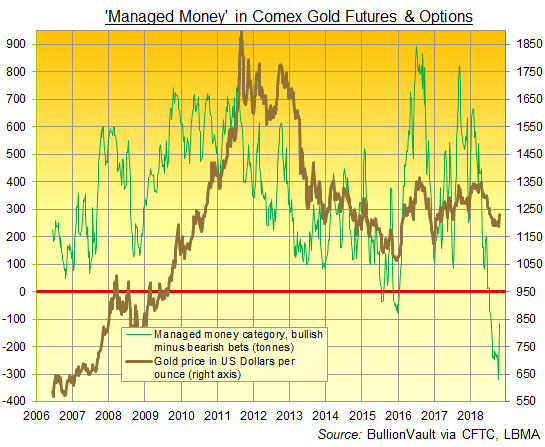
Starting from their heaviest net-negative betting against gold prices on record, hedge funds and other ‘Managed Money’ traders last week more than halved their bearish position on Comex gold futures and options, according to US regulator the CFTC.
 
Net of that group’s bullish bets, the overall short position fell 63% to the notional equivalent of 116 tonnes, remaining net negative for the 14th week running, still the longest period since this data series started in June 2006.
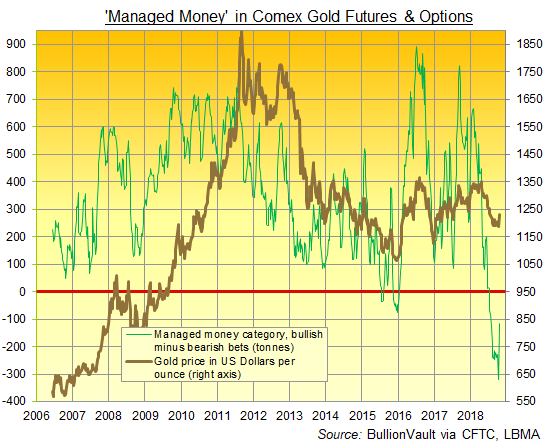
 
Chart of Managed Money net speculative position in Comex gold futures and options, tonnes equivalent. Source: BullionVault via CFTC
 
“After what has been a tense and terse month for Asia equities as a whole, they’re taking a breather, but that’s not to say volatility is going away,” reckons Kerry Craig, global market strategist at US investment bank J.P.Morgan’s asset management division.
 
The CSI 300 index of companies listed on the Shanghai and Shenzhen stock exchange – which sought to reassure investors about ‘share pledges’ used as security for big loans – closed up 4.3%, its largest one-day gain since November 2015, as the People’s Bank today injected $17 billion of ‘liquidity’ into China’s banking sector.
 
Answering Friday’s news of the slowest GDP growth in the world’s No.2 economy since the global financial crisis with promises of “support” for China’s financial markets, Beijing also released a plan to cut personal income taxes, while President Xi Jinping vowed “unwavering” support for non-state firms at the weekend.
 
Saudi Arabia’s foreign minister Adel al-Jubeir meantime told Fox News at the weekend that journalist Jamal Khashoggi was murdered by a “rogue operation” in Istanbul, leading US President Donald Trump to say there has been “deception” and “lies” in Riyadh’s story.
 
The UK, France and Germany issued a joint statement expressing saying “Nothing can justify this killing and we condemn it in the strongest possible terms.”
 
CCTV from Turkey shows a suspect in the murder wearing Khashoggi’s clothes.
 
Italy’s borrowing costs dropped early Monday after ratings agency Moody’s on Friday kept the country’s sovereign ratings above “junk bond” status, cutting Rome to Baa3 from Baa2 because of concerns over the coalition government’s spending and tax plans but potentially misreading the longer-term cost impact.
 
The yield spread on 10-year Italian government bonds over German Bund yields fell back below 300 basis points for the first time in a week, only to rise again in afternoon trade after the Finance Ministry said it is “necessary” to breach EU rules on Rome’s 2019 deficit.
 
Like Italy’s debt prices, the Euro currency failed to hold a rally, keeping gold prices for European investors near last week’s multi-month highs at €1063 per ounce.
 
The UK gold price in Pounds per ounce also moved sideways, trading at £940, after Dominic Raab, the Brexit Secretary, said he “understands” fellow Conservative Party members worried about the so-called “Chequers Plan” locking the UK into European Union rules and costs for an extended period.
 
Un-named backbench Tory MPs told The Sunday Times yesterday that Prime Minister Theresa May should “bring her own noose” to a meeting later this week, warning that “The moment is coming when the knife gets heated, stuck in her front and twisted. She’ll be dead soon.”
 
Saturday saw over 600,000 protesters march through Central London to call for a public vote on whatever Brexit deal is negotiated, with the majority of speakers opposing the 2016’s referendum’s narrow result.
Gold Prices Make Best Run Since January as Italy's Bond Spread Hits 340bp, US Threatens China, Saudi

GOLD PRICES slipped but held on track for the highest Friday finish since July for Dollar and Euro investors today, as the United States issued what one analyst reckons is a “final warning” to China over currency manipulation and Italy’s cost of borrowing rose to new 5-year highs compared to German Bund yields.
 
Trading $5 below Monday’s spike to 12-week highs at $1233 per ounce, gold prices have now risen for 3 weeks running – the longest stretch of US Dollar gains since January.
 
Crude oil rose back above $80 per barrel of Brent after US President Donald Trump also said “it certainly looks that” the Saudi government murdered US-based journalist Jamal Khashoggi in Istanbul, warning of “very severe” consequences – a threat already challenged by the oil-producing kingdom.
 
A key suspect in the murder has died in a “suspicious car accident” in Riyadh, claims Turkish newspaper Yeni Şafak.
 
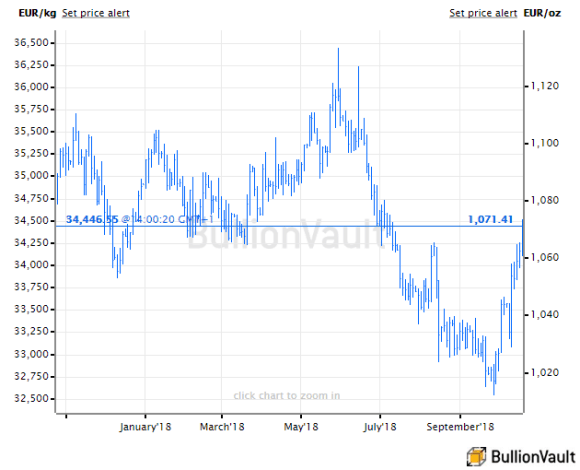
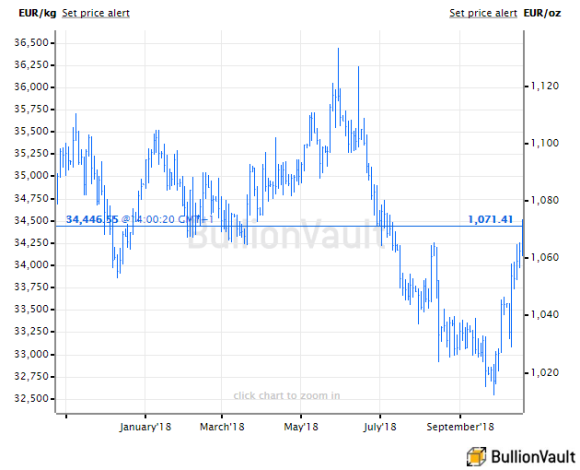
Priced in the falling Euro currency gold headed for its highest weekly finish since June at €1071 per ounce, rising 4.4% so far in October as the EuroStoxx 600 index has lost 5.7%.
 
Shares in European banks fell yet again Friday, reaching the lowest price since New Year 2016 as Germany said giant Spanish lender Santander has joined the list under investigation for the “cum ex” dividend tax credit fraud, thought to have cost Eurozone taxpayers €55bn over 15 years.
 
With Rome’s coalition government meantime facing a showdown with its EU partners over 2019’s deficit spending plans, the spread of Italy’s borrowing cost over comparable German Bunds today touched 340 basis points, a new 5-year high.
 
Chart of gold price in Euros, last 12 months. Source: BullionVault
 
Refraining from calling China a “currency manipulator” – a charge Beijing has repeatedly denied – the US Treasury last night said Washington is “deeply disappointed” the politburo won’t say when or if it intervenes in the FX market.
 
The Yuan today slipped to its lowest in 22 months, helping push the gold price for households and investors in the metals No.1 consumer market up to the highest since January.
 
Over in No.2 consumer market India, reports today varied wildly over the level of household gold demand during the Hindu calendar’s key festive season, set to culminate with Diwali in early November.
 
“Gold continues to be a safe haven for investors,” DNA quotes Surendra Mehta of the Indian Bullion & Jewellers Association (IBJA), “especially when they are rapidly withdrawing money from equity, bonds and Non Banking Finance Companies.”
 
But “gold jewellery sales have declined by 30%” from this time last year, the Times of India quotes Ahmedabad jeweler Kishore Zaveri.
 
“Only those who plan to buy jewelry for regular usage or weddings have pushed their purchases to this day,” he says, referring to Thursday’s Dussehra festival of good-defeating-evil.
 
“Markets around Delhi are still waiting for festival shoppers,” agrees the National Herald.
 
“According to shopkeepers, customers don’t have the money to splurge” thanks to the Rupee falling to new all-time lows in 2018, driving living costs higher and taking gold prices to multi-year highs.
 
Gold bullion imports to Indian rose 4% over the last 6 months versus the same period last year, says the Business Standard, “inflating the country’s trade deficit and fuelling worries about the current account deficit” with the rest of the world.
 
Gold priced in British Pounds meantime neared 11-week highs up at £944 per ounce, gaining 2.0% for the week as Sterling managed only a weak rally following news that the UK has struck a deal with Spain over the post-Brexit treatment of Gibraltor.
 
“Those issues on which we don’t agree,” said Spanish foreign minister Josep Borrell, “will be left for the transition period” of the UK’s exit from the European Union, now set to run until as late as 2021.

Short Covering in Gold Market 'Could See $1300' as Fed's 2019 Rate Hikes Hit Equities, Commodities

GOLD MARKET prices in the wholesale hub of London briefly slipped below $1220 Thursday morning after the US Federal Reserve signalled its commitment to continue raising Dollar interest rates in 2019.
 
Prices in the professional bullion market then rallied $5 per ounce as China’s stock market closed the day at a new 4-year low and the MSCI World Index of developed-market equities fell for the 15th time in 19 sessions.
 
The more industrial precious metals all fell harder than gold after Wednesday’s publication of minutes from the Fed’s September policy meeting, with silver, palladium and platinum prices all dropping back below last Friday’s finish – the strongest weekly close in 14 for platinum at $838 per ounce.
 
Brent crude oil meantime fell back below $80 per barrel for the first time in nearly 4 weeks despite US lawmakers calling on President Trump to force “consequences” on Saudi Arabia over Riyadh’s apparent murder of US-based journalist Jamal Khashoggi.
 
Now overtaken by the US as No.1 oil producer, Saudi Arabia has already threatened to “respond with greater action” if the scandal leads to sanctions against it.
 
“The gold market [was] set-up for a short-covering rally,” says new analysis from bullion-bank ICBC Standard, pointing to the last week’s $50 gain. 
 
“[There’s now] significant potential for a sharp short-covering rally back towards $1300,” the note goes on, as bearish traders cut their record negative bets on the metal amid this sharp drop in world stock markets.
 
“It is easy to see why gold prices are still down 6% year-to-date,” says the new Precious Metals Investment Focus 2018/2019, launched last night in London by specialist analysts Metals Focus.
 
“Expectations of further [US] rate increases have remained in place, bolstered by strong US consumer sentiment [hitting] an 18-year high and robust GDP growth in excess of 4%.”
 
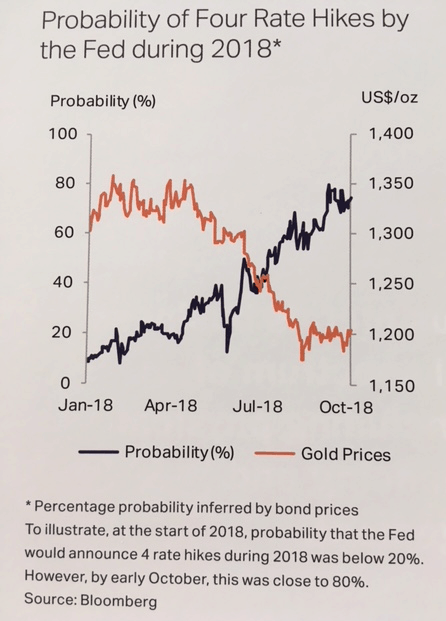
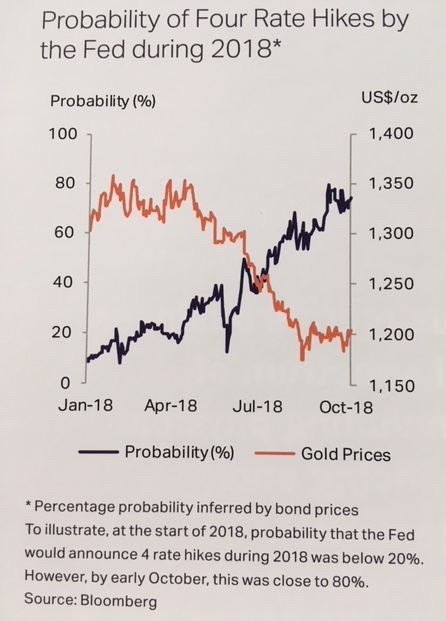
Gold prices vs. bond-market implied expectations for 4 US Fed rate rises in 2018. Source: Metals Focus
 
The fact that, prior to October, US equities “shrugged off” the risk of an economic slowdown from the US-China trade war also proved “a clear negative for gold”, Metals Focus goes on.
 
Together with rising US interest rates however, the threat of “protectionism…has led to a rout in [gold-consumer country] emerging-market currencies,” the consultancy adds, “and a flight to the safe haven of the US Dollar.”
 
“The last thing emerging markets or the US yield curve or equities want is a reminder that US rates are going to keep going up,” says Dutch bank Rabobank today, commenting on last night’s release of notes from the US Federal Reserve’s latest policy meeting.
 
The Fed’s policy team feels “there may be a greater risk associated with financial market excesses rather than traditional inflation,” adds fixed-income strategist Kathy Jones at brokerage Charles Schwab, also reading those notes.
 
Outside the Dollar, wholesale gold-market prices held firm for Euro investors on Thursday, trading near August’s high of €1065 per ounce as Italy’s left-right coalition government rejected calls from other European Union leaders to reduce its 2019 budget deficit plans.
 
Italy’s borrowing costs, over and above comparable German Bund yields, blew out to a new 5-year high at 3.25 percentage points.
 
The British Pound meantime fell to 1-week lows versus the Dollar as rumors spread that UK Prime Minister Theresa May wants to accept the EU’s offer of fudging Brexit and extending the “transition period” perhaps to 2021 – a suggestion immediately rejected by pro-Brexit members of her minority-government Conservative Party.

Gold Prices Firm Despite 'Resilient US Dollar', Waiting for 2019 'Trigger in Stock Market'

GOLD PRICES held firm Wednesday in London, trading $10 per ounce above last week’s finish even as the Dollar rallied on the currency market.
 
Crude oil edged back after 3 sessions of gains amid worsening political tensions over the apparent murder of a US-based Saudi journalist in Istanbul.
 
Asian equities rose for a second day after October’s 7.9% drop so far on the MSCI index, but European stock markets turned lower again.
 
The Dollar meantime pushed back the Euro and Sterling from new October highs and edged the Chinese Yuan – currency of the No.1 gold-consumer nation, where bank lending rebounded last month on Beijing’s move to ease monetary policy – back towards last week’s 17-month lows.
 
Thanks to the Rupee hitting new all-time lows, notes LiveMint, gold prices in India – now the No.2 gold-consumer market, where the Hindu wedding season is now underway ahead of Diwali – have risen 10% so far in 2018.
 
“Overseas gold has dropped 6%.”
 
Gold prices today hit $1228 in London trade, matching silver’s 0.7% gain for the week at $14.68 and outpacing platinum, now edging back below $838. 
 
“In spite of [Dollar-gold] price gains over the past week,” says specialist analyst Neil Meader at Metals Focus – launching the independent consultancy’s new Precious Metals Investment Focus 2018/2019 – “it remains the case that professional investors have spent much of this year either shunning the precious metals complex altogether or, over the past month or so, moving to the short side.”
 
Gold ETF trust-fund holdings last month last month to their smallest since August 2017 according to data from the mining-industry’s World Gold Council.
 
Hedge funds and other money managers then last week held their largest ever net bearish position on Comex gold futures and options according to data running since 2006 from US regulators the CFTC.
 
“Economic, geopolitical and financial market developments have mostly tended to be bearish for precious metals,” Meader explains. “In particular, the US Dollar received a boost from further US monetary tightening and growing market consensus of a more hawkish Fed…[plus] the windfall of the tax reform.
 
“Meanwhile, the trade war between the US and China saw a run emerge on emerging markets, which again boosted the US Dollar and US equities.”
 
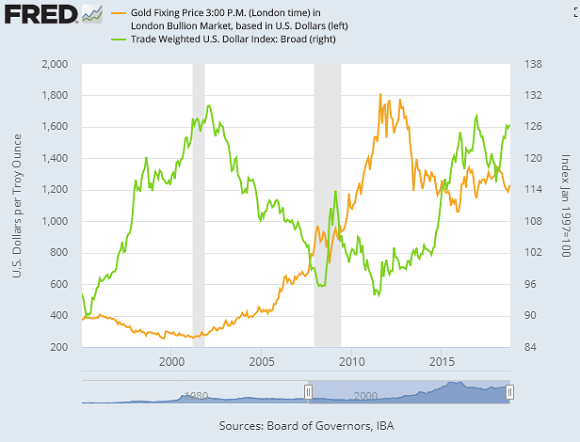
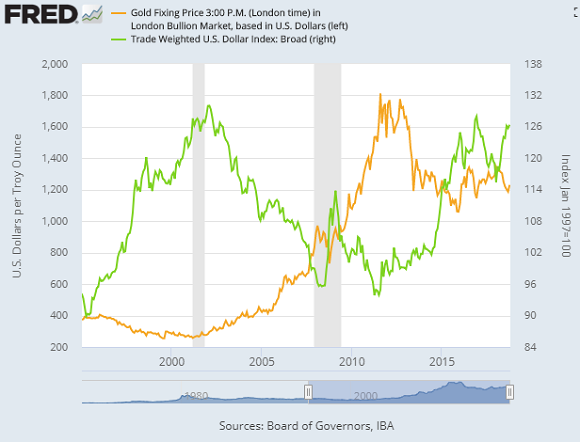
Chart of gold price (left) vs. USD index (green). Source: St.Louis Fed
 
“Some of the headwinds that have weighed on gold this year are likely to persist in the coming months,” reckons Meader at Metals Focus, including “a resilient Dollar, elevated bond yields and subdued inflation…[before] conditions slowly turn positive for gold into 2019.”
 
Looking for a steady rise in gold prices to average $1310 per ounce next year, “The main trigger [will be] a gradual asset rotation from equities back into gold by mainstream investors.”
 
Meantime however, “Investors may believe that equities are overvalued but, in the absence of an obvious trigger and the fact the probability of each tail risk is seen as low, there is no rush to jump ship.”
 
Both Poland amd Hungary meantime – the two European Union member states buying gold for their international reserves this summer – were asked by EU ministers on Tuesday to respond over Brussels’ fears that their governments are breaching “EU values and rules”.
 
Warsaw’s ruling nationalist Law & Justice Party (PiS) wants to force early retirement on 40% of Poland’s judges in what it calls “reforms” but which the European Commission calls a threat to judicial independence from government.
 
Last month the European Parliament also triggered so-called Article 7 procedures against Budapest, again worrying over judicial independence and the “deterioration” of democratic values.
 
The gold price in Euros again challenged August’s highs at €1065 per ounce on Wednesday after the Italian parliament approved the right-left coalition government’s 2019 spending plans, breaching the European Commission’s rules on national deficits.
 
The UK gold price in Pounds per ounce meantime rose within £1.50 of Monday’s 7-week high at £938 as Prime Minister Theresa May followed a heated debate over her Brexit strategy in parliament by heading to meet EU counterparts in Brussels for what is now a summit with “low expectations” for a resolution according to the BBC.

Hungary's Central Bank Joins Poland to Buy Gold as GLD Expands Again, India 'Robust' Ahead of Diwali

DEMAND to buy gold from central banks led bullion-market headlines on Tuesday, while the metal held near yesterday’s 12-week highs versus a falling US Dollar.
 
World stock markets bounced from their week-long drop, but London’s FTSE index held flat as UK Prime Minister Theresa May met with her Cabinet to try and rescue her “Chequers Deal” proposals for next March’s Brexit – a plan rejected by the European Union as well as many of her own Conservative Party MPs.
 
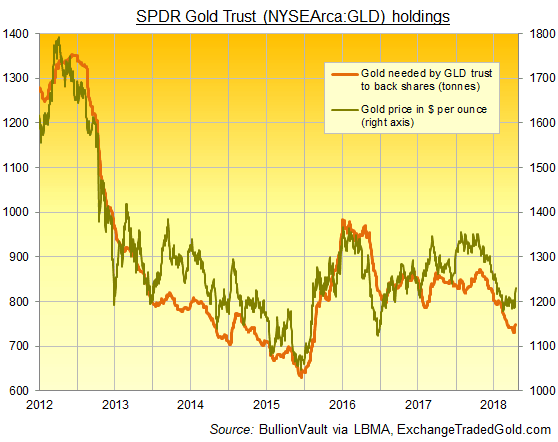
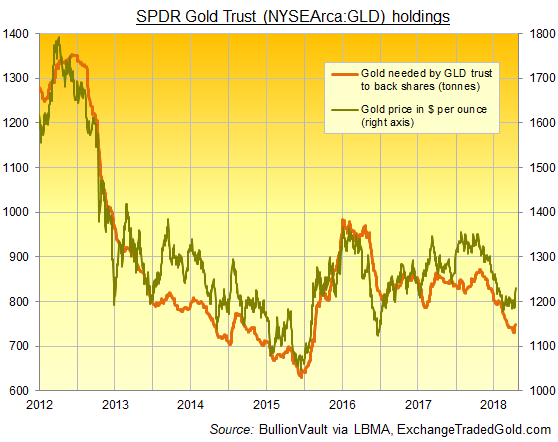
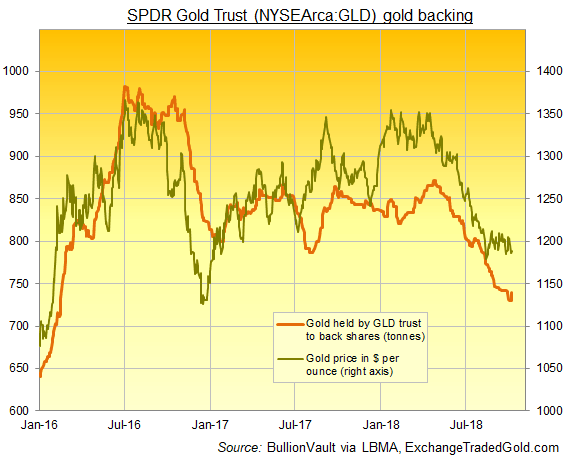
Monday’s rise in bullion prices saw investors move to buy gold exposure through ETF trust fund products, led by the third daily growth in 4 sessions for the largest such fund, the SPDR Gold Trust (NYSEArca:GLD).
 
Marking the GLD’s most consistent run of investor inflows since March, yesterday’s 4.1 tonne addition took the quantity of gold need to back GLD shares back up to end-August levels above 748 tonnes.
Chart of GLD gold backing in tonnes. Source: BullionVault via ExchangeTradedGold.com
 
Extending the strongest run of central-bank gold buying since 2012 meantime, both Hungary and Poland added bullion to their national reserves in September, with Budapest buying 28 tonnes and Warsaw adding more than 4 tonnes to the 9 acquired over July and August.
 
Gyorgy Matolcsy – head of Hungary’s central bank – “touted the move as a way to improve the security of the nation’s wealth and a nod to Hungary’s heritage as one of the world’s largest gold producers in the Middle Ages,” says Bloomberg, reporting the move.
 
The first change to Hungary’s official gold reserves since it stopped selling in 1993, last month’s rise matches the Magyar Nemzeti Bank’s second heaviest full-year addition since the end of WWII, coming behind only the 45 tonnes bought in 1971 when the United States “closed the gold window” and ended the Dollar’s convertibility into bullion.
 
Taking Poland’s gold reserves up to what Reuters calls a “record high” of 117 from 103 tonnes since June, Warsaw’s purchases this summer mark its first gold-policy change since the 75-tonne addition made when the Narodowy Bank Polski gained new powers and responsibility under the country’s new constitution of 1997.
 
“With Hungary’s gold levels below average and regional peers adding to holdings, it makes sense to maintain some kind of parity,” Bloomberg quotes analyst Gergely Palffy at Austrian bank Raiffeisen in Budapest.
 
“The announcement will have limited impact from a market perspective.”
 
Led by Germany, Italy and France, central banks in the Eurozone hold an average 53.9% of their foreign-currency reserves in gold bullion according to data compiled by the mining-industry’s World Gold Council.
 
End-June calculations from the Council put gold at just 3.8% of Poland’s national reserves and just 0.4% for Hungary.
 
“We believe [sanction risk] is one of the drivers of increased central bank gold buying from [these] new buyers,” says the Council’s chief market strategist John Reade, re-tweeting US investment bank Goldman Sachs’ view that the Trump White House’s actions against Russia have led Moscow to sell Dollar assets and buy more physical gold, highlighting the issue of political independence to other sovereign states.
 
Looking at the Dollar’s fall from 66% to below 63% of global central-bank currency reserves since 2013, “Sanction risk appears to explain a significant portion of the observed decline,” says Goldman Sachs’ analyst Zach Pandl wrote.
 
“The Dollar’s share of reserve assets could decline further if other large reserve holders were to make similar changes as the Central Bank of Russia over time.”
 
With Russia now No.3 in the world league of gold-mining nations, Moscow has bought 70% of domestic output since EU-US sanctions over the conflict in Ukraine and annexation of Crimea began 5 years ago.
 
Over in the consumer sector meantime, India’s household demand to buy gold ahead of next month’s key Diwali festival is “robust” says the Business Standard, quoting leading retailers, despite Rupee prices hitting a 5-year high on Monday.

Gold Prices Hit 12-Week High as Comex Bears Retreat from Record Short Betting

GOLD PRICES rose in London trade Monday, touching its highest Dollar price since late-July as world stock markets extended last week’s steep falls.
 
Rising to $1233 per ounce, gold prices set multi-month highs against most major currencies, reaching €1065 for Eurozone investors and £936 in Sterling as talks between the UK and European Union again hit the “real problem” of how to avoid a hard border between Northern Ireland and the Republic of Ireland after next March’s Brexit.
 
Western government bond prices rallied, pulling long-term interest rates back down from their recent multi-year highs.
 
Italy’s cost of borrowing held firm however, keeping the spread above Germany‘s key Bund rates at more than 300 basis points – a 5-year high when reached at the start of this month following the coalition government’s new 2019 deficit spending plans.
 
Betting that the price of Italy’s bonds will fall further, driving yields still higher, is now heavier than any time since the “populist” government of right-wing Lega and left-wing M5s politicians took power in June, reports the Financial Times.
 
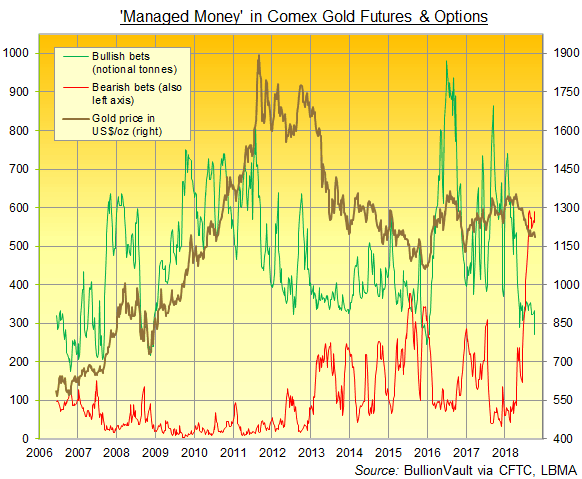
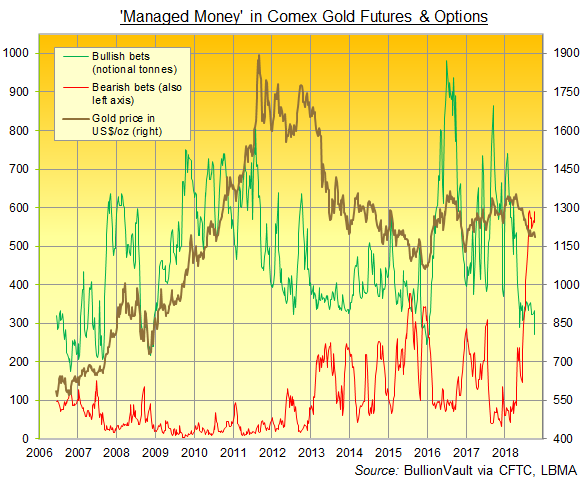
Net of bullish betting on the gold price meantime, betting among hedge funds and other speculators that the metal would fall grew to a new series record last week, latest data from US regulator the CFTC say.
 
Taken on Tuesday – before Thursday saw the fastest 1-day jump in gold prices since 2016 – the figures put the Managed Money’s total short position on Comex gold futures and options at the equivalent of 590 tonnes, just shy of late August’s record.
 
Bullish betting among that group of traders meantime fell to the equivalent of 269 tonnes, the lowest since end-2015’s six-year lows in the Dollar gold price.
 
Chart of Managed Money's bullish (green) and bearish bets (red) on Comex gold futures and options. Source: BullionVault via CFTC
 
“We believe gold is likely to have received its biggest boost [last week] from short covering,” say analysts at German financial services group Commerzbank, noting the record size of the net short position ahead of Thursday’s price jump.
 
“If this entire quantity were to be bought back, the gold price would no doubt increase considerably.”
 
Over in the currency market, China’s Yuan fell and then recovered overnight, touching last week’s 17-month lows versus the Dollar, after US Treasury Secretary Steve Mnuchin said he had “productive” talks with Chinese officials at the weekend’s IMF and World Bank meetings in Bali, confirming that Beijing doesn’t  want to see the currency continue to depreciate.
 
Mnuchin is also “not losing any sleep” he added over claims that Beijing could dump its massive holdings of US Treasury bonds, driving Dollar interest rates higher, as part of the tit-for-tat trade war over import tariffs.
 
“Only moderate demand seen from Chinese traders on the open,” says Monday’s Asian gold trading note from Swiss refiners and finance group MKS Pamp.
 
With Chinese gold prices at the highest since April, “Volumes were more subdued than last week,” MKS adds, noting that the Shanghai premium – over and above comparable quotes for London settlement – remained “fairly stable around $5-6” per ounce.
 
Gold’s No.2 consumer nation India could see Rupee gold prices rise another 3% between now and next month’s key Diwali festival, reckons Surendra Mehta of the India Bullion & Jewellers Association, pointing to worsening problems for household lenders outside of the regulated banking sector.
 
“Right now, there is no asset class in the market which can give good returns,” Mehta says, calling equities and bonds “a bloodbath.
 
“Even the non-banking finance company (NBFC) sector is in crisis.”
 
Platinum prices also rose with gold to multi-month highs on Monday, but silver lagged behind, achieving only a 2-week high at $14.75 per ounce.

Stock Market Slump Sees Gold Prices at 11-Week High as UK Plans for 'Unlikely' No-Deal Brexit

GOLD PRICES headed for their highest Friday close in 11 weeks in US Dollar terms in London today, holding onto most of yesterday’s 2.8% jump to trade above $1223 per ounce as world stock markets bounced from their sharpest drop since February.
 
Noting this week’s “sea of red spattered across equity investors’ screens”, bullion traders at Swiss refiners and finance group MKS Pamp see “a confluence of multiple factors – US/China trade tensions, US housing market stalling, upcoming mid-terms, narrowing breadth to the equity rally and concern about how far yields will rise.”
 
As world stock markets fell yet again on Thursday, the volume of Comex gold futures trading jumped 15% above the total number of such contracts now open, according to data from the CME derivatives exchange.
 
Over the last 12 months, daily trading volumes in Comex gold futures have averaged just 49% of open interest.
 
Thursday also saw the number of new accounts opened on BullionVault jump to its highest level since 14 August, when gold prices began a steep drop to their lowest Dollar value since January 2017 at $1160 per ounce.
 
“ETF holdings of gold surged this week after months in decline,” says Bloomberg, noting what has been a 0.4% rise in the amount of bullion needed to back such exchange-traded trust fund structures worldwide.
 
On a weekly basis however, gold ETFs expanded faster in April 2018 – up 0.7% on BullionVault’s analysis of data collated by the mining industry’s World Gold Council – and grew 3 times faster in June 2016 amid the shock of the UK’s Brexit referendum result.
 
Over on the FX market meantime, the Dollar rallied from new October lows versus the Euro on Friday, and also edged the British Pound back from its strongest level in more than 3 weeks as the UK government published its contingency plans for 28 industries in the “unlikely” event that Britain leaves the European Union with “no deal” next March, covering how it would affect the commercial fishing industry to the cross-border movement of race horses and the domestic UK rail network.
 
With London’s FTSE100 stock index down 3.6% for the week so far at Friday lunchtime, the gold price in British Pounds per ounce stood 2.8% higher, adding £25 per ounce from Monday’s dip below £900 – its lowest price since before the June 2016 vote.
 
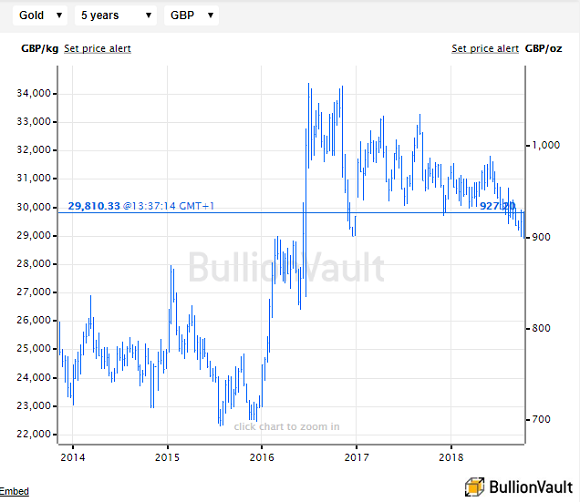
Chart of UK gold price in Pounds per ounce
 
In the gold-mining sector, shares in Randgold Resources (LON: RRS) added another 3.8% on Friday, taking the London-listed African mining stock 10.0% higher for the week.
 
Randgold has now risen by one-fifth since it announced plans to merge with No.1 global gold miner Barrick late last month.
 
That 20% gain matches the rise in Barrick’s stock – up 9.4% on Thursday – with which Randgold’s current shareholders will be paid if the merger is approved next month.
 
Gold demand in India – the No.2 consumer nation – is picking up, reports Live Mint today, as the Hindu festive season returns following last week’s observance of ‘shradh’ and ahead of next month’s key festival of Diwali.
 
Year-to-date however, India’s gold bullion imports are running 15% below 2017 levels, say specialist analysts GFMS.
 
“In October, again imports will rise due to festivals,” reckons former chair of the All India Gems and Jewellery Trade Federation Bachhraj Bamalwa.
 
With the Yuan meantime slipping 0.7% versus the Dollar since China’s markets closed for last week’s National Day holidays, gold priced in the Chinese currency has risen 2.9%, reaching 6-month highs at Friday’s afternoon fixing in Shanghai.
 
Shanghai premiums over London quotes however – a measure of how local supply is meeting demand inside the No.1 consumer nation – have retreated to $5 per ounce from the typical $9 level.

Gold Price Up as Trump's 'Stock Correction' Worsens, GLD Snaps Longest-Ever Run of No Growth

GOLD PRICES touched a 3-week high of $1210 per ounce in London trade Thursday as global stock markets fell yet again and the US Dollar retreated once more on the currency market.
 
Commodities also fell, with crude oil dropping to new lows for this month at $81 per barrel of Brent but silver edging up with gold prices to touch $14.50 per ounce.
 
Government bond prices stabilized but held longer-term interest rates near multi-month and multi-year highs on German and US debt respectively.
 
“Rising bond yields aren’t always a problem for stocks,” says Jeffrey Kleintop, chief global investment strategist at global brokerage Charles Schwab.
 
“But when bond yields and stock prices moved in different directions it has been a sign of trouble.”
 
Tokyo shares today lost 3.5%, Hong Kong 2.5% and Shanghai 4.8% after New York stock markets closed last night with their worst 1-day drop since February.
 
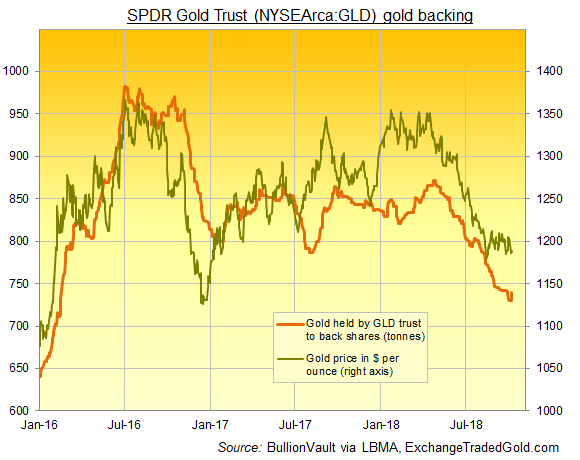
As Wall Street’s S&P500 index of US corporations fell for the 11th time in the last 15 sessions yesterday, the largest and most expensive gold-backed ETF – the SPDR Gold Trust (NYSEArca: GLD) – grew in size as more investors bought the stock than sold it for the first time in 58 trading days, the longest such run since the GLD was launched in November 2004.
 
That took the quantity of gold needed to back the GLD’s shares up to 739 tonnes, some 1.2% above this week’s 32-month low.
 
Chart of SPDR Gold Trust (NYSEArca:GLD) backing in tonnes of gold. Source: BullionVault via ExchangeTradedGold
 
The cheaper Gold Minishares (NYSEArca: GLDM) – launched by asset managers and SPDR marketing agents State Street in June, and undercutting their larger fund’s 0.40% annual charge with a fee of 0.18% – didn’t change in size on Wednesday, needing 6.1 tonnes of backing.
 
Nor did the Graniteshares Gold Trust (NYSEArca:BAR) – now the cheapest such product once more after trimming its annual charge to 0.175 percentage points this week – needing 7.3 tonnes to back the value of its shares.
 
Annual storage rates for physical gold bullion owned outright, with insurance included, run as low as 0.12% on BullionVault, which now cares for 38.9 tonnes of customer property in each client’s choice of London, New York, Singapore, Toronto or Zurich.
 
“Actually, it’s a correction that we’ve been waiting for, for a long time,” Donald Trump said of the Wall Street slump late Wednesday, after repeatedly taking credit for the US stockmarket’s run of new all-time record highs in 2017 and 2018.
 
“But I really disagree with what the Fed is doing, okay?” the President added to reporters, doubling down on comments he made in July about the US central bank raising its key Dollar interest rate.
 
“I think the Fed is making a mistake. They’re so tight. I think the Fed has gone crazy.”
 
“The fundamentals of the US economy continue to be extremely strong,” added Trump’s Treasury Secretary Steve Mnuchin to Bloomberg overnight, calling the plunge “somewhat of a correction”.
 
First-time claims for US unemployment benefits last week jumped above analyst forecasts, new data said today, but still held near the lowest level since 1969.
 
The latest US inflation figures also missed analyst forecasts however, with ‘core’ consumer prices slowing to 2.2% annual inflation on today’s release of September data.
 
“The situation is very fragile,” said European Commission vice president Jyrki Katainen meantime of the worsening row over Italy’s budget deficit plans, warning that other Eurozone member staes “may suffer from contagion risks” as the price of Italy’s government debt falls, driving Rome’s borrowing costs higher.
 
“Our interest,” Katainen said Thursday, “is to get a result which is credible and try to convince the Italian government to take the responsibility, which lies in their hands.”
 
Looking at Italy’s 10-year yield spread over German Bunds, “The spread was 270-280 [basis points], now it’s 300, because there is great prejudice about this government,” Rome’s deputy prime minister Luigi Di Maio of the anti-establishment M5s Party said overnight, echoing comments from his coalition partner Matteo Salvini of the rightwing Lega.
 
“There are too many people in the establishment who are cheering for a spread of 400 points, but the markets love Italy more than some Italian and European politicians.
 
“My aim is to make my fellow citizens happy.”
 
European shares extended their losses on Thursday, dropping another 1.1% on the Euro Stoxx 50 index and taking London’s FTSE100 3.7% down for the week so far.
 
Gold priced in the Euro today rose back above last week’s closing level of €1043 per ounce.
 
The UK gold price in Pounds per ounce rose 1.7% after slipping beneath £900 per ounce for the first time since before June 2016’s shock Brexit referendum result.

Gold Prices Fall Even as Italy Pays Bond Investors More Than Greece, Brexit 'No Deal' Now Evens

GOLD PRICES failed to hold a rally above $1190 per ounce for the second day running in London trade Wednesday, dropping back as the US Dollar rose and world stock markets fell again amid fresh worries over Italy’s government deficit and the UK’s impending Brexit from the European Union.
 
The Chinese Yuan held its lowest value against the Dollar in 17 months despite a senior Beijing official expressing “optimism” about resolving the tit-for-tat trade war tariffs with Washington.
 
Gold also fell against a weakening Euro, erasing most of last week’s 1.7% gain to trade back down at €1032 per ounce.
 
Milan’s FTSE MIB stock index meantime fell for the 8th session in two weeks, helping pull the EuroStoxx 600 3.2% below last Wednesday’s close, as Italy’s government paid the highest borrowing cost in half-a-decade to raise a 1-year loan from the bond market.
 
Investors locked in a yield of 0.94% on €6 billion of new Italian debt.
 
Greece meantime paid an annualized 0.65% on €625m of 13-week Treasury bills today.
 
Yields on 1-year bonds from all other Eurozone states – including Spain and Portugal – held well below zero, with investors willing to lose 0.59% of their money to hold Germany’s short-term government debt.
 
“Should I change my policies – my agreement with Italians – on the basis of what some speculators decide in the morning? No,” said Italy’s deputy prime minister Matteo Salvini of the right-wing Lega Party today, defending his coalition government’s plan for a 2.4% budget deficit in 2019.
 
Vowing that Italy’s 10-year spread over German Bund yields won’t reach 4 percentage points – a level last seen in the crisis of 2012 – Salvini also said he wants Italian residents to get a tax break on investing in Rome’s debt.
 
The BTP-Bund yield spread today eased back from Tuesday’s peak, but held near a 5-year record above 3 percentage points.

Italy checking all the boxes in terms of how not to react to a building market crisis; demonise “speculators”; draw tempting lines in the sand; impugn those able to provide a backstop; forlorn pleas for locals to buy debt.

— econhedge (@econhedge) October 10, 2018

The gold price for UK investors meantime fell back to £902 per ounce, just above its lowest level since 2016’s shock Brexit referendum result, as the Pound rallied on the currency market amid rumors that a Brussels-London deal for the UK’s exit from the European Union next March could be announced as soon as Monday.
 
With the final summit of EU leaders on Brexit due next week, the Pound reached to a 2-week high against the Dollar and a 4-month high versus the Euro.
 
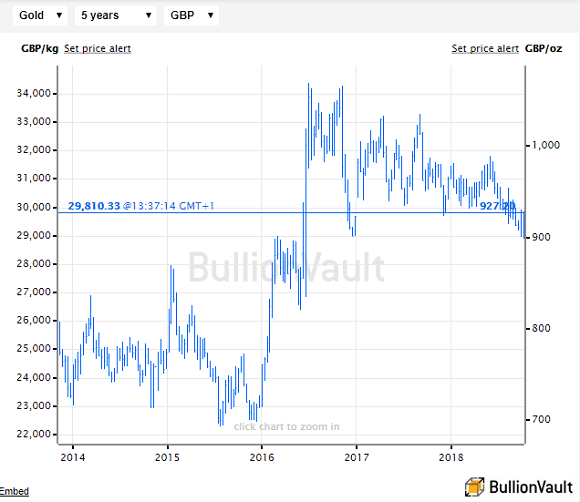
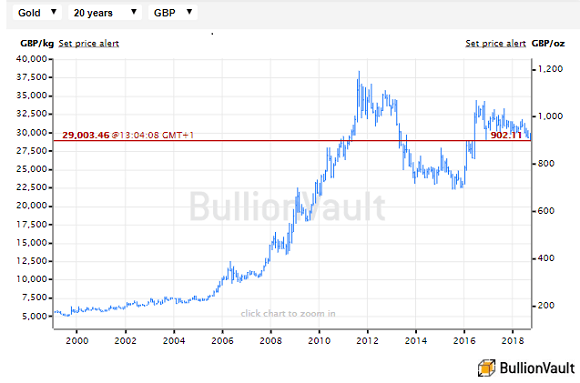
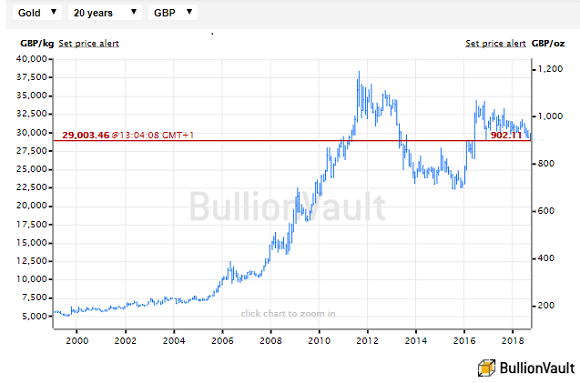
Chart of UK gold price in Pounds per ounce. Source: BullionVault
 
“Brexit is a serious problem for Scotland,” said Scottish first minister Nicola Sturgeon in a speech to her Scottish National Party (SNP) conference yesterday.
 
After 62% of Scots voted to remain in the 2016 ballot, “The only solution is to become an independent country,” Sturgeon said.
 
Brexit could see UK-EU trade fall in half over the long-term, says a new paper from the IW Institute in Cologne, warning Germany’s giant auto-manufacturers in particular.
 
Leaving the UK is likely to cost London some 5,000 financial jobs said City minister John Glen to a parliamentary committee today, calling the situation “stable” but agreeing with Bank of England estimates.
 
To prepare for “resilience” in local services around the end-March exit, the UK government is now advertising 3 posts nationwide, calling the work “exciting and challenging” and offering to pay 167% of the current UK national average salary.
 
UK bookmakers Coral and Ladbrokes both put the odds of a “no deal” Brexit at evens today.
 
Betting on US interest rates meantime puts a 1-in-4 chance on the Federal Reserve raising the cost of borrowing 4 times of more over the next 12 months, up from below 1-in-10 this time a month ago, according to data from the CME derivatives exchange.


Falling Gold Price 'Needs More Volatile Stocks' Plus 'Dollar Crash'

GOLD PRICES failed to hold a $5 bounce in London trade Tuesday morning, dropping back to $1186 per ounce as world stock markets fell with government bond prices, driving longer-term interest rates higher as the Dollar also rose on the currency market.
 
“It [is] a moment to cool down the temperature,” said a European Commission spokesperson on Tuesday as EC President Jean-Claude Juncker met Italy’s Robert Fico, president of the chamber of deputies, to discuss Rome’s planned 2019 budget deficit.
 
But Milan’s stock market hit 7-month lows and the price of Italian government debt fell once again, driving Rome’s cost of borrowing up to a new 5-year record spread over benchmark German Bund yields of 317 basis points.
 
The Euro lost almost 1 cent to hit 7-week lows against the Dollar at $1.14322.
 
That buoyed the gold price for Eurozone investors to €1038, halving Monday’s steep 1.1% drop.
 
“[To reach $1400 gold] you would have to see some real change in the financial markets,” says investment and bullion-bank analyst James Steel, speaking at base-metals conference London Metals Week and saying that gold needs much greater volatility in world stock markets to attract investment flows.
 
“A weaker Dollar would [also] have to be the case.”
 
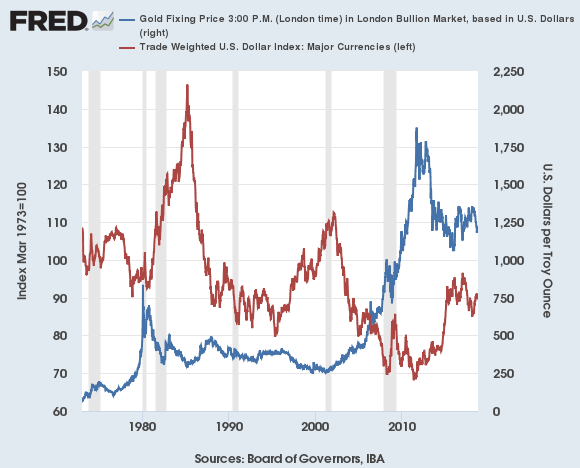
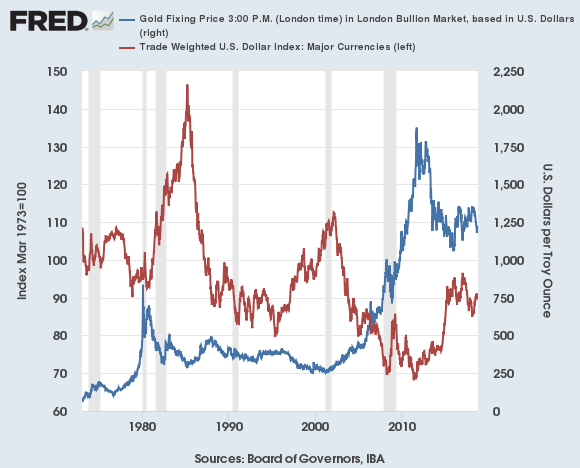
Averaging -0.49 over the last 45 years, the 12-month correlation between Dollar gold prices and the US currencies trade-weighted forex value last week read -0.85.
 
That figure would read +1.0 if they moved perfectly together, or -1.0 if they moved exactly opposite.
 
Gold’s 12-month correlation with the USD index has now been negative for 334 weeks without break, the longest stretch since global currencies began floating freely in 1973.
 
Chart of US Dollar index (red, right) vs. the gold price in Dollars. Source: St.Louis Fed
 
“The ‘jump to default’ risk is high for US sovereign credit,” reckons gold-miner-stock fund manager John Hathaway at Tocqueville Asset Management, warning of an imminent “30% depreciation of the Dollar.
 
“We believe that the gold market bottomed in August, and that exposure to precious metals is a credible strategy to mitigate risk of a Dollar collapse.”
 
China’s Yuan stabilized versus the US currency on Tuesday, holding around 18-month lows at ¥6.91 per Dollar.
 
That pulled the price of gold delivered in Shanghai back below the equivalent of $1200 per ounce at the city’s benchmark afternoon fixing, a premium of $8 per ounce above global quotes for London settlement.
 
Tokyo’s stock market meantime fell hard as Japan returned from the annual Health & Sports Day holiday, pulling the Topix index 3.5% below last week’s 7-month high.
 
Sterling also retreated versus the Dollar, down over 1 cent as ex-UK minister Steve Baker said “at least 40” fellow Conservative MPs are ready to vote against their leader Prime Minister Theresa May’s proposed Brexit deal for March 2019, the so-called “Chequers Plan”.
 
That failed to outpace the decline in bullion however, with the UK gold price in British Pounds per ounce falling back to £908 – just £7 above last month’s revisit of the cheapest level since mid-2016’s shock Brexit referendum result.
 
“If you think that eventually the forces of anti-globalization will wear trade down to no growth, then the gold market is likely to do well,” says Steel at HSBC.