Author Archives: City Gold Bullion

Gold Price Breaks Multi-Year Highs vs Dollar, Euro, Pound as Brexit Spooks Fed, Bank of Japan Holds QE and Negative Rates

GOLD PRICES jumped against all major currencies bar the Japanese Yen in Asian and London trade Thursday, setting a 22-month high versus the US Dollar after the Federal Reserve held its interest-rate and QE policy unchanged yet again, citing weaker jobs growth, low inflation, and next week’s UK Brexit referendum.
 
The Fed’s inaction was followed by another “no change” decision from the Bank of Japan – now creating and spending ¥6.7 trillion per month ($64bn) on QE asset purchases, while charging commercial banks a negative interest rate of 0.1% per year – and also from the Bank of England in London, which has now held UK rates at 0.5% for 7 years, and owns some 25% of the UK government’s record-high £1.5 trillion ($2trn) of outstanding debt.
 
Tokyo’s Nikkei stock index sank 3% as the Yen rose to September 2014 highs on the FX market.
 
European stock markets fell for the 8th in 12 sessions so far in June, while industrial commodities slipped 0.5% and major government bond prices rose, pushing the yield offered by 10-year German Bunds to new record lows at minus 0.02%.
 
Gold hit $1313 per ounce at the start of London dealing, its highest level since September 2014, but silver held 20 cents shy of start-May’s 15-month high above $18 per ounce.
 
Gold priced against the Euro rose faster than versus any other major currency, adding 3.6% for the week so far to break 3-year highs above €1173 per ounce. Priced in Australian Dollars, gold neared its all-time records of 2011.
 
After Fed voting member Esther George dissented at two meetings running by calling to raise rates, the FOMC was unanimous Wednesday in holding the US central bank’s key interest rate at 0.50%.
 
Only 2 of the 17-member committee now foresee the Fed Funds rate rising to 1.00% by the end of 2016, down from 7 in the April projections and down from 13 last December, when the US central bank finally hiked from 0% after six years at that record low.
 
[Brexit] was one of the factors [in] today’s decision,” said Fed chair Janet Yellen at her press conference, responding to a question about next Thursday’s UK referendum on quitting the European Union.
 
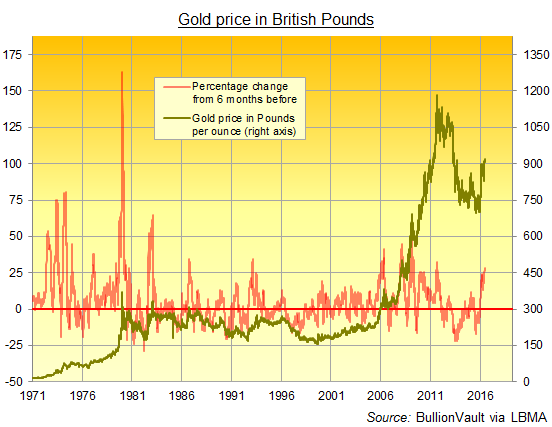
Gold priced in British Pounds today jumped above £920 per ounce as Sterling retreated from a brief bounce on the currency market following the Fed announcement.
 
Slipping back towards Tuesday’s new 2-month lows at $1.41, the falling Pound has helped drive prices to buy gold 28% higher for UK investors so far in 2016 – the fastest 6-month gain since the global financial crisis peaked with the US debt downgrade, Eurozone crisis and English rioting of summer 2011.
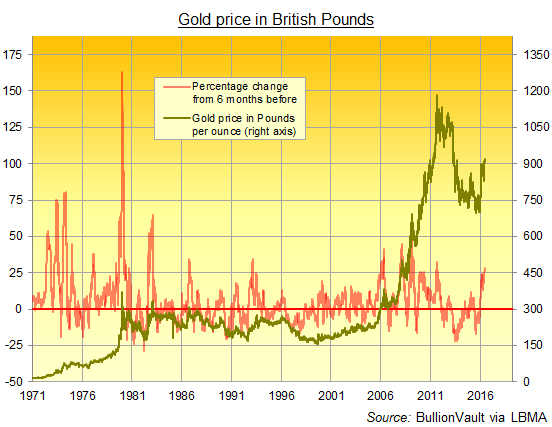
Chart of the gold price in British Pounds, last 45 years, via London PM Fix and LBMA Gold Price
 
“Were it not for next week’s Brexit vote, the Dollar would probably have sold off more after last night’s Fed meeting,” reckons a currency note from Dutch bank ING.
 
“Should the UK electorate vote to leave the EU a week today,” says Chinese-owned commodity, FX and bullion-broking ICBC Standard Bank, “we’d expect to see coordinated G7 intervention to stabilise the currency market.
 
“Movements in Sterling post a Brexit result seem very likely to conform to the ‘disorderly’ market conditions that both G7 and G20 central banks and finance ministers don’t want to see.”
 
“It is not [so] much the UK leaving the EU that is troubling,” says a gold recommendation from French investment and bullion bank Natixis – forecasting a Dollar price jump to $1375 per ounce on a Brexit result next week – “but what it means for the future of the European project.
 
“Euroscepticism is clearly on the rise in EU member countries,” Natixis says, pointing to polls saying that 61% of French voters view the EU unfavourably, as do 49% in Spain, 48% in Germany, and 46% in the Netherlands.
 
“The UK has always been…lukewarm to the idea of being part of the EU [but] a Eurozone member leaving (even a small sized member) could create a much bigger shock and announce the beginning of the end of the Euro currency.”
 
Calling gold “an excellent hedge against a local currency debasement,” Natixis advises clients to buy Comex gold options with a strike price of $1375, because the $10 cost would be a “minimal loss…should the UK vote to remain” while offering “important gains” if it leaves.
 
Even in a Bremain scenario, says London bullion-market clearing bank HSBC’s analyst James Steel, “gold would likely be well supported by a number of outside factors” such as the US Fed revising down its expected rate hikes for 2016, plus slow global growth and the coming US presidential election in November.
 
“These factors may well act to buoy gold regardless of the results of the UK referendum.”
Gold Prices Slip Before US Fed Rate Decision But 'Time to Start Panicking' as UK Brexit Vote Approaches

GOLD PRICES retreated 0.6% from yesterday’s 1-month high against the Dollar on Wednesday as world stock markets bounced and UK Brexit vote campaigning rolled on ahead of the US Fed’s long-awaited June announcement on interest rates.
 
Silver held at $17.40 per ounce as European stock markets including London gained 1% from Tuesday’s new 4-month lows.
 
Major government bond prices eased lower, nudging debt yields higher from multi-year and record all-time lows.
 
Gold prices slipped to $1281 per ounce and retreated to £900 for UK investors, down 1% from yesterday’s near 3-year high, as the Pound recovered almost 1.5 cents on the currency market following news of the lowest UK jobless rate in over a decade.
 
Key to Wednesday’s updated economic forecasts from the US central bank will be “how many of the Fed policy makers [are still] expecting two rate hikes this year,” says David Govett at brokerage Marex Spectron in London
 
“If the tone of the press conference is dovish,” he goes on, “I would look for gold prices to break $1300 and hold above it, with a view to making new highs on the year. If hawkish, we will probably see a bout of long liquidation with prices falling back towards $1270.”
 
Betting on Fed Funds interest-rate futures now puts the odds of a June hike to 0.75% at less than 1-in-50, down from almost 1-in-3 this time last month.
 
Odds that the Fed will set its key rate at 0.75% in July’s meeting have more than halved to 1-in-5 according to the CME Group’s FedWatch tool.
 
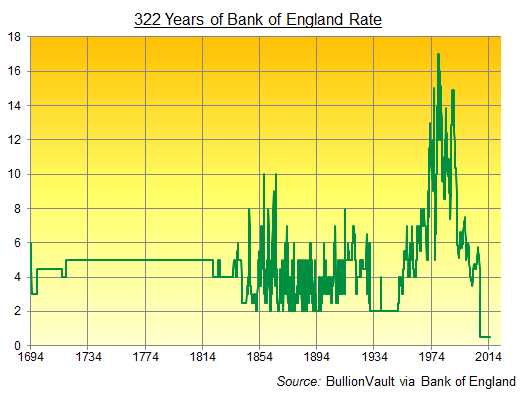
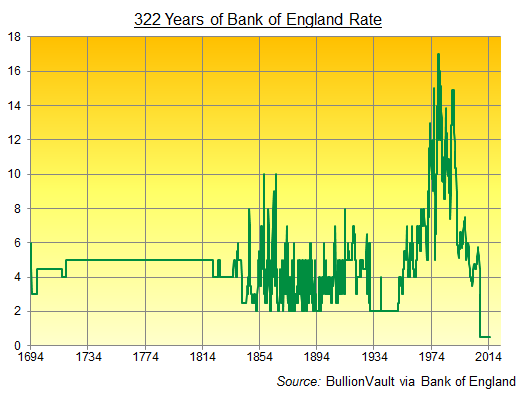
Following weak inflation data from the UK meantime, betting on UK interest rates now says the Bank of England will stick at its current record-low of 0.5% – first reached in early 2009 – until 2020.
 
That would extend the longest stretch of unchanged rates since the Bank of England’s then-record low of 2.0% between 1931 and 1951 was punctuated by a brief hike to 4.0% at the outbreak of World War II.
Chart of Bank of England interest rate, monthly since 1694
With the Bank of England due to announce its latest policy on Thursday – 1 week before the UK referendum on leaving the European Union – finance minister George Osborne today said he would have to announce an emergency budget, cutting spending and raising taxes, if the nation votes for Brexit on June 23rd.
 
After opinion polls yesterday showed a swing in favor of Brexit, “Betting odds [from bookmakers] which put the probability of a Remain win above 80% now place it at some 60%,” says The Economist magazine online.
 
Campaigning on Wednesday saw a flotilla of 35 trawlers sail up the Thames in London towards the Houses of Parliament, joined by UKIP leader Nigel Farage under the banner “Fishing for Leave”.
 
Former pop-star and knighted charity campaigner Bob Geldof appeared on a boat covered with “In” banners, reportedly blasting the Brexit boats with songs from a PA system including Chicago’s “If you leave me now”.
 
“Now seems the appropriate time to start panicking,” says Chinese-owned ICBC Standard Bank’s FX strategist Steven Barrow of the shift in Brexit opinion polls.
 
“In addition, outside events like the shootings in Orlando and violence at the Euro football championships all play into the hands of the anti-migration psyche that underlies the Brexit campaign.”
 
Investment professionals polled by the Financial Times‘s FTAdviser magazine “[are] divided” over both the likely outcome of the referendum and its impact on the markets.
 
“Equal numbers of advisers thought the UK stockmarket and Sterling would be winners in the event of a vote to remain, while the same number of people (29%) believed it is time to take risk off the table and go for gold as a hedge in the event of a vote to leave.”
 
“Of all the precious metals,” note commodities analysts at German financial services group Commerzbank, “it is only really gold that is profiting from the current market situation.”
 
Continued central-bank gold  buying by Russia and China, as well as the recent cash-raising sales by crisis-torn Venezuela, prove the metal’s appeal as a ‘safe haven’ asset according to both Societe Generale and Thomson Reuters GFMS this week.

Price to Buy Gold in Pounds Hits 3-Year High as Brexit Poll Pushes UK Bond Yields Down to 3-Century Record Low

BUY GOLD prices hit near-3 year highs for UK investors and savers on Tuesday as the Pound slumped with world stock markets after a new opinion poll put Leave campaigners well ahead in next week’s ‘Brexit’ referendum on Britain’s membership of the European Union.
 
The new survey by pollsters YouGov for The Times newspaper put Leave on 46%, its strongest showing to date, with Remain on just 39%.
 
However, “Eleven per cent of people do not know how they will vote and 4 per cent plan to abstain,” The Times says of the poll, the fourth published in two days to put Leave in front.
 
Sterling fell over 1% to new 2-month lows on the FX market, driving prices to buy gold bullion up to their highest level for UK investors since August 2013 at £910 per ounce.
 
London’s FTSE 100 share index meantime fell 1.2% to a new 4-month low, more than 15% below the record high of April 2015.
 
“Interesting argument that FTSE is down on Brexit fear,” said John Stepek, editor of best-selling UK investment magazine MoneyWeek, “[because the] worst-hit sector is global mining stocks.”
 
“[But] the latest run of UK referendum polls will continue to exacerbate fears of a potential global domino effect in the event of a Leave vote,” the Financial Times quotes strategist Marc Ostwald at IDM Investor Services.
 
Eurozone stock markets also fell, down for the fifth day running in Frankfurt, as German Bund prices rose yet again, taking the yield offered to new buyers below zero for the first time in history.
 
“We must set ourselves free from dictatorial Brussels,” urges the front page of The Times‘ fellow News UK daily paper The Sun – Britain’s best-selling tabloid – calling the European Union “increasingly greedy, wasteful, bullying and breathtakingly incompetent in a crisis.”
 
Ten-year US Treasury bond yields also fell, dropping intra-day below their lowest daily closing level since November 2012 at 1.59%.
 
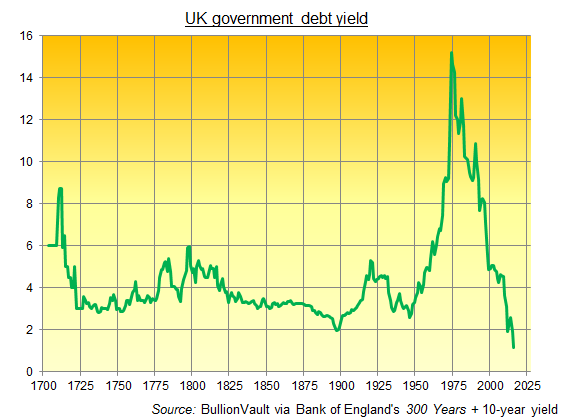
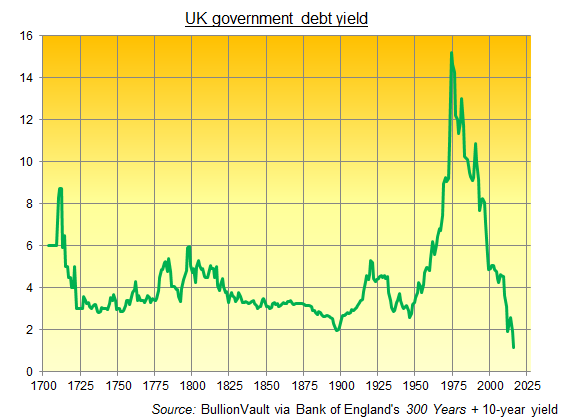
UK Gilt yields meantime sank to new all-time levels at 1.18% on 10-year government debt, a record low in more than 3 centuries of trading.
Chart of long-term UK government bond yields from Bank of England data
 
“Bond markets show prospect of vote leave is reassuring investors,” claims UKIP politician Douglas Carswell MP, citing a comment from fellow Leave campaigner John Redwood MP that UK government bond prices “have surged” on the turn in Brexit opinion polls.
 
“Nerves around the UK’s EU referendum are helping Gilts,” counters the FT, “with many analysts pondering whether the Bank of England might be bumped into another round of bond-buying to stimulate the economy” if recession now follows.
 
The S&P 500 in New York was set to open Tuesday more than 2% below last week’s 11-month high.
 
Chinese prices to buy gold at Shanghai’s new gold price benchmark auction had earlier held flat in Yuan terms, but slashed their Dollar-equivalent premium above live London quotes to zero from Monday’s $10 per ounce, as spot trading volumes slowed hard.
 
Silver meantime lagged the rise in prices to buy gold once more, trading up to $17.42 per ounce for US investors as gold rose twice as fast, adding 1% from last week’s finish to trade above $1286 per ounce.

Gold Trading at 32-Month GBP High as Brexit Risk Leads 'Safe Haven' Demand

GOLD TRADING in London pushed Dollar prices up to 1-month highs on Monday, touching $1287 per ounce as world stock markets fell after the weekend’s US terrorist shooting in Orlando, weak Japanese manufacturing data, and another shift towards Brexit from opinion polls on next week’s UK referendum on staying in the European Union.
 
Eurozone stock markets fell 1.5% as London’s FTSE dropped 1% with crude oil.
 
Gold priced in British Pounds hit new 32-month highs just shy of £910 per ounce, while Chinese dealers today returned from the long Dragon Boat holidays to find gold trading 2.8% higher from Wednesday’s close.
 
Hitting the highest Yuan price since spring 2013, Shanghai gold fixed at today’s key benchmark auction at a premium of $10 per ounce over spot London quotes.
 
“Chinese investors were aggressively on the offer,” says the Asian trading desk of Swiss refining group MKS, reporting heavy selling through Shanghai “which was not surprising.
 
“But as we have seen over the past week, Comex demand [for bullish gold futures and options] on dips was strong and happily absorbed the Chinese liquidation.”
 
“Asian physical demand has started to improve,” says a weekly note from Chinese-owned ICBC Standard Bank, “albeit from subdued levels.
 
“Western investors, meanwhile, remain consistent buyers.”
 
Last week saw exchange-traded trust funds backed by gold expand yet again, taking the SPDR Gold Trust (NYSEArca:GLD) to its largest holdings since late 2013.
 
Silver-backed ETFs led by the iShares vehicle (NYSEArca:SLV) expanded to a new all-time record size, beating the previous peak of 2014.
 
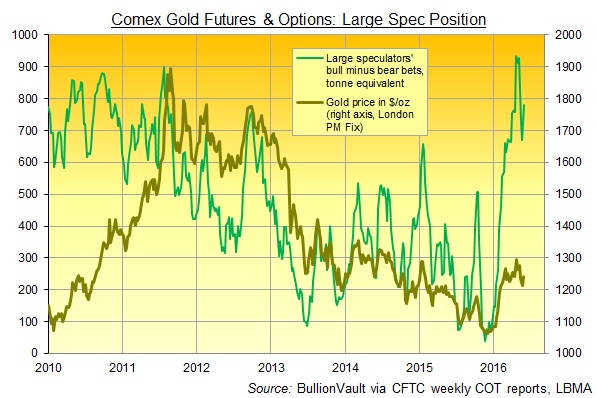
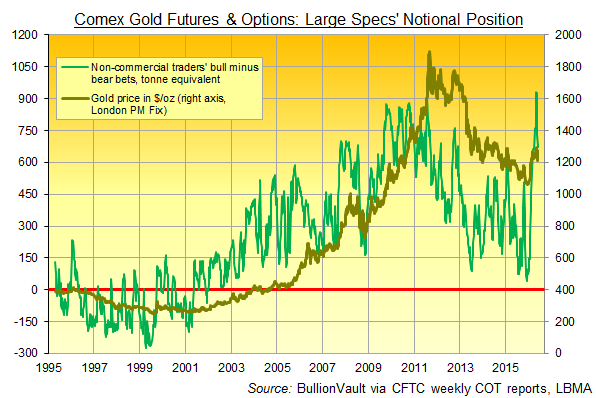
Speculative positioning in Comex futures and options meantime saw the number of bullish bets rise as bearish bets fell last week, according to data from US regulator the CFTC.
 
That drove the “net speculative position” of non-industry traders’ bullish minus bearish bets 16% higher.
Chart of Comex gold futures and options net speculative betting via CFTC data
 
Net speculation in Comex silver derivatives shrank in contrast, down to the smallest level in 2 months. But like gold, it remained around 275% of its average size over the last 20 years.
 
“Gold now has a window of opportunity to break into a higher range,” says ICBC Standard, as “falling [government bond] yields and the prospect of an unusually divisive US election campaign are supportive of higher gold prices.”
 
Looking at the Brexit referendum, “gold’s price-boost in January was accompanied by a sharp move towards the anti-Europe voters,” notes US financial services giant Citi, explaining that “for most of April and May, the vote trend was range-bound” as were gold prices.
 
“More recently…the June 2016 rally in gold [has] occurred at a time of a similar sharp move towards an anti-Europe outcome.”
 
“UK and German sovereign debt yields [last week] fell to record lows,” adds London bullion market maker HSBC, with “safe-haven and hedge-related trading ahead of the UK referendum…becoming more noticeable.
 
“A portion of this demand [is] being funneled into physical gold purchases in the EU.”
 
Silver prices meantime failed to follow gold higher on Monday, trading unchanged for the day even against the British Pound.

Gold ETF & Silver Prices Hit 4-Week High as 'Investment Nerves Fray' Ahead of US Fed Rate Vote

GOLD ETF and bullion prices neared their highest Friday close in four weeks in London today, with wholesale gold rising above $1273 per ounce as world stock markets fell on what news-wires called “frayed investment nerves” ahead of next week’s Federal Reserve decision on Dollar interest rates.
 
Ten-year US bond yields fell towards 3.5-year lows at 1.65%, while benchmark German Bund yields ticked down to a new record low of 0.02% per annum.
 
Industrial and energy commodity prices fell up to 1%, but silver ETF and investment prices pushed upwards with gold, reaching near 4-week highs at $17.36 per ounce.
 
“The recent run of weak employment data and below-target inflation may lead [the Fed] to take an even more dovish stance on the rate outlook,” says analyst Jonathan Butler at Japanese conglomerate Mitsubishi.
 
“Such developments would be gold supportive [but] the market is getting a little one sided again, [so] any perceived hawkish pronouncements could lead to profit taking.”
 
Money managers and other investors “ploughed into gold exposed exchange traded funds last month,” says the Financial Times, quoting asset-management giant Blackrock, with $5.4 billion going into gold ETFs in May as investors pulled $3.7bn out of stock-market tracker funds.
 
The world’s largest gold-backed exchange-traded fund vehicle, the SPDR Gold Trust (NYSEArca:GLD), yesterday needed another 7 tonnes of bullion to back its rising number of shares in issues, taking the total to a fresh 32-month high at 887 tonnes.
 
That’s still one-third smaller than the GLD’s end-2012 record holdings.
 
The largest silver-backed ETF, the iShares Silver Trust (NYSEArca:SLV), has meantime swollen by almost 1% so far in June.
 
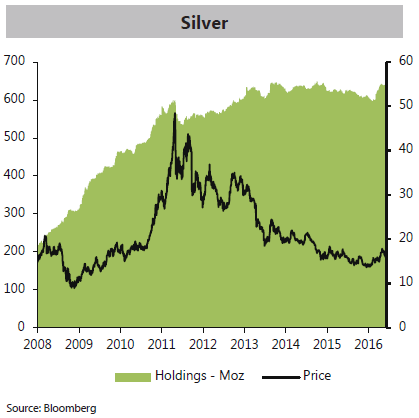
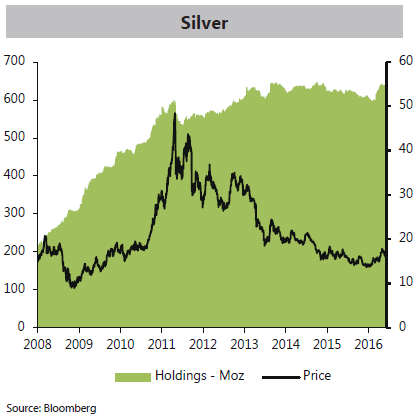
Silver-backed trust fund holdings worldwide are now within 1% of mid-2014’s record.
 
Chart of global silver-backed ETF holdings from MetalsFocus.com
 
In key consumer markets, meantime, Shanghai’s wholesale gold market was closed Friday for the second day of China’s Dragon Boat festival holidays.
 
Due to re-open on Monday, it last saw gold prices 1.5% lower than today in US Dollar terms.
 
In contrast to Western ETFs and investment, gold demand in India – the No.2 consumer market – this week drove dealer discounts down as deep as $46 per ounce from international spot quotes, according to a Reuters report, sharply worse than last week’s $14 as rising prices met a lack of festive or wedding occasions on the Hindu calendar.
 
“Consumers are very price sensitive…postponing purchases due to the recent rally in prices,” the news-wire quotes Harshad Ajmera at bullion wholesaler JJ Gold House in Kolkata.
 
“Traditionally demand remains weak in June but we never witnessed such kind of a lull in the market.”
 
India’s weak gold demand is also reflected in much lower smuggling, says The Hindu newspaper, with seizures at Kerala state’s Cochin airport falling by two-thirds in recent months from the start of 2016.
 
“‘The intake by jewellers has come down to such a pass that there is hardly any demand for the yellow metal, both legal and illegal,” the paper quotes Cochin Customs commissioner, K.N.Raghavan.”
 
Last week’s decision by the Indian government to reverse a proposed 1% tax collection at source on cash purchases of jewelry “brings some relief to the industry,” says the latest weekly note from specialist analysts Metals Focus.
 
While the additional 1% excise duty now levied on jewelry manufacturers remains, despite protests from the industry, “and arguably has affected the industry the most…the forecast of an above normal monsoon, along with the impact of salary [rises] which will come into effect in July…should bode well for gold consumption in India later in the year,” the consultancy says.

Gold & Silver Near 3-Week Highs as Draghi's 'Urgent Warning' Hits Euro

GOLD and SILVER held near 3-week highs against the Dollar in London on Thursday, bucking a sell-off in all other tradable assets bar major government bonds amid fresh worries about Eurozone growth and this month’s Brexit vote on European Union membership in the UK.
 
With gold and silver trading near $1260 and $17 per ounce respectively, Western stock markets followed Asian shares lower, losing over 1% for the day in Frankfurt and Paris, following what news-wires called an “urgent warning” on the Eurozone’s long-term economic outlook from European Central Bank chief Mario Draghi.
 
The Euro currency dropped half-a-cent from 4-week highs on the FX market, while German 10-year Bund yields fell within 2 basis points of zero as ‘safe haven’ bond prices rose, also driving 10-year US Treasury yields down to 1.67% – their lowest level since February’s slump in world stock markets.
 
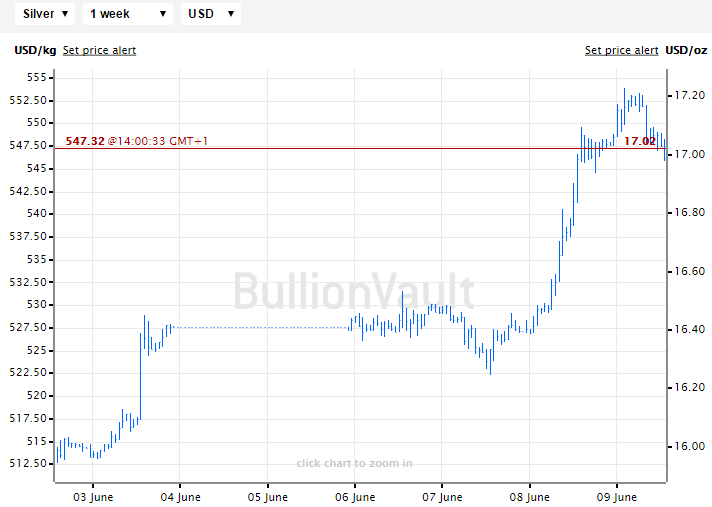
Holding 0.5% and 1.2% respectively below their overnight highs – set as Asian trading began – gold and silver have so far risen 5% and 7% from end-May’s three-month lows against the Dollar.
 
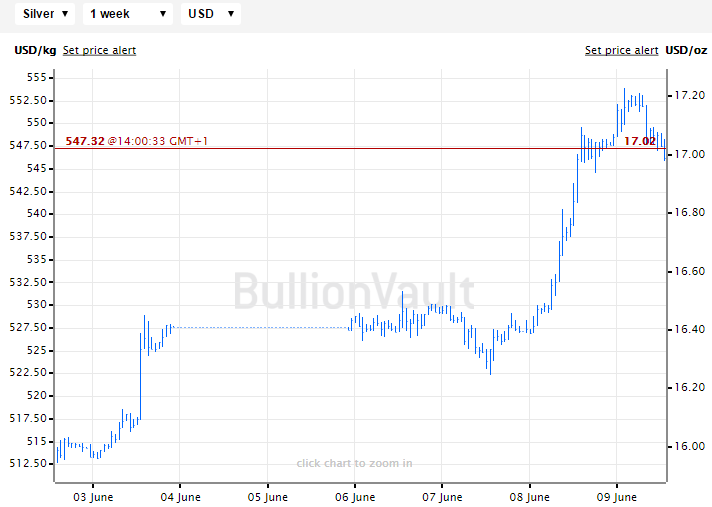
Silver has added over $1 per ounce in the last week alone.
 
Chart of Dollar silver prices, week to 9 June 2016, from BullionVault
 
“It is in fact in everybody’s interest to act without undue delay,” said the ECB’s Draghi in Brussels today, urging Eurozone politicians to speed economic and labor-market reforms, “removing [these] uncertainties without undue delay.”
 
Already creating €80 billion per month of new QE money and now buying corporate bonds as well as government debt, “For the ECB, this means that we do not let inflation undershoot our objective for longer than is avoidable given the nature of the shocks we face,” he added.
 
“I’m confident,” said hedge-fund speculator George Soros meantime to the Wall Street Journal – commenting on the UK referendum on EU membership due 23rd June – “that as we get closer to the Brexit vote, the Remain camp is getting stronger.
 
“[But] if Britain leaves, it could unleash a general exodus, and the disintegration of the European Union will become practically unavoidable.”
 
Urging the ECB to begin outright cash gifts to government or households to kick-start growth, “I don’t think they have any choice but to go to helicopter money,” said trading advisor Dennis Gartman to CNBC Thursday morning, adding that with “gold in Dollar terms rising and the Euro falling, gold in Euro terms gets very strong.”
 
Gold priced in Euros today held at €1110 per ounce, a 10-month high when first reached in February, and giving only a 16% rise for 2016-to-date against the US Dollar price’s 19% rise.
 
Touching £870 per ounce for UK investors in contrast – its highest price throughout 2015 – gold has gained 21% so far in 2016 against the British Pound, more than against any other major currency, and over twice the rate of gain versus the “commodity currency” of Canada.

ECB's Latest Euro QE Bond Buying 'Unequivocally Good' for Gold Prices as China's Exports Fall Faster

GOLD PRICES recovered the last of late-May’s 4% drop versus the Dollar in London on Wednesday, breaking above what technical analysts called “resistance” at $1252 per ounce as the European Central Bank began a new phase of QE monetary stimulus across the world’s largest single economic bloc.
 
Global stock markets struggled to hold yesterday’s sharp gains after new trade data showed China’s exports falling faster in May, down 4.1% per year.
 
But prices to buy government bonds, corporate debt, commodities and precious metals all rose, as did the Euro currency.
 
Running monetary policy for the 330 million citizens of the 19-nation Euro currency union, the ECB today began buying debt issued by “investment grade” corporations including the world’s largest brewer Anheuser-Busch InBev (EBR:ABI), Spain’s near-monopoly communications provider Telefonica (BME:TEF), Italy’s No.1 insurance firm Assicurazioni Generali (BIT:G, +1.9%),  France’s Renault automaker (EPA:RNO) and Europe’s largest engineer, Germany’s Siemens (ETR:SIE) according to “sources” quoted by the media.
 
Now diverting some of its €80 billion per month of QE bond purchases from government debt to buying investment-grade corporate debt, “The central bank has [already] bought more than €800 billion of government bonds since March 2015,” says Bloomberg News.
 
Borrowing costs for investment-grade Eurozone corporations today fell below 1% as bond prices rose head of the ECB purchases on average.
 
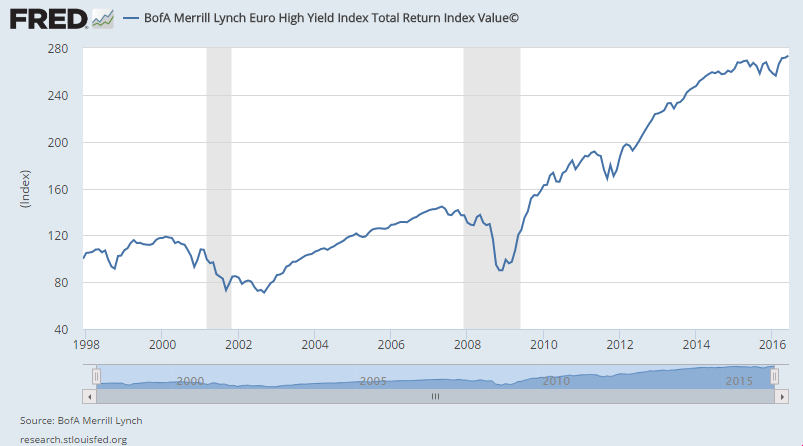
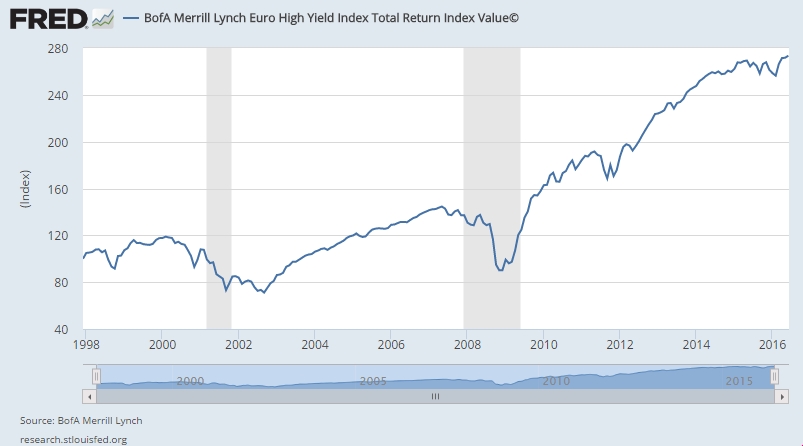
So-called “junk bonds” issued by Euro businesses ranked below investment grade – and paying a higher yield in return – have already tripled investors’ money since the depths of the global credit crunch in late 2008.
 
Chart of BofA Merrill Lynch Euro High Yield Index Total Return Index Value (c)
 
“Ten-year German [government] Bund yields are hovering just above the zero level,” noted forex strategist Steven Barrow at the Chinese-owned ICBC Standard Bank overnight – “the third time they have been here and…it could be third time lucky.”
 
“However,” adds his colleague Tom Kendall at ICBC Standard’s commodities team, “US 10-year yields are also dropping in reaction to [last Friday’s] weak jobs data and decline in benchmark rate expectations.”
 
US consumer credit grew at its slowest April pace since 2013, new data showed Tuesday, missing Wall Street forecasts by 25%.
 
“A simultaneous fall in US and European yields,” says Kendall, “should be unequivocally good for gold,” switching his view from near-term bearish.
 
ICBC Standard’s precious metals strategist now believes prices to buy gold “should be able to test the [May] 2015 high of $1308 again…[with] the next technical targets [at] $1333 then $1392.”
 
“A rebound is developing,” agreed a technical analysis Tuesday from ICBC’s fellow London bullion market-maker Societe Generale, saying that “a move above gold’s weekly [simple moving average] at $1251 would extend recovery towards $1264-1280.”
 
Wednesday morning’s rise to $1254 also broke what bullion market maker Scotia Mocatta’s technical note last night called “resistance at $1252…the 50% Fibo level of the May [gold price] decline.”

Gold Bullion Slips as Shanghai's New Price Benchmark Matches London's Century-Old Volume

GOLD BULLION prices rose in Shanghai but slipped in London trade Tuesday, retreating $10 per ounce from yesterday’s near 2-week highs as European stock markets rose sharply following better than expected GDP data.
 
Economic output across the 19-nation Eurozone grew 1.7% annualized in the first quarter – stronger than first estimated and also ahead of both the US and UK.
 
Edging down to $1237 per ounce, gold bullion also dropped 1% against the single Euro currency, erasing almost all of last Friday’s sharp gain for French, German and Italian investors.
 
Chinese Yuan prices for gold bullion has earlier ticked upwards again, fixing at the highest level in more than 2 weeks at Tuesday afternoon’s Shanghai Gold Benchmark Price.
 
Launched in mid-April, gold trading volumes at China’s twice-daily Yuan gold auction averaged 4.8 tonnes per day during its first month says Jiao Jinpu, chairman of the Shanghai Gold Exchange, in a new article published in English by the World Gold Council.
 
That compares with an average 5.1 tonnes matched each day by the LBMA Gold Price auctions in London, according to data from benchmark administrators ICE.
 
The Bank of Communications today became the fourth Chinese bank to join the LBMA Gold Price auctions, ICE announced, taking the total number of direct participants to 14.
 
Rising from just four members when the century-old London Gold Fixing was updated and formally regulated by the ICE process in March 2015, that still lags the 18 member institutions on the new Shanghai gold “concentration”.
 
That new price – found by matching the greatest volume of business through Shanghai’s new SHAU contracts – “serves as a benchmark for hedging and settlement” in China’s wholesale market, says the SGE’s Jiao, “[as well as] in financing arrangements such as gold leasing, pledging and such like.”
 
For private investors, he adds, “Commercial banks have started citing the Shanghai Gold Benchmark Price as the basis for their gold accumulation plans and other gold-based wealth management products, while security and fund companies have started to design their own products anchored on the benchmark price.”
 
Base metals trading houses and brokers in the West are meantime discussing a possible competitor to challenge the dominant London Metals Exchange according to news-wire reports, with former LME chairman Martin Abbott reviewing “a number of different options…[but] it’s really very early days.”
 
The parties involved, apparently “feel[ing] abused” in the words of one trader over rising fees at the 140-year old LME, “hope to do a feasibility study within a few weeks,” according to Abbott, speaking to Reuters.
 
In the government sector, China’s central bank failed to grow its official gold holdings for the first time in at least 10 months in May, new data showed Tuesday, while Beijing’s total foreign currency reserves fell to the lowest level since 2011 near $3 trillion.
 
Switching to monthly updates last July after revealing a 57% rise from 2009, the People’s Bank held its gold bullion reserves unchanged at 1,808 tonnes last month, even as prices fell 7% from the highest level since January 2015.
 
Gold imports to India – the world’s No.2 consumer nation – meantime fell in May for the fourth month running according to Finance Ministry sources quoted by Bloomberg today.
 
More than halving from May 2015 to just 31 tonnes according to the report, India’s latest gold imports are finding “hardly any demand” says one dealer in Mumbai’s Zaveri Bazaar.
 
“June and July are lean demand months as consumers get busy with agriculture and school activities.”

Gold Prices Hold $30 Jump, ETFs Expand, as US Fed Backs Off June Rate Rise After Jobs Data

GOLD PRICES held in a tight range 0.3% either side of last week’s finish at $1244 per ounce in Asia and London on Monday, retaining last week’s $30 gains as world stock markets struggled, commodities rose and major government bond yields bounced after Friday’s US jobs report shocked analysts and traders with the worst monthly print since September 2010.
 
Monday’s new data said Germany’s factory orders fell 2.0% in April from March – far worse than the 0.6% drop forecast.
 
Friday’s US non-farm payrolls data reversed almost all expectations that mid-June’s Fed meeting will be “live” for a possible rate hike – a near-consensus view only one week earlier.
 
“Markets have become quite sensitive to the possibility of a prolonged period of low growth, low inflation, and economic underperformance,” said US Fed governor Lael Brainard in a speech late Friday, after the May jobs report.
 
Also warning that this month’s UK referendum on leaving the European Union threatens volatility, “Some of the conditions underlying recent bouts of turmoil largely remain in place,” Brainard went on.
 
“An important reason for the fading of [such] turbulence was the expectation of more gradual US monetary policy tightening.”
 
US Fed chair Janet Yellen will give her last speech before next week’s June decision later today.
 
Shanghai’s benchmarking gold price auction rose more than 2% higher from Friday in Renmimbi terms today. Yet Chinese gold prices fell to a discount to international prices, dropping more than $1 per ounce below London quotes as Dollar prices rose faster.
 
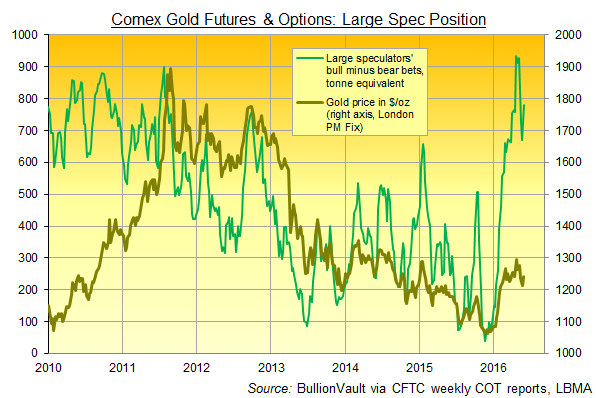
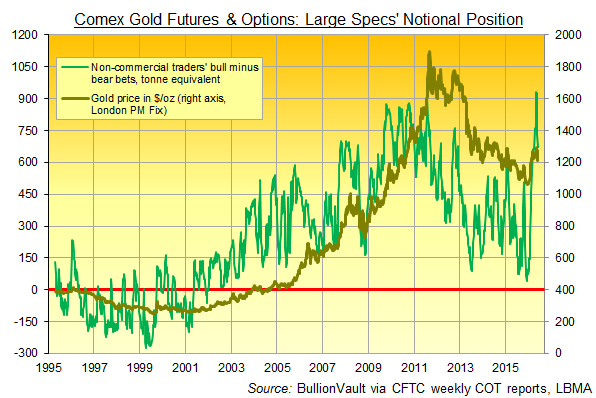
Ahead of the jobs data, in the week-ending last Tuesday, speculative traders in US gold futures and options cut their bullish betting twice as fast as their bearish bets, reducing their net bullishness to an 8-week low, data from US regulators the CFTC showed after Friday’s market close.
 
Now 28% smaller from the new all-time record high set a month ago, the “large non-commercial” net long position remained 2.6 times the size of the last 20 years’ average.
Chart of large speculators' net bullish position, notional tonnes, via Comex gold futures and options
Speculative traders also cut their bullish position in Comex silver futures and options from mid-May’s new all-time record high for the third week running.
 
Down to the equivalent of 9,776 tonnes however, that position of bullish minus bearish bets amongst non-industry players remained 2.4 times the size of the last 20 years’ average.
 
Silver investment through cash-price vehicles rose sharply Friday, with the number of shares issued by the iShares Silver Trust (NYSEArca:SLV) expanding 0.5% to need 10,491 tonnes of bullion backing – the most since December 2014.
 
Friday saw the giant SPDR Gold Trust (NYSEArca:GLD) expand again, growing for the 52nd day so far in 2016 – more than 2.5 times as often as the fund’s previous 10-year average – to need 881 tonnes of bullion backing, the most since mid-October 2013.
 
In contrast to silver ETFs, the precious metals price drop of 2012-2015 had seen the number of shares issued in gold-backed trust funds fall sharply, more than halving by the end of last year.
 
Silver today tracked gold prices, holding above last week’s finish at $16.44 and briefly spiking to a 6-session high at $16.53 per ounce.
 
“The probability of a hike in June has decreased,” Bloomberg quotes fixed-income fund manager Wontark Doh at the $200 billion Samung Asset Management in Seoul, Korea.
 
“Demand [for US Treasuries] will persist. That has an effect on all other countries [via lower interest rates].”

Gold Prices Jump 2% on Worst US Jobs Data In 6 Years, June Rate-Hike Odds Slashed to 1-in-25

GOLD PRICES jumped 2.0% against the US Dollar inside 20 minutes Friday as new data shocked analysts, economists and traders by showing the weakest monthly US jobs growth since 2010 and putting a June rate-hike from the Federal Reserve further in doubt.
 
Betting on interest-rate futures slashed the odds that the Fed will hike on 15 June to 0.75% from the current 0.50% level – reached after 7 years at zero in December – from above 1-in-5 to below 1-in-25.
 
Touching $1237 per ounce, gold outpaced base metals – as did silver, up 2.0% following the Non-Farm Payrolls data from the Bureau of Labor Statistics – and then held more of its jump too.
 
Friday’s official jobs data said the US added only 38,000 jobs in May, missing Wall Street’s consensus forecast by 126,000 with April and March’s earlier estimates also revised down by 59,000 in total, a cut of 16%.
 
New York stockmarket futures pointed sharply lower and European equities slashed earlier strong gains.
 
Base metals also jumped as gold and silver rose, with copper adding 0.7% before reversing all that move inside 30 minutes of the BLS release.
 
Employment in the communications sector fell 37,000 last month on the BLS data thanks to a strike over pay, out-sourced jobs and contracts by workers at the Verizon telecoms giant which began mid-April and ended Wednesday with what the CWA union called “big gains” for its members.
 
“Even without the Verizon strike, payrolls would have increased by a mere 72,000,” notes the Reuters news and data agency.
 
The Euro also jumped against the Dollar, reaching a sudden 2-week high above $1.12 on the FX market.
 
Gold priced in Euros still rose sharply, recovering all of the week’s earlier 1.1% loss and more to trade at €1095 per ounce.
 
The gold price in Japanese Yen barely moved, however, as the Dollar sank near 1-month lows beneath ¥108.
 
“ETFs are starting to see inflows again,” said a note from London brokerage Marex Spectron ahead of Friday’s US jobs data, pointing to another rise in the amount of gold needed to back exchange-traded trust fund investment vehicles.
 
The giant SPDR Gold Trust (NYSEArca:GLD) added a further 4.5 tonnes yesterday, taking its total holding to 875 tonnes.
 
Equal to some 27% of last year’s record-high global gold mine output, that marked a new 31-month high in the GLD’s holdings.
 
“[This] suggests,” said Marex, “that investors think prices are cheap down here [at Thursday’s low of $1206] and there is a small stirring in physical demand as well.”
 
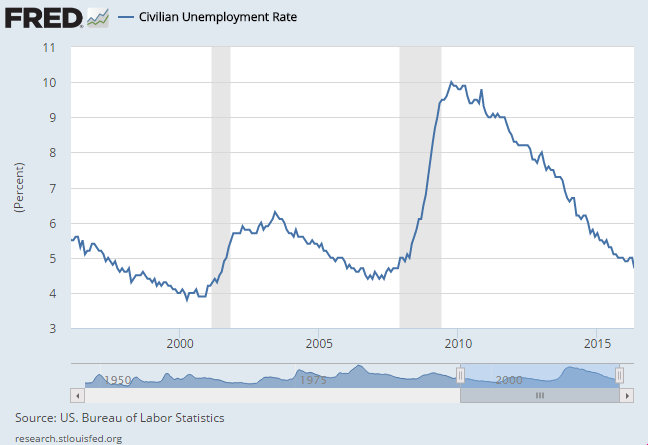
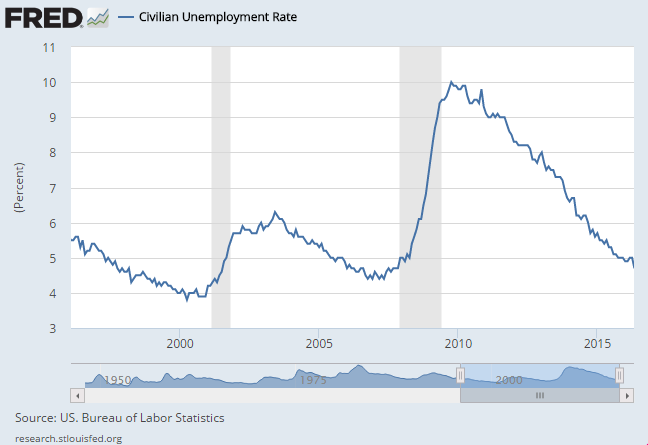
Average wage growth held at 2.5% annually on the new US jobs data, and the official unemployment rate slipped to 4.7% – its lowest level since October 2007.
 
Chart of US civilian unemployment rate
 
“Despite the drop in unemployment,” said US president Barack Obama earlier this week, “wages are still growing too slowly, and that makes it harder to pay for college or save for retirement.”
 
Employment in goods production, which includes mining and manufacturing, lost 36,000 jobs in May, the most in more than 6 years.
 
Renowned US Fed “dove” Charles Evans – a voting  member in 2016 – said overnight in a speech in London that while “it may be appropriate” to raise interest rates twice in 2016 as forecast by his committee colleagues, “a reasonable case can be made for holding off increasing the funds rate until core inflation actually gets to 2% on a sustainable basis.”
 
Stripping out fuel and food, CPI inflation rose to 2.1% per year in April, but on the US central bank’s own forecasts, a “sustainable” 2% pace would leave US interest rates at the current 0.50% level until 2018.