Author Archives: City Gold Bullion

Gold Price $1280, Silver Bears Turn Tail as 'Anemic' Inflation Hits US Fed Rate Outlook

The GOLD PRICE extended its gains and rallied to a 6-week high on Monday morning after London was struck by another terrorist attack at the weekend but oil prices sank despite rising geopolitical tensions in the Gulf region, writes Steffen Grosshauser at BullionVault.
 
The stock exchange in Qatar fell by nearly 8% – and crude oil retreated below $50 per barrel – as a four-country alliance led by Saudi Arabia cut diplomatic ties with the small but rich Arab state, accusing it of facilitating terrorism through its relationship with Iran and support of the Muslim Brotherhood.
 
Election campaigning meantime resumed in the UK after Saturday night’s murder of 7 people around London Bridge – the 3rd such “home grown” Islamist terror attack in the UK inside 3 months.
 
The ruling Conservative Party of Theresa May remains ahead in most surveys, but Socialist Jeremy Corbyn’s Labour Party could achieve a “shock” according to one pollster.
 
“[European elections] have been an underlying supportive factor for some time [for gold prices], providing some good safe-haven buying but not enough to spark any panic buying”, says Australian bank ANZ commodity analyst Daniel Hynes.
 
“That’s why we think things will be relatively subdued.” 
 
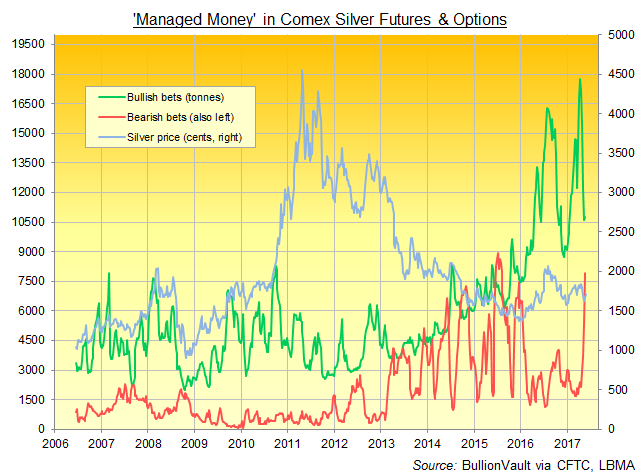
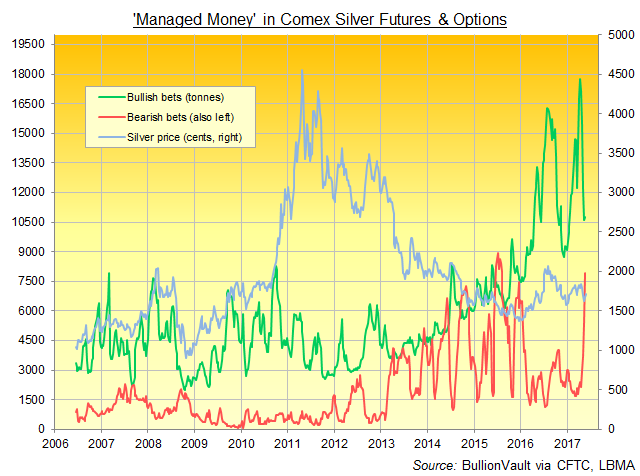
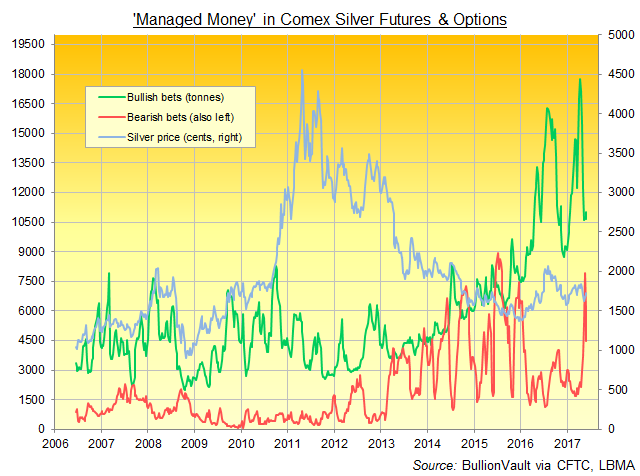
Silver prices today held in line with Friday’s 6-week closing high, trading at $17.59 per ounce after new data for last week showed hedge funds cutting their bearish bets against the metal at the fastest pace since November, down 26% from the previous week’s near record level.
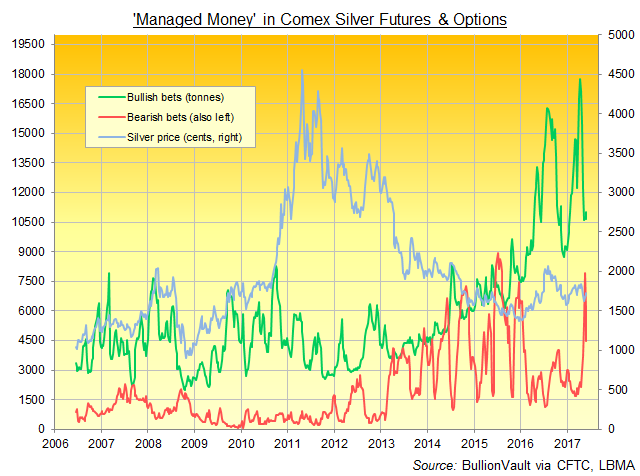
Chart of Comex silver futures and options' 'Managed Money' bull and bear positioning. Source: BullionVault via CFTC
 
Gold held steady on Monday after hitting $1282 per ounce – the highest since 23 April – after jumping 1.1% on Friday following lower-than-expecting US jobs data.
 
“Contrary to most headlines, it was not the payrolls figures that pushed gold up but weak inflation data,” said a note from strategist Tom Kendall at Chinese-owned bullion clearer ICBC Standard Bank, pointing in particular to “anemic” US wage growth.
 
“The bond market and the Fed have overestimated inflationary pressures…[and as] the risks of an aggressive tightening cycle by the Fed recede…that all means a reduced opportunity cost of holding gold and greater motivation for income funds to allocate something to it.”
 
The latest US consumer price inflation data are due on Wednesday next week, the same day as the Federal Reserve votes on its widely expected June interest-rate decision and issues new projections for inflation, GDP growth and its own rates outlook.
 
“Chances are that the Fed will certainly hike in June,” reckons Bart Melek of Canada-based brokerage TD Securities, “but after that, the certainty and then the rate that they’ve been talking about may not actually materialize.
 
“We’re fairly confident that gold prices should do well.”
 
“In the light of recent weaker US economic figures, the consensus for a June rate hike is weakening and the entire concept of further raises this year is being called into question,” agrees London brokerage Marex Spectron in a note.
 
“So focus will be on the next resistance level [of $1300], which is more of a psychological one than anything else.”
 
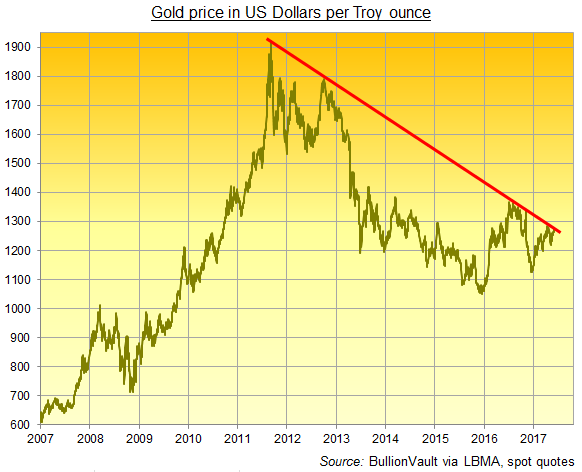
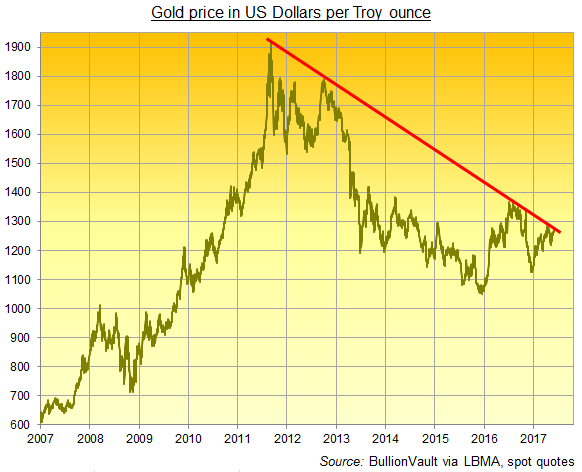
After gold prices tested their ‘game changing’ downtrend running since the all-time 2011 high of $1920 last Friday, “Prices may test $1475 before the end of this year,” believes Nikos Kavalis, director of London-based precious metals consultancy Metals Focus.
Gold Tests 'Game Changing' Trend Line Again After Weak US Jobs Data

GOLD PRICES jumped to 5-week highs against a weakening Dollar on Friday, rising to meet the metal’s 6-year downtrend – starting from the all-time peak of September 2011 – after new US data said the world’s largest economy added fewer jobs than expected in May.
 
Instead of expanded by 185,000 as analysts forecast, non-farm payrolls expanded by 138,000 according to the Bureau of Labor Statistics, which also revised both March and April’s NFP figures sharply lower.
 
Average earnings also grew less quickly than analysts prediced in May, while the unemployment rate only fell because the number of working-age people in or seeking work slipped from April’s near 3-year high.
 
The US trade deficit widened in April to $47.6 billion, separate figures showed.
 
Jumping over $11 inside 20 minutes, the Dollar gold price then broke $1275 to trade near its downwards trend line – joining the peaks since the metal’s high of $1920 – for the fourth time since last June’s UK Brexit referendum shock.
 
Gold’s trend-line resistance “drawn from the all-time high in 2011…is a game-changing level,” says analysis from French investment bank Societe Generale, currently putting the downtrend at $1295.
 
 
Chart of US Dollar gold prices with 6-year downtrend starting at Sept.2011 high. Source: BullionVault
 
US Treasury yields meantime fell hard as bond prices rose, squashing the 10-year rate towards its lowest since Donald Trump’s November victory for the US presidency at 2.18%.
 
“The market is primed for a June hike,” said a note from bullion, FX and commodity market-making bank ICBC Standard’s currency strategist Steven Barrow earlier this week, “leaving the Fed feeling almost duty bound to deliver or face a backlash as the market starts to doubt the reliability of the Fed’s unofficial guidance.
 
“But if the Fed really is as data dependent as it would like us to think, the case for delay is just as compelling…especially if the recent slide in inflation does not prove temporary.”
 
“The swing in expectations against US Fed rate rises was a major factor in both gold and silver prices rising in 2016,” said Neil Meader of analysts Metals Focus last night, launching the consultancy’s new Silver Focus 2017 and forcasting a further rise for silver this year despite a “large and growing surplus” of supply over demand.
 
“Institutional investment” remains strong thanks to “political uncertainty”, weakness in the Dollar, and – for silver – a growing consensus that the “bear market in industrial metals is ending,” Meader said.
 
Silver jumped faster than gold prices Friday, gaining 1.1% after the US jobs data to recover this week’s previous 30-cent loss at $17.39 per ounce.
 
Primarily used in catalysts to clean emissions from diesel engines, platinum also rallied but held 2.6% down from last Friday at $935 per ounce.
 
President Trump announced yesterday that the US is withdrawing from the Paris ‘Climate Change’ agreeement, signed in 2015 by 195 countries and requiring “ambitious efforts to combat climate change” by reducing greenhouse gas emissions, most notably CO2 from gasoline engines.
 
“We don’t want other leaders and other countries laughing at us anymore. And they won’t be,” Trump told a press conference.
 
“Car companies are moving ahead of stricter new [European] legislation on emissions…creating demand for us,” says Robert MacLeod, CEO of catalyst manufacturer and platinum technology specialists Johnson Matthey, reporting a 19% rise today in pre-tax profits for the year-ending March.

Gold Slips, London Trading Grows as 'Low Vol = High Complacency' for Stock & Bond Investors

GOLD TRADING in London’s wholesale market saw prices slip against a rallying Dollar on Thursday as new data said US jobs growth blew past analyst forecasts in May.
 
Wholesale bars traded down to $1262 per ounce – $10 below yesterday’s new 5-week highs – as world stockmarkets edged higher but US Treasury bonds fell, pushing up longer-term interest rates, after the private-sector estimate from payroll services provider ADP put May’s net jobs growth at 253,000 against average predictions of 185,000.
 
Friday will bring the US government’s estimate, currently expected to show lower growth from April.
 
The Chinese Yuan had earlier spiked on the FX market, trading up to its highest against the Dollar since Donald Trump won the US presidency last November on what some commentators called “meddling” by the Beijing authorities after new Chinese manufacturing data came in weaker than expected, with managers reporting a fall in activity overall on the Caixin PMI survey.
 
That buoyed Shanghai gold up to the equivalent of $1275 per ounce despite a drop in the official Yuan-denominated benchmark price, maintaining an $8 premium over comparable London quotes – just below the last 12-months’ average incentive to new imports into the world’s No.1 gold consumer nation.
 
“Some light real money buying accrued around the $1260 mark” earlier this week, says the dealing desk at Swiss refiners and finance group MKS, referring to cash-funded investment managers not trading on margin.
 
“Resistance for gold sits initially at [this week’s 1-month] high at $1270…followed by a significant downtrend line dating back to the all-time highs in 2011 at $1272.”
 
Amongst gold-backed investment trusts, New York’s giant gold ETF – the SPDR Gold Trust (NYSEArca:GLD) – yesterday held unchanged in size for the sixth day running, needing 847 tonnes of bullion to back its shares in issue, equal to some 24% of 1 year’s global mine output.
 
The giant iShares Silver Trust (NYSEArca:SLV) also ended the day unchanged in size once again, needing 10,605 tonnes of bullion backing – equal to some 38% of a global annual mine output.
 
“Minimum volatility = Maximum complacency,” says French investment bank Societe Generale’s strategist Albert Edwards, noting that “the last time volatility in the US bond market was this low (and complacency this high), 10-year yields spiked up some 150bp in only four months as part of Bernanke’s ‘Taper Tantrum’.
 
“[Now] it is worth bearing in mind, as the Fed continues to hike [interest] rates, that 10 of the 13 post-war tightening cycles have ended in recession.”
 
“We believe that many [equity] market participants today are too relaxed,” agrees a new strategy note from giant US bond-fund management group Pimco, saying that “medium-term risks are building and that investors should consider using cyclical rallies to build cash to deploy when markets eventually correct – and possibly overshoot.”
 
Demand to buy at Thursday morning’s LBMA Gold Price auction in London was light at an opening suggestion above $1267, with a balance found between buyers and sellers $1 lower.
 
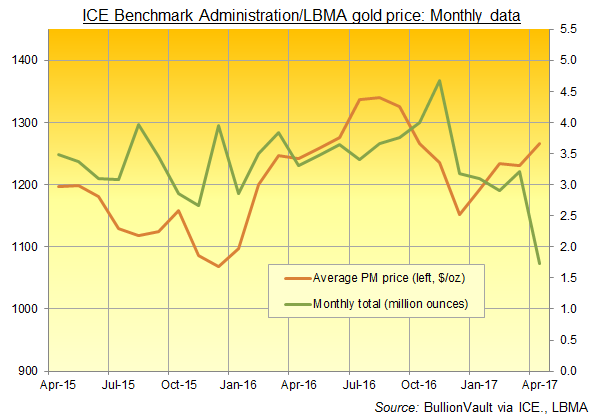
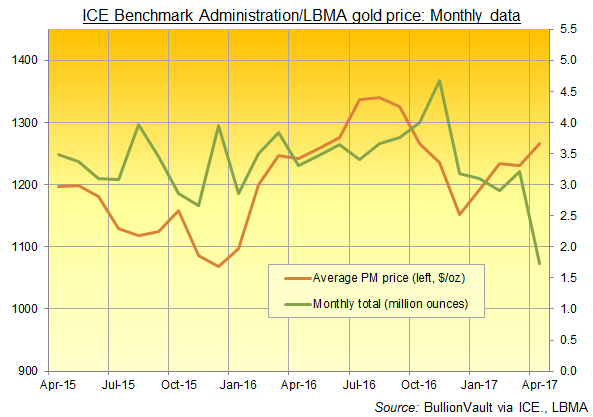
Gold trading volumes at London’s twice-daily benchmark rose on average in May from April’s plunge, data said today from independent administrators IBA, part of derivatives trading exchange ICE.
Chart of LBMA Gold Price monthly trading volumes. Source: BullionVault via ICE
 
Now regulated in UK law, the benchmark was “hit by volatility” in mid-April after 4 of the 14 direct participants stood aside from the process, a Reuters report claimed last week, because they weren’t ready for new exchange-traded contracts imposed on the auction by ICE in a race to beat competitor exchanges in launching gold futures trading in London. 
 
London’s benchmark trading volumes remained almost 29% smaller last month from the previous 2-year average, starting when the new process replaced the century-old London Gold Fixing.
 
The Shanghai Gold Exchange’s price benchmarking reported a 20% drop in its average daily trading volumes for April compared to March.
 
This spring’s drop in gold trading volumes at the twice-daily London benchmark stands in contrast to total volumes through the world’s central hub, with the major bullion banks yesterday reporting a continued uptrend in activity this April.

Gold Prices Split for Dollar, Euro and UK Investors as Trump-Merkel Spat 'Echoes Black Monday 1987'

GOLD PRICES in London’s wholesale market erased their monthly loss against a falling US Dollar on Wednesday, reversing May’s earlier 4% drop as world stock markets rose once again.
 
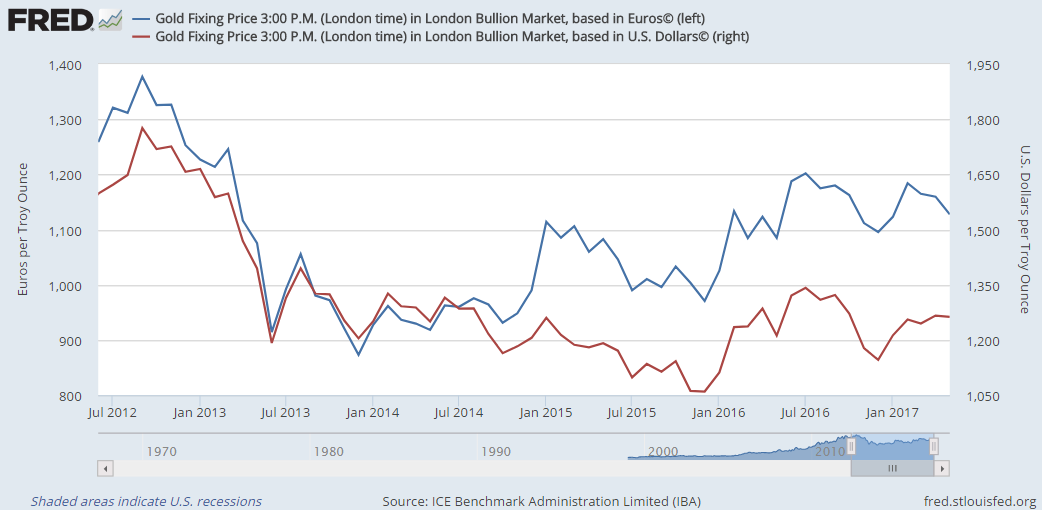
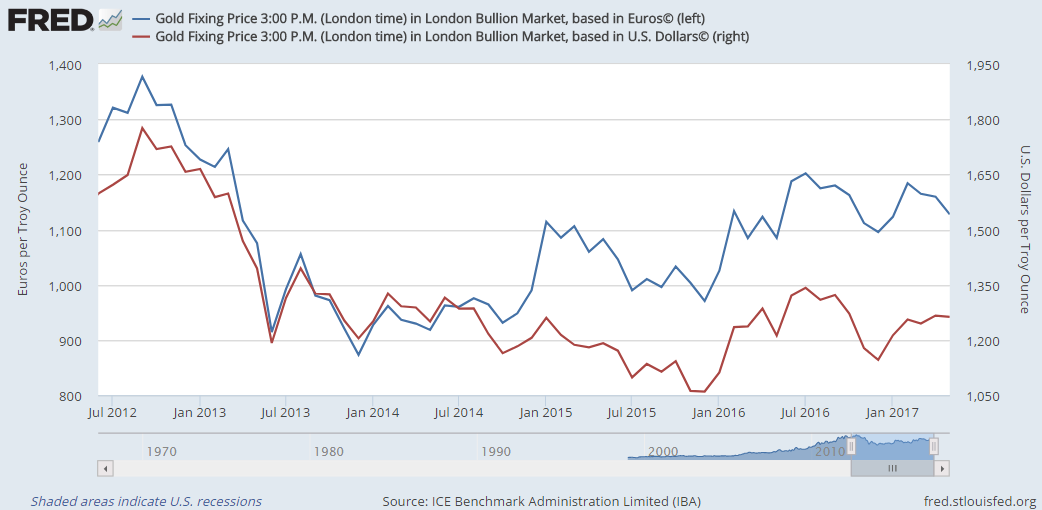
Rising back to end-April’s Dollar level of $1266, gold traded in wholesale bullion bars had fallen to 8-week lows in mid-May at $1214 per ounce.
 
Priced in the single-currency Euro in contrast, gold headed Wednesday for a 3% loss for May, nearing its lowest monthly close since January at €1129 per ounce.
 
Chart of end-month gold priced in Euros (left) and US Dollars (right)
 
“Transatlantic relations are of paramount importance,” said German Chancellor Angela Merkel to reporters today, apparently seeking to calm speculation over her comments following last week’s fraught meeting with US President Donald Trump that “we have to take our destiny in Europe into our own hands.”
 
“We have a MASSIVE trade deficit with Germany,” Trump meantime tweeted, “plus they pay FAR LESS than they should on NATO & military. Very bad for US. This will change”
 
“The last time there was disagreement on this scale, especially on trade,” notes Chinese bullion bar clearing bank ICBC Standard’s FX strategist Stevem Barrow, “was arguably just under 30 years ago.
 
“Back then US Treasury Secretary James Baker went on the offensive over German policy. The result, in many people’s eyes, was the stock market crash of October 1987.”
 
With barely 1 week until the UK’s snap General Election meantime, the British Pound fell further from mid-May’s 8-month highs after a “controversial” forecast from pollsters YouGov was splashed on the front page of The Times, predicting a “possible” hung Parliament despite the ruling Conservatives showing a 12-point lead.
 
Hitting $1.30 on 18 May, Sterling today dipped below $1.28 – its lowest level in 5 weeks – helping buoy the gold price for UK investors at last week’s closing level near £990 per ounce.
 
That was a 3-year high when first hit in the immediate aftermath of last June’s Brexit referendum vote to leave the European Union.
 
An outright win by Prime Minister Theresa May’s Conservative Party is now priced at 5/1-on according to the latest gambling odds from bookmaking exchange Betfair, down from 11/1-on this time last week.
 
The FTSE100 index of mostly global-operating but London-listed companies rose again Tuesday, taking its gains since the Brexit vote to 23%.
 
Accounting for the Pound’s 9% fall versus the Euro single currency however, the EuroStoxx 50 index has risen 1.5x as fast, gaining over 34% in Sterling terms.
 
New York’s S&P500 index has risen 31% for UK investors.
 
British Pound gold prices have risen 18%, heading for a small monthly gain on Wednesday of £5 per ounce for May.

Gold Slips from New 1-Month High as Bullion Market Re-joins Futures Trading, BTC Rallies 40%

GOLD FUTURES retreated from new 1-month highs as London’s bullion market re-opened after the long Whit weekend on Tuesday, trading down to $1260 per ounce as world stock markets slipped.
 
Silver fell faster than gold futures prices, losing over 1% from early Tuesday’s new 5-week high at $17.47 per ounce as US crude slipped further below $50 per barrel despite last week’s commitment from the Opec oil cartel to keep output capped until 2018.
 
Crypto-currency Bitcoin meantime rallied to $2,298 per unit, regaining two-fifths of Friday’s 29% plunge from BTC’s new all-time highs.
 
Ethereum, the next largest “digital asset” promoted as a new form of currency, has risen 30% so far this week, almost tripling in price since the start of May.
 
With Memorial Day meaning that US traders joined China’s Shanghai Gold Exchange and the London bullion market in taking a holiday on Monday, electronic trading in Comex gold futures and options saw June prices hold little changed on very low volumes.
 
Despite the SGE staying shut for the Dragon Boat Festival, prices then jumped at the start of Tuesday’s Asian trade, touching the highest since May 1st at $1270 before retreating $7 per ounce as London then returned from yesterday’s Whitsun Bank Holiday.
 
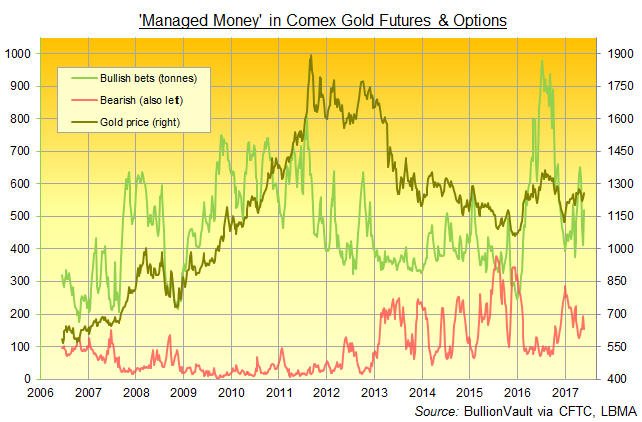
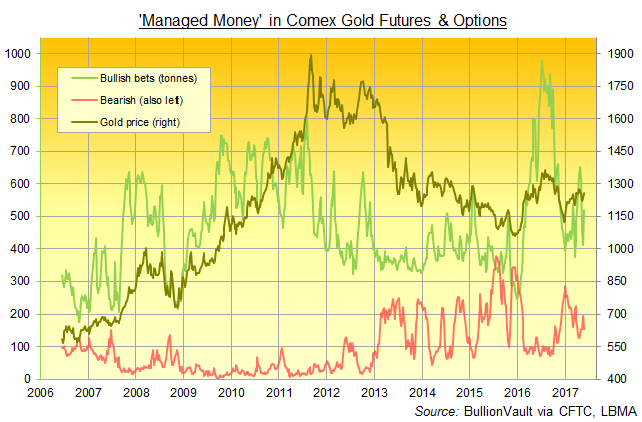
Hedge funds and other money managers last week raised their bullish bets and cut their bearish bets on Comex gold futures and options, according to US regulator the CFTC’s weekly data release on Friday.
 
That saw the ‘Managed Money’ category of traders’ net speculative long position on gold recover half of the previous 3 weeks’ sharp drop, taking it back almost in line with the last 10 years’ average at a notional value equal to 365 tonnes of bullion.
Chart of Managed Money's net speculative long position in Comex gold futures and options. Source: BullionVault via CFTC
 
“On balance, given the recent unwind in Comex length…we prefer to err on the bullish side,” said a note Friday from Chinese-owned London bullion clearers ICBC Standard Bank, also pointing to the market “maybe mispricing the likelihood of the Fed staying on hold” with its June interest-rate decision, plus a turn lower in “the trend in the Dollar.”
 
Tuesday morning saw betting on US interest-rate futures price a rise at the mid-June meeting as 84% likely, up from a 67% likelihood one month ago.
 
Longer-term interest rates fell again Tuesday however, with 10-year US Treasury bond yields dropping towards 6-week lows at 2.23%.
 
In contrast to gold, Comex silver contracts saw a drop in both bullish and bearish bets amongst ‘Managed Money’ traders in the week-ending last Tuesday. Overall, their net speculative long position recovered only one-seventh of the previous 5 weeks’ drop from new all-time records, but held 23% larger than the last 10 years’ average at the notional equivalent of 4,617 tonnes.
 
Hong Kong Exchanges and Clearing (HKEX) needs to offer extended hours on its forthcoming gold futures product, today’s South China Morning Post quotes traders in the city, because “the gold market trades around the clock.
 
“This is why our customers are trading [via Comex] in the US which trades 23 hours a day,” the SCMP quotes Alfred Yeung Ping-kwan at trading house Glory Sky Group.
 
Scheduled for launch in July, the new HKEX contracts will be its third attempt to find demand for Hong Kong-based gold futures.

Gold Risks 'Excitement' at 6-Year Downtrend as BTC Drops 10% from New Record, India Weighs GST Decision

GOLD PRICES jumped above $1265 per ounce in London trade Friday, gaining 0.9% for the week as world stock markets slipped despite another fresh overnight record-high in US equity indices.
 
Major government bond prices rose, pushing interest rates down, and crude oil extended its slump from Tuesday’s 1-month highs despite the Opec producers’ cartel agreeing to curb output until 2018.
 
Alongside gold prices, silver and platinum prices also traded at their highest Dollar level since late April, both gaining 2.3% for the week.
 
Thanks to rising prices for so-called “junk” bonds, the dividend yield offered by European stock markets has now risen above the supposed “high yield” offered by bonds rated below investment grade, says a note from Bank of America Merrill-Lynch.
 
More than doubling inside a month, the price of crypto-currency Bitcoin meantime fell sharply on Friday, retreating 10% from yesterday’s fresh alll-time high of $2779.
 
Over-the-counter fund the Bitcoin Investment Trust (OTCMKTS:GBTC) closed yesterday at a 103% premium to the NAV of the BTC it holds.
 
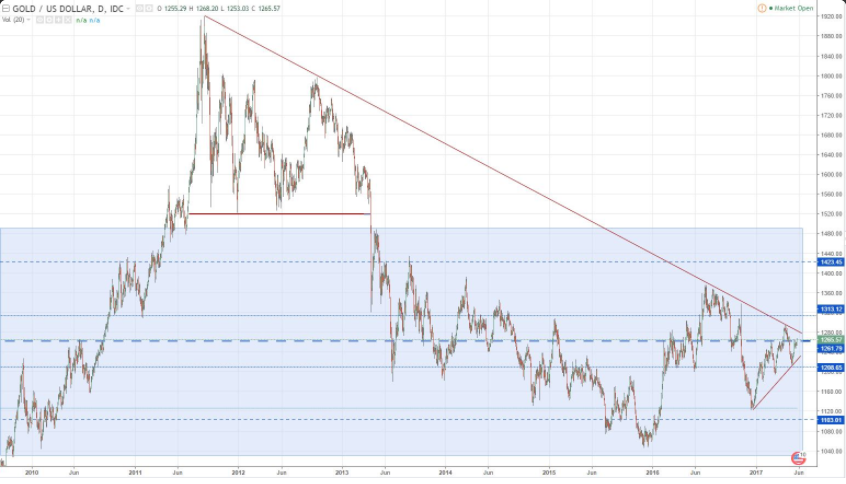
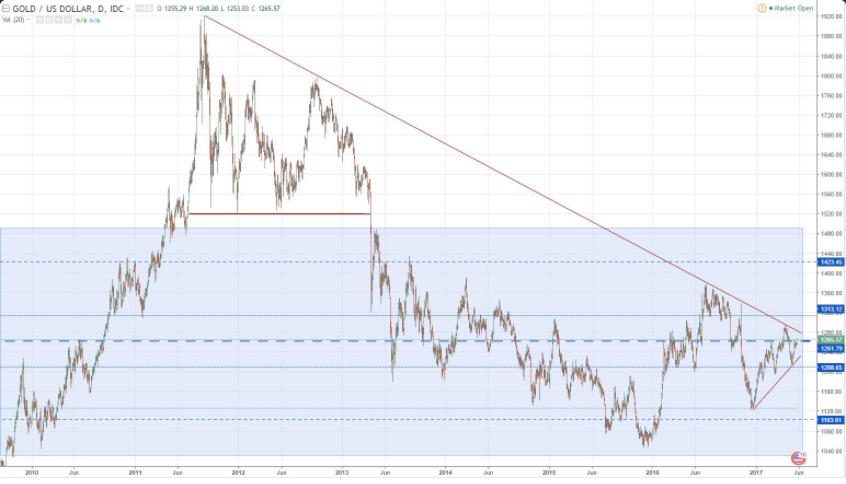
“Could be a burst of excitement if gold breaches that [6-year] trendline at $1280-ish,” says commodities and FX trader Sean Corrigan.
 
“Still very much a medium/long-term range, though”
 
Chart of Dollar gold price with 2011-2017 downtrend. Source: Sean Corrigan
 
Technical analysis from both French bank Societe Generale and Canada’s Scotiabank today put short-term suppot at $1245 because it represents last week’s late low and also the 200-day moving average of Dollar gold prices respectively.
 
The Euro on Friday erased the last of this week’s 0.8% rise to new post-Trump highs against the Dollar, buoying the gold price for German, French and Italian investors near 3-week highs at €1131 per ounce.
 
Gold priced in British Pounds meantime jumped over 2.3% for the week to hit fresh 1-month highs above £983 per ounce as Sterling extended yesterday’s sharp drop on the FX market following weaker-than-expected UK GDP data.
 
The Chinese Yuan in contrast pushed higher to early February highs against the Dollar after Beijing’s State Administrator of Foreign Exchange named 5 individuals and 5 companies as “major violators” of controls to block the buying and selling of foreign currency.
 
Gold prices rose faster however, taking the Shanghai Gold Fix back to last Friday’s level of ¥279 per gram, with a Dollar-equivalent premium over London quotes of $9.60 per ounce – right in line with the daily benchmark’s average incentive for new imports into the world’s No.1 gold mining, importing, central-bank buying and private consumer market.
 
New data yesterday said gold imports to China through Hong Kong – formerly the only conduit for bullion shipments – fell hard in April from March, but held virtually unchanged on a rolling 12-month basis from this time last year at 794 tonnes.
 
“I think high prices hurt gold imports,” Reuters quoted Ronald Leung at at Lee Cheong Gold Dealers, “[especially as] March imports were already too much.”
 
“Physical gold demand in the core demand countries has remained very robust of late,” says a note from Germany’s Commerzbank. 
 
“Nonetheless, there are growing doubts on the market that India will maintain this high import level throughout the year.”
 
Next week brings the final meeting of India’s Goods and Service Tax (GST) Committee regarding gold taxation – “the most significant reform…since the economy was liberalised 26 years ago,” according to specialist analysts Metals Focus.
 
“At present, gold imports in India attract a 10% import duty, 1% VAT and a 1% excise duty,” it explains in its latest India Focus Monthly.
 
“In the GST regime, we urge and expect that the total tax burden on gold be halved from the current level of around 12%,” says the mining-backed World Gold Council’s managing director for India, Somasundaram PR, speaking to The Business Standard today.

Gold Price 'Boring Like Summer' as LBMA Launches Code, Benchmark 'Loses Liquidity'

OVERNIGHT gold price gains of almost 1% were halved in London trade Thursday lunchtime as world stock markets ticked higher following yesterday’s new record highs in the US S&P500 index.
 
The Dollar rallied on the FX market despite what analysts called “cautious” comments on the issue of raising interest rates from the US Federal Reserve’s latest policy-meeting minutes.
 
After finishing last week at $1255 and trading in a tight 1% range since then, the gold price fell Thursday back to $1255 per ounce – just below its daily average of $1260 since 25 May last year.
 
Silver in contrast pushed back towards Tuesday’s 3-week highs at $17.30 per ounce, while platinum prices rose towards 1-month highs above $950 per ounce.
 
“It would seem that the market has looked out of the window and decided that the summer lull is already upon us,” says London broker David Govett at Marex Spectron.
 
“Boring unfortunately does not really do justice to the recent moves and I see very little changing in the near future.”
 
Wholesale gold-market trade association the LBMA today launched its new Precious Metals Code, requiring all trading members to sign a commitment to and implementation of its principles in what chairman Paul Fisher – formerly at the Bank of England – called “an important step forward to build greater trust, consistency and transparency throughout the market.”
 
Launched as an “independent…transparent” and formally-regulated benchmark in 2015, the LBMA Gold Price process has meantime lost the participation of four banks, Reuters reported on Thursday, after administrator IBA – part of the ICE derivatives trading exchange – added a requirement to accept new ICE gold futures contracts before those banks were ready.
 
Enabling IBA to clear each auction’s final trades centrally through ICE’s systems in New York, this “removes the need for firms to have large bilateral credit lines in place with each other…opens up the auction to a broader cross section of the market and also facilitates greater volume,” the administrators said when adding the requirement in April.
 
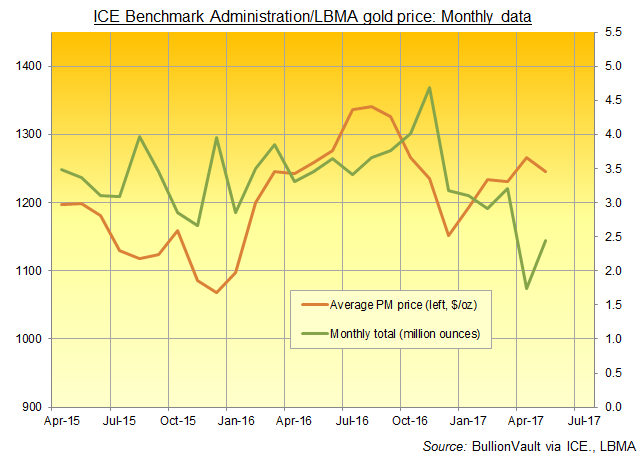
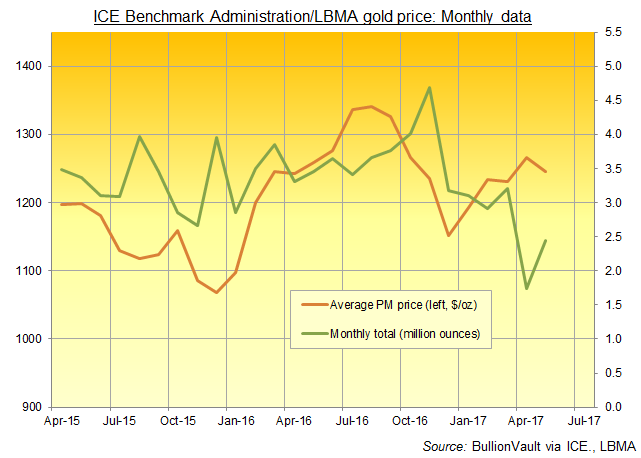
But volumes have fallen sharply since then, as Reuters notes, albeit recovering from April’s 50% plunge on an average daily basis from the IBA auction’s prior average.
Chart of LBMA Gold Price total monthly volumes vs. month-average price. Source: BullionVault via ICE, LBMA
 
Thursday morning’s LBMA Gold Price auction saw 8 direct participants out of a possible 15 find a price of $1257.10 per ounce to balance the greatest volume of buying and selling demand, matching some 56,000 ounces.
 
“When clearing for the auction was launched last month, four banks – China Construction Bank, UBS, Standard Chartered and Societe Generale – ceased participating,” says Reuters, claiming that “at least one of the four…were among those willing to offer flexible liquidity during the auction, according to…sources.”
 
Having participants change their orders in response to the auction’s suggested prices was a key feature of the former ‘Gold Fixing’ process running from 1919 until 2015, and described by economists as ‘tatonnement’.
 
Only one of those four banks, SocGen, is backing ICE competitor the London Metal Exchange’s forthcoming LMEprecious contracts for loco-London futures.
 
Fellow London bullion market-makers Goldman Sachs and Morgan Stanley remain as LBMA Gold Price participants whilst also backing the LME product – now due sometime in summer 2017 – as does clearing-bank and vault operator ICBC Standard Bank, part of the world’s largest banking group, China-based ICBC.
 
On 11 April 2017, the day after IBA added the futures contract requirement, the LBMA Gold Price fixed some 0.9% below the mid-point average of bullion market ‘spot’ quotes, where each buyer and seller trades directly with one another in a unique deal – a market structure known as ‘over the counter’ (or OTC) to  distinguish it from centrally-cleared exchange-traded contracts.
 
28 January 2016 saw the similarly new Silver Price auction process settle 7% below spot prices on what participants called “anti-arb compliance” rules, appparently enforced internally by member banks to block their staff from changing their orders or trading other markets during the process – a key feature of the previous Silver Fixing run daily since 1897.
 
Currently run by US-based derivatives trading exchange the CME together with data and news providers Thomson Reuters, the LBMA Silver Price will go to a replacement provider sometime this summer according to specialist news-site Metal Bulletin, chosen from an apparent shortlist of “two exchanges and one fintech company.”
 
Gold’s current benchmarking has seen net volumes average some 80,000 ounces since administrators IBA began running the auction in March 2015, greater than the average of fewer than 45,000 ounces recorded over the final week of the previous London Gold Fixing process.

Silver Prices Test 'Bullish 400-DMA' with Hedge Funds Most Bearish Since 2015 Lows

SILVER PRICES slipped from yesterday’s 3-week highs but held firmer than gold to bounce back above $17 per ounce on Wednesday ahead of the release of minutes from the US Federal Reserve’s latest interest-rate meeting.
 
Physical gold bullion dipped to bounce $4 higher from $1250 per ounce as world stockmarkets held flat with major government bond prices.
 
Crude prices held firm ahead of Thursday’s Opec oil cartel meeting on output cuts in Vienna, but other commodities also slipped as silver prices retreated over 40 cents from yesterday’s top at $17.31 per ounce.
 
That pulled the Gold/Silver Ratio of the dearer precious metal’s price relative to silver further down from last week’s 11-month highs above 75 to below 73.5 at this morning’s London benchmarkings.
 
“Gold has fallen…because rate hike expectations are rising,” says German financial services group Commerzbank’s commodities team.
 
“According to the Fed Fund Futures, the probability of a Fed rate hike in June is back at a good 80%.”
 
Those odds stood below 65% only last week according to betting on June interest-rate futures.
 
With global Dollar quotes for London settlement almost $15 lower per ounce from the same time Tuesday, the Shanghai afternoon gold price benchmark today fixed at ¥278 per gram, some 1% below yesterday’s 3-week high.
 
That widened the premium, however, for bullion delivered in China, offering new imports an incentive of $8.50 against yesterday’s 1-month low of $7.80 per ounce.
 
Swiss exports of gold directly to China “nearly tripled year-on-year” in April to more than 40 tonnes, Commerzbank also notes, while exports to Hong Kong – the former key conduit for metal into what is now the No.1 consumer nation – held at a “very low level” beneath 13 tonnes.
 
“At the same time, China imported large amounts of silver in April,” Commerzbank says, with Chinese customs data reporting a near-25% jump from the same month in 2016 to 298 tonnes.
 
Looking at silver prices, “$17 looms as a pivot point for the metal,” says an Asian trading note from Swiss refiners and finance group MKS Pamp, “with solid upside potential should the figure hold.”
 
“I am bullish as long as silver closes above the 400-day moving average [at] $16.91,” said technical strategist Russell Browne at Canada’s Scotiabank in New York overnight – the level which silver prices fell to and bounced from Wednesday.
Chart of 'Managed Money' positioning in Comex silver futures and options contracts. Source: BullionVault via CFTC
 
Hedge funds and other speculative traders as of Tuesday last week held more bearish bets against silver prices than any time outside the summer 2015 peak according to positioning data collected by US regulators covering the Comex silver futures and options market.
 
Counted against the same ‘Managed Money’ category’s bullish bets, that helped create its smallest net long position overall since mid-January 2016, back when silver prices began recovering from their lowest level in more than 6 years beneath $13.80 per ounce.
 
Both gross and net bullish betting on silver prices set fresh all-time highs only 6 weeks ago, in mid-April.
 
Yesterday saw the giant iShares Silver Trust (NYSEArca:SLV) hold unchanged in size as prices peaked above 3-week highs at $17.30 per ounce.
 
The SPDR Gold Trust (NYSEArca:GLD) in contrast shed 5 tonnes of gold from the bullion backing its value, taking it down to 847 tonnes – equal to 26% of annual world mining production – as shareholders liquidated 0.6% of the giant gold ETF.
 
Silver prices “found support [in early May] near $16.00,” says the technical analysis team at French investment and bullion market-making bank Societe Generale, but now “a move beyond $17.06/17.37 is needed for a larger recovery.”

Silver Jumps, Gold Price 'Stuck at $1245-65' as Oil Defies Trump, Indian States Disagree on GST

GOLD PRICES held in a tight $5 per ounce range Tuesday, trading around $1260 as world stock markets extended their push to new record highs.
 
English police made an arrest following the suicide-bomb murder overnight of 22 children, teenagers and other concert-goers in Manchester.
 
India’s army reported making its first “punitive” strikes of 2017’s spring thaw on Pakistani forces across the disputed border of Kashmir.
 
South Korea meantime said its troops today fired at what may have been an un-manned drone from North Korea, where hereditary dictator Kim Jong Un yesterday “supervised” the test-launch of a long-range missile.
 
Silver prices popped sharply higher to its highest since end-April at $17.30 per ounce Tuesday lunchtime in London.
 
“Gold is struggling to make it out of this $1245-65 range,” Reuters quotes spreadbetting provider Saxo Bank.
 
“Gold is now probing [a] first significant hurdle at $1263-65,” agrees the latest technical analysis from French investment and bullion market-making bank Societe Generale, also putting “$1245 [as] short term support.”
 
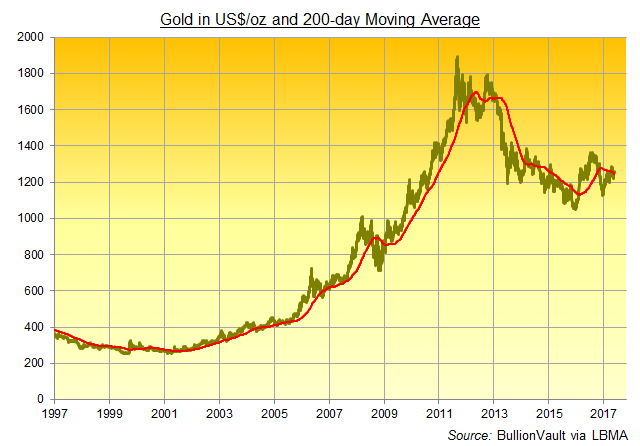
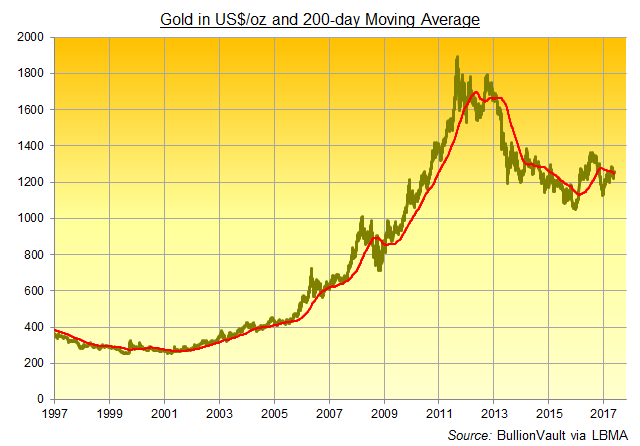
“Resistance is at $1264.50,” agrees bullion bank Scotia Mocatta’s New York team, pointing to the 61.8% Fibo retracement of April’s high to May’s low, and also putting “Support at $1245.50…[the] 200 day Moving Average.
 
“Momentum indicators are biased to the upside and…remain bullish as long as gold closes above the 200-day MA.”
Chart of Dollar gold price's 200-day moving average, basis London PM benchmark
 
Monday saw the giant SPDR Gold Trust (NYSEArca:GLD) expand its bullion backing by almost 2 tonnes, only its 3rd inflow of the last month against 5 days of shareholder liquidation.
 
That leaves the GLD almost 1% smaller from late April needing 852 tonnes of physical bullion to back the value of its exchange-traded shares.
 
Premiums in Shanghai, over and above London quotes, slipped to their lowest Dollar equivalent in a month, dropping below $8 per ounce against a 12-month average $9.40 incentive for new bullion shipments into the world’s largest gold mining, importing and consumer nation.
 
Gold imports to No.2 consumer India jumped 4-fold in April from the same month last year, Bloomberg reported last week, but shipments are now likely to drop according to industry figures as fears about the looming imposition of General Sales Tax on jewelry adds to the traditional summer lull in Hindu wedding and festival demand.
 
“This trend [of heavy imports] will not continue in the coming months,” Reuters quotes James Jose, at India’s Association of Gold Refineries and Mints.
 
“Ahead of GST, some people are stocking up fearing higher tax, but demand has been falling.”
 
Deferred until the end of next week, the decision on gold GST rates “was agreed at 5% by most states,” says Thomas Isaac, finance minister of Kerala, who wanted a higher rate while Maharashtra, Gujarat and Tamil Nadu pushed for a lower level.
 
“This means more discussions are in order before a decision next month.”
 
Having visited the oil-rich Arab state of Saudi Arabia this weekend meantime, US President Trump announced plans overnight to sell off half the United States’ strategic petroleum reserve, built to defend against Middle Eastern supply problems and price volatility in the 1970s.
 
With Saudi ministers now urging other Opec oil-cartel officials to extend output cuts in a bid to boost prices at this week’s meeting in Vienna, crude oil initially lost 50 cents before rallying towards new 1-month highs above $51 per barrel of US benchmark WTI.

Gold Unmoved as Silver Prices Hit 3-Week High, Trump Sees Dollar Sink Again

SILVER PRICES touched a 3-week high on Monday morning in London, while gold stayed firm and the Dollar fell again amid fresh political turmoil around US President Donald Trump, writes Steffen Grosshauser at BullionVault.
 
The US Dollar fell to its lowest Euro value since last November – just before Trump’s White House victory – as the President’s first foreign tour saw accusations of “double-speak” towards Saudi Arabia followed by a near-boycott amongst Israeli politicians of his arrival at Ben-Gurion airport.
 
Asian stock markets made their biggest daily increase in a month despite North Korea’s Communist regime declaring “successful” tests of missiles capable of reaching across the Pacific.
 
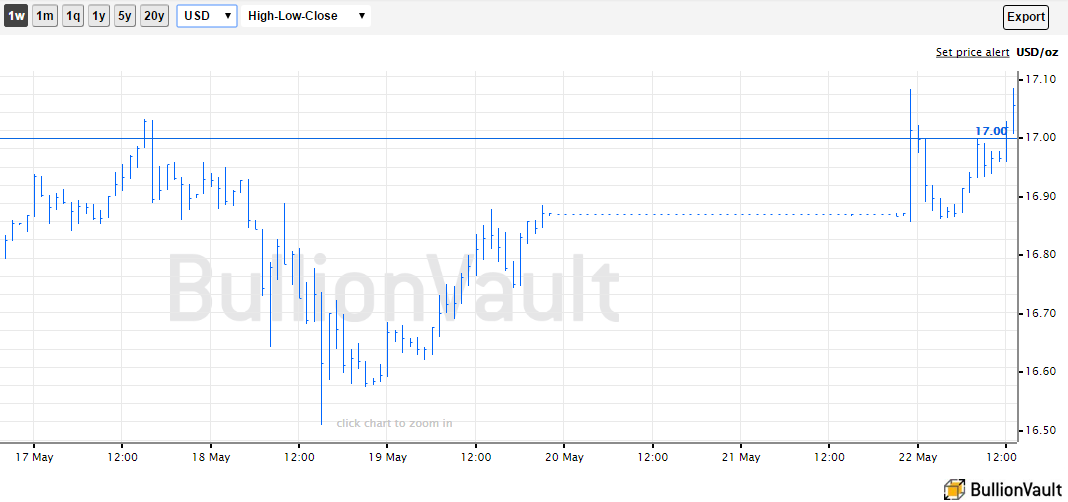
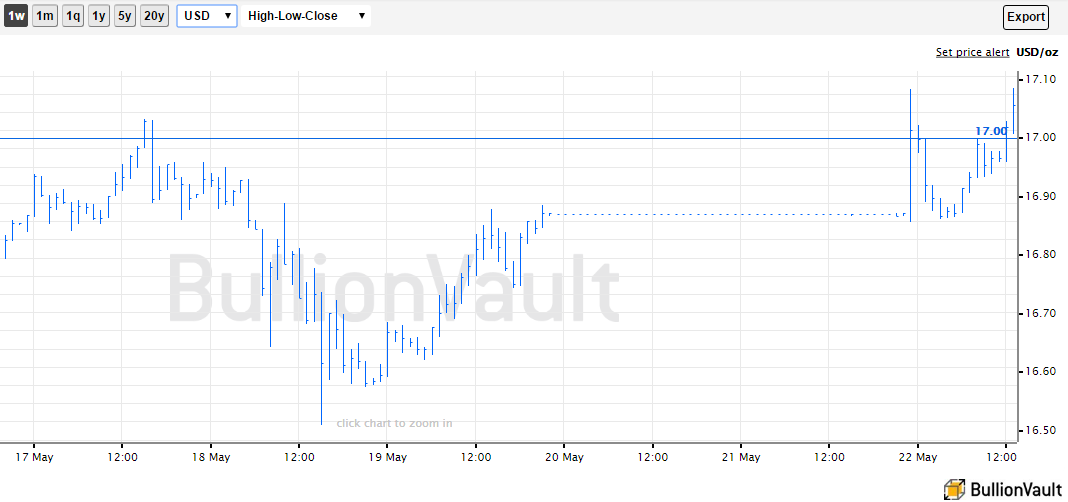
Silver prices jumped 1.2% at the start of Asian trade, dropping back only to reach $17.08 per ounce again at lunchtime in London.
 
Gold in contrast remained largely unchanged around last week’s close of $1255 per ounce.
 
Chart of silver priced in US Dollars. Source: BullionVault
 
“We would advocate abandoning our recent side-lined stance and would buy gold on any significant setback,” says US brokerage INTL FCStone analyst Edward Meir.
 
“The $1300 level is within reach” in the second half of the year if the political situation worsens, reckoned Australia and New Zealand Bank Group (ANZ) commodity strategist Daniel Hynes last Friday.
 
But “fundamentally, we remain bearish on the yellow metal, underpinned by two more rate hikes by the US central bank in 2017,” countered Singapore-listed bank OCBC’ analyst Barnabas Gan, suggesting that rising interest rates imply a higher opportunity cost of holding bullion like gold and silver.
 
Global equities meanwhile continued to rebound from last week’s drop on Monday, with the FTSE 100 index of leading shares in London breaking above 7,500 again while Hong Kong’s Hang Seng Index closed 0.9% higher.
 
Brent crude oil bettered last week’s 5.5% rally by edging up 0.5% to $54 per barrel after Saudi Arabia and Russia signalled that Opec-led production cuts may be extended beyond the initial deadline of March next year.
 
Even against the falling US Dollar however, the British Pound fell back below $1.30 as UK Prime Minister Theresa May made a U-turn on forcing senior citizens to mortgage their homes to pay for all but £100,000 of any old-age care bills – a key plank of last week’s Conservative manifesto for 8 June’s General Election.
 
The Tories’ lead over self-declared Marxist Jeremy Corbyn’s Labour Party fell at the weekend into single-digits according to a new survey by pollsters YouGov for the Sunday Times.