Author Archives: City Gold Bullion

Silver Doubles Gold Price Gain After Comex Speculators Turn 'Net Bearish', Bond Yields Retreat Before ECB, BoJ Decisions

GOLD PRICE gains of 0.5% were doubled by silver bullion in London trade Monday as world stock markets stalled at new all-time highs and major government bond prices rose, pushing longer-term interest rates down.
 
This week brings key policy decisions from the Bank of Japan and European Central Bank – both due Thursday and both currently holding deposit rates below zero with record-high quantities of new QE bond-buying each month.
 
Gold price gains were muted in non-Dollar terms as the US currency extended its recent drop, while silver recovered the lows of its 3 July slump at $16.19 per ounce.
 
Platinum outperformed, reaching its highest level in a month against the falling Dollar at $934 per ounce.
 
Gold at $1230 “puts [it] directly on the technically important 200-day moving average,” says a trading note from German financial services group Commerzbank’s commodities team.
 
“If it were to rise above this level in any lasting fashion, we could see technical follow-up buying…[but] that said, [Friday’s] rise in the gold price was not accompanied by ETF inflows.
 
“On the contrary, the gold ETFs tracked by Bloomberg actually saw outflows on Friday,” led by European trust funds as the giant New York-listed GLD held unchanged at its smallest size since mid-March.
 
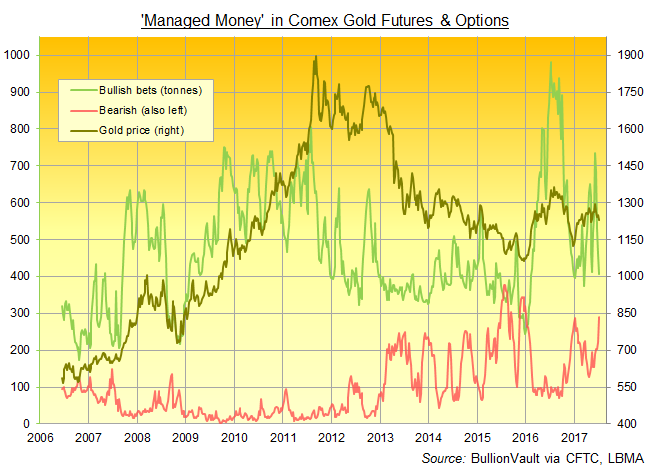
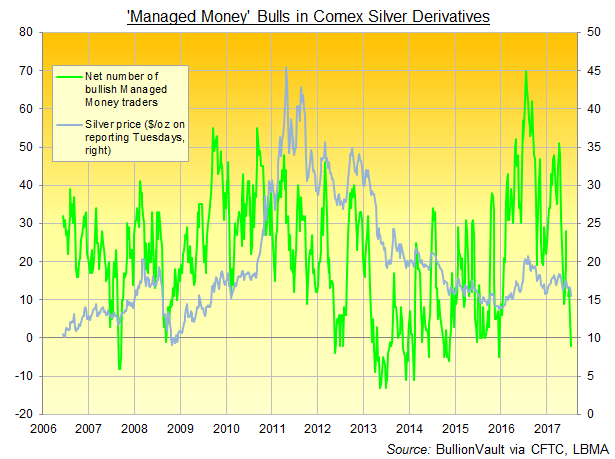
Latest data from the leveraged derivatives market meantime show hedge funds and other ‘Managed Money’ participants held the fewest bullish Comex bets last week – net of bearish bets – since January 2016, immediately as the gold price began to recover from 6-year lows.
 
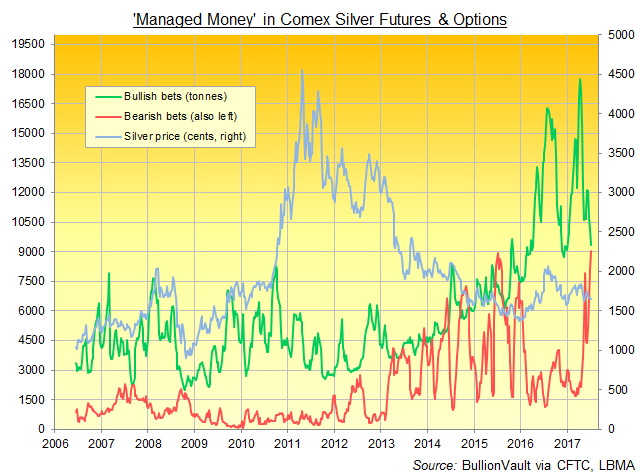
Speculators in Comex silver contracts were meantime net bearish overall for the first time since August 2015, with the count of bearish ‘Managed Money’ traders outnumbering bullish members of that group for the first time since December that year.
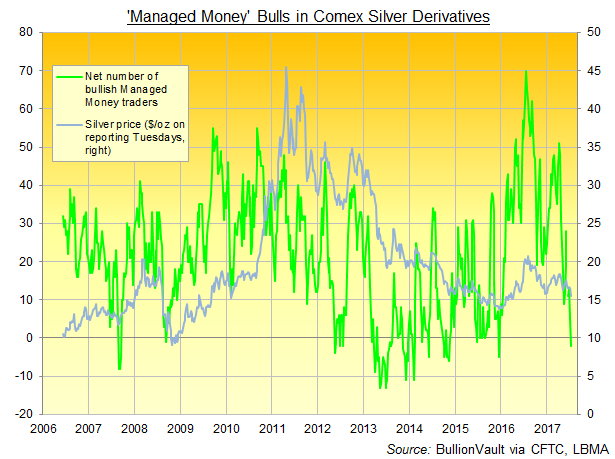
Chart of Comex silver 'Managed Money' bulls minus bears. Source: BullionVault via CFTC
 
Chinese gold prices rose overnight, holding Shanghai premiums above London quotes at $9.60 per ounce, in line with the city’s usual rate.
 
Gold prices in India – now the world’s No.2 consumer nation, overtaken by China – ended last week at a discount for the first time in a month, losing the slight premium paid by consumers just before the government introduced its new 3% GST sales tax on bullion, with a further 5% on fabrication charges on jewelry.
 
“Domestic factors in the US, and especially weak inflation data, suggest that yields will edge back down,” says currency strategist Steven Barrow at Chinese-owned investment and bullion bank ICBC Standard, pointing to Treasury bonds.
 
“The ECB has a chance to inch its more hawkish monetary policy agenda forward this week” at Thursday’s policy meeting, Barrow adds, “but it is a chance that we do not expect the bank to take.
 
“Rate hike speculation [meantime] continues to swirl in the UK…but, in our view, the huge uncertainty surrounding Brexit makes investment in UK assets extremely risky.”
 
With the S&P500 index of US shares setting a new record-high weekly close on Friday above 2,400 points, analysis from Prudential Portfolio Management Group quoted in the Wall Street Journal shows US high-yield bonds now offering zero risk premium to investors over ‘risk-free’ government bonds when adjusted for default rates – the second such time in the last decade.
 
Eurozone high-yield corporates are again paying less than sovereign bonds, says the analysis – the fourth such time since the global financial crisis blew up in 2007.
 
With the ECB targeting a ceiling of 2.0% annual growth in the cost of living, headline inflation across the 19-nation currency union ticked lower in June, new data said Monday, but the so-called ‘core’ index accelerated to rise 1.2% per year, just ahead of analyst forecasts.
Spot Gold Jumps as US Retail Sales + Inflation Hit Dollar, Risk of 'Bar Selling' on Japan's 0% JGB Plan

SPOT GOLD prices jumped near 2-week highs at $1232 per ounce Friday lunchtime in London as weak US retail sales and inflation data saw the Dollar drop hard on the forex market.
 
Consumer prices rose 1.6% in July from a year earlier, the Bureau of Labor Statistics said – the weakest inflation since before Donald Trump won the presidential election last November – while retail sales fell for a second month running, also defying analyst forecasts.
 
The Euro jumped half-a-cent towards this week’s 2-month highs versus the US currency, while the Japanese Yen jumped to a 2% gain for this week at its strongest level since 3 July.
 
The spot gold price outpaced them both however, rising to a weekly gain for Eurozone and Japanese investors and adding 0.6% from last Friday against the British Pound.
 
Major government bond prices jumped having weakend badly since the US Federal Reserve raised Dollar interest rates to a ceiling of 1.25% this time last month.
 
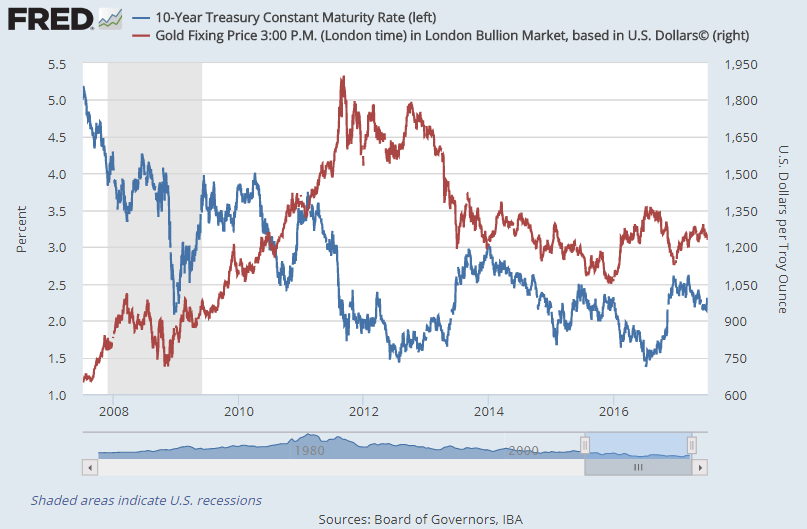
That pushed bond yields sharply lower across the board, with 10-year US Treasurys offering its lowest rate so far in July at 2.28%.
 
“Tightening actions by the Fed and other major central banks [would] create a negative backdrop for gold prices,” said a note earlier from bullion clearing bank HSBC
 
But “while yields on US and Eurozone debt have been rallying as [their] respective central banks turn attention to unwinding monetary stimulus,” says Jonathan Butler at Japanese conglemerate Mitsubishi, “the yield on 10-year Japanese government bonds [JGBs] has remained close to zero.
 
“This is no accident – in fact it is a direct result of the Bank of Japan’s policy of ‘yield curve targeting’ whereby QE [money creation and bond buying] is dialed up and down as needed in order to keep the yield around the 0% mark” on the 10-year JGB, with the aim of boosting corporate borrowing and investment.
 
“All other things being equal,” Butler concludes, “if Japanese yields remain low while US yields are rising, the Yen will lose ground to the Dollar and Yen-denominated precious metals prices will rise.
 
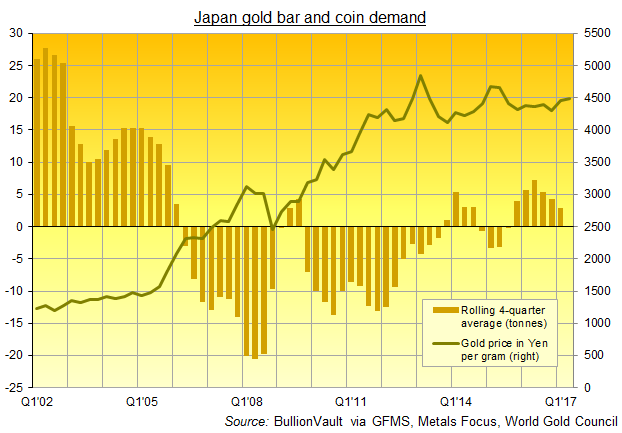
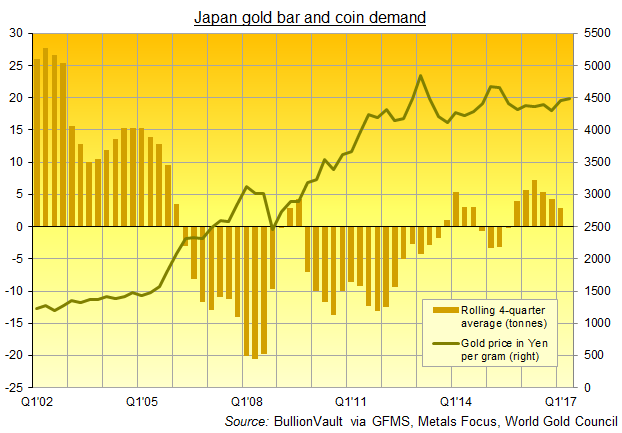
“This brings the risk of profit taking by physical investors in the Japanese large bar market.”
Chart of Japanese gold coin and bar demand, rolling 4-quarter average. Source: BullionVault, data courtesy of the World Gold Council
 
Building their holdings of gold bar and coin during the first decade of Japan’s economic deflation starting with the 1989 Tokyo crash, Japanese households turned net sellers as Yen prices rose sharply in the early 2000s, and continued taking profit amid the global financial crisis.
 
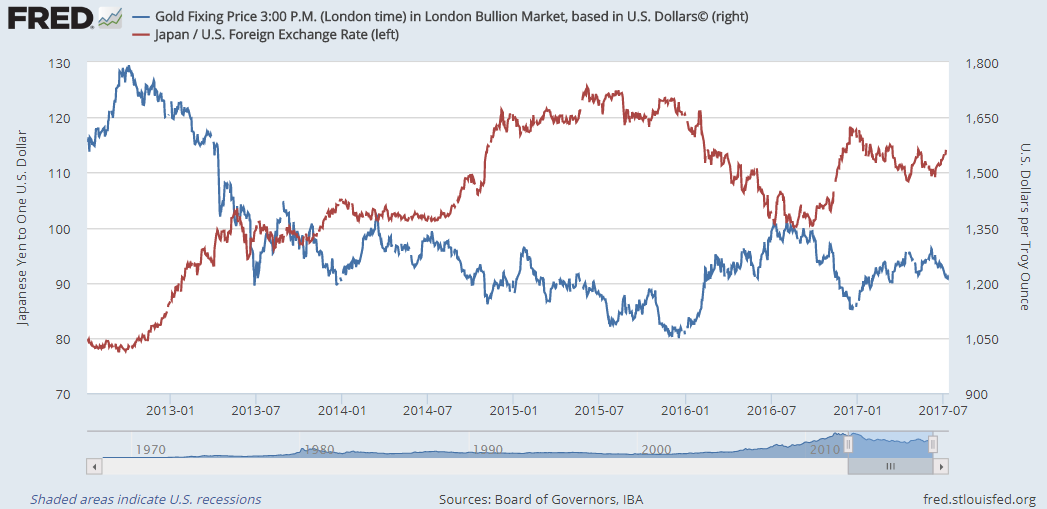
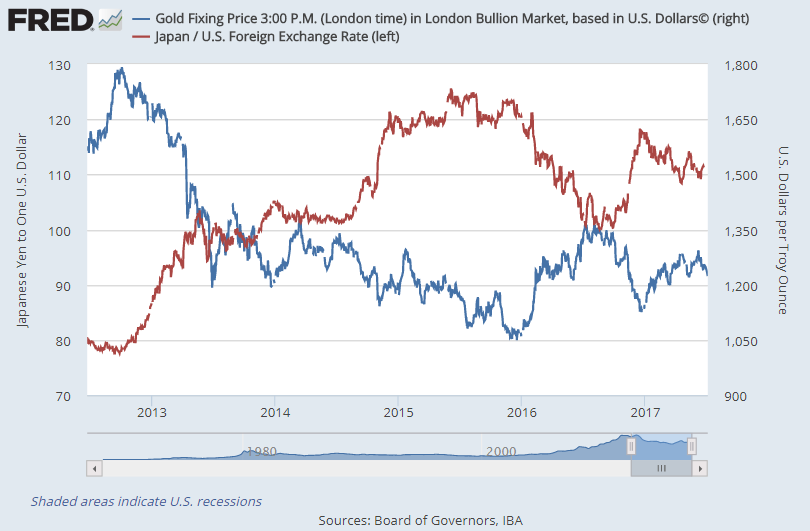
A falling Japanese Yen would also, however, likely see gold priced in Dollars fall as well if 2017 patterns hold according to daily from the bullion and currency markets.
 
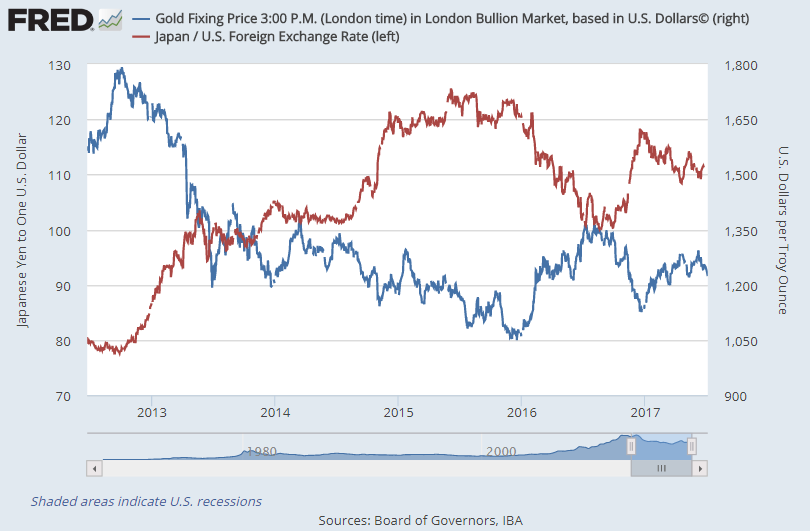
Chart of Dollar gold price versus the Dollar's value in Japanese Yen. Source: St.Louis Fed
 
Gold’s relationship with the Japanese Yen’s value in US Dollars yesterday reached its strongest since mid-June, holding shy of April’s record level.
 
On a rolling 1-month basis, the Yen now shows a daily correlation with gold priced in Dollars of 0.95. That statistical relationship would read 1.00 if gold and the Yen moved absolutely in lockstep with each other.
 
Averaging 0.30 across the last 20 years, gold’s correlation with the Yen has strengthened to average 0.85 so far in 2017 – stronger than gold’s 1-month rolling correlation of 0.83 with silver prices.
 
Ten-year Japanese government bond yields slipped one notch to 0.07% after Friday’s poor US data.
 
Tokyo’s Topix index of Japanese stocks had earlier closed near Wednesday’s new 2-year highs, higher by one-third from this time last year.
 
Spot gold priced in Japanese Yen held little changed from mid-July 2017 at ¥4,445 per gram.
 
Looking at US-listed precious metals vehicles, gold’s failure to rise in price Thursday saw shareholdings cut again in the giant SPDR Gold Trust (NYSEArca:GLD), taking the total liquidation since this time last month to 4.4% – the same percentage by which Dollar gold prices have fallen.
 
Silver’s largest ETF in contrast – the iShares Silver Trust (NYSEArca:SLV) – has grown 3.8% in size since mid-June as that metal fell 7.3% in price.

Gold Price +0.6% vs 'Gradual Rate Rise' Dollar as ECB Back-Tracks on QE, Sterling Gains Amid Brexit Wrangling

The GOLD PRICE in Dollars eased back but held 0.6% higher for the week so far against the Dollar on Thursday as world stock markets rose following Janet Yellen’s comment to lawmakers that the US Federal Reserve will raise interest rates only “gradually”.
 
The British Pound meantime rose but London’s FTSE-100 share index held almost 2% below last month’s new record highs as Westminster’s minority Conservative Government published its “Great Repeal Bill” for ending European Union supremacy over UK law when Brexit formally happens in 20 months’ time.
 
Trading at $1220 per ounce, gold prices touched 1-week highs versus the Euro at €1075 as the single currency fell after a voting member of the European Central Bank said its current policy of quantitative easing is unlikely to end before the Brexit deadline of 2019, reversing what many analysts had seen as a co-ordinated switch to ‘hawkish’ comments from ECB policymakers.
 
“Low inflation…means that [QE] program could continue for at least a couple of years,” said Latvian central-bank chief Ilmāru Rimšēviču on radio in Riga.
 
US Fed chief Yellen yesterday told Congress in her semi-annual testimony that only “gradual rate hikes are likely to be appropriate over the next few years.”
 
Beyond that, said Yellen, “the longer-run neutral level of the federal funds rate is likely to remain below levels that prevailed in previous decades.”
 
Here in London meantime, the minority Conservative Government of Theresa May presented what it called “The Great Repeal Bill” to Parliament, proposing how current European Union laws should be assumed and continued by the UK on the day of Brexit in March 2019.
 
“The Great Repeal Bill is a completely absurd name” for the UK’s post-Brexit law, according to former deputy prime minister Nick Clegg – who lost his seat in last month’s General Election –because it is in fact “a duplication bill” giving continuity to existing EU legislation.
 
One clause, however, says that “The [EU] charter of fundamental rights is not part of domestic law on or after exit day” – a change already challenged by the Opposition Labour and Lib-Dem parties, who said they will vote against the Bill as it stands.
 
“I am not hearing any whistling, just a clock ticking,” said the EU’s chief Brexit negotiator Michel Barnier overnight, responding to UK foreign secretary Boris Johnson’s claim that Brussels “can go whistle” for a large divorce payment from London.
 
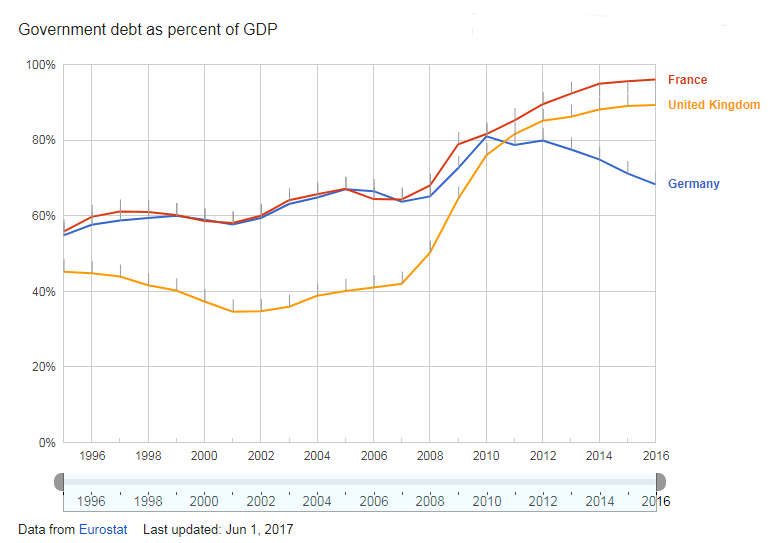
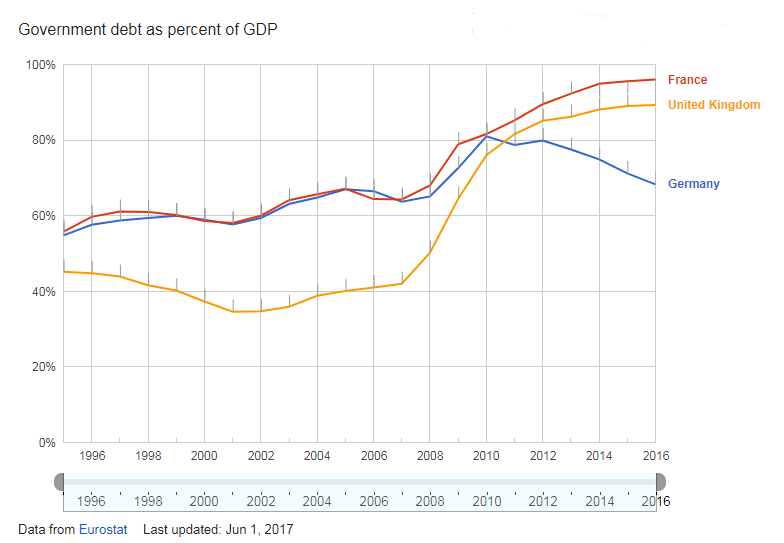
The Office for Budget Responsibility claimed today that, if Brexit shrinks the UK economy’s growth by just 0.1% per year over the next half-century, it risks growing the nation’s public debt-to-GDP ratio by one half.
 
Shorter-term, ratings agency Moody’s said late Wednesday that the UK’s credit “could be downgraded” if it fails to negotiate continued access to the EU single market.
Chart of UK, France and Germany debt-to-GDP ratios. Source: Eurostat
 
Without a new customs agreement in place by the March 2019 deadline for exit, said the UK’s National Audit Office chief Sir Amyas Morse today, the country’s flows of imports and exports face “a horror show” of officials having to manually process each consignment.
 
“In the case of an unorderly withdrawal,” said a joint letter from 8 pharmaceutical trade associations on Thursday, “[it could] lead to potential supply disruptions of life-saving medicines” across Europe’s “highly integrated” drugs market.
 
New data yesterday put the UK’s jobless rate at its lowest since July 1975 at 4.5%, while average wage growth of 2.0% beat analyst forecasts but fell further behind inflation in the cost of living, last put at 2.9% per year. 
 
Latest data from chartered surveyors today said UK house-price growth has fallen to its weakest since immediately after June 2016’s Brexit referendum result.
 
Sterling’s rise on the FX market Thursday knocked the UK gold price in Pounds per ounce £10 below yesterday’s 7-session highs of £952, erasing the week’s earlier 1.2% rally from new 2017 lows.
 
Deputy Bank of England governor Ben Broadbent said in a speech this week he is “not ready” to vote for interest-rate hikes, calling it “a bit tricky at the moment.”
 
Canadian gold prices meantime bounced 0.5% after touching new 6-month lows on Wednesday’s widely-expected central-bank interest rate rise.


Gold Prices Rally 1.5%, 'Long Liquidation Done' But Investors 'Uninterested' as SLV Grows Again

GOLD PRICES extended their recovery to 1.5% from this week’s new 3.5-month low against a falling US Dollar on Wednesday, rising to $1225 per ounce ahead of US Fed chair Janet Yellen’s semi-annual testimony on interest-rate and QE policy to Congress.
 
Asian and European stock markets flipped yesterday’s action to fall and rise respectively, while bond prices and commodities also rose.
 
Silver rose to touch $16 per ounce for the first time since last Friday’s “fat finger” crash on Comex derivatives exchange prices.
 
Yesterday’s drop in silver prices to April 2016 lows saw investors again buy shares in the iShares Silver Trust (NYSEArca:SLV), taking the ETF’s bullion backing up to a new 8-month high at 10,793 tonnes.
 
That’s equal to 39% of last year’s global silver mining output according to data from specialist analysts Metals Focus.
 
Shareholdings in the giant GLD gold ETF meantime stayed unchanged at Monday’s 3.5-month low, needing 832 tonnes of bullion backing – equal to 26% of 2016 global mine output.
 
“Investor disinterest in gold and the implied expression of trust in the sustainability of current economic arrangements bewilders us,” writes US fund manager John Hathaway in his latest quarterly letter for clients of Tocqueville Asset Management.
 
“A hard look at the facts suggests that a return to the normality of the past is unattainable, and that the captains of economic policy are living in a dream world.
 
“Even small exposure to [gold bullion] would be the financial-asset analog of fire insurance on one’s home. We therefore recommend taking advantage of periodic pullbacks…to initiate or expand positions.”
 
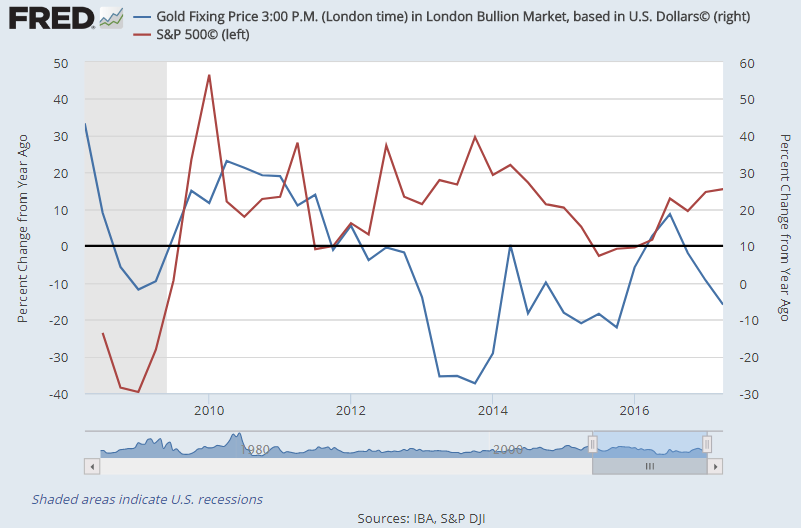
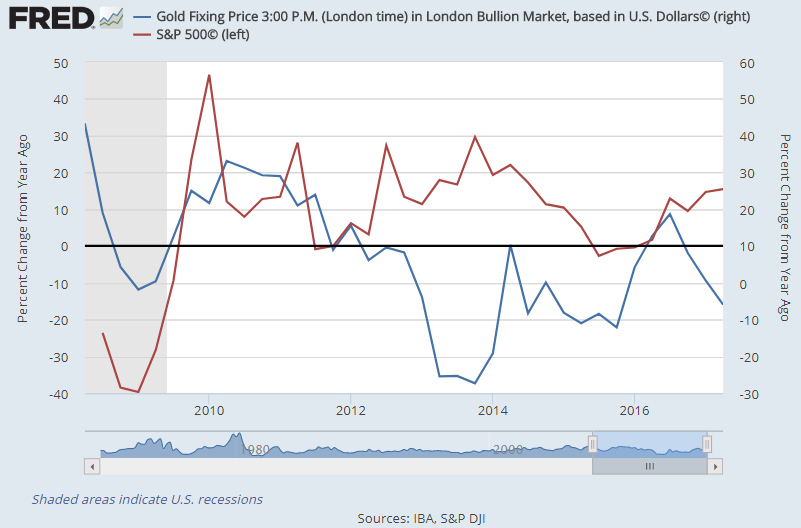
Data in fact show gold and the US stock market moving in the same direction slightly more often than opposite over the last decade, with the two assets either rising or falling together 57% of the time from 12 months earlier on a quarterly basis. 
 
Chart of S&P500 vs Dollar gold price annual % change, quarterly basis. Source: St.Louis Fed
 
“We think gold may trade sideways for now, holding above $1200 but not garnering enough buying interest to break decisively higher,” reckons James Steel, analyst at global retail, investment and bullion bank HSBC.he says.
 
“Physical demand in some important emerging market consumer nations also appears to be positive, notably India, and oil prices, if they stabilise, could help steady gold.”
 
Looking at the last month’s collapse in Comex gold futures and options speculation however, “Long positions have been cut and leave the market open to a short covering rally,” Steel adds.
 
The last 4 weeks of speculative selling on Comex mean “much of the potential long liquidation has already occurred” agrees Swiss bank and HSBC’s fellow London bullion clearer UBS in a note.

Gold Bullion 'Targets $80 Drop' as GLD Shrinks, SLV Grows on Silver's 16-Month Price Lows

GOLD BULLION on Tuesday halved last night’s $10 per ounce recovery from 4-month lows against a rallying US Dollar, trading at $1210 as major government bond prices fell again, pushing up longer-term interest rates.
 
Commodities reversed yesterday’s gains as European stock markets slipped, but Asian equities ended Tuesday higher after provisional data said new machine-tool orders in Japan jumped 31% in June from the same month last year.
 
Industrial output in Italy – the Eurozone’s third largest economy, which escaped a fourth year of recession in 2016 – grew 2.8% annually in May, outpacing analyst forecasts.
 
Silver tracked the rally in gold bullion meantime, recovering last week’s closing level of $15.60 per ounce after touching the lowest since April 2016.
 
“Global growth continues to improve modestly, inflation is closer to central bank targets, and financial stability seems much improved,” says a G10 currency strategy note from Chinese-owned investment and bullion bank ICBC Standard’s Steven Barrow today.
 
“These conditions are prompting other central banks to look at normalising monetary policy in the same way that we have seen in the US.”
 
With falling bond prices pushing up longer-term interest rates, gold bullion’s “key level at $1214…the double-top neckline…has given way on a weekly close basis,” says a note from US financial services giant Citigroup’s FX technicals team, noting the ‘bearish’ pattern seen last week by French bank SocGen.
 
Flipping the pattern’s peak-to-neckline, “The setup points towards a move to $1133,” predicts Citi.
 
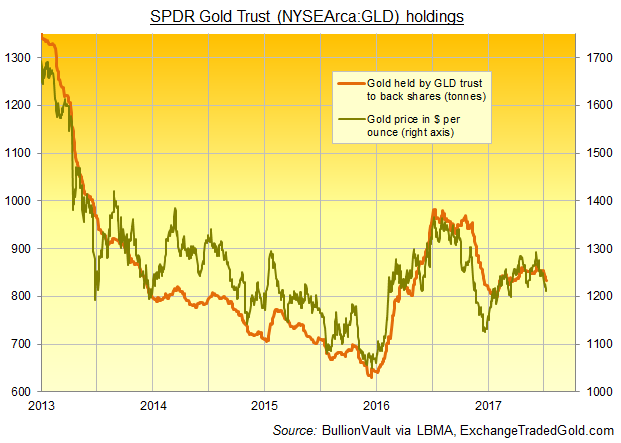
As gold prices fell for the 8th session in 10 on Monday, shareholders in the SPDR Gold Trust (NYSEArca:GLD) liquidated another 0.4% of the giant gold-backed ETF.
 
That cut the quantity of bullion needed to back the GLD’s value by 3 tonnes to the smallest size since end-March, down near 832 tonnes.
Chart of SPDR Gold Trust (NYSEArca:GLD) bullion backing vs. daily benchmark gold price. Source: BullionVault via ExchangeTradedGold.com, LBMA
 
In contrast to gold’s largest ETF, shareholdings in the iShares Silver Trust (NYSEArca:SLV) grew on Monday, expanding as the cheaper metal fell for the third session running.
 
That took the quantity of silver bullion needed to back the SLV up 0.9% to 10,720 tonnes – the largest since last December saw prices retreat to what were then 8-month lows at $15.65 per ounce.
 
Hedge funds trading Comex silver futures and options switched their betting to very nearly a net bearish position last week, latest data say.
 
Over 35% of gold-backed GLD shareholders are ‘institutional investors’ according to data from Nasdaq.com.
 
For the SLV silver ETF, that figure is just 15.6%.
 
“Another wild session for silver,” says one bullion trading desk in a note.
 
For gold, the Shanghai premium over London quotes “[has] provided some support,” adds Swiss refiner MKS Pamp, “but flows limited.”
 
Chinese gold prices today edged higher from Monday morning’s new 2017 lows at ¥266 per gram.
 
That held the incentive for new imports from London at $9.50 per ounce, some 20% below Shanghai’s average premium of the last 12 months.

Comex Gold Net Betting Slashed in Half, Silver Specs Near Net Short as LME Launches Precious Metals Derivatives

GOLD and SILVER prices fell to new multi-month lows versus a strengthening US Dollar at the start of European trade on Monday, hitting 4-month and 16-month Dollar lows respectively 
 
Priced in the Euro both precious metals fared worse still, dropping to their cheapest since February and March 2016.
 
With gold and silver hitting US Dollar lows of $1205 and $15.21 per ounce respectively at 8am London time, world-leading base-metals platform the London Metal Exchange this morning launched its new LMEprecious contracts, aimed at “modernising the gold and silver markets” currently centered in the UK capital, and also set to compete with dominant US-based futures and options exchange the CME Group’s Comex products.
 
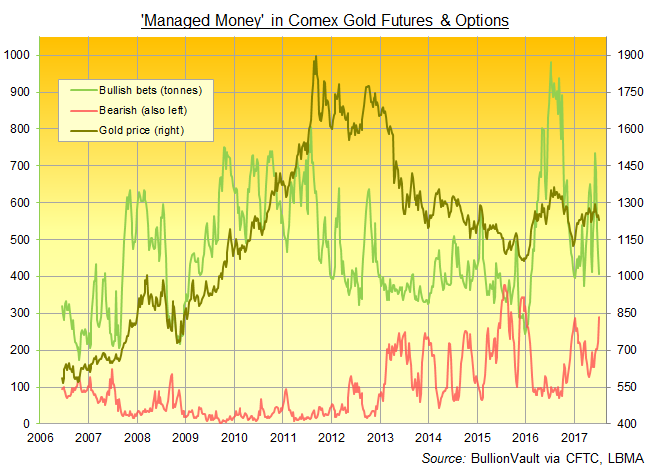
Latest data from US regulators say that hedge funds and other professional traders worldwide fitting the ‘Managed Money’ category of participants last week slashed their net bullish betting on Comex gold derivatives in half, down to the smallest size since New Year.
 
Those speculators cut their total number of bullish bets on Comex gold futures and options for a fourth week running, the CFTC data show, down 11% from a week earlier to the smallest size since mid-March.
 
The ‘Managed Money’s short position in contrast – counting bets that gold prices will fall – jumped 31% to its largest level since gold prices began their recovery from 6-year lows in January 2016.
Chart of Managed Money category bullish, bearish and net betting on Comex gold derivatives. Source: BullionVault via CFTC
 
Net speculative betting on Comex silver fell faster still, crashing 85% last week to near zero as the number of ‘Managed Money’ bullish bets shrank.
 
The number of bearish bets jumped to very nearly match them, reaching a new all-time record size.
Chart of Managed Money category bullish, bearish and net betting on Comex silver derivatives. Source: BullionVault via CFTC
 
“The grey metal continues to trade friendless,” says Swiss refiner MKS Pamp’s latest daily trading note, “and surely it’s only a matter of time before we see a 14 handle.”
 
Giant silver-backed exchange-traded trust fund the iShares Silver Trust (NYSEArca:SLV) in fact expanded last week by 0.6%, requiring a 5-week record of 10,629 tonnes in bullion to back the ETF’s value.
 
The giant SPDR Gold Trust (NYSEArca:GLD) in contrast shrank by 2.0%, cutting the volume of gold bullion needed to back the GLD’s shares by 17.2 tonnes to a 3-month low of 835 tonnes.
 
For the spot gold price in US Dollar terms, “support comes in at the $1200 level,” reckons the latest technical analysis from strategist Russell Browne at London bullion bank Scotia Mocatta’s New York branch, confirming his turn to “bearish” on both gold and silver, with the cheaper metal set to perform worse with a target at the April 2016 low of $14.78 per ounce.
 
As gold and silver bounced from 8am’s new lows in London, major government bond prices also rallied, nudging longer-term interest rates back down off their new multi-month highs.
 
Ten-year US Treasury yields eased back to 2.37% after setting their highest cost of borrowing since early May, jumping at the fastest month-on-month pace since Donald Trump won the US presidential election with a promise to boost spending and cut taxes last November.
 
China’s gold prices earlier fixed at their lowest Yuan value since December last year in Shanghai, trimming the premium over comparable London quotes back below $10 per ounce, down over half-a-dollar from Friday’s 6-week high in the incentive offered to new bullion imports into the world’s No.1 consuming nation.

'Fat Finger' Hits Comex Silver Price as London OTC Hits 18-Year High, LME Tries Gold Futures Again

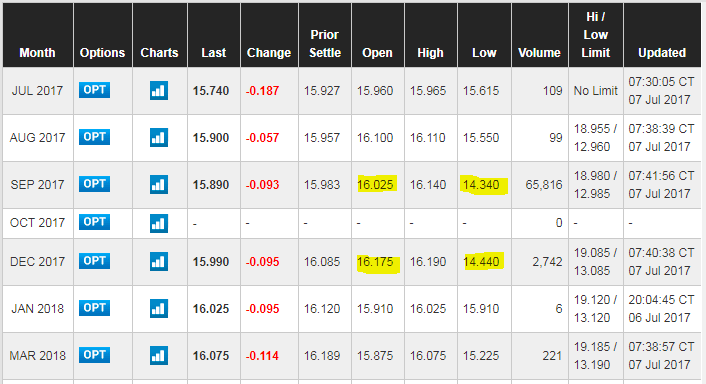
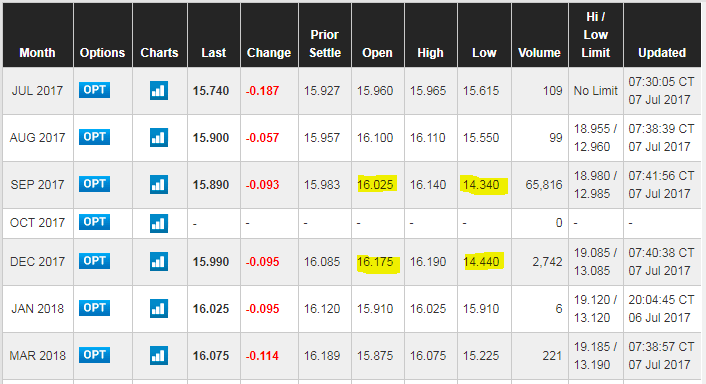
TRADING in Comex silver futures contracts was hit Friday by what dealers and analysts called a ‘fat finger’ error, knocking the metal down more than $1 per ounce to a sudden 15-month low at the start of Japanese hours.
 
A trade worth some $450 million in September and December silver futures saw those contracts plunge over 11%, immediately jumping back above $15.80 and rallying further as physical trading opened in London’s wholesale market.
 
 
Comex operator the CME Group adjusted all trades in Sept and Dec’ silver futures made below a price of $15.54 up to that level – still 1.9% below where London’s midday benchmark, the LBMA Silver Price, then fixed five hours later.
 
Silver prices then spiked to almost $16 per ounce against a falling Dollar after new US data said the world’s largest economy added more jobs than analysts forecast in June, but the number of people looking for work rose faster while annual wage growth stuck at 2.5%.
 
Retreating again as the Dollar then rallied, silver headed for a 4.5% week-on-week drop, three times the weekly loss in gold bullion, itself down $20 from last Friday at $1221.
 
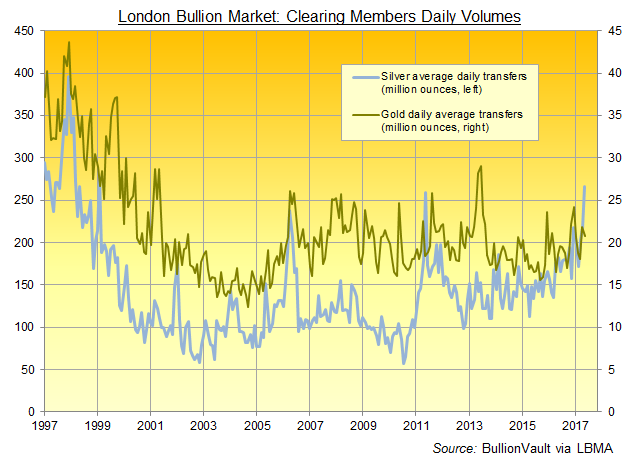
Silver trading through London’s ‘over the counter’ bullion market – where each buyer and seller deal directly with each other (OTC) – leapt in May according to data from the banks clearing those trades, reaching its largest level since early 1999.
 
The five clearing banks – including vault owners HSBC, J.P.Morgan and ICBC Standard Bank, all elected on Thursday to the management board of trade body the London Bullion Market Association – transferred more than 265 million ounces between them on average each working day, breaking May 2011’s peak when prices began their descent from near-record highs at almost $50 per ounce.
 
The volume of gold transfers slipped slightly in May, the data also said, but held 5% greater than London clearing’s previous 5-year average.
 
Estimates say the total volume of gold dealt OTC through London may be three, five or even 10 times the clearing data.
 
A survey of London Bullion Market Association members in 2011 put the multiplier at nine.
 
Mandatory trade reporting starts for LBMA market makers in September and then December 2017 for ordinary members said LBMA chief executive Ruth Crowell yesterday at the Association’s annual general meeting.
 
Chart of London bullion clearing banks' average daily gold and silver transfers. Source: BullionVault via LBMA
 
The latest London OTC figures come as base metals platform the London Metal Exchange (LME) prepares to launch new gold and silver contracts next Monday, aiming to attract a portion of the world’s precious metals trading through London – estimated by analysts to be worth perhaps $5 trillion per year.
 
Now owned by Hong Kong financial exchange HKEX, the LME launched but then abandoned gold futures contracts in the early 1980s. It also tried a silver futures contract in 1999, again suspending it three years later.
 
The new LMEprecious products are “designed to support ongoing regulatory change, enabling greater market transparency and access, as well as providing additional robustness to the precious metals market,” said the LME on Thursday in a joint statement with the mining-backed World Gold Council.

Gold Prices Rally After GLD Sees 2nd Outflow, Fed Split Over Low-Rate Risks

GOLD PRICES traded almost $10 per ounce above yesterday’s 8-week lows in London trade Thursday, holding at $1225 as world stock markets fell with government bond prices after the US Fed’s meeting notes from June showed a widening split over the future path for Dollar interest rates.
 
New US jobs data today came in much worse than expected, with the private-sector ADP report saying US employers added a net 158,000 jobs last month, well below the 185,000 consensus forecast from analysts.
 
The official non-farm payrolls estimate for June is due from the Bureau of Labor Statistics on Friday.
 
Last week’s US claims for jobless benefits today also said employment growth has slowed, with both continuing and new claims rising above Wall Street’s average estimate.
 
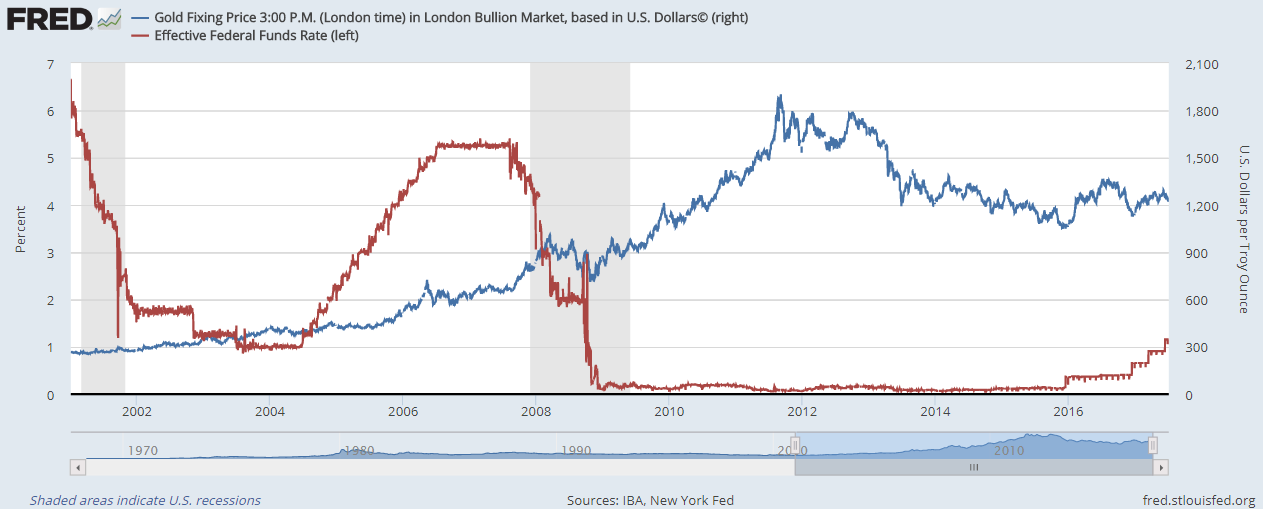
Thursday’s US jobs data came after Wednesday’s release of meeting notes from the US Federal Reserve’s June interest-rate rise decision, showing a split between voting members over the pace and extent of future hikes following that 0.25 point increase to a ceiling of 1.25%.
 
“The Fed grows worried its loose policy threatens US financial stability,” says CNBC’s summary of the notes.
 
But “Fed minutes suggest increasing tensions on inflation shortfall,” says Reuters’ report.
 
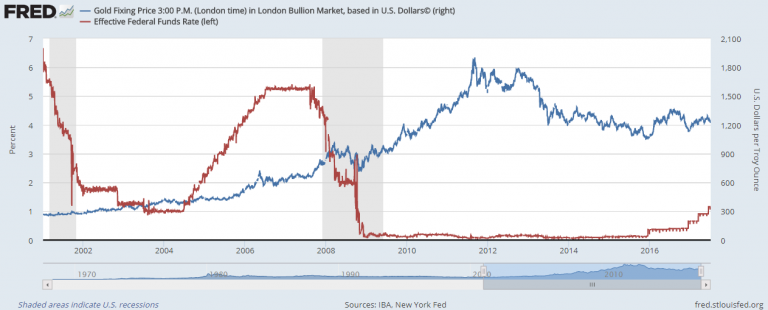
Chart of US Fed Funds rate vs. Dollar gold price per ounce
 
Looking at gold price action overnight, “For a second day in a row there was heavy Comex [gold futures and options] offering ahead of $1230,” says the daily trading note from Swiss refiners and finance group MKS Pamp.
 
“Traders’ next event to focus on will be Friday’s NFP [US jobs] figures, which always have the potential to provide fireworks.”
 
Wednesday’s drop in gold prices to $1217 per ounce saw a second day of liquidation by shareholders in the world’s largest gold-backed exchange-traded fund, the SPDR Gold Trust (NYSEArca:GLD).
 
Losing 13 tonnes on Wednesday, the GLD has now shrunk to its smallest size since mid-April at 840 tonnes.
 
Sponsored by the mining-backed PR and market-development organization the World Gold Council, the GLD closed yesterday needing 840 tonnes of bullion backing – 62% of the ETF’s peak weight, hit at the end of 2012, and equal to 42% of its peak value in Dollars, hit when gold prices topped at $1900 per ounce in September 2011.
 
Together with the London Metal Exchange, the World Gold Council today confirmed next Monday’s launch of new gold-based derivatives contracts, settled in London and widely seen as a challenge to the established ‘over-the-counter’ trade  in wholesale gold bars done between each buyer and seller directly (known as OTC).
 
Now owned by Hong Kong-based financial trading exchange HKEX, the LME attempted to launch a London gold futures contract in the early 1980s, but closed it 3 years later due to lack of interest.

Gold Bullion 'Risks Double Top Confirmation' at $1214 as Korea Tensions Rise, Yen Falls

GOLD BULLION touched new 8-week lows against a rising US Dollar on Wednesday, coming within $3.20 of early May’s bottom at $1214 per ounce as world stock markets rose yet again with Eurozone government bond yields.
 
Platinum dropped to $902 per ounce – erasing the last of 2017’s earlier 16% gain versus the US Dollar – while silver prices fell 7 cents through what Swiss refiners MKS Pamp in a trading note this morning called “psychological support” at $16 per ounce.
 
South Korea and the United States meantime held a joint missile drill following yesterday’s test of a new ICBM by Communist dictatorship North Korea.
 
After calling on Beijing to pressure Pyongyang into ending its nuclear program, “Trade between China and North Korea grew almost 40% in the first quarter,” tweeted US President Donald Trump today.
 
“So much for China working with us – but we had to give it a try!”
 
Trump is set to meet China’s Communist Party leader Xi Jinping at the G20 summit in Hamburg this week.
 
Beijing will likely agree “to punitive sanctions against North Korea” at today’s emergency meeting of the United Nations Security Council, reckons international relations specialist Professor Shi Yinhong, speaking to the Sydney Morning Herald.
 
But it won’t meet all US demands, he believes, and “faces a severe predicament.”
 
“Gold is under considerable pressure as central bankers have essentially signaled the end of years of ultra-loose monetary policies,” says James Steel – analyst at US investment bank, bullion market maker, and London vaulter HSBC – pointing to last week’s comments from US, Eurozone and UK policymakers on global ‘reflation’.
 
“Climbing yields traditionally bring an end to gold rallies.”
 
“The market’s in a tug of war between this reflation narrative [and] rising geopolitical tensions and that’s showing in Dollar-Yen,” said US investment bank Merrill Lynch’s currency strategist Kamal Sharma to Bloomberg overnight, referring to North Korea’s latest missile test.
 
The Yen currency of neighboring Japan today touched its weakest level against the US Dollar since mid-May, losing over 4% of its value since mid-June’s two-month high.
 
Gold’s correlation with the Yen – widely remarked by analysts earlier this year – yesterday extended its recovery from mid-June’s drop as both bullion prices and the Japanese currency fell in tandem versus the Dollar.
 
Touching 0.91 on a rolling 1-month basis Tuesday, gold’s correlation with the Yen has risen sharply since Donald Trump won the US presidential election last November.
 
It would read 1.00 if gold priced in Dollars and the Yen’s Dollar value moved in lockstep with each other.
 
Chart of gold priced in Dollars and the Dollar-Yen exchange rate. Source: St.Louis Fed to 23 June
 
Meantime for Shinzō Abe – Japan’s Prime Minister and grandson of the US-declared war criminal who led “punitive action” against the troops of North Korean leader Kim Jong-un’s grandfather during WWII – last weekend’s “[electoral] defeat in Tokyo [by] the upstart Tokyo Residents First Party is a humiliation,” says FX strategist Steven Barrow at Chinese-owned investment and bullion bank ICBC Standard.
 
“While this might be seen relating to some of the scandals that have afflicted [Abe’s party the] LDP recently, there’s the bigger charge that Abenomics is failing to deliver.
 
“The [US] Fed, for instance, is now into its third [interest-rate] tightening cycle since the early 90s; Japan has barely had one.”
 
For gold prices, “Confirmation level of a possible double top at $1214 will be a crucial support,” says the latest chart note from French bank and London bullion market makers Societe Generale, pointing to the April and then June highs at $1295 per ounce as a possible trigger for what technical analysts call a ‘bearish reversal pattern’.

Gold Prices +$5 After N.Korea's 4th of July ICBM Test, Trump Calls on China to 'End This Nonsense'

GOLD PRICES in London’s wholesale market recovered $5 per ounce from an overnight drop below $1220 on Tuesday, rallying from that 8-week low as North Korea marked US Independence Day by announcing the successful test of an intercontinental ballistic missile.
 
The isolated regime of Communist founder Kim Il-sung‘s grandson said dictator Kim Jong-un personally supervised the launch, with state newsreader Ri Chun-hee saying the “landmark” Hwasong-14 missile confirms North Korea as “a strong nuclear state which [will] proudly protect peace and security…in the region.”
 
The US Dollar pushed the Euro 1 cent down from the single currency’s new 14-month high above $1.14 hit late Monday.
 
That helped gold priced in Euros hold above the March 2016 low of €1078 per ounce hit Monday.
 
China’s benchmark gold price however fell Tuesday, fixing in Shanghai below ¥270 per gram for the first time since start-February.
 
South Korea and Singapore government bonds also fell in price, bucking a rally in other Asian and European debt which pulled yields lower from their recent multi-month highs.
 
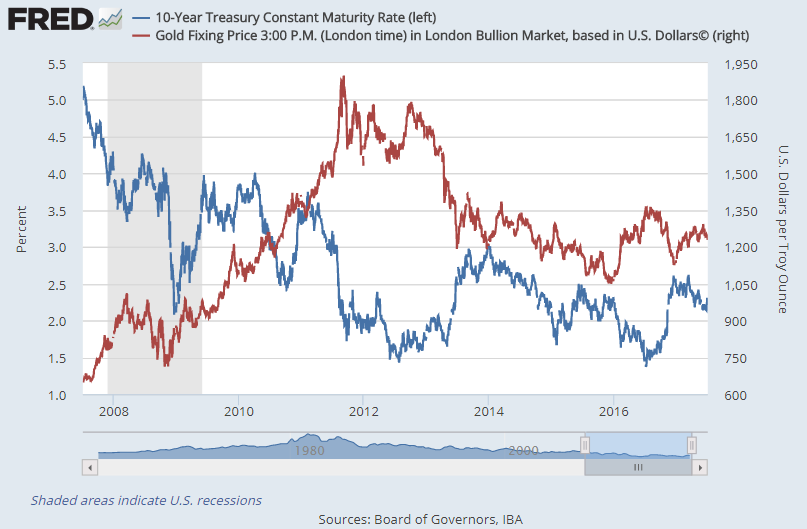
With US markets shutting for the Fourth of July holiday, 10-year US Treasury yields yesterday closed at 2.35%, their highest level since early May.
 
Jumping more than one-fifth of a percentage point over the last week, 10-year T-bond yields have made the fastest weekly rise in borrowing costs since Donald Trump won the US presidential election last November.
 
Gold prices then lost $55 per ounce. The metal has dropped $15 since the start of last week.
 
Chart of 10-year US Treasury bond yields vs Dollar gold price. Source: St.Louis Fed
 
“Does this guy have anything better to do with his life?” asked US President Donald Trump of North Korea’s Kim Jong-un on Twitter today.
 
Ahead of this week’s G20 summit in Hamburg, “Hard to believe that South Korea and Japan will put up with this much longer,” Trump added.
 
“Perhaps China will put a heavy move on North Korea and end this nonsense once and for all!
 
While N.Korea may not yet have the technology to put a nuclear warhead on the ICBM, its range could reach Singapore, Alaska, Australia or Moscow according to analysts cited by AFP.
 
Hong Kong’s Hang Seng stock index lost 1.5% today while mainland China’s key share index fell 0.8% but Japan’s lost only 0.3%.
 
Agricultural commodities rose sharply, but energy prices fell back.
 
“We have a view that real rates go sideways. So the pickup in nominal rates will be equally matched by the pickup in inflation,” said Swiss investment and bullion bank UBS Asian commodities and foreign exchange director Wayne Gordon to Bloomberg today.
 
So while “we’re not saying we have a bullish bias [on gold prices],” he went on, “we’re saying that tactically, people should be buying [gold] somewhere near $1200 and selling it again somewhere near $1300.”
 
Press reports from India – world No.2 gold buying nation behind China – meantime said today that consumer interest has halved and more since the weekend’s introduction of 3% GST sales tax on bullion, with an extra 18% charge on jewelry fabrication costs.
 
“The GST rate has increased the incentive to bring in smuggled gold,” Reuters quotes one Mumbai jeweler.
 
“The government should reduce import duty and make smuggling unviable.”