Author Archives: City Gold Bullion

Gold Prices Stuck to $1200 as China Cancels Trade Talks, Barrick-Randgold Praise 'Value Creating' Merger

GOLD PRICES moved sideways in quiet trade on Monday as the Dollar held firm ahead of this week’s widely-expected interest-rate rise from the US Federal Reserve.
 
Moving barely 1% away from $1200 per ounce over the last month, gold again stuck to that price as world stock markets slipped.
 
Tokyo and Shanghai were closed for mid-autumn festivals, but on the political front Beijing cancelled planned talks with Washington amid the worsening US-China trade war, with both sides imposing new tariffs last week.
 
“Gold traditionally trades poorly ahead of anticipated Fed hikes and the Dollar will have an upper ground,” says FX platform Oanda’s Stephen Innes.
 
Ahead of this Wednesday’s Federal Open Market Committee (FOMC) decision, betting against gold prices by hedge fund and other ‘Managed Money’ traders last week grew for the 10th week running on Comex futures and options, according to US regulator the CFTC’s data series
 
Net of that group’s bullish bets, the speculative short position grew 4.2% – reaching a notional equivalent of 231 tonnes – but held below the fresh series record hit at the start of September.
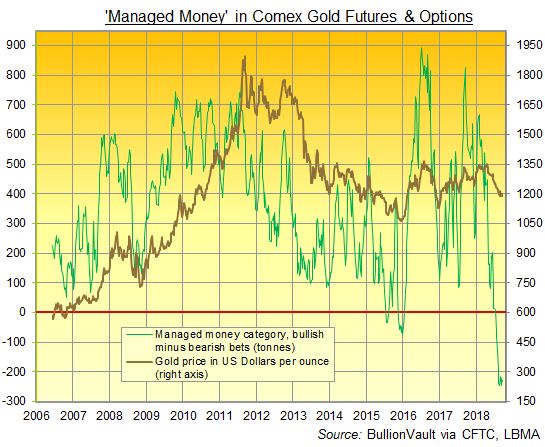
 
Chart of 'Managed Money' net speculative position in Comex gold futures and options. Source: BullionVault
 
Gold mining shares edged higher on Monday after No.1 producer Barrick (NYSE: ABX) announced a merger with No.15 miner Randgold Resources (LON: RRS) in a deal valuing the new joint business at $18 billion.
 
“The combination will create a new champion for value creation in the gold mining industry,” says Barrick CEO John Thornton.
 
Focused on central and western Africa, Randgold will be de-listed from the London Stock Exchange, and its shareholders paid in North America-listed Barrick stock.
 
Friday saw the launch of billionaire hedge-fund manager John Paulson’s new Shareholders Gold Council – a lobby group aimed at pushing mining bosses to curb executive spending and focus on boosting returns to equity investors.
 
The UK gold price in Pounds per ounce meantime slipped 0.5% to £913 on Monday as Sterling rallied despite fresh political wrangling over both the Conservative Government and opposition Labour Party’s plans for Brexit.
 
Attendees of Labour’s annual conference will this week vote on pushing for a second referendum on the 2016 decision – a so-called “people’s vote”.
 
Pro-Brexit politicians today put forward an alternative Brexit plan to the so-called “Chequers deal” offered by Prime Minister Theresa May and rejected by European Union leaders last week.
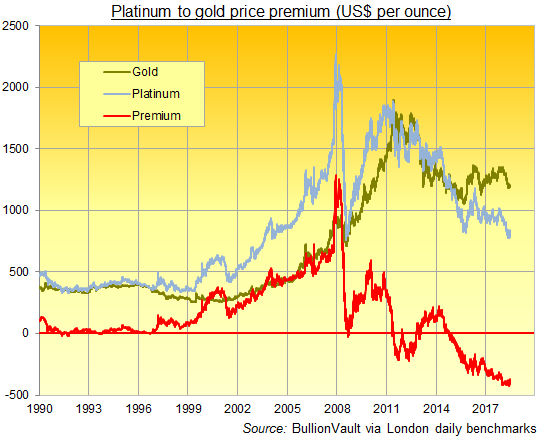
Platinum's 5% Weekly Gain Cuts Discount to Gold to 6-Month Low, Outpaces 'One-Trick' Palladium

PLATINUM PRICES outpaced gold and silver again on Friday in London, extending this week’s rally against the falling US Dollar to 5.1% as world stock markets also rose.
 
China’s stock market jumped over 3%, hitting 4-week highs as analysts said Beijing has built a strong economic “cushion” against its worsening trade war with the United States.
 
Donald Trump’s ex-strategy advisor Steve Bannon, however, told the South China Morning Post overnight that the White House is aiming to make the trade war “unbearably painful” for China, forcing it to cut tariffs and open its markets to more US goods.
 
With the Dollar falling to 3-month lows this morning versus the Euro currency Friday morning, gold added $10 for the week to trade at $1205.
 
Silver doubled that rate of gain to add 1.9% from last Friday’s finish, briefly touching $14.40 per ounce.
 
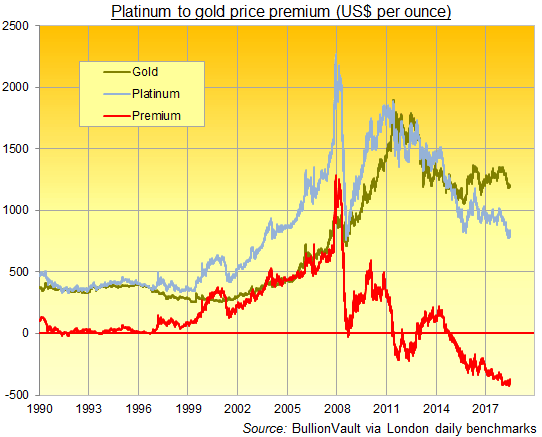
Platinum’s gain to $838 meantime cut the metal’s discount to gold prices to a 6-month low on Friday morning at $370 per ounce.
 
Over the last quarter-century, platinum prices have averaged a premium to gold of $160.
 
Chart of platinum minus gold price in US Dollar per ounce, daily London fix, 1990 to 2018. Source: BullionVault
 
Sister metal palladium also rose Friday but less quickly, hitting 8-month highs in US Dollar terms at $1058.
 
That trimmed its premium to platinum to $220 per ounce – a gap beaten on only 75 trading days during palladium’s spike above and plunge from $1000 in 2000-2001.
 
“Palladium continues to be in demand by industrial users and supplies remain very tight,” says a note from Japanese conglomerate Mitsubishi.
 
“[That’s] reflected by the continuing market backwardation,” with spot prices trading above palladium prices for future delivery.
 
Looking ahead, analysts at Canadian financial services firm BMO say they “have some worries about palladium being a one-trick pony” – relying for 80% of its demand on gasoline engines, against 40% of platinum’s demand coming for autocatalysts in diesel vehicles – and “as a result, we have palladium back below platinum on a longer-term basis.”
 
The British Pound meantime hit 9-week highs against the Dollar on Friday, keeping the UK gold price in Sterling terms per ounce unchanged for the week at £913 – some £5 above Thursday’s drop near the lowest price since June 2016’s shock Brexit referendum result.
 
UK prime minister Theresa May’s so-called “Chequers plan” remains “credible” said a member of her Government today, despite this week’s outright rejection – most notably over the issue of a “hard border” between Northern Ireland and the Republic of Ireland – by both the European Commission and leaders of the other 26 European Union states after meeting in Salzburg.

Gold Bullion Nears Post-Brexit-Vote Lows for UK Buyers as India Defies US, China and Turkey Attack 'Loose Talk'

GOLD BULLION crept higher against a falling US Dollar in London trade Thursday, edging up to new highs for this week at $1207 per ounce but flirting with new multi-year lows in terms of other major currencies.
 
The UK gold price in Pounds per ounce fell within £6 of its post-Brexit referendum low, briefly dipping below £908 as European Union leaders meeting in Salzburg, Austria called on British prime minister Theresa May to re-run the 2016 vote and warned that “time is running out” to avoid a “no-deal Brexit” next March.
 
Brent crude oil meantime dipped away from a 4-year high of $80 per barrel for the fourth time in 4 months after US president Donald Trump called on Saudi Arabia and other Opec oil-cartel nations to boost output.

We protect the countries of the Middle East, they would not be safe for very long without us, and yet they continue to push for higher and higher oil prices! We will remember. The OPEC monopoly must get prices down now!

— Donald J. Trump (@realDonaldTrump) September 20, 2018

Most Asian and European stock markets rose, but Shanghai ended flat – snapping a 3-day rally from multi-year lows – after the South China Morning Post reported that Beijing has ordered mainland stock brokers and other financial institutions “to avoid making public comments that lack professional prudence.
 
“[Such comments] have…caused a disorder in the market with huge negative impact.”
 
This “censorship memo” from the China Securities Regulatory Commission (CSRC) “will not effectively stem the slide” to 2015 lows, the SCMP quotes Shanghai hedge-fund manager Shen Ye, because “worries about slowing economic growth and trade war will cause damages to business operations.”
 
Denying rumors that Beijing wants a weaker currency to offset US president Donald Trump’s new trade tariffs, “China will never go down the path of stimulating exports by devaluing its currency,” said Prime Minister Li Keqiang at a conference in Tianjin yesterday.
 
“The persistent depreciation of the Renminbi will do more harm than good to our country.”
 
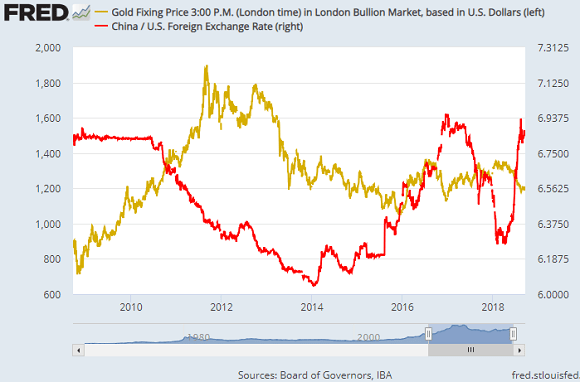
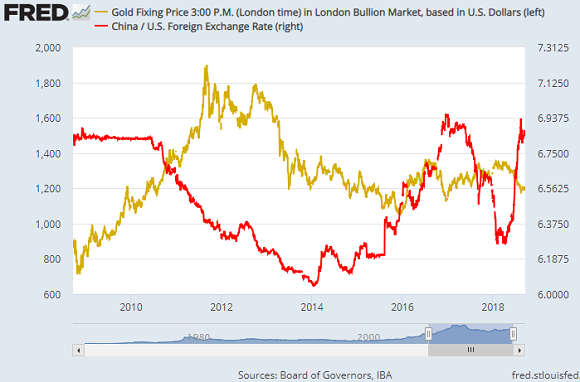
The No.1 gold consumer nation, China has seen its currency – also known as the Yuan – fall more than 8% against the US Dollar over the last 6 months.
 
Gold bullion has dropped nearly 10% in USD terms over that time.
 
Chart of gold in US$/oz (left) vs. USD/CNY (red, right). Source: St.Louis Fed
 
“Gold continued to grind higher in Asia today,” says a trading note from Swiss refiners and finance group MKS Pamp, calling business “fairly uneventful…despite some decent volume going through.”
 
No.2 gold bullion consumer nation India is meantime set to defy US sanctions and continue buying crude oil from Iran after November, paying with its own Rupee rather than Dollars according to sources quoted by Reuters.
 
New Delhi’s financial regulator SEBI says it will allow foreign investors to trade India’s derivatives markets, “a big step in deepening liquidity and in the long run actually helping India become a global price-setter,” according to Mrugank Paranjape, CEO of the Multi Commodity Exchange.
 
The mining-backed World Gold Council is meantime set to release a “blueprint” for launching a centralized physical gold bullion exchange, its managing director Somasundaram PR said today.
 
Like China, India currently bans the export of gold bullion, forcing domestic prices to reflect local supply and demand at a premium or discount to global wholesale quotes.
 
Iran itself is re-opening the import of gold bullion, as well as foreign currency, ahead of the United States’ November deadline blocking other nations from trading with the world’s No.4 oil producer.
 
Across the border in Turkey, “There is no crisis, do not be fooled by that. These are all manipulations,” said President Recep Tayyip Erdoğan on Wednesday, blaming the Lira’s 40% plunge in 2018 to new all-time lows on outside forces.
 
Consumer confidence in Turkey – the No.5 gold consumer nation – fell this month to a 3-year low, dropping over 13% on the Turkish Statistics Institute’s index.
 
Vowing to create 2 million new jobs by 2021, Finance Minister Berat Albayrak today said inflation will slow from 21% this year to 16% in 2019 and then below 10% in 2020 as part of Ankara’s new Medium-Term Economic Program.
 
The Turkish central bank’s gold holdings have dropped by one fifth since mid-June thanks to commercial banks – allowed to register customer gold deposits as part of their required reserves since 2011 – selling some $4.5bn of the metal to raise cash amid the Lira crisis.

Bearish-Gold Bets Top 2018 ETF Profits to Date as GLD Shrinks to 31-Month Low

GOLD ETF share prices popped to their highest level this week so far, tracking the price of bullion’s rise to $1205 per ounce as US data showed an unexpected plunge in the number of new home-building permits issued last month.
 
New UK data also surprised traders and analysts this morning, showing the strongest rate of consumer-price inflation in the world’s No.5 economy for 6 months at 2.7%.
 
The US Dollar eased back and global equities pushed higher however, with Asian stock markets jumping over 1% after China hit back at US president Donald Trump’s latest trade tariffs with new import duties of its own on US goods.
 
“Gold is not behaving like the haven that it is supposed to be,” Reuters quotes analyst Nitesh Shah at exchange-traded fund promoter ETF Securities.
 
But US investors have not needed a “safe haven” since the gold price fell through $1200 in mid-August, with the US stock market rising nearly 3% and setting new all-time highs on the S&P500 index.
 
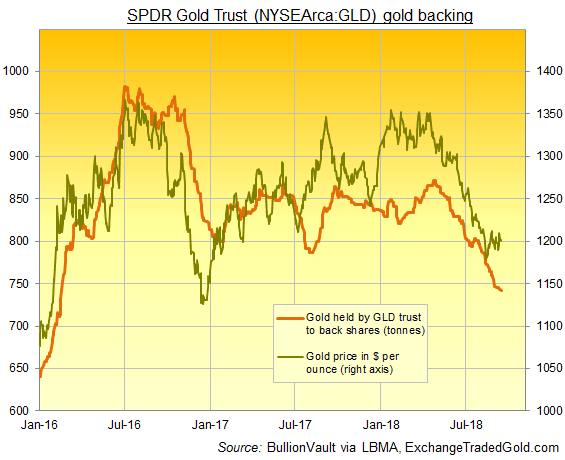
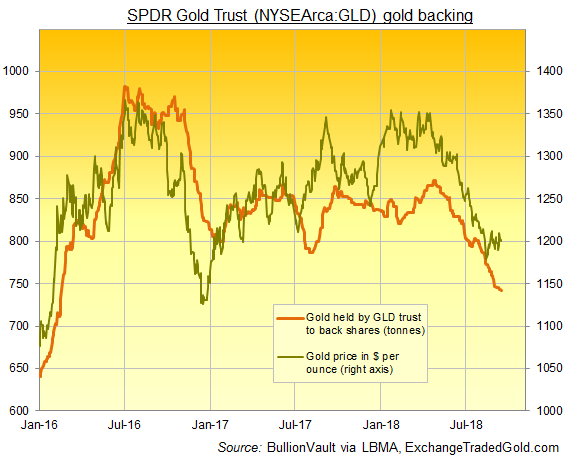
Over that same period investors have meantime liquidated more than 5% of the SPDR Gold Trust (NYSEArca:GLD), the largest gold-backed ETF vehicle, taking the quantity of bullion needed to back its shares in issue 42 tonnes lower.
 
The equivalent of 3 days’ global gold-mining output, that selling has shrunk the GLD to its smallest size since February 2016.
 
Chart of GLD gold backing vs. bullion price. Source: BullionVault via ExchangeTradedGold.com
 
2018’s top 3 performing ETF products for US investors are all heavily-leveraged bearish bets against precious metals, according to ETF.com data.
 
Direxion’s Daily Gold Miners Index Bear 3x Shares (NYSEArca: DUST) leads the table, up 72.6% by tripling the negative return from the NYSE Arca’s index of gold-mining stocks.
 
Out of the top 100 performing ETFs, DUST’s gain is followed by Credit Suisse’s bearish silver product, the VelocityShares 3x Inverse Silver ETN (Nasdaq: DSLV) – up by 59.4% – and then Direxion’s Daily Junior Gold Miners Index Bear 3X Shares (NYSEArca: JDST), now showing a year-to-date rise of 53.7%.
 
Launched in June this year, the new “mini-GLD” from SPDR (NYSEArca:GLDM) defied the lack of interest to grow nearly 10% on Tuesday.
 
Over its first 60 days of trading however, the GLDM – which carries the lowest on-going management fee of any gold-backed ETF trust fund vehicle at 0.18% – has grown to need just 3.5 tonnes of bullion backing.
 
Big brother the GLD launched in November 2004 with a fee of 0.40%. It grew to 155 tonnes over its first 60 days of trading.
 
The US precious-metals market faces “unprecedented low levels of activity that continue to persist,” says Greg Roberts, CEO of US bullion bar and coin wholesaler A-Mark Precious Metals (Nasdaq: AMRK).
 
A-Mark last night reported revenue growth of 9% in the 12 months ending 30 June, but the prior year’s net profit of $1.00 per share became a loss of 48 cents as the company digests August 2017’s purchase of retail-facing Los Angeles-based dealer Goldline.
 
Year-to-date, sales of brand-new gold American Eagle coins have fallen by one-fifth from the same period in 2017, data from the US Mint show.

Gold Prices Tight at $1200 as 'Dollar Battering' Eases But Real Interest Rates in Focus Ahead of Fed

GOLD PRICES again held tight around $1200 per ounce in London trade Tuesday as the US Dollar retreated on the currency market and global interest rates eased back on a rise in government debt prices.
 
Commodity prices edged higher but held near 2018 lows on Bloomberg’s index after the United States imposed a new 10% trade tariff on a further $200 billion of Chinese imports.
 
Asian and European stock markets meantime shrugged off yesterday’s drop on Wall Street, taking Japan’s Topix to a 7-week high.
 
Germany’s Dax rallied further from last week’s 5-month low, and China’s Shanghai Composite bounced from its new 4-year low hit on Monday.
 
Moscow meantime blamed Israel for the shooting-down of a Russian military plane near war-torn Syria.
 
Serbia will never recognise Kosovo, Belgrade’s foreign minister said, as plans for a “land swap” to align ethnic populations between the two Balkan states came into doubt.
 
Gold prices have been “battered by a relatively strong Dollar,” says the latest analysis from Japanese conglomerate Mitsubishi’s strategist Jonathan Butler.
 
“[But] with the market becoming one-sided towards risk assets in the current economic climate, there is a danger that the current US political risks will be overlooked,” he warns, saying this “could ultimately damage the Dollar and help precious metals.
 
“With inflation running at the target of 2% and the Fed running out of runway to raise rates, there is also potentially some support for precious metals as an inflation hedge.”
 
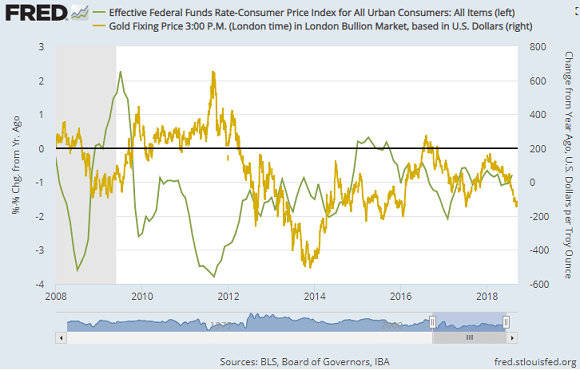
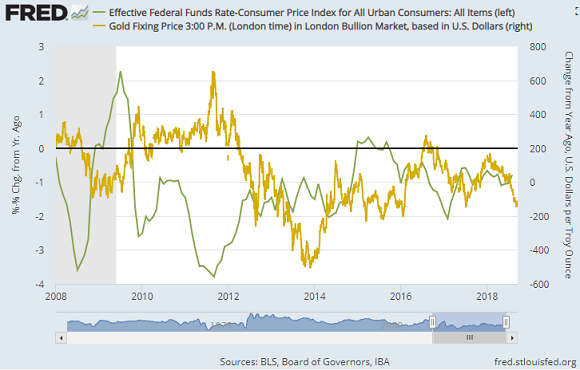
Since the Lehman’s crisis of 10 years ago this week, real US Fed interest rates, adjusted for inflation, have moved in the opposite direction to gold prices in more than 70% of all months.
 
Chart of real Fed Fund rates vs. gold priced in Dollars, 12-month change. Source: St.Louis Fed
 
Also looking at the impact of US interest rates on gold, “Additional hikes based upon higher inflation – and so raising only nominal rather than real rates – would not necessarily be a negative development for precious metals,” says a research note from Chinese-owned bullion market maker ICBC Standard Bank.
 
What counts in this month’s Federal Reserve meeting, the analysis says, will be any comment around the so-called “natural rate of interest”.
 
Also known as r* and defined by economists as “the real short-term interest rate expected to prevail when an economy is at full strength and inflation is stable,” this number has since August been estimated by the New York Fed on its website, using the Holston-Laubach-Williams model.
 
“What stands out from a market perspective,” ICBC Standard warns, “is that no real expectation for a higher r* is currently priced and that it would be a significantly bearish development for gold prices.”
 
Meantime in No.2 gold consumer nation India – where the current wedding and early festival season is finding weak demand as the Rupee trades at all-time record lows on the currency market – rumors that the government will act to “curb” imports of non-essential commodities has “sent ripples through the gold industry” says the Business Standard, with dealers fearing a repeat of the anti-gold measures taken to cut the country’s huge trade deficit in 2013.
 
“There is not much scope for hike in import duty on gold,” ZeeNews quotes government sources, favoring “some kind of policy measures” to deter imports because “higher import duty on gold may [only] increase smuggling activities.”
 
Illegal flows of gold into India continue to make headlines, with officials finding over $375,000-worth of bullion hidden on a flight into New Delhi on Tuesday.

Gold Prices 'Constructive' at $1200 as Specs Cut Shorts But US Yields Hit 3%, China Gets 'Tariffed!' by Trump

GOLD PRICES peeped above $1200 per ounce yet again in London trade on Monday, rising above what was an 18-month low when reached in mid-August for the 9th time in 5 weeks.
 
Silver and platinum also rose as Western stock markets cut their earlier gains, rallying to $14.20 and $805 respectively
 
Base metals were little changed, leaving copper 3% above the summer’s 1-year lows, as US President Trump praised the trade tariffs imposed on Chinese imports so far, saying ahead of this week’s likely decision on taxing a further $200 billion of goods that his policy’s impact on the US economy has been “almost unnoticeable”.

Tariffs have put the U.S. in a very strong bargaining position, with Billions of Dollars, and Jobs, flowing into our Country – and yet cost increases have thus far been almost unnoticeable. If countries will not make fair deals with us, they will be “Tariffed!”

— Donald J. Trump (@realDonaldTrump) September 17, 2018

“Pricing remains constructive” in Asian trade, says a note from Swiss refining and finance group MKS Pamp, “and layered bids underneath $1195 are evident.
 
“The most recent CFTC data shows an increase in [speculative] positioning across all metals [albeit from record bearish bets], with shorts tapering off somewhat to possibly indicate we are beginning to see a short-term bottom.”
 
But “concern over trade tensions between the US and China is translating into a stronger Dollar,” Reuters quotes Japanese conglomerate Mitsubishi strategist Jonathan Butler.
 
“As the Dollar remains relatively well supported, yields continue to rise and the US economic growth story remains in place, it’s hard to see where a strong rally would come from in gold.”
 
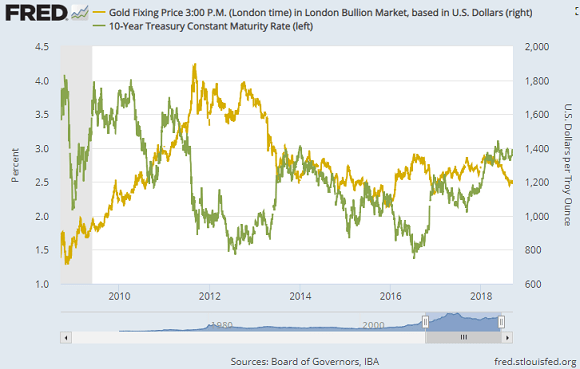
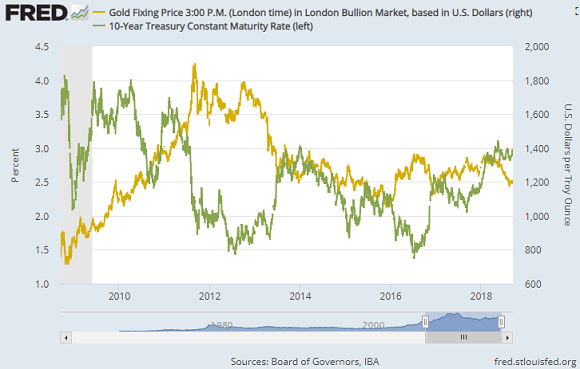
Chart of 10-year US Treasury yield vs. Dollar gold price. Source: St.Louis Fed
 
Ten-year US Treasury yields rose again above 3.0% in Monday’s trade.
 
Crude oil meantime rallied towards last week’s 2-month highs above $70 per barrel of US benchmark West Texas Intermediate as analysts questioned how heavy importers such as India are going to fill the supply gap caused by US sanctions blocking flows from Iran – the world’s 5th largest producer nation in 2017.
 
Saudi Arabia and Russia have “taken the oil market hostage” a Tehran official said at the weekend, accusing the Opec oil cartel of becoming “a US tool”.
 
Russian president Vladimir Putin met Turkish leader Recep Tayyip Erdoğan to discuss Syria’s military attack on the final rebel stronghold of Idlib, already causing a fresh spike in refugees fleeing across the border into Turkey.
 
Ukraine today said it plans to open a new naval base on the Sea of Azov – effectively closed to its ships since Russia annexed the region of Crimea in 2014 – aiming to “pave the way for repelling [such] aggressive acts” as tensions between the former Communist partners worsen.
 
With the UK continuing to challenge Moscow over the poisoning of a former spy in Salisbury, business investment in the world’s 5th largest economy has meantime “been lower than would be expected in the context of robust global growth” thanks to “uncertainty over the terms of the EU withdrawal” says the latest International Monetary Fund assessment.
 
“Above-target inflation following the sharp post-[Brexit] referendum sterling depreciation has slowed real income and consumption growth.”


Gold Price Flat, Asian Premiums Fall But Platinum +3.4% for Week as London 'Set to Fight EU' on Derivatives VAT

GOLD PRICES edged back Friday lunchtime in London, cutting this week’s gain to 0.5% as world stock markets rose and crude oil rallied but held below this week’s approach of May’s 3.5-year highs.
 
Russia joined Turkey in raising its key interest rate, making the first such move since 2014 and helping the Ruble recover almost 4% from this week’s 2.5-year low versus the Dollar on the FX market.
 
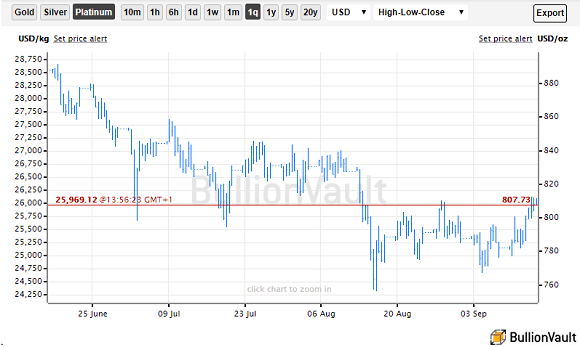
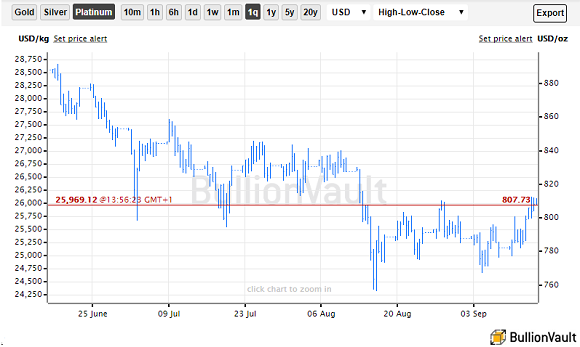
Silver fell back to unchanged for the week at $14.21, but platinum prices held firm to trade 3.4% above last Friday’s finish at $809 in US Dollar terms.
 
Price of platinum in US Dollars per ounce. Source: BullionVault
 
The Indian Rupee also rallied Friday after hitting fresh record lows versus the Dollar this week, gaining alongside Mumbai’s stock market as inflation in the No.2 gold consumer nation showed a slowdown to a 4-month low of 4.5% and the Finance Ministry said it will do “everything possible” to stem the currency’s plunge.
 
Despite the ongoing wedding season and next month’s start of Diwali however, domestic gold prices fell to a $2 discount per ounce versus bullion import prices, Reuters reports, suggesting poor demand.
 
“The market lost momentum due to the price rise,” the newswire quotes Harshad Ajmera of JJ Gold House in Kolkata.
 
“Buyers are waiting for prices to fall below $1200.”
 
Chinese gold premiums also slipped, falling from $7 per ounce over London quotes last Friday to finish today at $5.50 on the Shanghai Gold Exchange.
 
Alongside wholesale bullion, the SGE this week opened trading in Chinese Panda gold coin, calling it “an important measure to build an authoritative and fair commemorative coin trading platform.”
 
Launched in 1982 and exempt from China’s VAT sales tax in 2012, the Panda has become the 5th most popular bullion gold coin among collectors worldwide.
 
China’s state-owned gold miner Shandong is planning to float on the Hong Kong stock market, it said today, looking to raise US$768 million.
 
Already worth $6.3bn on the Shanghai market, Shandong (SHA: 600547) operates 12 mines producing almost 7% of China’s world-leading gold output.
 
Chinese conglomerate Fosun International is meantime looking to buy London commodities broker Marex Spectron, Reuters says elsewhere – rumors denied by Marex.
 
Heart of the world’s bullion market, London will fight the European Union’s push to impose VAT on commodity derivatives traded through the City, the Financial Times says, with government officials standing by the UK’s position on its Terminal Markets Order of 1973.
 
In physical supply, “a weaker Rand is lowering production costs” for platinum miners in South Africa, says Bloomberg – “good news for margins” but encouraging no “meaningful” cut in output as prices hold near 10-year lows “with top supplier Anglo American Platinum Ltd. even ramping up.”
 
“About half of South African output is estimated to be unprofitable,” says the newswire.
 
Among platinum’s many industrial uses, it is a vital part of hydrogen fuel cells – a technology which could by 2030 power 6.4 million vehicles worldwide, according to new industry forecasts, potentially generating almost one-fifth of the world’s energy by 2050.
 
You can buy platinum at 0% commission fee this month using BullionVault.

Gold, Silver and Platinum Prices Jump as Dollar Slips, Turkey's Central Bank Hikes Rates to Defend Lira

GOLD PRICES rose to 3-week highs against a weakening US Dollar on Thursday, trading up to $1209 per ounce in London’s wholesale bullion market as equities rose together with commodities and US Treasury bond prices.
 
As the Dollar eased back – most notably versus emerging market currencies led by the Turkish Lira after a shock interest rate hike – silver also gained, halving the last 2 weeks’ loss to trade at $14.30.
 
Platinum prices spiked to $810 per ounce, the highest level in a month.
 
All three precious metals have seen speculative money managers place record bearish bets using Comex futures and options contracts over summer 2018, leading some analysts to predict a “short covering rally” if prices fail to fall further.
 
Istanbul’s stock market meantime rose 1.5% on Thursday, extending its rally from August’s near 18-month lows, after the Central Bank of the Republic of Turkey hiked its main interest rate by over 6 percentage points to more than 24% per annum, the highest cost of borrowing in 15 years.
 
With gold priced in Dollars also rising however, domestic bullion prices in the world’s No.5 consumer nation retreated only to TRY 230 per gram, albeit 15% below last month’s new all-time highs.
 
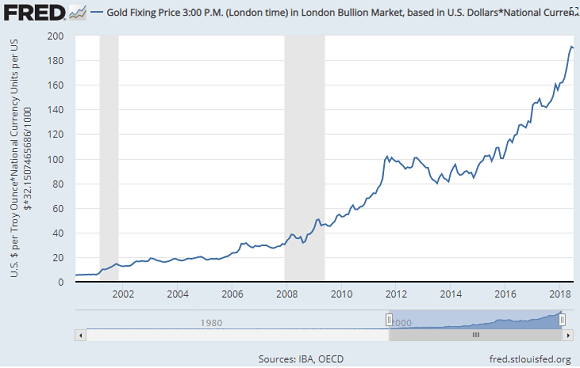
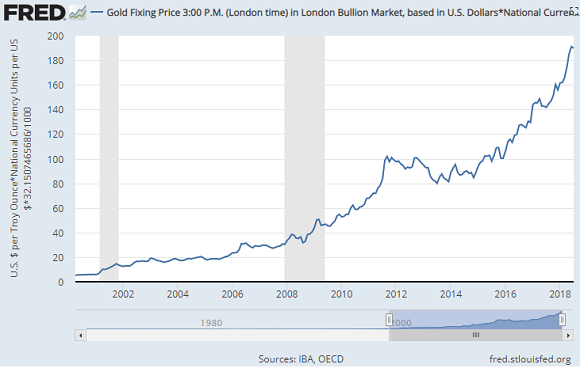
Chart of gold priced in Turkish Lira per gram, monthly average. Source: St.Louis Fed
 
Looking at developed-world stock market, “Investors do not seem prepared for anything but a continuation of the current upward trend, something that is hard to fathom if US tariffs on $200 billion in Chinese goods go into effect,” says a note from US investment bank Morgan Stanley’s head of investment and portfolio strategies for wealth management Lisa Shalett.
 
Short term, “We see gold as oversold and the likely beneficiary if recession fears rise,” she says, advising clients to think about “tactically deploying” 3-5% of their portfolios towards the metal.
 
Long term however, “Gold has not proven to be a good inflation hedge…[its] correlations with stocks and bonds are unstable…[and Morgan Stanley] no longer views gold as a strategic asset class, as it provides no interest or yield – and in the case of physical gold, there is a cost to store it.”
 
Shalett in mid-May said broader emerging markets looked “a good place to invest.” The MSCI Emerging Markets index has since lost 14% of its value.
 
“The Dollar is close to peaking” she told Bloomberg in mid-June. It has since risen nearly 3% against the world’s other currencies, recovering January 2017 levels.
 
Jumping sharply on today’s CBRT news to reach 3-week highs near 6.0 per US Dollar, the Turkish Lira had earlier sunk ahead of the central bank’s decision, coming with 5% of last month’s new record low, after President Recep Tayyip Erdoğan – who yesterday put himself and his son-in-law in charge of Turkey’s sovereign wealth fund – called interest rates a “tool of exploitation”, repeating a phrase which helped spur the currency’s plunge in mid-August.
 
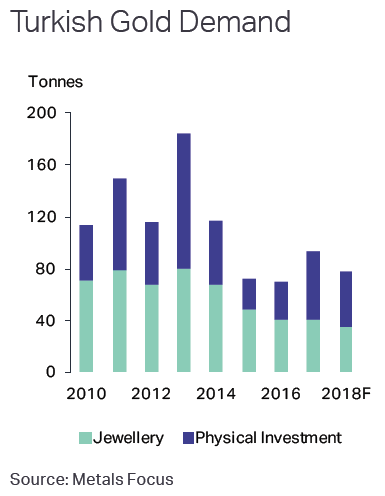
“If and when the prices fall back to the low TL200’s or below,” wrote specialist analysts Metals Focus in a note late in August, “we believe that [Turkish] investors will start buying again.
 
“[But] weakness in the Lira will persist and Dollar gold prices will also rebound.
 
“This suggests that disinvestment, as well as scrap, will grow this year while jeweller demand [for fabrication] is likely to post a double digit decrease.”
 
 
The Euro and British Pound were meantime little changed Thursday after their central banks made no change to their monetary policies, keeping their main rates at 0.00% and 0.75% respectively.
 
The Bank of England’s short statement kept the stock of quantitative easing asset purchases at £445 billion and referred twice to “greater uncertainty” about the UK’s March 2019 Brexit from the European Union.
 
The European Central Bank repeated its plan to reduce and then end its new monthly QE purchases between now and New Year, before maintaining that €2.5 trillion stock of assets “for an extended period of time…to maintain favourable liquidity conditions and an ample degree of monetary accommodation.”
 
The UK gold price in Pounds per ounce rose back towards last week’s finish at £924, and the Euro gold price held unchanged from the last 1, 2, 3 and 4 weekends at €1036.

Gold Price Near 25-Year High vs Silver But 'Stuck Below $1200' as Oil Jumps, Juncker Calls Dollar Dominance 'Absurd'

GOLD PRICES held tight below last week’s finish in London trade Wednesday, moving around $1195 per ounce as Asian stock markets fell again but European shares gained ahead of tomorrow’s policy decisions from the Eurozone and UK central banks – both expected to deliver “no change”.
 
Global oil prices rose, with energy traders pointing to both the loss of supply from Iran following new US sanctions over Tehran’s nuclear research program and to Hurricane Florence, now approaching the US east coast and set to make landfall at ‘Category 4’ in North Carolina on Thursday.
 
Brent crude oil neared $80 and US benchmark WTI rose near $70 per barrel.
 
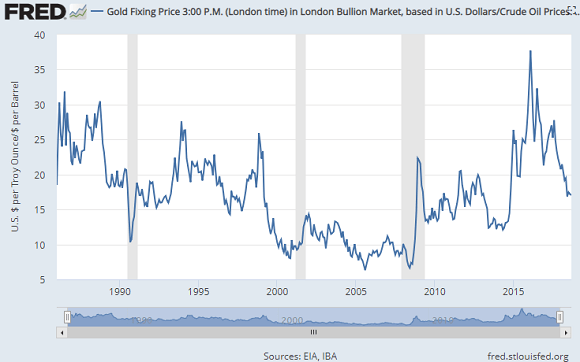
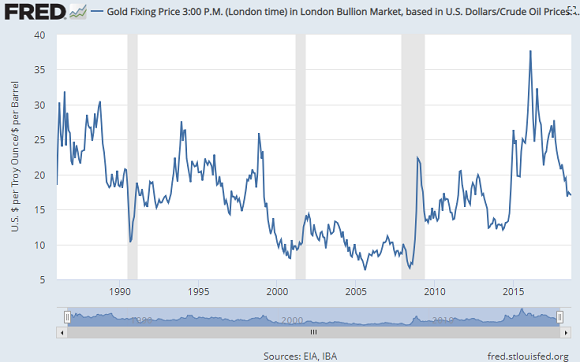
Still 5% below July’s 3.5-year highs, that squashed the Gold/WTI ratio of bullion to barrels down near 17, only a little above the 4-year low in gold relative to crude oil hit this summer.
 
Chart of Gold/Oil Ratio (London Fix vs. WTI Nymex). Source: St.Louis Fed
 
“It is absurd that Europe pays for 80% of its energy import bill, worth €300bn a year, in US Dollars when only roughly 2% of our energy imports come from the United States,” said out-going European Commission president Jean-Claude Juncker in his final ‘state of the union’ speech to lawmakers in Strasbourg today.
 
Also vowing to boost EU border patrols against illegal migrants, Juncker said he wants “to strengthen the international role of the Euro…[making it] the active instrument of a new and more sovereign Europe.
 
“There is strong demand for Europe throughout the world,” Juncker also claimed.
 
“To meet such high demand, Europe will have to speak with one voice on the world stage.”
 
Members of the European Parliament meantime voted 448 to 197 on Wednesday in favor of Article 7 procedures against member state Hungary, accusing Budapest’s prime minister Viktor Orban of breaching EU values.
 
The Euro rose but struggled to get back above $1.16 to the Dollar, holding gold prices for Eurozone investors at €1030 per ounce.
 
Silver meantime held flat around $14.12 after recorded its lowest London benchmark price yesterday since the “anti-arb” flash crash of late January 2016, when the auction process fixed at $13.58 – some 80 cents below spot-market quotes – on a lack of buyers to balance with sellers.
 
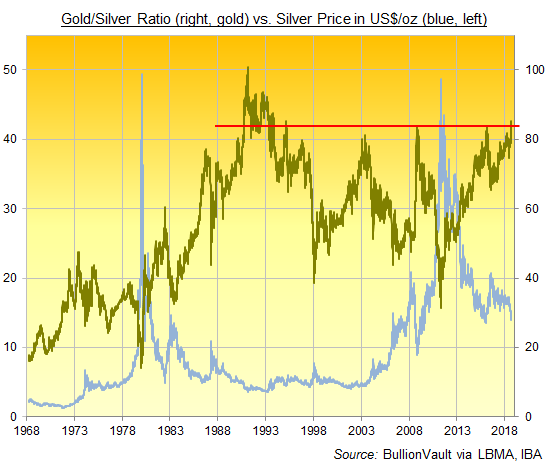
Tuesday’s brief plunge beneath $14 put the Gold/Silver Ratio of the two metals’ prices relative to each other just shy of a 25-year high, breaking above 85 ounces of silver per 1 ounce of gold for the first time since March 1995.
 
Chart of the Gold/Silver Ratio, London benchmark prices. Source: BullionVault via LBMA
 
“China [is] again showing little demand” despite the drop in gold prices, says one Asian trading desk.
 
“There is some selling pressure on the Renminbi, which is affecting gold,” agrees Ronald Leung at Hong Kong traders Lee Cheong Gold Dealers.
 
“Also, people are reluctant to buy as $1200 is acting as strong resistance after failing to break through the level last night.”
 
Weaker silver prices have seen investor demand for exposure through the iShares Silver Trust (NYSEArca:SLV) grow that exchange-traded fund to a 14-month high, needing over 10,377 tonnes of backing.
 
Gold’s 3-month price drop of $100 in contrast has seen the giant SPDR Gold Trust (NYSEArca:GLD) shrink by more than 10%, ending Tuesday with backing of 745 tonnes, the lowest since February 2016.
 
On the political front Wednesday, Russian president Vladimir Putin claimed that the two suspects wanted by UK police over the attempted murder of a former KGB spy in Salisbury this spring are civilians and who will “soon” give their version of events.
 
Pro-Brexit Conservative MPs – who now show “no dissent” on wanting to oust Prime Minister Theresa May – meantime said an “invisible” border between Northern Ireland and the Republic could exist post-Brexit thanks to “existing” technology for customs checks and VAT sales-tax payments.

Rupee Plunge Sees Silver Price Drop Below $14, Gold 'Excruciating' on Record US Confidence

GOLD PRICES fell back below $1190 and silver tumbled through $14 per ounce for the first time since January 2016 on Tuesday in London as the Indian Rupee – currency of the No.2 precious-metals consumer nation – fell to fresh all-time lows versus the US Dollar.
 
European stock markets fell for the 7th time in 10 sessions, pulling the EuroStoxx 50 index down towards its lowest close since February 2017.
 
New survey data today said economic sentiment in the 19-nation Eurozone has become markedly less negative so far this month, while small-business confidence in the United States has set a new all-time record on the NFIB’s four-decade survey.
 
London’s FTSE100 index meantime fell 0.5%, hitting a 5-month low, as Sterling spiked against both the Dollar and the Euro on confirmation that Canadian career policy-maker Mark Carney will stay on as Governor of the Bank of England into 2020 “to support a smooth and successful Brexit.”
 
The UK gold price in Pounds per ounce fell to touch mid-August’s 21-month low beneath £915 per ounce.
 
“[Gold] has shown excruciating weakness as the US economy demonstrated a stellar performance,” Reuters today quotes Benjamin Lu, a commodities analyst at Phillip Futures in Singapore.
 
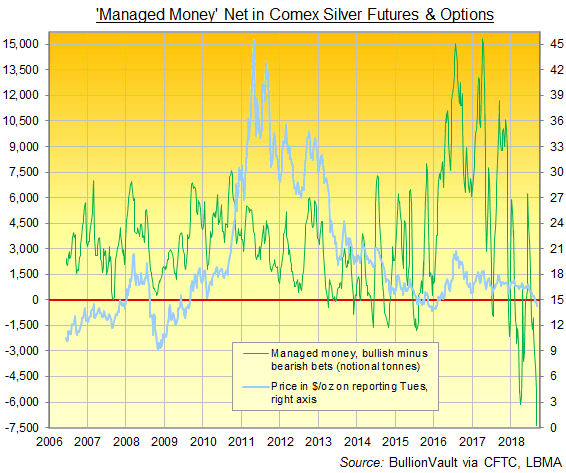
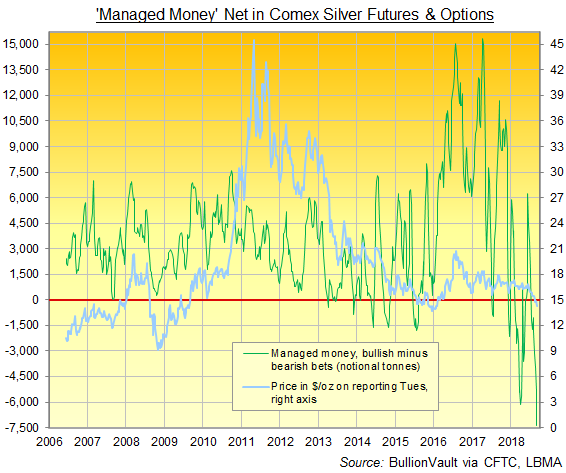
Like gold, silver last week saw hedge funds and other ‘Managed Money’ traders in Comex futures and options contracts build a record short net position on the metal, betting against more heavily than any time since current data began in 2006.
 
Chart of Managed Money net position in silver Comex futures and options. Source: BullionVault via CFTC
 
An increasingly key market for silver as consumers substitute the cheaper metal for gold, India today saw its Rupee hit a fresh all-time low against the US Dollar, down 12% for 2018 to date.
 
This latest plunge came as foreign investment funds – worried by stronger oil prices worsening the country’s current account deficit with the rest of the world – dumped Rupee-denominated bonds to try and avoid the currency’s next drop according to Bloomberg.
 
“There will be steps taken to arrest the fall as and when the government and the RBI feel it is the correct time to do so,” claims the Economic Times, reporting that New Delhi has asked the central bank to consider ideas to stem the Rupee’s slide, including asking non-resident Indian citizens to hold their cash savings inside the country in a bid to close its current account deficit with the rest of the world.
 
The Chinese Yuan also fell back on Tuesday, dropping with 1% of mid-August’s plunge to the weakest Dollar value since January 2017.
 
Together with quiet trade in Shanghai’s gold market, that curbed the premium for metal landed in China rather than London beneath $7 per ounce, almost 20% below the typical incentive for new imports into gold’s No.1 consumer market.
 
“[Gold] struggled to entice Chinese demand once Shanghai opened,” says a trading note from Swiss refiners and finance group MKS Pamp.
 
“Flows were lighter than we are used to seeing and it looks as though participants are treading water until the metal breaks outside of the recent range.”
 
As for silver prices, “Rallies are [also] being sold into,” says MKS, “and thus far the metal hasn’t been able to extend away from $14.”