Author Archives: City Gold Bullion

Gold Prices Cost Near-Record Comex Bulls Dear as ECB Holds Euro QE & Negative Rates

GOLD PRICES slipped in a tight $3 range Thursday morning while commodities edged higher, bond prices slipped and global equities held flat overall as the central bank of the 19-nation Eurozone – the world’s largest single currency bloc – kept its asset purchase and negative interest-rate policies unchanged at its June meeting.
 
Priced in US Dollars, gold traded at $1214 per ounce as European Central Bank chief Mario Draghi prepared to give his regular press conference.
 
The European Central Bank faces a final ruling from the constitutional court in Germany, the Eurozone’s largest economy and member-state, regarding the legality of its QE money-creation and bond-buying policy in 3 weeks’ time.
 
Tokyo’s Nikkei share index today fell over 2% as the Japanese Yen continued to rise on the FX market, potentially denting the country’s export sales, despite record levels of QE plus negative interest rates from the Bank of Japan. 
 
Gold priced in Euros held 0.5% lower for the week at €1085 per ounc e, and slipped back towards Wednesday’s new 4-month lows against the Yen at ¥4,254 per gram.
 
“Possibility of another leg of down-move near term to the key support of $1190 [in US gold prices],” says a technical analysis from French investment bank and bullion market maker Societe Generale, pointing to last October’s high.
 
“[A move back] above multi-month channel at $1243 will be needed to resume uptrend.”
 
“Initial support is offered by $1192,” agrees the latest Bullion Weekly Technicals from Karen Jones at Commerzbank, also pointing to the October 2015 high.
 
But for the German financial services group’s technical analyst, gold’s “near-term weakness is viewed as corrective only [as] the weekly close above $1201 completed a large falling wedge pattern which offers an upside measured target to $1450 longer term.”
 
“Heavy speculative positioning in gold and silver [does] pose downside risks to prices,” says Dutch bank ABN Amro analyst Georgette Boele.
 
Commodity investments held by fund managers worldwide grew to $220 billion in April, a report from UK retail and bullion bank Barclays said Tuesday – up 14% from March to a 1-year high – with precious metals positions and bets accounting for half that total.
 
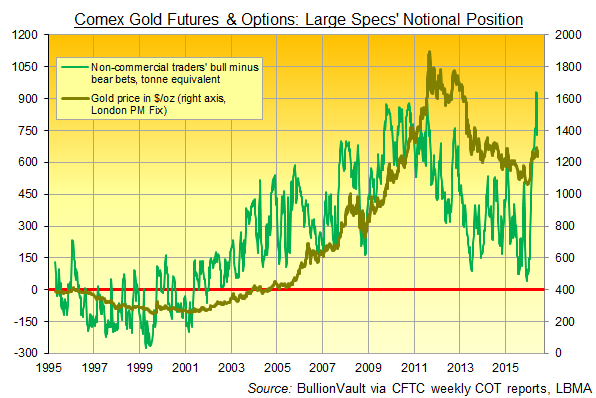
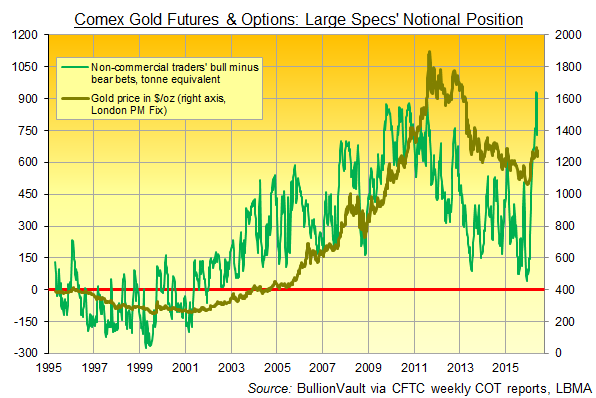
Latest data on US derivatives show hedge funds and other speculative traders slashing their bullish bets, net of bearish contracts, by almost 30% in gold futures and options since the 5-year record set a month ago.
 
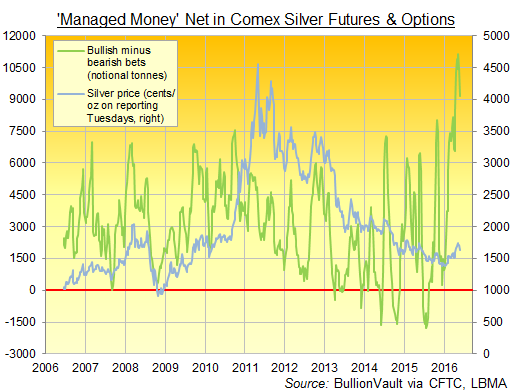
The ‘Managed Money’s net speculative position in Comex silver contracts has meantime fallen by almost one-fifth from the new record high set in mid-May.
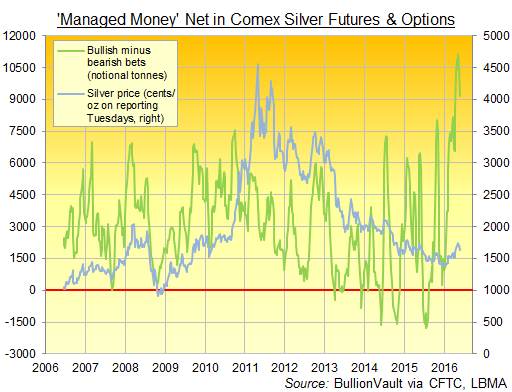
Chart of Managed Money net spec long in Comex silver futures & options, notional tonnes
 
“We don’t think the trend [in precious metals has] changed,” the note from ABN Amro goes on, “as long as prices remain above their 200-day moving averages.”
 
For gold prices, says ABN’s Boele, the 200-day moving average comes in at $1163 per ounce, and at $15.19 for silver.
 
Silver prices briefly rallied above $16 per ounce on Thursday from yesterday’s drop to a 7-week low at $15.83 in London trade.
 
Gold speculators currently losing money on their bullish bets, and so needing to roll their Comex futures and options onto the next calendar contract, “are paying the most in at least half a decade to maintain [their position],” reports Bloomberg, quoting Swiss refiner and finance group MKS’s head of trading Bernard Sin.
 
“Those holding June futures would have paid an extra $3.40 an ounce on May 23 to swap that position for the most-active August contract,” says the news-wire, citing Comex data.
 
Physical gold demand, in contrast, saw imports to India – the second-heaviest consumer market – through the key hub of Ahmedabad in Gujarat decline for a fourth month running in May, says the latest data.
 
Down 93% from the same period a year ago, inflows fell to the lowest monthly total since the government’s “80:20” block on legal imports in 2013 and the lowest May total since the global financial crisis of 2009.
 
“The market is yet to get over the impact of the 42-day long strike earlier this year,” the Times of India quotes one Ahmedabad jeweler, pointing to the recent protests at a new gold sales tax.
 
Shanghai gold prices meantime slipped Thursday for the first day in three, edging down 0.2% against the Yuan at China’s afternoon benchmark auction, and cutting their premium over comparable London quotes below $3 per ounce.
 
Since launching in mid-April, the new Shanghai Gold Price benchmark has shown an average $2 per ounce premium to international ‘spot’ quotes for London delivery, offering importers an incentive to buy and ship metal into the world’s largest gold mining, importing, private consumer and central-bank buying nation

Gold Bullion Tries $1220, Drop 'Now Finished' as China's Yuan Nears 5-Year Low on Weak PMI

GOLD BULLION retreated twice from a 3-session high of $1220 per ounce on Wednesday, dropping back but holding firmer than world stock markets as new data again showed manufacturing activity contracting in China and slowing in Germany.
 
The May manufacturing PMI survey from news outlet Caixin and data agency Markit said activity contracted for the 15th month running, contrasting with a pop to unchanged on the government’s official NBS index.
 
“Has gold’s $100 drop [from start-May] been enough?” asks London bullion and futures brokerage Marex Spectron’s David Govett in a note. “Personally I think it has.
 
“The market was horribly long, overly bullish and at the top of the range…[but] little else has changed in the world. China is still struggling with a very weak currency, Europe is little better.
 
“There is still every reason to hold gold in a portfolio, but not to get over excited.”
 
“Sit tight” counters a note from the strategists at Chinese-owned bullion market-maker and London clearing bank ICBC Standard Bank, advising their clients it is still “too early to buy the dip [because, while] precious metals have already retreated by between 7% (gold) and 14% (palladium)…we think there is probably more to come.
 
“There is too much stale length in the gold market..[T]he recent negative performance is unlikely to encourage fresh entrants just yet.”
 
Analysis by BullionVault says that each tonne of speculative length added by gold investors and traders so far in 2016 using exchange-traded notes has resulted in the price rising just 14 cents per ounce. 
 
That compares with nearer $1 per ounce added by each tonne of exchange-traded speculation between 2005 and the bull-market peak of summer 2011.
 
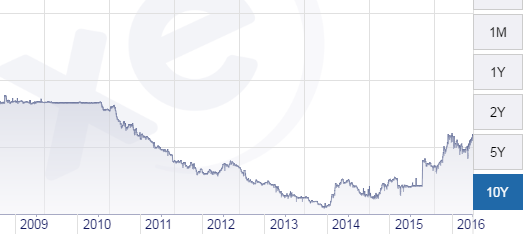
Shanghai gold prices meantime rose again Wednesday morning, pushing the premium above London quotes to $4 per ounce at China’s benchmarking price auction, even as the Chinese currency dropped towards January’s 5-year lows against the US Dollar on the FX market.
 
Chart from XE.com of China's Yuan against the US Dollar
 
With CNYUSD approaching 6.60, “at least for the moment we’re not seeing any evidence of capital flight,” said Australian bank Westpac’s global head of market strategy Robert Rennie to Bloomberg, although it should be expected as the US Fed moves to raise Dollar interest rates.
 
“But it’s by no means certain the Fed will raise in June – indeed, we just shifted our forecast from June to September.”
 
Meantime in India – now the world’s second-largest gold consumer nation behind China – a decision to rollback one of the sales taxes spurring protests amongst the jewelry industry still finds “very little demand in the market,” according to one managing director, as Rupee prices remain 20% higher for 2016 to date.
 
June may boost sales, reports the Economic Times, as it brings some wedding dates to the Hindu calendar.
 
“In addition to physical buyers not being there to help absorb supply,” noted Swiss bullion bank UBS of the global gold market last week, “it also means investors don’t have the natural gauge to assess whether a floor [in the price] is nearby.”

Gold Price Bounces at $1200 But May's Record Bullish Bets Slashed Before Yellen's Rate-Hike Vow

GOLD PRICE losses of more than 7% for the month of May held in London on Tuesday as trading in the metal’s key Western markets re-opened after the long weekend following ‘hawkish’ comments on US interest rates from Federal Reserve chief Janet Yellen.
 
“It’s appropriate for the Fed to gradually and cautiously increase our overnight interest rate over time,” said US Fed chair Yellen in an interview at Harvard University on Friday afternoon, adding that investors and traders should expect the next rise “in the coming months.”
 
The Fed vowed to raise rates from 0% throughout 2015, finally acting at its last meeting of the year and then failing to follow up with any of the 4 further hikes then predicted for 2016.
 
European stock markets held flat Tuesday as bond yields ticked higher with commodity prices.
 
Gold rallied 0.9% to $1211.50 by lunchtime in London, down from start-May’s 15-month peak at $1303 per ounce.
 
Ahead of Yellen’s comments on Friday, speculative traders in US Comex gold futures and options had already slashed their “net long” position of bullish minus bearish bets by 22% in the week-ending last Tuesday, new data showed after last week’s market close.
 
The deepest cut since gold prices set new 6-year lows in December, last week’s retreat came in contrast after speculative traders had built a record net long position by the start of this month.
 
Even after May’s one-fifth retreat, speculative net bullish positioning remained 3 times the last 20 years’ average as of last Tuesday.
Chart of non-commercial traders' net long in Comex gold futures and options, notional tonnes
 
With London closed Monday for the Whit Bank Holiday and New York shut for Memorial Day, solid trading in Shanghai and then quiet trading in European hours saw gold priced in US Dollars slip beneath $1200 per ounce for the first time since mid-February.
 
Silver today fixed at London’s midday benchmark auction at $16.06 per ounce, down for the 9th time in 10 sessions – a pattern seen only 35 times in more than 12,600 trading days since 1968.
 
Gold earlier fixed at the 10.30am LBMA benchmark at $1210.50 – the lowest gold price since late February, and marking the 7th drop in 10 days.
 
Silver prices have now fallen on 15 of the 20 trading days since the metal set a 15-month high at the LBMA benchmark auction of $17.855 per ounce.
 
Trading volume in Shanghai’s main gold contract meantime retreated again from Friday’s multi-week high as Yuan prices bounced from yesterday’s trip to the lowest level since early April on a fresh drop in the Chinese currency’s FX rate.
 
Beijing’s monetary authorities today set the Yuan’s mid-point versus the US Dollar at its weakest level in almost 5 years, with spot prices trading back at levels last seen just before February 2016’s surprise revaluation.
 
That took the Yuan to its second-steepest monthly drop in a decade of market trading, according to the Reuters data and news agency, with “pessimistic bets on the Yuan [rising] to the largest since early February, according to a…survey of 20 fund managers, currency traders and analysts.”
 
China’s stock market, in contrast, jumped 3.3% – the fastest 1-day gain in almost 3 months – on what MarketWatch called “optimism” that Shanghai shares may be included from mid-June in the highly influential MSCI World Index of global equities, with US investment bank and brokerage Goldman Sachs putting the odds at 70% from an earlier 50% estimate.
 
China’s giant CNY2 trillion private pension-fund industry saw assets grow larger than payments in cash terms in 2015, Beijing’s Ministry of Human Resources & Social Security said Tuesday.
 
But with 837 million people contributing, and 226 million retirees currently receiving payments, the rate of growth in spending was greater at 20% than the year-on-year growth of 17% in total income.
 
Tuesday’s fresh fall in the Yuan buoyed Shanghai’s benchmark gold price above CNY257 per gram – equal to $1215 per ounce at a near-$4 premium to London quotes overnight.

Gold Recovers from 6-Day Drop as Crude Oil Above $50 for 1st Time Since November

GOLD BULLION rebounded from its lowest level in seven weeks to $1228.90 per ounce in London trade Thursday, writes Atsuko Whitehouse at BullionVault.

Brent crude oil meantime climbed above $50 per barrel in early Asian trading – the highest price since November 2015 – following a US report which showed a decline in crude inventories and which also helped lift energy and materials stocks.

US stocks advanced for a second straight session yesterday, with the S&P 500 posting its highest close in nearly a month.

The Dollar index was down to 95.170 after hitting a fresh multi-week high of 95.61 on renewed expectations of an earlier -than-expected interest rate hike in the US.

Yesterday, Bloomberg reported Philadelphia FRB Governor Patrick T Harker said he expected two or three rate increases in 2016 as did San Francisco Fed President John Williams on Monday.

Federal Reserve Board Governor Jerome Powell is due to speak today at 1615 GMT and Federal Reserve Chair Janet Yellen tomorrow at 1715 GMT.

IMF’s data revealed that Russia added 16.24 tonnes of gold to its official reserves in April, bringing total holdings to 1,476.7 tonnes. China also added 10.9 tonnes to its reserves, bringing the total to 1,808 tonnes.  Venezuela however sold 34.2 tonnes of gold in February and another 8.5 tonnes in March.  In the first quarter of 2016 Venezuela has sold $1.7 billion of precious metals to repay their debts. 

China’s new benchmark Shanghai Gold Price today showed a premium to London wholesale prices at Dollar equivalent price of some $2.51.

The SPDR Gold Trust (NYSEArca:GLD) the world’s largest exchange-traded gold-backed trust fund was unchanged at 868.66 tonnes on Wednesday after losing 3.9 tonnes on the previous day.  Its holdings, however, have increased 14 times in the last 22 trading days.

Today Japanese Prime Minister Shinzo Abe presented documents to his fellow Group of Seven leaders.  He said they indicated a risk of the world economy falling into a crisis on the scale of the 2008 Lehman shock, unless appropriate policy measures were taken.

The G7 leaders did agree on the need for flexible spending to spur world growth but the timing and amount depended on each country, Deputy Chief Cabinet Secretary Hiroshige Seko told reporters, adding some countries saw no need for such spending.

Britain and Germany have been resisting calls for fiscal stimulus.

Silver meantime gained 1.5% Thursday, rising to $16.46 per Troy ounce at the benchmarking LBMA Silver Price auction after declining for 3 days.  
 
Major silver miner First Majestic (NYSE:AG) told Bloomberg it sees silver prices surging perhap 9-fold by 2019 to reach $140 per ounce after Canada’s largest silver producer was asked by a Japanese electronics maker to discuss locking in future supplies at current prices.
 
“For an electronics manufacturer to come directly to us – that tells me something is changing in the market,” said Keith Neumeyer, chief executive officer of First Majestic.
 
The London Bullion Market Association today announced it is, together with the Bank of England and other official agencies, replacing the current Non-Investment Products code for market participants with a new Precious Metals Code from 2017.
 
More detailed than the current NIPS code, which also covers FX dealing in London, will apply to all precious metals market participants, and will provide participants with “guidance on best practice.”

Gold recovers from six days of losses whilst crude oil passes $50 for the first time since November 2015.

GOLD BULLION rebounded from its lowest level in seven weeks to $1,228.90 per ounce.

Brent crude climbed to $50.08 per barrel in early Asian trading – the first time since November 2015.

The jump in oil prices followed a Tuesday report which showed a decline in crude inventories and which also helped lift energy and materials stocks.

U.S. stocks advanced for a second straight session yesterday, with the S&P 500 posting its highest close in nearly a month.

The dollar index is down to 95.170 after hitting a fresh multi week high of 95.61 on Tuesday from renewed expectations of an earlier -than-expected interest rate hike in the US.

Yesterday, Bloomberg reported Philadelphia FRB Governor Patrick T Harker said he expected two or three rate increases in 2016 as did San Francisco Fed President John Williams on Monday.

Federal Reserve Board Governor Jerome Powell is due to speak today at 1615 GMT and Federal Reserve Chair Janet Yellen tomorrow at 1715 GMT.

IMF’s data revealed that Russia added 16.24 tonnes of gold to its official reserves in April, bringing total holdings to 1,476.7 tonnes. China also added 10.9 tonnes to its reserves, bringing the total to 1,808 tonnes.  Venezuela however sold 34.2 tonnes of gold in February and another 8.5 tonnes in March.  In the first quarter of 2016 Venezuela has sold $1.7 billion of precious metals to repay their debts. 

China’s new benchmark Shanghai Gold Price today showed a premium to London wholesale prices at Dollar equivalent price of some $2.51.

The SPDR Gold Trust (NYSEArca:GLD) the world’s largest exchange-traded gold-backed trust fund was unchanged at 868.66 tonnes on Wednesday after losing 3.9 tonnes on the previous day.  Its holdings, however, have increased 14 times in the last 22 trading days.

Today Japanese Prime Minister Shinzo Abe presented documents to his fellow Group of Seven leaders.  He said they indicated a risk of the world economy falling into a crisis on the scale of the 2008 Lehman shock, unless appropriate policy measures were taken.

The G7 leaders did agree on the need for flexible spending to spur world growth but the timing and amount depended on each country, Deputy Chief Cabinet Secretary Hiroshige Seko told reporters, adding some countries saw no need for such spending.

Britain and Germany have been resisting calls for fiscal stimulus.

Gold Bullion Slips Below 'Multi-Year Downtrend' vs Dollar as GLD Swells Fastest Since 2010 Euro Debt Crisis

GOLD BULLION slipped through what several analysts and traders called key support at $1243 per ounce in London on Tuesday morning, extending its drop from early May’s 15-month high to almost 5% as world stockmarkets rose.
 
The Dollar rose to 2-month highs versus the single Euro currency as the Eurozone’s 3rd wealthiest nation, Austria, confirmed the narrow election victory of left-wing Green Party-backed candidate Alexander Van der Bellen as president over right-wing Freedom Party chief Norbert Hofer.
 
That curbed the drop in Euro gold bullion prices to 2-week lows at €1109 per ounce.
 
French prime minister Manuel Valls, visiting Israel, was one of several senior Eurozone politicians to express what he called his “relief at seeing Austrians reject extremism and populism.”
 
New data in the UK – where Bank of England governor Mark Carney today clashed with Eurosceptic politician Jacob Rees-Mogg over his bank’s stated view of the economic risks should Britain vote to leave the European Union next month – meantime showed government borrowing falling last month from April 2015, but rising above analyst forecasts.
 
Gold bullion priced in Sterling slipped below £850 per ounce in wholesale London trade for only the 4th time since rising through what was then a 13-month high in February.
 
“Gold is now probing a multi-year descending trend near $1243,” says technical analysis of weekly Dollar-price charts from French investment and bullion bank Societe Generale, “which also corresponds with the 23.6% retracement of the recent recovery” – a so-called Fibonacci level some analysts watch.
 
“If we drop down to daily chart, gold is now close to the median of an upward channel drawn since February [also] at $1243.
 
“A break below…will mean possibility of a deeper down move…with next support at March lows of $1206/$1190.”
 
“There appears to be good demand for gold at $1243-44,” says a note from the Australian offices of Swiss refiners MKS, commenting on physical trading in Asia overnight.
 
“It will be interesting to see whether this level will prove to be a triple bottom. [But] if [gold] does break through convincingly, there could be a fresh wave of liquidation.”
 
There was no liquidation in gold Monday, but further buying in the SPDR Gold Trust (NYSEArca:GLD) instead, with the world’s largest exchange-traded gold-backed trust fund needing to add gold to its holdings 14 times in the last 20 trading days.
 
That pattern has been seen only twice since the GLD launched in November 2004, first as global stockmarkets hit 13-year lows following the collapse of Lehman Brothers in late-2008, and then as the Greek debt crisis broke in summer 2010.
 
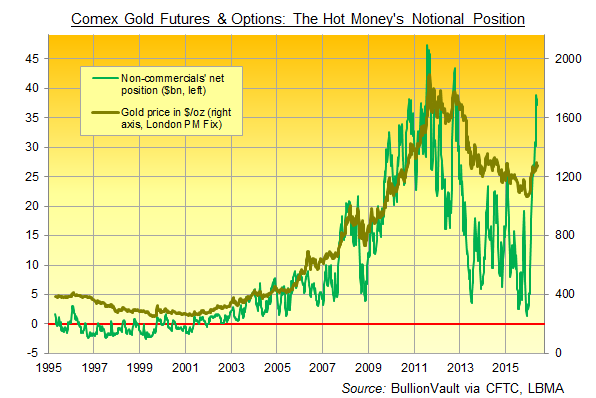
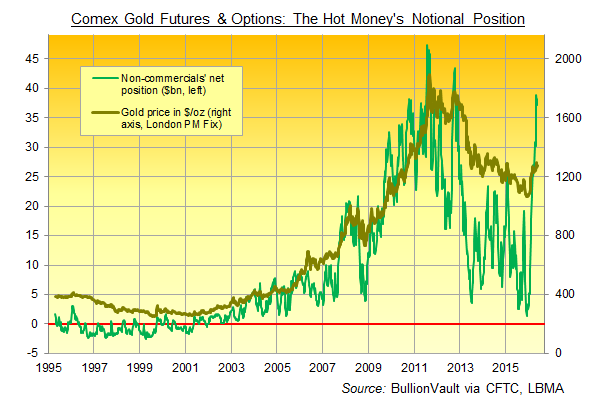
Latest data for US gold futures and options meantime show speculative “non-commercial” traders retreating only a little last week from the largest bullish position, net of that group’s bearish bets, on record.
 
In Dollar terms, the notional value of that “net spec long” position was last this great in late 2012, when gold prices traded at $1750 per ounce.
Chart of Comex non-commercials' net long in gold futures and options by notional US Dollar value
 
“Once again we made lower highs and lower lows,” says a technical note on Monday’s trading action from the New York bullion desk of Canada’s Scotiabank.
 
“[That] has now occurred over the last 5 trading days” – something which will mark gold’s longest run of daily drops since November’s approach of new 6-year lows if repeated Tuesday, says the Reuters news and data agency.

Gold Prices 'Will Work Lower' Amid US Dollar Uptrend on June Fed Rate-Hike Outlook

GOLD PRICES traded in a narrow range Monday morning in London, largely unchanged from last week’s finish at $1252 against the rising US Dollar before slipping close to the 3-week low of $1244 touched after the release of the Fed’s April meeting minutes last Wednesday, writes Steffen Grosshauser at BullionVault.

The US Dollar index remained above 95 against a basket of other major currencies, having reached a 7-week high following the Fed minutes, which raised expectations of a June rate hike.

New York Federal Reserve president William Dudley separately said last week that the US economy could be strong enough for another rate hike in June or July.

Interest-rate futures currently see the probability of a June rate hike at 26%, according to the CME Group’s FedWatch tool.

“We see gold continuing to work lower over the course of the coming week, as an upward trending Dollar should continue to weigh in on prices,” said INTL FCStone analyst Edward Meir after the Dollar saw its third straight week of gains.

“Leading into June, gold will be at the mercy of US dollar flows and market positioning, with key support levels for the metal [at] $1243 and below this, $1205,” added Swiss refining and finance group MKS.

However, “a premature hike by the Federal Reserve may lead to a slide in inflation, a pullback in growth and greater volatility, causing investors to shun risky assets,” points out Gary Dugan, chief investment officer for wealth management at Emirates NBD.

A loss of trust in the greenback, says Dugan, may lead to a bigger demand among investors in alternative assets like gold, which he sees at $1400 an ounce in the near term and around $1800 by the end of next year. 

Even if the Fed hikes rates twice more this year, that won’t necessarily stop gold’s 2016 rally, reckons Julian Jessop, chief international economist at UK consultancy Capital Economics.

“The conventional wisdom, of course, is that Fed tightening is bad for gold, mainly because higher US rates can strengthen the Dollar and increase the opportunity cost of holding commodities,” he explains.

“However…gold and silver prices actually rallied in the weeks and months after the Fed first raised rates last December.”

Billionaire hedge fund manager George Soros revealed last week that he recently made an investment of nearly $390 million in total between Canadian miner Barrick Gold (NYSE:ABX) and the giant gold-backed ETF SPDR Gold Trust (NYSEArca:GLD), while significantly cutting down his existing stock portfolio.

Total holdings in the GLD increased 1% to need 869 tonnes of backing on Friday, the highest level since November 2013.

Silver, in the meantime, dropped 1% to $16.37 per ounce Monday, and other precious metals also edged lower with platinum down 0.4% and palladium down 0.9%.

European stocks fell from a three-week high as Brent crude oil slips 1% to around $48 a barrel, indicating that after the recent rally towards $50 the demand may already be fading again.

Gold Prices Largely Unchanged but Expected "to Work Lower" Amid Upward Trending Dollar and Growing Expectations of June Rate Hike

GOLD PRICES traded in a narrow range between $1255 and $1248 per ounce Monday morning in London, largely unchanged from last week’s close of $1252 and close to the 3-week low of $1244 which it touched last week, writes Steffen Grosshauser at BullionVault.

The U.S. dollar index remained above 95 against a basket of other major currencies since it reached a 7-week high following the release of the Fed’s April meeting minutes last Wednesday.

Markets were affected by the growing expectations of an early rate hike following New York Federal Reserve President William Dudley’s hawkish remark last week that the U.S. economy could be strong enough for another rate hike in June or July. Market participants currently see the probability of a June rate hike at 26%, according to CME Group FedWatch.

“We see gold continuing to work lower over the course of the coming week, as an upward trending dollar should continue to weigh in on prices,” said INTL FCStone analyst Edward Meir after the dollar saw its third straight week of gains.

“Leading into June, gold will be at the mercy of US dollar flows and market positioning, with key support levels for the metal [at] $1243 and below this, $1205,” added Swiss refining and finance group MKS.

However, “a premature hike by the Federal Reserve may lead to a slide in inflation, a pullback in growth and greater volatility, causing investors to shun risky assets,” points out Gary Dugan, chief investment officer for wealth management at Emirates NBD. A loss of trust in the greenback may lead to a bigger demand among investors in alternative assets like gold, which Dugan sees at $1400 an ounce in the near term and around $1800 by the end of next year. 

Even if there will be two more rate rises this year, this must not necessarily stop gold to continue its rally, reckons Julian Jessop, chief international economist at Capital Economics.

“The conventional wisdom, of course, is that Fed tightening is bad for gold, mainly because higher US rates can strengthen the dollar and increase the opportunity cost of holding commodities,” he explains.

“However, there is surely more to say than this; after all, gold and silver prices actually rallied in the weeks and months after the Fed first raised rates last December.” Especially the persistent weakness in the dollar and renewed interest in inflation hedges are considered the main reasons for the metal’s strength by the commodities expert.

Billionaire hedge fund manager George Soros revealed last week that he recently made an investment of nearly $390 million in total in shares of Canadian miner Barrick Gold and the already giant gold-backed ETF SPDR Gold Trust, while significantly cutting down his existing stock portfolio.

Total holdings in the SPDR Gold Trust (NYSE Arca: GLD) increased 1% to 869 tonnes on Friday, the highest level since November 2013.

Silver, in the meantime, dropped 1% to $16.37 per ounce. Other precious metals also edged lower with platinum down 0.4% and palladium down 0.9%.

European stocks fell from a three-week high as Brent crude oil slips 1% to around $48 a barrel, indicating that after the recent rally towards $50 the demand may already be fading again.

Gold Bullion -1.5% for Week as Fed Points US Rates Higher, But ETF Investing Expands Again

GOLD BULLION prices slipped from a morning rally in London trade Friday afternoon, heading into the weekend $10 per ounce above yesterday’s 3-week low as world stock markets rallied from new 6-week lows.
 
The price of gold bullion still held 1.5% down for the week as the Dollar rose further following Wednesday’s news that the US Federal Reserve will “likely” raise US interest rates at its June meeting.
 
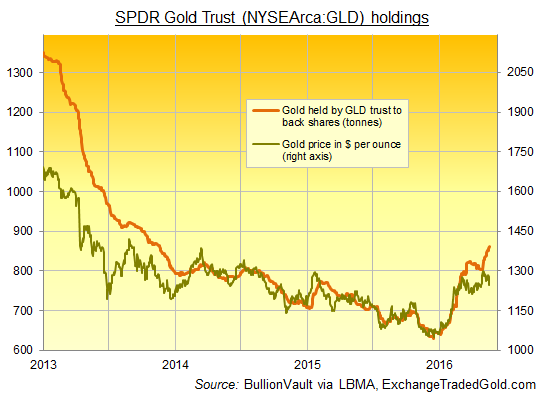
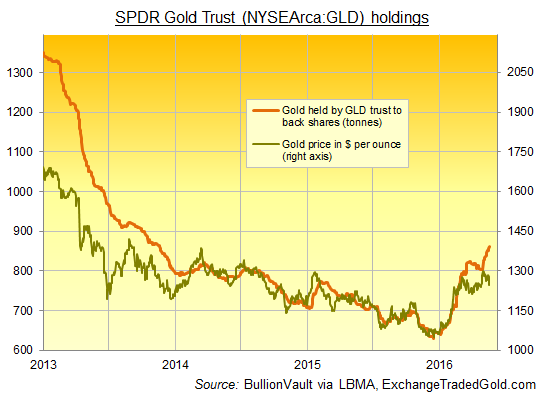
Exchange-traded trust funds tracking the gold price expanded again, however, with shareholder demand needing another 15 tonnes over the last week to back the giant SPDR Gold Trust (NYSEArca:GLD) – now back to its largest size since November 2013.
Chart of SPDR Gold Trust (NYSEArca:GLD) holdings vs bullion price
 
“Some investors have clearly been viewing the lower price level as an attractive opportunity to buy,” says the commodities team at German financial services group Commerzbank.
 
“This should protect the gold price from any further slide. We are confident that it will stabilise at roughly its present level.”
 
But “gold’s rally has now started to fade,” says strategist Jonathan Butler at Japanese conglomerate Mitsubishi, “and elevated gold COMEX [derivatives] longs and new ETF positions may not prove to be all that sticky if ‘risk-on’ mentality returns.
 
“It is hard to see what the catalyst for another big move higher across the precious complex will be, unless the Fed pushes out rate expectations again or…an extension of monetary stimulus at other central banks.”
 
Betting on US futures contracts now puts the odds of Fed rates reaching 1.0% from the current 0.50% by the September meeting at nearly 1-in-5 – up from just 1-in-50 a month ago.
 
Ten-year US Treasury yields held at the highest level so far in May at 1.87%, markedly above the 33-month lows hit in early February.
 
Looking at the technical picture, “The strength in the USD was a catalyst,” agrees Swiss refining group MKS’s Asian trading desk, “[but] there were also several significant technical levels which were breached which exacerbated the move. 
 
“The mid/late session recovery technically keeps gold above the medium-term uptrend.”
 
“The momentum indicator is showing signs of weakness,” counters a technical note from London bullion bank Scotia Mocatta’s parent Scotiabank’s New York office, “and [the] current view on gold is bearish, confirmed by [Thursday’s] close below $1256.
 
“Support now comes in at $1243…and the next downside target is in the $1205…area.”
 
Commodities meantime bounced Friday from their sharp mid-week sell-off on the US Fed’s latest meeting notes, but silver held onl;y at $16.54 per ounce, down 3.3% from last Friday and heading for its lowest weekly finish since mid-April.
 
China’s new gold bullion pricing benchmark had earlier fixed on Friday afternoon in Shanghai unchanged from Thursday, but 1.1% down for the week in Yuan terms.
 
Shanghai’s premium over spot quotes for London delivery rose above $3 per ounce, doubling this week’s previous average incentive to new imports from the world’s central gold dealing hub.
 
World No.2 gold bullion consumer nation India meantime “suddenly seems to be losing appetite,” says an article at the Economic Times from fund manager Chirag Mehta, noting weak demand data for Q1.
 
“This could be on account of reduced space towards discretionary spend as the economy tries to recover from lower growth and the end effect of two years of back-to-back droughts.”

Gold Prices Sink as US Fed's George Replays Lacker's Double Dissension Before Dollar Rate Hike

GOLD PRICES dropped to their lowest Dollar level in almost 3 weeks on Thursday, as the US currency rose but everything else fell after yesterday’s minutes from April’s Federal Reserve meeting said a June rate-hike looks “likely appropriate”.
 
World stock markets today followed New York’s sharp drop lower on the news, with betting on US interest-rate futures jumping to put the odds of a June hike above 1-in-3.
 
 
Gold priced in other currencies fell less quickly, but silver sank below $16.40 per ounce, down more than a dollar from Monday’s high, while gold traded 3.5% lower against the US currency from that peak.
 
Chart of US Dollar gold prices
 
The Euro currency Thursday fell to its lowest level since 29 March against the Dollar at $1.11, while commodity prices dropped over 1.6% by mid-afternoon in London.
 
US government bond prices fell far enough to drive 10-year yields up to 1.87%, erasing all of May’s previous drop to 1.71%, as all other major-developed and emerging-market debt prices dropped.
 
Brazil’s 10-year bond yields jumped 0.25 percentage points to their highest level in 4 weeks at 12.85%.
 
“Gold [is] the most responsive commodity to changes in Fed interest-rate hike probabilities,” found a new research paper last week from French investment and bullion bank Societe Generale.
 
“Obviously the possibility of a rate rise in June is very much beholden to US economic figures,”says David Govett at London brokers Marex Spectron.
 
But “gold [on Thursday] broke a one month uptrend line at around $1270, and almost immediately dropped to a low of $1255” before dropping further to $1244 per ounce.
 
That level marked a 12-month high for Dollar gold prices when first seen on the way up in early February 2016.
 
Shanghai’s new daily benchmark gold price had already dropped 1.4% from Wednesday, hitting its lowest ‘fix’ since 28 April even as the Yuan fell versus the Dollar.
 
“Most participants,” said the Fed’s minutes of April’s US policy meeting, “judged that if incoming data were consistent with economic growth picking up…labor market conditions continuing to strengthen, and inflation making progress toward the 2% objective, then it likely would be appropriate…to increase the target range for the federal funds rate in June.”
 
One member of the FOMC’s 10-person committe voted against the consensus, with the Kansas City bank’s president Esther George calling for the second meeting in succession to raise rates by 25 basis points.
 
The same lone dissent from the consensus was previously made in September and then October 2015 by Richmond Fed president Jeffrey Lacker, now a non-voting member until 2018.
 
US investors are holding the most cash as a proportion of portfolios in almost 15 years, according to a survey from the BAML financial services group.
 
Having been a voice of just one, Lacker’s double dissension was followed in December by a unanimous vote to make the first hike to US rates in over a decade.
 
India’s largest refiner, MMTC Pamp, meantime said demand for gold bullion is so poor in the world’s second-largest consumer nation that it is suspending production
 
“It is absolutely reflecting the current climate,” London-based news providers Fast Markets quote an Indian analyst, “which is not at all conducive for smelting at this moment…It’s in bad shape.”