Author Archives: City Gold Bullion

Platinum and Palladium surge, Gold prices gain for a 2nd day amid Dollar drop after weak US data

Gold prices rose 0.8% to $1352.49 per ounce this Wednesday lunchtime amid dollar index decline after weak U.S. productivity figures were published yesterday.

Silver prices made a more significant gain of 1.9% to $20.32 per ounce.

However, palladium gained the most by climbing as much as 7.6% to $746.38 per ounce this morning, the highest level since June 2015.

Platinum was also up 2.4% at $1,177.80, after rising to $1182.20 per ounce, the highest since April 2015.

Second-quarter productivity in the U.S. declined by 0.5%, the third quarter in a row of declines and the longest streak since 1979. 

The dollar index, which tracks the U.S. currency against a basket of six peers, retreated 0.6 percent to 95.599 early UK lunch time, as investors re-evaluated whether the U.S. Federal Reserve will raise interest rates this year.

Markets are currently pricing in less than a 50% chance of a rate hike in December, according to CME Group’s Fed Watch tool.

Asian stock markets finished the day down. The Nikkei 225 closed down 0.18%, Chinese Shanghai composite down 0.21%, Shenzhen composite down 0.328% and HK Hang Seng index down 0.18%, as investors awaited important data from China due Friday, including industrial production, fixed asset investment and retail sales.

European stocks are also trading lower, FTSE down 0.29%, Dax down 0.51% & CAC 0.33%.

Crude oil is down 1.26% to 42.23 prior to OPEC releasing its monthly oil market report  later today.  OPEC members are due to meet in September to discuss a production freeze. 
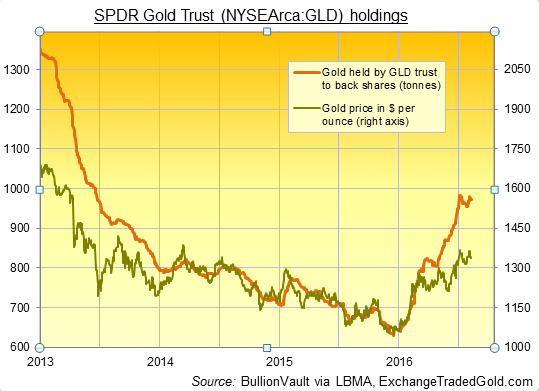
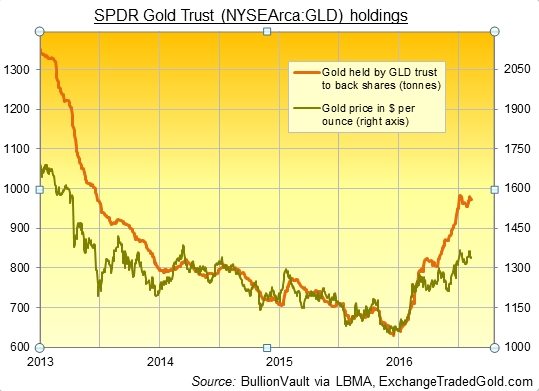
The world’s largest gold-backed exchange traded fund the New York-listed SPDR Gold Shares (NYSEArca:GLD) reported the second day outflow of 1.2 tonnes to 972.62 Tuesday after 6.5-tonnes Monday, which was the largest in over a month.  This offset its growth of 7.1 tonnes last Friday. 

‘This is likely a cautionary function from investors following the strong NFP figure on Friday, who are looking to trim positions with the rate expectation becoming more cloudy.’ the Asian trading desk of Swiss bullion refiner MKS said. 

UK gilt yields hit record lows touching just 0.123% today after Bank of England bond-buying failure yesterday.

The pound was depressed further yesterday after BOE policy maker Ian McCafferty warned in The Times on Tuesday that further rate reductions and QE may be required. 
 

Gold Bullion Trading Hits 'Dull August', New Futures & Spot Contracts Coming to 'Revive London Liquidity'

GOLD BULLION held flat in dull summer-time trade again in London on Tuesday, moving in a tight 0.3% range either side of $1333 per ounce as world stockmarkets extended their gains of the last month.
 
Silver also held flat just above 2-week lows, priced at $19.60 in wholesale bullion trade as base metals slipped and European government bond prices eased back, nudging yields higher.
 
Platinum traded 2% below last week’s new 12-month high, holding 38% higher from January’s 7-year lows.
 
“Nothing to really report in way of flows today,” said the Asian trading desk of Swiss bullion refiner MKS overnight, noting only “light Asian demand.”
 
“[Monday was] an extraordinarily dull day in precious world, as gold could barely muster a $9 range all day,” says a note from London broker David Govett at Marex Spectron.
 
“Let us hope business can pick up a bit, but I fear we may be in for a period of lacklustre [summer] trading.”
 
Longer-term, “Liquidity has dropped in London to an extent that is unhealthy,” news and data provider Bloomberg quotes Aram Shishmanian, chief executive of mining-backed market development organization the World Gold Council, “and to revive it is crucially important.”
 
The center of wholesale bullion trading worldwide, London’s market is primarily “over the counter”, with each buyer and seller contracting and settling their deals privately between them, rather than through exchange-traded contracts.
 
With support from 5 banks and 1 proprietary trading house, the World Gold Council today announced its intention to launch new spot, futures and options contracts for gold sometime in the first half of 2017, traded on and cleared by base-metal exchange the London Metal Exchange.
 
Now part of the Hong Kong-listed HKEX Group (HKG:0388), the 140-year old LME says it cleared contracts worth $12 trillion of total notional value in 2015.
 
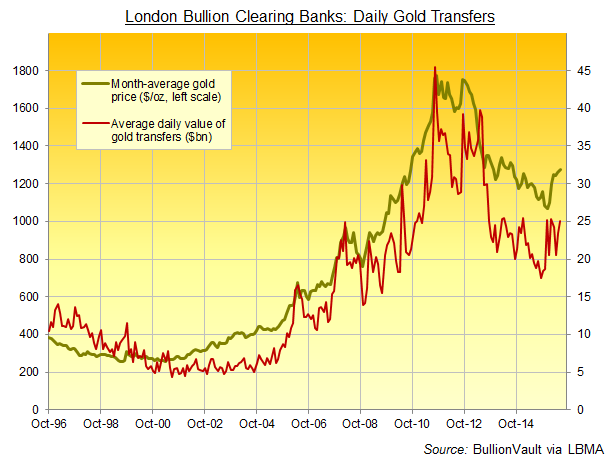
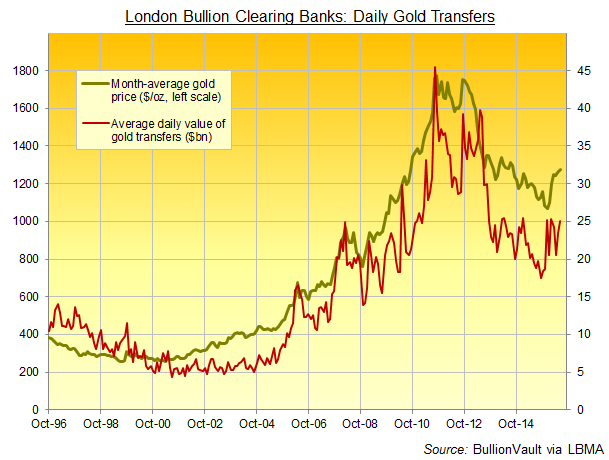
Gold transfers made between the 6 member banks of London Precious Metals Clearing Ltd (LPMCL) averaged $25 billion per day in June, according to data reported to trade body the London Bullion Market Association – 20% ahead of the 2015 average, and 6% ahead of the last 10 years’ average of $23.5bn.
Chart of London bullion clearing banks' reported daily volume in US Dollars
 
Those figures only capture gold settlements made in London by the 6 clearing banks – Barclays, HSBC, ICBC Standard Bank, J.P.Morgan, Scotiabank and UBS.
 
Analyst estimates say that figure can be multiplied by 3-5 times to approach the true loco-London daily volume.
 
Part of the largest banking group in the world, Chinese-owned London bullion clearer ICBC Standard Bank is also supporting the World Gold Council’s new LME initiative, alongside US investment banks Goldman Sachs and Morgan Stanley, French investment banks Natixis and Societe Generale, and privately-owned proprietary trading firm OSTC.
 
“[This] is not replacing what there is already, it is an addition to,” says LME chief executive Garry Jones of the new LMEprecious platform, with the proposal coming after “an extended process of engagement with major market participants and users.”
 
“It will strengthen London’s position in the global gold market,” agrees Shishmanian, “enabling it to meet the needs of all participants, attract new players and satisfy the highest standards of regulatory compliance.”
 
“A joint venture between the LME and the bullion market to create a gold futures exchange in London was [previously] formed” in the early 1980s, recalls former LME chairman John Wolff in the latest edition of the LBMA’s Alchemist magazine.
 
“Unfortunately, it was short-lived [as] the gold futures market on Comex [in the US] was already well established. It is very difficult to create a second market trading the same thing if the first one is already successful.
 
“Clients want to trade where the liquidity is.”
 
Notional volume in Comex gold contracts totaled over 130,000 tonnes in 2015 according to specialist consultancy Metals Focus.
 
LBMA data, which include forward and options contracts for miners and other market users wanting to hedge prices, suggest London’s clearing members settled 122,000 tonnes between them last year.
 
Global gold-mining output rose to a record 3,211 tonnes in 2015.
 
“In retrospect, we…got a bit carried away,” said former LBMA chair Robert Guy – like Wolff, one of the original founders of the LBMA in 1987 – in a 2012 interview.
 
“The Achilles heel…was the lack of domestic investor and speculator interest, without which no futures market can survive.”
 
“This is the first time that anyone has taken on the issue of clearing for spot,” says Jones at the LME, referring to deals made for settlement now, typically within 2 working days.
 
“People are already trading futures, but to trade everything together in one trading pool gives us confidence that [LMEprecious] will be success.”

Gold Prices 'Negative' After US Jobs Data But ETFs Swell Faster Than China's Reserves

GOLD PRICES extended their hard drop on Monday following Friday’s strong US jobs data, while global stock markets rose with commodities, writes Steffen Grosshauser at BullionVault.
 
Gold traded between $1330 and $1338 per ounce after experiencing its worst drop in 4 months on Friday’s better-than-expected US payrolls report.
 
Expectations of faster economic growth today saw traders raise their outlook for a Federal Reserve rate hike by December to 43%, up from 31% before Friday’s jobs data release according to betting in the futures market.
 
“We may be seeing a turning point setting in for both gold and silver, as the impact of the non-farm payroll number cannot be dismissed,” brokerage INTL FCStone’s analyst Edward Meir said in a note.
 
“Precious metals could remain under selling pressure” thanks to the jobs report, agrees specialist news provider FastMarkets’ analyst Boris Mikanikrezai. 
 
“Still, it seems too early to assert that a negative swing in sentiment has emerged in precious metals.”
 
“Gold prices have fully digested the nonfarm payrolls data,” counters Oversea-Chinese Banking Corp’s economist Barnabas Gan.
 
“US economic fundamentals have picked up, but the downside risks from whatever is happening from the [UK’s referendum result on] Brexit is still unknown.”
 
In other precious metals, silver was little changed from last week’s close at $19.73 per ounce, falling 0.3% to a near 2-week low.
 
Nearby silver price support stands at $19.50, according to a technical analysis from Swiss refiner MKS Pamp’s trading desk.
 
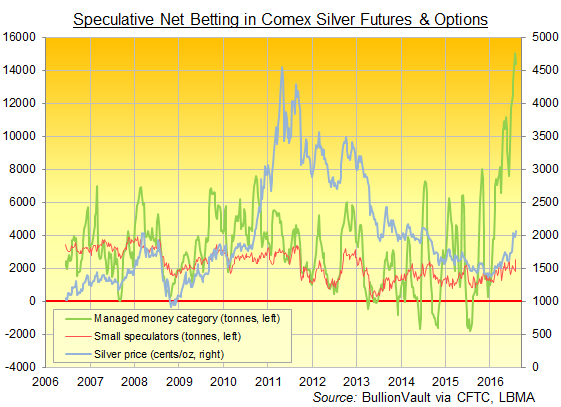
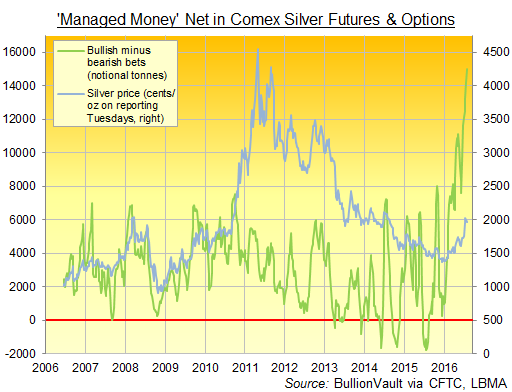
New data released after Friday’s close showed private investors and other ‘small speculators’ trading Comex silver futures and options growing their bullish bets to the largest level – net of bearish contracts – since February 2013 ahead of last week’s US jobs data.
Chart of Comex silver net betting by 'Managed Money' and 'Non-Reportable' categories
 
The ‘Managed Money’ category of Comex derivatives traders trimmed their net bullish betting on silver prices from end-July’s new record high.
 
Gold positioning, in contrast, rose across both professional and private speculators according to US regulator the CFTC’s weekly report.
 
The People’s Bank of China – central bank in the world’s biggest gold consumer nation – slowed its pace of gold purchases in July, new data showed today, buying fewer than 6 tonnes as prices rose above 2-year highs following the UK’s Brexit referendum result.
 
Bullion held to back the value of exchange-traded trust funds grew more than that on Friday alone, reaching 2,039.5 tonnes according to Bloomberg, the highest level since July 2013.
 
The gold ETF market leader SPDR Gold Trust (NYSEArca:GLD) grew 0.7% to 980.34 tonnes. 
 
While China has the world’s 5th biggest national gold reserves at 1829 tonnes, its holdings amount to only 2.3% of total reserves, compared to 76% in the US and 70% in Germany, according to data compiled by mining-backed market-development organization the World Gold Council.

US Jobs Growth Spurs Gold's Worst Drop Since April Fool's Day

GOLD PRICES sank at their fastest pace 4 months Friday lunchtime in London, retreating below $1350 per ounce – and erasing all the week’s previous 1.2% gains vs the Dollar – after the US reported much stronger-than-expected jobs growth for July.
 
US non-farm payrolls expanded by 255,000 on the government’s first estimate, way above analysts’ consensus forecast of 180,000.
 
Added to June’s upwardly revised 292,000 – the strongest in 8 months – that makes for the strongest 2-month US jobs growth of 2016 to date on the Bureau of Labor Statistics’ data.
 
Unemployment held at 4.9% however as the number of people in the jobs market rose, with some 7.8 million seeking work – a figure showing “little movement since August of last year.”
 
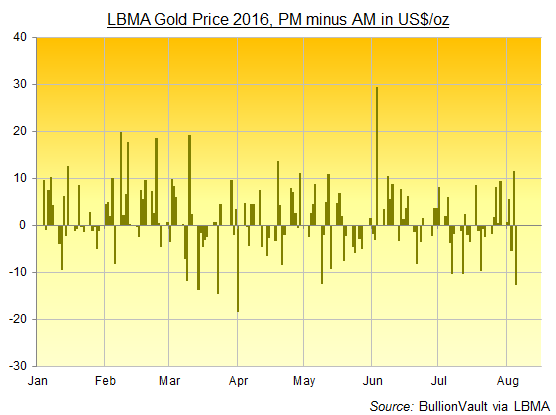
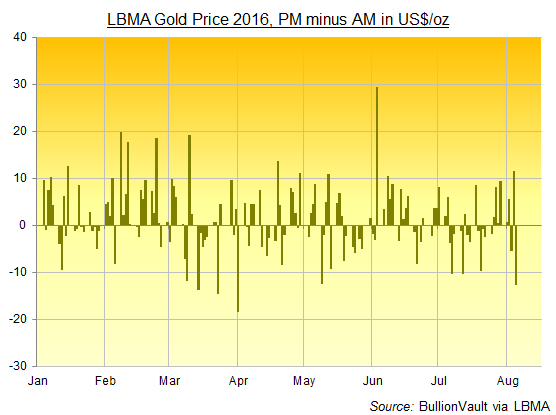
Initially dropping $15 per ounce from London’s morning benchmark price – formerly known as the Gold Fix – wholesale bullion headed for its sharpest intra-day fall since April Fool’s Day, when stronger-than-expected US jobs data saw gold drop $18 to trade $130 below current levels.
Chart of LBMA Gold Price, AM to PM change in US Dollars per ounce in 2016 to date
 
May’s US jobs report – released on Friday 3 June, and the weakest print in 6 years – then saw gold’s 6th strongest Fix-to-Fix gain of the last half-decade, adding almost $30 per ounce to the global benchmark.
 
Gold priced in non-US currencies held firmer on Friday, gaining 0.5% for the week against the Euro and adding 1% from last weekend for UK investors after the Bank of England cut its key interest rate to a new all-time historic low and unveiled up to £170 billion ($220bn) of new quantitative easing money-creation and asset purchases.
 
Bullion prices in Shanghai – where gold leasing deals by Chinese corporations to raise to loans are masking a 20% plunge in household gold demand – today neared last month’s new 3-year highs above CNY 290 per gram.
 
“The concept of a $15 rally on the back of a UK interest rate cut is a new one,” says long-time London broker David Govett at Marex Spectron of Thursday’s rise, “but in this day and age, markets behave very differently and one must adapt or perish!”
 
“The ultra-loose monetary policy pursued by many central banks,” says German finance group Commerzbank’s analysts, “should lend the gold price good support in our view.
 
“The Australian central bank cut interest rates [this week], the Bank of Japan and the ECB are continuing their bond purchases for the foreseeable future, and the US Federal Reserve will probably wait some time before implementing its next rate hike.”
 
Trading in US interest-rate futures today put the odds of a Federal Reserve hike to 0.75% at September’s meeting at 18%, double the odds forecast by trader positioning at Thursday’s close of business.
 
Silver meantime tracked and extended the drop in gold prices, losing 2% from last Friday’s finish to trade below $20 per ounce for the first time in over a week.

Gold Prices Jump on $220bn of New UK QE and Record-Low Rates, US Jobs Data Weak Before Non-Farm Friday

GOLD PRICES jumped and world stock markets rose with all major government bonds on Thursday after the Bank of England made its first change to UK interest rates in over 7 years by cutting to a new all-time low of 0.25% and announcing up to $220 billion-worth of new quantitative easing following the Brexit referendum result.
 
Gold prices jumped over 2% for UK investors as the Pound dropped over 2 cents to the Dollar, falling beneath $1.3550.
 
Priced in the US Dollar, gold rose 0.9% for the week so far, nearing 3-week highs at $1363 per ounce.
 
Silver broke its last month of outperformance however, lagging gold prices despite the Bank of England decision to trade flat from last week’s finish at $20.33 per ounce as crude oil slipped and copper prices fell 1.7% on the day.
 
Besides adding £60 billion to the existing £375bn pile of revolving government bond purchases last increased in 2012, the Bank of England will create £10bn of additional QE money to buy corporate bonds, plus up to £100bn for a new Term Funding Scheme – detailed in Thursday’s new quarterly Inflation Report – which offers loans to commercial banks at the official 0.25% rate to ease pressure on their margins between customer deposit and lending rates.
 
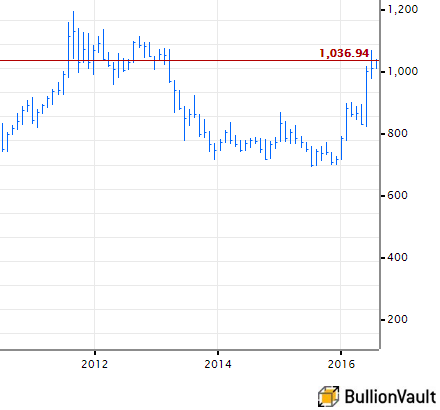
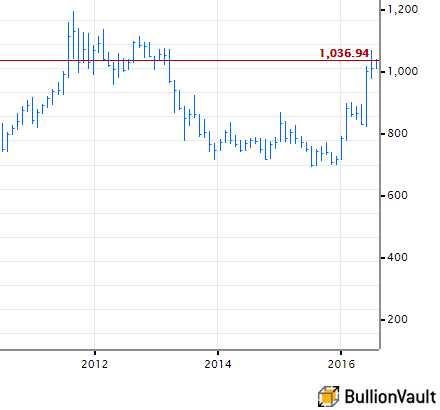
Chart of Sterling gold price, 5 years to August 2016 Bank of England QE decision
 
This all puts savers in a “very difficult position” admitted Governor Mark Carney in a press conference, but failing to act would see the UK slide into recession, he said, following June’s Brexit referendum result on quitting the free trade, capital and labor market of the European Union.
 
UK bond yields sank as government debt prices jumped, driving the 10-year yield down to new all-time record lows beneath 0.7% per annum.
 
The FTSE-100 share index leapt as bond prices rose, turning a 0.3% loss into a 1.6% gain within an hour led by banks, home-builders, and insurance companies.
 
London’s worst performing stocks included Randgold Resources – one of the world’s top 15 producers – down 6% lower by lunchtime despite the rise in gold prices, after bucking the 2016 uptrend in gold miner margins by reporting a drop in quarterly output and profit thanks to mechanical failures at key sites.
 
“Gold prices [had already] seen a very strong recovery,” says the latest technical chart analysis from German finance giant Commerzbank’s Karen Jones, pointing to the rally starting in late-July “just ahead of initial support at $1304…the May high, the 200-week moving average and the 23.6% [Fibonacci] retracement of the move seen this year.
 
“While above here that the up move remains fully entrenched…[with] a longer term target of $1450.”
 
Ahead of Friday’s non-farm US jobs data for July, “A lot of people are on holiday, but the algorithms and [high-frequency trading] systems don’t go on holiday,” says a note from David Govett in London for brokers Marex Spectron – “and they are the ones that push these markets further than would be normally expected.
 
“With the absence of genuine traders, we see exaggerated moves amidst thinner than normal volumes.”
 
US lay-offs rose 19% in July, said out-sourcing consultants Challenger, Grey & Christmas in new data, the second monthly rise in a row, with employers announcing over 45,000 cuts.
 
Last week’s claims for US jobless benefits rose above analysts’ forecasts.

2016 Gold Mining Margins Jump 150%, Put Miners 'In Sweet Spot' But Hedging 'All Short-Term'

GOLD MINING shares slipped from 3-year highs as bullion prices stalled near mid-July’s two-year Dollar highs on Wednesday, while Asian stockmarkets closed sharply lower once more but Japanese government bonds steadied from the last 3 days’ sell-off.
 
Western equities also stabilized as European banking shares rallied.
 
US crude oil held below $40 per barrel. Silver retreated 1% from yesterday’s pop to 1-month highs at $20.78 per ounce.
 
“Gold prices have improved, but gold miners do not yet believe in its longevity,” CNBC quotes analyst Alexander Hacking at US financial services giant Citi.
 
“This is typically a sweet spot of the cycle, with cash flows rising but the miners still focused on cost cutting and capital discipline.”
 
“Gold producer margins have soared,” says the latest Precious Metals Weekly from analysts Metals Focus, “as cost cuts finally pay dividends.”
 
Despite slashing executive perks, headcount and investment, gold miners began 2016 with an average margin between cash costs and market prices of just $220 per ounce, says the report.
 
“Some 25% of the industry [was] loss making” when all-in sustaining costs such as corporate HQ and admin, third-party smelting and refining, and also exploration to maintain current output are included.
 
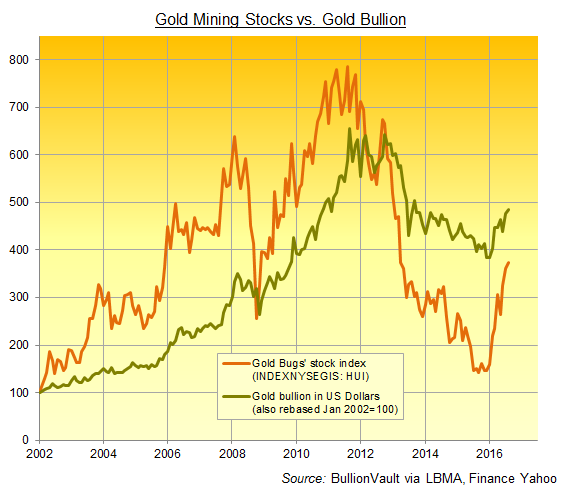
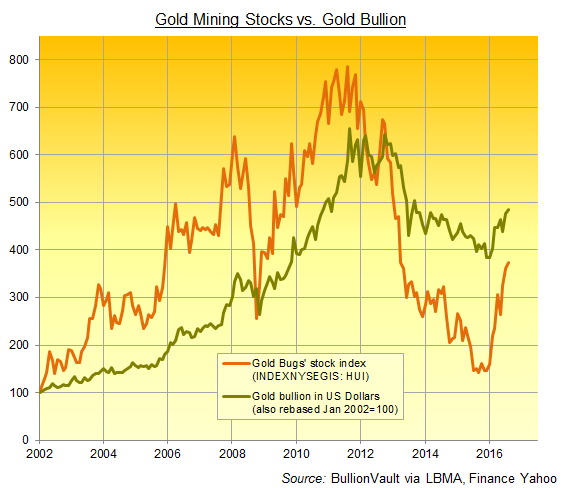
“Fast forward seven months and sentiment has dramtically changed,” Metals Focus says, with gold 27% higher but the HUI’s weighted index of major gold mining equities surging “by an impressive 140%” as margins have risen “nearly 150% to over $500, their highest level since 2012.”
Chart of Dollar gold price vs HUI gold mining stock index, 2002-2016, rebased to 100
 
With gold prices rising sharply from end-2015’s new 6-year lows, “over the first quarter of 2016, the delta-adjusted global producer hedge book rose  23%,” says the latest analysis of miner price hedging from Thomson Reuters GFMS.
 
Rising for a third consecutive quarter, that took the total amount of future production already sold at fixed prices “to its highest level since Q2 2010 [at] 270 tonnes” says GFMS – equivalent to some 8% of 2015’s record-high global mine output on BullionVault’s math.
 
Peak when gold prices bottomed in 2001, the global gold-mining industry’s hedge-book sold forward some 3,100 tonnes, equal to 125% of that year’s then record-high output.
 
The industry then slashed its hedge-book, buying back contracts to sell future production for price protection at ever-higher costs in the market, and culminating with No.1 miner Barrick (NYSE:ABX) eliminating the last of its hedges in 2009 at prices 250% higher from a decade before.
 
“The locking-in of prices over extended time periods was a prominent criticism (among many) levelled at the hedging practices of the 1990s and early 2000s,” writes GFMS director William Tankard and analyst Dante Aranda in the latest Alchemist magazine for members of the London Bullion Market Association.
 
Back then, “substantial contango was used to generate meaningful forward premia” as sale prices for future delivery were well above market values.
 
But now, “with cash deposit rates remaining close to zero in most major currencies, the premium available in the gold forward price is now a fraction of pre-financial crisis levels.”
 
Together with shareholders’ prior criticism of hedging, and the losses it generated when unwound during gold’s 2001-2011 bull market, “hedges maturing over short timeframes now appear to be very much the norm.”

Gold & Silver Gain as Stocks & Bonds Drop, JGBs Make 'Bazooka' Move, Euro Banks 'Brutal'

GOLD and SILVER prices rose as Asian and European stockmarkets fell on Tuesday, with gold touching 3-week highs at $1360 per ounce as major government bond prices also fell, driving borrowing yields higher from their recent new record lows.
 
The Reserve Bank of Australia today cut it main interest rate to a new all-time low of 1.50%. 
 
Futures markets in the US closed Monday putting the odds of a Federal Reserve rate rise to 0.75% at the September meeting at 18%, up from 12% on Friday.
 
Silver prices also rose, touching 1-month highs at $20.70 per ounce.
 
European banking shares today suffered a “brutal” drop according to the Financial Times, with Italy’s Unicredit – due to announce half-year results tomorrow – dropping another 5% in Milan after last week’s bank stress test results said the country’s lenders need to raise more capital.
 
Japan’s Topix index of major shares meantime closed 1.6% lower, and investors also continued to sell down Japanese government bonds following last week’s surprisingly weak new monetary stimulus from the central bank.
 
The drop pushed up yields, with Japan’s 10-year government bonds offering minus 0.025% per annum – the least negative yield in almost 5 months according to the Wall Street Journal – after prime minister Shinzo Abe’s cabinet confirmed the first $132 billion of a new fiscal stimulus, starting with support for low-income families and new infrastructure spending.
 
“The 0.2-percentage point gain over three sessions is the biggest move [in 10-year JGB yields] since May 2013,” says the WSJ, “a month after Bank of Japan Gov. Haruhiko Kuroda introduced his first ‘bazooka’ of monetary easing.”
 
“In view of the continuing low interest rate environment and amid numerous political risks,” says German financial services group Commerzbank’s commodity team, “gold should remain in demand among investors.
 
“While speculative financial investors are clearly withdrawing from gold, ETF investors are remaining loyal to gold.”
 
Exchange-traded funds backed by gold ended Monday needing the most bullion in more than 3 years according to Bloomberg, with aggregate inflows above 8 tonnes.
 
Falling consumer demand in India in contrast – formerly the world’s No.1 private gold buyer – saw imports drop for the sixth month in a row in July, according to analysis from specialists Thomson Reuters GFMS.
 
“Demand for imported gold fell sharply as discounts [to London quote] were in the range of $50 to $100 per ounce,” says GFMS analyst Sudheesh Nambiath.
 
Major European government bond prices also fell hard on Tuesday, driving 10-year UK Gilt yields 0.1 percentage points higher to 0.82% per annum while 10-year German Bund yields rose to minus 0.02%, the least negative since mid-July and 16 basis-points above last month’s new record lows.

Gold Down, Silver Up as Hedge Fund Bets Hit 6th New Record on the Run

GOLD FELL but silver rose again on Monday in London as European stock markets failed to follow Asian shares higher to new 1-year highs, write Steffen Grosshauser and Adrian Ash at BullionVault.
 
Gold prices traded between $1346 and $1351 per ounce, holding below the $1355 hit last Friday – the highest level since 12 July.
 
Silver meantime rise 1% and touched a 3-week high of $20.65 per ounce on Monday, and the metal’s bullish trend will remain intact as “long as it closes above $19.94” said technical analysis from Canada-based investment and bullion bank Scotia in their daily update last Friday.
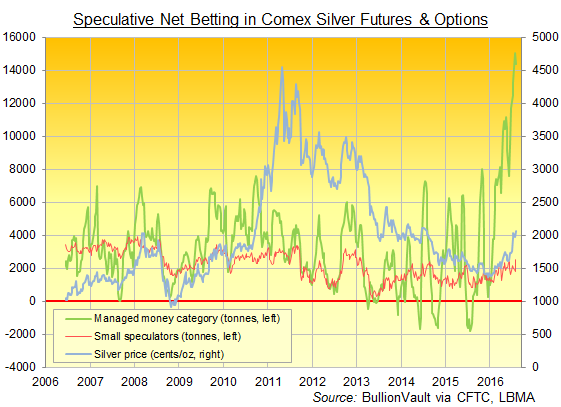
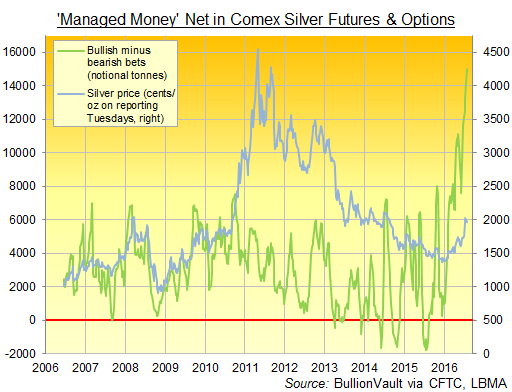
Chart of 'Managed Money' net speculative long position in Comex silver futures and options
 
Ahead of last week’s US Fed decision on Dollar interest rates, hedge funds and other leveraged speculators under the ‘Managed Money’ category grew their net bullish betting on Comex silver futures and options contracts to the 6th new all-time record in a row, new data showed after Friday’s close.
 
The Dollar steadied today after last week’s drop to 3-week lows followed the US Commerce Department’s announcement of much weaker than expected GDP growth in the second quarter, reported at 1.2% against analysts’ 2.6% forecasts.
 
Friday this week will bring US jobs data for July.
 
With UK business activity shrinking at the fastest pace since its last recession seven years ago, the Bank of England is expected to cut borrowing costs to a new record low of 0.25% when it announces policy on Thursday. 
 
“Just at a time when evidence was building that the US economy was in a position for the Fed to again contemplate rate hikes, some weak domestic data or a global event quite quickly scuttle those plans,” said commodities researchers at Australia’s ANZ Bank on Monday morning.
 
“The Fed will likely abstain from doing anything in September or October as that will be too early to make a move,” agrees US brokerage INTL FCStone’s analyst Edward Meir in a note.
 
The Fed’s dovish posture “should weaken the Dollar, pushing gold to test July highs of $1374 levels, with an outside chance of getting to $1400,” Meir adds.
 
Manufacturing survey data today said China’s factory activity held flat overall in July, while Eurozone activity grew but the UK’s output fell more in July than forecast after the Brexit referendum result, suffering its biggest drop in more than three years.
 
Markit’s Purchasing Managers’ Index (PMI) declined to 48.2, below the 50 mark which separates expansion from contraction.
 
The British Pound extended its decline against the Dollar, slipping further to $1.32 as the Euro also eased back.
 
That buoyed the gold price in Sterling near 3-week highs at £1025 per ounce, while gold priced in Euros held flat from last week’s finish at €1208.
 
Silver rose around 1% against both currencies, and eased back from an early 1.6% gain versus the Dollar to the highest price since 11 July at $20.65 per ounce.

Best Gold & Silver Forecasters Revise 2016 Targets Sharply Higher after 26% and 45% Gains to Date

GOLD and SILVER prices rose against a falling US Dollar after the Bank of Japan announced smaller-than-expected policy stimulus Friday and more analysts revised their forecasts sharply higher following this year’s 26% and 45% gains to date.
 
Gold slipped versus the Euro and Yen however, erasing the last of this month’s earlier gains to match Dollar and Sterling prices with no change for July – only the third month to miss a substantial rise in 2016 so far.
 
Major government bond yields eased lower as world stock markets flatlined.
 
More than $10 trillion of bonds issued by developed-world governments and corporations now offer new buyers an annual yield below zero, according to Reuters.
 
“The relationship between the opportunity cost of holding gold and interest rates has become ever more apparent,” says Bernard Dahdah, precious metals analyst at French investment and bullion bank Natixis, revising his 2016 full-year forecast 31% higher from $970 to $1275 per ounce.
 
Winner of the London Bullion Market Association’s 2015 gold forecast survey, and previously forecasting a drop below $1000 by April this year, Dahdah now says “the [2016] Fed rate hike won’t happen until at least December.”
 
The UK’s Brexit referendum result, Dahdah adds, makes “the future of the European project and the economic stability of the region…of great concern.”
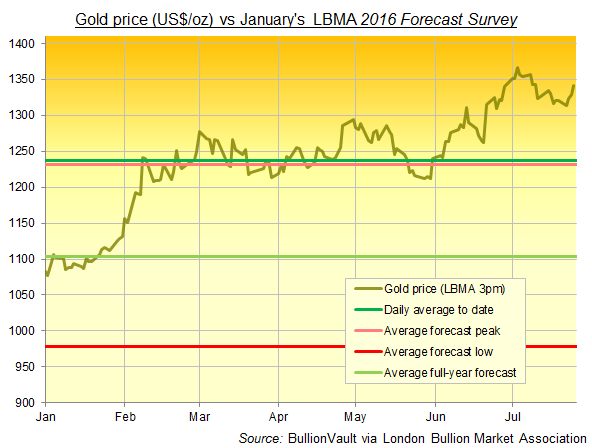
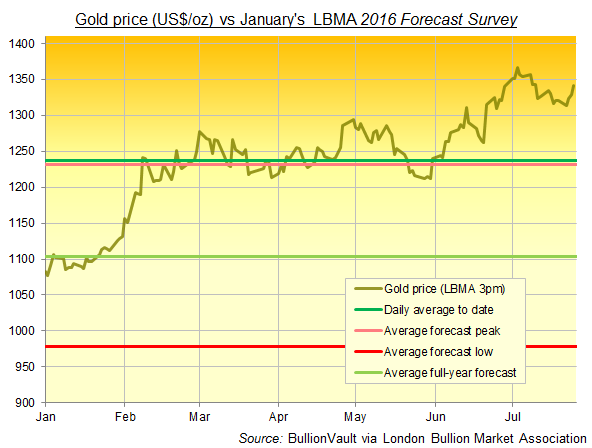
Chart of 2016 gold price to end-July vs January's LBMA Forecast Survey averages
 
“The likelihood of a US recession in the next three years is becoming very high,” writes Rene Hochreiter, mining analyst at Sieberana Research in Johannesburg and winner of last year’s LBMA silver price forecast.
 
Hochreiter was in January more bearish on gold’s 2016 low-point than Dahdah, predicting a drop to $850 per ounce sometime this year.
 
The metal bottomed to date at $1077 on 5th January, the second trading day of 2016 – almost $100 above the average low-end forecast of the 31 analysts then submitting entries to the LBMA’s 2016 Forecast Survey.
 
“If Britain can exit the EU,” Hochreiter now says, “then Trump could very well become [US] President…certain to cause a massive rise in US debt…and a fall in US share prices.”
 
The resulting “weaker Dollar will, without doubt, mean a stronger silver (and gold) price,” he adds, raising his full-year daily average silver forecast 27% from $13.40 per ounce to $17.10.
 
Touching $20.47 earlier this month, silver has now risen above the most bullish top-price forecast from January’s LBMA survey ($19.50 from Philip Newman at consultancy Metals Focus) and averaged more so far in 2016 at $16.39 than all but one full-year forecast ($17.50 from Joni Teves at Swiss bank UBS).
 
Gold’s year-to-date average of $1237.35 meantime comes above all 31 forecasters’ full-year predictions from January.
 
London’s peak 2016 gold benchmark of $1366.25 on Wednesday 6 July means it has beaten all but one top-range forecast ($1375 from Martin Murenbeeld at Dundee Economics).
 
Failing to cut deposit rates for Japanese banks deeper below zero today, the Bank of Japan did say it’s doubling quantitative easing money-creation to buy exchange-traded trust funds holding Japanese assets, raising its spend on ETFs to the equivalent of $58 billion per year, and also increase its lending of US Dollars.
 
The US Federal Reserve this week held its key interest rate unchanged from December’s solitary hike to 0.50%.
 
“After years of declines, silver prices made significant gains in the first half,” says a note from bullion market-making bank HSBC, raising its 2016 average price forecast from $15.90 to $18.00 per ounce.
 
“Our expectation of gold strength is supportive [for silver], as are an accommodative Fed policy, negative interest rates, and geopolitical risks.”

Buy Gold 'to Go Short Politicians' as Fed Holds Rates & QE, Commodity Profits Sink

BUY GOLD prices rose to 2-week highs against the Dollar on Thursday as the US currency fell following yesterday’s “no change” decision on Federal Reserve interest rates and QE.
 
Gold priced in Dollars touched $1344 per ounce in London wholesale trade, making it the most expensive to buy since July 14 – one week after the 2-year highs hit in the aftermath of the UK’s Brexit referendum result.
 
Prices in Euro and Sterling terms also rose, adding 0.6% and 1.8% respectively for the week so far.
 
US Treasury bond yields edged higher as world stock markets held flat overall but commodities rose.
 
Silver jumped faster than prices to buy gold, gaining 4.4% for the week so far to reach $20.50 per ounce.
 
Betting on US interest-rate futures now put the odds of a hike at the Fed’s September meeting to 0.75% further below 1-in-5.
 
“Near-term risks to the economic outlook have diminished,” said the Fed’s July statement, but while “indicators point to some increase in labor utilization in recent months [and] household spending has been growing strongly, business fixed investment has been soft [and] inflation has continued to run below the Committee’s 2% longer-run objective.
 
“Longer-term inflation expectations are little changed, on balance, in recent months.
 
“[So] the stance of monetary policy remains accommodative,” the Fed concluded, and it will keep re-investing money from maturing bonds in its $3.7 trillion QE program of 2008-2014 at least “until normalization of the level of the federal funds rate is well under way.”
 
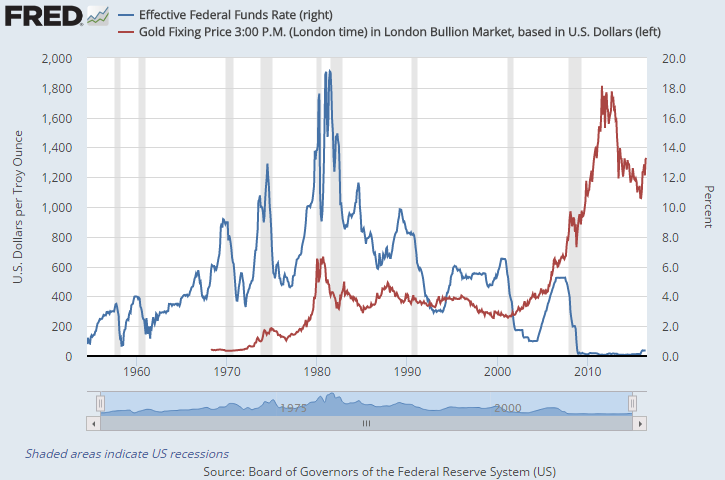
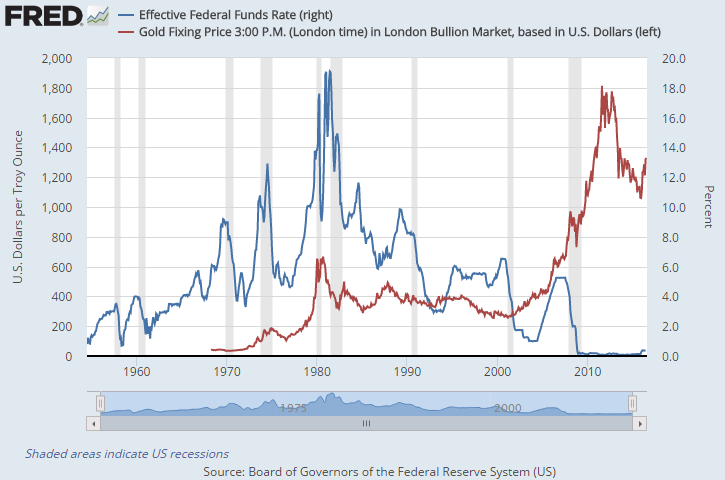
The Fed funds rate stays at 0.5%. It has averaged 5.1% over the last six decades.
 
Chart of the US Fed funds rate vs gold priced in Dollars per ounce
 
“We maintain a longer-term target of $1450,” says the latest technical analysis of Dollar gold prices from German financial services group Commerzbank, but “short term we suspect that the market will opt to consolidate around current levels.”
 
“Near-term resistance lies at $1375 [early July] high…the 38.2% [Fibonacci] retracement at $1381 of the move down from 2011 [and] also the $1392 peak of 2014.”
 
Looking at the investment case for buying gold, “Being long gold is the same as being short politicians,” said Jeff Currie, global head of commodities research at Goldman Sachs, to Bloomberg on Wednesday.
 
“There’s lots of uncertainty in the world today, and gold makes a great strategic hedge against those.”
 
Industrial commodity producers meantime reported a raft of write-downs and profit drops, with Anglo American (LON:AAL) taking a $1.2 billion charge on Australian coal projects it is currently trying to sell in a bid to reduce the miner’s net debt to $10bn.
 
Oil giant Royal Dutch Shell (LON:RDSA) reported a 93% drop in quarterly earnings, while commodity giant BHP Billiton (LON:BLT) said it’s putting up to $1.3bn aside to cover costs from last November’s Bento Rodrigues dam bursting in Brazil, since called the country’s worst-ever environmental disaster.
 
Local mining giant, and BHP’s partner in that iron-ore project, Vale (BVMF:VALE5) is also making provision of $1.2bn.