RSS

What's New

Stay up to date with gold, silver and platinum news, market developments and bullion insights.
Explore our latest articles or browse the archives to revisit the events that have shaped precious metal markets over the years.

Gold, Silver And Platinum Prices Jump As Dollar Slips Turkeys Central Bank Hikes Rates To Defend Lira


GOLD PRICES rose to 3-week highs against a weakening US Dollar on Thursday, trading up to $1209 per ounce in London’s wholesale bullion market as equities rose together with commodities and US Treasury bond prices.

As the Dollar eased back – most notably versus emerging market currencies led by the Turkish Lira after a shock interest rate hike – silver also gained, halving the last 2 weeks’ loss to trade at $14.30.

Platinum prices spiked to $810 per ounce, the highest level in a month.

All three precious metals have seen speculative money managers place record bearish bets using Comex futures and options contracts over summer 2018, leading some analysts to predict a “short covering rally” if prices fail to fall further.

Istanbul’s stock market meantime rose 1.5% on Thursday, extending its rally from August’s near 18-month lows, after the Central Bank of the Republic of Turkey hiked its main interest rate by over 6 percentage points to more than 24% per annum, the highest cost of borrowing in 15 years.

With gold priced in Dollars also rising however, domestic bullion prices in the world’s No.5 consumer nation retreated only to TRY 230 per gram, albeit 15% below last month’s new all-time highs.
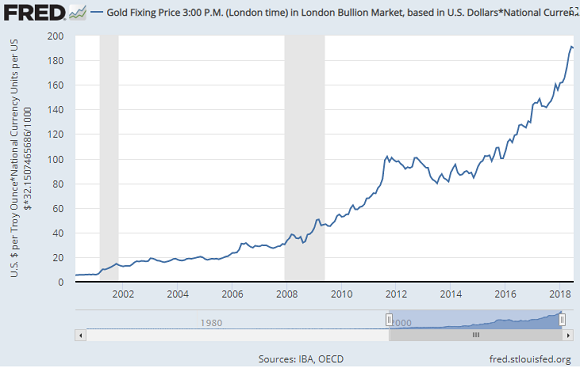
Chart of gold priced in Turkish Lira per gram, monthly average. Source: St.Louis Fed

Looking at developed-world stock market, “Investors do not seem prepared for anything but a continuation of the current upward trend, something that is hard to fathom if US tariffs on $200 billion in Chinese goods go into effect,” says a note from US investment bank Morgan Stanley’s head of investment and portfolio strategies for wealth management Lisa Shalett.

Short term, “We see gold as oversold and the likely beneficiary if recession fears rise,” she says, advising clients to think about “tactically deploying” 3-5% of their portfolios towards the metal.

Long term however, “Gold has not proven to be a good inflation hedge…[its] correlations with stocks and bonds are unstable…[and Morgan Stanley] no longer views gold as a strategic asset class, as it provides no interest or yield – and in the case of physical gold, there is a cost to store it.”

Shalett in mid-May said broader emerging markets looked “a good place to invest.” The MSCI Emerging Markets index has since lost 14% of its value.

“The Dollar is close to peaking” she told Bloomberg in mid-June. It has since risen nearly 3% against the world’s other currencies, recovering January 2017 levels.

Jumping sharply on today’s CBRT news to reach 3-week highs near 6.0 per US Dollar, the Turkish Lira had earlier sunk ahead of the central bank’s decision, coming with 5% of last month’s new record low, after President Recep Tayyip Erdoğan – who yesterday put himself and his son-in-law in charge of Turkey’s sovereign wealth fund – called interest rates a “tool of exploitation”, repeating a phrase which helped spur the currency’s plunge in mid-August.

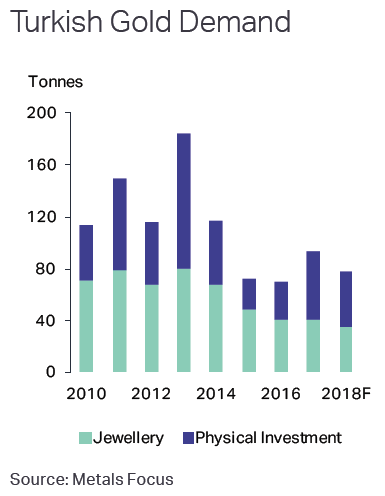
“If and when the prices fall back to the low TL200’s or below,” wrote specialist analysts Metals Focus in a note late in August, “we believe that [Turkish] investors will start buying again.

“[But] weakness in the Lira will persist and Dollar gold prices will also rebound.

“This suggests that disinvestment, as well as scrap, will grow this year while jeweller demand [for fabrication] is likely to post a double digit decrease.”
The Euro and British Pound were meantime little changed Thursday after their central banks made no change to their monetary policies, keeping their main rates at 0.00% and 0.75% respectively.

The Bank of England’s short statement kept the stock of quantitative easing asset purchases at £445 billion and referred twice to “greater uncertainty” about the UK’s March 2019 Brexit from the European Union.

The European Central Bank repeated its plan to reduce and then end its new monthly QE purchases between now and New Year, before maintaining that €2.5 trillion stock of assets “for an extended period of time…to maintain favourable liquidity conditions and an ample degree of monetary accommodation.”

The UK gold price in Pounds per ounce rose back towards last week’s finish at £924, and the Euro gold price held unchanged from the last 1, 2, 3 and 4 weekends at €1036.


Disclaimer

This publication is for education purposes only and should not be considered either general of personal advice. It does not consider any particular person’s investment objectives, financial situation or needs. Accordingly, no recommendation (expressed or implied) or other information contained in this report should be acted upon without the appropriateness of that information having regard to those factors. You should assess whether or not the information contained herein is appropriate to your individual financial circumstances and goals before making an investment decision, or seek the help the of a licensed financial adviser. Performance is historical, performance may vary, past performance is not necessarily indicative of future performance. This report was produced in conjunction with ABC Bullion NSW.
Gold Price Near 25 Year High vs Silver but Stuck Below 1200 as Oil Jumps Juncker Calls Dollar Dominance Absurd

GOLD PRICES held tight below last week’s finish in London trade Wednesday, moving around $1195 per ounce as Asian stock markets fell again but European shares gained ahead of tomorrow’s policy decisions from the Eurozone and UK central banks – both expected to deliver “no change”.

Global oil prices rose, with energy traders pointing to both the loss of supply from Iran following new US sanctions over Tehran’s nuclear research program and to Hurricane Florence, now approaching the US east coast and set to make landfall at ‘Category 4’ in North Carolina on Thursday.

Brent crude oil neared $80 and US benchmark WTI rose near $70 per barrel.

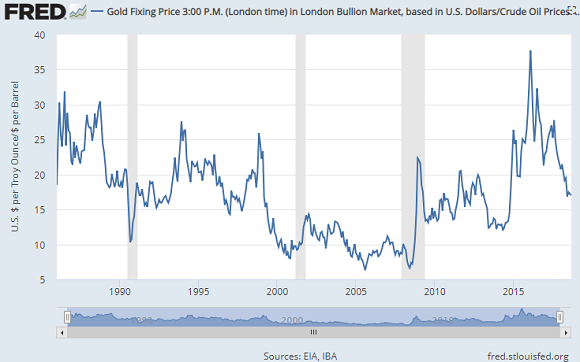
Still 5% below July’s 3.5-year highs, that squashed the Gold/WTI ratio of bullion to barrels down near 17, only a little above the 4-year low in gold relative to crude oil hit this summer.

Chart of Gold/Oil Ratio (London Fix vs. WTI Nymex). Source: St.Louis Fed

“It is absurd that Europe pays for 80% of its energy import bill, worth €300bn a year, in US Dollars when only roughly 2% of our energy imports come from the United States,” said out-going European Commission president Jean-Claude Juncker in his final ‘state of the union’ speech to lawmakers in Strasbourg today.

Also vowing to boost EU border patrols against illegal migrants, Juncker said he wants “to strengthen the international role of the Euro…[making it] the active instrument of a new and more sovereign Europe.

“There is strong demand for Europe throughout the world,” Juncker also claimed.

“To meet such high demand, Europe will have to speak with one voice on the world stage.”

Members of the European Parliament meantime voted 448 to 197 on Wednesday in favor of Article 7 procedures against member state Hungary, accusing Budapest’s prime minister Viktor Orban of breaching EU values.

The Euro rose but struggled to get back above $1.16 to the Dollar, holding gold prices for Eurozone investors at €1030 per ounce.

Silver meantime held flat around $14.12 after recorded its lowest London benchmark price yesterday since the “anti-arb” flash crash of late January 2016, when the auction process fixed at $13.58 – some 80 cents below spot-market quotes – on a lack of buyers to balance with sellers.

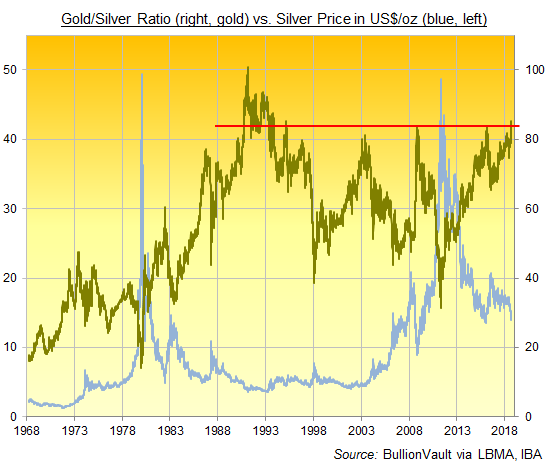
Tuesday’s brief plunge beneath $14 put the Gold/Silver Ratio of the two metals’ prices relative to each other just shy of a 25-year high, breaking above 85 ounces of silver per 1 ounce of gold for the first time since March 1995.

Chart of the Gold/Silver Ratio, London benchmark prices. Source: BullionVault via LBMA

“China [is] again showing little demand” despite the drop in gold prices, says one Asian trading desk.

“There is some selling pressure on the Renminbi, which is affecting gold,” agrees Ronald Leung at Hong Kong traders Lee Cheong Gold Dealers.

“Also, people are reluctant to buy as $1200 is acting as strong resistance after failing to break through the level last night.”

Weaker silver prices have seen investor demand for exposure through the iShares Silver Trust (NYSEArca:SLV) grow that exchange-traded fund to a 14-month high, needing over 10,377 tonnes of backing.

Gold’s 3-month price drop of $100 in contrast has seen the giant SPDR Gold Trust (NYSEArca:GLD) shrink by more than 10%, ending Tuesday with backing of 745 tonnes, the lowest since February 2016.

On the political front Wednesday, Russian president Vladimir Putin claimed that the two suspects wanted by UK police over the attempted murder of a former KGB spy in Salisbury this spring are civilians and who will “soon” give their version of events.

Pro-Brexit Conservative MPs – who now show “no dissent” on wanting to oust Prime Minister Theresa May – meantime said an “invisible” border between Northern Ireland and the Republic could exist post-Brexit thanks to “existing” technology for customs checks and VAT sales-tax payments.


Disclaimer

This publication is for education purposes only and should not be considered either general of personal advice. It does not consider any particular person’s investment objectives, financial situation or needs. Accordingly, no recommendation (expressed or implied) or other information contained in this report should be acted upon without the appropriateness of that information having regard to those factors. You should assess whether or not the information contained herein is appropriate to your individual financial circumstances and goals before making an investment decision, or seek the help the of a licensed financial adviser. Performance is historical, performance may vary, past performance is not necessarily indicative of future performance. This report was produced in conjunction with ABC Bullion NSW.

Gold Recovered From $1160 but Set to Fall 2.8% on Prior Week Amid Trump Says 'Cutting Back on Turkey' by Threatening to Impose More Economic Sanctions

GOLD MINING shares rose as the broader stock market rallied Tuesday while the rise in US bond yields paused with 10-year rates just shy of 3%.

Gold bullion prices bounced $5 per ounce from yesterday’s 2-week low, touching $1328 as London opened for business.

That left gold little changed around last Friday’s finish in non-US currency terms as the Dollar joined bond yields and paused its rise of the last week on the FX market.

Silver and platinum kept all of Monday’s 2.7% and 1.0% drops respectively, trading back at $16.65 and $918 per ounce.

Palladium also failed to bounce after sinking over 6% yesterday amid reports that Washington may ease US sanctions over the metal against its No.1 miner, Russia.

The FTSE Gold Mines index meantime edged higher after the world’s largest stockmarket-listed gold miner reported a 5% rise in first-quarter earnings despite a 20% drop in gold ounces mined.

Announcing suspension of a “prefeasibility study” on the Andes mountain project at Pascua-Lama – expected to produce 125 tonnes over its first 5 years but shut since 2013 by environmental orders from the government of Chile – Barrick said its all-in sustaining costs rose 4.1% in January-March from the same period of 2017 to reach $804 per ounce.

Bullion market prices rose 9.0% year-on-year in Q1 to average $1329.

Barrick’s full-year guidance remains for maximum output of 155 tonnes in 2018, a further 6% drop after 2017’s fall of 4%.

Barrick’s output has now shrunk “nearly 40% since its peak of 2006,” according to Reuters, having sold a raft of assets to raise money in 2014-17.

Total debt has meantime halved to $6.4 billion from the peak of 2012-2013, and “Barrick does not intend to sell further assets for the purposes of debt repayment,” the company said Monday.

“Proceeds from any future portfolio optimization will be used to enhance our project pipeline, or returned to shareholders.”

At the top of gold’s bull run in 2012, ABX paid a dividend of 75 cents per share, offering a yield of some 1.6% to that year’s opening price.

Last year it paid 12 cents per share, a yield on 2017’s opening price of 0.5%.

Chart of Barrick Gold Corporation (NYSE:ABX) vs Dollar price of gold, 1985-2018. Source: BullionVault

Barrick’s stock fell 1.8% on Monday, dropping to 1-week lows.

First quarter results are due from No.4 gold miner Goldcorp (NYSE:GG) on Wednesday, No.2 Newmont (NYSE:NEM) on Thursday, and No.3 Anglogold Ashanti (JSE:ANG) in early May.

Data from the world’s largest gold producer nation China last week said its mining output fell 3% in Q1 after falling 6% across 2017 as a whole.

Gold Price Drop Spurs ETF Selling Physical Investor Buying As Trump Warns Over Trading With Iran

GOLD PRICES held in a tight $5 range around $1213 per ounce Tuesday morning in London, moving sideways against a weaker US Dollar as commodities edged higher and Donald Trump issued a warning to other countries over doing trade with Iran – now back under US sanctions over its nuclear research program.

With gold prices barely $10 above last week’s 12-month lows, world stock markets followed Wall Street higher, adding over 2.9% to China’s main equity index as the Yuan extended its rally versus the Dollar on the currency market.

The UK gold price in Pounds per ounce meantime ticked a 2-week high just below £938 as Sterling fell after both the National Farmers Union and the Association of Police & Crime Commissioners warned against a “no deal” Brexit – now 60/40 likely according to trade minister Liam Fox, “uncomfortably high” odds according to Bank of England chief Mark Carney.

Trump’s warning to other countries over the re-applied US sanctions was met by what the White House called “propaganda” from Tehran, where Iranian President Hassan Rouhani said “I don’t have preconditions [for talks]. If the US government is willing, let’s start right now.”

The Iran sanctions have officially been cast. These are the most biting sanctions ever imposed, and in November they ratchet up to yet another level. Anyone doing business with Iran will NOT be doing business with the United States. I am asking for WORLD PEACE, nothing less!

— Donald J. Trump (@realDonaldTrump) August 7, 2018

Despite the rise in trade and geopolitical tensions, investment in gold-backed trust funds shrank by 1.6% in July new data showed today, pulling their value down to $94 billion, the lowest in 12 months.

“Gold price performance was a large contributor to [those ETF] outflows,” says the mining-backed World Gold Council, posting the figures as a PDF, “as it fell over 2% in US Dollar terms.”

Private investors, in contrast, grew their physical bullion holdings at the fastest pace since December according to data from BullionVault this morning, with major coin fabricators also reporting a sharp rebound in business during July’s price drop.

The largest gold-backed ETF, the giant SPDR Gold Shares (NYSEArca:GLD), yesterday shrank again, reduced by 0.8% as investors sold once again.

That took the amount of gold needed to back the GLD’s value down to a new 12-month low at 788 tonnes.

The GLD peaked in size with 1,353 tonnes at end-2012.

Chart of SPDR Gold Trust gold backing vs. London benchmark price. Source: BullionVault via ExchangeTradedGold

Silver’s largest ETF product has also bucked the trend in gold-backed trust funds, with the iShares Silver Trust (NYSEArca:SLV) ending Monday at its largest size in almost a year to need 10,274 tonnes of bullion.

Silver outperformed gold prices in London on Tuesday, edging above last week’s finish to trade at $15.46 per ounce.

Platinum prices also recovered Monday’s drop, adding 1.9% to near last week’s peak around $840.

The Chinese Yuan meantime extended its rally from Friday’s new 15-month low, adding 1.0% versus the Dollar on the forex market.

Shanghai prices held unchanged in Yuan terms, showing a premium to London quotes of $4 per ounce – less than half the typical incentive for new bullion imports into the No.1 consumer market.

Disclaimer

This publication is for education purposes only and should not be considered either general of personal advice. It does not consider any particular person’s investment objectives, financial situation or needs. Accordingly, no recommendation (expressed or implied) or other information contained in this report should be acted upon without the appropriateness of that information having regard to those factors. You should assess whether or not the information contained herein is appropriate to your individual financial circumstances and goals before making an investment decision, or seek the help the of a licensed financial adviser. Performance is historical, performance may vary, past performance is not necessarily indicative of future performance. This report was produced in conjunction with ABC Bullion NSW.

Platinum Near 10 Year Euro Low as Gold Prices Fall Amid Latest 'Trade War' Shots

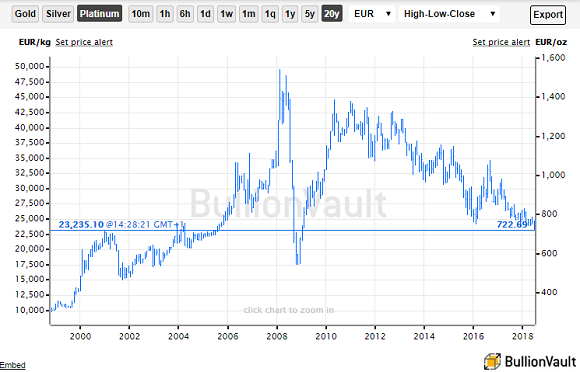
PLATINUM PRICES measured in Euros fell to a near-10 year low on the first trading day of H2 2018, while gold stayed close to this year’s low as the US Dollar strengthened again, writes Steffen Grosshauser at BullionVault.

For US investors, gold fell $3 from last week’s close at $1252 per ounce, moving closer to the 6-month low at $1246 to which the yellow metal crashed last Thursday.

Silver meantime fell through $16 per ounce, also touching its lowest Dollar price since mid-December, as platinum fell to a 29-month low at $838 per ounce having already declined by 6.2% in June alone.

For Euro investors however, the grey metal fell to €719 per ounce – the lowest level since 6 January 2009.

Chart of platinum spot price in Euros. Source: BullionVault

“Commodities face a twin threat in the coming months,” according to analysts at US investment bank Morgan Stanley, pointing at the risks to consumption from a potential escalation in global trade tensions and an economic slowdown in China.

“It is quite possible that we have not seen the bottom [for gold] yet,” warns Canadian brokerage TD Securities, saying that traders are ignoring signs of weaker economic data and a loss of risk appetite.

“[But] a pragmatic approach on the part of the US central bank, as we approach the end of the US tightening cycle, should eventually weaken the USD and should be quite supportive of gold,” the TDS analysts added.

“We also think that the negative fallout from Washington’s aggressive trade rhetoric will soon bite the US itself.”

“The US Dollar has been the biggest beneficiary as investors’ first choice safe haven,” reckons Gavin Wendt, senior analyst at MineLife Pty, speaking to Bloomberg.

“This has indirectly led to gold price weakness, as the Dollar and gold typically move inversely to each other.”

“[But] with the emergence of inflation, gold is likely to find a bottom as the Dollar’s gains weaken.”

US consumer prices accelerated in the year to May, new data showed Friday, with the underlying inflation rate reaching the Fed’s 2% target for the first time in six years.

European stock markets on Monday followed their Asian counterparts sharply lower as the European Union set out plans for retaliatory tariffs for the United States worth $300 billion after President Trump announced he would put new tariffs on European cars.

Speaking to Fox News, Trump suggested that the EU was “possibly as bad as China, just smaller”.

The US is also due to impose $34 billion of tariffs on Chinese exports. According to two new surveys, Chinese manufacturing activity slowed last month as the Yuan experienced its sharpest drop since devaluation by China’s government in August 2015.

Trump meantime tweeted congratulation overnight to new president of Mexico, Andrés Manuel López Obrador, elected by a landslide on a ticket of fighting corruption.

Left-wing former mayor of Mexico City, Amlo has called Trump “erratic and arrogant” and said that the real-estate magnate’s demands for a border wall paid for by Mexico “goes against humanity, it goes against intelligence and against history.”


Disclaimer

This publication is for education purposes only and should not be considered either general of personal advice. It does not consider any particular person’s investment objectives, financial situation or needs. Accordingly, no recommendation (expressed or implied) or other information contained in this report should be acted upon without the appropriateness of that information having regard to those factors. You should assess whether or not the information contained herein is appropriate to your individual financial circumstances and goals before making an investment decision, or seek the help the of a licensed financial adviser. Performance is historical, performance may vary, past performance is not necessarily indicative of future performance. This report was produced in conjunction with ABC Bullion NSW.
Gold Prices Unmoved as US 10-2 Yield Spread Hits 2007 Low, China Ready for All-Out Trade War

GOLD PRICES gave back a $5 rally from new 2018 lows in London trade Wednesday lunchtime, falling back to $1255 as the US Dollar pushed higher once more on the currency market following better than expected US trade data.

Despite worsening ‘trade war’ tensions between the US and China, world stock markets rallied from this week’s sharp fall to date, while longer-term interest rates fell on a rise in longer-term government bond prices.

The yield offered by 10-year US Treasury debt slipped to 2.83% – its lowest since the end of May.

Two-year bonds fell in price however, pushing their yield higher and cutting the spread between long and short-term US rates to the narrowest since August 2007 – eve of the global banking crisis – at just 33 basis points.

Pulling that spread below zero, the US yield curve has inverted – with expectations for future interest rates falling below near-term rates – just before each of the last five US recessions.

Chart of 10-minus-2 US yield spread vs gold. Source: St.Louis Fed

New data today put the US trade deficit in goods at $64.9 billion in May, the smallest gap between the value of US physical exports and imports since August on a seasonally-adjusted basis.

A group of Republican senators said overnight they will try to stem US President Donald Trump’s new import tariffs and blocks on Chinese investment.

Unconfirmed reports from China say that President Xi Jinping has ordered the politburo to prepare for “all-out trade war”.

Meeting today with US Defense Secretary Jim Mattis, China is committed to peace but “cannot give up even an inch of territory” said Xi, apparently referring to Taiwan as well as disputed islands in the South China Sea.

Over the last 2 weeks the Yuan has now lost more than 3% versus the Dollar, its sharpest drop since the devaluation of mid-2015.

“Moderate depreciation is reasonable,” said the state-run Securities Daily newspaper today.

“It can leave some room for China to respond to the trade situation, so it’s not a bad thing.”

But “the speed the Yuan fell earlier today was obviously considered too fast from the authorities’ point of view,” says one Shanghai bank’s head of currency trading, quoted by the Wall Street Journal.

With the weak Yuan cutting domestic Chinese gold prices in Dollar terms, the premium for metal delivered in Shanghai rather than London dropped as low as $2-3 per ounce, says a note from Swiss refiners MKS.

That drop “prompted decent selling action” in China’s domestic bullion market.

“If we see higher trade tension, that could at some point be positive for gold,” says private Swiss bank Pictet’s wealth management FX strategist Luc Luyet.

“Given the recent equity-market correction and talk of a trade-driven slowdown in the global economy,” agrees Canadian brokerage TD Securities’ analyst Bart Melek, the US Fed is unlikely to press ahead with any aggressive interest rate hikes.

Gold prices “may do better” soon, Melek thinks.

But for now, “it appears that gold is being treated currently as part of the commodity complex” rather than a ‘safe haven’, Bloomberg quotes National Australia Bank economist John Sharma.

Gold’s failure to jump as world stock markets fell at the start of this week “has prompted stale longs to exit their positions,” says brokerage INTL FCStone in a note.

Looking at technical gold price charts, “Gold appears poised to target the Dec 2017 low,” says the New York office of bullion bank Scotia Mocatta, pointing to the $1236 level.


Disclaimer

This publication is for education purposes only and should not be considered either general of personal advice. It does not consider any particular person’s investment objectives, financial situation or needs. Accordingly, no recommendation (expressed or implied) or other information contained in this report should be acted upon without the appropriateness of that information having regard to those factors. You should assess whether or not the information contained herein is appropriate to your individual financial circumstances and goals before making an investment decision, or seek the help the of a licensed financial adviser. Performance is historical, performance may vary, past performance is not necessarily indicative of future performance. This report was produced in conjunction with ABC Bullion NSW.

Gold Price Hits 2 Week Euro Low as ECB Sees End of QE Trade War Threatens Global GDP

GOLD PRICES rallied back near $1300 per ounce on Wednesday but fell to 2-week lows for European investors as Eurozone bond yields rose after two key Euro central-bank officials said Frankfurt remains on track to start reining back its historic monetary stimulus.

Italian bond prices fell faster than other Eurozone debt, driving the yield spread over benchmark German Bund interest rates higher after the new right- and leftwing government’s prime minister, Giuseppe Conte, promised “radical change”.

Gold priced in the single currency dipped below €1100 per ounce, the first time since Italy’s new Eurosceptic coalition began trying to form a government in late-May.

Head of the German Bundesbank Jens Weidmann today said it looks “plausible” that rising inflation data will allow the European Central Bank to end new QE purchases of government bonds by the close of 2018.

A key contender to replace Mario Draghi as ECB president next year, Weidmann last month called an interest rate hike in mid-2019 – the first since the ECB raised rates just before Lehman Brothers collapsed in 2008 – a “realistic” possibility.

Chief ECB economist Peter Praet meantime called annual pay growth of 1.9% across the 19-nation currency zone an “upsurge” in a speech on Wednesday, but noted that the central bank’s huge stockpile of long-dated government bonds “will continue to put downward pressure on longer-term interest rates well beyond the end of our net purchases.”

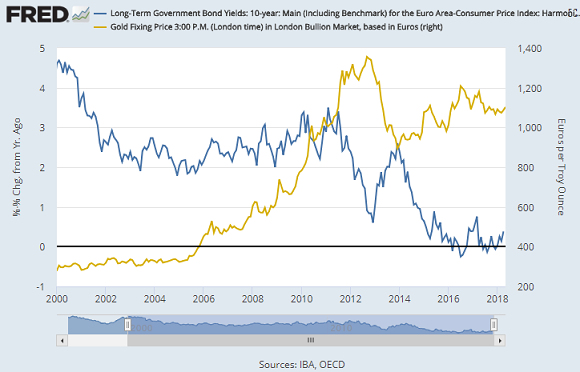
After accounting for inflation in consumer prices, the real yield on longer-term Eurozone bonds has over the last half-decade shown a strongly negative relationship with the direction of gold priced in the single currency.

Facing calls in autumn 2012’s Euro debt crisis for Greece, Spain or even ‘core’ member Italy to quit the single currency, the ECB vowed to do “whatever it takes” to preserve the union, moving first to quantitative easing and then cutting interest rates below zero on commercial bank deposits.

Euro-gold has since shown an average 12-month correlation of -0.48 with real Eurozone bond yields.

That figure would read +1.0 if they moved in lockstep together, or -1.0 if they moved exactly opposite.

Chart of inflation-adjusted Eurozone government bond yields vs. gold priced in Euros. Source: St.Louis Fed

“Global growth is expected to decelerate over the next two years,” forecast the World Bank yesterday, “as slack dissipates, major central banks remove policy accommodation, and the recovery in commodity exporters matures.”

“Rising debt levels make countries more vulnerable to higher interest rates,” warned World Bank development economics director Ayhan Kose, saying that emerging-market policymakers need to prepare for “financial market volatility as advanced-economy monetary policy normalization gets into high gear.”

With the Chinese Yuan strengthening to a 1-week high versus the Dollar on the FX market Wednesday, Shanghai gold prices rose more $6 per ounce above global quotes, the strongest premium since mid-May but still one-third below the typical incentive for new bullion-bar imports to the No.1 consumer gold consumer nation.

Wholesale prices in No.2 consumer India held a small $1 premium meantime, suggesting improved demand, but new data showed that bullion imports fell almost 40% in May from the same month last year.

“Anything that puts sand in the wheels of global trade is a risk to global growth,” says the World Bank report’s author Franziska Ohnsorge, calling “the threat of trade protectionism…a real risk.”

After six of the G7 group of developed nations rebuked 7th member the US on Saturday over the “negative impact” of its new tariffs ahead of this week’s meeting in the Quebec resort of La Malbaie, Canada, the European Commission today said it will impose tariffs on up to $3.4 billion of US imports as early as next month.

The governments of Britain, France and Germany have now also written to Washington asking that EU companies active in Iran are spared from the re-imposition of US sanctions against the Middle Eastern state over its nuclear research program.

For British investors, the UK gold price in Pounds per ounce today dipped to a 2-week low of £964 as Sterling rallied on the FX market despite fresh concerns over Brexit negotiations for a free trade agreement after March 2019.

Ahead of Brexit, “European governments are advising businesses not to use British parts in goods for export,” says Sky News, quoting a warning over ‘rules of origin’ problems from the Dutch authorities to manufacturers in the Netherlands.

The UK car industry has, according to Sky, “explicitly told the government” that it faces major problems exporting to the European Union after Brexit under the kind of arrangements currently proposed by Theresa May’s ruling Conservative Party.


Disclaimer

This publication is for education purposes only and should not be considered either general of personal advice. It does not consider any particular person’s investment objectives, financial situation or needs. Accordingly, no recommendation (expressed or implied) or other information contained in this report should be acted upon without the appropriateness of that information having regard to those factors. You should assess whether or not the information contained herein is appropriate to your individual financial circumstances and goals before making an investment decision, or seek the help the of a licensed financial adviser. Performance is historical, performance may vary, past performance is not necessarily indicative of future performance. This report was produced in conjunction with ABC Bullion NSW.
Gold Price Bounces From New 2018 Low As Real US Yields Hit 7 Year High

GOLD PRICES set fresh 2018 lows for the third day running in London trade Thursday, dipping below $1286 per ounce as US bond prices continued to fall, pushing longer-term interest rates up to yet more 7-year highs.

The rising US Dollar also pushed the Euro currency back down near this week’s drop to the lowest level since December.

Gold prices then rallied $5 as world stock markets gained, the Dollar edged back, and bond prices steadied – pulling 10-year US Treasury yields back down from 3.10% – on a surprise rise in the number of people starting to claim US jobless benefit payments.

Adjusted for market-expectations of inflation, the real 10-year yield has risen this week above 0.9%, a level touched on only one day since May 2011.

That day, in September 2013, saw gold prices extend a rally from the Spring’s historic crash as weak US jobs data then raised doubts over the Fed’s timeline for starting to ‘taper’ the size of its monthly quantitative-easing bond buying.

Real yields have shown a strongly negative relationship with Dollar gold prices over the last decade. On a 52-week analysis of weekly data, the median correlation – which would read +1.0 if they moved positively together – has been minus 0.7.

Tapering began in 2014 and new QE ended that October. Since the Federal Reserve Banks’ total assets peaked in January 2015 at $4.5 trillion, they have now shrunk by $158 billion – some 3.4%.

Of that reduction, more than half has come in the first five months of 2018 as the central bank stops re-investing money from maturing US government bonds.

“[This] may not be tantamount to tightening,” reckons senior IMF economist Manmohan Singh, but instead have “an easing effect [because] US Treasuries in the hands of the market, with reuse, are likely to lubricate markets [whereas] excess reserves have remained idle in recent years.”

But “if the expansion of the Fed’s balance sheet was essential to preserve easy monetary conditions,” notes World Bank director Otaviano Canuto, “the reduction of the former can be expected to tighten the latter.”

Should the Dollar continue this month’s rise “gold prices might still have room to correct over the next few weeks,” says a note from French investment and bullion bank Natixis’ Bernard Dahdah.

But while Dahdah now forecasts a drop to $1260 in 2019’s average gold price, “We think [Dollar prices] could pick up towards the last quarter of [this] year as the ECB preps the market for a normalisation of its monetary policy,” he writes, “heading again towards the $1330 level.”

Silver bounced harder than gold prices as New York opened for business on Thursday, halving this week’s prior 2.9% drop to reach $16.47 per ounce, barely changed for May so far.

Platinum also rallied after dipping beneath $890 per ounce for the first time since mid-December.

Euro gold prices today held 1.5% below last week’s 8-month peak, trading at €1093 per ounce.

Gold priced in Sterling has now halved the last 4 weeks’ rise of 5% to trade at £955.

Disclaimer

This publication is for education purposes only and should not be considered either general of personal advice. It does not consider any particular person’s investment objectives, financial situation or needs. Accordingly, no recommendation (expressed or implied) or other information contained in this report should be acted upon without the appropriateness of that information having regard to those factors. You should assess whether or not the information contained herein is appropriate to your individual financial circumstances and goals before making an investment decision, or seek the help the of a licensed financial adviser. Performance is historical, performance may vary, past performance is not necessarily indicative of future performance. This report was produced in conjunction with ABC Bullion NSW.

Gold Mining Output 20 in Q1 at No. 1 Barrick But Rising Costs Lag Price

GOLD MINING shares rose as the broader stock market rallied Tuesday while the rise in US bond yields paused with 10-year rates just shy of 3%.

Gold bullion prices bounced $5 per ounce from yesterday’s 2-week low, touching $1328 as London opened for business.

That left gold little changed around last Friday’s finish in non-US currency terms as the Dollar joined bond yields and paused its rise of the last week on the FX market.

Silver and platinum kept all of Monday’s 2.7% and 1.0% drops respectively, trading back at $16.65 and $918 per ounce.

Palladium also failed to bounce after sinking over 6% yesterday amid reports that Washington may ease US sanctions over the metal against its No.1 miner, Russia.

The FTSE Gold Mines index meantime edged higher after the world’s largest stockmarket-listed gold miner reported a 5% rise in first-quarter earnings despite a 20% drop in gold ounces mined.

Announcing suspension of a “prefeasibility study” on the Andes mountain project at Pascua-Lama – expected to produce 125 tonnes over its first 5 years but shut since 2013 by environmental orders from the government of Chile – Barrick said its all-in sustaining costs rose 4.1% in January-March from the same period of 2017 to reach $804 per ounce.

Bullion market prices rose 9.0% year-on-year in Q1 to average $1329.

Barrick’s full-year guidance remains for maximum output of 155 tonnes in 2018, a further 6% drop after 2017’s fall of 4%.

Barrick’s output has now shrunk “nearly 40% since its peak of 2006,” according to Reuters, having sold a raft of assets to raise money in 2014-17.

Total debt has meantime halved to $6.4 billion from the peak of 2012-2013, and “Barrick does not intend to sell further assets for the purposes of debt repayment,” the company said Monday.

“Proceeds from any future portfolio optimization will be used to enhance our project pipeline, or returned to shareholders.”

At the top of gold’s bull run in 2012, ABX paid a dividend of 75 cents per share, offering a yield of some 1.6% to that year’s opening price.

Last year it paid 12 cents per share, a yield on 2017’s opening price of 0.5%.

Chart of Barrick Gold Corporation (NYSE:ABX) vs Dollar price of gold, 1985-2018. Source: BullionVault

Barrick’s stock fell 1.8% on Monday, dropping to 1-week lows.

First quarter results are due from No.4 gold miner Goldcorp (NYSE:GG) on Wednesday, No.2 Newmont (NYSE:NEM) on Thursday, and No.3 Anglogold Ashanti (JSE:ANG) in early May.

Data from the world’s largest gold producer nation China last week said its mining output fell 3% in Q1 after falling 6% across 2017 as a whole.

Gold And Silver Fall Ratio Turns Up As US Bond Yields Rise Near 4 Year High


The GOLD / SILVER RATIO rose from near 2-month lows in London trade on Monday as both metals fell against a rising Dollar after new US data beat analyst forecasts.

With manufacturing activity and sales of existing homes both stronger than Wall Street predicted, world stock markets held flat as falling bond prices saw the yield on 10-year US Treasury debt rise near 4-year highs at 2.98%.

Silver prices erased all of last week’s 2.8% gain by mid-afternoon in London, trading back down at $16.65 as gold fell to 2-week lows of $1323 per ounce.

That pushed up the Gold/Silver Ratio of the two precious metals’ relative prices, with one ounce of gold equal to 79.5 ounces of silver.

“Higher real [interest] rates have not always resulted in negative gold returns,” says analysis from the mining-backed World Gold Council today, pointing to a “waning” correlation between gold prices and bond yields adjusted for inflation expectations, while “the US Dollar is again [becoming] a stronger indicator of the direction of price.”

Chart of gold priced in Dollars vs. real 10-over-10 US bond yields. Source: St.Louis Fed

Based on monthly returns since 1971, the WGC finds that gold prices have risen twice as much during weak Dollar periods than they fell when the Dollar rose, adding 1.5% on average versus a weaker USD but losing only 0.7% against the greenback when it strengthened.

“Weaker USD and [investors] hedging tail risks [are] supportive, but easing geopolitics [make] price risk broadly balanced,” says a precious metals note from analyst Robin Bhar at French investment and London market-making bank Societe Generale.

“More downside than upside potential,” says the SocGen note of gold, silver and platinum, with palladium “the [only] highlight from a range bound complex – buy the dips.”

Net of bearish bets, the position of hedge funds and other money managers on Comex gold futures and options last week grew to the most bullish since end-March.

Rising to the equivalent of 446 tonnes of notional gold, it was one-eighth greater than the ‘Managed Money’s average net speculative long position of the last 10 years.

Betting on silver prices in contrast stayed negative among money managers for the 10th week running, now the longest stretch since current records began in 2006.

Rising again after falling from 2-year highs when silver prices jumped last week, the Gold/Silver Ratio has risen 81% of the time that silver has fallen on a 1-month basis since 1968.

“Gold failed at resistance [around] $1355 and the 100-day moving average might be the first support level at $1328,” said a brief technical analysis from the trading desk of Belgian refinery group Umicore Monday morning.

Silver “[has] found buyers once again below $17,” says a trading note from Swiss refining and finance group MKS Pamp.

“Gold should find support at the April lows around $1321.”


Disclaimer

This publication is for education purposes only and should not be considered either general of personal advice. It does not consider any particular person’s investment objectives, financial situation or needs. Accordingly, no recommendation (expressed or implied) or other information contained in this report should be acted upon without the appropriateness of that information having regard to those factors. You should assess whether or not the information contained herein is appropriate to your individual financial circumstances and goals before making an investment decision, or seek the help the of a licensed financial adviser. Performance is historical, performance may vary, past performance is not necessarily indicative of future performance. This report was produced in conjunction with ABC Bullion NSW.