
RSS

News articles of '2018' 'June'

Stay up to date with gold, silver and platinum news, market developments and bullion insights.
Explore our latest articles or browse the archives to revisit the events that have shaped precious metal markets over the years.

Gold Prices Unmoved as US 10-2 Yield Spread Hits 2007 Low, China Ready for All-Out Trade War

GOLD PRICES gave back a $5 rally from new 2018 lows in London trade Wednesday lunchtime, falling back to $1255 as the US Dollar pushed higher once more on the currency market following better than expected US trade data.

Despite worsening ‘trade war’ tensions between the US and China, world stock markets rallied from this week’s sharp fall to date, while longer-term interest rates fell on a rise in longer-term government bond prices.

The yield offered by 10-year US Treasury debt slipped to 2.83% – its lowest since the end of May.

Two-year bonds fell in price however, pushing their yield higher and cutting the spread between long and short-term US rates to the narrowest since August 2007 – eve of the global banking crisis – at just 33 basis points.

Pulling that spread below zero, the US yield curve has inverted – with expectations for future interest rates falling below near-term rates – just before each of the last five US recessions.

Chart of 10-minus-2 US yield spread vs gold. Source: St.Louis Fed

New data today put the US trade deficit in goods at $64.9 billion in May, the smallest gap between the value of US physical exports and imports since August on a seasonally-adjusted basis.

A group of Republican senators said overnight they will try to stem US President Donald Trump’s new import tariffs and blocks on Chinese investment.

Unconfirmed reports from China say that President Xi Jinping has ordered the politburo to prepare for “all-out trade war”.

Meeting today with US Defense Secretary Jim Mattis, China is committed to peace but “cannot give up even an inch of territory” said Xi, apparently referring to Taiwan as well as disputed islands in the South China Sea.

Over the last 2 weeks the Yuan has now lost more than 3% versus the Dollar, its sharpest drop since the devaluation of mid-2015.

“Moderate depreciation is reasonable,” said the state-run Securities Daily newspaper today.

“It can leave some room for China to respond to the trade situation, so it’s not a bad thing.”

But “the speed the Yuan fell earlier today was obviously considered too fast from the authorities’ point of view,” says one Shanghai bank’s head of currency trading, quoted by the Wall Street Journal.

With the weak Yuan cutting domestic Chinese gold prices in Dollar terms, the premium for metal delivered in Shanghai rather than London dropped as low as $2-3 per ounce, says a note from Swiss refiners MKS.

That drop “prompted decent selling action” in China’s domestic bullion market.

“If we see higher trade tension, that could at some point be positive for gold,” says private Swiss bank Pictet’s wealth management FX strategist Luc Luyet.

“Given the recent equity-market correction and talk of a trade-driven slowdown in the global economy,” agrees Canadian brokerage TD Securities’ analyst Bart Melek, the US Fed is unlikely to press ahead with any aggressive interest rate hikes.

Gold prices “may do better” soon, Melek thinks.

But for now, “it appears that gold is being treated currently as part of the commodity complex” rather than a ‘safe haven’, Bloomberg quotes National Australia Bank economist John Sharma.

Gold’s failure to jump as world stock markets fell at the start of this week “has prompted stale longs to exit their positions,” says brokerage INTL FCStone in a note.

Looking at technical gold price charts, “Gold appears poised to target the Dec 2017 low,” says the New York office of bullion bank Scotia Mocatta, pointing to the $1236 level.


Disclaimer

This publication is for education purposes only and should not be considered either general of personal advice. It does not consider any particular person’s investment objectives, financial situation or needs. Accordingly, no recommendation (expressed or implied) or other information contained in this report should be acted upon without the appropriateness of that information having regard to those factors. You should assess whether or not the information contained herein is appropriate to your individual financial circumstances and goals before making an investment decision, or seek the help the of a licensed financial adviser. Performance is historical, performance may vary, past performance is not necessarily indicative of future performance. This report was produced in conjunction with ABC Bullion NSW.
Gold Price Hits 2 Week Euro Low as ECB Sees End of QE Trade War Threatens Global GDP

GOLD PRICES rallied back near $1300 per ounce on Wednesday but fell to 2-week lows for European investors as Eurozone bond yields rose after two key Euro central-bank officials said Frankfurt remains on track to start reining back its historic monetary stimulus.

Italian bond prices fell faster than other Eurozone debt, driving the yield spread over benchmark German Bund interest rates higher after the new right- and leftwing government’s prime minister, Giuseppe Conte, promised “radical change”.

Gold priced in the single currency dipped below €1100 per ounce, the first time since Italy’s new Eurosceptic coalition began trying to form a government in late-May.

Head of the German Bundesbank Jens Weidmann today said it looks “plausible” that rising inflation data will allow the European Central Bank to end new QE purchases of government bonds by the close of 2018.

A key contender to replace Mario Draghi as ECB president next year, Weidmann last month called an interest rate hike in mid-2019 – the first since the ECB raised rates just before Lehman Brothers collapsed in 2008 – a “realistic” possibility.

Chief ECB economist Peter Praet meantime called annual pay growth of 1.9% across the 19-nation currency zone an “upsurge” in a speech on Wednesday, but noted that the central bank’s huge stockpile of long-dated government bonds “will continue to put downward pressure on longer-term interest rates well beyond the end of our net purchases.”

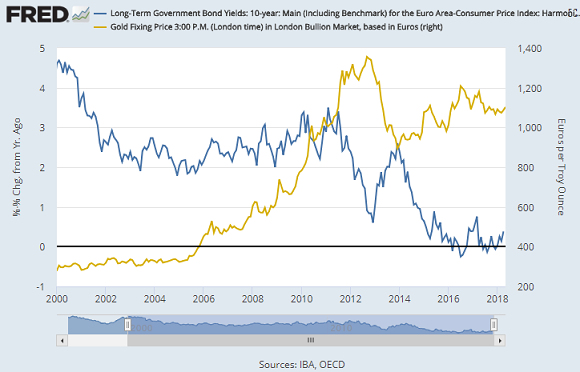
After accounting for inflation in consumer prices, the real yield on longer-term Eurozone bonds has over the last half-decade shown a strongly negative relationship with the direction of gold priced in the single currency.

Facing calls in autumn 2012’s Euro debt crisis for Greece, Spain or even ‘core’ member Italy to quit the single currency, the ECB vowed to do “whatever it takes” to preserve the union, moving first to quantitative easing and then cutting interest rates below zero on commercial bank deposits.

Euro-gold has since shown an average 12-month correlation of -0.48 with real Eurozone bond yields.

That figure would read +1.0 if they moved in lockstep together, or -1.0 if they moved exactly opposite.

Chart of inflation-adjusted Eurozone government bond yields vs. gold priced in Euros. Source: St.Louis Fed

“Global growth is expected to decelerate over the next two years,” forecast the World Bank yesterday, “as slack dissipates, major central banks remove policy accommodation, and the recovery in commodity exporters matures.”

“Rising debt levels make countries more vulnerable to higher interest rates,” warned World Bank development economics director Ayhan Kose, saying that emerging-market policymakers need to prepare for “financial market volatility as advanced-economy monetary policy normalization gets into high gear.”

With the Chinese Yuan strengthening to a 1-week high versus the Dollar on the FX market Wednesday, Shanghai gold prices rose more $6 per ounce above global quotes, the strongest premium since mid-May but still one-third below the typical incentive for new bullion-bar imports to the No.1 consumer gold consumer nation.

Wholesale prices in No.2 consumer India held a small $1 premium meantime, suggesting improved demand, but new data showed that bullion imports fell almost 40% in May from the same month last year.

“Anything that puts sand in the wheels of global trade is a risk to global growth,” says the World Bank report’s author Franziska Ohnsorge, calling “the threat of trade protectionism…a real risk.”

After six of the G7 group of developed nations rebuked 7th member the US on Saturday over the “negative impact” of its new tariffs ahead of this week’s meeting in the Quebec resort of La Malbaie, Canada, the European Commission today said it will impose tariffs on up to $3.4 billion of US imports as early as next month.

The governments of Britain, France and Germany have now also written to Washington asking that EU companies active in Iran are spared from the re-imposition of US sanctions against the Middle Eastern state over its nuclear research program.

For British investors, the UK gold price in Pounds per ounce today dipped to a 2-week low of £964 as Sterling rallied on the FX market despite fresh concerns over Brexit negotiations for a free trade agreement after March 2019.

Ahead of Brexit, “European governments are advising businesses not to use British parts in goods for export,” says Sky News, quoting a warning over ‘rules of origin’ problems from the Dutch authorities to manufacturers in the Netherlands.

The UK car industry has, according to Sky, “explicitly told the government” that it faces major problems exporting to the European Union after Brexit under the kind of arrangements currently proposed by Theresa May’s ruling Conservative Party.


Disclaimer

This publication is for education purposes only and should not be considered either general of personal advice. It does not consider any particular person’s investment objectives, financial situation or needs. Accordingly, no recommendation (expressed or implied) or other information contained in this report should be acted upon without the appropriateness of that information having regard to those factors. You should assess whether or not the information contained herein is appropriate to your individual financial circumstances and goals before making an investment decision, or seek the help the of a licensed financial adviser. Performance is historical, performance may vary, past performance is not necessarily indicative of future performance. This report was produced in conjunction with ABC Bullion NSW.