Author Archives: City Gold Bullion

Gold Prices Drop after Hawkish FED Meeting as BOJ Continues their Unprecedented Ultra-Easy Economic Policy

GOLD PRICES are trading at its lowest level since August 28th 2017 after the Federal Open Market Committee put the option of an interest rate hike before the end of the year back on the table, writes Atsuko Whitehouse at BullionVault.

Dollar Index, measuring the US currency against a basket of other currencies, surged 0.5% as soon as the announcement was made.  The yield on 10-year Treasuries is rose to 2.27 percent, reaching the highest in more than seven weeks on its fifth consecutive advance.

The Fed made no change to the 1.25% ceiling on its key interest rate, but Wednesday’s new forecasts repeated the committee’s view from June of one more hike to 1.50% before year-end.

A December hike was already expected by the interest-rate market ahead of Wednesday’s decision, with betting on Fed Funds futures seeing a 62% probability.

Those odds rose above 70% as stocks and gold prices fell immediately after the announcement, jumping from the 37% possibility seen by interest-rate betting just a month ago.

“The lack of movement in the dot [plot] signals that the committee is still comfortable that the recent dip in inflation is a blip,” said Rob Carnell, Asia head of research at ING,in a note. The dot plot charts Fed members’ targets for future interest rates.

“In the bigger picture, I still see the price action as corrective. It should base in this $1,280-$1,296 region. I see global uncertainty, diversification as continuing to underpin gold for now,” said Jeffrey Halley, a senior market analyst at OANDA.

In contrast to the FED, as widely expected the Bank of Japan left its policy unchanged by maintaining its bond-purchase plan in which its holdings increase at an annual pace of 80 trillion yen ($717.6 billion).  It also maintained its short-term interest rate target at minus 0.1 percent and the 10-year government bond yield target of around zero percent. 

However new board member Goushi Kataoka dissented to the BOJ’s decision to hold its interest rate targets, saying current monetary policy was insufficient to push inflation up to 2 percent during fiscal 2019.

Back in April this year, Japan’s parliament nominated banker Hitoshi Suzuki and economist Goshi Kataoka to the Bank of Japan board to replace two members who have frequently dissented against the policy direction set by Governor Haruhiko Kuroda.

“The nominations show Prime Minister Shinzo Abe wants the BOJ to continue the current reflationary stimulus program,” said Yasuhiro Takahashi, an economist at Nomura Securities Co.

The Japanese yen fell 0.2 percent to 112.49 per dollar, hitting its weakest level in more than two months.

“While the BOJ meeting will highlight the U.S.-Japan monetary policy divergence, the currency market is likely to take its policy decision in its stride,” said Ishizuki at Daiwa Securities.

The Nikkei ended 0.18per cent higher at 20,347.48 points, the strongest level since 18th August 2015.

In Europe the DAX was up 0.31% and CAC 40 advanced 0.53% on the back of the FED and BOJ decisions and also a report about a possible merger between two of Europe’s largest banks, Germany’s Commerzbank and French lender BNP Paribas.  The FTSE100 is slightly down 0.08%

Silver prices fell harder than gold at 2.3% to $16.99 per oz after the FED announcement.
Gold Bars Find 'Far East Support' Above $1300 Before Fed Vote, GLD ETF Grows on Price Drop

GOLD BARS traded in London’s wholesale bullion market halved this week’s 1.1% drop ahead of the US Federal Reserve’s September rates decision on Wednesday, rallying as the Dollar fell on the currency market.
 
Peaking at $1315 per ounce, the price of large 400-ounce gold bars rose as the Euro hit a 1-week high of $1.20 and the Mexican Peso rose from 2-week lows to the Dollar despite the powerful earthquake which killed at least 220 people in Mexico City on Tuesday.
 
Major economy bond prices rose, edging yields lower before the Fed, while global stock markets held flat overall after the MSCI World index set a fresh record high on Tuesday.
 
A rise in the Chinese Yuan held gold bar prices in Shanghai little changed, edging the No.1 consumer nation’s premium above quotes in London – the global hub for bullion storage and dealing – up to a 5-week high above $7 per ounce, still below the average $9 incentive for new imports.
 
After “seeing solid underlying interest above $1300” on Tuesday, bullion bars today found “decent physical interest out of the Far East,” reports the Asian trading desk of Swiss refining group MKS Pamp.
 
With gold prices “static” yesterday, “Support remains unchanged at the $1300 level,” agrees a technical analysis from bullion bank Scotia Mocatta’s New York office, pointing to “the 38.2% Fibo retracement level of the July low [to] September high range.”
 
Wednesday morning’s benchmark LBMA Gold Price auction in London was quiet, fixing at $1314.90 per ounce on interest two-thirds below last month’s average volume. 
 
Because the Federal Reserve is 99% certain to leave rates and QE holdings unchanged according to betting in the futures market, “The press release that goes with the announcement is what is important,” says London broke David Govett at Marex Spectron.
 
For gold trading on Wednesday, “This will no doubt create turmoil for ten minutes before everyone comes back to their senses.”
 
Gold investing “works well in a real low rate environment,” says UK fund manager George Cheveley of investment bank Investec’s Global Gold fund.
 
Gold is currently “under-owned” by investors says a report from UK asset managers Schroders, warning of “complacency” in equity and bond markets and pointing to how gold-backed ETFs accounted for 10% of the value held in exchange-traded trust funds at their peak of 2012, but only 2% today.
 
“For gold, in a world still awash in liquidity and with financial asset values very high, this is positive.”
 
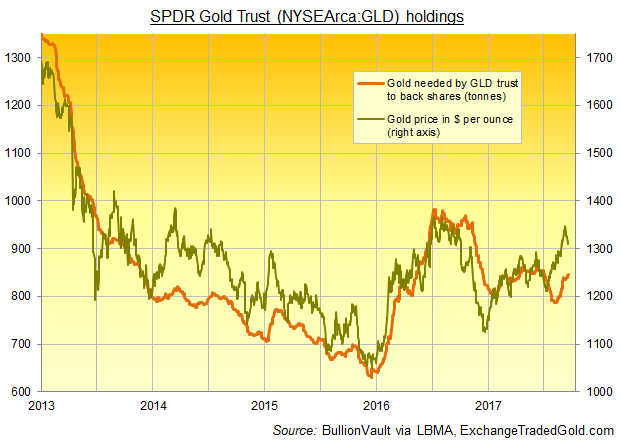
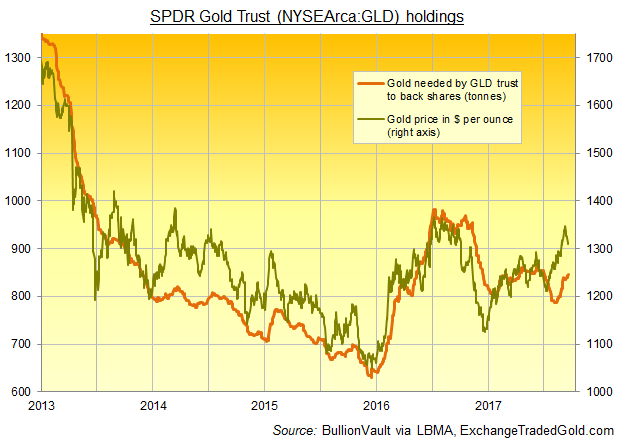
Tuesday’s drop in gold bar prices saw the largest such gold ETF – the New York-listed SPDR Gold Trust (NYSEArca:GLD) – expand to its largest size since early, needing an extra 2 tonnes of bullion to back its shares as investor interest grew.
 
Chart of gold bullion held for the SPDR Gold Trust. Source: BullionVault via ExchangeTradedGold.com
 
Reaching a total of 846 tonnes at last night’s close, the GLD’s gold bar holdings peaked at 1,353 tonnes in late-2012, averaging 823 tonnes overall since it was launched in late 2004.
 
Wholesale gold bar prices have rallied because “the Dollar is under pressure ahead of the Fed,” reckons Dutch bank ABN Amro’s analyst Georgette Boele.
 
“But I think it’s more to do with [Tuesday’s] comments from [Donald] Trump [to the United Nations], which are affecting the Dollar and indirectly gold as well.”
 
Trump’s inaugural speech to the UN in New York – in which he threatened “to totally destroy North Korea…if [the US] is forced to defend itself or its allies” – saw key world leaders Xi of China, Putin of Russia and Merkel of Germany fail to attend, notes Bloomberg News.
 
Sunday’s national elections in Germany – expected to deliver a landslide for Chancellor Angela Merkel‘s centrist CDU coalition – will come one day before a vote on independence for the Kurdish region of northern Iraq, now declared illegal by the Supreme Court in Baghdad.
 
Spain’s civil guard today detained Catalan minister Josep Maria Jové and 13 other leading figures from the regional government in a series of early-morning raids aimed at preventing a referendum on independence, scheduled for 1 October but also now deemed illegal by judges in the national capital.

Gold Investment 'Roars' in Japan on N.Korea Tension But Rate-Rise Talk Hits Price as Stocks Rise

GOLD INVESTMENT prices at multi-week lows against all major currencies except the Japanese Yen on Tuesday in London, erasing the last of September’s earlier 4.0% jump versus the Dollar as global stock markets edged up to set yet another new record high.
 
Starting 2017 at fresh all-time highs just above the spring 2015 peak, the MSCI World index gained another 12.2% in Dollar terms by Monday’s close, as New York’s stock markets set new historic highs of their own.
 
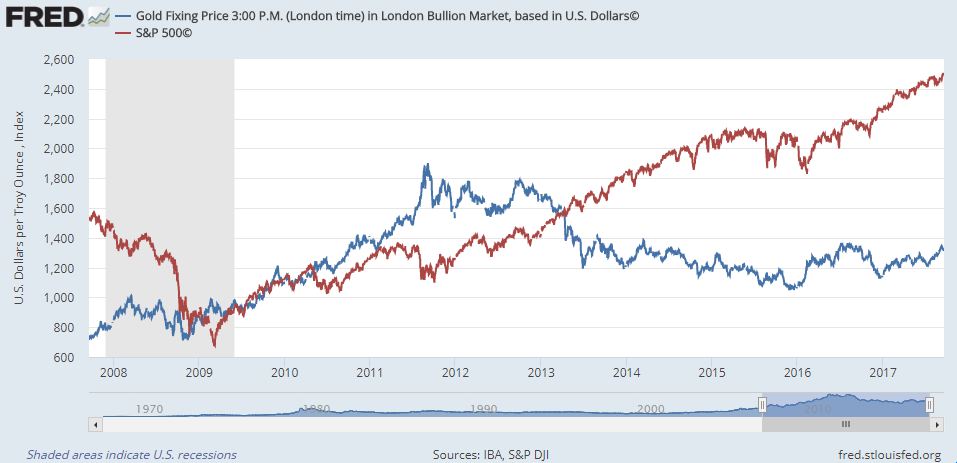
Chart of gold priced in Dollars per ounce vs. S&P500 index of US stocks
 
“The most eye-catching sign” in the US stock market’s near 9-year bull market, says a new third-quarter chart outlook from the technical analysis team at French bank Societe Generale, “is the lack of market breadth in the US small caps and their exacerbated relative underperformance.
 
“Usually a prelude to stock market corrections, small and mid caps’ relative underperformance suggest great caution ahead of early/mid-2018, when we still expect a major peak for the S&P500.”
 
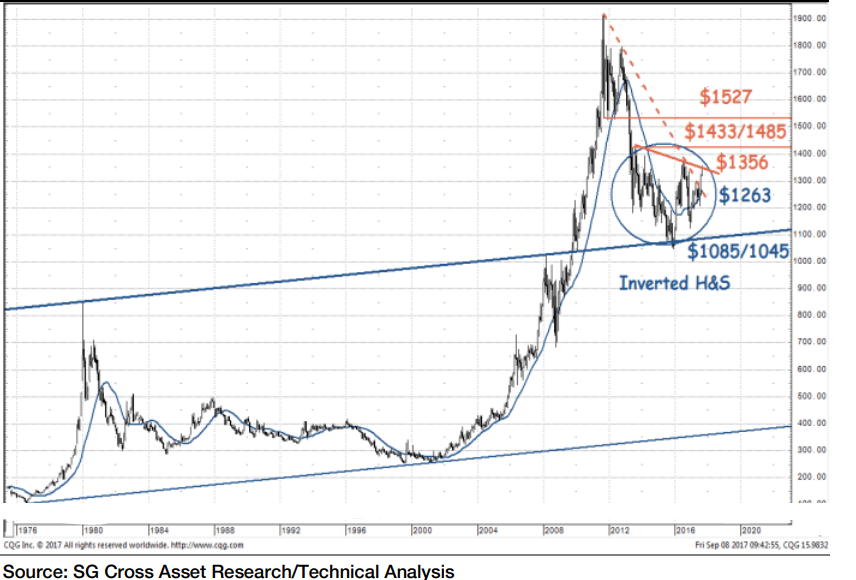
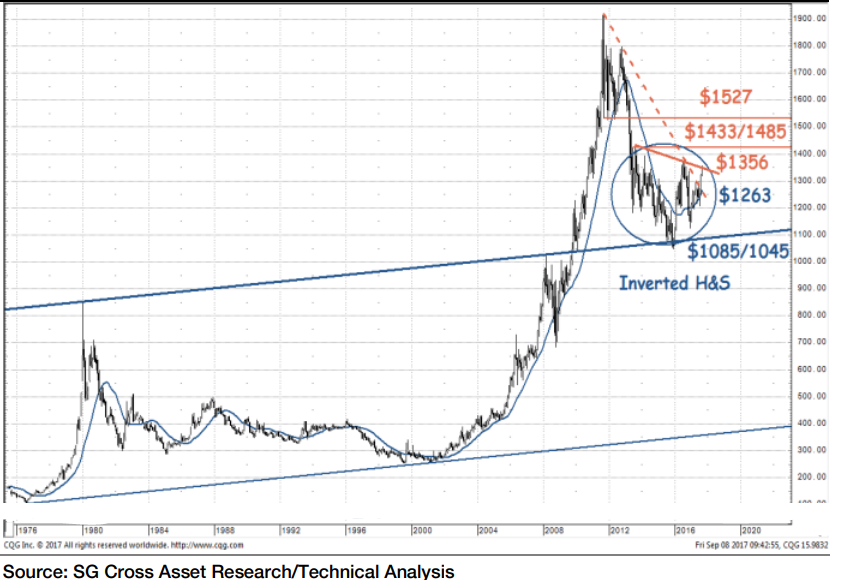
Having dropped 45% from its 2011 high to end-2015 low in contrast, gold now shows “formation of a multi-year bullish reversal,” SocGen’s analysts go on, adding that the metal could “foretell a risk-off environment” for other investment markets in 2018.
 
“After 8 months of inactivity, Japanese retail investment for gold suddenly roared back to life in September,” says a note from specialist analysts GFMS’s director Cameron Alexander, highlighting the repeated missile and nuclear tests by neighboring North Korea.
 
GFMS data put Japan’s gold bar and coin investment demand negative for the first quarter of 2017 – the first time since early-2015 finally marked the end of more than a decade of net gold selling by Japanese investors – with only a small positive inflow during Q2.
 
“Safe haven purchases [are] driving demand higher,” Alexander now says of the world’s third largest economy. “Meanwhile, jewelry consumption remains subdued and looks set for a decline.”
 
Japanese investors wanting to buy gold today saw prices slip to 1-week lows against the Yen beneath ¥4,700 per gram.
 
US Dollar prices struggled to bounce $5 per ounce from yesterday’s new 3-week low at $1305, while Euro-priced gold dipped towards August’s average monthly price of €1086.
 
UK gold investing prices in Pounds per ounce meantime sank to £964, the lowest in 5 weeks – and a near-7% discount to early September’s 10-month high – after Bank of England chief Mark Carney said yesterday that Brexit “on balance” risks higher inflation and so a need for higher interest rates from the current all-time low of 0.25%.
 
“[US] President Trump’s deal with the Dems has persuaded some traders that fiscal stimulus may be on the way,” says a commodities note from Canadian brokerage TD Securities.
 
“[That’s] had the market turn away from caring about North Korea’s provocations and shifted attention toward Fed hikes.”
 
“Gold continues to trend lower into Wednesday’s FOMC meeting,” agrees Tuesday’s trading note from Swiss refiners and finance group MKS Pamp, “[but] we are seeing interest toward $1300 restrict further down-side moves [because there is] still an underlying geopolitical bid.”
 
A drop in the Chinese Yuan, back to its lowest US Dollar exchange rate so far in September, saw gold stem its drop in Shanghai to the equivalent of $1315 per ounce.
 
That buoyed the Shanghai premium, over and above comparable London quotes, up to $6.60 per ounce – still only two-thirds of the typical incentive offered for new bullion imports into the world’s No.1 mining, importing and consumer nation.

Stocks & Bond Yields Up, Gold Prices Down with Silver After 12-Month Record Comex Position

GOLD PRICES fell on Monday morning in London, retreating against all major currencies as global stocks hit new highs and major government bond prices fell amid growing expectations that the US Federal Reserve will tighten its monetary policy at this week’s meeting, writes Steffen Grosshauser at BullionVault.
 
With US Treasury bond yields rising, non-interest bearing gold dropped another $7 per ounce from last Friday’s close of $1320, reaching its lowest level so far in September after touching 12-month highs only a week before.
 
The US Dollar stabilized ahead of the 2-day Fed meeting starting tomorrow, at which the US policymakers are expected to announce a plan for trimming their $4.5 trillion balance sheet of QE bond purchases, while keeping interest rates unchanged at 1.25%. 
 
Traders now see a 53% probability of a rate hike in December, according to the CME’s FedWatch tool.
 
“Gold prices [have come] under some selling pressure,” says Australian bank ANZ’s analyst Daniel Hynes, “with investors dismissing geopolitical risks and instead focusing on the possibility of rate hikes from central banks.”
 
“The FOMC’s latest verdict will be of special interest,” agrees analyst Daniel Lenz at DZ Bank in Frankfurt.
 
“The Fed could well set the balance-sheet-reduction process in motion” when Janet Yellen’s team publish their decision on Wednesday.
 
Silver meantime tracked gold prices lower today, falling back below $17.40 per ounce – a near 3-month high when reached at the end of August, and some 4.5% below early September’s 5-month peak.
 
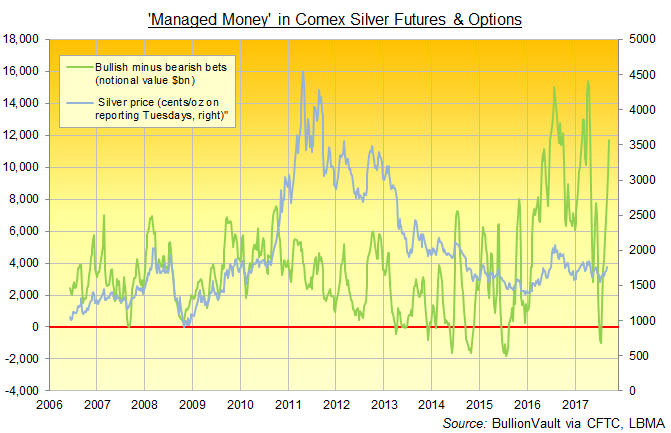
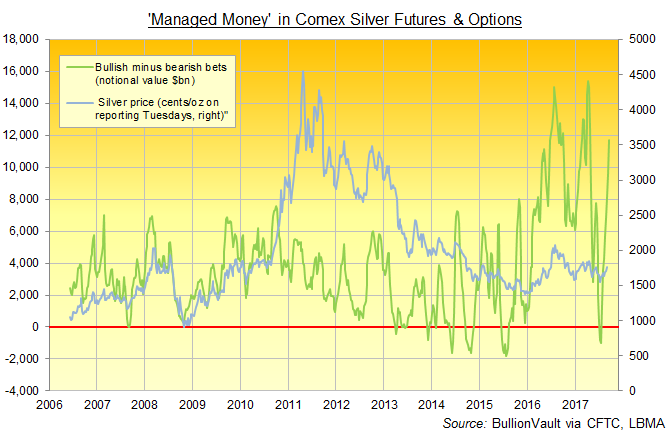
Chart of Managed Money net speculative long in Comex silver futures and options, total US$ equivalent. Source: BullionVault via CFTC
 
New data from US regulator the CFTC say that hedge funds and other professional speculators last week grew their bullish betting on silver prices to the highest Dollar value since April.
 
As of last Tuesday, and net of bearish bets, the so-called ‘Managed Money’ category raised its notional position in Comex silver futures and options to $6.7 billion, up more than one-fifth from the Tuesday before and the eighth weekly gain in succession.
 
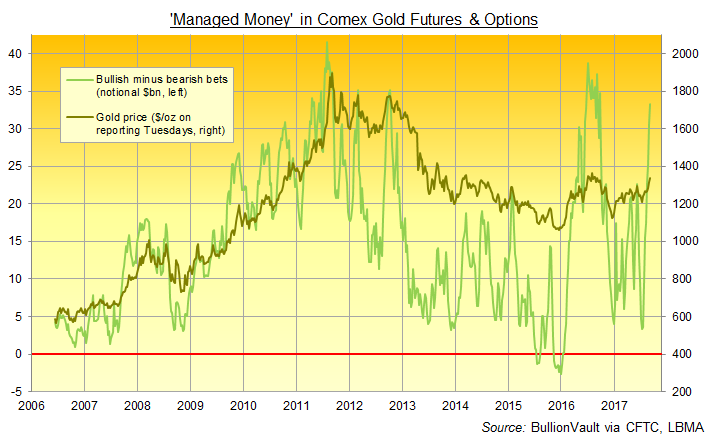
The Managed Money’s net speculative long position on Comex gold prices also rose, expanding to a notional 12-month record above $35bn.
 
Holdings for the largest gold-backed ETF, the SPDR Gold Trust (NYSEArca:GLD), meanwhile expanded by 4.2 tonnes in the week-ending Friday, recovering most of the previous week’s small outflow to need 839 tonnes of bullion.
 
Friday’s new record highs in US stock markets today saw Asian shares hit their highest in a decade overall.
 
The pan-European Stoxx index also rose, led by Portuguese stocks after Lisbon’s credit rating was upgraded back to ‘investment grade’ for the first time in more than 5.5 years.
 
Brent crude oil today rose to $55 per barrel, just a few cents shy of the 5-month high it touched last Thursday.

Gold Price Falls, Sinks vs UK Pound Despite N.Korea Missile, London Bomb + Spain's Catalonia Crisis

GOLD PRICE gains of 1.6% from last week were again erased Friday in London, as the outlook for interest-rate hikes trumped new geopolitical tensions led by another weapons test by the pariah state of North Korea.
 
Dollar priced-gold retreated to $1325 per ounce – more than $30 below last Friday’s 12-month high – as major government bond prices fell yet again, driving US Treasury bond yields up to their highest since mid-August above 2.20% on 10-year debt.
 
After threatening to “sink” Japan and turn the US “into ashes and darkness” on Thursday, Pyongyang this morning fired its furthest-yet missile test over the northern Japanese island of Hokkaido, splashing into the Pacific.
 
British police said an ‘improved explosive device’ caused an explosion on a rush-hour London Tube train, with 22 people needing hospital treatment, mostly for burns.
 
Spain’s finance ministry meantime won a court order to take control of financial payments by the regional government in Catalonia, where a referendum on independence – deemed “illegal” by Madrid – is scheduled for 1 October.
 
Yesterday saw Madrid threaten local mayors in the would-be breakaway region with jail if they assist with the vote.
 
“Today’s trading has been surprisingly uneventful given the news from North Korea this morning,” says a trading note from Swiss refining and finance group MKS Pamp’s Asian team.
 
Most notably, “the SGE premium has pulled back a little from yesterday,” MKS says of benchmark Chinese prices, “to trade between $2-4 over loco London prompting some selling out of China” – the world’s No.1 mining, consumer and importing nation.”
 
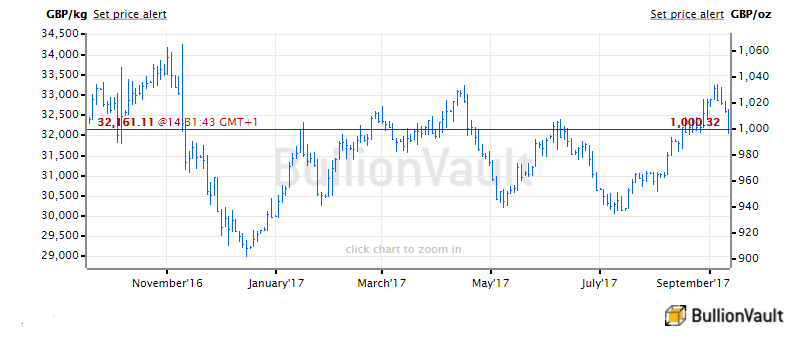
The UK gold price in Pounds per ounce meantime slid to a 5-week low Friday, down almost 6% from last week’s 10-month high as Sterling continued its rally after the Bank of England yesterday hinted it may need to raise its key rate – now at a all-time record lows of 0.25% – “by a somewhat greater extent…than current market expectations.”
 
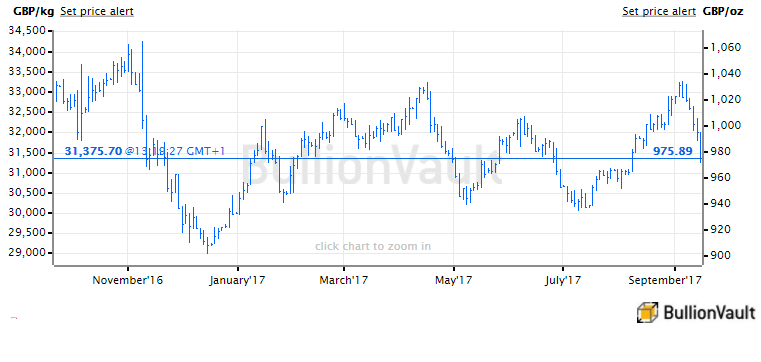
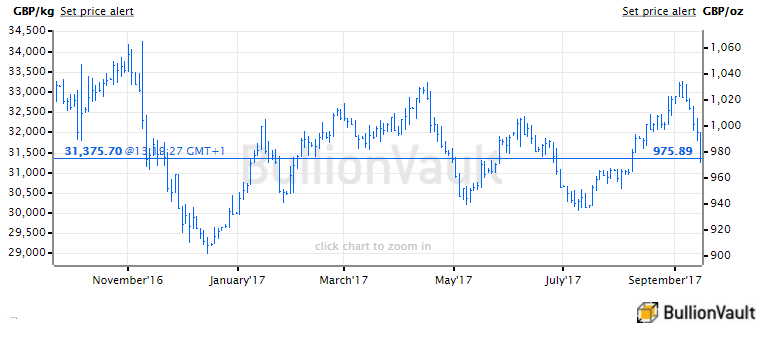
Chart of the UK gold price in Pounds per ounce. Source: BullionVault
Since late-August the Pound has now jumped 6.4% against the Dollar, recovering levels last seen on 24 June 2016 – the day of the UK’s shock Brexit referendum result – at $1.36.
 
Today’s jump in Sterling saw London’s stockmarket fall for the 4th day running, with the FTSE100 index of primarily international businesses losing 1.2% as other European equities held flat.
 
Trading in US interest-rate futures now puts a near-99% certainty on the Fed holding unchanged next week, but betting on a November hike has risen from zero to 4% over the last week, and betting on the end of 2017 now sees a 53% chance of rates being higher than now – up from barely 30% at the start of this month according to the CME’s FedWatch tool.
 
The gold price in Euro terms also fell to 2-week lows on Friday, dropping back to €1106 per ounce, a new low for September so far.

Gold Bullion Falls as US Inflation Rises, 'Rates Going Up' Says Faber, Miners Drop Twice as Fast

GOLD BULLION held near 2-week Dollar lows in London trade Thursday as new data showed an uptick in US inflation, keeping a likely December rate rise from the Federal Reserve “on the table” according to some analysts.
 
The Dollar spiked on the FX market to its highest level against the Euro so far in September, while world stock markets retreated from new all-time record highs.
 
Consumer prices rose 1.9% year-on-year in August, today’s figures said, just beating analyst forecasts.
 
Next week’s US Fed meeting “will carry more weight” for gold prices reckons analyst Ed Meir at brokerage INTL FCStone, “and we suspect it will ultimately be supportive for the precious metal, as the Fed should again come across as quite dovish, especially in light of the recent natural disasters in both Texas and Florida.”
 
Thursday saw the Bank of England mark the 10th anniversary of Britain’s first High Street banking run since 1866 by holding interest rates at a record-low of 0.25% with its record £435bn of QE bond purchases also maintained.
 
Two of the nine policy team voted to raise, and the Bank’s accompanying statement called the economic picture “if anything, slightly stronger.
 
“Monetary policy could need to be tightened by a somewhat greater extent…than current market expectations.”
 
The Pound leapt on the news, reaching its strongest vs. the Euro since 20 July and driving the gold bullion price in Sterling terms down to 1-month lows at £990 per ounce, more than 4% below this month’s 1-year high.
 
The UK hasn’t hiked rates since July 2007, immediately before the ‘credit crunch’ in global money markets led to the crisis at Northern Rock that September.
 
“Interest rates [worldwide] are now likely to no longer move lower,” says Swiss author and money manager Marc Faber, speaking this morning to CNBC in Hong Kong.
 
“There are some inflationary pressures in some sectors of the economy, and I think central banks in Europe and especially in Japan will reduce their purchases of assets somewhat.”
 
Meantime, “Gold is an under-appreciated asset,” Faber went on, noting how in the US “some stocks are up 20% and they are talked about every day. But from the December lows of 2015, the GDX gold[-mining] ETF is up more than 100%…a fantastic performance compared to the S&P.”
 
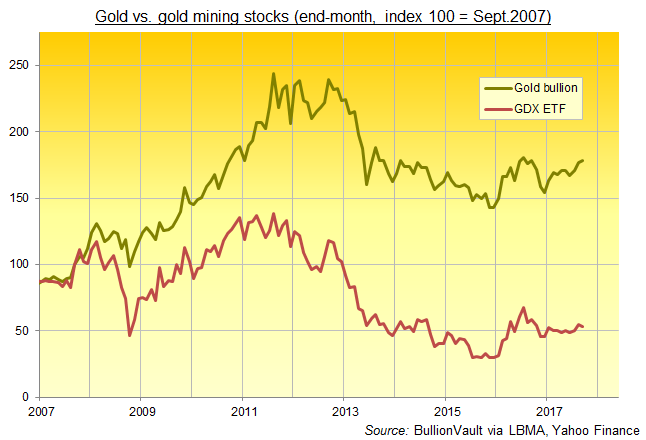
Hitting 12-month highs with the Dollar gold price at the start of September, the VanEck Vectors Gold Miners ETF (NYSEArca:GDX) has since retreated more than 5% – twice the drop in bullion prices.
 
Chart of gold bullion vs. gold-mining share prices (GDX ETF), rebased to Sept. 2007. Source: BullionVault
 
The trust fund, which holds major gold mining producers led by Barrick (NYSE:ABX) and Newmont (NYSE:NEM), initially tracked gold prices after the global credit crunch began in summer 2007, but it then sank amid the financial crisis of late 2008.
 
Back in physical bullion, “[We’re] seeing initial failure at [gold’s] 4-year downtrend [now] at $1349,” says the latest weekly technical analysis from Germany’s financial services group Commerzbank, joining the peaks of July 2013 with July 2016 and the start of this month.
 
“We would allow for this [resistance] to hold…[but] dips lower should remain well supported by the uptrend channel support line” drawn by Commerzbank from gold’s start-July lows and now coming in at $1306.
 
“The steep upward trend from July will be an important support near term,” agrees the technical analysis team at French bank Societe Generale, pointing to levels around $1295-1300.

Gold Bullion +189% Since Northern Rock Run, Top UK Asset Bar None

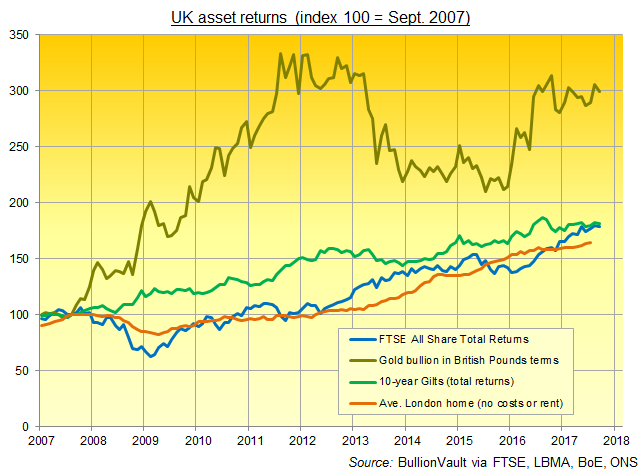
GOLD BULLION marked today’s 10th anniversary of the UK’s Northern Rock banking run as the best-performing major asset class bar none for UK investors since mid-September 2007.
 
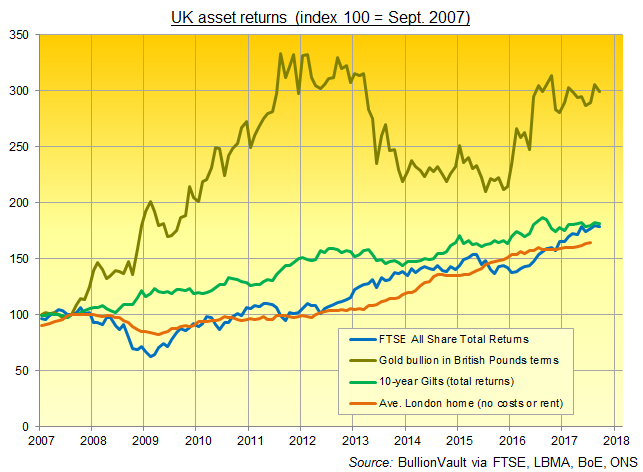
Physical gold bars have beaten the total return from shares and bonds over the last 10 years, with the UK gold price in Pounds Sterling gaining 189%.
 
That means gold bullion has outpaced even London house prices.
 
Ignoring all transaction costs, official data say London residential property prices have risen 64% (not accounting for possible rental income) since the run on Northern Rock, while conventional 10-year Gilts have paid 81% (constant maturity, capital plus yield).
 
Falling by almost a half to the depths of the global financial crisis in early 2009, the UK stock market has returned 79% overall (FTSE All Share Total Returns index, including dividends, not allowing for tax).
 
Physical bullion meantime doubled to its peak of September 2011, rallying since the slump of 2013 to rise from £347.58 on the day the Northern Rock crisis broke to £1003.85 per ounce at this morning’s LBMA Gold Price benchmarking auction.
 
Chart of UK major asset class total returns (excl. costs and tax) since Northern Rock's banking run of September 2007. Source: BullionVault
 
13 September 2007 saw Northern Rock – then the UK’s fifth largest bank – ask the Bank of England for emergency lending as the global credit crunch starting a month earlier froze its vital but short-term source of finance.
 
After the BBC’s Robert Peston reported the news that evening, lines of savers formed outside branches of NRK the following morning, marking the UK’s first retail banking run since the late 19th Century.
 
“Gold [today] is being kept in check by the increased risk appetite among market participants,” says the latest analysis from German financial services group Commerzbank, noting yesterday’s new record high in the US stock market.
 
World stock markets held just shy of their new all-time highs Wednesday morning, while the US Dollar rallied again on the FX market from last week’s 2.5-year lows.
 
That curbed the gold price in Dollars at $1330 per ounce – some 2.0% below last week’s new 12-month highs – while bullion rose for Euro investors above €1112, halving this week’s previous 1.1% drop.
 
“Many factors were at play” in gold bullion’s jump last week, says a note from German-based refining group Heraeus, including worries about the US debt ceiling, the economic impact of Hurricane Harvey and then Storm Irma, and also “uncertainty” about the US Federal Reserve’s willingness to raise Dollar interest rates more than once again in 2017.
 
But with gold prices now at $1330, “There is not a lot of demand” for physical bullion, says Barry Canham of brokerage INTL FCStone, especially from the traditional consumer markets of Asia.
 
“I don’t think the gold price is being driven by demand. It’s being driven by safe-haven [interest]” from financial players.

Gold Price -$30 as UN Korea Sanctions See Stocks Hit Fresh Records, UK Inflation Jumps, Opec Oil Output Falls

GOLD PRICES erased last week’s 1.7% gain versus the Dollar on Tuesday in London as the US stock market opened at a new all-time record high following a UN agreement on new sanctions against North Korea over its nuclear weapons tests.
 
Dollar gold prices traded $30 per ounce below Friday’s 12-month high of $1356 and major government bond prices also fell, pushing 10-year US yields up towards 3-week highs at 2.17%.
 
World stock markets had already pushed higher after setting a fresh record high on Monday, while the Euro fell again, losing over 1.5 cents from last week’s new 32-month highs just shy of $1.21.
 
That supported the gold price for Eurozone investors just 1.5% below last week’s 2-month highs.
 
The Chinese Yuan meantime fell 1.6% from its jump to 2-year highs, helping buoy the premium offered for new bullion imports into the world’s No.1 gold consumer nation at $6 per ounce.
 
Twice the Shanghai premium offered last week, that was still one third smaller than the average.
 
“[Stock markets are being] buoyed by a tempering of tensions on the Korean peninsula and a downgraded Hurricane Irma,” says a trading note from Swiss refining and finance group MKS Pamp.
 
“The new UN sanctions against North Korea are not as wide-ranging as the US had originally demanded,” adds German bank Commerzbank in a gold price note.
 
“This is clearly a relief for market participants and is generating higher risk appetite.”
 
“If I’m more confident about the outlook,” says fund giant Fidelity’s UK multi-asset manager Nick Peters, “especially over the next 3 months, it makes sense to reduce the more defensive positions [such as] fixed-income and gold.”
 
Chart of UK gold price in Pounds per ounce. Source: BullionVault
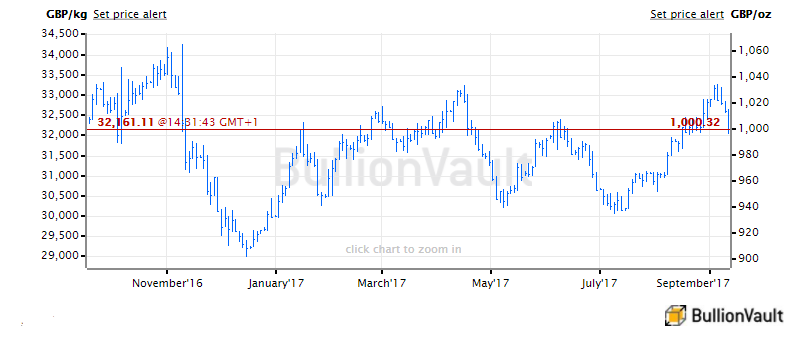
The UK gold price in Pounds per ounce today sank to dip below £1,000 per ounce – a 1-month low almost 4% below last week’s 10-month peak – as the British Pound rose to its strongest so far in 2017 on the FX markets following new inflation data.
 
Consumer prices in the European Union’s 2nd largest economy rose to 2.9% annually in August, matching this spring’s 5-year high.
 
The Bank of England next decides this Thursday on UK interest rates, cut last year to a fresh record low of 0.25% after the Brexit referendum shock, when new QE money creation also took the central bank’s holdings of government debt to £435 billion ($575bn) – equal to more than one-fifth of the UK’s annual GDP.
 
Separately the UK Government of former Home Secretary, now prime minister Theresa May, said Tuesday it is removing the 1% per year public-sector pay cap, but only for police and prison staff.
 
Trade union Unite’s leader Len McCluskey says he’s willing to “go outside the law” to call for mass action by other public-sector workers without getting 50% turn-out in a strike ballot.
 
Brent crude oil meantime pushed up towards last week’s 5-month highs above $54 per barrel Tuesday amid news of falling output from Opec cartel member states.
 
Top producer Saudi Arabia today said it foiled an ISIS terror attack on a military base, arresting 7 including Yemeni nationals.
 
US-based campaign group Human Rights Watch today said the Saudi-led coalition supporting the Yemen government against Houthi rebels has carried out 5 unlawful airstrikes killing 39 civilians, including 26 children, over the last 2 months.
 
Last weekend saw 31-year-old Crown Prince Mohammed bin Salman – now first in line to the throne after what analysts are widely calling a palace coup at the end of Eid in June – suspend talks with Qatar, isolated by its Arab neighbors since start-June over funding terrorism.
 
Those accusations are seen by some observers as a smokescreen for trying to silence Al Jazeera‘s news network and enforce Saudi control across the region.

Gold Prices Drop 0.5% After Comex Net Long Doubles 10-Year Average But Irma + N.Korea Risks Recede

GOLD PRICES fell from last week’s 12-month highs on Monday morning in London as the Dollar rebounded and global stocks hit new highs after Hurricane Irma was downgraded to a ‘storm’ and the weekend passed without North Korea testing any nuclear weapons to mark its national foundation day, writes Steffen Grosshauser at BullionVault.
 
Spot gold bullion retreated to $1335 per ounce after reaching above $1356 on Friday, while the US Dollar Index climbed from a 32-month low.
 
Irma has still affected more than 3 million homes on its way to Florida’s west coast. Pyongyang said Monday that the US would pay a “due price” if new sanctions against North Korea or its dictator Kim Jong-un were imposed at a UN Security Council meeting being held today.
 
“Markets seem to have headed into the weekend priced for the worst,” Bloomberg quotes Sean Callow, a senior currency strategist at Australian bank Westpac – “a North Korean missile test and maximum financial damage from Irma.”
 
Already by last Tuesday, new data showed late on Friday, betting on gold prices rising had reached the most extreme level amongst hedge funds and other money managers since 2016’s Brexit shock.
 
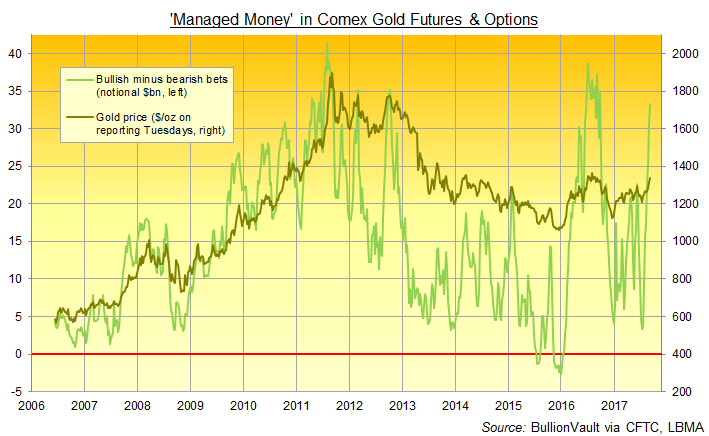
The week to 5 September saw the ‘Managed Money’ category of Comex futures and options traders raise their bullish bets on gold prices, net of bearish bets as a group, for the eighth straight week – the longest period of gains since the beginning of 2016.
 
That took the net long position to 207% of its 10-year average by size, reaching a notional value of more than $33 billion.
 
Chart of Managed Money net long position on gold futures and options in notional Dollar terms. Source: BullionVault via CFTC
 
Physical holdings needed to back the world’s largest exchange-traded gold fund, the SPDR Gold Trust (NYSEArca:GLD), rose by 0.3% across last week, but slipped on Friday as gold touched new 12-month highs.
 
“So long as there is still a chance the US central bank pulls the trigger [at next week’s meeting] on the higher Fed funds, along with the risk of three more hikes next year, money managers will have difficulties to justify growing long positions past their current extreme levels,” according to analysts at Canadian brokerage TD Securities. 
 
But “the major determinant of gold last week was geopolitical tensions,” says research chief Mark To at Wing Fung Financial Group in Hong Kong, “[and while] at the weekend we did not see any crisis triggering event…[those tensions] are still with us and the slowing of interest rate hikes and other tightening measures are going to be with us as well.”
 
“The geopolitical risk is already in the price,” counters Lakshmi Iyer, Head of Fixed Income and Product at Kotak Mahindra Bank.
 
“Gold will see an immediate correction if the Korean peninsula crisis ends.”
 
Along with Irma’s strength downgraded from category three to one, US Treasury bond prices retreated on Monday as Asian and European equities climbed back towards record highs.
 
South Korea’s Kospi stock index and Japan’s Nikkei index rose 0.6% and 1.4% respectively while the Stoxx Europe 600 index also jumped over 1% – the most in more than a week.
 
In other metals, silver prices tracked gold lower and fell to $17.80 per ounce, down from last week’s close at $17.97 after already dropping around 1% after hitting a 4.5-month high in Friday’s trade.
 
Base metals traded on the London Metal Exchange, in contrast, edged higher by an average of 0.5% on Monday morning, led by a 1.25% price jump in zinc.

Gold Prices 'Probe Key $1356 Level' But Fall for Non-Dollar Investors

GOLD PRICES fell below $1350 per ounce Friday lunchtime in London, cutting the metal’s weekly Dollar gain to 1.7% and heading for a loss against other major currencies after touching a new 12-month high for US investors at what some chart analysts called a key level.
 
The Euro rose back to its strongest Dollar value since January 2015, peaking just shy of $1.21, while the Chinese Yuan hit USD levels last seen in December that year.
 
“After a phase of consolidation [after] a major trough late 2015,” says the latest technical analysis of Dollar gold prices from French investment and bullion market-making bank Societe Generale, “gold has recently accelerated the up move, as shown by the break above the descending trend in force since the all-time high in 2011.
 
“More importantly, gold formed a massive multi-year bullish reversal pattern (Inverted Head and Shoulder pattern)…and just probed its confirmation level at $1356.”
 
Chart of Dollar gold prices, 1971 to present. Source: Societe Generale
 
While the current surge “looks overstretched” short term, a further rise and weekly close above $1356 would see “the up-move extend further towards $1433/1485,” reckons SocGen’s technical analysis team.
 
With wind speeds expected to hit 165 miles per hour (270km/h) in southern Florida this Sunday meantime, half-a-million people have been told to leave the area and Irma will prove “devastating” according to the US federal emergency agency.
 
New data yesterday put US claims for jobless benefits at a sudden 2-year high on lay-offs amid Hurricanes Harvey and now Irma.
 
Thursday also saw the European Central Bank predict that it “should be ready to take the bulk of [QE tapering] decisions in October,” slowing the pace of bond purchases from the current €60 billion per month.
 
“[But] the recent volatility of the exchange rate represents a source of uncertainty,” said ECB chief Mario Draghi at his post-decision press conference.
 
Draghi’s comment was “actually pretty unequivocal” about the risk to tapering posed by Euro strength, says a commodities note from German financial services giant Commerzbank, “[but] were not enough to prevent a renewed surge in the Euro.
 
“Wednesday night’s agreement between US President Trump and the Democrats to extend the debt ceiling until 15 December was likewise unable to prevent the US Dollar from sliding further.”
 
Betting on the Fed raising its key interest rate before the end of this year has sunk the implied odds from a 46.7% probability to just 31.9% according to the CME’s FedWatch tool.
 
Euro gold prices had risen earlier on Friday but failed to reach Tuesday’s 3-month high at €1127, trading only 2.3% higher for 2017 to date.
 
Shanghai gold prices meantime set 3-month highs in Yuan terms and “China were on the bid,” says a note from Swiss refining and finance group MKS Pamp, “with the premium [to London quotes] sitting around $6/7” – double this week’s 12-month low in the incentive for new bullion imports into the world’s No.1 mining and consumer nation.