Author Archives: City Gold Bullion

Gold Prices Slip vs. Euro as ECB Holds Rates + QE, Fall vs. Loonie as BoC Hikes

GOLD PRICES in London rose back towards 12-month highs above $1340 in Dollar terms on Thursday morning but slipped versus the Euro as the European Central Bank left its negative interest rates and €60 billion per month QE bond-buying scheme untouched.
 
The Bank of Canada yesterday raised its key interest rate for the second time in 2 months, hiking to 1% and calling the country’s second quarter annual GDP growth of 4.5% “broadly based and self-sustaining.”
 
That squashed the gold price in Loonies 2.1% overnight as the Canadian Dollar jumped on the FX market.
 
Currency of 19 nations in Western Europe – the world’s single largest economic bloc – the Euro today peaked 1 cent shy of last month’s 32-month highs against the Dollar just before the ECB’s widely expected announcement.
 
The FX market’s reaction to “no change” from the ECB held the gold price in Euros at €1118 per ounce after it had erased this week’s previous 0.8% gains.
 
World stock markets meantime pushed higher, edging the MSCI index back up towards last month’s new record peak.
 
Commodity indices held flat overall as base metals slipped from their new multi-year highs but crude oil extended new 4-week highs amid Hurricane Irma‘s threat to US facilities.
 
“With a highly uncertain geopolitical backdrop, subdued global core inflation and flat yield curves, gold remains an attractive safe haven asset,” says a new gold price note from Chinese-owned bullion and investment bank ICBC Standard.
 
But betting on prices via the Comex futures market “shows that much of the good news for gold is already in the price,” says analyst Marcus Garvey, forecasting that the price “will need to consolidate – possibly pulling back to support around $1300…[with] a challenge of last year’s high of $1375 [now] a question of when rather than if.”
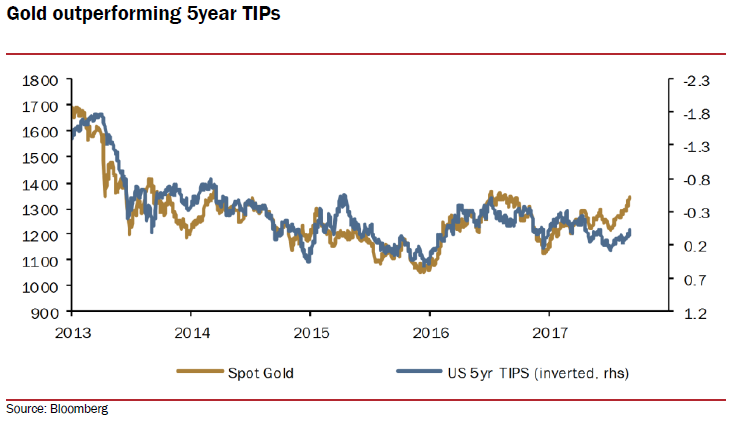
 
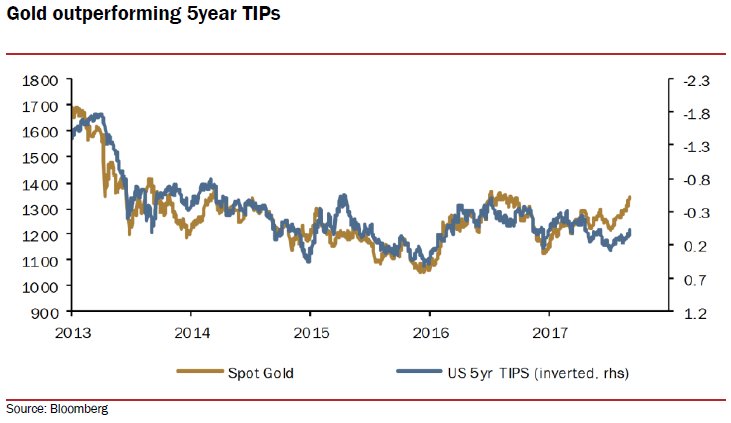
Chart of gold price vs. US 5-year TIPS. Source: ICBC Standard Bank
 
Looking at what’s driven the gold price’s recent surge, “The extent of the recent rally has surpassed what can be explained by just US interest rates and the weak Dollar,” ICBC’s Garvey goes on, countering this week’s note from analysts at investment bank Goldman Sachs and noting that the metal has “comfortably outperformed” inflation-protected US Treasury bonds – something explained “in large part” by the Korean nuclear missile crisis.
 
Giant gold-backed ETF the SPDR Gold Trust (NYSEArca:GLD) yesterday saw its first and largest outflow of investor cash in a month, even as bullion rose to touch new 12-month highs at global benchmark the LBMA Gold Price.
 
Silver meantime tracked gold prices Thursday morning in London, also erasing this week’s gain versus the Euro and holding 10 cents shy of Tuesday’s pop to a 4-month high of $18.00 per ounce.
 
Platinum struggled in contrast, falling back below last week’s finish in US Dollar terms and losing 1.1% from Monday’s 6-month high to trade at $1003 per ounce.
Gold Bullion +16% YTD vs Weak Dollar Yet European Gold ETFs Grow Faster

GOLD BULLION held $5 below yesterday’s late spike to 12-month highs in Asian and London action on Wednesday, trading at $1340 per ounce after a key US Fed policymaker said weak inflation warns against raising interest rates and new data showed gold-backed ETFs expanding strongly in August.
 
Consumer demand and physical buying in the wholesale bullion market remained weak however, with the Shanghai premium, over and above comparable London quotes, slipping below $3 per ounce as the Chinese Yen rose to new 14-month highs against the Dollar.
 
That was the weakest level incentive for new gold bullion imports to China – the world’s No.1 miner, importer and consumer market – since September last year, and barely 30% of the last 18 months’ average.
 
Demand in the No.2 consumer market of India also remained weak Wednesday as prices rose for a fifth day running, with dealers reporting wider discounts to the global benchmark of London quotes from last week’s $6 level despite the approaching peak festival season.
 
Asian stock markets meantime followed New York lower after Tuesday’s drop in US equities as reports said North Korea’s latest nuclear weapons tests “caused numerous and widespread landslides“.
 
European shares gained however despite Russian president Vladimir Putin saying that Pyongyang’s stand-off with Washington may prove “impossible” to solve, urging the US to avoid getting “emotional”.
 
Silver today held firm versus the weakening US Dollar but stayed 2 cents below Tuesday’s new 5-month high at $18.00 per ounce.
 
Platinum re-touched Monday morning’s 6-month highs above $1013.
 
“I am concerned that the recent low readings for inflation may be driven by depressed underlying inflation,” said Fed governor Lael Brainard – a key member of chair Janet Yellen’s policy team – in a speech on Tuesday, “which would imply a more persistent shortfall in inflation.
 
“In that case, it would be prudent to raise the federal funds rate more gradually.”
 
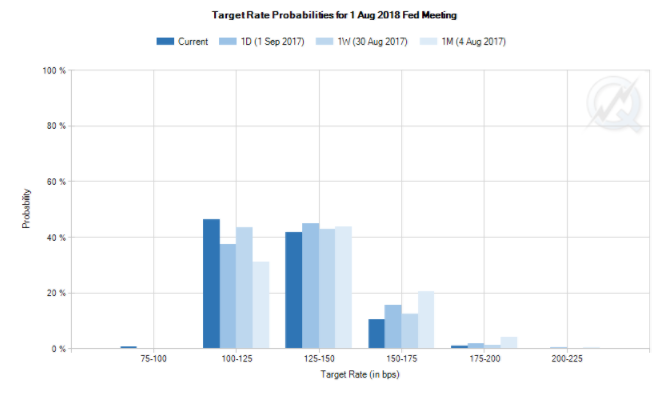
Brainaird’s comments today saw traders bet for the first time in 3 months of traders on a possible rate cut by the Fed, back down to a ceiling of 1.00% sometime between now and next August.
 
Trading in US interest-rate futures currently puts the odds of ‘no change’ at greater than 50% until at least June 2018, with the likelihood of US rates being raised to reach a ceiling of 2.00% evaporating entirely from the betting on Fed meetings as far out as March next year.
 
Chart of US interest-rate probablities implied by CME futures markets
 
New data from the mining-backed World Gold Council meantime said gold-backed trust funds listed on world stock markets last month saw their strongest inflows of investor cash since February, needing an extra 35 tonnes of bullion to support their value.
 
Equal to more than 3 days of global gold-mine output, that reversed only half of July’s ETF outflows however, taking the sector’s aggregate gold bullion holdings up to 2,295 tonnes, a global total first reached in December 2010.
 
Despite US Dollar prices rising 15.6% so far in 2017 against a 9.1% gain in Sterling and a 2.2% rise in Euro terms, “European funds continue to lead inflows,” says the World Gold Council of its new data, “accounting for nearly 79% of all inflows during the year.”
 
Only one US-listed trust fund shows in the top 10 fastest-growing such vehicles for the year-to-date.

Gold Prices Ease at 2-Year Yen High as Japan Plans Evacuation, N.Korea Prepares for Foundation Day

GOLD PRICES dipped briefly below $1330 per ounce in London trade Tuesday morning, holding near yesterday’s spike to 11-month highs as the Dollar weakened again and reports said North Korea is moving an intercontinental missile towards its west coast after firing a 6th test in 2 weeks.
 
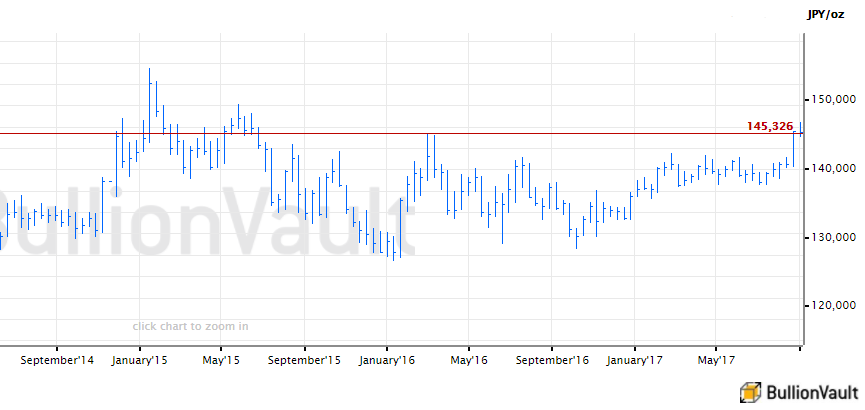
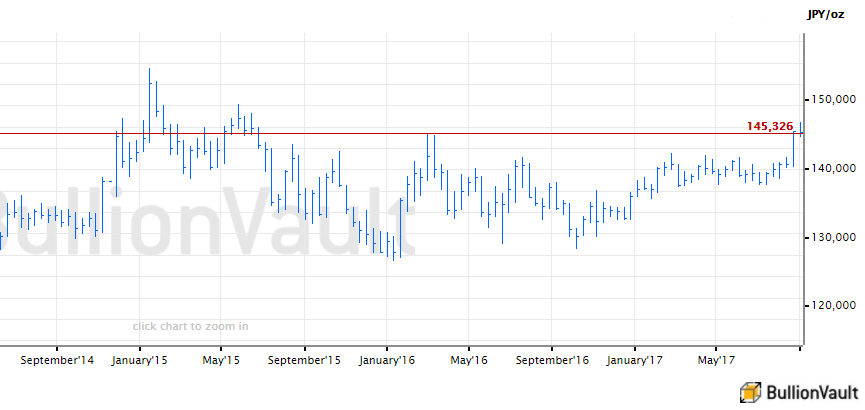
Gold priced in Yen eased back from early Monday’s spike to sudden 2-year highs as the Japanese currency recovered on the FX market.
 Chart of gold price per Troy ounce in Japanese Yen. Source: BullionVault
 
Japan is planning a possible evacuation of 60,000 nationals from neighboring South Korea, said Prime Minister Shinzo Abe – grandson of Nobusuke Kishi, deemed a war criminal for his pursuit of Korean nationalists during WW2 – at a meeting Monday.
 
North Korea will on Saturday mark the Day of the Foundation of the Republic by current dictator Kim Jong-un’s grandfather, Kim Il-sung – an adversary of Kishi – in 1948.
 
“After running into resistance on Monday toward $1340,” says Swiss refining and finance group MKS Pamp’s Asian trading team, “bullion once again tested this level [early Tuesday] following headlines that North Korea were moving ICBM’s toward launch sites.
 
“[Those] headline-driven gains proved to be unsustainable [but] we continue to see interest on dips underneath $1335…Moves below $1330 and $1325 are likely required to flush out any short-term [bullish] positioning that has accumulated so far this week.”
 
European stock markets meantime reversed earlier gains on Tuesday and major government bond prices rose, pushing interest rates down, as the return of New York traders from the long Labor Day weekend approached.
 
Broad commodity indexes pushed higher for the fourth session running, with US crude oil nearing 2-week highs and base-metal zinc “piercing above the upper band of [a] bullish channel in place since 2008,” according to technical analysis from French investment bank Societe Generale.
 
“Money managers [have an] insatiable appetite for copper,” says SocGen in a separate, new positioning report, calling the base metal – now at 3-year highs against the Dollar – “overbought” and “vulnerable to profit taking.”
 
So too, say SocGen’s cross-commodity strategists, are nickel, aluminum, heating oil, WTI crude oil, palladium and also Comex gold futures contracts.
 
“Support comes in at $1300 level,” says the latest daily technical analysis from bullion bank Scotia Mocatta’s New York office.
 
“Resistance is at $1337.85 (Nov 2016 high)…and momentum indicators are biased to the upside.  [We] remain bullish on gold, targeting the $1350 level.”
 
End of summer in the US will meantime see lawmakers return to Washington, where a vote on a near $8bn package of aid for Houston following Hurricane Harvey will take place tomorrow.
 
President Trump, however, has already said he wants to tie the aid to raising the near-$20 trillion US federal debt ceiling – due to expire and risk a default or government shutdown on 29 September.
 
“There is no historical parallel to assess how a failure to raise the debt ceiling before the ‘drop dead’ date would affect the economy,” says J.P.Morgan economist Michael Feroli, still calling it an “extreme scenario” he views as unlikely

N.Korea Nuclear Test Sees Gold Price Hit 11-Month High vs. Weak Dollar, GLD + Comex Bets Jump

GOLD PRICES rose near 1-year highs against the Dollar and British Pound on Monday morning in London after jumping at the start of Asian trade amid reports that North Korea will follow its series of nuclear weapon tests with an intercontinental ballistic missile (ICBM) launch, writes Steffen Grosshauser at BullionVault.
 
While world stock markets fell 0.5%, the spot gold price jumped by 1% to $1338 per ounce – the highest since 26 September 2016 – after the regime of Kim Jong-un in Pyongyang hailed its sixth nuclear test, said to be a hydrogen bomb with “unprecedentedly big power”.
 
US Defence Secretary James Mattis reacted by warning of a “massive military response” if the US or an ally were threatened.
 
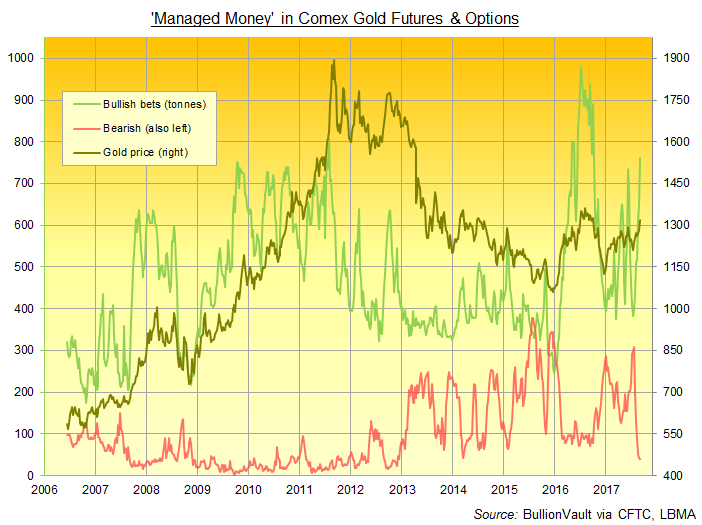
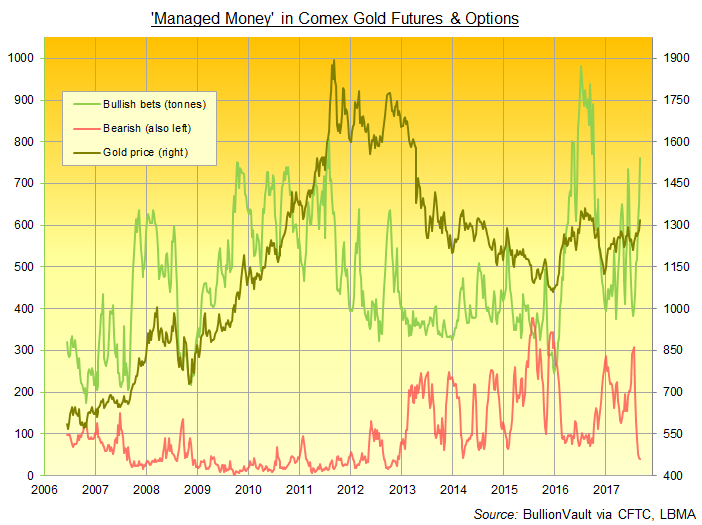
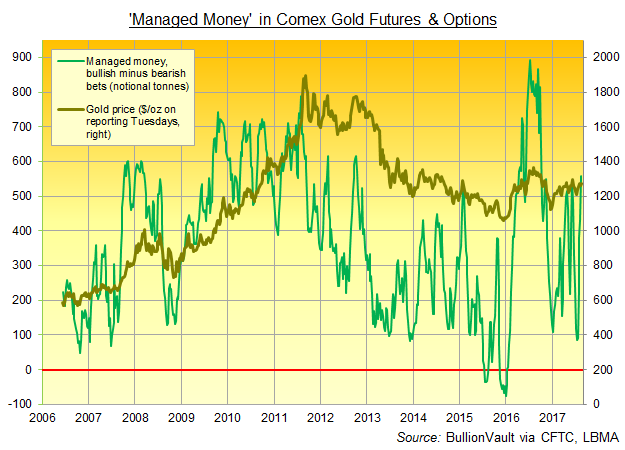
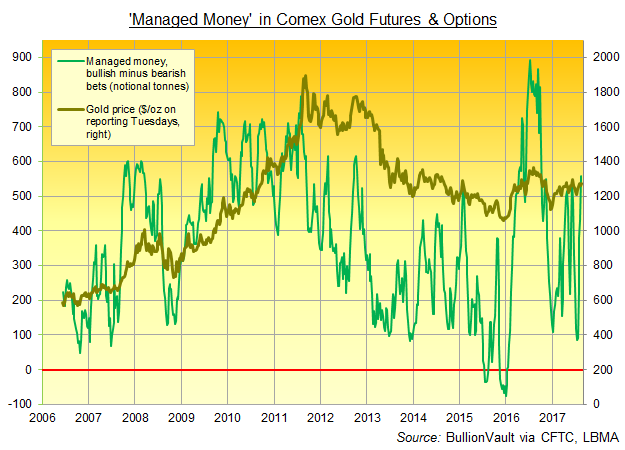
With North Korea firing a missile-test across Japan last week, new data released Friday said Comex gold contracts saw betting on higher prices by the Managed Money category of trader increase almost 17% to reach its highest level since September 2016.
 
Bearish ‘short’ positions amongst hedge funds and other money managers in contrast shrank to the fewest since 2012.
 
Chart of Managed Money gross bullish and bearish bets on Comex gold futures and options. Source: BullionVault via CFTC
 
Demand for new shares in the world’s largest gold-backed exchange-traded fund vehicle, the SPDR Gold Trust (NYSEArca:GLD), grew Friday at the fastest  daily pace since the UK’s shock Brexit referendum result in mid-2016, needing an extra 14.5 tonnes of bullion.
 
That took the GLD’s total gold backing to 831 tonnes. The gold price in Dollars has gained $100 per ounce since the GLD was last that large, back in early July.
 
“What dominates the [gold] market is really the geopolitical tensions right now, either in North Korea or in the United States,” reckons research head Mark To at Wing Fung Financial Group in Hong Kong.  
 
“The technical uptrend is well established,” says analyst Jonathan Butler at Japanese conglomerate Mitsubishi, “there is continuing uncertainty over North Korea’s nuclear ambitions, and an imminent wrangle between Congress and the White House over the debt ceiling that must be solved by late September to avoid technical default.” 
 
“We had expected gold prices to bottom out close to $1200 per ounce,” says Dutch bank ABN Amro’s FX and precious metals strategist Georgette Boele, “but we didn’t foresee this sharp rally in gold prices we have seen so far.”
 
“The longer term gold price outlook should be positive.”
 
Silver tracked gold prices Monday by climbing 1% to touch a 4-month high at $17.89 per ounce, while platinum prices extended their rally to 6-month highs at $1014 per ounce.
 
Palladium hit $993, its highest price since the all-time record highs of January 2001.
 
So-called “safe haven” assets such as the Japanese Yen and sovereign bonds also gained Monday, but the US Dollar fell further on the currency market after Friday’s weak jobs data dented expectations of a Federal Reserve rate rise.
 
The European Central Bank in contrast, set to meet this Thursday and supported by solid growth in the Eurozone, will set out a reduction of its monthly QE asset purchase program in October, according to a Reuters poll of economists.
 
“Such short-term risk-aversion trades tend to be short-lived,” counters economist Johanna Chua at US banking giant Citigroup.
 
“Unless the global response to this test raises the probability of a military strike or North Korean regime collapse, this time may play out similarly.”

Gold Price 'Surge' to $1320 Attracts Institutional Investors as US Debt Ceiling Deadline Looms

GOLD PRICES held at 10-month highs versus the Dollar on Friday morning in London but traded at only 2-month highs in Euros and Chinese Yuan as the US currency slipped ahead of key monthly jobs data from the world’s largest economy.
 
Rising back to $1320 per ounce today, the Dollar gold price on Thursday ended August well above the 6-year downtrend starting at its all-time high of $1920 – set when US government debt lost its “risk-free” AAA status amid wrangling over raising Washington’s debt ceiling.
 
September 29th marks the deadline for Congress to agree a new ceiling above the current $19.8 trillion limit.
 
“Even before this latest surge in gold prices,” says the latest Precious Metals Weekly from specialist analysts Metals Focus, “sentiment towards gold had already started to slowly improve among institutional investors.”
 
Hedge funds and other speculators grew their net bullish betting on Comex futures for 5 weeks straight, Metals Focus notes, reaching a post-Trump victory high after setting an 18-month low in mid-July. 
 
“Gold ETP holdings have also recorded healthy inflows over the same period,” the consultancy adds, 
 
The largest such vehicle – the SPDR Gold Trust (NYSEArca:GLD) – expanded at its fastest 3-session pace since February as gold prices broke above $1300 at the start of this week after the annual central-banking conference at Jackson Hole failed to deliver any hint of tighter US, Eurozone or Japanese monetary policy to come and the pariah state of North Korea fired missile tests across Japan.
 
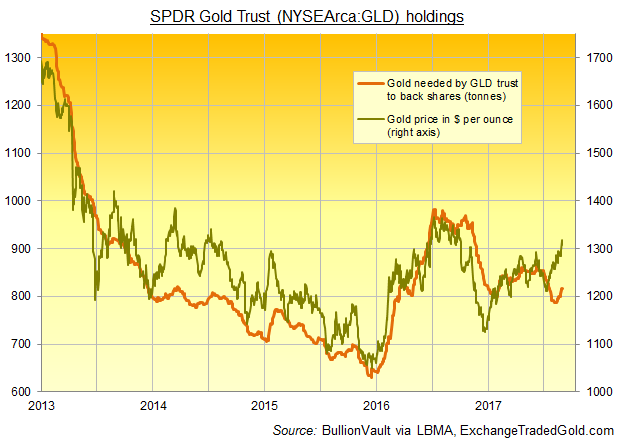
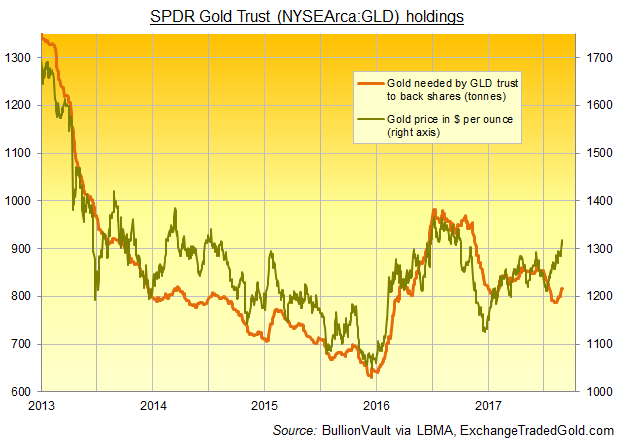
Now needing 816 tonnes of bullion to back its shares, the GLD had shrunk to a 5-month low at the start of August as investors liquidated the trust fund’s stock.
 
The gold price has risen almost 6% versus the Dollar since mid-July, when the GLD was last as large as at Thursday night’s close.
 
Chart of SPDR Gold Trust (NYSEArca:GLD) bullion backing. Source: BullionVault via ExchangeTradedGold.com
 
The Dollar meantime eased backed Friday after rallying hard from last week’s new 2-year lows versus the Euro.
 
The US currency also slipped today to new 15-month lows against the Chinese Yuan, helping trim the Shanghai premium – over and above comparable London quotes – to just $3.80 per ounce.
 
That was the smallest incentive to new imports into the world’s No.1 gold consumer market since immediately after last October’s National Day Golden Week holidays.
 
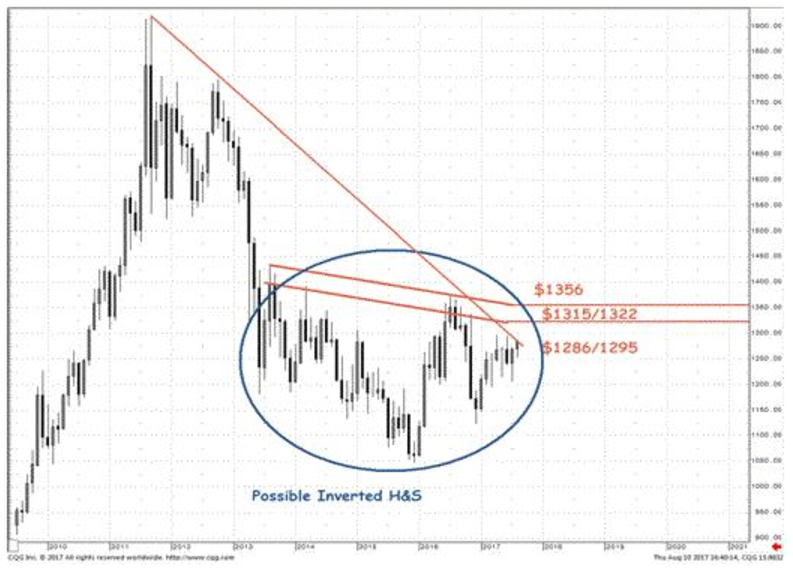
In US Dollar terms, “Gold is evolving within a large inverse Head and Shoulders,” reckons the latest technical analysis of gold prices from French investment bank Societe Generale.
 
Seeing a neckline at $1350-1356 – and with technical analysis of inverse head and shoulders patterns suggesting a possible $300 rise from there – SocGen’s team says that level “will be a crucial hurdle”. 
 
Chart from Societe Generale's technical analysis team in mid-August showing Dollar gold's inverse head-and-shoulder pattern
 
Despite Pyongyang’s continued threats and Hurricane Harvey’s damage to Texan oil facilities, Tokyo’s Topix index rose Friday to begin September 1.3% below late August’s 2-year high while US crude oil prices slipped further from August’s 5% drop.
 
US president Donald Trump may today link this month’s looming deadline for Congress to either raise Washington’s legal debt ceiling or risk suspending federal government spending with aid for the Houston region after Hurricane Harvey sparked flooding last week, killing 39 and damaging some 100,000 homes.
 
Treasury Secretary Mnuchin said overnight that September 29th’s debt ceiling deadline may have to come forwards following the disaster, with Texan authorities putting the aid needed at $125 billion.
 
Political argument around the debt ceiling is likely to center on Trump’s request for funds to build his “great wall” along the border with Mexico, contracts for which are now being issued.
 
“The US political backdrop is likely to remain turbulent,” says Metals Focus, “[making] major policy change hard to implement. This in turn should cast doubts on the US economy’s ability to outperform expectations.”

Gold Prices 'Could Remain Above $1300 for Some Time' Despite Revised US Growth Figures and Gaining Dollar

GOLD PRICES retreated on Thursday morning in London while the Dollar recovered on positive economic data from the United States and China and investors extended stock market gains, writes Steffen Grosshauser at BullionVault.

The US Dollar regained ground after the US second-quarter gross domestic product grew by 3.0% – its quickest pace in more than two years.

Furthermore, 237,000 workers were hired in the US in August, compared with an expectation of a 185,000 rise, which was the biggest increase in 5 months, according to the ADP National Employment data that was released 2 days before the official non-farm payroll report.

“Gold will be somewhat at the mercy of random month-end US dollar flows today, with the technical picture still constructive as long as the $1284 support holds,” said Jeffrey Halley, senior market analyst at currency data provider Oanda.

While Asian and European stock markets advanced, gold declined to $1306 per ounce from the 9-month high at $1325 reached after North Korea fired a missile over Japan on Tuesday. But the yellow metal managed to hold above the key $1300 level, capping losses whilst heading for a 3% monthly gain, as geopolitical tensions between the US President Donald Trump’s government and North Korea remain.

“Talking is not an answer,” Trump tweeted about the standoff with North Korea. US Defensive Secretary James Mattis, however, sent a different signal by reassuring that a diplomatic solution remains on the table. Russia also warned the US that taking military action against the regime in Pyongyang could lead to “unpredictable consequences”.

“Barring a quick resolution to the current stalemate, gold could remain buoyed above $1300 per ounce for some time,” said Singapore-listed OCBC Bank in a note, revising its year-end outlook for gold from $1200 to $1250.

“[However,] given that the rhetoric coming from Japan and the US to date has been tempered, prices could drift lower,” countered Cameron Alexander, analyst at the precious metals consultancy Thomson Reuters GFMS.

Support comes in at $1297 per ounce, the 23.6% Fibo retracement level of the recent 8-week rally, said Canada-based investment bank and bullion clearer Scotiabank’s technical analysts in yesterday’s note.

In other precious metals, silver and platinum remained steady around $17.40 and $990 respectively, while palladium was up 0.8% to $940 per ounce.

Global fuel prices, meanwhile, jumped as hurricane “Harvey” continued to batter the energy-rich Gulf of Mexico with around 23% of US refinery capacity, which raised concerns over fuel shortages ahead of the US Labor Day.

Over the next few weeks, the markets will closely monitor the looming US debt crisis as its government will need to raise the debt ceiling before the end of September to avoid running out of cash.

Gold Price Reverses Partially as Markets Refocusing on Jackson Hole

GOLD PRICES slipped by $5 per ounce this Thursday lunchtime, as markets turn their attention to Jackson Hole.  Gold rose to $1291 yesterday amid concerns over President Donald Trump’s threats to shut down the U.S. government and withdraw from NAFTA.

Markets are focussed on the Economic Policy Symposium, which begins today at Jackson Hole, Wyoming.  Federal Reserve Chair Janet Yellen and European Central Bank President Mario Draghi are scheduled to speak on Friday.

“I think people will most look forward to, but also be most disappointed by, the Draghi speech,” Bill Northey, chief investment officer at U.S. Bank Private Client Group said. “At most he will make some additions to what is already known, but it will be devoid of any real new policy information.”

However, “If any news does emerge from Jackson Hole, thin liquidity in the summer could amplify any market move, so the market will be on edge even with nothing expected,” said Kumiko Ishikawa, FX market analyst at Sony Financial Holdings in Tokyo. 

On Tuesday President Donald Trump threatened a government shutdown if he doesn’t get funding for the proposed border wall with Mexico at a rally in Arizona.

“It’s clearly concerning if he wants to tie the wall to the government shutdown. That’s certainly an issue and that’s an issue for the dollar,” Chris Watling, CEO of Longview Economics, stated on Wednesday.

At the same rally President Trump also said he doubts the United States can reach a deal to renegotiate the North American Free Trade Agreement (NAFTA) which is a trade agreement with Mexico and Canada

Congress needs to pass a spending measure to keep the government open by 30th September, and faces a deadline to raise the nation’s debt limit by mid-October or  the United States will risk defaulting on its debt obligations.

“While political manoeuvring can lead to a shutdown, missing a debt payment is considerably more serious and one that in this game of brinkmanship largely within the Republican Party neither side seems to want to risk,” Marc Chandler, global head of currency strategy at Brown Brothers Harriman & Co., wrote in a note Wednesday. 

Fitch Ratings said on Wednesday, “If the debt limit is not raised in a timely manner prior to the so-called “x date” Fitch would review the US sovereign rating, with potentially negative implications. We have previously said that prioritising debt service payments over other obligations if the limit is not raised – if legally and technically feasible – may not be compatible with ‘AAA’ status. “

The Congressional Budget Office (CBO) estimates that the Treasury is likely to exhaust “extraordinary measures” (reaching the “x date”) in October.

During the debt ceiling showdown in August 2011, Standard & Poor’s stripped the United States of its highest rating. It has since then kept a slightly lower grade of AA+ on the world’s largest economy. Neither Fitch nor Moody’s cut its AAA rating.

Immediately after the S&P’s downgrade six years ago, the Treasuries market rallied, sending yields lower and helped push the gold price higher.

The dollar index, which tracks the U.S. currency against a basket of six other major currencies, gained 0.1 percent to 93.270 on Thursday lunch time, following the previous day’s 0.4 percent slide.

Most Asian indexes closed higher on Thursday despite US equities closing lower.  European markets were higher Thursday lunchtime, FTSE 100 Index gained 0.5 percent to the highest in more than a week and DAX Index increased 0.3 percent.

Germany’s central bank has completed its operation to bring back $27.9 billion worth of gold reserve from New York and Paris to Frankfurt, announced by the Bundesbank on Wednesday. The operation started in 2013 and was expected to be completed in 2020.

Data from the World Gold Council shows that Germany as of July 2017 holds 3,374.1 tonnes in their gold reserve.  It has the second biggest gold reserve after the United States.

As a result of the transfer, 50.6 percent of its reserves are now stored in Frankfurt. The remainder is split between the U.S. and Britain, with 36.6 percent at the Federal Reserve and 12.8 percent at the Bank of England.

Gold Price makes Small Recovery in Wake of Political/Geopolitical Uncertainty, while the Market Closely Watches Jackson Hole

GOLD PRICES edged 0.3 percent higher on Monday lunch time, after falling $15 from $1300 per ounce last Friday, as news broke that President Trump’s chief strategist Steve Bannon had left his position at the White House. $1300 per ounce was the highest gold price since the U.S. presidential election.

This latest upheaval in the Trump administration followed the resignation of several top CEOs from President Trump’s Manufacturing Council, following his weak response to the Charlottesville march. The President announced in a tweet last Wednesday that he was ending the Council.

The council’s disbandment and Bannon’s departure has raised more questions about the Trump administration’s ability to implement its pro-growth agenda. 

The tensions around North Korea have also intensified as Pyongyang warned on Sunday that military exercises were “adding fuel to the fire.”  The annual joint military exercise between the US and South Korea began today. Kim Jong-Un did not follow through on his threat of last week to land four ballistic missiles in the waters around the US Pacific territory of Guam.

“Demand for gold is likely to remain high nonetheless, as the US and South Korea began a joint military exercise earlier today. This could rekindle the conflict between the US and North Korea, which had taken something of a back seat again recently.” said Commerzbank’s in a note.

The MSCI All-Country World Index declined 0.1 percent to the lowest in almost five weeks on Monday, Nikkei 225 was down 0.40%,  the Korean KOSPI Index fell 0.14%, although the Chinese stock markets finished higher.

From Thursday this week, top central bankers including US Federal Reserve’s Janet Yellen and ECB’s Mario Draghi, will meet in Jackson Hole, Wyoming for the annual Economic Policy Symposium to discuss the critical economic issues facing the world economies.

The global market will be paying keen attention to the event as the Fed chair, Janet Yellen, is the first leading figure to speak at the event on Friday, followed by Draghi later in the day.  

Yellen said in June 2017 that the Federal Reserve would begin to reduce the size of its balance sheet “relatively soon”, leading to speculation the central bank could start to reduce reinvestments of maturing securities it holds this year.

Yellen’s two immediate predecessors, Alan Greenspan and Ben Bernanke, both used Jackson Hole to hint at future shifts in policy.

“The market spotlight will likely focus on Yellen, given the generally low U.S. inflation environment and the likelihood of Fed balance sheet reduction occurring relatively soon.” Citigroup strategists including Peter Goves wrote in a note to clients. 

The Managed Money category of traders in Comex gold futures and options increased the net long position nearly 30% to 558 tonnes last Tuesday according to data released Friday by US regulators the CFTC.  The net long position has been rising 5 weeks in a row to reach the highest level since the 4th October 2016, when concerns over a possible Trump victory were heightened. 

The net long position of Managed Money for Comex silver also increased 33% last Tuesday.

The price of silver also rose to $17.03 per ounce Monday lunch time.  It reached $17.30 last Friday which was the highest for 10 weeks.

The giant SPDR Gold Trust (NYSEArca:GLD) has increased its holding by 12.3 tonnes to 799 tonnes last week.  It was the first weekly gain since the week of 12th June 2017.

Gold Prices Advance towards Resistance on Weak Dollar and Cautious FOMC Minutes, Palladium Hits 16-Year High

GOLD PRICES rallied towards its resistance level this Thursday morning in London, while the US Dollar remained weak after rather dovish hints from Fed officials suggesting that the next rate hike may be further postponed, writes Steffen Grosshauser at BullionVault.

Gold briefly touched $1289 per ounce before dropping back to $1286 failing to reach the resistance level of $1294 and the psychological barrier of $1300. 

The metal started its rise from $1268 on Thursday afternoon after the release of Fed minutes from the July FOMC policy meeting, according to which policymakers grew increasingly concerned about the sluggish inflation numbers. Whilst also on Thursday US President Donald Trump fell out with business leaders over his response to the recent turmoil in Charlottesville.

“In the shorter term, and in the absence of any geopolitical headlines, traders should watch the performance of the dollar against its G-10 peers for clues to gold’s short term direction,” said market analyst Jeffrey Halley at currency data provider OANDA.

Palladium, meanwhile, rallied to a new 16-year high at $923 per ounce, while silver and platinum saw a slight correction. In the first half of 2017, palladium prices increased 45% year-on-year.

“Palladium took some inspiration from the more industrially oriented metals,” said UBS Wealth Management analyst Dominic Schnider, pointing to the current record prices of base metals and zinc’s jump near a 10-year high.     

“Strong demand from the automotive industry – up 4% on year – driven by increase in SUV sales globally, ongoing shift away from diesel to gasoline engines in Europe and tightening emission legislation” were factors in the price rise, explained a spokesperson from Russian palladium miner Norilsk.

Meanwhile, the Euro declined and European shares halted a 3-day rise – their longest in a month – ahead of the European Central Bank’s release of its last policy meeting minutes. ECB President Mario Draghi is not expected to deliver “a big monetary policy speech” at the Economic Policy Symposium conference at Jackson Hole on August 24-26, as one unnamed source said.

Gold for UK investors hit £1000 – the highest since 14 June – while British consumers are trying to cut costs at the fastest pace in two years, according to a new survey carried out by Nielsen. As household incomes were affected by the Sterling’s sharp depreciation after the Brexit referendum and hence rising import costs, 53% of Britons were reported to have cut their spending in the second quarter of this year.

Over in India, the government banned exports of gold jewellery and other products above 22 carats in an attempt to reduce “round-tripping”, at which “some exporters were availing of export incentives by claiming export of gold items of above 22 carat purity with some value addition,” according to an official of the Gems and Jewellery Export Promotion Council (GJEPC).

“This is not possible as India is a net importer of gold and no trader would import above 22 carats gold and export it as it is without value addition. This is not a financially viable business,” a GJEPC official added.

Gold Prices 'Shed Crisis Premium' as N.Korea's Kim 'Backs Down' to 'Foolish Yankees'

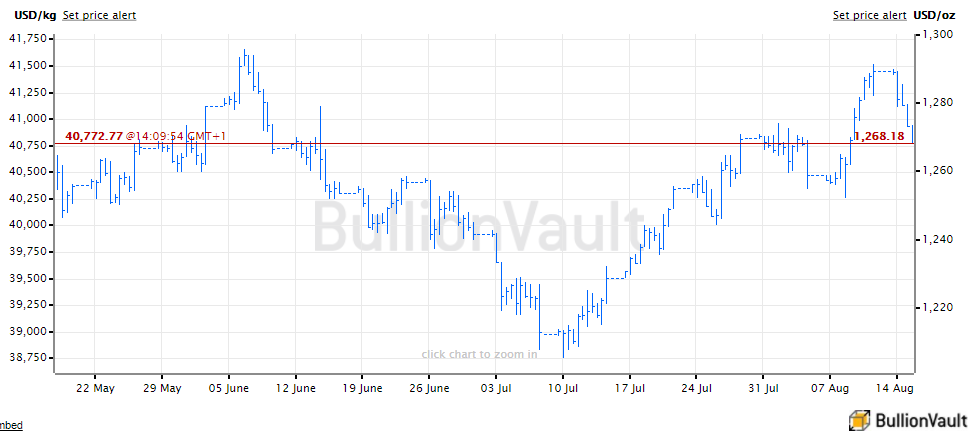
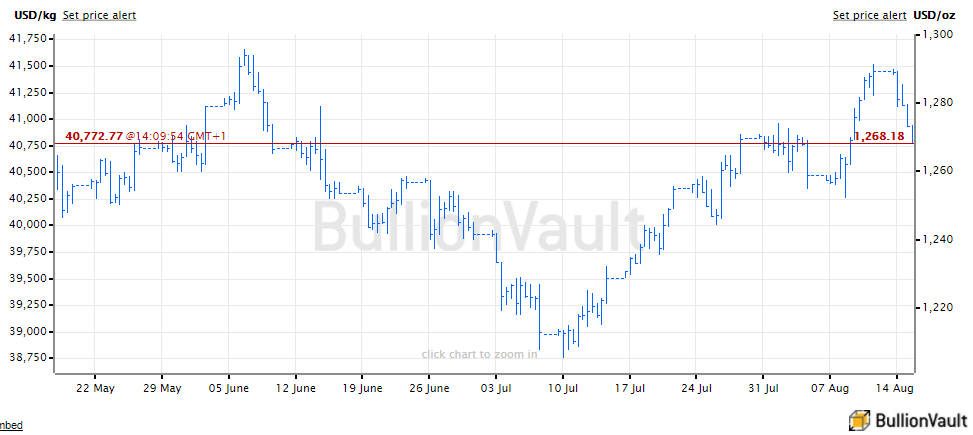
GOLD PRICES fell 1.4% in Asian and London trade Tuesday, erasing all of August’s prior gains as world stock markets rose for a second day amid reports of easing tensions between the US and North Korea after last week’s threats of nuclear missile strikes.
 
As Washington’s Secretary of Defense James Mattis said it would be “game on” if Pyongyang attacked, the pariah state’s regime said it would wait and watch the next move from “the foolish Yankees” before sending “enveloping fire” at the US island and military base of Guam.
 
“We are very…I’d say almost ecstatic that Kim Jong Un has backed off,” said Guam Homeland Security Advisor George Charfauros.
 
“The yellow metal continued to see some of its recent risk premium wiped away during Asian hours today,” said Tuesday morning’s note from Swiss refiners and finance group MKS Pamp.
 
“Afternoon pricing did little to instil confidence in the metal, unable to settle above $1275 and looking likely to test lower into European hours.” 
 
Chart of Dollar spot gold price, last 3 months. Source: BullionVault
 
Shanghai premiums edged down to $6 per ounce Tuesday – one third below the average incentive to new imports – even as Yuan gold prices in the world’s No.1 consumer market fell to 3-session lows.
 
Amongst Western investment products, the giant SPDR Gold Trust (NYSEArca:GLD) yesterday continued to act against type, growing for the first time since 26 June as gold prices fell from Friday’s highest weekly close in Dollar terms since before Donald Trump won the US presidential election last November.
 
“Global tensions seem now to be ratcheting down,” Reuters today quotes French investment bank Societe Generale’s head of metals research Robin Bhar.
 
“[So] investors are looking to liquidate [gold] and pick up some more risky assets.”
 
“It was particularly the threat of a military conflict in East Asia that had driven the gold price up sharply last week,” agrees today’s commodities note from German financial services group Commerzbank.
 
“However, speculative financial investors also caused the price to climb by opening long positions in anticipation of a rising gold price.
 
“These investors are now likely to take profits, pushing the price back down again.”
 
“Lower US real yields and a lower US Dollar were [in fact] the usual suspects,” counters Dutch bank ABN Amro’s precious metals analyst Georgette Boele in a new note.
 
“[But as] we don’t expect a full-blown crisis concerning North Korea…safe-haven demand for gold and to a lesser extent silver and platinum will probably ease…before another test of $1300.”