

GOLD BULLION retreated twice from a 3-session high of $1220 per ounce on Wednesday, dropping back but holding firmer than world stock markets as new data again showed manufacturing activity contracting in China and slowing in Germany.
The May manufacturing PMI survey from news outlet Caixin and data agency Markit said activity contracted for the 15th month running, contrasting with a pop to unchanged on the government’s official NBS index.
“Has gold’s $100 drop [from start-May] been enough?” asks London bullion and futures brokerage Marex Spectron’s David Govett in a note. “Personally I think it has.
“The market was horribly long, overly bullish and at the top of the range…[but] little else has changed in the world. China is still struggling with a very weak currency, Europe is little better.
“There is still every reason to hold gold in a portfolio, but not to get over excited.”
“Sit tight” counters a note from the strategists at Chinese-owned bullion market-maker and London clearing bank ICBC Standard Bank, advising their clients it is still “too early to buy the dip [because, while] precious metals have already retreated by between 7% (gold) and 14% (palladium)…we think there is probably more to come.
“There is too much stale length in the gold market..[T]he recent negative performance is unlikely to encourage fresh entrants just yet.”
Analysis by BullionVault says that each tonne of speculative length added by gold investors and traders so far in 2016 using exchange-traded notes has resulted in the price rising just 14 cents per ounce.
That compares with nearer $1 per ounce added by each tonne of exchange-traded speculation between 2005 and the bull-market peak of summer 2011.
Shanghai gold prices meantime rose again Wednesday morning, pushing the premium above London quotes to $4 per ounce at China’s benchmarking price auction, even as the Chinese currency dropped towards January’s 5-year lows against the US Dollar on the FX market.
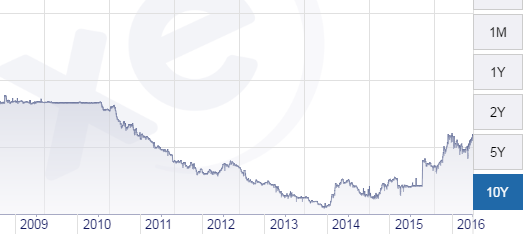
With CNYUSD approaching 6.60, “at least for the moment we’re not seeing any evidence of capital flight,” said Australian bank Westpac’s global head of market strategy Robert Rennie to Bloomberg, although it should be expected as the US Fed moves to raise Dollar interest rates.
“But it’s by no means certain the Fed will raise in June – indeed, we just shifted our forecast from June to September.”
Meantime in India – now the world’s second-largest gold consumer nation behind China – a decision to rollback one of the sales taxes spurring protests amongst the jewelry industry still finds “very little demand in the market,” according to one managing director, as Rupee prices remain 20% higher for 2016 to date.
June may boost sales, reports the Economic Times, as it brings some wedding dates to the Hindu calendar.
“In addition to physical buyers not being there to help absorb supply,” noted Swiss bullion bank UBS of the global gold market last week, “it also means investors don’t have the natural gauge to assess whether a floor [in the price] is nearby.”